PG&E Corporation cut electric rates for the fourth time in two years, an 11% reduction since 2024, CEO Patti Poppe told analysts on the company’s fourth-quarter 2025 earnings call on February 17, 2026. She attributed much of the affordability gain to accelerated large-load growth from data centers, electric vehicles and California manufacturing, while flagging state wildfire policy as a continuing burden on ratepayers.
The utility’s large-load pipeline stood at 7.3 GW at year-end 2025, down from 9.6 GW in September, with 3.6 GW now in final engineering. PG&E maintains that each new gigawatt of load lowers customer bills by roughly 1%.
Executive Summary
The announcement runs counter to the prevailing headline that AI-era data centers are pushing household power bills higher. PG&E’s argument is straightforward utility economics: fixed costs — poles, wires, substations, generation capacity — are spread across the kilowatt-hours a utility sells, so when a large industrial customer arrives and buys a lot of electricity, everyone else’s per-unit share of those fixed costs falls. That logic holds only if the new load actually pays its full cost of service and if the utility does not spend disproportionately to serve it.
PG&E is telling investors both halves of that story. Rates are down 11% cumulatively since 2024. The $73 billion five-year capital plan is unchanged despite management seeing an additional $5 billion of potential growth capex, and no new equity is planned. The company will issue up to $4.6 billion in debt in 2026 as it pursues investment-grade credit ratings from the two agencies that have not yet followed Fitch’s September 2025 upgrade.
The uncomfortable subtext for California policymakers: Poppe pointed at the state’s wildfire liability regime, not at data-center customers, as the affordability problem. A California Public Utilities Commission report on January 30 called the current Wildfire Fund structure “regressive,” and the California Earthquake Authority is due to publish reform recommendations on April 1 that could seed legislation later this session.
Why New Large Loads Can Actually Lower Everyone’s Bill
A regulated utility recovers its costs — the grid, the generation, the debt service, the operations staff — through the rates it charges its customers. Divide a big fixed cost by a bigger number of billed kilowatt-hours and the per-kilowatt-hour rate falls. That is the mechanism behind PG&E’s claim that every incremental gigawatt of new load trims about 1% off customer bills, and it is why utility CEOs across the country are, quietly or loudly, courting hyperscale data centers rather than resisting them. Whether the arithmetic actually reaches households depends on tariff design: the new customer must pay for the grid upgrades it triggers, and any purpose-built generation must not saddle other ratepayers with stranded-asset risk if the load leaves. PG&E did not detail its large-load tariff structure on the call, so the 1%-per-gigawatt figure is a corporate estimate rather than an independently verified per-customer outcome.
The pipeline itself is worth reading carefully. Total prospective large load fell from 9.6 GW in September to 7.3 GW by year-end, which sounds bearish, but the 3.6 GW now in final engineering is a firmer number than a top-of-funnel inquiry. Pipelines shrink as speculative projects wash out and serious ones advance; the mix has arguably improved.
The Wildfire Question Is the Real Rate Story
PG&E’s own framing is that data centers help and wildfire policy hurts. The California Earthquake Authority administers the state Wildfire Fund, which reimburses investor-owned utilities for wildfire-related legal claims; its reform report is due April 1, and Poppe is openly lobbying for legislative changes before the session ends. The January 30 CPUC report she cites called the fund’s current structure “regressive,” language that will resonate with consumer advocates even when they disagree with utilities on most everything else.
There is a scrutiny question to apply on both sides here. PG&E has a direct financial interest in reforms that shift wildfire liability off shareholders, and its 43% year-over-year decline in ignitions tied to company equipment is a genuine operational result but also a talking point in that lobbying campaign. Consumer advocates, in turn, will want to see whether “regressive” means the fund’s cost recovery falls hardest on residential customers, or something narrower. The reform proposal itself is not yet public, so specifics have to wait.
What the Capital Plan Is Really Signaling
CFO Carolyn Burke’s decision to hold the $73 billion five-year plan flat, even while acknowledging up to $5 billion of additional growth opportunities, is the most investor-relevant disclosure on the call. The stated reason — the company’s current valuation would not support raising the plan — is candid, and it is why management is prioritizing load growth that actually lowers rates and pursuing the credit upgrades the equity market seems to be waiting for. No new equity issuance in the five-year window means growth capex has to be financed by debt and internally generated cash, which puts a ceiling on how aggressively PG&E can chase large-load interconnection queues even in a market where hyperscalers are willing to fund a lot of the infrastructure themselves.
Poppe’s warning that “all aspects of the company’s current plans would be subject to re-evaluation” absent wildfire reform is a live threat, not boilerplate. If the two remaining agencies do not upgrade, the debt cost rises and something in the plan gives.
Implications Beyond California
The PG&E data point matters nationally because the “data centers are raising my power bill” storyline has become a defining political frame in Virginia, Ohio, Georgia and Texas. PG&E’s numbers do not settle that argument — different utilities have different fixed-cost structures, tariff designs and generation mixes — but they do complicate any blanket claim that new hyperscale load is inherently regressive for households. Where large-load customers pay their full cost of service and the utility discipline is real, the mechanics can genuinely cut retail rates. Where they do not, they will not. The policy question in every state is which of those two versions is being negotiated at the interconnection queue.
Background
PG&E Corporation is the parent of Pacific Gas and Electric Company, the investor-owned utility that serves roughly 16 million people across northern and central California. The company emerged from Chapter 11 in 2020 following wildfire liabilities, and the state subsequently created the California Wildfire Fund to socialize a portion of future wildfire claims across participating utilities and their ratepayers. CEO Patti Poppe joined in 2021.
Large-load growth — hyperscale data centers, transportation electrification and industrial reshoring — has become the defining rate-design question for U.S. utilities in the AI era. Whether that load lowers or raises household bills depends on tariff structure, cost-allocation methodology and how much new generation and transmission the utility must build to serve it.
French AI developer Mistral and HUMAIN, the artificial-intelligence company owned by Saudi Arabia’s Public Investment Fund (PIF), announced a strategic collaboration on August 25, 2026, covering AI infrastructure, advanced model development, and AI deployment across Saudi Arabia and the wider region. The companies describe the collaboration as representing an investment of hundreds of millions of euros.
Initial work will focus on cybersecurity and speech-recognition models, alongside plans for frontier models with strong Arabic-language performance. Mistral will explore using HUMAIN’s data-center infrastructure to serve local compute demand, and the two plan a joint go-to-market strategy aimed at regulated sectors in Saudi Arabia.
Executive Summary
The announcement pairs one of Europe’s most prominent independent AI labs with the Saudi state’s purpose-built national AI champion. Mistral brings open-weight models — models whose trained parameters customers can inspect, customize, and own — plus its Mistral Compute infrastructure offering. HUMAIN brings next-generation data centers, cloud platforms, Arabic-language model expertise, and privileged access to the Saudi public sector and regulated industries.
The stated purpose is “sovereign AI”: keeping data, models, compute, and operations under the customer’s control, inside jurisdictions the customer chooses, without ceding the learning loop to an external platform. That framing targets financial services, manufacturing, telecommunications, cybersecurity, and government — sectors where compliance and operational autonomy often rule out foreign-hosted AI services.
It matters because it is the clearest signal yet that national AI capability is being assembled the way countries once assembled telecom or energy infrastructure: through state-backed procurement of models, compute, and data centers as a package. For Saudi Arabia, the deal adds a frontier-model partner to an infrastructure buildout already underway; for Mistral, it adds Gulf capital, regional distribution, and potential access to large-scale compute.
Sovereign AI Is Becoming a Procurement Race
“Sovereign AI” — the idea that a nation or enterprise should control where its data lives, where its models train and run, and who governs the learning loop — has moved from talking point to purchasing criterion. This deal shows the emerging playbook: a state-backed infrastructure player supplies data centers, power, and market access, while an external lab supplies model technology that can be localized and, critically, owned via open weights. Neither side can easily build the other’s half alone, so alliances rather than acquisitions are becoming the standard structure.
The choice of Mistral is strategically legible. As a French, independent lab championing open-weight models, it offers something the largest American closed-model providers structurally cannot: models a sovereign customer can fully possess, fine-tune, and run inside its own borders. For a buyer whose central requirement is control, that is not a feature — it is the product.
What Each Side Actually Gets
For HUMAIN, the partnership addresses the hardest part of the full-stack ambition: frontier-model capability. Data centers and cloud platforms can be capitalized into existence; competitive model development is scarcer. Localizing Mistral’s models — initially for cybersecurity and speech recognition, and eventually for high-performance Arabic — gives HUMAIN’s stack a credible model layer and a differentiated regional asset, since Arabic remains underserved by most leading models.
For Mistral, the economics run the other way. Frontier-model development consumes enormous compute, and the release says Mistral will explore using HUMAIN’s data-center infrastructure to meet growing local demand. A Gulf partner with PIF backing offers capital intensity, regional revenue through a joint go-to-market motion, and a compute footprint Mistral does not have to finance alone. The collaboration’s stated size — hundreds of millions of euros — is material for a company of Mistral’s scale, though the release does not say who invests what.
Regulated Sectors Are the Commercial Wedge
The joint commercialization strategy explicitly targets regulated industries: banking, telecom, manufacturing, cybersecurity, and government. These are the buyers for whom generic cloud-hosted AI is hardest to adopt — data-residency rules, supervisory expectations, and resilience requirements make “send your data to someone else’s API” a non-starter. They are also the buyers with budgets. If sovereign AI has a near-term revenue model anywhere, it is here, and pairing model localization with in-country inference infrastructure is a coherent answer to that demand.
The competitive backdrop is crowded, however. American hyperscalers are building sovereign-cloud offerings, other labs are striking their own national partnerships, and Gulf states are running parallel AI programs. The winners in this race will likely be determined less by announcements than by who actually delivers accredited, in-production deployments in regulated environments — a slow, audit-heavy grind that press releases tend to compress.
The Geopolitics of Picking a Model Partner
There is a diplomatic dimension worth noting without overreading. A Saudi state company partnering with an independent European lab — rather than exclusively with American providers — diversifies technology dependencies in both directions. Europe gains a demand anchor for its most visible AI lab; Saudi Arabia gains a model partner whose open-weight approach aligns with sovereignty requirements and whose home jurisdiction adds regulatory optionality. None of this precludes either party’s other alliances, and the release positions the deal as part of a broader global shift toward such pairings rather than an exclusive alignment.
Background
HUMAIN was launched in 2025 by Saudi Arabia’s Public Investment Fund as the kingdom’s national AI champion, part of a broader state strategy to diversify the economy and position Saudi Arabia as a global AI hub through large-scale investment in data centers, compute, and homegrown models. Mistral, founded in Paris in 2023 by researchers from leading AI labs, rose quickly to become Europe’s most prominent independent AI company on the strength of open-weight models that customers can run and customize on their own infrastructure.
Their pairing reflects a wider pattern in 2025–2026: nation-scale AI programs in the Gulf and elsewhere assembling capability through partnerships that bundle sovereign infrastructure with external model expertise, as compute, energy, and frontier models become objects of national industrial strategy.
Pesach Lattin, who writes the advertising newsletter ADOTAT, recently made an argument that deserves a wider audience than the ad industry it was aimed at. Borrowing from the philosopher Harry Frankfurt’s essay On Bullshit, he draws a distinction that matters: a liar knows the truth and conceals it, while a bullshitter simply doesn’t care whether what he says is true. Lattin’s claim is that the advertising business is mostly doing the second thing about AI — making confident, unverifiable assertions with an apparent indifference to whether they hold up. He says he reviewed six months of conference talks and found four claims that were actually checkable.
I run an infrastructure company, not an ad agency. And reading it, I recognized the pattern immediately — because the same epistemics now govern how artificial intelligence gets sold one layer down, in the data centers, networks, and compute that everything else is built on.
The tell is verifiability, not sincerity
The useful part of Frankfurt’s framing is that it takes the argument away from intent. You do not have to decide whether a vendor is honest. You only have to ask a colder question: is this claim the kind of thing I could check? Most of the loudest statements in AI infrastructure marketing are not.
“AI-optimized” is not a specification. “Cloud-scale” is not a number. “Enterprise-grade reliability” is not an SLA. A GPU cloud that advertises a headline price per hour has told you almost nothing until you know the utilization you can actually achieve, the queue times at your scale, the egress charges, and whether the accelerators you were sold are the ones you get. A data center that markets a power-usage-effectiveness figure has told you something real only if it says whether that number is a design target or a measured annual average, at what load, in what climate. The gap between those two readings is where a year of operating budget hides.
The one uncontested number
Lattin points out that in his world, exactly one figure goes uncontested: the collapse in referral traffic as AI answer engines absorb the clicks that used to reach publishers — reductions he puts in the range of 20 to 90 percent. It is uncontested precisely because it is measurable. Everyone can see their own analytics.
Infrastructure has its own version of the uncontested number, and it is the electricity bill. You can argue about a model’s benchmark scores; you cannot argue with a utility invoice or a substation’s interconnection queue. This is why the most honest conversations in our industry right now are the ones about power and cooling. Megawatts do not bullshit. A grid operator’s capacity map is the least performative document in the AI economy, and it is quietly setting the ceiling on all of the confident projections layered above it.
A working buyer’s test
None of this is a case for cynicism. The technology is real, and the demand is real. The point is narrower and more practical: when someone sells you AI infrastructure, sort every claim into two piles before you sort it into true or false.
Testable now: Can it be written into a contract with a number and a penalty? Latency percentiles, delivered throughput, measured PUE over a defined period, uptime with real credits, a fixed price with the egress spelled out. Ask for the measurement method, not the headline.
Testable later: Can you run a bounded pilot that produces your own data — a parallel workload, a real month of your traffic — rather than the vendor’s reference benchmark? Insist on it before the multi-year commitment, not after.
Not testable: Adjectives, roadmaps, and transformation narratives. These are not lies. They are simply not evidence, and they should carry the weight of things that are not evidence.
The vendors worth working with will not flinch at this. In my experience, the willingness to be measured is the single most reliable signal of whether a claim was meant to be true or merely meant to be said. The ones who lead with the utility bill, the SLA, and the pilot are telling you something. So are the ones who change the subject to the future.
Lattin’s essay is about advertising, and it is worth reading on its own terms. But its real subject is a habit of mind that has spread well past his industry. The infrastructure layer is the last place that habit can safely live, because down here the claims eventually meet a power meter, a thermal limit, and a bill. Ask for the number. If there isn’t one, you have your answer.
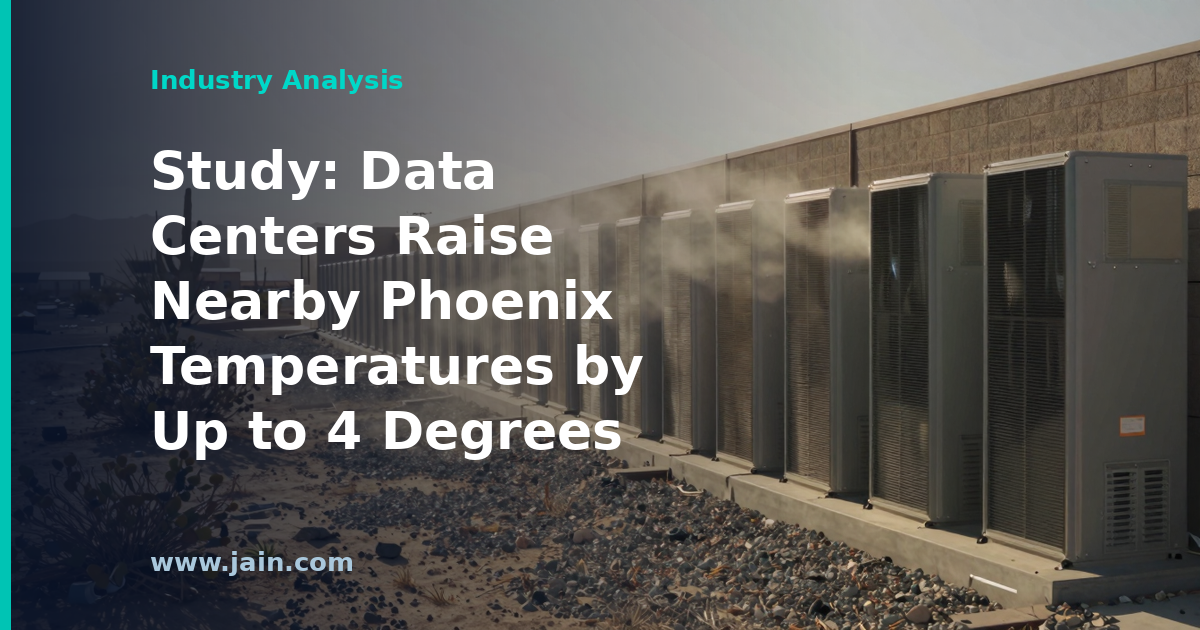
A peer-reviewed study published in ASME’s Journal of Engineering for Sustainable Buildings and Cities (Vol. 7, Issue 2) reports that data centers raise temperatures in their surrounding areas by up to 4 degrees in Phoenix, Arizona — one of the largest and fastest-growing data center markets in the United States.
The research, which frames data center waste heat as an emerging urban heat source, drew broad attention on August 19, 2026, when it reached the Hacker News front page with 267 points and more than 375 comments — a signal that the industry itself is taking the question seriously.
Executive Summary
The finding is simple to state and hard to dismiss: the electricity a data center consumes does not disappear. Nearly all of it becomes heat, and cooling systems must eject that heat into the surrounding air. In a dense cluster of facilities, that ejected heat measurably warms the neighborhood — by as much as 4 degrees, according to this study of Phoenix.
Why it matters: Phoenix is both a top-tier data center hub and the hottest major city in America, where summer heat is already a public-health and grid-reliability issue. A peer-reviewed number linking data centers to local warming gives residents, city councils, and regulators something they have not had before — citable evidence. Expect it to surface in zoning hearings, permitting conditions, and community-benefit negotiations well beyond Arizona.
For operators and their customers, the study reframes waste heat from an engineering afterthought into a siting externality alongside power draw, water use, and noise — one that will increasingly shape where and how new capacity gets built.
Heat Is the New Noise: An Externality Goes on the Record
Data center opposition has historically centered on three complaints: power consumption, water use, and the low-frequency hum of cooling plants. Localized warming now joins that list with something the others took years to acquire — a peer-reviewed citation. Once a measurable external cost is published in an engineering journal, it tends to migrate into environmental-impact reviews, zoning board testimony, and eventually permit conditions. That is how noise limits and water-reporting requirements became standard, and waste heat is positioned to follow the same path.
The practical consequence is that thermal impact modeling may become part of the pre-construction diligence package. Developers who can show — with sensors and models, not assurances — that a facility’s heat plume will not worsen conditions for adjacent neighborhoods will move through approvals faster than those who cannot. In a market where time-to-power already decides deals, an avoidable six-month permitting fight over heat is real money.
Why Phoenix Is the Stress Test for the Whole Industry
Phoenix became a data center magnet for rational reasons: comparatively cheap land, available power, low natural-disaster risk, and proximity to California customers without California costs. But the same desert climate that makes the land cheap makes cooling expensive and makes every added degree socially costly. Extreme heat is already the region’s deadliest weather phenomenon, so a study saying nearby temperatures rise by up to 4 degrees lands very differently in Phoenix than it would in a temperate metro.
There is also an economic feedback loop worth naming: hotter ambient air makes chillers and evaporative systems work harder, which consumes more electricity and water, which ejects more heat. If clustered facilities are warming their own microclimate, they are marginally degrading their own cooling efficiency — and everyone else’s. That is a classic commons problem, and commons problems invite regulation when the industry does not self-organize first.
From Liability to Asset: The Waste-Heat Reuse Question
In Nordic countries, data center waste heat is piped into district heating networks that warm homes — the externality becomes a product. The awkward truth is that this playbook works worst exactly where the U.S. is building fastest: Phoenix has essentially no heating demand for most of the year, and the low-grade heat that air-cooled facilities reject is difficult to transport or upgrade economically. Reuse candidates exist — industrial preheating, water treatment, agriculture — but none absorb hyperscale volumes in a desert.
That points the mitigation conversation toward engineering rather than reuse: liquid cooling that captures heat at higher, more usable temperatures; facility siting and airflow design that lofts exhaust away from neighborhoods; and honest accounting of the water-versus-heat trade-off, since evaporative cooling ejects less sensible heat into the air but consumes scarce water to do it. Operators who get ahead of this with published thermal data will own the narrative; those who wait will have it written for them.
Background
Metro Phoenix has spent a decade becoming one of America’s leading data center markets, attracting hyperscale and colocation development with affordable land, available power, low disaster risk, and proximity to West Coast demand. The AI buildout has accelerated that growth just as the region confronts record-breaking heat and long-term water constraints.
Urban heat island science, meanwhile, has decades of history attributing city warming to pavement, buildings, and vehicles. What is new is peer-reviewed work isolating data centers — among the most energy-dense buildings ever constructed — as a distinct and growing contributor, arriving at the exact moment communities nationwide are weighing the local costs and benefits of hosting them.
The Associated Press reports that governors’ races across the United States are being increasingly buffeted by what it calls the toxic politics of data centers. The facilities that power the AI and cloud economy — and the electricity, water, and land they consume — have moved from zoning-board obscurity to the center stage of statewide campaigns.
Executive Summary
According to AP’s reporting, data centers have crossed a political threshold: they are no longer a local land-use question decided quietly by county boards, but a statewide campaign issue that candidates for governor are being forced to answer for. The word choice matters — ‘toxic’ signals that the issue now carries more downside than upside for politicians, regardless of party.
For the infrastructure industry, this is a material shift in the operating environment. Governors appoint utility commissioners, sign or veto tax-incentive legislation, and set the tone for state permitting agencies. When the people seeking that office campaign against — or hedge on — data center growth, the political risk premium on every new site goes up. Siting risk, long treated as a paperwork problem, is becoming an electoral one.
From Zoning Boards to the Ballot Box
For most of the industry’s history, data center approvals were decided in county planning meetings that almost nobody attended. The AI build-out changed the scale of the ask: modern campuses draw utility-grade electricity, meaningful volumes of water for cooling, and large tracts of land, often near residential areas. That scale made the facilities visible, and visibility made them political. AP’s framing — governors’ races ‘buffeted’ by the issue — captures the escalation: the debate has jumped two levels of government, from town hall to statehouse.
The mechanism is straightforward. Residents connect rising electricity bills, strained grids, and changed landscapes to the server farms appearing nearby, and they take that frustration to the most visible official on the ballot. Candidates then face a bad trade: embrace data centers and own the utility-bill anger, or oppose them and own the lost jobs and tax revenue. That no-win structure is what makes an issue ‘toxic’ in campaign terms.
Why Governors Matter More Than Mayors
A hostile county board can kill one project; a hostile governor can reshape an entire state’s pipeline. Governors influence public utility commissions that decide who pays for grid upgrades, sign the tax-abatement packages that make site economics work, and direct the environmental agencies that issue water and air permits. If campaigning against data centers proves to be a winning message, the policy consequences will outlast any single election cycle.
The economics compound the risk. Data centers are decade-scale capital commitments made against assumptions about power pricing, tax treatment, and permitting timelines. An election that flips a state from courting the industry to constraining it can strand those assumptions mid-project. Operators and their investors now have to underwrite political volatility the way they underwrite grid interconnection queues.
Winners, Losers, and the Flight to Friendly Ground
The likely near-term effect is sorting. Capital will tilt toward jurisdictions where the political climate is settled — states, and increasingly specific utility territories, where community benefit agreements, transparent power-cost allocation, and water-efficient designs have kept the backlash manageable. States where data centers become a campaign punching bag risk watching projects, and the associated construction jobs and tax base, route around them.
The industry’s own conduct will help decide which column each state lands in. Secretive land assemblies, non-disclosure agreements around utility deals, and cost-shifting onto residential ratepayers are the fuel of the backlash. Operators that show up early, disclose resource demands, pay their full share of grid costs, and design for minimal water draw are effectively buying political insurance. In an environment where a governor’s race can reprice a state’s entire pipeline, that insurance is no longer optional.
Background
Data centers are the physical backbone of the internet, cloud computing, and artificial intelligence — warehouse-scale buildings full of servers that require enormous amounts of electricity and, in many designs, water for cooling. For two decades states actively courted them with tax incentives, prizing their construction jobs and property-tax revenue while their modest visibility kept public attention low.
The generative-AI boom broke that equilibrium. Facilities grew from tens of megawatts to campus-scale power draws rivaling heavy industry, land acquisitions became front-page news in host communities, and questions about who pays for grid expansion landed on residential utility bills. The AP’s report marks the point at which that accumulated friction became statewide electoral politics.
A suburb outside Philadelphia voted down five giant buildings meant to hold the computers that run artificial intelligence. Together they would have covered roughly 80 football fields of floor space.
The builder promised $55.4 million a year in local taxes, mostly for schools. Neighbors worried about noise, dirty air and home values, and more than 17,000 people signed a petition against it.
The twist: to avoid raising local electric bills, the site would have made its own power with gas-burning generators. That fix became part of the fight. The builder says an appeal is coming.
WHYY reported that Upper Merion Township’s Board of Supervisors on Thursday, August 13, 2026, rejected all five applications from developer Brian O’Neill for a hyperscale data center campus totaling more than 4.6 million square feet near King of Prussia, Pennsylvania. The campus would have been built at Discovery Labs, a health care and life sciences office property run by O’Neill’s company, and was designed to generate its own power using natural gas turbines with diesel backup generators.
The vote followed a July planning commission recommendation against three of the five projects, a developer lawsuit seeking more review time that a Montgomery County judge cleared on the afternoon of the vote, and a resident petition with more than 17,000 signatures. O’Neill told 6ABC an appeal is planned.
Executive Summary
A suburban Philadelphia township has turned down one of the largest data center proposals in the region, despite the developer’s estimate of $55.4 million a year in local tax revenue, nearly $38 million of it for the local school district. The board’s stated grounds were procedural and specific: Chair Tina Garzillo said the township never received landscape, traffic impact, emergency management or sanitary sewer plans, and called the projects “at best speculative and conceptual in nature.”
The case matters beyond Upper Merion because of how the campus was to be powered. Generating electricity on site is increasingly pitched as the responsible way to build AI-scale facilities without burdening the grid or ratepayers. Here, that design put gas turbines and diesel generators in front of a township board and its residents, and air pollution became a central objection. Self-generation did not remove the local approval gate; it added a power plant to what that gate had to judge.
For developers, investors and utilities trying to forecast where AI capacity will actually get built, the vote is a reminder that a proposed campus is not capacity until it clears local land-use approval, and that the power strategy is now part of that approval.
Self-Generation Swapped a Grid Question for a Local One
The campus was pitched as a good grid neighbor: it would generate its own electricity so it would not strain the regional power system or push up household bills. That is an increasingly common design for AI-scale facilities, often called on-site or behind-the-meter power because the electricity is produced on the property rather than drawn from the utility. But in Upper Merion, the power plant came with the building. The proposal included natural gas turbines and diesel backup generators, and air pollution became one of residents’ leading objections, alongside noise and water use.
That is the mechanism this vote exposes. A data center that buys power from the grid leaves most generation questions to utilities and grid planners. A data center that makes its own power brings combustion equipment, fuel supply and emissions controls onto a site that a township board must approve, in front of neighbors who will live beside it. O’Neill said scrubbers would control emissions and that discussions had been held with Bloom Energy about using fuel cells on site, but no deal had been finalized, which left the board and residents to evaluate the turbine-and-diesel version of the plan.
Upper Merion is not the only place where on-site power has drawn local enforcement. In Vineland, New Jersey, where a data center under construction plans to use Bloom fuel cells, the city issued a stop-work order on parts of the 300-megawatt facility (a megawatt is a measure of electrical capacity), alleging that a liquefied natural gas tank and fuel cell units were being installed before city approval. Generating power on site may answer concerns about grid strain and electricity bills, but it adds a power plant to the list of things local officials get to review.
The Board Ruled on Missing Plans, Not Just Public Anger
The emotional scenes at the meeting can obscure what the board actually said. Garzillo cited the absence of landscape, traffic impact, emergency management and sanitary sewer plans. Those are ordinary engineering submissions for any large industrial project, and their absence gave the board a procedural basis for denial that stands apart from residents’ objections.
The process had been heading this way for weeks. In July, the township planning commission voted not to recommend three of the five projects. The developer then sued, seeking an extension and arguing there had not been adequate time to address township concerns; a Montgomery County judge vacated the injunction on the afternoon of the vote, clearing the board to reject the extension. Vice chair William Jenaway said the developer had earlier opportunities to respond to review comments and did not do so in a timely fashion. The two sides’ accounts of the timeline differ, and an appeal would likely test them.
For the industry, the lesson is about entitlement risk, meaning the risk that a site never receives the land-use approvals it needs. As AI demand pushes developers to repurpose existing properties, here a life sciences office campus, into data center sites, applications that arrive without complete plans risk being denied on the paperwork alone, whatever their scale or revenue promise.
A $55.4 Million Tax Pitch Met a 17,000-Signature Petition
The developer’s economic case was large on its face: an estimated $55.4 million a year in local tax revenue, with nearly $38 million going to the Upper Merion Area School District. For a suburban township, that is the kind of figure that usually carries weight. It did not carry the vote. Residents weighed it against quality-of-life costs that do not appear in a revenue projection, and one resident nearing retirement said a loss of home equity “would destroy our savings.”
Both sides’ claims deserve the same scrutiny. The tax figure is the developer’s own estimate, and its value depends on assumptions about how much gets built and when. Residents’ fears about property values and health are sincere, but their magnitude depends on specifics that were never settled, such as how many turbines would run, how often, and with what controls. The water debate is similar: O’Neill said a closed-loop system would reuse cooling water, while hyperscale facilities in general can consume up to 5 million gallons of drinking water a day. Closed-loop designs reduce consumption substantially, but how much make-up water this campus would need was not specified.
The backdrop is shifting against developers who lead with revenue. A University of Pennsylvania Annenberg Public Policy Center survey found a 12-point jump in widespread resistance to new data center construction over four months. In that climate, detailed answers on emissions, water and noise are likely to matter more to approval than headline tax estimates.
What Comes Next for AI Capacity Around Philadelphia
The denial is not necessarily final. The developer can appeal or submit new or revised plans, and has said an appeal is planned. Residents have said they will oppose any appeal or new application. O’Neill is also seeking approval for a data center in nearby Plymouth Township, which becomes the next test of whether a more complete application, and possibly a different power plan such as the fuel cells under discussion, changes the outcome.
For operators, investors and utilities counting future AI capacity in the region, the practical point is that local land-use approval is a gate that neither scale, tax revenue nor a plan to stay off the grid can bypass. Capacity forecasts that treat proposed campuses as inevitable will miss decisions like this one, which are made parcel by parcel at township meetings.
Background
Upper Merion Township sits in Montgomery County, Pennsylvania, and includes much of the King of Prussia area, a major suburban commercial and office hub northwest of Philadelphia. Data centers, the buildings that house the servers behind internet services, have existed since the mid-20th century, but the rise of power-hungry artificial intelligence has pushed demand toward much larger hyperscale campuses that need substantial electricity and cooling.
That demand has driven developers to look at existing commercial properties, such as office and life sciences campuses, as potential data center sites, and to consider generating their own power rather than waiting on the grid. It has also produced growing local resistance in the Philadelphia region and beyond, where township boards, not state or federal agencies, hold the zoning and land-use approvals that decide whether a campus can be built.
On July 22, an ordinary electrical fault on a power line in northern Virginia caused a cluster of data centers, the buildings full of computers that run the internet, to disconnect from the grid almost at once.
In minutes, about 4% of all the electricity being used across 13 states and Washington, D.C. vanished from the system.
The organization that runs that grid says the data centers were too jumpy. It is now considering rules requiring them to stay connected through brief power glitches. If those rules arrive, how a data center reacts to a glitch could decide whether it gets connected at all.
Utility Dive reported that PJM Interconnection, the grid operator for 13 Mid-Atlantic and Midwest states and the District of Columbia, is considering new interconnection reliability requirements for “computational loads” such as data centers and crypto-mining facilities. The requirements under consideration include “ride-through” standards, which require equipment to stay connected through brief voltage and frequency disturbances rather than disconnecting.
The trigger was a July 22 event in which about 3,800 MW of data center load in northern Virginia tripped offline in two waves after a fault on a 230-kV transmission line in Dominion Energy’s zone. PJM’s total load fell about 3.8%, from 99,984 MW to 96,205 MW. PJM called it the largest such event in its history.
Executive Summary
PJM is evaluating whether to expand its reliability requirements for large computing loads after data centers disconnected from the grid in response to what its Operating Committee chair called “a normally cleared fault.” In other words, the grid did what it was supposed to do, and the data centers dropped off anyway. PJM staff told an August 6 Operating Committee meeting that the facilities appear to be disconnecting too early.
This matters because it shifts part of the grid-reliability burden onto the load side. Until now, the obligation to stay online through disturbances has fallen mainly on power plants. PJM’s position is that a data center cluster large enough to remove nearly 4% of system demand in minutes now needs the same kind of behavioral rules. As David Souder, PJM’s executive director of system operations, put it, those requirements need to be “in place before the load comes on the system.”
The timing also matters. The North American Electric Reliability Corp. (NERC) is building national standards for computational loads under a Federal Energy Regulatory Commission directive. PJM said, however, that NERC will not address voltage and frequency ride-through until sometime next year. That leaves PJM weighing whether to act in the meantime.
How a Routine Fault Became a 3,800 MW Problem
Transmission faults happen constantly. A line gets struck by lightning or contacts a tree, protective relays isolate it within a fraction of a second, and voltage briefly sags on nearby parts of the network before recovering. Power plants are expected to “ride through” that sag, meaning they stay connected and keep producing. Data centers are generally built with the opposite instinct. Their electrical systems are designed to protect servers from bad power, so when voltage moves outside a set tolerance window, they switch to batteries and on-site generators and stop drawing from the grid.
For a single facility, that is sensible engineering. For a cluster, it becomes a system event. When thousands of megawatts of demand leave the grid at the same moment while generation keeps running, supply suddenly exceeds demand. Frequency and voltage swing, and the operator has to rebalance quickly. PJM said the July 22 event caused “a high imbalance between generation and load” and large swings in both voltage and frequency, and that it dispatched reactive power resources to bring system voltage down. PJM’s Operating Committee chair, Emanuel Bernabeu, described the data centers as “too sensitive to the kind of voltage that they like.”
The Event Sizes Are Growing Faster Than the Rules
PJM listed two earlier events in the same Dominion zone. Each caused a sudden load transfer of about 1,500 MW, one in 2024 and one in 2025. The July 22 event was roughly two and a half times that size. Three incidents in one region do not make a statistical trend, but the direction is consistent with how northern Virginia is building out: more and larger facilities, clustered on the same transmission network and often reacting to the same disturbance at once. For scale, 3,800 MW is on the order of the output of three large nuclear reactors.
The grid handled it. PJM said it brought its Area Control Error, the running measure of the mismatch between supply and demand, back within limits in nine minutes, against a NERC standard of 30 minutes. That is a good operational result, and it should not be read as a near miss. The concern PJM raised is forward-looking: each new facility connected under current practice adds to the amount of demand that could disappear in a single disturbance. At some point the operator has to either hold more balancing capacity in reserve or require the load to behave differently. PJM’s move signals it prefers the second option.
Ride-Through Moves From Design Choice to Condition of Connection
This is the substance behind the headline. PJM is framing the fix as an interconnection reliability requirement, a condition attached to connecting to the grid, rather than a best-practice guideline. Souder’s remark that requirements must be in place “before the load comes on the system” points to the interconnection queue as the enforcement point. If PJM follows through, projects now in development would need to show that their electrical design keeps them connected through a normally cleared fault. Retrofitting that behavior after energization is harder and more contested.
The practical effects would be felt in specific places. Developers and colocation operators would need to revisit the voltage and frequency tolerance settings on their uninterruptible power supplies and switchgear, and possibly the hardware itself. Hyperscale tenants would need to accept that their facilities ride out disturbances their servers were previously shielded from. Equipment vendors whose systems can demonstrate grid-friendly behavior would gain a selling point. Utilities such as Dominion, whose zone hosts the world’s largest data center cluster, would gain a clearer technical basis for connection studies. The rules would cover crypto miners too, because PJM used the broader category of “computational loads.” Mining loads are generally more flexible about interruption, but they are no less able to trip off in a block.
There is a real engineering tradeoff, and it deserves an even-handed hearing. Data center operators set tight tolerances to protect equipment and meet uptime commitments to customers, and loosening them carries risk for the operator. PJM’s argument is that the risk of undisciplined load, which falls on everyone connected to the grid, now outweighs the private risk. Where the thresholds land, and whether PJM offers alternatives such as coordinated or staggered transfer settings, will determine how costly the change becomes.
A Gap Between Regional Urgency and National Standards
NERC is scheduled to finalize registry criteria and initial reliability standards for computational loads by December 31, and to produce a plan by March for additional standards. According to PJM, ride-through for minimum voltage and frequency will not be addressed until sometime next year. Meanwhile, Northern Virginia continues to add capacity. That leaves PJM choosing between acting regionally now and risking a mismatch with a later national standard, or waiting and connecting more load under today’s practices. Wharton’s reference to “existing and future industry ride-through standards and practices” suggests PJM intends to align with NERC where it can, without waiting for NERC to finish.
Background
Northern Virginia, largely within Dominion Energy’s service zone, hosts the largest concentration of data centers in the world. Rapid growth in data center demand there and elsewhere in PJM’s 13-state footprint has made large computing loads a central grid-planning issue. PJM has reported sudden data center load transfers of about 1,500 MW in both 2024 and 2025, and NERC issued alerts on sudden data center load losses earlier in 2026, including a Level 3 alert in May calling for mandated actions.
Grid reliability rules in North America are set by NERC and approved by the Federal Energy Regulatory Commission. Regional operators such as PJM can add their own interconnection requirements. Historically those rules focused on generators. The rise of very large, clustered loads has prompted FERC to direct NERC to develop registry criteria and reliability standards specifically for computational loads.
Businesses are on track to nearly double what they spend renting powerful computers for artificial intelligence this year, to about $42 billion, according to research firm Gartner.
The bigger change is what that money pays for. For the first time, more will go to running artificial intelligence tools every day — answering customers, handling tasks at work — than to building new ones.
Building happens in bursts. Running never stops. So the giant computer warehouses behind these tools increasingly have to stay busy, and powered, around the clock.
Gartner said in a forecast published August 10, 2026 that worldwide spending on AI-optimized infrastructure as a service (IaaS) — rented cloud computing built for artificial intelligence workloads — will grow 96.4% in 2026 to $42.3 billion, up from $21.5 billion in 2025, and reach $66.1 billion in 2027, a further 56.5% increase.
The research firm also forecast that in 2026 spending on inference (running trained AI models in production) will reach $23.3 billion and surpass spending on training (building those models) at $19 billion. Inference is projected to account for 55% of AI-optimized IaaS spending in 2026 and 59% in 2027.
Executive Summary
The headline number is the near-doubling of rented AI cloud spending, but the more consequential figure is the crossover: in Gartner’s forecast, 2026 is the year inference overtakes training as the larger use of AI-optimized cloud capacity. Hardeep Singh, Sr Principal Research Analyst at Gartner, attributes the shift to fine-tuned and domain-specific models being built into customer-facing and operational systems that require “continuous, real-time execution rather than periodic training.”
That distinction matters for anyone who builds, powers or connects AI infrastructure. Training demand arrives as large, time-bound projects; inference demand scales with everyday usage and persists. A market increasingly weighted toward inference behaves less like a series of construction jobs and more like a utility load — steady, growing with adoption, and tied to where users and applications are.
Gartner’s numbers also put the AI boom in proportion: AI-optimized services are forecast at 14.7% of total IaaS spending in 2026, and conventional cloud infrastructure keeps growing at roughly 20% a year alongside it. Data center operators face rising demand on both fronts, not a wholesale swap of one for the other.
Inference Overtakes Training, and Demand Stops Arriving in Bursts
Training is the process of building an AI model by feeding it vast amounts of data; inference is the work of using that finished model to answer a question, draft a document or complete a task. Gartner forecasts inference spending of $23.3 billion in 2026 against $19 billion for training, with inference’s share of AI-optimized IaaS rising from 55% in 2026 to 59% in 2027. Singh ties the shift to models moving into production systems that require “continuous, real-time execution rather than periodic training.”
The mechanism is the shape of the demand. A training run is a project: a large block of accelerators — the specialized chips, usually GPUs, that do AI math — is reserved, runs for weeks, and is then released. Inference consumption instead scales with use: every customer query and every step an AI agent takes draws compute. Gartner specifically flags agentic AI, software that carries out multistep tasks on its own, as amplifying compute intensity. Demand that tracks usage behaves like a utility load — it persists, rises with adoption and follows the rhythm of the businesses it serves.
That changes the planning problem for several groups. Cloud providers get fleets that are more consistently busy, which improves the economics of expensive accelerators. Data center operators and utilities see more load that draws close to its contracted power much of the time, rather than in project-driven peaks. And because inference feeding customer-facing systems has to reach those customers quickly, well-connected sites near users and networks tend to gain value relative to remote campuses chosen purely for cheap power.
The Percentages Are Slowing. The Dollars Are Not.
On growth rates alone, AI-optimized IaaS looks like it is cooling: 180% in 2025, 96.4% in 2026, 56.5% in 2027. But the absolute increments rise each year — about $20.7 billion of new annual spending in 2026 and roughly $23.9 billion in 2027. For people who build capacity, the increment is what counts: under Gartner’s forecast, each year requires more new AI-ready capacity than the year before, not less.
The forecast also keeps AI in proportion. AI-optimized services are about 9.7% of total IaaS spending in 2025, 14.7% in 2026 and 18.4% in 2027. They account for roughly a third of the market’s growth in each forecast year. The remainder — general-purpose rented infrastructure — still grows by about 22% in 2026 and about 20% in 2027, on Gartner’s figures. AI is not crowding conventional cloud out of these numbers; builders face demand for both high-density AI halls and standard cloud capacity, which have very different power and cooling requirements.
Rented AI Capacity Is Not the Same as Built Capacity
Gartner’s figures measure what customers pay to rent AI-optimized infrastructure, not what cloud providers spend building it or what enterprises spend on hardware for their own facilities. The forecast therefore shows strong and rising demand for rented AI capacity, but on its own it cannot show AI investment shifting away from ownership toward the cloud, because it does not measure the ownership side.
What it does indicate is where enterprise AI is being consumed as it moves into production. Singh says the shift toward deployment is “accelerating the cloud consumption patterns.” Rental spending is the revenue that providers weigh their construction against, and a forecast in which that revenue nearly doubles and tilts toward always-on inference strengthens the case for facilities designed for sustained, high-density load — heavier power delivery and the advanced cooling dense AI racks often require. The caveat is that this is a forecast: whether chips, power and finished data center space arrive fast enough to meet it is a separate question.
Background
Gartner, Inc. (NYSE: IT) is a Stamford, Connecticut-based research and advisory firm whose market spending forecasts are widely used by technology buyers, vendors and investors. Infrastructure as a service is the part of cloud computing in which customers rent raw computing, storage and networking from providers such as Amazon Web Services, Microsoft Azure and Google Cloud, paying for what they use instead of running their own hardware.
The generative AI boom created a distinct segment within that market: cloud capacity built around accelerator chips and the high-speed networking needed to train and run large language models. Gartner’s figures show that segment grew 180% in 2025 to about $21.5 billion, and the firm now expects spending to shift from building models toward running them in everyday business applications.
Nvidia, the company whose chips run most of today’s artificial intelligence, is the main customer for 16 new fiber-optic cable routes that Zayo is building across the United States.
These cables are bundles of glass strands buried underground that carry data between cities. Zayo is laying them where there is enough electricity for the giant computer warehouses that AI needs.
A rival network company says new long-distance cable usually loses money. Zayo’s answer was to sign a very large customer before digging. Neither company has said what it costs.
Zayo Group has confirmed that Nvidia is the anchor tenant behind the “monster deal” it first described in April, when chief product and strategy officer Bill Long said the company was building 8,000 more route miles of fiber. Zayo executives told Fierce Network on August 7 that, in partnership with Nvidia, Zayo is building 16 new long-haul fiber routes in high-growth AI corridors across the U.S.: six entirely new (greenfield) routes and ten overbuilds that add fiber along existing Zayo paths. Nvidia is also leasing fiber on eight other Zayo long-haul routes that already had enough capacity.
The program runs for several years, with the first routes expected as early as 2027 and the full set by 2030. Zayo declined to disclose the cost of the build or how much Nvidia is investing, saying only that it is “good business with an attractive return profile.”
Executive Summary
The world’s dominant AI chip supplier has become the named anchor customer for one of the largest new long-haul fiber builds in the United States. Long-haul fiber is the cable that links cities and regions, as opposed to the metro fiber inside a single city. Nvidia’s involvement spans 24 Zayo routes in total: six new, ten upgraded and eight leased as they stand.
The announcement matters because it arrived the same week Lumen Technologies’ CFO, Chris Stansbury, said the economics of building new long-haul routes “stink” and that Lumen had walked away from several such deals. Lumen’s one exception, a Seattle-to-Minneapolis route called NorthLine, works financially because a partner is sharing it. Zayo’s Nvidia deal follows the same pattern. New intercity fiber for AI is getting built where a large, committed customer underwrites the route before construction begins.
Zayo also says the routes were chosen by mapping where electrical power is available for future data centers, and that the conduit is sized well beyond Nvidia’s own needs. That makes the build relevant to every data center developer and cloud operator siting capacity along these corridors.
Why an Anchor Tenant Changes the Math
Building a new long-haul fiber route is expensive long before it earns anything. Zayo’s executives described what the work involves: dealing with hundreds of municipalities, regulators and permitting bodies, and coordinating multiple construction contractors. The money goes out during construction, while lease revenue arrives gradually over years. If a route is built on speculation and demand arrives slowly, the builder pays to finance an asset that is sitting idle.
Lumen’s comments show this risk plainly. Stansbury said Lumen has “stepped away from a number of deals” because shareholder returns on greenfield routes are “awful.” Yet Lumen is building NorthLine because a partner, which it has not named, makes “the economics for that actually very good.” Zayo’s position rests on the same mechanism. With Nvidia committed as anchor tenant across 16 new or upgraded routes plus eight existing ones, Zayo starts construction with a large share of demand already contracted. It describes the result as an attractive return. The two companies reach opposite verdicts on greenfield fiber in general, but they agree on the condition that makes it work: a committed buyer before the trench is dug.
This is a pattern in two data points, not a law of the market. Zayo also argues that its experience building new routes over the past seven or eight years gives it a cost and execution edge competitors lack. Because neither the cost nor Nvidia’s commitment has been disclosed, outsiders cannot check the return claim. What they can see is that the one greenfield build each company is pursuing has a large partner behind it.
Fiber Is Now Following the Power Map
Long said Zayo began seeing sharply higher long-haul demand about two years ago, in the form of orders for far higher fiber counts than before. The company responded by analysing where electrical power was available across the U.S. and concluding that those corridors were where bulk fiber would be needed. Bulk fiber means large quantities of strands sold to a few big users rather than small circuits sold to many.
This reverses the traditional logic of long-haul networks, which were drawn between population centers and internet exchange points. AI data centers need hundreds of megawatts of electricity, and that power is scarcer than land or fiber, so it now decides where these facilities go. Fiber is being planned to meet them there. For developers, a site with both secured power and a new high-count fiber route nearby becomes more valuable. For utilities and regional economic planners, a new route can signal that data center projects are expected to follow.
Built Bigger Than One Customer
Zayo CEO Steve Smith said popular routes will carry at least 1,728 fibers, and that the conduit going into the ground can support up to 20,000. Conduit is the protective pipe that cables are pulled through, and it can be filled with more fiber over time. Long said Nvidia wanted a build package that would serve “the rest of the ecosystem” as well as its own use.
For Zayo, oversizing the conduit turns an anchor-backed build into a multi-tenant asset. Pulling additional cable through existing conduit is typically far cheaper than new trenching, so every later customer on the route improves returns on the original construction. Cloud providers, newer GPU-cloud operators and other carriers would all be potential buyers. The main risk is timing. With completion stretching to 2030, the build depends on AI data center demand in these corridors holding up for years.
Mostly Upgrades, Not Blank-Slate Builds
Of the 24 routes Nvidia is using, only six are true greenfield builds. Ten are overbuilds on existing Zayo fiber, and eight needed no new construction at all. Overbuilds can typically draw on existing paths and permissions, which reduces permitting risk and cost compared with new routes. That mix suggests the deal leans heavily on Zayo’s existing footprint. It also suggests the greenfield portion, which Lumen called hardest to finance, is the smaller share of the program.
Background
Zayo Group is a U.S. fiber infrastructure provider that sells bandwidth and bulk fiber to carriers, cloud providers and large enterprises. Its executives say it has been the only company building new long-haul routes at scale in the U.S. over the past seven or eight years. It has also grown through acquisitions, including a $4.25 billion fiber deal with Crown Castle. Zayo reports that AI has driven a sharp rise in long-haul demand, with customers ordering much higher fiber counts than in the past.
Nvidia is the leading supplier of the processors used to train and run AI models, and its customers are building large data centers wherever power is available. Lumen Technologies, formerly CenturyLink, operates one of the largest U.S. fiber networks and competes with Zayo for AI-driven long-haul demand.
Chipmaker AMD is buying Taalas, a Toronto startup founded only in 2023. Taalas designs chips shaped around the artificial intelligence model they will run, instead of chips built to run anything.
Every time someone asks a chatbot a question, a computer in a data center does the work, and that happens constantly. Flexible, do-everything chips waste time and electricity on that job. AMD is betting that purpose-built chips can answer faster and use less power.
The price and the first products have not been announced.
AMD announced on August 6, 2026 that it has reached a definitive agreement to acquire Taalas, a Toronto-based company founded in 2023 that develops specialized silicon for AI inference, the work of running a trained model to answer requests. AMD said it plans to integrate Taalas’ technology into its accelerator roadmap and build system-level products that pair it with AMD Instinct GPUs.
Financial terms were not disclosed. The deal is subject to customary closing conditions and regulatory approvals, and AMD gave no expected closing date.
Executive Summary
AMD, one of two major suppliers of general-purpose GPUs for AI data centers, is buying a company whose stated purpose is to get around the limits of general-purpose hardware. AMD’s own announcement describes Taalas’ technology as reducing “compute and memory bottlenecks associated with general-purpose architectures.” Taalas CEO and co-founder Ljubisa Bajic described the company’s approach as “building the hardware around the model.”
The significance is directional. AMD is not abandoning GPUs. It frames Taalas as a complement to Instinct accelerators, EPYC CPUs, ROCm software and Helios rack-scale systems. But a leading GPU vendor is treating inference as a workload that justifies dedicated silicon on its own roadmap. That matters for anyone planning data center capacity, power budgets or AI hardware purchases over the next several years.
What the announcement does not yet provide is proof. There is no price, no performance figure behind the “breakthrough” claim, no named customer and no product timeline. The deal is best read as a strategic commitment whose payoff remains to be demonstrated.
A GPU Maker Buying Non-GPU Silicon Is the Signal
AMD’s flagship AI product, the Instinct GPU, is a general-purpose accelerator. It can train models, run them, and handle scientific computing. So it is notable that AMD’s release justifies this acquisition by pointing to the bottlenecks of general-purpose architectures. AMD says it will integrate Taalas’ technology into its accelerator roadmap and pair it with Instinct GPUs in system-level solutions. In other words, AMD is adding inference-specific hardware alongside the GPU rather than asking the GPU to do everything.
The mechanism behind that bet comes from how the two main AI workloads differ. Training teaches a model and happens periodically, at enormous scale, on hardware that benefits from flexibility. Inference runs the finished model every time a user sends a request. It is repetitive: the same model performs the same operations, over and over, at high volume. Inference is often limited less by raw arithmetic than by moving the model’s data between memory and the compute units, the “memory bottleneck” AMD’s release refers to. Taalas says it optimizes inference dataflows, the path data takes through the chip, for the model being served. That is what Bajic means by building the hardware around the model, an approach sometimes described as hard-wiring a model into silicon.
If the approach delivers, the people most affected are those who pay for inference at scale: cloud providers, AI service companies and the data center operators who host them. Inference runs continuously, so efficiency per answer compounds into power, cooling and floor-space requirements. More answers per unit of electricity would let operators serve more demand within a fixed grid connection, and grid connections are increasingly the constraint on new AI capacity.
The Price of Specialization Is Flexibility
Hardware tuned to a model is efficient for as long as that model is in use. AI models are revised and replaced quickly, while chips take years to design, validate and manufacture. A chip fitted too tightly to today’s model risks being stranded when customers move on. This likely explains why AMD positions Taalas as a complement rather than a replacement. Boppana’s framing, the “right compute solutions for every AI workload,” implies a division of labor. GPUs would handle training and fast-changing models, and specialized silicon would take stable, high-volume inference.
For infrastructure buyers, that points toward mixed fleets: racks combining different accelerator types, each doing the job it is best at. Mixed fleets complicate capacity planning, procurement and software. Workloads have to be routed to the right hardware, and utilization has to stay high across all of it. How Taalas’ technology is exposed through ROCm, AMD’s software platform for programming its accelerators, will largely decide whether customers can adopt it without rewriting their deployment stacks.
What AMD Is Actually Buying
Taalas was founded in 2023, making it roughly three years old at signing. The release names no Taalas product, customer or performance figure. Instead, it leans heavily on the “world-class engineering team” and on retaining and growing Canadian talent. That suggests AMD is acquiring a design approach and the people behind it as much as any finished product line. Acquiring engineering teams to accelerate a chip roadmap is a well-established move in semiconductors, and it is a reasonable way to enter a design space quickly.
Read even-handedly, the claims in the release fall into two groups. Some are substantiated by the fact of the deal itself: AMD has committed to acquiring the company and has stated where the technology will go. Others remain assertions until products ship, including “breakthrough inference performance and efficiency” and “significantly reducing” bottlenecks. The competitive logic is clear enough. AMD is building a full-stack AI platform of CPUs, GPUs, networking, software and rack-scale systems, and inference-specific silicon would fill a gap in that stack. Whether it closes that gap depends on execution the market cannot yet evaluate.
Background
AMD, based in Santa Clara, California, sells EPYC server CPUs and Instinct GPU accelerators for AI and high-performance computing. It also sells ROCm, its software platform for programming those accelerators, and Helios, a rack-scale system that packages them for data centers. The company has used acquisitions to broaden its data center portfolio before, most notably its purchase of programmable-chip maker Xilinx. It positions itself as a full-stack alternative in AI infrastructure.
Taalas was founded in 2023 in Toronto to design silicon specifically for AI inference. Inference is the stage where trained models serve real users, and AMD calls it one of the fastest-growing segments of the AI market. As inference volumes rise, the cost and power consumed per answer have become central concerns for cloud providers and data center operators. That has drawn interest in specialized chips designed to do that one job more efficiently than general-purpose hardware.