Tag: Data Center

  • Huawei Named a Gartner Storage Leader: What It Signals

    Huawei Named a Gartner Storage Leader: What It Signals

    Gartner has published its Magic Quadrant for Enterprise Storage Platforms, 2026, and Huawei says it has been placed in the Leaders quadrant — the only vendor outside North America to land there, according to the company’s announcement issued from Shenzhen, China, on 28 August 2026.

    The announcement centers on Huawei OceanStor Data Storage, which the company describes as a high-efficiency, unified AI data platform offering capacity density, energy efficiency and forward-looking data resilience. Huawei says its data storage business operates in more than 150 countries and regions, serving finance, telecommunications, manufacturing, healthcare, government and utilities customers across Latin America, Europe, the Middle East, Africa and Asia-Pacific.

    Executive Summary

    A Magic Quadrant is Gartner’s two-axis vendor map: the horizontal axis rates “completeness of vision” (strategy, roadmap, understanding of where the market is going) and the vertical rates “ability to execute” (products, support, viability, delivery). Vendors scoring high on both land in the Leaders quadrant. It is a widely used procurement shortcut, not a benchmark result — no throughput or latency numbers underpin the placement.

    That is precisely why this particular placement is interesting. Enterprise storage spent two decades being bought on capacity, availability and cost per terabyte. The attributes Huawei chose to foreground — a unified platform that serves AI workloads, capacity density and energy efficiency — are the criteria that matter when storage sits behind expensive accelerators in a power-constrained facility. The pitch is a tell about where the category’s center of gravity has moved.

    The second signal is structural. If the Leaders quadrant contains exactly one vendor headquartered outside North America, then for a large share of Western enterprise buyers the practical shortlist and the published shortlist are not the same document. Huawei faces procurement restrictions and security reviews in the United States and several allied markets, and the regional footprint the company itself lists does not include North America. The report describes a global market; most buyers shop in a regional subset of it.

    Storage Is Being Re-Specified Around AI Pipelines

    The economics of an AI cluster are brutally simple: the accelerators are the expensive part, and every second they spend waiting on data is money burned. That inverts the traditional storage conversation. A training run reads enormous volumes of small files at random; a checkpoint writes a very large object very fast; inference and retrieval workloads want low, predictable latency against vector and object stores. Historically those were three different systems from three different budgets.

    Huawei’s framing — “unified AI data platform” — is the industry’s current answer to that fragmentation: one platform presenting file, object and block access over shared media, so data does not have to be copied between silos at each pipeline stage. Every serious storage vendor is making some version of this argument, which is itself the point. When the leading players converge on the same message, the category has re-specified. Buyers who wrote their last storage RFP around capacity tiers and snapshot policy will find that document does not ask the questions that now decide the outcome.

    The other two attributes named — capacity density and energy efficiency — are facility economics wearing a product label. Density means terabytes per rack unit, which matters when a data hall is out of floor space; efficiency means watts per terabyte, which matters when the site is out of power long before it is out of space. In markets where grid connections are the binding constraint on new capacity, storage that consumes fewer watts is not a sustainability line item, it is the difference between deploying and waiting.

    Reading the “Only Non-North American Leader” Claim Carefully

    The claim is checkable and, taken at face value, striking: it implies the rest of the Leaders quadrant is North American. Enterprise storage has long had significant Japanese and European engineering, so a quadrant that concentrates that way is worth noticing. But two caveats belong in any fair reading. First, “non-North American” is a headquarters test, and several storage businesses run global R&D under a US-domiciled entity owned elsewhere — the label may sort vendors differently than an engineering-origin test would. Second, Magic Quadrant inclusion criteria (minimum revenue, product scope, geographic coverage) shape the field before any vendor is scored; who is absent is often a function of the inclusion rules, not of the evaluation.

    It is also worth being precise about what a Leader placement is and is not. It is an analyst judgment, informed by vendor briefings, customer references and Gartner’s own inquiry volume, about strategy and delivery capability. It is not a bake-off. Gartner publishes Strengths and Cautions for every vendor it names, and the Cautions are frequently the most useful page in the document for a buyer. The announcement does not summarize Huawei’s Cautions — which is normal for vendor press releases across the industry, and equally a reason to read the source report rather than the release.

    None of that makes the placement hollow. Landing in Leaders requires demonstrating both a coherent product direction and evidence of delivering at scale, and doing so as the sole vendor from outside the incumbent geography is a genuine competitive result. The honest reading is that the announcement substantiates the placement and the product positioning, and substantiates nothing about comparative performance, price or suitability for any specific workload — because it does not claim to.

    One Report, Two Buying Realities

    The most consequential fact in this story is not in the quadrant at all; it is in the regional list Huawei provides. The company cites customers across Latin America, Europe, the Middle East, Africa and Asia-Pacific. North America is not named. That reflects a well-documented reality: Huawei is subject to procurement restrictions and heightened security review in the United States and in a number of allied jurisdictions, which in practice removes it from many Western enterprise and public-sector shortlists regardless of how it scores.

    The effect is a market that is bifurcated rather than global. A bank in Riyadh, a telecom operator in São Paulo and a manufacturer in Kuala Lumpur can evaluate the full Leaders quadrant. A US federal agency, a defense contractor or an operator carrying regulated critical-infrastructure obligations in several allied markets cannot. Both are reading the same report; only one of them can act on all of it. Buyers in the restricted set should treat the quadrant as market intelligence — a read on where the technology frontier is — rather than as a shortlist.

    Who wins and loses from that split is not one-directional. Western incumbents benefit from reduced competitive pressure in protected markets, which historically translates into slower price erosion for customers. Huawei benefits from a large addressable market in regions where no such restrictions apply, and from being the credible non-US option for buyers who want supply-chain diversity for their own sovereignty reasons. The buyers who pay for the arrangement are the ones facing a shortened shortlist, and the buyers who benefit are the ones with a longer one. That is a description of the market structure, not an argument about the policies that created it — those rest on national-security judgments that sit well outside a storage procurement decision.

    What a Buyer Should Actually Do With This

    Analyst placements are best used to set the shortlist, never to close it. The practical translation of an AI-era storage evaluation is a proof of concept that mirrors the real pipeline: sustained small-file read throughput at training-scale concurrency, checkpoint write bandwidth at the size the models actually produce, metadata operations per second, and — critically — measured rack-level watts and rack units at the target capacity, since those are the numbers the facility team will hold you to.

    Two questions belong alongside the technical ones. First, total cost across the refresh cycle, including the effective cost of data reduction, support renewals and any capacity licensing — density claims and efficiency claims both compress or expand dramatically depending on how dedupe and compression ratios are counted. Second, supply and support continuity across the asset’s full life: not only whether a vendor can be bought today, but whether it can be supported, expanded and patched in every jurisdiction the organization operates in for the next five to seven years. For any vendor exposed to export-control or procurement-policy shifts in either direction, that risk assessment is part of the engineering decision, not a separate legal footnote.

    For investors, the signal is narrower than it looks. A Leaders placement is directional evidence about competitive standing, not a revenue disclosure. The announcement contains no market-share figure, no storage-segment revenue, no growth rate and no customer count — only a footprint claim of more than 150 countries and regions. Anyone modeling the enterprise storage market should treat the placement as one input among several and go to disclosed financials for the rest.

    Background

    Enterprise storage platforms are the systems that hold an organization’s primary data — the databases, virtual machine images, file shares and object stores that applications read and write continuously. The market has consolidated over the past decade around a handful of large vendors selling all-flash arrays and software-defined systems, with buying decisions historically driven by capacity, availability, data services and cost per terabyte. Gartner has tracked the category through successive Magic Quadrants, renaming and rescoping the research as the technology shifted from disk arrays to flash and from single-protocol appliances to unified platforms.

    Huawei entered enterprise storage as an extension of its telecommunications equipment business and built the OceanStor line into a global product family, strongest in Asia-Pacific, the Middle East, Africa, Latin America and parts of Europe. Its position in Western markets is shaped by a separate history: since the late 2010s the company has faced US export controls, procurement bans and security reviews in several allied jurisdictions, primarily concerning network equipment, with knock-on effects across its enterprise portfolio. The result is a vendor that competes at the top of the global market on the analyst scorecards while being effectively unavailable to a significant segment of Western buyers.

    Source: Huawei, Gartner®’ın 2026 Kurumsal Depolama Platformları Magic Quadrant™ raporunda lider olarak gösterildi — Huawei’s PR Newswire announcement, issued from Shenzhen on 28 August 2026 and distributed in multiple languages, stating its placement in the Leaders quadrant of Gartner’s 2026 enterprise storage Magic Quadrant.

  • Goldman Sachs: AI Capex Pivots Toward Inference and Enterprise Use

    Goldman Sachs: AI Capex Pivots Toward Inference and Enterprise Use

    Goldman Sachs published a note dated July 10, 2026 arguing that AI investment is rotating from headline-grabbing training clusters toward inference workloads and broader enterprise adoption. The bank frames the shift as a maturing phase of the AI capital cycle rather than a slowdown.

    Executive Summary

    The Goldman Sachs view, as summarized in the release, is that the marginal AI dollar is increasingly directed at inference — the runtime serving of trained models to end users and applications — and at enterprise deployments that put those models to work inside businesses. Training remains significant, but the growth vector is moving.

    For infrastructure operators, that framing matters because inference and enterprise AI have a different physical and economic profile than training. They favor latency-sensitive placement, steadier utilization curves, and integration with existing corporate data — all of which reshape where capacity is built, how it is cooled and powered, and which vendors capture the spend.

    What ‘Shift to Inference’ Actually Means for Infrastructure

    Training a large model is a bursty, capital-intensive event: tens of thousands of accelerators wired together, run flat-out for weeks, tolerant of remote siting as long as power and interconnect are cheap. Inference — the act of answering a user’s query with a trained model — is the opposite. It runs continuously, scales with usage, and rewards proximity to users and to enterprise data. If Goldman’s read is right, the next tranche of AI capex will look less like one giant campus in a remote grid pocket and more like distributed capacity closer to demand.

    That has second-order consequences the note itself does not spell out. Metro data centers, edge sites, and existing enterprise colocation footprints become more strategically valuable. Networking — low-latency fiber between inference points, users, and data gravity centers — becomes a first-class concern rather than a training-cluster afterthought.

    Enterprise Adoption Changes the Buyer

    A capex signal tied to enterprise adoption implies a different customer mix than the hyperscaler-and-frontier-lab spending that has dominated headlines. Enterprises buy differently: they care about data residency, regulatory posture, integration with existing systems, and predictable unit economics. They are also more sensitive to total cost of ownership than to raw peak FLOPS.

    If that customer base grows as the note suggests, the winners are likely to include vendors and operators that can package AI capacity as a consumable service — with governance, observability, and support — rather than raw GPU hours. It also expands the addressable market for private cloud, sovereign cloud, and hybrid deployments where the model runs near the data.

    Reading the Capex Signal With Appropriate Caution

    Analyst notes are directional, not deterministic. Goldman is describing a rotation in how AI dollars are spent, not a retreat from AI spending overall, and the release as summarized does not quantify the magnitude, timing, or geographic distribution of that rotation. It is fair to ask what data underpins the call — enterprise deal flow, hyperscaler capex disclosures, chip shipment mix — and how much of the shift is already priced into infrastructure equities.

    The same scrutiny applies to the counter-narrative. Claims that training demand is peaking have been made before and repeatedly revised as new model generations arrived. A durable inference-led phase would still coexist with periodic training surges tied to frontier releases. Buyers planning multi-year builds should treat the shift as a change in mix, not a substitution.

    Background

    AI infrastructure spending accelerated sharply from 2023 onward, dominated by large training clusters built by hyperscalers and frontier model developers. That phase concentrated capital in a small number of very large sites optimized for dense accelerator deployments, cheap power, and high-bandwidth interconnect.

    As foundation models have matured and enterprise pilots have moved toward production, industry attention has increasingly turned to inference — the runtime side of AI — and to the operational, data, and governance challenges of deploying models inside businesses. Goldman’s July 2026 note sits within that broader transition, articulating a capex signal that many operators and vendors have been positioning for.

    Source: AI Investment Is Shifting as Inference, Enterprise Adoption Accelerate – Goldman Sachs — Goldman Sachs note dated July 10, 2026 describing a rotation in AI capital spending toward inference workloads and enterprise adoption.

  • Smoke Over Virginia Data Center Signals PJM Grid Strain

    Smoke Over Virginia Data Center Signals PJM Grid Strain

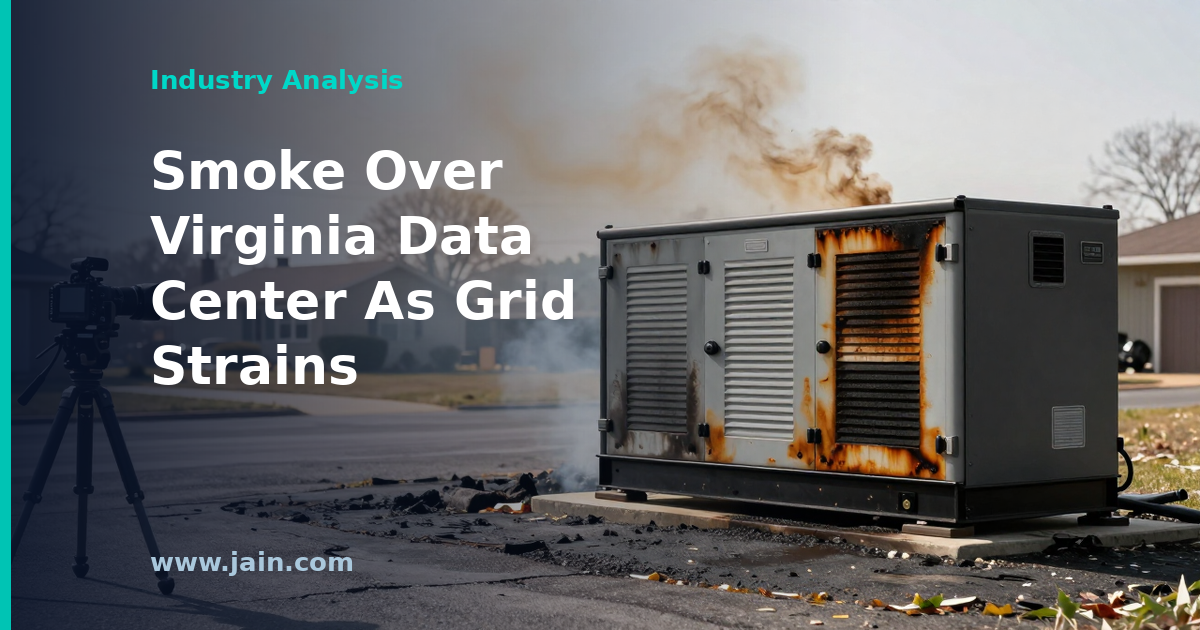
    Business Insider reported that dark smoke was seen rising above a Virginia data center during a summer heat wave, at the same time PJM Interconnection — the grid operator serving the mid-Atlantic — was approaching the upper edge of its available supply. The incident occurred in the region that hosts the largest concentration of data center capacity in the world.

    Executive Summary

    A visible smoke event at a Virginia data center, coinciding with heat-driven stress on the PJM grid, has drawn attention to the fragility of the infrastructure that carries a large share of global internet traffic. The report does not detail the cause, the operator, or the scale of any outage, but the optics — smoke above a hyperscale campus during peak demand — are hard to ignore.

    For an industry that has spent the last two years defending its power appetite in front of regulators and communities, the timing matters. Northern Virginia’s data center cluster is already the subject of intense debate over transmission buildout, ratepayer cost allocation, and permitting. A high-visibility incident during a grid emergency is the kind of event that shifts political conversations even when the technical facts turn out to be modest.

    Why Loudoun County Is the Pressure Point

    Northern Virginia, and Loudoun County in particular, hosts more data center capacity than any other region on Earth. That density exists because of a self-reinforcing cycle: fiber routes were built to serve early internet exchanges, cheap land and tax incentives attracted more operators, and each new campus made the next one more attractive by shortening latency between tenants. The result is a corridor where a single county’s electricity draw rivals that of a mid-sized country.

    PJM Interconnection, the regional transmission organization that runs the grid across 13 states and D.C., has warned publicly for the past two years that generation retirements are outpacing new supply, and that data center growth is a major driver of load. A heat wave compresses the margin between demand and available capacity, and in that state any visible failure — smoke, sirens, a plume — reads as a system-level warning rather than a site-level problem.

    The Anatomy of a Data Center Fire Risk

    Smoke at a data center campus can originate from several places, and each carries different implications. Utility switchgear and transformers can fail under thermal stress, particularly when ambient temperatures push cooling systems past design points. Backup diesel generators, which typically start when grid voltage sags, can experience exhaust or lube-oil incidents when run for extended periods. Battery energy storage systems, increasingly used to bridge grid disturbances, carry their own thermal-runaway risks. Without more detail from the operator or the fire authority, the public cannot distinguish among these, and the release does not.

    What is unambiguous is that data centers are designed to fail gracefully — that is the entire premise of N+1 redundancy, on-site generation, and multiple utility feeds. A visible smoke event does not, by itself, mean customer workloads went down. It does mean that at least one layer of the redundancy stack was exercised, and that the incident happened at the worst possible moment for the grid around it.

    The Political Physics of a Bad Photograph

    Data center operators have historically preferred to operate quietly. That posture is harder to maintain when smoke is visible from residential streets during a heat wave that has neighbors watching their thermostats. Virginia legislators have already been debating whether data center load growth should be paid for by the industry rather than socialized across residential ratepayers, and PJM’s capacity auctions have delivered sharp price increases that landed on household bills earlier this year.

    None of that is caused by a single incident. But single incidents shape narratives. Operators, utilities, and regulators who want to sustain the current build-out will need to be more forthcoming — about what happened, what the redundancy actually did, and what the incident says (or does not say) about the wider grid — than the industry’s default communications posture typically allows.

    What the Grid Data Actually Shows

    The article’s framing — that PJM was near its limits — is worth taking seriously without overstating. Grid operators routinely run close to reserve margins during heat waves; that is what reserve margins are for. The relevant question is not whether PJM was stressed on a hot afternoon, but whether the trajectory of load growth, generator retirements, and transmission build is converging or diverging. Public filings from PJM suggest the latter, and the coincidence of a visible incident with a stressed grid gives that concern a face.

    Background

    Northern Virginia has been the center of gravity for the data center industry since the 1990s, when Equinix and others built exchange points that anchored transatlantic and domestic internet traffic. Loudoun County alone now hosts several gigawatts of operating capacity, with more under construction, and its tax revenue from the sector has reshaped county budgets.

    PJM Interconnection, founded in 1927 as a pool among Pennsylvania and New Jersey utilities, today coordinates generation and transmission across a footprint stretching from Illinois to North Carolina. In recent capacity auctions, prices have risen sharply as generator retirements have outpaced new interconnections, a dynamic industry observers attribute in part to accelerating data center load growth.

    Source: Dark smoke rose above a Virginia data center as a heat wave pushed the power grid close to its limits — Business Insider. Report on a visible smoke incident at a Virginia data center coinciding with heat-driven stress on the PJM grid.

  • Ecolab Closes $4.75B CoolIT Deal for AI Cooling

    Ecolab Closes $4.75B CoolIT Deal for AI Cooling

    Ecolab, the Minnesota-based water, hygiene and industrial services company, has closed its $4.75 billion acquisition of CoolIT Systems, a Calgary-based specialist in liquid cooling for high-density computing. The deal, reported by Electronics360 on July 7, 2026, gives Ecolab a foothold in direct-to-chip cooling technology used in AI training clusters.

    Executive Summary

    The acquisition places Ecolab, historically known for cleaning chemicals and water treatment, squarely inside one of the fastest-growing subsegments of data center infrastructure: liquid cooling for AI workloads. CoolIT’s direct-to-chip (DTC) systems circulate coolant across cold plates mounted on processors, removing heat that increasingly cannot be shed with air alone.

    At $4.75 billion, the price signals that Ecolab views AI-driven thermal management as a durable industrial category rather than a cyclical bet. It also consolidates a market that, until recently, was populated largely by specialist engineering firms. For buyers of AI infrastructure, the transaction raises questions about supplier concentration; for competitors, it raises the bar for the scale of balance sheet needed to serve hyperscale customers.

    Why Liquid Cooling, and Why Now

    Modern AI accelerators, such as the GPUs used to train large language models, dissipate hundreds to over a thousand watts per chip. Once rack densities exceed roughly 30-50 kilowatts, forced-air cooling becomes impractical: fans cannot move enough air, and the room-level heat load overwhelms conventional CRAC (computer room air conditioning) units. Direct-to-chip liquid cooling, which CoolIT sells, moves a fluid across a cold plate bolted to each chip and carries heat out of the rack via a coolant distribution unit. It is more efficient than air, but demands new plumbing, materials expertise, and long-term service contracts — precisely the kind of recurring industrial work Ecolab is built to sell.

    The timing reflects a broader shift. Hyperscale operators and colocation providers are retrofitting existing halls and designing new campuses around liquid-ready racks. That transition creates a decade-long tail of installation, chemistry, monitoring and maintenance revenue, which fits Ecolab’s route-based service model more naturally than one-off equipment sales.

    Industrial Services Meets Silicon

    Ecolab’s core competency is delivering water, cleaning and process chemistry to industrial customers at scale, with technicians on site and consumables on subscription. CoolIT’s core competency is engineering cold plates, manifolds and coolant distribution units for demanding compute environments. The strategic thesis is that these are complementary: CoolIT gets access to a global services organization and enterprise procurement relationships; Ecolab gets a defensible product line in a growth market where its existing water-treatment expertise — corrosion, biofouling, fluid chemistry — is directly relevant.

    The risk in that thesis is cultural and technical integration. Data center customers demand tight change control, rapid engineering iteration, and validated compatibility with each new generation of chip. Industrial-services firms historically operate on slower cycles. Whether Ecolab preserves CoolIT’s engineering cadence, or slows it in pursuit of scale efficiencies, will shape the deal’s outcome.

    Market Structure and Competitive Response

    Liquid cooling has been an active acquisition target across the infrastructure industry, with mechanical, electrical and chemical majors all seeking exposure. Ecolab’s $4.75 billion outlay is large enough to reset valuation expectations for remaining independent cooling specialists, and to encourage rival strategics to accelerate their own moves. For hyperscalers standardizing on multi-vendor supply chains, further consolidation could narrow sourcing options and increase reliance on a small number of large suppliers.

    Competitors — including established thermal management vendors and newer entrants building rear-door heat exchangers or immersion systems — now face a rival with a global service footprint they cannot easily replicate. Immersion cooling, which submerges entire servers in dielectric fluid, remains a parallel approach that this deal does not directly address, leaving room for differentiated bets.

    Background

    Ecolab has spent decades building a global route-based industrial services business, selling water treatment, cleaning chemistry and related engineering to manufacturers, hospitals, food processors and utilities. CoolIT Systems, founded in Calgary, grew from PC cooling into an established supplier of liquid cooling hardware for enterprise and high-performance computing, expanding sharply as AI training clusters drove rack power densities beyond the limits of air cooling.

    Liquid cooling itself is not new — mainframes used it decades ago — but the surge in AI-driven demand has turned a niche into a strategic infrastructure category. Direct-to-chip systems are now standard in new hyperscale AI builds, and retrofits of existing data halls are underway across the industry.

    Source: Ecolab closes $4.75B CoolIT acquisition to corner AI data center cooling – Electronics360 reports the closing of Ecolab’s acquisition of liquid cooling specialist CoolIT Systems.

  • Bitdeer Puts 28 MW of Mining Behind Soluna’s Texas Wind Farm

    Bitdeer Puts 28 MW of Mining Behind Soluna’s Texas Wind Farm

    Bitcoin mining operator Bitdeer will deploy 28 megawatts (MW) of mining capacity at a Soluna Holdings wind-powered site in Texas, according to a June 4, 2026 report by ForkLog. The arrangement pairs Bitdeer’s application-specific mining hardware with electricity generated at Soluna’s co-located Texas wind facility.

    Executive Summary

    The announcement is modest in scale — 28 MW is a fraction of a typical hyperscale data-center campus — but it is a clean illustration of a business model that has become a fixture of the U.S. power market: bitcoin miners acting as flexible offtakers for renewable generation that the grid cannot always absorb.

    For Soluna, whose stated strategy is to co-locate compute loads with wind and solar assets in transmission-constrained regions, the deployment adds a paying tenant to existing infrastructure. For Bitdeer, it is incremental hashrate at a site whose marginal power cost should be low precisely because the underlying wind energy is often curtailed. Neither company disclosed contract length, pricing, or revenue-share terms in the source material.

    Stranded Wind, Willing Buyer

    West and South Texas produce more wind power than local transmission lines can always evacuate to demand centers. When the grid operator, ERCOT, cannot move the electrons, wind farms either curtail output or accept negative prices to keep turbines spinning. Bitcoin miners — which can start, stop, and modulate consumption in seconds — are among the few loads willing to sit next to that generation and buy the surplus. The Bitdeer–Soluna deployment is a textbook example of that pairing at 28 MW, roughly the draw of a mid-sized industrial park.

    The economic logic is straightforward: mining revenue is set by the global bitcoin price and network difficulty, but the cost side is dominated by electricity. A site that can source curtailed wind at a deep discount to grid retail rates has a structural margin advantage, provided the operator can tolerate the intermittency.

    What This Says About the Post-Halving Miner Playbook

    Following bitcoin’s April 2024 halving, block rewards dropped to 3.125 BTC, compressing miner gross margins and forcing operators to hunt for the cheapest available power. Publicly traded miners have responded by signing behind-the-meter deals with independent power producers, buying distressed sites, and — as here — plugging into renewables developers that need a compute anchor tenant. Bitdeer, which is Nasdaq-listed and was spun out of Bitmain, has been methodically expanding its self-mining fleet alongside its hosting and cloud-hashrate businesses.

    Soluna, for its part, is a small-cap public company whose thesis is that co-located data compute makes marginal renewable projects financeable. Every incremental megawatt under contract validates that thesis to its own investors, even if the absolute numbers remain small relative to utility-scale peers.

    Winners, Losers, and the AI Overhang

    The immediate winners are the two counterparties and, arguably, the wind farm’s original developer, which gains a more predictable revenue floor. Ratepayers in ERCOT are largely indifferent at this scale, though critics of behind-the-meter mining argue that adding flexible load anywhere on the grid changes wholesale price formation in ways that deserve scrutiny.

    The looming variable is AI. Hyperscalers and neocloud operators are now competing with miners for the same combination of cheap power, fast interconnect, and permissive siting. AI training clusters generally pay more per megawatt-hour than mining and demand higher uptime, which could crowd miners off the best sites over time. A 28 MW mining build today is defensible; whether the same footprint gets renewed at 2029 pricing, when a GPU tenant might be willing to pay a premium for the same substation capacity, is an open question.

    Background

    Texas has become the center of gravity for U.S. bitcoin mining, driven by abundant wind and solar generation, a deregulated ERCOT market, and permissive local siting. Curtailment of West Texas wind — power that the grid physically cannot deliver to load centers — created an opening for flexible industrial consumers, and bitcoin miners, whose loads can ramp in seconds, filled it.

    Soluna Holdings has built its strategy around this dynamic, developing modular compute sites next to renewable projects. Bitdeer, spun out of mining-hardware giant Bitmain and listed on Nasdaq in 2023, has grown by combining its own mining fleet with hosting and cloud-hashrate products, and by seeking low-cost power in the U.S., Norway, Bhutan, and elsewhere.

    Source: Bitdeer to deploy 28 MW of bitcoin mining at Soluna’s Texas wind site – ForkLog — trade-press item reporting Bitdeer’s 28 MW mining deployment at a Soluna wind-powered Texas site.

  • Uinta County Approves 1.25-GW Prometheus Data Center Site

    Uinta County Approves 1.25-GW Prometheus Data Center Site

    On May 29, 2026, the Uinta County Planning and Zoning Commission in southwestern Wyoming voted unanimously to approve the Prometheus data center, a proposed 1.25-gigawatt campus. The scale places the project among the largest single data center sites publicly disclosed in the Mountain West.

    Executive Summary

    Wyoming has quietly become one of the more permissive jurisdictions for hyperscale data center siting, and the Uinta County vote extends that pattern. At 1.25 gigawatts — enough electricity to power roughly a million homes at typical U.S. per-household draw — the Prometheus project sits in the top tier of announced campuses, closer in scale to the multi-hundred-megawatt AI training complexes now being built for hyperscalers than to traditional colocation facilities.

    A unanimous local vote clears one gating item: land use. It does not clear the harder ones — power interconnection, water for cooling, transmission upgrades, and identification of the eventual tenant or tenants. For the industry, the significance is less about a single site and more about the accelerating pace at which rural counties are being asked to green-light multi-gigawatt loads that will materially reshape their electric grids.

    Why Wyoming, Why Now

    Wyoming offers what hyperscale developers increasingly value: cheap land, a cold climate that reduces cooling costs, an existing base of thermal and wind generation, and a permitting culture accustomed to large industrial projects from the extractive sector. Uinta County sits along the I-80 corridor near existing high-voltage transmission and natural gas infrastructure, which lowers the incremental cost of standing up new load. The state has no corporate income tax and has actively courted digital infrastructure, positioning itself against Virginia, Texas, and Arizona — jurisdictions where transmission queues and community pushback have lengthened project timelines.

    The 1.25-Gigawatt Number in Context

    A gigawatt is a thousand megawatts. Traditional enterprise data centers ran 5 to 20 megawatts; a decade ago, a 100-megawatt campus was considered large. AI training workloads have inverted those norms: individual buildings now draw 100 to 250 megawatts, and campuses are planned in gigawatt increments to accommodate future GPU refresh cycles. A 1.25-gigawatt approval does not mean 1.25 gigawatts will be built or energized on day one — it is a ceiling that lets the developer phase construction and lock in interconnection capacity before it is fully needed.

    Local Approval Is the Easy Part

    Planning commission approval is a necessary but not sufficient condition. The binding constraints on a project of this size are almost always upstream: whether the regional transmission operator can deliver the requested capacity, whether the utility will build the substations and lines, and whether state regulators will let the cost of those upgrades be socialized across ratepayers or require the data center to pay directly. Water for evaporative cooling — modest per unit of IT load, but non-trivial at gigawatt scale in a semi-arid basin — is a second live question. Neither is resolved by a zoning vote.

    Winners, Losers, and the Ratepayer Question

    Winners in the near term include the landowner, local construction trades, and the county tax base. Wyoming’s electric utilities gain a large new customer, which spreads fixed costs. The harder question is who ultimately pays for grid upgrades: if transmission build-out is rate-based, residential customers may see bills rise to serve a load that does not employ many of them. This is the same tension playing out in Virginia, Ohio, and Georgia, and it is the reason state public utility commissions — not planning boards — are becoming the real decision-makers on hyperscale siting.

    Background

    Wyoming has been a quiet but consistent recipient of data center investment since Microsoft’s Cheyenne campus expanded in the 2010s, followed by additional projects tied to Meta and cryptocurrency operators. The state’s low power costs, cool climate, and pro-development posture have made it a natural fit for compute-heavy workloads, though it has historically lagged the largest markets in absolute capacity.

    The current cycle is different in kind. AI training and inference workloads are driving requests for gigawatt-scale campuses that until recently would have been considered utility-scale generation projects, not IT facilities. That shift is forcing rural counties, state utility commissions, and grid operators to make decisions with implications for electricity prices and system reliability far beyond the fenceline of any single site.

    Source: Uinta County Planners Give Unanimous OK To 1.25-Gigawatt Prometheus Data Center — Cowboy State Daily reports the local planning commission’s unanimous approval of the Prometheus hyperscale site in southwestern Wyoming.

  • Cleveland Denies Hyperscale Data Center Permit in Slavic Village

    Cleveland Denies Hyperscale Data Center Permit in Slavic Village

    The City of Cleveland has rejected a permit application for a hyperscale data center proposed in Slavic Village, a historically industrial neighborhood on the city’s southeast side, according to a report published by Ideastream Public Media on 14 May 2026.

    The available report is a headline-level item. It does not identify the applicant, the size of the proposed facility in megawatts or square feet, the specific permit or approval that was sought, the body that issued the denial, or the stated grounds for the decision. Those details are treated as open questions throughout this article rather than assumed.

    Executive Summary

    A hyperscale data center is a very large computing facility — typically a windowless industrial building housing tens of thousands of servers, backup generators, and cooling equipment — built to serve cloud platforms or artificial-intelligence workloads. Cleveland’s denial of a permit for such a facility in Slavic Village is, on its face, a routine municipal land-use decision. Its significance lies in where it happened and what it interrupts.

    For the past three years, the public conversation about data center siting has been dominated by electricity: interconnection queues, transformer lead times, generation shortfalls. That framing has quietly become incomplete. In dense, older cities, the first gate a project must clear is not the utility’s — it is the zoning counter. A grid constraint is a schedule problem that money and patience can often solve. A municipal denial is a binary outcome that money cannot buy through, and it arrives earlier in the development timeline.

    The Slavic Village outcome matters most as a signal to site-selection teams who have been treating legacy industrial neighborhoods as underpriced opportunity: cheap land, inherited heavy-industrial zoning, and substation capacity left behind by departed manufacturing. That thesis is sound on the engineering merits and increasingly fragile on the political ones. What is not yet knowable from the available reporting is why Cleveland said no — and that distinction, between a denial grounded in specific code criteria and one grounded in general opposition, determines almost everything about what the decision means for the next applicant.

    Zoning Has Quietly Overtaken the Grid as the Binding Constraint

    Ask an infrastructure investor what stops a data center in 2026 and the answer is usually electrical: no available interconnection, no transformers, no firm capacity until the early 2030s. That answer is accurate for greenfield campuses in transmission-constrained regions. It is misleading for urban infill sites, where the sequence of approvals puts local government first. Before a utility study matters, a developer generally needs the right to build the use at all — through by-right zoning, a conditional-use permit, a variance, or a rezoning. Each of those runs through a planning commission, a board of zoning appeals, or a city council, and each is discretionary in ways an interconnection queue is not.

    The asymmetry is worth stating plainly. Grid limits are negotiable: a developer can pay for network upgrades, accept curtailment terms, bring on-site generation, or wait. Those are cost and schedule variables. A municipal denial is not a variable — it is a stop, appealable only on narrow legal grounds and rarely reversible on the merits within a project’s option period. Capital markets have not fully repriced this. Entitlement risk on urban sites is still frequently modeled as a delay, when it should increasingly be modeled as a probability of total loss on pre-development spend.

    Geography compounds it. Exurban and township sites sit in jurisdictions where a handful of trustees weigh a large new tax base against a small residential population. An urban site sits inside a ward whose council member answers to thousands of nearby households. The same building, with the same load and the same emissions profile, faces materially different political economics depending on which side of a municipal boundary it lands.

    Why Legacy Industrial Neighborhoods Look Better on a Map Than at a Hearing

    The appeal of a place like Slavic Village to a data center developer is genuine and not speculative. Neighborhoods built around heavy manufacturing carry three assets that are scarce elsewhere: parcels already zoned for industrial use, brownfield land available at a fraction of greenfield pricing, and — most valuable — electrical infrastructure sized for loads that no longer exist. When a mill or foundry closes, the substation and the transmission spurs that fed it often remain. Reusing that capacity is faster and cheaper than building it, and it is a legitimately good outcome for the grid as a whole.

    The flaw in the thesis is that the zoning map records history, not the present. An “industrial” designation inherited from the 1950s describes what a parcel once was; it does not describe the residential blocks that grew around it, outlasted the factory, and now sit within earshot of it. The original bargain that justified heavy land uses in residential proximity was employment: thousands of jobs in exchange for noise, trucks, and air quality impacts. A hyperscale data center does not offer that trade. It is capital-intensive and labor-light, with permanent staffing typically counted in dozens rather than thousands relative to its land and power footprint.

    That changes the local calculus in a way developers underweight. The residual impacts a data center does bring — periodic backup generator testing, continuous cooling equipment noise, construction traffic, water use where evaporative cooling is chosen, and a large share of a city’s electrical headroom consumed by a single customer — are real and locally felt, while the offsetting benefits are largely fiscal and diffuse. Where those fiscal benefits are further reduced by tax abatements, the arithmetic a neighborhood performs can end up looking different from the arithmetic in the development pro forma. Whether any of this drove Cleveland’s decision is not established by the available report; it is, however, the structural pattern into which such decisions have been falling.

    Who Absorbs the Cost of a No

    Permit denials are expensive in ways that do not appear in headlines. By the time an application reaches a hearing, a developer has typically spent on land options, geotechnical and environmental diligence, preliminary engineering, utility coordination, legal work, and sometimes a deposit toward electrical capacity. That spend is largely unrecoverable, and the option period consumed cannot be bought back in a market where schedule is the scarcest commodity. For a hyperscale tenant with committed capacity dates, a failed site does not merely cost money — it forces a re-planning cycle across an entire regional portfolio.

    The beneficiaries are predictable. Sites with by-right entitlements — where the use is permitted outright and no discretionary vote is required — command a growing premium over sites that are merely well-located and well-powered. So do jurisdictions that have done the work in advance: pre-zoned data center overlay districts, published standards for noise limits, setbacks, generator testing hours, and water use. Those places convert a political question into an engineering checklist, which is exactly what a developer will pay for. Expect more capital to route toward them, and toward exurban parcels where the zoning conversation is simpler, even at the cost of building new electrical infrastructure that an urban site would have supplied for free.

    Cities face a genuine trade-off here, and it is not obvious which way it cuts. A denial demonstrates that local standards are enforceable, which strengthens a municipality’s hand in negotiating community benefit agreements, noise covenants, water commitments, and payments in lieu of taxes with the next applicant. It also carries a cost to a city’s reputation for predictability, which is one of the few variables in site selection that a municipality fully controls. The durable answer for cities that want the investment on their own terms is not to approve or deny case by case, but to publish the terms in advance.

    What a Thin Record Does and Does Not Support

    The available source for this story is a single headline-level report. That imposes a discipline worth being explicit about: it establishes that a rejection occurred, and essentially nothing else. Readers should be skeptical of any account of this decision — from any direction — that supplies motive, vote counts, or project specifications without citing the underlying record.

    The fair questions run in every direction. Of the applicant: what load, water use, generator testing schedule, noise modeling, and permanent employment figures were placed on the record, and were they disclosed early or late? Of any opposition: what evidence was presented, and was it technical analysis, procedural objection, or general concern — all legitimate inputs to a hearing, but different in weight and in legal consequence? Of the city: was the denial grounded in specific, articulable code criteria, or in a more general reading of neighborhood interest? That last distinction is not academic. In Ohio, as elsewhere, the reviewability of a zoning decision turns heavily on whether the record shows the decision-maker applied the standards in the code.

    It is equally worth resisting the two lazy readings that tend to attach to stories like this one. The first treats organized neighborhood opposition as inherently manufactured; the second treats a municipal denial as evidence of hostility to investment. Neither is supported by anything in the available report, and neither should be asserted without the hearing record, the application file, and the written decision. Those documents exist. Until they are examined, the honest summary is that Cleveland said no in Slavic Village, and the reasons are not yet public.

    Background

    Slavic Village grew in the late nineteenth and early twentieth centuries around Cleveland’s steel and manufacturing corridor, and it retains the physical signature of that era: large industrial parcels, rail access, and electrical infrastructure originally sized for factory loads. Like much of Cleveland’s southeast side, the neighborhood experienced sustained industrial decline and was among the areas most severely affected by the 2000s foreclosure crisis, leaving significant vacant land alongside occupied residential blocks — precisely the mix that makes redevelopment both attractive and politically complicated.

    Against that backdrop, northeast Ohio has drawn growing interest from data center developers during the current artificial-intelligence buildout, aided by state-level incentives for qualifying data center equipment, available water, and a moderate climate favorable to cooling. That interest has arrived alongside an unresolved public debate about how large computing loads should be charged for electricity and what obligations they should carry to the communities that host them. Cleveland’s May 2026 permit denial in Slavic Village sits at the intersection of those two trends: strong developer demand for legacy industrial land, met by municipal land-use authority that operates on entirely separate criteria from the grid or the tax code.

    Source: Cleveland rejects permit for hyperscale data center in Slavic Village — Ideastream Public Media, 14 May 2026, reporting the city’s denial of a permit application for a proposed hyperscale data center on Cleveland’s southeast side.