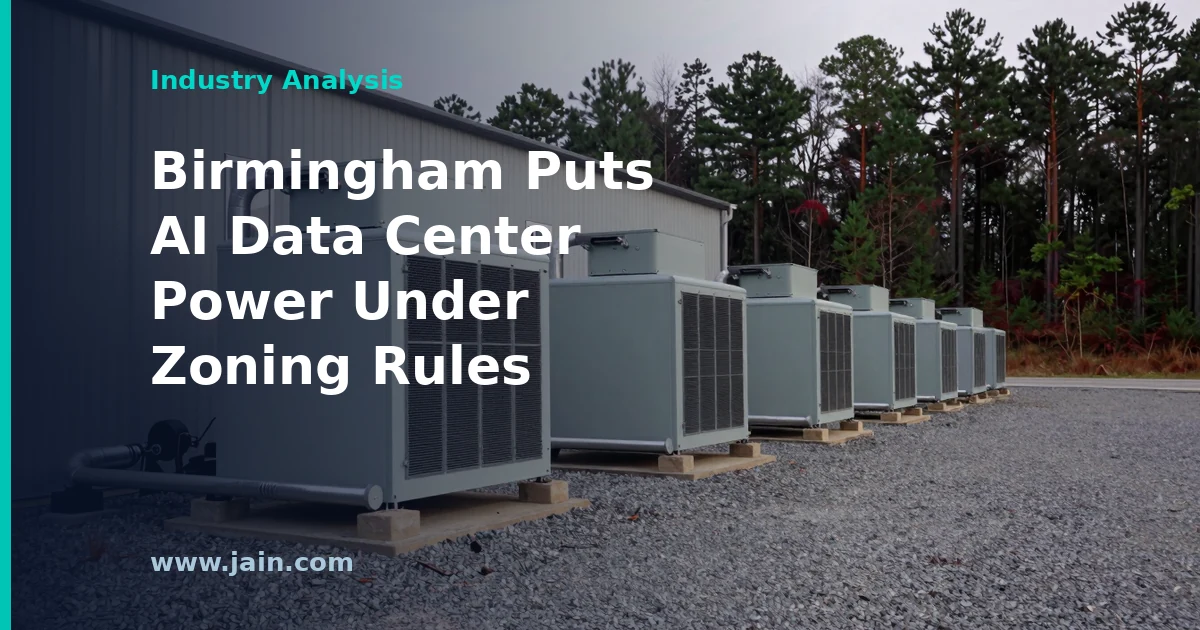
Birmingham, Alabama, has passed strict new rules for giant data centers, the warehouse-sized buildings full of computers that run cloud services and artificial intelligence.
They must sit at least 500 feet from homes, more than a football field and a half.
They cannot run their own gas-fired power plants on site.
Their cooling must use no more water than an ordinary office building.
Nearby neighbors must be told by certified letter before one is built.
The city, not the state, now decides these terms.
The City of Birmingham announced on June 9, 2026, that its City Council had approved a zoning ordinance setting 20 protective conditions for hyperscale data centers, the very large facilities built by cloud and AI operators. The city describes it as the toughest such ordinance in Alabama.
The rules include a 500-foot setback from residential districts, a 1,000-foot separation from high-capacity transit facilities, a 5-acre minimum lot size, mandatory closed-loop cooling, a ban on onsite gas turbines and round-the-clock diesel generation, noise studies before and after construction, disclosure of projected peak electricity demand, and certified-mail notice to property owners within 500 feet.
Executive Summary
Birmingham has written the most contested parts of AI data center development, power, water and noise, directly into its zoning code. A developer seeking a site in the city now has to show where its water comes from, how much electricity it expects to draw at peak and in what phases, which utility will supply it, and how it will keep noise at the property line in check, all before the project can proceed.
The most consequential provision is the prohibition on onsite gas turbines and diesel generators running 24/7. Onsite gas generation has become one of the ways large AI campuses bring capacity online faster than a utility connection allows. Birmingham has closed that route within city limits while leaving room for solar, fuel cells and battery storage under review.
The city pairs these limits with a pitch: it cites its strong electrical grid, industrial infrastructure and affordable land as reasons developers want to build there. The ordinance is an attempt to keep that demand while setting the conditions locally.
Power Moves From the Utility Contract to the Zoning File
Traditionally, how a data center gets its electricity is negotiated between the developer and the utility, and the city’s role is limited to land use. Birmingham’s ordinance changes that in two ways. First, it restricts the generation a site may build for itself: gas turbines and diesel generators running around the clock are prohibited, solar and fuel cells are allowed, and battery storage is permitted subject to emergency-response review. Second, it requires developers to disclose projected peak demand, planned development phases and the identity of the utility provider as part of the application.
For AI-focused developers, that matters because speed to power is often the binding constraint. When a utility cannot deliver a large new connection quickly, one workaround has been to install gas turbines on site and run them as primary or bridging power. Within Birmingham, that option is off the table. A hyperscale project there will depend on grid supply, supplemented only by solar, fuel cells or batteries, which puts the utility’s delivery timeline back at the center of the project schedule.
The disclosure requirement has a quieter effect. Peak demand projections and phasing plans give the city a public record of how much load each project intends to add and when. That turns electricity from a private commercial term into something neighbors and officials can see and question during permitting.
The Water Rule Is a Performance Standard With an Energy Cost
The ordinance does not just require closed-loop cooling; it sets a benchmark that water use be no greater than that of a similarly sized office building. That is a performance test, not simply a technology checkbox. Closed-loop systems recirculate the same coolant rather than evaporating water to shed heat, which sharply reduces consumption.
The trade-off is well understood in the industry: cooling without evaporation generally takes more electricity, particularly in hot, humid summers like Alabama’s. Birmingham has therefore chosen to protect local water supplies at the price of somewhat higher power draw per facility, which loops back to the peak demand figures developers must now disclose. Dense AI hardware, which runs hotter than conventional servers, makes that trade-off more pronounced.
Setbacks, Not Lot Size, Will Decide Where Campuses Fit
A 5-acre minimum lot is modest by hyperscale standards, so it is unlikely to be the constraint that matters. The 500-foot setback from residential and urban neighborhood districts is more demanding: a 5-acre parcel is only about 470 feet on a side if square, so a small site bordering a neighborhood could struggle to fit a building at all. In practice, the rules steer large projects toward bigger industrial tracts, which Birmingham, with its long manufacturing history, has in supply.
The 1,000-foot separation from high-capacity transit facilities is less common. It keeps land near major transit, which cities typically reserve for housing and employment-dense development, from being absorbed by facilities that employ relatively few people once built. Combined with pre- and post-construction noise studies, acoustical walls and certified-mail notice within 500 feet, the ordinance front-loads community disclosure rather than leaving disputes to surface after construction.
Weighing the City’s ‘Toughest’ Claim
The city’s description of the ordinance as Alabama’s toughest and as a mark of national leadership is its own characterization, and it has not published a side-by-side comparison with other jurisdictions to support it. What can be said is that combining an onsite gas ban, a water-use benchmark, noise studies and power disclosure in a single zoning instrument is more comprehensive than codes that address only setbacks or noise.
For developers, stricter rules are not purely a cost. Clear conditions published in advance reduce the risk of a project being stalled by opposition late in the process, and a site that meets them arrives with a documented answer to the questions neighbors most often raise. The larger point is structural: state-level tax incentives can make Alabama attractive, but in Birmingham it is the city code that now determines whether and how a specific site gets built.
Background
Birmingham grew as an iron and steel center, leaving it with industrial land, heavy electrical infrastructure and rail and utility corridors that suit large facilities. Alabama has courted data centers with state tax incentives and has already drawn large projects from companies such as Google and Meta elsewhere in the state.
Nationally, the surge in AI computing has driven demand for ever-larger data centers that consume significant electricity and, depending on cooling design, water. Many local zoning codes were written before facilities of this scale existed, and cities have begun adding specific rules on siting, noise, water and power as proposals arrive.
Google is advocating for industry-wide standards on how data centers measure and disclose their water use, according to a June 4, 2026 report from Axios. The move comes as public and political backlash over data-center water consumption intensifies, driven by the rapid buildout of AI computing capacity in communities that are increasingly asking what these facilities take from local water supplies.
Executive Summary
According to the Axios report, Google — operator of one of the world’s largest data-center fleets — is pushing for water-use standards across the data-center industry at a moment when the sector’s social license to build is under real strain. Water has joined electricity as the most contested resource in data-center siting fights, and operators have historically disclosed water consumption inconsistently, if at all, often citing competitive sensitivity.
The significance is less about any single company’s practices than about the reporting baseline. Today there is no universally applied, apples-to-apples standard for how a data center reports water withdrawal, consumption, and offsetting. If a major hyperscaler — one of the handful of companies operating cloud infrastructure at global scale — succeeds in normalizing common metrics and disclosure, it changes the conversation for every operator, utility, and permitting authority in the market. The available reporting is brief, so the details of what Google is proposing, and to whom, remain to be seen.
Why Water Became the AI Buildout’s Flashpoint
Data centers consume water primarily for cooling: many facilities use evaporative systems, which lower temperatures by evaporating water and are energy-efficient but consumptive — much of that water leaves as vapor rather than returning to the local system. As AI training and inference drive a historic wave of data-center construction, the aggregate water question has moved from sustainability reports to city-council meetings, especially in drought-prone regions where residents and farmers compete for the same supply.
The backlash dynamic is straightforward: communities are asked to approve large industrial facilities, often under non-disclosure agreements during site selection, and then struggle to learn how much water those facilities actually use. That information vacuum breeds distrust regardless of the underlying numbers. In several well-publicized siting disputes, the absence of clear water data has itself become the story.
Transparency as a Strategic Play, Not Just a Virtue
A push for common standards from a company of Google’s scale is best read as both principled and pragmatic. Voluntary, industry-defined standards frequently emerge when an industry senses that mandatory, jurisdiction-by-jurisdiction regulation is the alternative. A single common disclosure framework is far cheaper for a global operator to comply with than fifty different state or municipal reporting regimes — and it lets efficient operators demonstrate that efficiency in a comparable way.
Standardized metrics also reframe the competitive field. Water-use effectiveness (WUE) — a ratio of water consumed to computing energy delivered, analogous to the industry’s PUE metric for energy — only becomes meaningful if everyone measures it the same way. Operators that have invested in air cooling, recycled or non-potable water sources, or closed-loop liquid cooling would benefit from a regime that makes those investments visible. Operators that have relied on cheap potable water in stressed basins would face uncomfortable comparisons. That is how standards shift markets: not by mandate, but by making differences legible.
What It Could Mean for Communities, Utilities, and the Rest of the Industry
For host communities and water utilities, credible standardized disclosure would change permitting conversations from adversarial guesswork into negotiations over real numbers — how much withdrawal, how much consumption, from what source, with what offsets. For colocation providers and smaller operators, an emerging standard cuts both ways: it adds reporting burden, but it also offers a ready-made framework to answer the water question before it derails a project.
The open risk is that voluntary standards become a ceiling rather than a floor — disclosure calibrated to what the largest operators are already comfortable reporting. Fair questions apply in both directions here: critics should ask whether an industry-authored standard will require site-level data in water-stressed basins, and operators can fairly ask whether blanket opposition to data centers engages with actual consumption figures or with worst-case anecdotes. Standards only defuse a backlash if both sides accept the numbers they produce.
Background
Google operates one of the world’s largest fleets of data centers and, alongside the other major cloud providers, is in the midst of an unprecedented expansion to serve AI workloads. The company has positioned itself as a sustainability leader among hyperscalers, publishing water usage data for its operations and pledging in 2021 to replenish more freshwater than it consumes by 2030. The industry as a whole, however, has no universally applied standard for water reporting: metrics, boundaries, and disclosure practices vary widely between operators, and some have historically treated water data as competitively sensitive. That inconsistency has collided with a wave of community opposition to data-center construction — particularly in water-stressed regions of the United States — making water disclosure one of the sector’s most consequential unresolved questions.
Google has pledged $500 million toward local water projects, a commitment reported June 2, 2026 by E&E News (POLITICO) as the company continues an aggressive data center buildout. The pledge lands amid growing scrutiny of how much freshwater hyperscale computing facilities consume, particularly in water-stressed regions where new sites are planned.
Executive Summary
The announcement, as reported, ties a nine-figure dollar commitment to water infrastructure and stewardship in communities affected by Google’s data center push. Data centers use water primarily for evaporative cooling — a process that consumes water to reject the heat generated by servers — and the AI era has sharply increased both the number of facilities and the density of the computing inside them.
Why it matters: water has become the second front, after electricity, in the contest over where and how fast AI infrastructure gets built. Local opposition over water has delayed or reshaped projects in several U.S. markets, and hyperscalers have learned that a permit fight is more expensive than a partnership. A commitment of this size signals that community water benefits are moving from voluntary sustainability programs toward the cost of doing business for large-scale data center development — though the reported announcement leaves the mechanics of the spending largely undefined.
Water Is Now a Siting Currency
For most of the cloud era, electricity determined where data centers went. Water has now joined it. Evaporative cooling remains the most energy-efficient way to cool dense server halls, but it can draw millions of gallons per facility per year — a visible, local impact in a way that grid electrons are not. Communities from the American Southwest to the Pacific Northwest have pushed back on data center water use, and those disputes have made water access a genuine gating factor for new capacity.
Against that backdrop, a $500 million pledge functions as more than philanthropy: it is a de-risking tool. Funding aquifer recharge, leak repair, or watershed restoration in host communities builds the local goodwill and regulatory credibility that expedite the next permit. That does not make the money less real or less useful — it means the incentive structure has aligned so that community water investment and business strategy point the same direction.
From Pledges to Proof
Google has previously set a goal of replenishing more freshwater than it consumes across its operations — a “water positive” ambition targeting 120% replenishment by 2030. The challenge with replenishment accounting, as with carbon accounting before it, is locality: replenishing water in one basin does not help a community whose own aquifer supplies the cooling towers. The strongest version of this new commitment would direct money into the specific watersheds that host Google facilities, with independently verifiable volumes.
The reported announcement, based on the available source material, does not yet detail which projects, which basins, or over what period the $500 million will be deployed. That distinction — local, measured, and verified versus aggregate and self-reported — is exactly where community groups, utilities, and state regulators will focus. Hyperscalers that get ahead of it with transparent, basin-level disclosure will find siting easier; those that do not will keep meeting organized opposition.
What It Means for the Rest of the Industry
When the largest operators attach dollar figures to community water benefits, they reset expectations for everyone else. Colocation providers, GPU-cloud startups, and enterprise builders negotiating with the same counties will increasingly face water-benefit asks modeled on hyperscaler precedents. That favors operators with strong balance sheets and disadvantages smaller developers — a dynamic already visible in power procurement, where hyperscalers’ ability to fund grid upgrades and long-term energy contracts has become a competitive moat.
It also accelerates the engineering alternatives. Closed-loop liquid cooling, air-side economization, and treated wastewater (reclaimed water) supply all reduce potable water draw, each with cost and energy trade-offs. As community water commitments become priced into projects, designs that minimize freshwater consumption get relatively cheaper — a quiet but consequential shift in how the next generation of AI facilities will be engineered.
Background
Google operates one of the world’s largest data center fleets, and the generative-AI boom has pushed it — alongside Microsoft, Amazon, and Meta — into a historic expansion of computing capacity. Because many facilities rely on evaporative cooling, that growth has drawn increasing attention to freshwater consumption, especially in drought-prone regions of the U.S. where several communities have challenged or scrutinized data center water permits.
Google announced a company-wide water stewardship strategy in 2021, including the goal of replenishing 120% of the freshwater it consumes by 2030. The June 2026 pledge of $500 million for local water projects, reported by E&E News, extends that posture with a concrete dollar figure at a moment when water transparency has become a live permitting and political issue for the entire data center industry.
An independent analysis published on Substack on 13 May 2026 argues that Nevada’s restrictions on evaporative cooling towers at data centers do not eliminate the industry’s water consumption so much as relocate it. The piece, headlined “The $3 Billion Blind Spot,” estimates that roughly 100 million gallons of annual water use moves from data center sites to the thermoelectric power plants that supply the extra electricity air-cooled equipment requires.
The item reached us as a syndicated Google News listing with the headline and a truncated summary; the full text and its underlying calculations were not available for review. The figures below are therefore reported as claims from a single, unverified source, and the analysis that follows tests the logic rather than endorsing the arithmetic.
Executive Summary
The claim is structural rather than scandalous, and that is what makes it worth taking seriously. Cooling a data center by evaporating water is thermodynamically cheap: the phase change from liquid to vapour carries away a great deal of heat for very little electricity. Remove that option, as a cooling tower ban does, and the heat still has to go somewhere. It goes into air-cooled chillers and dry coolers, which use no water on site but draw materially more power, particularly in desert summers when ambient air is hottest and the equipment is least efficient.
That extra power is generated somewhere. If it comes from gas, coal or nuclear plants using recirculating cooling, those plants evaporate water of their own. The water has not disappeared; it has crossed a jurisdictional and accounting boundary. On the site’s books, water use falls toward zero. On a whole-system basis, it may not.
Whether the net effect is good or bad for Nevada is a separate question from whether the accounting is complete, and the two are routinely conflated by both sides. Moving consumption out of a stressed groundwater basin into a different basin, or onto a grid increasingly served by solar and wind that consume almost no water, can be a genuine improvement even if the headline “zero water” figure overstates it. The problem is that current disclosure practice makes it nearly impossible to tell which is happening.
The Trade Is Water for Electricity, and It Is Real
Every cooling design is a choice about which resource to spend. An evaporative cooling tower sprays warm water over fill material and lets a fraction evaporate; the vapour leaves with the heat, and the site tops up the loss from the municipal supply or a well. A dry or air-cooled system rejects the same heat directly to the atmosphere using fans and refrigeration, consuming no water but more kilowatt-hours. In a hot, arid climate the penalty is largest exactly when demand peaks, because the temperature difference the equipment relies on is smallest on a 40°C afternoon.
Industry has a shorthand for the water side of this: Water Usage Effectiveness, or WUE, measured in litres of water per kilowatt-hour of IT load. It is a site metric. It counts what comes through the meter at the fence line. It does not count the water evaporated at a power station a hundred miles away to make the electricity that ran the fans, and it was never designed to. That is a reasonable engineering convention, not a conspiracy — but a metric built for one purpose becomes misleading the moment it is used as a sustainability claim in a public filing or a permit hearing.
The upstream figure is not fixed, and this is where the analysis’s headline number needs interrogation. Thermoelectric water intensity varies by an order of magnitude across generation types and cooling designs: once-through plants withdraw enormous volumes but return most of it, recirculating plants withdraw far less but evaporate most of what they take, and solar photovoltaic and wind consume essentially nothing beyond occasional panel washing. A 100 million gallon estimate is really a statement about an assumed grid mix, and reasonable analysts can differ on whether to use the average mix or the marginal generator that actually responds to new load.
Accounting Boundaries Decide the Answer Before the Arithmetic Starts
Carbon reporting solved a version of this problem years ago by splitting emissions into Scope 1 (direct), Scope 2 (purchased energy) and Scope 3 (everything else in the value chain). Water reporting has no equivalent convention in general use. There is no widely adopted “Scope 2 water” line item, so the electricity-embedded water footprint of a data center is, in most public disclosures, simply absent — not understated, absent.
Two further distinctions do a lot of quiet work in arguments like this one. The first is withdrawal versus consumption: water taken from a river and returned warmer is not the same as water evaporated and gone from the basin, and figures that mix the two can inflate or deflate a result dramatically. The second is location. A gallon evaporated from an over-allocated desert aquifer and a gallon evaporated beside a well-supplied river are equivalent on a spreadsheet and completely different in hydrological reality. Water-stress-weighted accounting exists to handle this, but it is not what most headline totals use.
Applied evenly, this cuts both ways. It undercuts an operator advertising an air-cooled campus as “water-free” when the phrase describes only the fence line. It equally undercuts a critic who books upstream gallons at full weight without asking whether that water leaves a stressed basin, whether the marginal generator is a gas plant or a solar farm, and whether the plant in question uses evaporative cooling at all.
Who Gains, Who Absorbs the Cost
The clearest winners are local water authorities and the residents they answer to. A ban on evaporative cooling gives a regulator a bright-line, enforceable rule that removes a visible, meterable draw from a constrained supply, and it does so without having to adjudicate every project’s efficiency claims. Whatever its system-wide merits, as local water policy it is administratively coherent.
Developers absorb a cost that is real but survivable. Air-cooled plant is typically more capital-intensive per megawatt of rejected heat, occupies more space, and raises Power Usage Effectiveness — the ratio of total facility power to IT power — which in turn raises operating cost and increases the megawatts a campus must contract for. For an operator negotiating an interconnection queue position in a constrained market, that last point may matter more than the electricity bill. Rising energy demand also strengthens the case for on-site or contracted generation, which is where the water question becomes the operator’s own again rather than an anonymous grid externality.
The party with the least voice is the community near the generating plant, which may sit in an entirely different county or state and has no standing in the data center’s permitting process. That asymmetry — decision made in one basin, consequence landed in another — is the substantive point the analysis raises, and it stands independently of whether the specific 100 million gallon estimate survives scrutiny.
Reading the Claim Fairly
A single Substack post working from public data is a legitimate contribution; independent analysis has repeatedly surfaced infrastructure issues before trade coverage did, and dismissing it on the basis of the venue would be lazy. But the same standard applied to a vendor sustainability report applies here: the estimate is only as good as its disclosed method, and we could not see the method.
The “$3 billion” in the headline is the weakest element on the available evidence. The figure is not defined in the material we can see — it could denote capital investment in affected facilities, the economic value at stake, an avoided-cost estimate, or something else entirely. Large round numbers in headlines travel further than the caveats attached to them, and a reader encountering this claim second-hand is likely to acquire a precise-sounding figure with no idea what it measures.
The responsible position, at this stage, is that the mechanism is sound and well understood, the direction of the effect is almost certainly correct, and the magnitudes are unverified. That is enough to justify better disclosure. It is not yet enough to justify a conclusion about whether Nevada’s policy makes the state’s water situation better or worse.
Background
Nevada sits at the sharp end of two trends at once. It depends heavily on Colorado River water through Lake Mead, where sustained drought and over-allocation have made every new consumptive use politically visible, and Southern Nevada has spent decades building one of the most aggressive urban water conservation programmes in the United States. At the same time, cheap land, favourable tax treatment and proximity to California demand have made the state a significant data center market, with large campuses clustered in Northern Nevada industrial parks and in the Las Vegas area.
The collision was predictable. As AI workloads pushed rack densities and total facility power upward through the mid-2020s, cooling water became a permitting flashpoint in arid states generally, not only Nevada. Restricting evaporative cooling is one of the more direct policy levers available to a water authority. Whether it reduces total water consumption or mainly relocates it is the question this analysis raises, and it is a question the industry’s current reporting conventions are not equipped to answer.
Ars Technica reported on May 10, 2026 that a data center drew roughly 30 million gallons of water — and that the consumption went undetected for months. The headline alone frames the story: the issue is not only the volume, which is significant but not unheard of for a large facility, but the fact that no one — apparently neither the operator’s oversight processes nor the local water authority — flagged it while it was happening.
Executive Summary
The report describes a data center that “guzzled” about 30 million gallons of water while the draw went unnoticed for months. For scale, 30 million gallons is roughly 45 Olympic-size swimming pools, or about a year’s supply for several hundred typical U.S. households. Data centers commonly use water for evaporative cooling — spraying or trickling water so that its evaporation carries away server heat — which is energy-efficient but consumptive: much of the water leaves as vapor rather than returning to the system.
Why it matters: the industry is under growing scrutiny over water in drought-prone regions, and the standard defense is that usage is metered, permitted, and disclosed to the relevant utility. An episode in which tens of millions of gallons flow without timely detection undercuts that assurance and strengthens the case — made by regulators and communities alike — for real-time submetering, faster reconciliation between withdrawals and billing, and public reporting of facility-level water use.
How Tens of Millions of Gallons Go Missing From View
Water is easy to lose track of in a way electricity is not. Power draw is metered continuously because it is billed continuously, and grid operators watch load in real time. Water billing, by contrast, often runs on monthly or quarterly meter reads, estimated bills, and manual reconciliation — and large industrial users sometimes draw from wells or dedicated lines that sit outside a municipality’s ordinary consumption dashboards. A facility running evaporative cooling around the clock can therefore accumulate an enormous draw between the moments anyone actually looks at the numbers.
The headline’s claim that “nobody noticed for months” is consistent with that structural lag rather than requiring any bad intent. But intent is not the point: a monitoring regime that only surfaces a 30-million-gallon draw after the fact is not a monitoring regime in any meaningful sense. The same volume flowing through a leak, a stuck valve, or an unauthorized connection would have gone equally unnoticed.
The Volume Is Ordinary; the Blindness Is the Story
Thirty million gallons over several months is within the range that large evaporatively cooled data centers can plausibly consume — big hyperscale campuses can use hundreds of thousands of gallons on a hot day. So the fair reading is not that this facility was uniquely thirsty, but that a routine level of industrial water use ran without effective oversight. That distinction matters for how the industry should respond: the fix is measurement and disclosure, not necessarily a smaller pipe.
It also matters for the public debate. Data center water use is frequently discussed in aggregate estimates precisely because facility-level figures are scarce — operators often treat water contracts as confidential, and utilities have historically honored that. Every incident like this one shifts the burden of proof: if the numbers are unremarkable, operators strengthen their own position by publishing them; if the numbers only emerge when something goes wrong, skepticism is the rational default.
What Good Looks Like: Metering, WUE, and Utility Practice
The remedies are unglamorous and well understood. Continuous submetering at the facility intake, with telemetry to both the operator and the water utility, turns months of invisibility into hours. Publishing water usage effectiveness (WUE — liters of water consumed per kilowatt-hour of IT load, the water analogue of the PUE efficiency metric) lets outsiders compare facilities on a common basis. Utilities, for their part, can set anomaly thresholds on large industrial accounts the way credit-card issuers flag unusual spending — an established technique that simply has not been standard practice for water.
There are trade-offs worth being honest about. Cutting water use usually means air-cooled or closed-loop systems, which consume more electricity — shifting the environmental burden from watershed to grid. Communities and operators may reasonably choose evaporative cooling in water-rich regions. But that choice is only defensible when the water is measured, permitted, and disclosed. Transparency is the precondition for the trade-off being legitimate, and this episode is a case study in what happens when it is absent.
Background
Data center water use has become one of the industry’s most contested environmental questions, alongside electricity demand. As AI and cloud growth drive construction of ever-larger campuses, communities from the American Southwest to Europe have pushed back on facilities sited in water-stressed regions, and operators have responded with a mix of efficiency pledges, “water positive” commitments, and — less often — actual facility-level disclosure. Unlike power, which is continuously metered and increasingly reported, water has historically been governed by opaque utility contracts and infrequent meter reads, leaving both regulators and the public reliant on aggregate estimates rather than measured data. Incidents in which large draws surface only after the fact have repeatedly reset that debate.