Tag: data center thermal management

  • Castrol CORE’s 150-Country Network Recasts AI Coolant as a Lifecycle Service

    Castrol CORE’s 150-Country Network Recasts AI Coolant as a Lifecycle Service

    TL;DR · 30-second read

    The Short Version

    Castrol, best known for motor oil, is now selling a full package to keep the computers behind artificial intelligence from overheating.

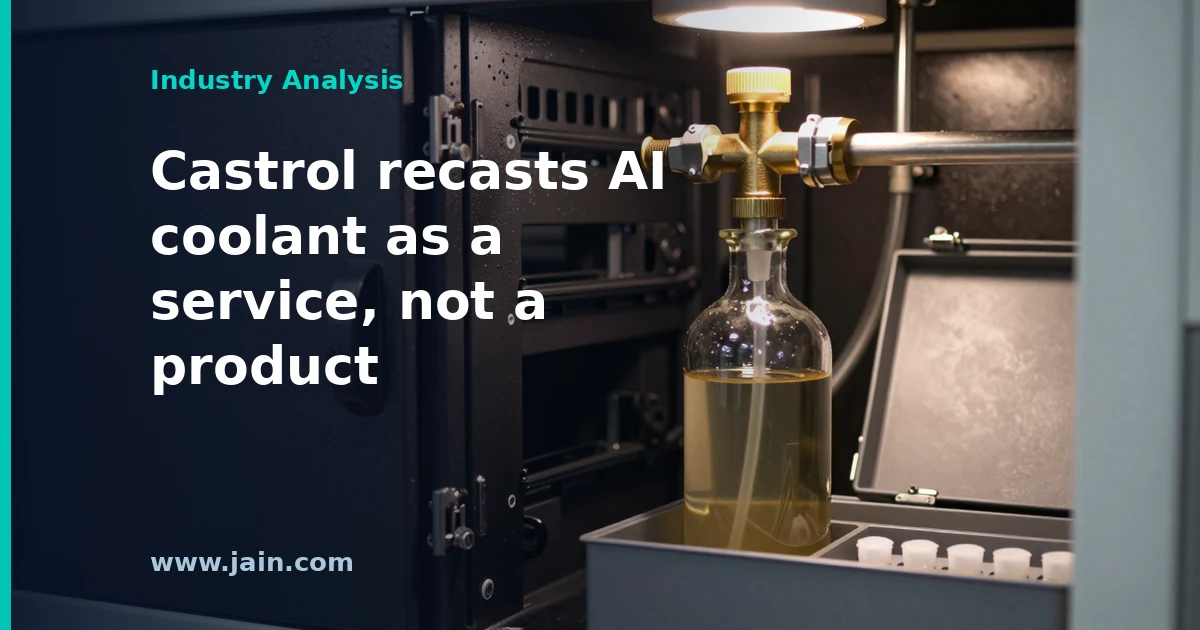
    Those chips run so hot that many buildings now cool them with liquid instead of fans. Castrol says it will help design those cooling systems, supply the fluid, test it, and look after it for years, backed by service teams in more than 150 countries.

    This matters because a cooling failure can knock very expensive computers offline. Castrol is wagering that customers would rather pay one company to own that risk.

    Castrol announced on September 29, 2026, from Singapore, the launch of Castrol CORE, an end-to-end thermal management offer for data centers, in a release distributed through PR Newswire. The package combines Castrol’s cooling fluid technology with testing, new design capabilities, and support through deployment, commissioning, operation and maintenance. It is backed by Castrol labs in the UK, US, Germany and China, joint labs across Asia, and a service-provider network covering more than 150 countries.

    Castrol says its cooling technology has been tested and validated by leading chip and hardware makers including NVIDIA and Intel. It has completed a proof-of-concept program with an unnamed major data center operator in China and is working with other global operators on similar projects.

    Executive Summary

    Castrol CORE is Castrol’s move from selling cooling fluid to selling responsibility for how that fluid performs over a facility’s life. Rather than supplying a product that operators must integrate with hardware from other vendors, Castrol says it will act as a single point of contact, coordinating a network of partners in products, infrastructure, design and services. The company attributes the shift to its own industry study, which it says found rising demand for integrated thermal management, plus concerns about supply chains and the high cost of failures.

    The launch matters because liquid cooling, circulating fluid close to or around hot chips instead of relying on air, is becoming a standard requirement for AI and high-performance computing. When cooling moves from fans to fluids, the chemistry of the fluid becomes part of the uptime equation. A supplier that tests and monitors that fluid on site, across more than 150 countries, is offering something closer to an operational guarantee than a commodity.

    What Castrol has not disclosed is how much of this is already contracted. It names no customers, deployed capacity, pricing or performance commitments, so CORE is best read as a clear statement of strategy with one completed pilot behind it.

    Why a Coolant Maker Is Selling Accountability

    The core of the announcement is a change in what the customer is paying for. Castrol says CORE covers the full lifecycle, from early design and specification through deployment, commissioning, operation and maintenance, and that its service network in more than 150 countries enables ongoing testing, validation and on-site monitoring to reduce the risk of costly interruptions. That is the mechanism behind the headline: the fluid is no longer the whole product. It is the anchor for a recurring relationship built around keeping the cooling loop healthy.

    This follows from how liquid cooling works. In an air-cooled hall, a failing fan is a swappable part. In a liquid-cooled system, the fluid’s condition, including contamination, degradation or incompatibility with pumps, seals and cold plates, can affect every server on the loop. Castrol’s own study, it says, flagged the high cost of failures as a major industry concern. A supplier that samples and validates fluid on site throughout a facility’s life is effectively selling a reduction in that risk, and the geographic reach of the service network is what makes that promise credible for operators with sites on several continents.

    The people most affected are data center operators and the engineering firms that design their facilities. For operators, a single interlocutor could simplify procurement and clarify who is responsible when something goes wrong. For design and integration firms, a fluid supplier moving upstream into design is a new participant in work they have typically led. Castrol frames this as partnership, saying CORE brings together specialists across products, infrastructure, design and services, but the balance of who leads a project will depend on terms it has not yet published.

    What Chipmaker Validation Does and Does Not Establish

    Castrol’s strongest technical claim is that its cooling technology has been tested and validated by leading chip and hardware makers, including NVIDIA and Intel. For buyers, validation from the companies whose processors are being cooled carries real weight, because running an unapproved fluid can raise questions about hardware compatibility and support.

    The claim is also broad. Castrol does not specify which products or platforms were validated, whether the fluids are for direct-to-chip cooling (where liquid flows through plates mounted on processors) or immersion cooling (where servers sit submerged in a non-conductive fluid), or what the validation tested. Operators evaluating CORE will want that detail, since compatibility with one generation of hardware does not automatically carry over to the next.

    Asia-Pacific as the Proving Ground

    Castrol has set up a regional data center design team in Asia-Pacific, supported by local specialists, and describes the region as adopting new cooling infrastructure quickly. Its one disclosed field result is a completed proof-of-concept program with a leading data center operator in China, with similar projects now under way with global operators.

    A proof of concept demonstrates that the approach can work in a real facility; it is not a commercial rollout. The combination of a Singapore launch, an Asian design team, joint labs across Asia and a China pilot suggests Castrol sees the region as its early market for the integrated model. Whether CORE scales from pilots into multi-site contracts is the question that will determine whether the service shift is a strategy or a business.

    The Trade-Off in One-Stop Cooling

    Integrated offers solve a real coordination problem, but they shift risk in both directions. For Castrol, taking on design and lifecycle responsibility means absorbing some of the liability that previously sat with integrators and operators, and managing a partner network it does not fully control. For customers, a single supplier simplifies accountability but can raise switching costs if fluids, monitoring and design are tightly bundled.

    Castrol also says CORE is a platform that should gradually extend its thermal management offering beyond data centers. That signals the company views thermal management as a growth line in its own right, not a side market for lubricants, though it has not said which applications come next or on what timeline.

    Background

    Castrol is one of the world’s largest lubricant brands, with more than 127 years of experience formulating fluids for automotive, marine, industrial and energy applications. Its data center work sits within a dedicated Data Centers and Thermal Management division, led globally by president Peter Huang, who says customers are looking for experienced partners to handle the full range of thermal challenges rather than another standalone product.

    The broader context is the rise of liquid cooling. As AI and high-performance computing push chip heat output higher, operators are adopting systems that use specialized fluids to carry heat away from processors. That has turned fluid suppliers into participants in data center design and operations, a role Castrol is now formalizing with CORE.

    Sources

    Source: Castrol lance « Castrol CORE », une offre intégrée de gestion thermique destinée aux centres de données (Castrol launches Castrol CORE, an integrated thermal management offer for data centers), Castrol’s announcement of its end-to-end data center cooling offer, distributed via PR Newswire on September 29, 2026.

  • TSMC Moves the Cooling Fight Inside the Chip

    TSMC Moves the Cooling Fight Inside the Chip

    TL;DR · 30-second read

    The Short Version

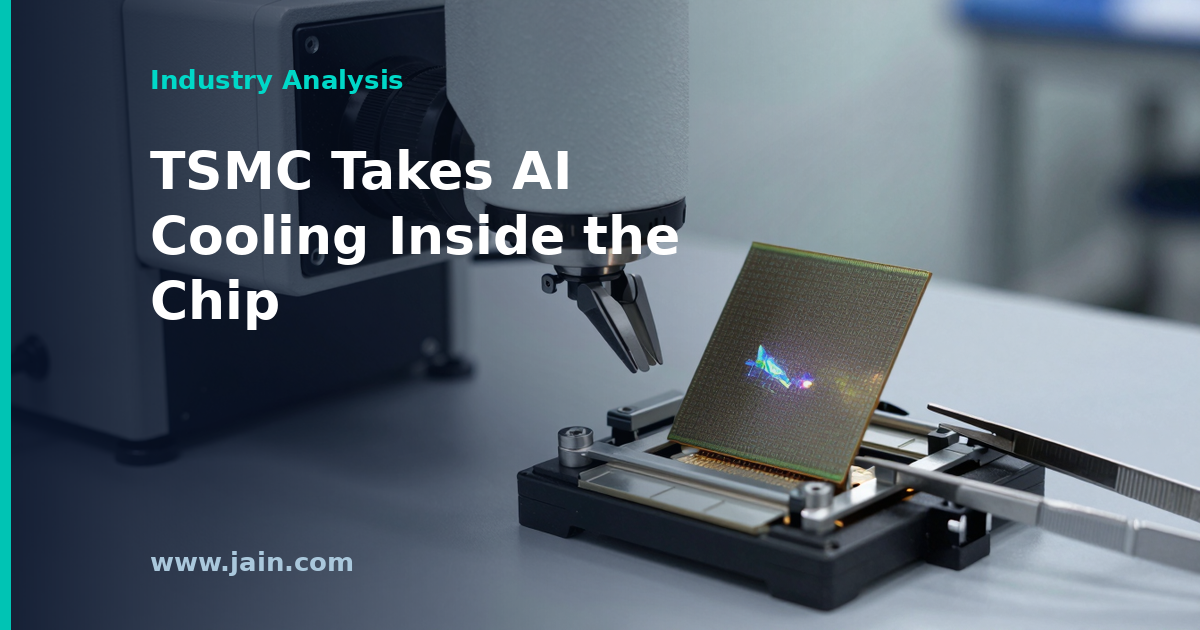
    The chips that run artificial intelligence are getting so hot that cooling them from the outside is starting to run out of room. TSMC, the Taiwanese company that manufactures most of the world’s advanced processors, is looking at cutting channels finer than a human hair into the chip itself and pumping liquid through them, right next to where the heat is made.

    Forecasts put the power a single artificial intelligence system draws at roughly six times today’s level within five years. If cooling moves inside the chip, the company that builds the chip starts selling the cooling too.

    TrendForce reported that TSMC is evaluating microchannel cooling integrated at the chip level — etching or bonding fluid channels directly into the silicon package so coolant flows microns from the transistors — as projected power draw for AI systems rises roughly sixfold over the next five years. The report frames the technology as a response to the point at which conventional external cooling, including metal cold plates strapped to the top of a processor, stops keeping pace with heat generated inside the package.

    TSMC has not addressed the technology in its recent filings with United States regulators. Its 6-K filed August 25, 2026 covering July activity reported no board-approved capital appropriations for the month, and its 6-K filed September 1, 2026 dealt with a routine dividend adjustment.

    Executive Summary

    For a decade, cooling improvements in computing happened outside the chip: better fans, then cold plates, then facility water loops and immersion tanks. Chip-level microchannel cooling breaks that pattern. It puts the coolant inside the package itself, shortening the path heat must travel from transistor to fluid — the single largest source of thermal resistance in a modern accelerator stack. If TSMC productizes it, cooling stops being purely a data center purchase and becomes partly a foundry and advanced-packaging purchase.

    The sixfold power projection is the forcing function. Each generation of AI accelerator has raised per-package power while shrinking the area over which that heat can be spread. External cooling can move more fluid faster, but it cannot shorten the distance between the hot spot and the fluid. Microchannels can, which is why the approach has moved from research curiosity toward roadmap discussion.

    The commercial implications run in several directions at once: advanced packaging gains value, cold-plate and thermal-interface suppliers face a long-run substitution question, and data center operators inherit a component that is sealed, unserviceable and warranted by the chipmaker rather than the integrator. None of that is settled, and TSMC has published no timeline, node, capacity or customer detail.

    Why the Thermal Bottleneck Has Moved Below the Heatsink

    Heat leaving a processor passes through a chain of obstacles: the silicon itself, a thermal interface material, a metal lid, another interface layer, and finally a cold plate or heatsink carrying the heat away. Each junction adds resistance. Data center engineering over the past few years has attacked the last link in that chain — swapping air for water, moving from rear-door heat exchangers to direct-to-chip cold plates, adding coolant distribution units. Those changes worked, but they optimise the part of the path furthest from the problem.

    Microchannel cooling attacks the first link. By routing fluid through channels formed in or immediately against the silicon, it removes several interface layers and places coolant adjacent to the hot spots rather than millimetres above them. That matters most for the tightly packed, high-power dies used in AI training accelerators, where heat is not evenly distributed and a small area of the die can limit the performance of the whole package.

    The projected sixfold rise in AI system power over five years is what makes this urgent rather than academic. Cooling capacity outside the package can be scaled by spending more — bigger pumps, colder water, more plumbing. Thermal resistance inside the package cannot be spent away. Once it dominates, the only remaining lever is to redesign the package, which is precisely where a foundry with leading advanced-packaging capability has an advantage.

    Cooling Becomes a Foundry Product

    The business consequence is a shift in where cooling value is captured. Today a hyperscaler — an operator of very large cloud data centers — buys accelerators from a chip designer and cooling from a separate thermal supply chain of cold-plate makers, manifold vendors, pump and coolant distribution unit manufacturers. If the highest-value part of the thermal path is fabricated at the packaging stage, part of that spend migrates upstream into the price of the package.

    That is a favourable structural position for TSMC, which already assembles AI accelerators using advanced packaging that stacks logic dies and high-bandwidth memory on a shared substrate. Adding fluid channels to that flow extends an existing chokepoint rather than opening a new competitive front. For established thermal suppliers, the risk is gradual rather than immediate: facility-side cooling, plumbing and heat rejection remain necessary regardless, because heat still has to leave the building. What could shrink is the premium attached to the interface between chip and coolant.

    There are real costs on the other side of the ledger. A sealed fluid path inside a package is not field-serviceable. Leaks, corrosion, particulate clogging and mechanical stress become manufacturing yield and warranty problems for the chipmaker rather than maintenance problems for the operator. Testing a package that only performs correctly when fluid is flowing complicates production test. Those are engineering problems with known research literature behind them, but solving them at high volume and acceptable yield is a different exercise from demonstrating them.

    What TSMC’s Filings Do and Do Not Show

    TSMC’s recent disclosures to United States regulators contain nothing about the technology. The 6-K filed on August 25, 2026, which reports the company’s July activity, listed no capital appropriations approved by the board that month, recorded a NT$0.7 billion equity investment disposition, and reported no share pledges or cancellations. The 6-K filed on September 1, 2026 was narrower still: an adjustment of the first-quarter 2026 cash dividend from NT$7.0 to NT$7.00000137 per common share, payable October 8, 2026, after shares were reclaimed from 2024 restricted stock awards.

    This absence is not evidence against the programme. Research and early development work does not normally surface in monthly shareholding and appropriation reports, and companies routinely discuss roadmap directions publicly long before they appear as line items. But it does bound what can currently be said: there is no disclosed capital commitment, no announced capacity, and no financial scale attached to chip-level cooling at TSMC.

    For investors, that suggests where to look next rather than what to conclude now. Board-approved capital appropriations in the monthly filings, advanced-packaging capacity announcements, and any customer disclosure from accelerator designers would be the first hard signals that microchannel cooling has moved from evaluation to committed investment.

    What It Changes for Data Center Buyers — and What It Doesn’t

    Operators planning liquid-cooled halls should not read this as a reason to wait. Chip-level cooling reduces resistance inside the package; it does not eliminate the need for a facility water loop, coolant distribution units, heat rejection equipment or the electrical capacity to feed the racks. If anything, a package designed to shed more heat more efficiently makes the facility-side loop more important, because more watts per rack must ultimately be rejected to air, water or the outside environment.

    The more consequential change is contractual. Cooling that ships inside the processor moves specification authority to the chipmaker: coolant chemistry, filtration standards, inlet temperature and flow requirements would become conditions of the chip’s warranty rather than choices made by the integrator. Operators used to negotiating thermal design with a systems vendor may find those parameters arriving pre-set.

    None of this is imminent. What the direction of travel does justify is designing new capacity for liquid distribution and water quality management as a baseline rather than an upgrade, since every plausible version of the next five years — cold plates, microchannels or both — ends with liquid at the rack.

    Background

    TSMC is the world’s largest contract chip manufacturer, producing leading-edge processors for companies that design but do not fabricate their own silicon. Its role in AI hardware extends beyond making transistors: its advanced packaging capacity, which bonds logic dies and high-bandwidth memory onto a shared substrate, has been one of the industry’s tightest bottlenecks through the current build-out. As a foreign private issuer listed in New York, TSMC files monthly 6-K reports with United States regulators covering board capital appropriations, asset transactions, bond issuance and insider shareholdings.

    Cooling has escalated in parallel. Air cooling gave way to rear-door heat exchangers, then to direct-to-chip cold plates and facility water loops as accelerator power outgrew what fans could handle. Each step moved the working fluid closer to the processor while leaving the package itself untouched. Chip-level microchannel cooling is the logical next step in that sequence — and the first one that would be manufactured by the chipmaker rather than installed by the data center.

    Source: [News] TSMC Eyes Chip-Level Microchannel Cooling as AI System Power Could Rise 6× in Five Years — TrendForce report on TSMC’s evaluation of microchannel cooling integrated at the chip level against projected growth in AI system power.

    Primary sources: Taiwan Semiconductor Manufacturing Company, Form 6-K filed September 1, 2026 (adjustment to first-quarter 2026 cash dividend per share); Taiwan Semiconductor Manufacturing Company, Form 6-K filed August 25, 2026 (monthly report covering July 2026 shareholdings, asset transactions and capital appropriations).