TL;DR · 30-second read
The Short Version
Almost all of the advanced chips that make artificial intelligence work are built by one company in Taiwan. In August it sold roughly 16 billion US dollars’ worth in a single month, more than half again what it sold in the same month a year earlier.
This matters to anyone outside the industry because the huge computing warehouses being built around the world cannot switch on without those chips. The buildings can go up fast. The chips cannot.
So the real waiting line for artificial intelligence computing now begins long before anyone pours concrete.
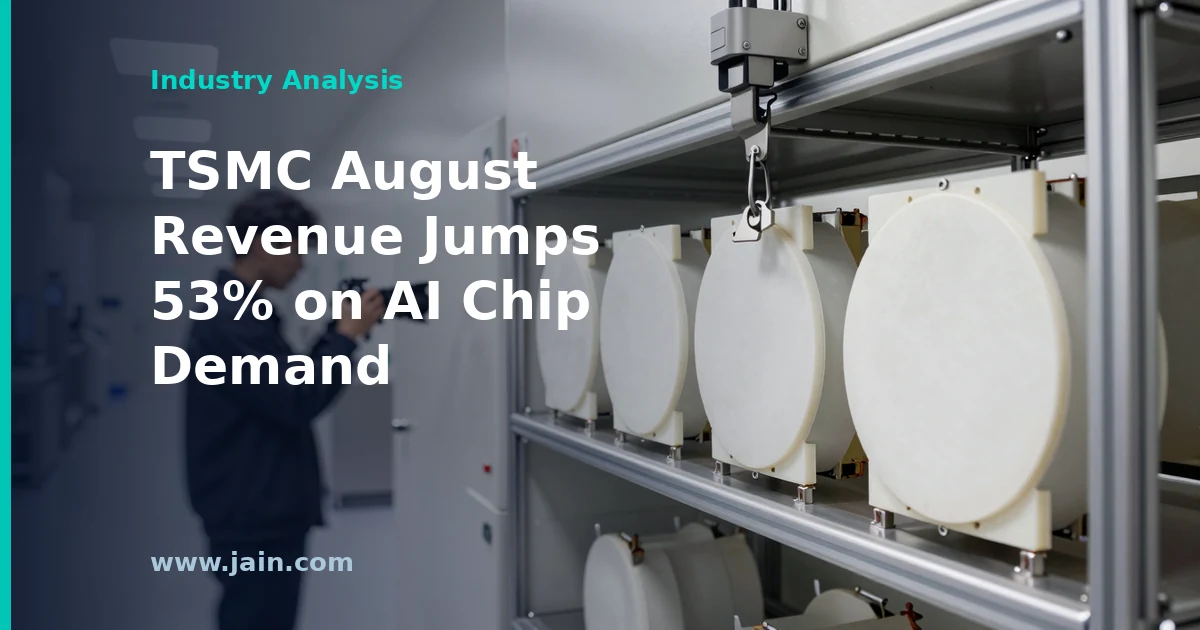
Taiwan Semiconductor Manufacturing Company (TWSE: 2330, NYSE: TSM) reported consolidated net revenue of approximately NT$514.81 billion for August 2026, up 10.1 percent from July and 53.3 percent from August 2025, according to the revenue report the company filed with the US Securities and Exchange Commission on Form 6-K on September 10. Revenue for January through August 2026 totalled NT$3,386.87 billion, a 39.3 percent increase over the same period in 2025.
The August figure sits roughly 22 percent above the company’s average month so far this year, and its year-over-year growth rate runs well ahead of the 39.3 percent pace of the eight-month total, meaning growth is accelerating rather than merely continuing. Benzinga reported that August marked a fourth consecutive month of revenue growth, that TSMC raised its 2026 capital spending plan in July to a record US$60 billion to US$64 billion, that second-quarter revenue rose 36 percent year over year to NT$1.27 trillion, and, citing research firm TrendForce, that TSMC held 72.5 percent of the global foundry market in the second quarter with its 5, 4 and 3 nanometre capacity fully booked on demand for AI server processors.
Executive Summary
A single month of revenue from one Taiwanese manufacturer has become one of the more reliable read-throughs on the health of global AI infrastructure spending. TSMC is a foundry, meaning it does not design chips but manufactures them for companies that do, including the accelerator vendors whose parts fill AI data centres. When its monthly revenue accelerates to 53.3 percent growth, the most direct interpretation is that customers are taking every wafer they can get, and that the manufacturer is able to price and mix accordingly.
The strategic point for infrastructure buyers is where the queue actually forms. Public debate about AI capacity has centred on land, grid interconnection and cooling, all of which are genuine constraints. But a rack cannot be commissioned without accelerators, and accelerators cannot be finished without leading-edge wafers and the advanced packaging that bonds those wafers to high-bandwidth memory. Capacity at the leading edge is described as fully booked. That places the tightest link in the chain upstream of anything a data centre developer controls.
The second implication is financial. TSMC lifted its 2026 capital budget to a record range in July while continuing to distribute cash, adjusting its first-quarter dividend to NT$7.00000137 per common share for payment on October 8 in a separate 6-K filed on September 1. Spending at that scale is a multi-year commitment made against demand signals that are, so far, monthly. The capacity being funded now will arrive after the current shortage, which is the central risk in any capital cycle built on scarcity.
The Constraint Has Moved From Buildings to Wafers
For most of the last two years, the limiting factor discussed in data centre planning has been physical and local: available land, transformer lead times, water for cooling, and the interconnection queue, the waiting list operators join to connect a large load to the electricity grid. Those constraints have not eased. What August’s number suggests is that they now share the critical path with something further upstream, and less visible from the site fence.
An AI accelerator is not a single piece of silicon. It is a leading-edge logic die manufactured on a 3 or 4 nanometre process, joined to stacks of high-bandwidth memory through advanced packaging, a set of techniques that place multiple dies on a shared substrate so they can exchange data at speeds a conventional package cannot support. Packaging capacity is a separate physical constraint from wafer capacity, built in different buildings on different timelines. A shortage in either one caps finished accelerator output regardless of how many wafers the fabs can start.
That is why a foundry’s revenue line has become a leading indicator for facilities that will not open for another two years. If leading-edge capacity is fully booked, as reported for the second quarter, then the marginal buyer of AI compute is not competing for megawatts alone. They are competing for an allocation that was effectively decided upstream, months before their building was energised.
Reading a Monthly Number Without Overreading It
Monthly revenue is a coincident indicator, not a forecast. It records wafers shipped and recognised now, from orders placed and started months earlier. A strong August therefore confirms that demand was strong in the spring and early summer. It does not, by itself, tell you what the order book looks like for the second half of 2027, which is the period most relevant to infrastructure now under construction.
Two further cautions apply to the headline growth rate. The first is the comparison base: a 53.3 percent increase is measured against August 2025, and the strength of that month shapes the number as much as the strength of this one. The second is currency. TSMC reports in New Taiwan dollars, so any US dollar figure quoted alongside it moves with the exchange rate, and dollar-denominated growth can differ from the reported figure in either direction. The 10.1 percent sequential rise from July is in some ways the cleaner signal, because it compares two adjacent months on the same basis and is unaffected by what happened a year ago.
What the monthly disclosure does not contain is mix. It is a consolidated total, without a breakdown by process node, end market or customer. The attribution of the growth to AI is an inference drawn from the pattern of demand, from the reported utilisation of the advanced nodes, and from the second-quarter commentary about a multi-year infrastructure build-out. It is a well-supported inference. It remains an inference, and readers should hold it as one.
A Record Capital Budget Is a Bet That Demand Persists
The July decision to raise 2026 capital spending to a record US$60 billion to US$64 billion is the more consequential disclosure for the industry, because it determines what supply looks like in 2028 and 2029. Fabs take years to build, qualify and ramp. Capital committed during a shortage arrives, almost by definition, into a different market than the one that justified it. This is the oldest dynamic in semiconductors, and it has produced both the industry’s great expansions and its sharpest downturns.
The September filing offers an incidental view of how that expansion is being carried. Alongside the revenue table, TSMC discloses funds lent to TSMC Washington and guarantees extended to TSMC North America, TSMC Global and TSMC Arizona, all wholly-owned subsidiaries. Overseas manufacturing is being financed and backstopped from the parent balance sheet rather than standing on its own. For customers concerned about geographic concentration of leading-edge supply, that structure is worth understanding: diversification of sites does not by itself diversify the credit or the operating control behind them.
Capital returns are running in parallel. The dividend adjustment filed on September 1 reset the first-quarter distribution to NT$7.00000137 per common share, a technical correction after shares were reclaimed from 2024 restricted stock awards, payable on October 8. The approved distribution of roughly NT$181.5 billion for a single quarter is equivalent to about a third of one strong month’s revenue. A company financing record capacity expansion while sustaining distributions of that size is signalling confidence in cash generation, not merely in demand.
What Buyers of Compute Should Take From This
For enterprises procuring AI capacity, whether as hardware or as cloud instances, the practical lesson is that allocation risk sits upstream of the vendor they negotiate with. If accelerator supply is rationed at the foundry and packaging stage, then delivery commitments from any intermediary inherit that scarcity. The right questions in a procurement conversation are about the supplier’s own allocation and its timing, not only about their willingness to sign a schedule.
For operators and developers, the sequencing implication cuts both ways. A site that lands power and interconnection early but cannot secure silicon carries stranded capital in the form of an energised shell with nothing to run. A site with committed accelerators and no grid connection carries the mirror-image problem. The scarce resources are complementary and their lead times are not synchronised, which argues for procuring them against each other rather than in sequence.
For investors, concentration is the theme worth tracking. A reported 72.5 percent share of global foundry revenue in the second quarter, with the leading-edge nodes described as fully booked, means one manufacturer’s throughput is a meaningful variable in the capital plans of the largest technology firms in the world. That is a strong commercial position and, simultaneously, a systemic dependency. Both readings are true, and the numbers above support each.
Background
TSMC pioneered the pure-play foundry model after its founding in 1987: rather than designing and selling its own chips, it manufactures to order for companies that design them. That model now underpins most of the semiconductor industry, because building a leading-edge fab costs tens of billions of dollars and only a handful of firms can operate at the front of the process roadmap. Process generations are named for nominal feature size, with 3 nanometre currently at the leading edge, 4 and 5 nanometre one step behind, and older nodes still serving automotive, industrial and consumer parts.
Because it is listed in Taipei, TSMC discloses revenue every month, a cadence rare among large manufacturers elsewhere and one reason its figures are watched as a proxy for global chip demand. The same report is filed with the SEC on Form 6-K, which is how US investors receive it. Since AI accelerators became the industry’s dominant growth driver, these monthly disclosures have functioned as a near-real-time gauge of how fast the AI infrastructure build-out is actually consuming silicon. Source: TSMC August Revenue Surges 53% as AI Chip Demand Powers Record Sales — report on TSMC’s August 2026 revenue disclosure, including 2026 capital spending plans and second-quarter foundry market share. Primary sources: Taiwan Semiconductor Manufacturing Company, Form 6-K filed September 10, 2026 (TSMC August 2026 Revenue Report); Taiwan Semiconductor Manufacturing Company, Form 6-K filed September 1, 2026 (Adjustment to Cash Dividend Per Share).Sources