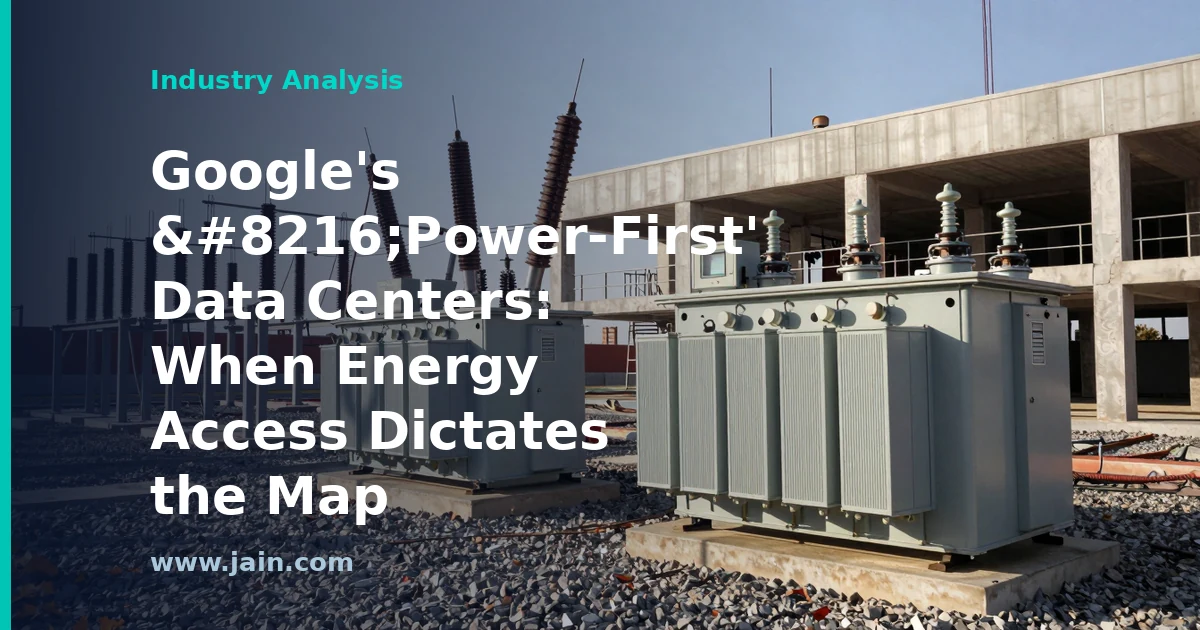
Data Center Knowledge reported on June 5, 2026, that Google is pursuing what it frames as a ‘power-first’ data center model — an approach in which access to electricity, rather than proximity to fiber routes, land, or customers, becomes the primary factor deciding where and how new facilities get built. The framing positions the model as a potential template for an industry now defined by energy scarcity.
Executive Summary
The report’s headline poses power-first siting as ‘a new model for energy scarcity’ — and that question mark matters. What is being described is less a single project announcement than a strategic posture: when grid interconnection queues stretch for years and utilities cannot promise large blocks of firm capacity, the rational response for a hyperscaler (a company operating cloud infrastructure at global scale, such as Google) is to start the site-selection process with the question ‘where can we actually get megawatts?’ and let everything else follow.
If that is genuinely how Google is now sequencing its development decisions, it inverts decades of data center orthodoxy. Historically, operators picked locations for network latency, tax incentives, land cost, and workforce, then asked the local utility to deliver power — which utilities, until recently, could almost always do. The reported shift is a public acknowledgment that electricity has become the scarce input around which everything else in digital infrastructure must now be designed.
From Location, Location, Location to Megawatts, Megawatts, Megawatts
Site selection used to treat power as a utility in the literal sense: always there when you flipped the switch. The AI buildout broke that assumption. Training clusters demand campus-scale power draws that rival heavy industry, and in many popular data center markets the local grid simply cannot add that load quickly. A power-first model responds by making energy availability the first filter — screening geographies by generation capacity, transmission headroom, and interconnection timelines before considering the traditional criteria at all.
For laypeople, the analogy is a factory town: the plant goes where the resource is, and the rest of the operation organizes itself around that fact. The strategic consequence is a likely redrawing of the data center map away from saturated hubs toward regions with surplus generation or the ability to build it — a shift with real winners (energy-rich regions, utilities with spare capacity, landowners near transmission) and real losers (constrained legacy markets that can no longer trade on their connectivity advantages alone).
What Power-First Implies for Design, Not Just Siting
The editorial angle here is worth taking seriously: if energy is the binding constraint, it shapes design as much as geography. A facility conceived power-first tends to be engineered around its energy reality — sized to the block of capacity actually secured, potentially paired with on-site or contracted generation, and optimized to extract maximum compute per watt because every watt was hard-won. Efficiency stops being a sustainability talking point and becomes the core economic lever.
That logic also favors operators with the balance sheet to participate in energy development itself — funding new generation, signing long-duration power purchase agreements (contracts to buy a plant’s output for years in advance), or co-developing sites with utilities. Hyperscalers can play that game. Smaller operators and enterprises largely cannot, which suggests power scarcity could further concentrate AI-scale infrastructure among a handful of companies with the ability to originate their own electricity supply.
A Question Mark Doing Honest Work
It is equally important to note what this coverage is and is not. The available material is a report framing a strategic concept, with a headline that explicitly asks whether this constitutes a new model rather than declaring it one. From the source available to us, there are no disclosed site lists, capacity figures, investment commitments, or timelines to evaluate. ‘Power-first’ is a compelling frame, and it is consistent with pressures the whole industry acknowledges — but as presented, it remains a thesis about Google’s approach rather than a verifiable program with published specifics. Readers should hold both things at once: the underlying constraint is real and well-documented across the sector, while the specific contours of Google’s response are, on this evidence, still thinly detailed.
Background
Google was among the earliest builders of hyperscale data centers and has long treated energy procurement as a strategic discipline, including years of large-scale renewable purchasing and a stated goal of running on carbon-free energy around the clock. That history makes it a bellwether: when Google changes how it sequences power and siting decisions, the rest of the industry pays attention.
The broader context is the AI infrastructure boom that accelerated from 2023 onward, which pushed data center power demand up sharply and collided with a grid whose generation and transmission additions move on multi-year regulatory timelines. By 2026, power availability — not land, capital, or chips alone — had become the most commonly cited bottleneck for new capacity across the sector, setting the stage for strategies like the one described here.
Gallup, the U.S. polling organization, published survey results on May 14, 2026 finding that a majority of Americans oppose having an AI data center built in their local area. The finding lands in the middle of the largest data center construction boom in history, as hyperscalers and developers race to site multi-gigawatt AI campuses across the country.
Executive Summary
The headline is simple and uncomfortable for the industry: when Gallup asked Americans about AI data centers coming to their community — not AI in the abstract — most said no. Local opposition to data centers has until now been documented mostly anecdotally, through contested rezoning hearings, county moratoriums, and organized neighborhood campaigns. A national probability survey from one of the most established names in public-opinion research converts those anecdotes into a measurable, majoritarian sentiment.
That matters because the AI build-out is, at bottom, a series of local land-use decisions. Every campus needs a rezoning vote, a utility interconnection, water and grading permits, and often tax-abatement approval from elected county boards. Each of those decision points is exposed to public opinion. A documented national majority against local siting raises the political cost of every approval and hands opponents a citable statistic. Operators that have treated community relations as a check-the-box exercise now face evidence that the default public position is opposition, not indifference.
From Abstract Ambivalence to Backyard Opposition
Public-opinion research has long shown a gap between how people evaluate infrastructure in general and how they evaluate it next door — the dynamic commonly shorthanded as NIMBY, or “not in my backyard.” Power plants, transmission lines, and warehouses all poll worse locally than nationally. What is notable here is that AI data centers appear to have entered that category quickly, within roughly three years of the generative-AI investment surge. The industry’s preferred framing — data centers as quiet, low-traffic, high-tax-base neighbors — has not, on this evidence, won the argument with the median American.
The commonly cited drivers of that sentiment are well documented in local fights even where this survey’s own breakdowns are not yet available: electricity demand and its feared effect on residential rates, water consumption for cooling, construction disruption, noise from chillers and generators, and skepticism that a highly automated facility delivers many permanent jobs relative to the land and power it consumes. Whether Gallup’s respondents ranked those concerns the same way is one of the key details the topline finding does not settle.
Why a Poll Number Becomes a Permitting Problem
National sentiment does not directly block any project — county boards and utility commissions do. But local officials read polls, and challengers in local elections read them more closely. Over the past two years, U.S. jurisdictions from Northern Virginia to Georgia to Arizona have seen data center moratoriums proposed, setback and noise ordinances tightened, and tax-incentive packages contested. A Gallup majority gives every one of those efforts a legitimizing citation: opponents can now argue they represent the mainstream position rather than a vocal minority.
The practical consequences show up as time and money. Longer hearing calendars, additional impact studies, community benefit negotiations, and litigation risk all extend schedules — and in the AI era, schedule is the scarce commodity. Hyperscalers are competing on time-to-power; a six-month permitting delay can be worth more than the entire cost of a generous community package. Expect the sophisticated operators to internalize that math quickly.
Winners: Pre-Permitted Land, Friendly Jurisdictions, and Retrofits
If greenfield siting gets politically harder, the value of everything that avoids a public fight goes up. Already-zoned industrial land, campuses with existing entitlements, and jurisdictions that actively court data centers with by-right zoning become scarcer and more valuable. The same logic favors retrofitting existing industrial sites — former factories, retired power plant sites with live grid interconnections — where the community has already lived with heavy industry. Secondary markets that want the tax base gain leverage to extract better community terms, and brokers of entitled land may capture as much value as the builders themselves.
Conversely, the losers are speculative developers banking land in residential-adjacent areas on the assumption that rezoning is a formality. This survey suggests it increasingly is not. Utilities also inherit part of the problem: if the public believes data centers raise residential rates, regulators will face pressure to wall off data-center costs into separate tariff classes, a shift already underway in several states.
The Industry’s Answer Has to Be Substantive, Not Rhetorical
The tempting response to adverse polling is a messaging campaign. The durable response is changing the underlying deal: paying demonstrably full freight for grid upgrades so residential ratepayers are insulated, committing to water-neutral or air-cooled designs in stressed basins, accepting enforceable noise limits, and structuring community benefit agreements with independent verification rather than press-release pledges. Public opinion formed by lived local controversies will only be reversed by different lived outcomes. Operators that get there first convert a sector-wide headwind into a competitive moat — because in a majority-opposed environment, being the developer communities trust is a siting advantage money cannot quickly buy.
Background
The generative-AI investment surge that began in late 2022 triggered an unprecedented wave of data center construction in the United States, with hyperscale cloud providers and specialist developers announcing multi-billion-dollar, multi-gigawatt campuses at a pace the utility and permitting systems were not built for. As projects moved from established hubs into new communities, local controversies over electricity rates, water, noise, and land use multiplied — but evidence of how the broader public felt remained largely anecdotal. Gallup, the venerable U.S. polling firm, regularly measures American attitudes toward technology and economic issues; its May 2026 finding of majority opposition to local AI data center siting is among the most prominent national measurements of that sentiment to date.
CalMatters published a report on May 4, 2026, headlined “The data center backlash is here — and Big Tech is spending big to shape it.” The story frames a growing wave of community opposition to hyperscale data center projects alongside what the outlet characterizes as significant expenditures by large technology companies to influence public perception, local politics, and permitting outcomes.
Because only the headline and outlet are available in the source feed reviewed here, the specific dollar figures, named companies, jurisdictions, and campaign tactics referenced by CalMatters are not reproduced in this article.
Executive Summary
The CalMatters headline crystallizes a trend that has been building for at least two years: as artificial intelligence workloads push hyperscalers to site ever-larger campuses, the communities being asked to host them are pushing back on power draw, water consumption, tax abatements, noise, and land conversion. The report’s framing — that Big Tech is “spending big to shape” the response — asserts a coordinated influence effort rather than a series of isolated PR moves.
Why it matters: data center siting has moved from a technical procurement exercise into contested civic politics. If the pattern CalMatters describes holds, project timelines, community-benefit agreements, and utility-rate designs will increasingly be decided in front of city councils and public-utility commissions rather than in back-of-house negotiations. That reshapes cost of capital, land option strategies, and the reputational exposure of every operator in the sector — not only the hyperscalers named in any given story.
What is not yet substantiated from the source reviewed: the scale of spending, its recipients, which companies are most active, and whether the activity meets the legal threshold of lobbying, political advertising, or grassroots organizing under applicable state law.
Why the Backlash Arrived Now
Two forces converged. First, AI training and inference clusters draw hundreds of megawatts per campus — an order of magnitude above the 20 to 50 megawatt facilities that dominated the last cycle — which has pulled data centers onto grids and into rate cases that previously ignored them. Second, the queue of new interconnection requests in regions like Northern Virginia, Central Ohio, Georgia, and parts of California has spilled into residential-adjacent parcels, which surfaces zoning, noise, and traffic issues that colocation providers historically avoided by clustering in industrial zones. When a project competes with households for the same substation capacity, the fight becomes visible on the household’s electric bill.
The CalMatters framing suggests operators have recognized this shift and are resourcing it accordingly. That is consistent with public lobbying disclosures across several states in prior reporting cycles, though the specific 2026 figures referenced by CalMatters are not in the material reviewed here.
What ‘Spending to Shape’ Can Mean — And What It Cannot
Influence spending is a broad category. It ranges from clearly disclosed activity — registered lobbyists, campaign contributions filed with state ethics agencies, membership dues to trade associations — to less transparent forms such as sponsored community events, funded economic-impact studies, and paid grassroots organizing. Each carries different legal, ethical, and reputational weight. A community-benefits fund is not the same instrument as an astroturf letter-writing campaign, and conflating them weakens both critique and defense.
Fair questions cut both ways. Of industry: which expenditures are disclosed, which studies are independently peer-reviewed, and are the jobs and tax figures cited in siting hearings audited after the fact? Of critics: are the coalitions organic residents’ groups, or do they receive funding from competing land uses, ratepayer advocates, or ideological funders — and is that funding disclosed? Neither question should be used to dismiss the other side; both should be answered on the record.
The Economics Underneath the Politics
A single gigawatt-scale AI campus can represent 5 to 10 billion dollars of capital, decades of property-tax revenue, and a few hundred permanent jobs — a lopsided ratio that has always made data centers a peculiar economic-development target. Local officials get large capex announcements and modest payroll; residents get transmission upgrades that may or may not be socialized across the rate base. The math is defensible when the load is firm, the tax abatements are time-limited, and the utility recovers infrastructure costs from the specific customer causing them. It becomes politically fragile when any of those conditions slip.
Operators who invest early in transparent cost-allocation frameworks, independently verified water and power reporting, and enforceable community-benefit agreements tend to face lower opposition later. Those who rely primarily on influence spending to smooth approvals may win individual projects but raise the ambient political risk premium for the whole sector.
Implications for the Broader Infrastructure Stack
The backlash is not confined to hyperscalers. Colocation providers, connectivity carriers building fiber to new campuses, and power developers proposing behind-the-meter gas or nuclear all inherit the reputational climate the largest builders create. If permitting friction rises, the winners are likely to be operators with existing entitled land, brownfield reuse expertise, and demonstrated ability to close power-purchase agreements without triggering rate-case fights. The losers are speculative greenfield developers dependent on speed-to-permit assumptions that no longer hold.
For enterprise buyers and investors, the practical read is that siting risk deserves the same diligence weight as latency, power price, and fiber diversity. Contracts should account for the possibility that a project announced today may face a very different approval environment when it enters construction two years from now.
Background
Data centers evolved from single-tenant enterprise rooms in the 1990s to multi-tenant colocation campuses in the 2000s and hyperscale cloud regions in the 2010s. The current AI cycle, beginning roughly in 2023, has pushed unit sizes an order of magnitude higher and concentrated demand in a handful of metro areas already facing grid constraints. Communities that welcomed earlier generations of facilities as quiet, tax-generating neighbors have found the new class harder to absorb.
CalMatters is a nonprofit newsroom covering California policy and politics; its coverage of data center siting has focused on the intersection of AI infrastructure demand, state climate goals, and local land-use authority. The May 4, 2026 article extends that beat into the influence-spending dimension of the debate.
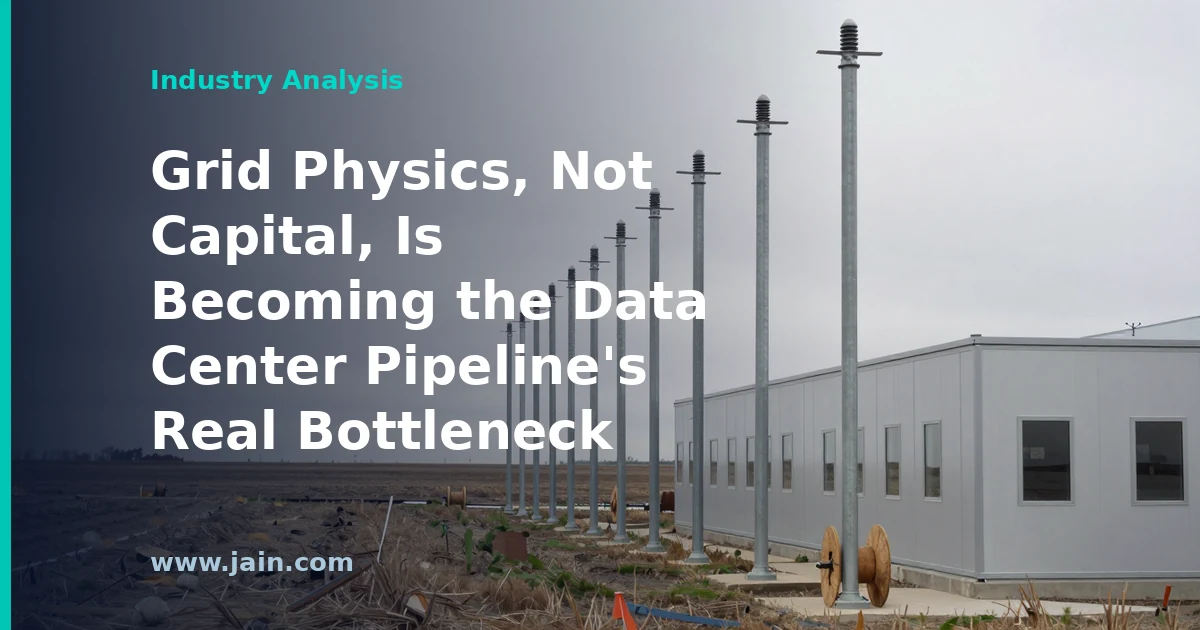
Latitude Media reports that the physical realities of the electric grid are “setting in” for the data center development pipeline. The April 26, 2026 piece frames a shift the industry has been circling for two years: the constraint on new AI-driven data center capacity is increasingly not capital, land, or chips, but whether the grid can physically deliver the power — and how long interconnection and transmission upgrades take.
Executive Summary
The report’s core observation is that the announced data center pipeline — the sum of projects developers have declared — is colliding with what the transmission system can actually serve. Interconnection (the formal process of connecting a large new load or generator to the grid) and transmission capacity (the physical ability of high-voltage lines to move power to a given location) operate on utility timescales measured in years, while hyperscale demand has been announced on timescales measured in quarters.
Why it matters: if grid physics is the binding constraint, then the familiar metrics of the buildout — megawatts announced, acres acquired, capital committed — stop predicting what actually gets energized and when. Siting strategy shifts from “where is land and fiber” to “where is deliverable power,” and the advantage moves to players who secured interconnection positions early or who can bring their own generation.
Announced Megawatts Are Not Energized Megawatts
A recurring pattern in this cycle is the gap between the announced pipeline and deliverable capacity. A developer can buy land, order equipment, and issue a press release in months; a utility must study the new load’s effect on the surrounding network, plan any needed substation and transmission upgrades, and build them — a sequence that routinely runs on multi-year timelines. The Latitude Media framing, that physical realities are “setting in,” suggests the market is starting to discount announcements accordingly. For readers of industry news, the practical takeaway is to treat energization dates, not announcement dates, as the real milestone.
Why Transmission Is the Hard Constraint
Transmission is unforgiving because it is physics plus process. Physically, a high-voltage line can carry only so much power before thermal and stability limits bind, and a concentrated gigawatt-scale load changes flows across an entire region, not just one feeder. Procedurally, upgrades require engineering studies, regulatory approvals, cost-allocation fights over who pays, and often new rights-of-way. None of these steps compresses easily with money. That is what distinguishes this bottleneck from earlier ones like GPU supply or land: you cannot pay a premium to make load-flow studies and line construction happen in a quarter.
Winners: Whoever Holds Deliverable Power
If interconnection position is the scarce asset, several groups benefit. Incumbent data center operators with existing utility relationships and already-energized capacity hold something new entrants cannot quickly replicate. Sites with surplus deliverable power — including brownfield industrial locations with legacy grid infrastructure — gain value relative to greenfield land. And “bring your own power” strategies, from on-site generation to co-location with existing plants, move from novelty to mainstream consideration, though they introduce their own permitting, fuel, and regulatory questions. Conversely, late-arriving developers whose projects sit deep in interconnection queues face the risk that their capacity arrives after the demand it was meant to serve has been placed elsewhere.
The Siting Map Is Being Redrawn
For two decades, data center geography followed fiber routes, tax incentives, and cheap land. A grid-constrained era redraws that map around electrical headroom: regions with spare transmission capacity, faster-moving utilities, or generation-rich locations become competitive even without a legacy data center cluster. This also raises a policy dimension — utilities and regulators must decide how much speculative load to plan for, and how to protect other ratepayers from paying for infrastructure serving projects that may not materialize. How that risk gets allocated will shape which regions court this demand and which slow-walk it.
Background
Data center development historically treated electricity as a routine input: sites were chosen for fiber connectivity, land cost, and tax treatment, and utilities absorbed the load growth without drama. The AI buildout that accelerated from 2023 onward broke that assumption, with individual campuses proposed at power levels comparable to heavy industry and developers announcing capacity far faster than grid infrastructure has historically been built.
By 2026 the conversation across the industry had shifted from chip supply and capital availability to power delivery — interconnection queues, transformer and equipment lead times, and transmission planning. The Latitude Media piece discussed here sits in that context: an energy-sector publication documenting the moment when the announced pipeline meets the grid’s physical and procedural limits.
Maine Governor Janet Mills has vetoed legislation described as a landmark data center ban, according to an April 25, 2026 report from the Maine Morning Star. The bill would have made Maine the first U.S. state to impose a statewide moratorium on new data center development — a sharp escalation of a siting fight that has, until now, played out mostly at the town and county level.
The veto keeps Maine formally open to data center projects and hands the industry a notable, if narrow, victory in the first statewide test of the moratorium movement.
Executive Summary
The significance of this veto extends well beyond Maine, a state that has never been a major data center market. Legislatures across the country have been debating how to respond to the wave of AI-driven data center construction — its electricity demand, its water use, its tax treatment, and its effect on ratepayers. Maine’s bill was the movement’s most aggressive expression: not stricter permitting or ratepayer protections, but a statewide halt. Mills’ veto establishes the first precedent for how a governor responds when that idea actually reaches a desk.
For the industry, the takeaway is double-edged. A moratorium passed a state legislature — proof the backlash has matured from zoning-board resistance into statewide lawmaking. But it also failed at the executive branch, suggesting that even in states with little economic stake in the sector, governors are reluctant to slam the door entirely. How durable that reluctance proves — and whether Maine’s legislature attempts an override — will shape the template other states copy.
From Zoning Boards to Statehouses
Data center opposition is not new, but its venue is changing. For years, siting fights were hyper-local: individual towns and counties passing zoning restrictions or temporary building pauses while they studied noise, land use, and utility impacts. A statewide moratorium — a legislated pause on an entire category of development across a state’s whole territory — is a categorically different instrument, and Maine’s bill appears to be the first of its kind to clear a legislature.
That escalation matters because state-level action changes the risk calculus for developers. A hostile town can be routed around; a hostile state cannot. Site selectors already screen states on power availability, tax incentives, and permitting speed. If moratorium bills become a live possibility, legislative risk joins that screening list — and states seen as wobbly may be quietly dropped from shortlists long before any bill passes.
Why a Governor Blinked at a Ban
The reported veto is consistent with a pattern visible across state politics: even leaders sympathetic to concerns about energy demand and ratepayer costs tend to resist outright prohibitions on investment. A moratorium forecloses future tax base, construction employment, and the option value of attracting projects on the state’s own terms. For a governor, signing the nation’s first statewide ban also carries signaling risk — branding the state as closed to a technology sector into which capital is flowing at historic rates.
The source report does not include Mills’ stated rationale, so the specific reasoning here is unconfirmed. But the structural logic is worth noting: vetoing a moratorium is not the same as endorsing unregulated growth. Governors in several states have paired resistance to bans with support for targeted measures — cost-allocation rules that shield residential ratepayers, or minimum efficiency standards. Whether Maine pursues that middle path is one of the most important open questions the veto leaves behind.
Maine as an Unlikely Bellwether
Maine is a curious venue for the first statewide test. It is a small New England market with high electricity prices, a constrained regional grid, and no significant hyperscale footprint — precisely the profile of a state with little to lose from a moratorium and, arguably, little to attract without one. That is what makes the veto instructive: if a ban could not survive the executive branch in a state with minimal industry presence, its odds look longer in states where data centers already anchor local tax bases.
The counter-reading deserves equal weight. The bill’s passage shows that in states where the industry has no built-in constituency — no employees, no host-community payments, no utility revenue on the table — a moratorium can command a legislative majority. As AI-driven load growth pushes developers into new geographies beyond Virginia, Texas, and Arizona, they will increasingly encounter exactly these constituency-free states. Maine may be less an outlier than an early sample of the terrain ahead.
The Template for the Fights to Come
Both sides of the siting debate will study this sequence. For moratorium advocates, the lesson is that legislative passage is achievable but insufficient; veto-proof margins or governors’ races become the real battleground. For the industry, the lesson is that goodwill cannot be assumed — the case for data centers now has to be made state by state, with concrete commitments on grid costs, water, and local benefit, rather than relying on the sector’s momentum.
The practical winners in the near term are developers with optionality: those able to shift projects toward states offering regulatory certainty. The losers are harder to name from this report alone — it is not clear any specific Maine project was pending. The broader risk is a patchwork: a national map where the rules for building digital infrastructure diverge sharply by state, complicating the long-term planning that grid operators and hyperscalers both depend on.
Background
Data center siting has become one of the most contested land-use questions in the U.S. as AI workloads drive a historic construction boom, with projects measured in hundreds of megawatts of electricity demand. Opposition that began at zoning boards — over noise, water, and land — has increasingly moved into state legislatures, which have debated tax-incentive rollbacks, ratepayer protections, and disclosure requirements.
Maine had largely sat outside this boom: a small, energy-constrained New England state without a meaningful data center footprint. Its legislature nonetheless produced what was reported as the nation’s first statewide moratorium bill, and Governor Janet Mills — the state’s Democratic governor since 2019 — vetoed it in April 2026, creating the first executive-branch precedent in the statewide moratorium debate.
Source: Gov. Mills vetoes landmark data center ban — Maine Morning Star report, April 25, 2026, on the veto of what was described as the first statewide data center moratorium bill in the U.S.