Tag: data center siting

  • TeraWulf Data Center Plan Draws Cayuga Lake Protests

    TeraWulf Data Center Plan Draws Cayuga Lake Protests

    Residents in Central New York have publicly protested a data center proposed by TeraWulf (Nasdaq: WULF) near Cayuga Lake, according to a report from Syracuse broadcaster WSYR distributed via Google News. The opposition surfaced while the project is still described as proposed — before construction and before any customer or contracted load has been disclosed publicly.

    The source available to us is headline-level. It does not state the acreage or capacity of the proposed site, the number of people who attended, the specific approvals at issue, or a construction timeline. Those details are not established by the material at hand and are treated here as open questions rather than facts.

    Executive Summary

    The news itself is small: a local protest against a proposed facility, reported by a regional television station. Its significance is structural. Community objection to data centers used to cluster around visible impacts once a building existed — truck traffic, generator testing, a substation on the horizon. Increasingly it arrives earlier, at zoning hearings, environmental review and site-plan review, when a project is still a set of drawings and a land option.

    That shift changes the risk profile of digital infrastructure. Permitting risk is the hardest kind to hedge: it is local, discretionary, and largely immune to balance-sheet strength. A developer can have financing, transformers on order and a creditworthy tenant in hand and still lose eighteen months to a rezoning fight. For a company such as TeraWulf, which has been repositioning from bitcoin mining toward hosting high-performance and AI computing, the speed at which new sites clear local review is a direct input into how quickly capacity — and revenue — comes online.

    A necessary caveat: this article analyses a pattern the report illustrates. It does not adjudicate this specific project. We do not know what residents alleged, what TeraWulf has proposed, or whether the concerns raised are supported by the project record, because the source does not say.

    Opposition Has Moved Upstream, to the Permitting Stage

    Permitting is the phase in which a local government decides whether a proposed use is allowed on a given parcel and on what conditions — zoning approvals, site-plan review, environmental assessment, and in New York the State Environmental Quality Review Act process that can require a developer to study and mitigate impacts before an approval is granted. It is the point of maximum leverage for residents, because a discretionary approval can be delayed, conditioned or refused, while an operating facility can generally only be regulated at the margins.

    What makes the Cayuga Lake report notable is the timing implied by the word proposed. There is no contracted megawatt to defend, no anchor tenant publicly attached, and no built asset whose local benefits — construction employment, property and sales tax receipts, host-community payments — can be weighed against complaints. Both sides are arguing about a hypothetical, which tends to make the argument about category rather than specifics: not is this data center acceptable but should there be a data center here at all.

    For the industry, that is the expensive version of the debate. Project-specific concerns can usually be engineered away with closed-loop cooling, sound attenuation, setbacks and landscaping. Categorical objections cannot be negotiated on the same terms, and they resolve on political timelines rather than procurement ones.

    What the Report Substantiates — and What It Does Not

    The material substantiates three things: that a data center is proposed by TeraWulf in the Cayuga Lake area, that some residents opposed it publicly, and that a regional news outlet judged the event newsworthy. That is a legitimate news event and worth covering. It is not, on its own, evidence about the project’s merits in either direction.

    Several claims that would ordinarily attach to a story like this are absent here and should not be assumed. We do not know the proposed electrical load, the cooling design or its water requirements, the interconnection arrangement with the grid, the noise modelling, or the tax and host-community terms on offer. We also do not know how many residents attended, whether they represent a majority local view, or what the municipality’s own planners have concluded. Filling those blanks from imagination would be the failure mode of both boosterish trade coverage and reflexively hostile coverage.

    Applying the same standard to each side: residents’ concerns deserve to be tested against the project record once it exists rather than dismissed as reflexive, and the developer’s eventual assurances about water, noise and grid impact deserve to be tested against modelling and enforceable permit conditions rather than accepted as stated. Nothing in the available source supports a claim that the opposition is anything other than local residents acting on their own behalf, and nothing supports a claim that the project is anything other than what its sponsor says it is. Both are open questions with no evidence yet on the record.

    The Economics of Local Consent

    Data centers are unusual neighbours. They occupy substantial land and draw substantial power, but employ relatively few people once operational compared with the manufacturing plants that historically justified similar infrastructure. The value they generate is real — property tax base, grid investment, construction spending, and the compute capacity that increasingly underpins the broader economy — but much of it is either diffuse or invisible to the people who live nearest the fence line.

    That asymmetry is the core siting problem, and it is why host-community benefit terms have become as important to project delivery as transformer lead times. Where a project offers legible, durable local value — fixed annual payments, funded road or water upgrades, guaranteed noise limits written into the permit, transparent water accounting — approvals tend to move faster. Where the pitch rests on abstract economic development, opposition tends to harden. The Finger Lakes region adds a further dimension: an economy built substantially on tourism, viticulture and the lake itself gives residents a concrete, monetisable interest in the visual, acoustic and water-quality character of the area, which raises the evidentiary bar a developer must clear.

    The winners in this environment are operators who accept siting as an engineering and civic problem rather than a communications problem: sites with pre-existing industrial zoning, closed-loop or air-cooled designs that remove water from the argument, and early, specific disclosure. The losers are those who arrive with a land option and a press release and discover that consent cannot be procured on a schedule.

    Why Investors Should Read Siting News as Schedule News

    For anyone holding or evaluating WULF, the useful frame is not sentiment but calendar. Bitcoin miners repositioning toward AI and high-performance computing hosting are, in effect, selling delivery dates: the ability to energise a given quantity of capacity by a given quarter for a customer who has alternatives. Land, power and permits are the three constraints, and permits are the only one that cannot be accelerated with capital.

    A single protest does not imply a project will fail; most contested proposals are ultimately approved, often with conditions, and local opposition frequently narrows once specifics replace speculation. But contested proposals are slower, and slower has a price when hyperscale and AI tenants are contracting against fixed windows. The relevant question for investors is not whether residents object to any one site but whether a developer’s pipeline is diversified across jurisdictions, weighted toward parcels with existing industrial use, and disclosed with enough specificity to survive a public hearing.

    The same logic applies to enterprise and AI buyers evaluating where to place workloads. A site that has not cleared local review is not capacity; it is an option on capacity. Contract terms should reflect that distinction, with delivery milestones and remedies tied to permitting outcomes rather than to a developer’s stated intentions.

    Background

    TeraWulf emerged from the wave of North American bitcoin mining companies that built large, power-intensive facilities in regions with available electricity, developing its flagship operations in upstate New York. Like several of its peers, it has been shifting emphasis from cryptocurrency mining toward hosting high-performance computing and artificial intelligence workloads — a pivot driven by the fact that both businesses need the same scarce inputs: land, grid interconnection and hundreds of megawatts of power.

    That pivot has intensified competition for sites across the United States, and with it public attention. Where mining facilities were once sited quietly on industrial land, AI-era proposals now attract scrutiny at the application stage, with residents, municipalities and utility regulators all weighing in before construction begins. The Cayuga Lake protest is one data point in that broader shift, and specifics of TeraWulf’s operations and pipeline should be verified against the company’s own disclosures.

    Source: CNY residents protest proposed TeraWulf data center near Cayuga Lake — WSYR’s report that Central New York residents publicly opposed a proposed TeraWulf data center near Cayuga Lake; details of scale, permits and timeline were not included in the available summary.
  • Study: Data Centers Raise Nearby Phoenix Temperatures by Up to 4 Degrees

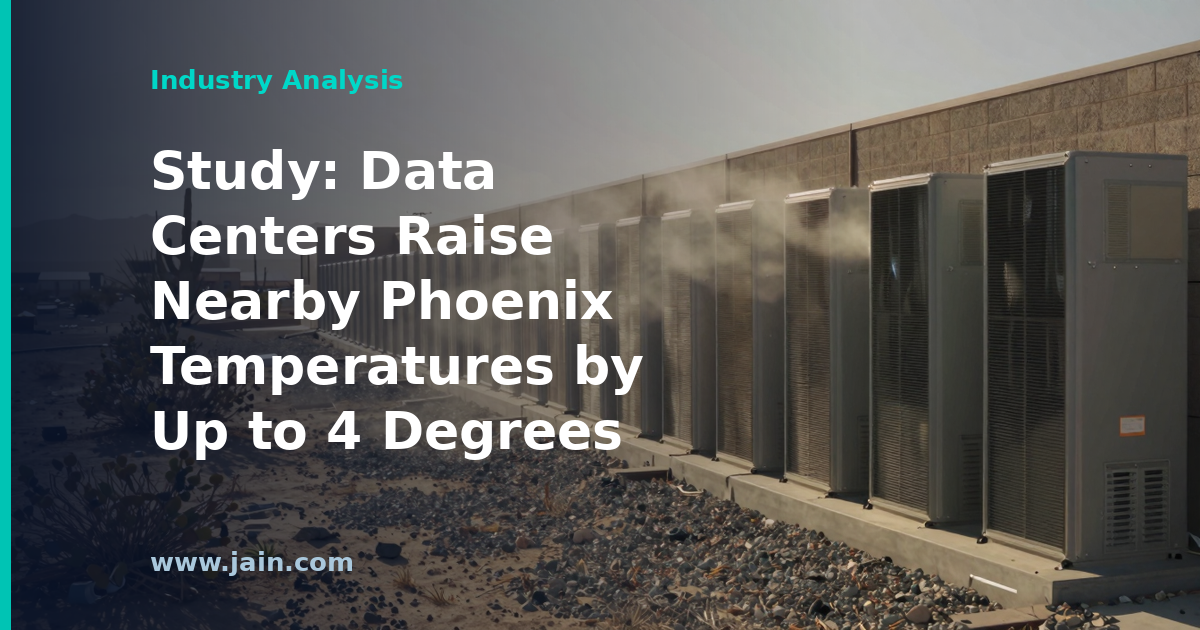
    Study: Data Centers Raise Nearby Phoenix Temperatures by Up to 4 Degrees

    A peer-reviewed study published in ASME’s Journal of Engineering for Sustainable Buildings and Cities (Vol. 7, Issue 2) reports that data centers raise temperatures in their surrounding areas by up to 4 degrees in Phoenix, Arizona — one of the largest and fastest-growing data center markets in the United States.

    The research, which frames data center waste heat as an emerging urban heat source, drew broad attention on August 19, 2026, when it reached the Hacker News front page with 267 points and more than 375 comments — a signal that the industry itself is taking the question seriously.

    Executive Summary

    The finding is simple to state and hard to dismiss: the electricity a data center consumes does not disappear. Nearly all of it becomes heat, and cooling systems must eject that heat into the surrounding air. In a dense cluster of facilities, that ejected heat measurably warms the neighborhood — by as much as 4 degrees, according to this study of Phoenix.

    Why it matters: Phoenix is both a top-tier data center hub and the hottest major city in America, where summer heat is already a public-health and grid-reliability issue. A peer-reviewed number linking data centers to local warming gives residents, city councils, and regulators something they have not had before — citable evidence. Expect it to surface in zoning hearings, permitting conditions, and community-benefit negotiations well beyond Arizona.

    For operators and their customers, the study reframes waste heat from an engineering afterthought into a siting externality alongside power draw, water use, and noise — one that will increasingly shape where and how new capacity gets built.

    Heat Is the New Noise: An Externality Goes on the Record

    Data center opposition has historically centered on three complaints: power consumption, water use, and the low-frequency hum of cooling plants. Localized warming now joins that list with something the others took years to acquire — a peer-reviewed citation. Once a measurable external cost is published in an engineering journal, it tends to migrate into environmental-impact reviews, zoning board testimony, and eventually permit conditions. That is how noise limits and water-reporting requirements became standard, and waste heat is positioned to follow the same path.

    The practical consequence is that thermal impact modeling may become part of the pre-construction diligence package. Developers who can show — with sensors and models, not assurances — that a facility’s heat plume will not worsen conditions for adjacent neighborhoods will move through approvals faster than those who cannot. In a market where time-to-power already decides deals, an avoidable six-month permitting fight over heat is real money.

    Why Phoenix Is the Stress Test for the Whole Industry

    Phoenix became a data center magnet for rational reasons: comparatively cheap land, available power, low natural-disaster risk, and proximity to California customers without California costs. But the same desert climate that makes the land cheap makes cooling expensive and makes every added degree socially costly. Extreme heat is already the region’s deadliest weather phenomenon, so a study saying nearby temperatures rise by up to 4 degrees lands very differently in Phoenix than it would in a temperate metro.

    There is also an economic feedback loop worth naming: hotter ambient air makes chillers and evaporative systems work harder, which consumes more electricity and water, which ejects more heat. If clustered facilities are warming their own microclimate, they are marginally degrading their own cooling efficiency — and everyone else’s. That is a classic commons problem, and commons problems invite regulation when the industry does not self-organize first.

    From Liability to Asset: The Waste-Heat Reuse Question

    In Nordic countries, data center waste heat is piped into district heating networks that warm homes — the externality becomes a product. The awkward truth is that this playbook works worst exactly where the U.S. is building fastest: Phoenix has essentially no heating demand for most of the year, and the low-grade heat that air-cooled facilities reject is difficult to transport or upgrade economically. Reuse candidates exist — industrial preheating, water treatment, agriculture — but none absorb hyperscale volumes in a desert.

    That points the mitigation conversation toward engineering rather than reuse: liquid cooling that captures heat at higher, more usable temperatures; facility siting and airflow design that lofts exhaust away from neighborhoods; and honest accounting of the water-versus-heat trade-off, since evaporative cooling ejects less sensible heat into the air but consumes scarce water to do it. Operators who get ahead of this with published thermal data will own the narrative; those who wait will have it written for them.

    Background

    Metro Phoenix has spent a decade becoming one of America’s leading data center markets, attracting hyperscale and colocation development with affordable land, available power, low disaster risk, and proximity to West Coast demand. The AI buildout has accelerated that growth just as the region confronts record-breaking heat and long-term water constraints.

    Urban heat island science, meanwhile, has decades of history attributing city warming to pavement, buildings, and vehicles. What is new is peer-reviewed work isolating data centers — among the most energy-dense buildings ever constructed — as a distinct and growing contributor, arriving at the exact moment communities nationwide are weighing the local costs and benefits of hosting them.

    Source: “Data Center Waste Heat as an Emerging Urban…”, ASME Journal of Engineering for Sustainable Buildings and Cities (Vol. 7, Issue 2) — a peer-reviewed study reporting that data centers raise nearby temperatures by up to 4 degrees in Phoenix, surfaced via the Hacker News front page.

  • Texas Bets on 765 kV Lines to Power the Next Wave of AI Data Centers

    Texas Bets on 765 kV Lines to Power the Next Wave of AI Data Centers

    Texas has committed to building out its grid with 765 kilovolt (kV) transmission lines — the highest-capacity class of overhead power line used in North America — in a strategy Data Center Knowledge summarized on July 5, 2026 as “build the wires, the AI will follow.” Rather than waiting for AI data center projects to sign up first, the state’s approach is to construct extra-high-voltage backbone capacity in anticipation of that demand arriving on the ERCOT grid.

    Executive Summary

    The decision reported here is less about a single project than about a planning philosophy. Historically, most U.S. transmission has been built reactively: a large customer or generator commits, studies are run, and wires follow years later. Texas is inverting that sequence at the 765 kV level — the class of line capable of moving several times the power of the 345 kV circuits that have long formed the backbone of ERCOT, the grid operator serving most of Texas.

    Why it matters: access to power has become the single biggest constraint on AI data center siting. A state that can credibly promise deliverable gigawatts on a known timeline gains a decisive edge in attracting capital-intensive AI campuses. But anticipatory building also shifts risk — if the forecast load arrives late, smaller than expected, or somewhere else, the cost of underused infrastructure lands on someone, and that someone is usually the ratepayer.

    Why 765 kV Is a Statement, Not Just a Specification

    Voltage class is the freeway-versus-farm-road question of the power grid. A 765 kV line can carry far more power than a 345 kV line over the same corridor, with proportionally lower electrical losses, which means fewer parallel lines, fewer towers, and less land consumed per delivered gigawatt. For a grid staring at data center campuses that each want hundreds of megawatts — sometimes a gigawatt or more — 765 kV is the only overhead technology that comfortably matches the scale of the ask.

    Choosing it is also a signal. 765 kV projects take longer to permit and build, require specialized transformers with notoriously long lead times, and cost more up front than incremental 345 kV additions. A jurisdiction that standardizes on 765 kV is telling the market it expects load growth measured in tens of gigawatts, not incremental upticks — and that it intends to be structurally ready rather than perpetually catching up.

    The Economics of Building Ahead of Demand

    The core bet is that transmission, not land or fiber, is now the scarce input for AI infrastructure. Interconnection timelines — the queue a new large customer or generator waits in before it can plug into the grid — have stretched to years across much of the country. Every month of waiting is a month of idle capital for an AI developer whose chips depreciate quickly. If Texas can compress that wait by having backbone capacity already energized, it converts grid readiness directly into economic development.

    The counterargument is forecast risk. AI load projections are among the most volatile numbers in the utility industry right now: they depend on chip supply, model efficiency gains, corporate capital cycles, and siting decisions that can pivot on a single tax incentive. Building wires for demand that hasn’t signed contracts means the state is, in effect, underwriting a demand forecast. If the forecast is right, the infrastructure looks prescient. If it’s wrong, Texas will have built expensive capacity whose carrying costs must still be recovered.

    Winners, Losers, and Who Carries the Risk

    The clearest winners are large-load customers — AI and cloud data center developers — who gain siting certainty, and the transmission utilities and equipment suppliers who get a multi-year construction pipeline. Landowners along new corridors face the familiar friction of routing and easement disputes, which 765 kV’s larger towers can intensify even as its higher capacity reduces the total number of corridors needed.

    The pivotal question is cost allocation. In ERCOT, transmission costs have traditionally been spread across consumers, which works when new load broadly benefits everyone but becomes contentious when the driver is a handful of very large private customers. Whether Texas requires AI-scale loads to shoulder a larger, more direct share of the wires built substantially for them — through contribution requirements, minimum-take commitments, or special rate classes — will determine whether this build-out is remembered as smart industrial strategy or as a subsidy from households to hyperscalers. The source piece frames the bet; it does not settle who holds the downside.

    What It Means Beyond Texas

    Other states and grid operators are watching, because Texas is running the experiment they have avoided: proactive, speculative, extra-high-voltage expansion in a market famous for moving faster and regulating lighter than its peers. If the wires fill up with AI load on schedule, expect copycat programs and renewed pressure on slower-moving regional planning processes elsewhere. If they don’t, the episode will become the cautionary tale cited in every future transmission docket.

    For the data center industry itself, the message is immediate: power-first siting is now official policy in at least one major market. Developers comparing regions will increasingly weigh not just today’s available megawatts but a grid’s demonstrated willingness to build ahead of them — and Texas has just bid aggressively on that dimension.

    Background

    Texas operates most of its grid through ERCOT, a system largely separate from the rest of the U.S., which allows the state to plan and permit infrastructure faster than regions governed by multi-state processes. That autonomy, combined with abundant land and energy resources, has already made Texas one of the country’s fastest-growing data center markets. The backbone of the ERCOT grid has long been built at 345 kV; standardizing new backbone corridors at 765 kV represents a step-change in the scale of power the state is preparing to move.

    The backdrop is the AI infrastructure boom: since the early 2020s, demand from AI training and cloud computing has transformed electricity access from a routine utility matter into the decisive factor in where billions of dollars of data center capital lands. Grid operators nationwide have struggled with long interconnection queues — the waiting line for new large loads and generators — and Texas’s 765 kV program is a direct attempt to turn that bottleneck into a competitive advantage.

    Source: Texas’ 765 kV Decision: Build the Wires, the AI Will Follow — Data Center Knowledge’s July 5, 2026 report on Texas’s anticipatory extra-high-voltage transmission strategy for AI data center growth.

  • AI Data Center Moratorium Act: Ocasio-Cortez Targets the AI Build Boom

    AI Data Center Moratorium Act: Ocasio-Cortez Targets the AI Build Boom

    Rep. Alexandria Ocasio-Cortez (D-NY) has introduced the AI Data Center Moratorium Act, legislation that — as its name states — would impose a moratorium, or temporary freeze, on new AI data center construction in the United States. The bill was reported by Broadband Breakfast on June 27, 2026.

    It represents the most direct federal legislative challenge yet to the AI infrastructure boom, moving opposition from county zoning boards and state utility commissions to the floor of Congress.

    Executive Summary

    Until now, resistance to AI data center construction has been overwhelmingly local: rezoning denials, water-use disputes, and rate cases before state utility commissions. The AI Data Center Moratorium Act changes the venue. By proposing a federal pause on new builds, the bill converts a patchwork of site-by-site fights into a single national policy question about whether the AI buildout should continue at its current pace.

    The bill’s practical odds are a separate matter from its significance. Legislation introduced by a House member in the minority of a policy debate this contested rarely becomes law quickly, and nothing in the initial report indicates committee support or a Senate companion. But introduced bills do three things regardless of passage: they give opposition a national organizing document, they force industry to argue its case in federal terms, and they establish a marker that future Congresses can pick up if public sentiment shifts.

    For data center developers, hyperscalers, and the utilities planning decades of capacity around AI demand, the substance of the moratorium matters less right now than the signal: the political cost of the buildout is rising, and it has reached Washington.

    From Zoning Boards to Capitol Hill

    The AI infrastructure boom has drawn scrutiny wherever it lands — over electricity demand, water consumption for cooling, land use, and the question of who pays for the grid upgrades large facilities require. What has been missing is a federal focal point. Local opposition wins or loses one site at a time; a federal moratorium bill, even one unlikely to pass, nationalizes the argument.

    That shift matters because the industry’s siting strategy has partly relied on jurisdictional flexibility: if one county says no, a neighboring one courting tax revenue may say yes. A federal freeze would remove that option entirely, which is precisely why the industry will take the bill seriously as a signal even while discounting it as law. It also invites a counter-response — federal legislators favorable to the buildout may now push preemption or permitting-acceleration measures, making Congress a two-way battleground rather than a bystander.

    The Economics a Moratorium Would Collide With

    AI data centers sit at the center of enormous committed capital. Hyperscale cloud providers and AI developers have publicly planned multi-year construction programs, and utilities in several regions have built their load forecasts — and their generation and transmission investment plans — around expected data center demand. A construction freeze, if enacted, would ripple through all of it: land already optioned, power purchase agreements already signed, chip and electrical-equipment orders already placed.

    Supporters of a pause would frame that as the point — that commitments are being locked in faster than communities and grids can evaluate them, and that a freeze creates space to assess electricity price impacts and resource use before the buildout becomes irreversible. Opponents would argue a moratorium simply exports construction, jobs, and AI capability to other countries without pausing global demand. Both arguments deserve scrutiny against evidence: what a moratorium would actually change depends on details — scope, duration, exemptions — that the initial report does not provide.

    What Each Side Still Has to Prove

    The bill’s proponents carry a burden of evidence: demonstrating that data center growth is materially raising household electricity rates or straining water supplies in ways existing state and local review cannot manage, and that a blanket federal freeze is a proportionate remedy rather than a blunt one. Grid-cost allocation is genuinely contested territory — some utilities and regulators have moved to special tariffs that make large loads pay their own way, which weakens the case that a moratorium is the only protective tool available.

    The industry carries a symmetrical burden. Claims that data centers are net community benefits rest on tax revenue and construction employment, but permanent job counts at data centers are modest relative to their footprint, and confidential agreements around power pricing and incentives make independent verification difficult. If developers want to defeat moratorium politics, the most effective rebuttal is transparency: publishable data on rate impacts, water use, and cost allocation. Neither side’s talking points should be accepted by label alone.

    Background

    The AI boom that followed the emergence of large language models set off the fastest data center construction wave in the industry’s history, with hyperscale cloud providers and AI developers committing capital on a multi-year horizon and utilities re-planning generation and transmission around expected demand. As facilities grew from tens to hundreds of megawatts — a single large campus can draw as much power as a mid-sized city — friction with host communities grew with them, producing zoning fights, water disputes, and rate cases across the country.

    Rep. Ocasio-Cortez has long been associated with legislation linking energy, climate, and economic policy, most prominently the Green New Deal framework. The AI Data Center Moratorium Act extends that posture to AI infrastructure, and marks the first time the buildout’s opponents have consolidated their case into a proposed nationwide freeze rather than site-by-site resistance.

    Source: Ocasio-Cortez Introduces AI Data Center Moratorium Act — Broadband Breakfast, reporting the introduction of federal legislation to pause new AI data center construction, June 27, 2026.

  • Why Data Centers Still Cling to Evaporative Cooling Despite Water Backlash

    Why Data Centers Still Cling to Evaporative Cooling Despite Water Backlash

    Data Center Knowledge published a report on June 18, 2026 examining why the data center industry continues to rely on evaporative cooling — a heat-rejection method that consumes large volumes of water — even as public and regulatory backlash over water use intensifies. The piece frames the industry’s position as hesitation rather than refusal: operators broadly acknowledge the water problem but have been slow to abandon a technology that remains cheaper and more energy-efficient than the alternatives.

    Executive Summary

    The report’s core subject is a tension the industry has lived with for years and that the AI build-out has sharpened: evaporative cooling rejects heat by evaporating water, which makes it highly energy-efficient but water-hungry, while the main alternatives — dry (air-cooled) systems and refrigerant-based chillers — save water at the cost of higher electricity consumption, larger equipment footprints, or both. In markets where power is the scarcest commodity a data center can buy, trading water savings for a bigger electrical load is not a simple upgrade; it is a genuine engineering and economic trade-off.

    That trade-off is why the headline speaks of hesitation. Operators face mounting pressure from drought-affected communities, local governments, and sustainability commitments to cut water use, and technologies such as closed-loop liquid cooling and hybrid systems are maturing. But retrofitting existing facilities is expensive, and for new builds the calculus depends heavily on local climate, water price, and power availability — variables that differ from one metro to the next. The result is an industry moving unevenly rather than uniformly, which is precisely the dynamic worth understanding for anyone siting capacity or evaluating operators’ sustainability claims.

    The Water-for-Energy Trade at the Heart of Cooling

    Every data center must move heat from chips to the outside world, and the physics offers no free option. Evaporative systems — cooling towers and their variants — exploit the fact that evaporating water absorbs enormous amounts of heat, which lets a facility reject heat with comparatively little electricity. Dry coolers and air-cooled chillers avoid consuming water but must push heat into the air mechanically, which takes more fan and compressor power, especially on hot days when the temperature difference working in the operator’s favor shrinks. In plain terms: saving water usually means burning more electricity, and in an era when grid connections are the binding constraint on data center growth, extra megawatts spent on cooling are megawatts not available for revenue-generating compute.

    This is the economic logic the Data Center Knowledge piece points at with its framing of industry hesitation. An operator that switches a large campus from evaporative to dry cooling is not just paying for new equipment; it is accepting a permanently higher power draw — degrading power usage effectiveness, the industry’s standard efficiency metric — and potentially reducing the sellable IT capacity of a power-constrained site. Where water is cheap and power is scarce, the incumbent technology keeps winning on spreadsheets even as it loses in public opinion.

    Why the Backlash Is Getting Harder to Price at Zero

    For most of the industry’s history, water was effectively an afterthought in site selection — abundant, inexpensive, and invisible to the public. That has changed. Data center water consumption has become a recurring flashpoint in drought-prone regions, a subject of local permitting fights, and a standard line of questioning for journalists and community groups evaluating new projects. Operators now routinely publish water usage effectiveness figures and, in some cases, commit to becoming “water positive” — replenishing more water than they consume.

    The practical consequence is that water carries a growing shadow price beyond the utility bill: longer permitting timelines, conditions attached to approvals, reputational exposure, and in the worst case the loss of a site altogether. The report’s premise — that the industry hesitates rather than transitions — suggests that many operators still judge those risks manageable relative to the hard costs of switching. Whether that judgment holds depends largely on how regulators and communities act next, which varies enormously by jurisdiction.

    The Alternatives Are Real, but Not Drop-In

    The transition options are well understood in engineering terms. Dry cooling eliminates onsite water evaporation at the cost of energy and space. Hybrid systems run dry most of the year and evaporate water only during peak heat, cutting consumption substantially without the full energy penalty. Direct-to-chip liquid cooling and immersion cooling — increasingly common in AI deployments because high-density chips demand them — move heat in closed loops that consume little or no water onsite, though the heat still has to be rejected somewhere, and that final stage can itself be wet or dry. None of these is a simple swap for an operating facility: cooling infrastructure is capital-intensive, deeply integrated with a building’s design, and typically replaced on decade-plus cycles.

    That replacement cycle is the quiet variable in the whole debate. The realistic path for the industry is less about retrofitting the installed base and more about what gets designed into the enormous wave of new construction now underway. If new AI-era facilities standardize on low-water designs where climate and economics allow, the fleet’s water profile shifts over years, not quarters. If they default to evaporative cooling because power constraints dominate, the backlash the report describes is likely to intensify.

    Winners, Losers, and the Siting Chessboard

    The cooling transition redistributes advantage. Cooler, water-rich regions gain appeal because they make both wet and dry cooling cheaper; hot, arid markets that boomed on cheap land and power face the sharpest version of the water-versus-energy dilemma. Vendors of hybrid and liquid cooling systems benefit from every tightening of water rules. Utilities and municipalities gain leverage, since water service is becoming a negotiated element of large deals rather than a formality. And operators that invested early in low-water designs acquire a permitting and public-relations asset that is difficult for laggards to replicate quickly. Buyers of colocation and cloud capacity should read cooling architecture as a proxy for siting risk: a facility’s water dependence is now part of its long-term cost and continuity profile.

    Background

    Cooling is one of the two great resource demands of data centers, alongside electricity: every watt a server consumes becomes heat that must be removed. For decades, evaporative cooling towers have been a workhorse of large-scale heat rejection across many industries because evaporating water is thermodynamically cheap. Data centers adopted the approach widely as the industry scaled through the cloud era, and it helped drive the sector’s headline efficiency gains. The AI construction boom that accelerated through the mid-2020s raised the stakes on both sides of the equation — far denser computing produces far more heat, while the communities hosting these facilities have grown increasingly vocal about local water and power impacts. Trade publication Data Center Knowledge, which published the report discussed here, has tracked this cooling debate as one of the defining infrastructure questions of the AI build-out.

    Source: Evaporative Cooling in Data Centers: Why the Industry Hesitates to Move On — Data Center Knowledge report, June 18, 2026, on the economics slowing the industry’s shift away from water-intensive cooling.

  • Google’s ‘Power-First’ Data Centers: When Energy Access Dictates the Map

    Google’s ‘Power-First’ Data Centers: When Energy Access Dictates the Map

    Data Center Knowledge reported on June 5, 2026, that Google is pursuing what it frames as a ‘power-first’ data center model — an approach in which access to electricity, rather than proximity to fiber routes, land, or customers, becomes the primary factor deciding where and how new facilities get built. The framing positions the model as a potential template for an industry now defined by energy scarcity.

    Executive Summary

    The report’s headline poses power-first siting as ‘a new model for energy scarcity’ — and that question mark matters. What is being described is less a single project announcement than a strategic posture: when grid interconnection queues stretch for years and utilities cannot promise large blocks of firm capacity, the rational response for a hyperscaler (a company operating cloud infrastructure at global scale, such as Google) is to start the site-selection process with the question ‘where can we actually get megawatts?’ and let everything else follow.

    If that is genuinely how Google is now sequencing its development decisions, it inverts decades of data center orthodoxy. Historically, operators picked locations for network latency, tax incentives, land cost, and workforce, then asked the local utility to deliver power — which utilities, until recently, could almost always do. The reported shift is a public acknowledgment that electricity has become the scarce input around which everything else in digital infrastructure must now be designed.

    From Location, Location, Location to Megawatts, Megawatts, Megawatts

    Site selection used to treat power as a utility in the literal sense: always there when you flipped the switch. The AI buildout broke that assumption. Training clusters demand campus-scale power draws that rival heavy industry, and in many popular data center markets the local grid simply cannot add that load quickly. A power-first model responds by making energy availability the first filter — screening geographies by generation capacity, transmission headroom, and interconnection timelines before considering the traditional criteria at all.

    For laypeople, the analogy is a factory town: the plant goes where the resource is, and the rest of the operation organizes itself around that fact. The strategic consequence is a likely redrawing of the data center map away from saturated hubs toward regions with surplus generation or the ability to build it — a shift with real winners (energy-rich regions, utilities with spare capacity, landowners near transmission) and real losers (constrained legacy markets that can no longer trade on their connectivity advantages alone).

    What Power-First Implies for Design, Not Just Siting

    The editorial angle here is worth taking seriously: if energy is the binding constraint, it shapes design as much as geography. A facility conceived power-first tends to be engineered around its energy reality — sized to the block of capacity actually secured, potentially paired with on-site or contracted generation, and optimized to extract maximum compute per watt because every watt was hard-won. Efficiency stops being a sustainability talking point and becomes the core economic lever.

    That logic also favors operators with the balance sheet to participate in energy development itself — funding new generation, signing long-duration power purchase agreements (contracts to buy a plant’s output for years in advance), or co-developing sites with utilities. Hyperscalers can play that game. Smaller operators and enterprises largely cannot, which suggests power scarcity could further concentrate AI-scale infrastructure among a handful of companies with the ability to originate their own electricity supply.

    A Question Mark Doing Honest Work

    It is equally important to note what this coverage is and is not. The available material is a report framing a strategic concept, with a headline that explicitly asks whether this constitutes a new model rather than declaring it one. From the source available to us, there are no disclosed site lists, capacity figures, investment commitments, or timelines to evaluate. ‘Power-first’ is a compelling frame, and it is consistent with pressures the whole industry acknowledges — but as presented, it remains a thesis about Google’s approach rather than a verifiable program with published specifics. Readers should hold both things at once: the underlying constraint is real and well-documented across the sector, while the specific contours of Google’s response are, on this evidence, still thinly detailed.

    Background

    Google was among the earliest builders of hyperscale data centers and has long treated energy procurement as a strategic discipline, including years of large-scale renewable purchasing and a stated goal of running on carbon-free energy around the clock. That history makes it a bellwether: when Google changes how it sequences power and siting decisions, the rest of the industry pays attention.

    The broader context is the AI infrastructure boom that accelerated from 2023 onward, which pushed data center power demand up sharply and collided with a grid whose generation and transmission additions move on multi-year regulatory timelines. By 2026, power availability — not land, capital, or chips alone — had become the most commonly cited bottleneck for new capacity across the sector, setting the stage for strategies like the one described here.

    Source: Google’s ‘Power-First’ Data Centers: A New Model for Energy Scarcity? — Data Center Knowledge, a June 5, 2026 report examining whether Google’s energy-led approach to data center siting marks a new industry model.

  • Gallup: Majority of Americans Oppose an AI Data Center in Their Own Area

    Gallup: Majority of Americans Oppose an AI Data Center in Their Own Area

    Gallup, the U.S. polling organization, published survey results on May 14, 2026 finding that a majority of Americans oppose having an AI data center built in their local area. The finding lands in the middle of the largest data center construction boom in history, as hyperscalers and developers race to site multi-gigawatt AI campuses across the country.

    Executive Summary

    The headline is simple and uncomfortable for the industry: when Gallup asked Americans about AI data centers coming to their community — not AI in the abstract — most said no. Local opposition to data centers has until now been documented mostly anecdotally, through contested rezoning hearings, county moratoriums, and organized neighborhood campaigns. A national probability survey from one of the most established names in public-opinion research converts those anecdotes into a measurable, majoritarian sentiment.

    That matters because the AI build-out is, at bottom, a series of local land-use decisions. Every campus needs a rezoning vote, a utility interconnection, water and grading permits, and often tax-abatement approval from elected county boards. Each of those decision points is exposed to public opinion. A documented national majority against local siting raises the political cost of every approval and hands opponents a citable statistic. Operators that have treated community relations as a check-the-box exercise now face evidence that the default public position is opposition, not indifference.

    From Abstract Ambivalence to Backyard Opposition

    Public-opinion research has long shown a gap between how people evaluate infrastructure in general and how they evaluate it next door — the dynamic commonly shorthanded as NIMBY, or “not in my backyard.” Power plants, transmission lines, and warehouses all poll worse locally than nationally. What is notable here is that AI data centers appear to have entered that category quickly, within roughly three years of the generative-AI investment surge. The industry’s preferred framing — data centers as quiet, low-traffic, high-tax-base neighbors — has not, on this evidence, won the argument with the median American.

    The commonly cited drivers of that sentiment are well documented in local fights even where this survey’s own breakdowns are not yet available: electricity demand and its feared effect on residential rates, water consumption for cooling, construction disruption, noise from chillers and generators, and skepticism that a highly automated facility delivers many permanent jobs relative to the land and power it consumes. Whether Gallup’s respondents ranked those concerns the same way is one of the key details the topline finding does not settle.

    Why a Poll Number Becomes a Permitting Problem

    National sentiment does not directly block any project — county boards and utility commissions do. But local officials read polls, and challengers in local elections read them more closely. Over the past two years, U.S. jurisdictions from Northern Virginia to Georgia to Arizona have seen data center moratoriums proposed, setback and noise ordinances tightened, and tax-incentive packages contested. A Gallup majority gives every one of those efforts a legitimizing citation: opponents can now argue they represent the mainstream position rather than a vocal minority.

    The practical consequences show up as time and money. Longer hearing calendars, additional impact studies, community benefit negotiations, and litigation risk all extend schedules — and in the AI era, schedule is the scarce commodity. Hyperscalers are competing on time-to-power; a six-month permitting delay can be worth more than the entire cost of a generous community package. Expect the sophisticated operators to internalize that math quickly.

    Winners: Pre-Permitted Land, Friendly Jurisdictions, and Retrofits

    If greenfield siting gets politically harder, the value of everything that avoids a public fight goes up. Already-zoned industrial land, campuses with existing entitlements, and jurisdictions that actively court data centers with by-right zoning become scarcer and more valuable. The same logic favors retrofitting existing industrial sites — former factories, retired power plant sites with live grid interconnections — where the community has already lived with heavy industry. Secondary markets that want the tax base gain leverage to extract better community terms, and brokers of entitled land may capture as much value as the builders themselves.

    Conversely, the losers are speculative developers banking land in residential-adjacent areas on the assumption that rezoning is a formality. This survey suggests it increasingly is not. Utilities also inherit part of the problem: if the public believes data centers raise residential rates, regulators will face pressure to wall off data-center costs into separate tariff classes, a shift already underway in several states.

    The Industry’s Answer Has to Be Substantive, Not Rhetorical

    The tempting response to adverse polling is a messaging campaign. The durable response is changing the underlying deal: paying demonstrably full freight for grid upgrades so residential ratepayers are insulated, committing to water-neutral or air-cooled designs in stressed basins, accepting enforceable noise limits, and structuring community benefit agreements with independent verification rather than press-release pledges. Public opinion formed by lived local controversies will only be reversed by different lived outcomes. Operators that get there first convert a sector-wide headwind into a competitive moat — because in a majority-opposed environment, being the developer communities trust is a siting advantage money cannot quickly buy.

    Background

    The generative-AI investment surge that began in late 2022 triggered an unprecedented wave of data center construction in the United States, with hyperscale cloud providers and specialist developers announcing multi-billion-dollar, multi-gigawatt campuses at a pace the utility and permitting systems were not built for. As projects moved from established hubs into new communities, local controversies over electricity rates, water, noise, and land use multiplied — but evidence of how the broader public felt remained largely anecdotal. Gallup, the venerable U.S. polling firm, regularly measures American attitudes toward technology and economic issues; its May 2026 finding of majority opposition to local AI data center siting is among the most prominent national measurements of that sentiment to date.

    Source: Americans Oppose AI Data Centers in Their Area — Gallup News, Gallup’s May 14, 2026 report on U.S. public attitudes toward local AI data center siting.

  • Data Center Backlash Grows as Big Tech Spends to Shape It

    Data Center Backlash Grows as Big Tech Spends to Shape It

    CalMatters published a report on May 4, 2026, headlined “The data center backlash is here — and Big Tech is spending big to shape it.” The story frames a growing wave of community opposition to hyperscale data center projects alongside what the outlet characterizes as significant expenditures by large technology companies to influence public perception, local politics, and permitting outcomes.

    Because only the headline and outlet are available in the source feed reviewed here, the specific dollar figures, named companies, jurisdictions, and campaign tactics referenced by CalMatters are not reproduced in this article.

    Executive Summary

    The CalMatters headline crystallizes a trend that has been building for at least two years: as artificial intelligence workloads push hyperscalers to site ever-larger campuses, the communities being asked to host them are pushing back on power draw, water consumption, tax abatements, noise, and land conversion. The report’s framing — that Big Tech is “spending big to shape” the response — asserts a coordinated influence effort rather than a series of isolated PR moves.

    Why it matters: data center siting has moved from a technical procurement exercise into contested civic politics. If the pattern CalMatters describes holds, project timelines, community-benefit agreements, and utility-rate designs will increasingly be decided in front of city councils and public-utility commissions rather than in back-of-house negotiations. That reshapes cost of capital, land option strategies, and the reputational exposure of every operator in the sector — not only the hyperscalers named in any given story.

    What is not yet substantiated from the source reviewed: the scale of spending, its recipients, which companies are most active, and whether the activity meets the legal threshold of lobbying, political advertising, or grassroots organizing under applicable state law.

    Why the Backlash Arrived Now

    Two forces converged. First, AI training and inference clusters draw hundreds of megawatts per campus — an order of magnitude above the 20 to 50 megawatt facilities that dominated the last cycle — which has pulled data centers onto grids and into rate cases that previously ignored them. Second, the queue of new interconnection requests in regions like Northern Virginia, Central Ohio, Georgia, and parts of California has spilled into residential-adjacent parcels, which surfaces zoning, noise, and traffic issues that colocation providers historically avoided by clustering in industrial zones. When a project competes with households for the same substation capacity, the fight becomes visible on the household’s electric bill.

    The CalMatters framing suggests operators have recognized this shift and are resourcing it accordingly. That is consistent with public lobbying disclosures across several states in prior reporting cycles, though the specific 2026 figures referenced by CalMatters are not in the material reviewed here.

    What ‘Spending to Shape’ Can Mean — And What It Cannot

    Influence spending is a broad category. It ranges from clearly disclosed activity — registered lobbyists, campaign contributions filed with state ethics agencies, membership dues to trade associations — to less transparent forms such as sponsored community events, funded economic-impact studies, and paid grassroots organizing. Each carries different legal, ethical, and reputational weight. A community-benefits fund is not the same instrument as an astroturf letter-writing campaign, and conflating them weakens both critique and defense.

    Fair questions cut both ways. Of industry: which expenditures are disclosed, which studies are independently peer-reviewed, and are the jobs and tax figures cited in siting hearings audited after the fact? Of critics: are the coalitions organic residents’ groups, or do they receive funding from competing land uses, ratepayer advocates, or ideological funders — and is that funding disclosed? Neither question should be used to dismiss the other side; both should be answered on the record.

    The Economics Underneath the Politics

    A single gigawatt-scale AI campus can represent 5 to 10 billion dollars of capital, decades of property-tax revenue, and a few hundred permanent jobs — a lopsided ratio that has always made data centers a peculiar economic-development target. Local officials get large capex announcements and modest payroll; residents get transmission upgrades that may or may not be socialized across the rate base. The math is defensible when the load is firm, the tax abatements are time-limited, and the utility recovers infrastructure costs from the specific customer causing them. It becomes politically fragile when any of those conditions slip.

    Operators who invest early in transparent cost-allocation frameworks, independently verified water and power reporting, and enforceable community-benefit agreements tend to face lower opposition later. Those who rely primarily on influence spending to smooth approvals may win individual projects but raise the ambient political risk premium for the whole sector.

    Implications for the Broader Infrastructure Stack

    The backlash is not confined to hyperscalers. Colocation providers, connectivity carriers building fiber to new campuses, and power developers proposing behind-the-meter gas or nuclear all inherit the reputational climate the largest builders create. If permitting friction rises, the winners are likely to be operators with existing entitled land, brownfield reuse expertise, and demonstrated ability to close power-purchase agreements without triggering rate-case fights. The losers are speculative greenfield developers dependent on speed-to-permit assumptions that no longer hold.

    For enterprise buyers and investors, the practical read is that siting risk deserves the same diligence weight as latency, power price, and fiber diversity. Contracts should account for the possibility that a project announced today may face a very different approval environment when it enters construction two years from now.

    Background

    Data centers evolved from single-tenant enterprise rooms in the 1990s to multi-tenant colocation campuses in the 2000s and hyperscale cloud regions in the 2010s. The current AI cycle, beginning roughly in 2023, has pushed unit sizes an order of magnitude higher and concentrated demand in a handful of metro areas already facing grid constraints. Communities that welcomed earlier generations of facilities as quiet, tax-generating neighbors have found the new class harder to absorb.

    CalMatters is a nonprofit newsroom covering California policy and politics; its coverage of data center siting has focused on the intersection of AI infrastructure demand, state climate goals, and local land-use authority. The May 4, 2026 article extends that beat into the influence-spending dimension of the debate.

    Source: The data center backlash is here — and Big Tech is spending big to shape it — CalMatters report on growing community opposition to data center projects and industry influence spending.

  • Grid Physics, Not Capital, Is Becoming the Data Center Pipeline’s Real Bottleneck

    Grid Physics, Not Capital, Is Becoming the Data Center Pipeline’s Real Bottleneck

    Latitude Media reports that the physical realities of the electric grid are “setting in” for the data center development pipeline. The April 26, 2026 piece frames a shift the industry has been circling for two years: the constraint on new AI-driven data center capacity is increasingly not capital, land, or chips, but whether the grid can physically deliver the power — and how long interconnection and transmission upgrades take.

    Executive Summary

    The report’s core observation is that the announced data center pipeline — the sum of projects developers have declared — is colliding with what the transmission system can actually serve. Interconnection (the formal process of connecting a large new load or generator to the grid) and transmission capacity (the physical ability of high-voltage lines to move power to a given location) operate on utility timescales measured in years, while hyperscale demand has been announced on timescales measured in quarters.

    Why it matters: if grid physics is the binding constraint, then the familiar metrics of the buildout — megawatts announced, acres acquired, capital committed — stop predicting what actually gets energized and when. Siting strategy shifts from “where is land and fiber” to “where is deliverable power,” and the advantage moves to players who secured interconnection positions early or who can bring their own generation.

    Announced Megawatts Are Not Energized Megawatts

    A recurring pattern in this cycle is the gap between the announced pipeline and deliverable capacity. A developer can buy land, order equipment, and issue a press release in months; a utility must study the new load’s effect on the surrounding network, plan any needed substation and transmission upgrades, and build them — a sequence that routinely runs on multi-year timelines. The Latitude Media framing, that physical realities are “setting in,” suggests the market is starting to discount announcements accordingly. For readers of industry news, the practical takeaway is to treat energization dates, not announcement dates, as the real milestone.

    Why Transmission Is the Hard Constraint

    Transmission is unforgiving because it is physics plus process. Physically, a high-voltage line can carry only so much power before thermal and stability limits bind, and a concentrated gigawatt-scale load changes flows across an entire region, not just one feeder. Procedurally, upgrades require engineering studies, regulatory approvals, cost-allocation fights over who pays, and often new rights-of-way. None of these steps compresses easily with money. That is what distinguishes this bottleneck from earlier ones like GPU supply or land: you cannot pay a premium to make load-flow studies and line construction happen in a quarter.

    Winners: Whoever Holds Deliverable Power

    If interconnection position is the scarce asset, several groups benefit. Incumbent data center operators with existing utility relationships and already-energized capacity hold something new entrants cannot quickly replicate. Sites with surplus deliverable power — including brownfield industrial locations with legacy grid infrastructure — gain value relative to greenfield land. And “bring your own power” strategies, from on-site generation to co-location with existing plants, move from novelty to mainstream consideration, though they introduce their own permitting, fuel, and regulatory questions. Conversely, late-arriving developers whose projects sit deep in interconnection queues face the risk that their capacity arrives after the demand it was meant to serve has been placed elsewhere.

    The Siting Map Is Being Redrawn

    For two decades, data center geography followed fiber routes, tax incentives, and cheap land. A grid-constrained era redraws that map around electrical headroom: regions with spare transmission capacity, faster-moving utilities, or generation-rich locations become competitive even without a legacy data center cluster. This also raises a policy dimension — utilities and regulators must decide how much speculative load to plan for, and how to protect other ratepayers from paying for infrastructure serving projects that may not materialize. How that risk gets allocated will shape which regions court this demand and which slow-walk it.

    Background

    Data center development historically treated electricity as a routine input: sites were chosen for fiber connectivity, land cost, and tax treatment, and utilities absorbed the load growth without drama. The AI buildout that accelerated from 2023 onward broke that assumption, with individual campuses proposed at power levels comparable to heavy industry and developers announcing capacity far faster than grid infrastructure has historically been built.

    By 2026 the conversation across the industry had shifted from chip supply and capital availability to power delivery — interconnection queues, transformer and equipment lead times, and transmission planning. The Latitude Media piece discussed here sits in that context: an energy-sector publication documenting the moment when the announced pipeline meets the grid’s physical and procedural limits.

    Source: The grid’s physical realities are setting in for the data center pipeline — Latitude Media reporting, April 26, 2026, on grid interconnection and transmission constraints in the data center buildout.

  • Maine Governor Vetoes First Statewide Data Center Moratorium: A Template Emerges

    Maine Governor Vetoes First Statewide Data Center Moratorium: A Template Emerges

    Maine Governor Janet Mills has vetoed legislation described as a landmark data center ban, according to an April 25, 2026 report from the Maine Morning Star. The bill would have made Maine the first U.S. state to impose a statewide moratorium on new data center development — a sharp escalation of a siting fight that has, until now, played out mostly at the town and county level.

    The veto keeps Maine formally open to data center projects and hands the industry a notable, if narrow, victory in the first statewide test of the moratorium movement.

    Executive Summary

    The significance of this veto extends well beyond Maine, a state that has never been a major data center market. Legislatures across the country have been debating how to respond to the wave of AI-driven data center construction — its electricity demand, its water use, its tax treatment, and its effect on ratepayers. Maine’s bill was the movement’s most aggressive expression: not stricter permitting or ratepayer protections, but a statewide halt. Mills’ veto establishes the first precedent for how a governor responds when that idea actually reaches a desk.

    For the industry, the takeaway is double-edged. A moratorium passed a state legislature — proof the backlash has matured from zoning-board resistance into statewide lawmaking. But it also failed at the executive branch, suggesting that even in states with little economic stake in the sector, governors are reluctant to slam the door entirely. How durable that reluctance proves — and whether Maine’s legislature attempts an override — will shape the template other states copy.

    From Zoning Boards to Statehouses

    Data center opposition is not new, but its venue is changing. For years, siting fights were hyper-local: individual towns and counties passing zoning restrictions or temporary building pauses while they studied noise, land use, and utility impacts. A statewide moratorium — a legislated pause on an entire category of development across a state’s whole territory — is a categorically different instrument, and Maine’s bill appears to be the first of its kind to clear a legislature.

    That escalation matters because state-level action changes the risk calculus for developers. A hostile town can be routed around; a hostile state cannot. Site selectors already screen states on power availability, tax incentives, and permitting speed. If moratorium bills become a live possibility, legislative risk joins that screening list — and states seen as wobbly may be quietly dropped from shortlists long before any bill passes.

    Why a Governor Blinked at a Ban

    The reported veto is consistent with a pattern visible across state politics: even leaders sympathetic to concerns about energy demand and ratepayer costs tend to resist outright prohibitions on investment. A moratorium forecloses future tax base, construction employment, and the option value of attracting projects on the state’s own terms. For a governor, signing the nation’s first statewide ban also carries signaling risk — branding the state as closed to a technology sector into which capital is flowing at historic rates.

    The source report does not include Mills’ stated rationale, so the specific reasoning here is unconfirmed. But the structural logic is worth noting: vetoing a moratorium is not the same as endorsing unregulated growth. Governors in several states have paired resistance to bans with support for targeted measures — cost-allocation rules that shield residential ratepayers, or minimum efficiency standards. Whether Maine pursues that middle path is one of the most important open questions the veto leaves behind.

    Maine as an Unlikely Bellwether

    Maine is a curious venue for the first statewide test. It is a small New England market with high electricity prices, a constrained regional grid, and no significant hyperscale footprint — precisely the profile of a state with little to lose from a moratorium and, arguably, little to attract without one. That is what makes the veto instructive: if a ban could not survive the executive branch in a state with minimal industry presence, its odds look longer in states where data centers already anchor local tax bases.

    The counter-reading deserves equal weight. The bill’s passage shows that in states where the industry has no built-in constituency — no employees, no host-community payments, no utility revenue on the table — a moratorium can command a legislative majority. As AI-driven load growth pushes developers into new geographies beyond Virginia, Texas, and Arizona, they will increasingly encounter exactly these constituency-free states. Maine may be less an outlier than an early sample of the terrain ahead.

    The Template for the Fights to Come

    Both sides of the siting debate will study this sequence. For moratorium advocates, the lesson is that legislative passage is achievable but insufficient; veto-proof margins or governors’ races become the real battleground. For the industry, the lesson is that goodwill cannot be assumed — the case for data centers now has to be made state by state, with concrete commitments on grid costs, water, and local benefit, rather than relying on the sector’s momentum.

    The practical winners in the near term are developers with optionality: those able to shift projects toward states offering regulatory certainty. The losers are harder to name from this report alone — it is not clear any specific Maine project was pending. The broader risk is a patchwork: a national map where the rules for building digital infrastructure diverge sharply by state, complicating the long-term planning that grid operators and hyperscalers both depend on.

    Background

    Data center siting has become one of the most contested land-use questions in the U.S. as AI workloads drive a historic construction boom, with projects measured in hundreds of megawatts of electricity demand. Opposition that began at zoning boards — over noise, water, and land — has increasingly moved into state legislatures, which have debated tax-incentive rollbacks, ratepayer protections, and disclosure requirements.

    Maine had largely sat outside this boom: a small, energy-constrained New England state without a meaningful data center footprint. Its legislature nonetheless produced what was reported as the nation’s first statewide moratorium bill, and Governor Janet Mills — the state’s Democratic governor since 2019 — vetoed it in April 2026, creating the first executive-branch precedent in the statewide moratorium debate.

    Source: Gov. Mills vetoes landmark data center ban — Maine Morning Star report, April 25, 2026, on the veto of what was described as the first statewide data center moratorium bill in the U.S.