Tag: data center security

  • Cisco and Supermicro Deepen Secure AI Factory Ties: What Holds Up

    Cisco and Supermicro Deepen Secure AI Factory Ties: What Holds Up

    Investment commentary site Simply Wall St reports that Cisco has expanded its Secure AI Factory partnership with Super Micro Computer (NASDAQ: SMCI), and argues the development could alter the bull case for the server maker’s stock. A “Secure AI Factory” is industry shorthand for a pre-validated bundle of GPU servers, networking, storage and security software sold as a single, tested design rather than as parts a customer must assemble.

    The item reaching our desk is a stock-watchlist analysis rather than a joint corporate announcement. It does not, in the material available to us, disclose contract value, product availability dates, named customers or revenue expectations. The substantiated fact is the direction of travel: two large infrastructure vendors are binding security more tightly into a packaged AI compute stack.

    Executive Summary

    The headline claim is narrow but strategically legible. Cisco supplies networking and security; Super Micro supplies dense, rapidly-configured GPU server systems. An expanded partnership around a “Secure AI Factory” means the two are shipping a joint reference design in which security controls are part of the validated architecture rather than a layer a customer bolts on after the racks are powered up.

    That matters because AI clusters have changed the security problem. A traditional enterprise application sits behind a perimeter. An AI training or inference cluster concentrates enormous value in one place — proprietary model weights, curated training data, high-bandwidth east-west traffic between GPUs that never touches a conventional firewall — and it is often stood up on aggressive timelines by teams under pressure to show results. Retrofitting controls onto that environment is slow and expensive; designing them in is the cheaper path if the design actually holds.

    For readers assessing the news, the important distinction is between a genuine architectural shift and a marketing package. The available source supports the former as a hypothesis and the latter as a risk. It does not yet supply the specifics — validated configurations, availability, pricing, support ownership — that would let a buyer or an investor tell the difference.

    Why Security Is Migrating Into the Rack

    The economics of retrofit are unforgiving. Adding segmentation, traffic inspection and identity controls to a live GPU cluster usually means change windows on hardware that a business has justified on utilization, plus integration labour that scales with every non-standard choice made during the build. A pre-validated design moves that cost to the vendor, who amortizes it across every customer who buys the same bundle. That is the same logic that produced converged and hyperconverged infrastructure a decade ago, applied to a workload with far higher value density.

    There is a technical driver too. Much of the traffic inside an AI cluster is east-west — GPU to GPU, node to node, across high-speed fabrics — and it is precisely the traffic that classic perimeter tooling was never designed to see. Controls have to live closer to the fabric and the host. That pushes security decisions into the reference architecture, where the networking vendor and the server vendor have to agree on them jointly, rather than into a procurement conversation that happens six months later.

    The unresolved question is depth. “Designed in” can mean security functions genuinely embedded in the data path and validated under load, or it can mean the same products tested together and sold on one quote. Both are useful; only the first changes the risk profile of the deployment. The source material does not distinguish between them.

    Asymmetric Stakes: What Each Side Gets

    The strategic value is not evenly split. Super Micro competes largely on speed and configurability — getting new GPU platforms into shipping systems quickly, at competitive cost. Its structural vulnerability is being seen as a box supplier in deals where enterprise buyers want a single accountable party for a full stack. Association with a validated security architecture from a large incumbent addresses that objection directly, and does so in enterprise and sovereign accounts where procurement rules and audit expectations favour recognized names.

    Cisco’s position is different. It has an installed base and a security portfolio, and its exposure in the AI build-out is the risk that compute-centric architectures route around it. Being embedded in the reference design of a fast-moving server vendor keeps its networking and security attached to workloads that might otherwise be specified by GPU vendors and cloud operators. For Cisco this is defense of attach rate; for Super Micro it is a credibility upgrade. That asymmetry is worth holding in mind when reading any claim that the partnership is transformative for either party.

    The plausible losers are pure-play security vendors selling into AI environments as an overlay, and system integrators whose margin comes from assembling and hardening clusters by hand. Neither is displaced by an announcement. Both are squeezed if validated bundles become the default way mid-sized enterprises buy AI capacity.

    Reading a Thin Source Fairly

    Editorial candour is warranted here. What we have is a headline and framing from an investment-commentary publisher, written to address whether a stock thesis changes. That is a legitimate genre, but it is not a primary disclosure. It carries no contract terms, no availability window, no customer reference and no financial quantification, and its intended reader is an investor rather than a buyer of infrastructure.

    The fair reading is neither dismissal nor amplification. Partnership expansions between established vendors are ordinary commercial activity and are usually incremental; they become material when they convert into named designs, shipping SKUs and disclosed revenue. Equally, the underlying trend — security folded into AI infrastructure architectures — is real and observable across the sector, and this report is consistent with it. The claim that deserves scepticism is not that the partnership exists, but that its existence alone should move a valuation.

    Buyers can apply a simple test. Ask for the validated design document, the specific security functions it covers, the performance overhead measured under representative load, and the name of the party who owns a support case when something in the integrated stack fails. Answers to those four questions separate an engineered product from a joint logo on a slide.

    What This Means for Enterprise AI Buyers

    For organizations building their first serious AI cluster, packaged secure designs lower the skill barrier. The scarcest resource in most enterprises is not GPUs but people who understand GPU networking, storage tiering and cluster security simultaneously. A validated architecture substitutes vendor engineering for in-house expertise, which is a real and quantifiable saving in time-to-first-workload.

    The trade is flexibility and negotiating position. Reference designs constrain component choice, and the deeper the security integration, the more expensive it becomes to swap a networking or server vendor at the next refresh. That is not automatically a bad deal — standardization has genuine operational value — but it should be priced. Buyers who intend to run mixed estates, or who expect to procure GPUs opportunistically across suppliers, should confirm how much of the security architecture survives when the compute underneath it changes.

    The practical recommendation is to treat this as a signal to ask better questions during the next AI infrastructure procurement, not as a reason to reopen a settled vendor decision. The market is moving toward integrated, security-inclusive stacks; which specific bundle wins remains an open commercial question.

    Background

    The AI build-out has reorganized how enterprises buy infrastructure. Rather than selecting servers, switches, storage and security tools separately, many organizations now purchase pre-validated “AI factory” designs — complete architectures tested by vendors and delivered as a unit — because the in-house expertise to integrate GPU clusters correctly is scarce and expensive. Server manufacturers, networking incumbents and GPU suppliers have responded with joint reference architectures aimed at shortening deployment from months to weeks.

    Super Micro Computer built its position by moving new silicon into shipping systems quickly and offering unusually wide configuration choice, which suited early GPU buyers optimizing for speed and cost. Cisco entered the same conversation from networking and security, where its interest is ensuring that AI infrastructure decisions do not bypass its portfolio. Partnerships between the two categories are a natural consequence: the server vendor gains stack credibility with conservative enterprise buyers, and the networking vendor stays attached to the fastest-growing workload in the data center.

    Source: The Bull Case For Super Micro Computer (SMCI) Could Change Following Cisco’s Secure AI Factory Partnership Expansion — investment commentary from Simply Wall St on the expanded Cisco and Super Micro Secure AI Factory partnership and its implications for the SMCI thesis.
  • Warner Bill Would Force CISA to Refresh Infrastructure Cyber Plans for AI Threats

    Warner Bill Would Force CISA to Refresh Infrastructure Cyber Plans for AI Threats

    Sen. Mark Warner (D-Va.) has introduced legislation that would compel the Cybersecurity and Infrastructure Security Agency (CISA) — the Department of Homeland Security unit responsible for defending U.S. critical infrastructure — to update its critical infrastructure cybersecurity plans to account for threats driven by artificial intelligence, according to a June 12, 2026 report by Industrial Cyber.

    Executive Summary

    The core of the proposal, as reported, is procedural rather than technical: it would use statute to force a planning refresh. CISA maintains national-level plans and guidance that federal agencies and the operators of the 16 designated critical infrastructure sectors — power, water, communications, financial services, and the data centers and networks that underpin them — use to organize their cyber defenses. Warner’s bill would require those plans to be updated with AI-driven threats explicitly in scope.

    That matters because planning documents in this space have historically aged badly. The foundational National Infrastructure Protection Plan dated to 2013 and stood for over a decade before the federal government began modernizing the underlying policy framework in 2024. Meanwhile, the threat landscape has shifted quickly: AI tooling can accelerate phishing, vulnerability discovery, and social engineering at a pace that decade-old planning assumptions never contemplated. A statutory mandate converts “we should update this” into “the agency must update this” — with the congressional oversight hook that implies.

    Why a Planning Mandate Is Bigger Than It Sounds

    National cyber plans can read as bureaucratic paperwork, but they do real work: they set the shared assumptions that sector risk management agencies, regulators, and private operators build their own security programs around. When the top-level plan is stale, everything keyed to it inherits the staleness. By forcing an update through legislation rather than leaving timing to agency discretion, the bill — if enacted — would create an enforceable deadline and a paper trail Congress can audit. The trade-off is familiar from other compliance regimes: mandates guarantee that a document gets refreshed, not that the refresh is good. The substance will depend on CISA’s execution and resourcing, neither of which is described in the source report.

    What “AI-Driven Threats” Could Mean for Operators

    The report does not detail how the bill defines AI-driven threats, so operators should watch the bill text closely. In practice the term usually spans two categories. The first is AI as an attacker’s tool: machine-generated phishing and deepfake-enabled fraud, faster reconnaissance and vulnerability discovery, and malware that adapts to defenses. The second is AI as an attack surface: as utilities, hospitals, and industrial operators embed AI into operations, the models, data pipelines, and inference infrastructure themselves become targets. A credible planning update would need to address both — and clarify which agency guidance applies to each.

    There is also a third dimension of particular interest to infrastructure providers: the facilities running AI are increasingly critical infrastructure in their own right. Data centers, high-capacity fiber routes, and the power systems feeding them now sit underneath much of the AI economy. Whether an updated national plan treats AI infrastructure as a protected asset class, and not just a threat vector, is one of the more consequential open questions.

    The Business Signal for Infrastructure Providers

    For operators of data centers, networks, and cloud platforms, legislation like this is a leading indicator even before it passes. Updated federal plans tend to cascade: sector-specific guidance follows, procurement language follows that, and customers in regulated sectors begin asking vendors to demonstrate alignment. Providers who can already document AI-aware threat modeling, incident response, and supply chain controls will be positioned ahead of any cascade. The cost side is real too — planning refreshes often precede new reporting or assessment expectations — but the source report identifies no specific obligations on private operators, so any compliance impact remains speculative until bill text and subsequent rulemaking are public.

    The Path From Bill to Law Is the Real Test

    A proposal is not a statute. The report available to us covers the introduction of the bill, not co-sponsorship, committee prospects, or companion legislation in the House — and the majority of introduced bills never reach a floor vote. Warner’s long tenure on cybersecurity issues and his seat on the Senate Intelligence Committee give the proposal a credible sponsor, but timing, amendments, and whether the measure moves standalone or gets folded into a larger vehicle such as an annual defense authorization bill will determine whether this becomes binding policy or a marker of congressional intent. Both outcomes carry signal; only one carries force of law.

    Background

    CISA was created by Congress in 2018 to serve as the federal government’s lead civilian agency for cybersecurity and critical infrastructure protection, working with the private owners and operators who control most U.S. infrastructure. The planning framework it inherited was showing its age: the National Infrastructure Protection Plan dated to 2013, and the underlying presidential policy directive from that same year was only replaced by a new national security memorandum in April 2024. Congress has been layering statute onto this space in recent years — most notably the 2022 law requiring critical infrastructure operators to report significant cyber incidents — and Warner, a former telecommunications executive and senior member of the Senate Intelligence Committee, has been a consistent voice in those debates. The rapid mainstreaming of generative AI since 2023 has given both attackers and defenders new tooling, which is the gap this bill reportedly aims to close at the planning level.

    Source: Warner proposes bill to force CISA updates to critical infrastructure cybersecurity plans amid AI-driven threats — Industrial Cyber’s June 12, 2026 report on the senator’s proposed legislation.

  • NVIDIA Pushes Security Into Silicon: DOCA and the Agentic AI Factory

    NVIDIA Pushes Security Into Silicon: DOCA and the Agentic AI Factory

    NVIDIA published a technical blog on May 30, 2026 making the case for “in-silicon security” for agentic AI infrastructure, delivered through DOCA — the software framework for its BlueField data processing units (DPUs). The pitch: as AI systems shift from answering prompts to autonomously taking actions, the security controls protecting AI data centers should move out of host software and into dedicated hardware at the network edge of every server.

    Executive Summary

    The post positions DOCA, NVIDIA’s development framework for BlueField DPUs, as the security layer for what the company calls AI factories — data centers purpose-built to produce AI inference at scale. A DPU is a programmable processor that sits on the server’s network card and handles networking, storage, and security tasks so the CPU and GPU don’t have to. Running security there, rather than in the operating system, means the enforcement point survives even if the host itself is compromised.

    The timing tracks the industry’s pivot to agentic AI — systems that plan, call tools, and act on other systems with limited human supervision. That autonomy multiplies machine-to-machine traffic inside the data center and widens the blast radius of any single compromised workload, which is precisely the traffic that perimeter firewalls never see. NVIDIA’s argument is that the enforcement point has to move to where that east-west traffic actually flows: the server’s own network interface.

    It matters because NVIDIA is not a neutral party here. If security becomes a silicon feature of the AI stack, the company that already supplies the GPUs, the networking, and the DPUs consolidates one more layer of the platform. The blog is a technical argument, not a product launch — and readers should weigh it as both engineering guidance and strategic positioning.

    Agentic AI Breaks the Perimeter Model

    Traditional data center security assumes a hard shell and a soft interior: inspect traffic at the boundary, trust most of what happens inside. Agentic AI erodes that assumption. When autonomous agents call APIs, query databases, spin up jobs, and message other agents, the overwhelming majority of traffic is east-west — server to server inside the facility — and it is generated by software identities, not humans logging in.

    That shifts the useful control point from the perimeter to the individual server. Zero trust — the model in which no connection is trusted by default and every request is verified — has been the stated direction of enterprise security for years, but enforcing it on every packet between thousands of GPU servers is computationally expensive. NVIDIA’s framing of the DPU as the natural place to do that enforcement is a coherent answer to a real architectural problem, whatever one concludes about the specific product.

    Why the DPU Is an Attractive Security Boundary

    Putting security in the DPU buys two things. First, isolation: the DPU runs its own software stack, so firewalling, encryption, and telemetry keep operating even if an attacker gains root on the host — a meaningful property when the host is running semi-autonomous agents whose behavior is hard to fully predict. Second, offload: security processing done in dedicated silicon doesn’t consume the CPU cycles or GPU time that the facility exists to sell.

    That second point is the quiet economic argument. In an AI factory, every host cycle spent on packet inspection is margin lost. In-silicon security is thus pitched not only as safer but as cheaper per unit of useful work — an argument that will resonate with operators watching utilization dashboards. The trade-off is operational: security teams gain a new hardware layer to program, patch, and monitor, and DOCA skills are far scarcer than firewall administration skills.

    Platform Consolidation Cuts Both Ways

    For NVIDIA, embedding security into DOCA deepens an already formidable platform position spanning GPUs, interconnects, and networking. For buyers, that is simultaneously the appeal and the risk. A vertically integrated stack where security is co-designed with the fabric can genuinely outperform bolted-on alternatives; it also concentrates dependency on a single vendor for compute, networking, and now the control plane that polices both.

    Incumbent security vendors face a positioning question rather than immediate displacement: several already ship DPU-accelerated versions of their products, and the realistic outcome is DOCA as a substrate that third-party security software runs on, rather than a wholesale replacement. Infrastructure operators — including colocation and cloud providers hosting AI workloads — should read this as directional: the security perimeter of AI infrastructure is migrating into the server itself, and facility-level offerings will need to interoperate with it.

    Background

    NVIDIA transformed from a graphics chip maker into the dominant supplier of AI data center infrastructure, with its GPUs powering the large-scale model training and inference boom. Its 2020 acquisition of Mellanox brought high-performance networking in-house, yielding the BlueField DPU line and the DOCA framework introduced alongside it. Since then NVIDIA has steadily pitched a full-stack vision — compute, networking, software — for what it brands AI factories.

    The security angle gained urgency through 2025 and 2026 as enterprises moved from chatbot-style AI to agentic deployments, where autonomous software acts on live business systems. That shift has pushed the industry’s long-running zero-trust conversation from corporate networks into the AI cluster itself, making the question of where enforcement lives — perimeter, host, or silicon — a live architectural debate.

    Source: Advancing AI Infrastructure for Agentic AI with NVIDIA DOCA In-Silicon Security — NVIDIA Technical Blog post arguing for DPU-layer, in-silicon security as the foundation for agentic AI data centers.

  • Offensive Cyber Goes Mainstream in Statecraft

    Offensive Cyber Goes Mainstream in Statecraft

    Federal News Network reports that governments around the world increasingly assume offensive cyber operations will be a standing instrument of state power, on par with diplomatic, economic, and military tools. The framing marks a normalization of capabilities that were once treated as exceptional or covert.

    The account, published 23 May 2026, does not announce a specific operation. Instead, it describes a doctrinal shift: offensive cyber is being written into how states plan to compete, coerce, and defend interests.

    Executive Summary

    The story matters because doctrine drives budgets, authorities, and targets. When offensive cyber moves from a niche capability to an assumed lever of statecraft, more governments build teams, more contractors sell tools, and more operations occur below the threshold of armed conflict.

    For operators of critical infrastructure — data centers, fiber networks, cloud platforms, and the utilities that feed them — the practical consequence is a threat model that must assume patient, well-resourced, state-directed adversaries as a baseline, not an edge case.

    The Federal News Network piece is a framing article rather than a disclosure of new incidents, so its value is directional: it signals where policy and procurement are headed, not which systems are already in the crosshairs.

    From Exception To Instrument

    For much of the internet era, offensive cyber operations were treated as sensitive, compartmented, and rare — the province of a handful of intelligence agencies. The shift Federal News Network describes is that governments now plan around the assumption that these tools will be used, much as they plan around sanctions or naval patrols. That reframing changes procurement priorities, legal authorities, and the willingness to conduct operations in peacetime.

    The economic effect is a broader market for offensive capabilities: exploit brokers, red-team contractors, and specialist training. It also creates a larger surface for spillover, because tools developed for one target frequently leak, get repurposed by criminals, or hit unintended systems on shared infrastructure.

    What Changes For Infrastructure Operators

    Data center, connectivity, and cloud providers have long assumed criminal threats — ransomware crews, credential thieves, DDoS extortionists. A doctrine that normalizes state offensive cyber pushes a different profile to the top of the risk register: adversaries with time, custom tooling, insider recruitment budgets, and tolerance for long dwell times. Detection engineering, supply-chain hygiene, and incident-response rehearsal all cost more against that adversary.

    There is also a jurisdictional dimension. Operators sitting between hyperscale customers and regulated verticals — finance, health, energy — increasingly find themselves inside the blast radius of geopolitical disputes they are not party to. Contracts, insurance, and liability frameworks written for criminal threats do not always map cleanly onto state activity, which is often excluded from cyber insurance policies as an act of war.

    Norms, Deterrence, And The Questions No One Has Answered

    A durable question is whether normalization deters or invites conflict. Advocates argue that visible capability, like nuclear posture, creates restraint. Skeptics note that cyber operations are cheaper, more deniable, and less escalatory-looking than kinetic force, which historically lowers the threshold for use rather than raising it. The public record does not yet settle that debate, and reasonable analysts disagree.

    It is also fair to ask pointed questions of every side. Governments framing offensive cyber as routine should explain oversight, targeting rules, and civilian protection. Vendors selling the shift as inevitable should show evidence, not just marketing. And critics who characterize any state cyber activity as reckless should engage with the reality that adversaries are already operating whether or not one’s own government does.

    Background

    Offensive cyber operations have been part of statecraft since at least the early 2000s, with disclosed incidents ranging from industrial sabotage to election interference and prepositioning inside critical infrastructure. What has shifted over the past decade is the number of governments openly building such capabilities and the willingness to acknowledge them in doctrine and budget documents.

    For infrastructure providers, the practical backdrop is that data centers, subsea cables, cloud regions, and internet exchanges are increasingly viewed by states as strategic terrain. That framing brings new regulatory attention, new customer expectations, and new adversary interest, regardless of whether an individual operator wants a role in geopolitics.

    Source: Governments increasingly assume they’ll use offensive cyber tools as part of state power — Federal News Network framing article on the normalization of offensive cyber in statecraft.

  • Critical Infrastructure Supplier Discloses Cyberattack, Renewing Supply-Chain Fears

    Critical Infrastructure Supplier Discloses Cyberattack, Renewing Supply-Chain Fears

    A major supplier to the critical-infrastructure sector has reported a cyberattack, according to an April 28, 2026 report by trade publication Cybersecurity Dive. The syndicated report identifies the victim only as a “major critical infrastructure supplier” and, in the form available to us, provides no further detail on the company’s identity, the nature of the intrusion, or its operational impact.

    Executive Summary

    On April 28, 2026, Cybersecurity Dive reported that a major critical-infrastructure supplier had disclosed a cyberattack. Suppliers in this category — the vendors that build and service the switchgear, transformers, control systems, cooling plants, and software that power grids and data centers run on — occupy a uniquely sensitive position: a compromise at one vendor can create exposure across hundreds of downstream operators at once.

    The available report is thin on specifics, and that itself is worth noting. Early-stage incident disclosures from infrastructure vendors are often deliberately sparse while forensics are underway. But for grid operators, data-center owners, and their customers, even a bare-bones disclosure is actionable: it is the trigger to check vendor dependencies, review remote-access pathways, and press the supplier for indicators of compromise. This article lays out what the disclosure signals, why supplier breaches matter disproportionately in this sector, and the specific questions the announcement leaves open.

    Why a Supplier Breach Is Never Just the Supplier’s Problem

    Critical-infrastructure supply chains are highly concentrated. A relatively small set of vendors provides the industrial control systems (the computers that operate physical equipment like breakers, pumps, and chillers), the engineering software, and the field services that utilities and data-center operators depend on. When one of those vendors is breached, the blast radius is not one company — it is every customer whose networks the vendor can touch, whose equipment runs the vendor’s firmware, or whose engineering files sit in the vendor’s systems.

    Precedent explains why these disclosures draw immediate attention. The 2020 SolarWinds campaign turned one software vendor’s build system into a distribution channel for espionage across government and industry. The 2023 MOVEit file-transfer breach cascaded through thousands of organizations that had never heard of the underlying vendor. In the industrial world, attackers who obtain a supplier’s design documents, credentials, or remote-maintenance access gain exactly the foothold that is hardest for an operator to detect, because vendor traffic is expected and trusted.

    Reading a Thin Disclosure

    The report available to us confirms only that an attack occurred and was significant enough for a major supplier to report it. It does not — at least in the syndicated form we can verify — name the company, the attack type, or the impact. Readers should resist filling that vacuum with assumptions: “cyberattack” can span anything from a contained IT ransomware incident with no customer exposure to a compromise of systems that touch customer environments, and the difference matters enormously.

    Sparse initial disclosures are common and not inherently evasive. U.S. securities rules adopted in 2023 push public companies to disclose material cyber incidents within four business days of determining materiality — often before forensics are complete — and companies in the EU face tightened reporting duties under the NIS2 directive. The predictable result is a first announcement that confirms the incident and little else. The fair test of the supplier’s handling is not the first press release but the follow-through: whether customers receive timely indicators of compromise, whether the scope statement holds up, and whether subsequent filings expand or quietly walk back the initial account.

    What Grid and Data-Center Operators Should Do With This News

    For operators, a vendor-breach headline is a prompt to exercise the third-party-risk muscle regardless of whether this particular supplier is in their stack. The practical checklist is well established: inventory which vendors have remote access into operational networks, confirm that access is segmented and logged, verify the provenance of recent firmware and software updates, and ask key suppliers directly whether they are affected. Operators bound by NERC CIP — the mandatory cybersecurity standards for the North American bulk power system — already have supply-chain risk-management obligations that make this review an auditable expectation, not a nicety.

    Data-center operators sit in a similar position even where regulation is lighter. Modern facilities are dense with vendor-managed building-management, power-monitoring, and cooling-control systems, and the AI build-out has only deepened dependence on a fast-moving supplier ecosystem. The economic logic is straightforward: the cost of verifying vendor access paths is trivial next to the cost of an intrusion that arrives through a trusted maintenance channel.

    The Market Backdrop: Suppliers Are Now Front-Line Targets

    This disclosure lands in a market where infrastructure suppliers are under sustained pressure from both criminal and state-aligned actors, precisely because they aggregate access to many high-value environments. Governments have responded with overlapping reporting regimes — the SEC’s disclosure rule, the U.S. CIRCIA incident-reporting framework being implemented through CISA, and NIS2 in Europe — which means more of these announcements, not fewer, should be expected. That is arguably healthy: a steady stream of disclosures is evidence of reporting obligations working, not necessarily of a sector suddenly getting worse.

    For buyers, the durable takeaway is that supplier cybersecurity is now a procurement criterion with teeth. Operators increasingly demand software bills of materials (a machine-readable list of a product’s software components), contractual breach-notification windows, and evidence of secure development practices. Suppliers that can demonstrate mature incident response — including candid, detailed disclosure — are turning security into a competitive differentiator rather than a compliance cost.

    Background

    Critical infrastructure — power grids, data centers, water systems, telecommunications — runs on equipment and software from a concentrated set of specialist suppliers, and those suppliers have become prime cyber targets because one intrusion can yield access to many downstream operators. Landmark incidents shaped today’s defenses: the 2020 SolarWinds software-supply-chain campaign, the 2021 Colonial Pipeline ransomware shutdown, and the 2023 MOVEit breach that cascaded through thousands of organizations. In response, governments layered on reporting and supply-chain security mandates, including the SEC’s 2023 cyber-disclosure rule, NERC CIP standards for the North American grid, the U.S. CIRCIA reporting framework, and the EU’s NIS2 directive — making public disclosures like the one reported here an increasingly routine, and increasingly scrutinized, part of the infrastructure landscape.

    Source: Major critical infrastructure supplier reports cyberattack — Cybersecurity Dive, April 28, 2026, reporting a cyberattack disclosure by an unnamed major critical-infrastructure supplier.

  • CISA Warning: Active Cyber Threat Targets Critical Infrastructure PLCs

    CISA Warning: Active Cyber Threat Targets Critical Infrastructure PLCs

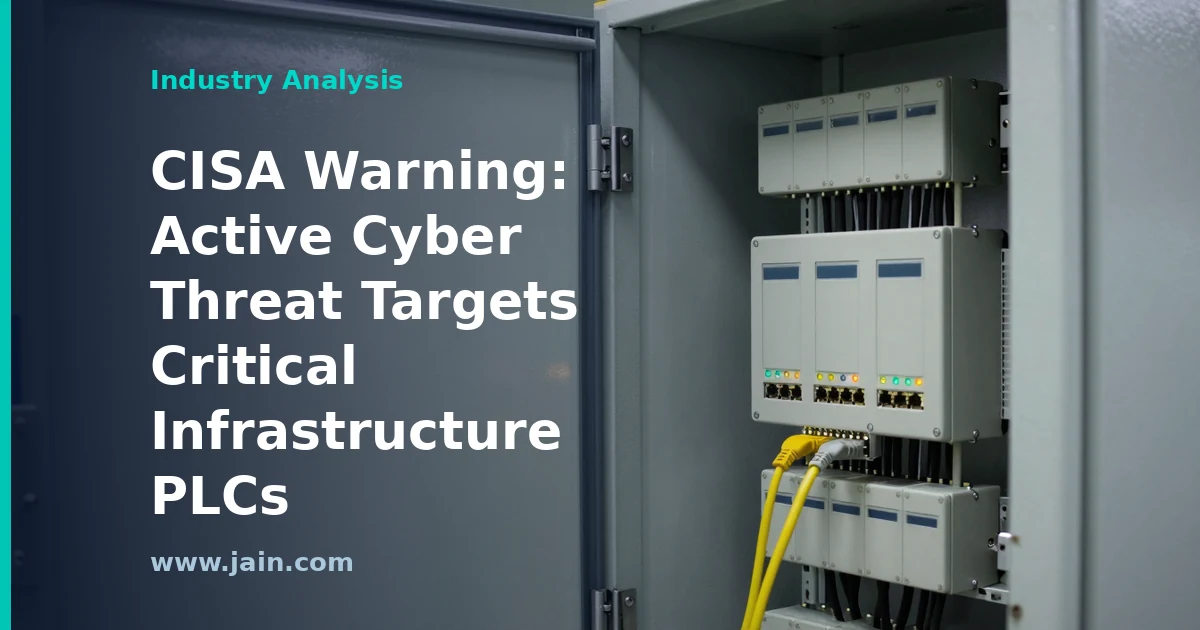
    The US government has issued a warning about an active cyber threat targeting critical infrastructure, with programmable logic controllers (PLCs) — the ruggedized industrial computers that directly operate pumps, breakers, valves and cooling equipment — at the center of the concern, according to an April 26, 2026 Fox Business report. The alert comes from the Cybersecurity and Infrastructure Security Agency (CISA), the Department of Homeland Security unit responsible for defending the systems that keep power, water and communications running.

    The report describes the threat as active — meaning adversaries are currently attempting or conducting intrusions, not merely capable of them. Details on attribution, affected vendors and confirmed victims were not included in the initial coverage.

    Executive Summary

    According to the report, CISA is warning that threat actors are actively targeting operational technology (OT) — the layer of industrial control systems that sits between software and physical machinery — across US critical infrastructure sectors. PLCs matter because they are the last digital step before a physical action: a compromised email server leaks data, but a compromised PLC can shut off a pump, trip a breaker or disable a chiller.

    For operators of power systems and data centers, the warning lands on a well-documented weak spot. Many PLCs in the field run with default credentials, lack modern authentication, and were designed for isolated networks that have since been bridged to corporate IT and the internet for remote monitoring. When CISA flags active targeting of this equipment, the practical message is that exposure that was theoretically risky yesterday is being probed today.

    It is worth being precise about what the initial coverage does and does not establish. The existence of a federal warning is reported; the specific advisory, the threat actor behind the activity, the vulnerabilities exploited and whether any disruption has occurred are not detailed in the source. Operators should treat the report as a prompt to consult CISA’s published advisories directly rather than act on secondhand characterizations.

    Why PLCs Are the Soft Underbelly of Critical Infrastructure

    A programmable logic controller is a small industrial computer that reads sensors and drives equipment on a fixed loop — open this valve, start that fan, trip this breaker. They are built for reliability and longevity, not security: units installed 15 or 20 years ago are still in service, many with no authentication, unencrypted protocols, and firmware that is rarely if ever updated. Security researchers have called this class of exposure “insecure by design,” because the weaknesses are features of the product era, not bugs that a patch can remove.

    The attack path is usually mundane. Adversaries do not need exotic exploits when internet-scanning tools can find PLCs and their human-machine interfaces exposed directly online, often protected by a default password printed in the vendor manual. That is why prior US government advisories on OT threats have emphasized basics — take devices off the public internet, change default credentials, segment networks — rather than sophisticated countermeasures. An “active threat” warning against this backdrop suggests someone is systematically working through that exposed population.

    The Data-Center Angle: OT Risk Is Not Just a Utility Problem

    Data-center operators sometimes read critical-infrastructure warnings as a power-and-water problem. That is a mistake. A modern data center is itself a dense OT environment: building management systems, chillers, computer-room air handlers, generators, transfer switches and uninterruptible power supplies are all orchestrated by PLCs and adjacent controllers. An attacker who cannot touch a single server can still take a facility down — or force a thermal shutdown — by manipulating the cooling plant.

    The interdependence runs both ways. Data centers are among the fastest-growing loads on the US grid, and their availability depends on the same utility OT systems the warning implicates. A regional grid disruption caused by an OT intrusion becomes every colocation tenant’s outage. That shared fate is why federal warnings of this kind deserve attention across the infrastructure stack, not just inside utilities’ security teams.

    What “Active” Changes — and What It Doesn’t

    Government cyber warnings span a wide range, from generic threat awareness to specific incident-driven alerts with indicators of compromise. The word “active” pushes toward the serious end: it implies observed adversary operations, not hypothetical capability. Recent history supports taking such language literally. In late 2023, US water utilities had Unitronics PLCs defaced by an Iran-linked group exploiting default passwords, and through 2024 and 2025 US agencies repeatedly warned that state-sponsored actors — most prominently the China-linked group tracked as Volt Typhoon — had pre-positioned inside US critical-infrastructure networks for potential future disruption.

    What the initial report does not change is the economics of the defense. OT security spending has historically lagged IT security because control systems were assumed to be isolated, and because taking a production PLC offline to patch it carries real operational cost. The honest reading of a headline-level report is that it confirms direction — attackers continue to move toward the physical layer — without yet telling operators which specific products or protocols to triage first. That specificity has to come from the underlying CISA advisory itself.

    The Operator Playbook: Boring, Proven, and Still Not Done

    The mitigations for PLC-targeting campaigns have been remarkably consistent across a decade of advisories: inventory every controller and its network path; remove OT devices from direct internet exposure; put remote access behind VPNs with multi-factor authentication; change default and shared credentials; segment OT networks from IT with monitored boundaries; and maintain tested manual-operation and restoration procedures so a cyber event does not automatically become a physical outage.

    The persistent gap is not knowledge but execution — asset inventories are incomplete, legacy gear cannot support modern authentication, and maintenance windows are scarce. For executives, the actionable question this warning raises is not “are we compliant?” but “if CISA named our PLC vendor tomorrow, could we locate every affected unit within a day?” Organizations that cannot answer yes have their next quarter’s OT security priority already defined.

    Background

    CISA was established in 2018 as the Department of Homeland Security’s lead agency for defending civilian critical infrastructure, and industrial control systems have been a steady focus of its advisory output. The threat it tracks has escalated visibly: the 2021 Colonial Pipeline ransomware attack showed how IT intrusions can halt physical operations, the late-2023 Unitronics incidents showed hacktivists compromising water-utility PLCs through default passwords, and joint advisories in 2024 warned that the China-linked group Volt Typhoon had quietly pre-positioned inside US energy, water and communications networks.

    Against that backdrop, PLC-focused warnings are less a new development than an intensifying pattern. The installed base of industrial controllers — millions of devices across utilities, manufacturing and building systems, many designed before cybersecurity was a requirement — represents one of the longest-tail risk remediation problems in US infrastructure, because the equipment often outlives both its vendor support and the network assumptions it was built on.

    Source: US warns of active cyber threat targeting critical infrastructure — Fox Business report, April 26, 2026, on a CISA warning concerning active targeting of industrial control systems.

  • US Warns of Active Cyber Threat to Critical Infrastructure: What to Check Now

    US Warns of Active Cyber Threat to Critical Infrastructure: What to Check Now

    The US government has warned of an active cyber threat targeting critical infrastructure, according to an April 20, 2026 report from Fox Business circulated via Google News. The warning puts operators across essential sectors — power, water, communications, transportation, and the data facilities that underpin them — on notice that a threat is currently in play, not merely theoretical.

    The public report is headline-level: it does not identify the issuing agency, the threat actor, the targeted sectors, or specific technical indicators. That thinness is itself the operative fact for operators deciding how to respond.

    Executive Summary

    According to the April 20, 2026 Fox Business report, US authorities issued a warning about an active cyber threat aimed at critical infrastructure. In federal parlance, “critical infrastructure” covers the systems whose disruption would harm national security, the economy, or public health — the electric grid, water treatment, pipelines, communications networks, and increasingly the data centers those sectors depend on.

    The word that matters is active. Federal agencies publish a steady stream of routine hygiene advisories; a warning framed around an active threat signals that adversary activity is believed to be underway now, which shifts the operator posture from “patch on your normal cycle” to “go look for this in your environment.”

    Because the public reporting carries no technical detail, the immediate task for infrastructure and data center operators is twofold: obtain the underlying federal advisory through official channels, and in parallel run the baseline checks that hold up regardless of which actor or technique the warning concerns — remote access, network segmentation, logging, and incident readiness.

    Why “Active Threat” Is the Operative Phrase

    Federal cyber communications come in tiers. At the low end are routine vulnerability notices and best-practice guides. At the high end are alerts that adversaries are actively exploiting systems in the wild. The Fox Business headline places this warning in the second tier, and that framing — if it accurately reflects the underlying government language — carries urgency: it implies intrusions or exploitation attempts are happening now, and that defenders should hunt for evidence of compromise rather than simply harden for the future.

    What the public report does not substantiate is equally important. There is no named agency, no named threat actor, no list of affected sectors, and no indicators of compromise in the material available. Operators should treat the headline as a prompt to retrieve the authoritative advisory — typically published through official government channels and sector information-sharing bodies — rather than as an actionable document in itself. Acting on a headline alone risks both over-reaction and misdirected effort.

    Critical Infrastructure’s Expanding Attack Surface

    The reason these warnings recur is structural. Operational technology (OT) — the industrial control systems that open breakers, run pumps, and manage chillers — was designed for reliability over decades, not for exposure to the internet. As utilities and facility operators connected those systems to corporate IT networks for monitoring and efficiency, they inherited IT’s threat landscape without IT’s patch cadence. Remote-access pathways added for vendors and after-hours staff are, year after year, among the most common ways attackers get in.

    Data centers sit on both sides of this equation. They are critical infrastructure in their own right — hosting the workloads of banks, hospitals, and government — and they are industrial facilities full of OT: building management systems, power distribution units, generators, and cooling plants. A federal warning about critical infrastructure is therefore a data center issue twice over: once for the tenants’ systems, and once for the physical plant that keeps them running.

    What Operators Should Check Now

    Absent specific indicators, the highest-value moves are the ones that blunt most intrusion campaigns regardless of actor. First, inventory every remote-access pathway — VPNs, vendor jump boxes, remote desktop exposure — and confirm multi-factor authentication is enforced on each, with unused accounts disabled. Second, verify that OT and building-management networks are genuinely segmented from corporate IT, so a compromised laptop cannot reach a chiller controller. Third, confirm internet-facing systems are patched and that logging is enabled, centralized, and retained long enough to support a look-back investigation.

    Beyond the technical checklist, operators should confirm their connection to official channels: sector-specific information sharing and analysis centers (ISACs) and government advisory feeds are where the technical detail behind a headline warning normally lands. Finally, this is a reasonable moment to dust off the incident-response plan — who gets called, how systems are isolated, and how the facility runs if IT systems must be taken offline. The cost of these checks is modest; the cost of discovering mid-incident that a vendor VPN had no MFA is not.

    Background

    Warnings about cyber threats to US critical infrastructure have become a recurring feature of the national security landscape. Over the past decade, federal agencies — chiefly the Cybersecurity and Infrastructure Security Agency (CISA), often jointly with the FBI and NSA — have repeatedly cautioned that both criminal ransomware groups and state-sponsored actors probe and, in some cases, pre-position inside the networks of utilities, pipelines, and other essential services. High-profile incidents, such as the 2021 ransomware attack that disrupted a major US fuel pipeline, demonstrated that cyber events can produce real-world physical and economic consequences.

    The persistent vulnerability stems from the convergence of information technology and operational technology: control systems designed decades ago for isolated operation are now reachable, directly or indirectly, from corporate networks and the internet. That is why federal warnings, whatever their specific trigger, tend to converge on the same defensive fundamentals — secured remote access, network segmentation, patching, logging, and rehearsed incident response.

    Source: US warns of active cyber threat targeting critical infrastructure — Fox Business report, April 20, 2026, on a federal warning of active cyber activity aimed at US critical infrastructure.