The US government has issued an emergency order covering PJM Interconnection — the largest electric grid operator in the United States — ahead of a heatwave expected to drive electricity demand toward the edge of available supply, Reuters reported on June 30, 2026. Emergency orders of this kind allow the Department of Energy to temporarily relax normal operating constraints so that generators can run at maximum output to keep the lights on.
Executive Summary
According to the Reuters report, federal authorities acted preemptively: the order was issued as the heatwave loomed, not after the grid had already buckled. That timing matters. Emergency authority — typically exercised under Section 202(c) of the Federal Power Act, which lets the Energy Secretary direct generators to operate notwithstanding permits or other limits — was historically reserved for rare, acute crises such as hurricanes or sudden plant failures.
That such an intervention now precedes a forecastable summer weather event suggests the buffer between peak demand and available generation in PJM’s territory has grown uncomfortably thin. PJM coordinates power for roughly 65 million people across 13 states and the District of Columbia — including Northern Virginia, the densest data-center market on Earth — so an emergency footing on this grid is a material signal for the entire digital-infrastructure industry.
When Emergency Powers Become Routine Tools
An emergency order is, by design, an extraordinary instrument. It can authorize power plants to exceed environmental or operational limits, keep units scheduled for retirement running, and compel generation that market signals alone would not produce. Using it in anticipation of hot weather — one of the most predictable stresses a grid faces — indicates that ordinary market and reliability mechanisms are no longer producing enough headroom on their own. Similar orders were issued for PJM and other regions during heat events in prior summers, so the June 2026 action fits an emerging pattern rather than standing as a one-off.
The pattern is the story. Each individual order is defensible as prudent risk management; a sequence of them amounts to the federal government repeatedly bridging a structural gap between demand growth and supply additions. That gap has causes on both sides of the ledger: large thermal plants retiring faster than replacement capacity comes online, interconnection queues that delay new generation for years, and demand rising after two decades of near-flat load.
AI Load Growth Meets a Tightening Grid
PJM sits at the center of the demand-growth debate because its footprint includes Northern Virginia’s ‘Data Center Alley,’ along with fast-growing campuses in Ohio, Pennsylvania, and Maryland. Grid planners across the country have sharply raised load forecasts, driven in large part by AI-oriented data centers, electrification, and new manufacturing. PJM’s own capacity auctions — the market that pays generators to be available during peaks — have cleared at record-high prices in recent cycles, a direct financial symptom of scarcity.
A heatwave is where these abstractions become physical. Air-conditioning load peaks at exactly the moment thermal plants lose efficiency in the heat, and data-center cooling demand rises in parallel. When the margin for error narrows, operators lean on emergency tools. For the industry we cover, the lesson is blunt: electricity availability, not land or fiber, is now the binding constraint on digital-infrastructure growth in America’s largest power market.
What It Means for Data-Center Operators and Their Customers
For operators, recurring grid emergencies raise both operational and reputational stakes. Operationally, facilities in PJM territory should expect more frequent conservation appeals, demand-response calls, and scrutiny of backup-generation readiness during peak season. Reputationally, data centers are increasingly cast as the face of load growth; every emergency order sharpens public and regulatory questions about who pays for grid stress and whether large loads should be required to be curtailable or bring their own generation.
The likely winners in this environment are firms that treat power as a first-class engineering problem: those with flexible-load capability, on-site or contracted generation, long-dated capacity positions, and sites in regions with genuine surplus. The exposed parties are speculative projects counting on grid interconnection timelines and power prices that no longer reflect reality. Utilities and generators in PJM, meanwhile, gain leverage — scarcity is lucrative for whoever owns dispatchable megawatts.
Background
PJM Interconnection, founded as a utility power pool in 1927, evolved into the largest competitive wholesale electricity market in the United States, coordinating generation and transmission across the Mid-Atlantic and parts of the Midwest. Its footprint includes Northern Virginia’s data-center corridor, which has made PJM the frontline grid for AI-era load growth. Section 202(c) of the Federal Power Act gives the Department of Energy authority to order emergency generation during grid crises — a power used sparingly for decades but invoked more frequently in recent years as plant retirements, slow interconnection of new resources, and surging demand forecasts have narrowed the system’s reserve margins.
Reuters reported on June 30, 2026 that PJM Interconnection — the largest power grid operator in the United States, coordinating electricity across 13 states and the District of Columbia for roughly 65 million people — is moving toward actively managing data center demand on its system. The report signals a shift from treating data centers as ordinary customers whose consumption must simply be served, toward a framework in which the grid operator can shape when and how much power the largest new loads draw.
Details of the mechanism, timeline, and scope were not spelled out in the headline announcement, but the direction alone is consequential: PJM’s territory includes Northern Virginia’s “Data Center Alley,” the densest concentration of data centers in the world, and the region at the center of the AI-driven surge in U.S. electricity demand.
Executive Summary
According to Reuters, PJM is taking steps toward managing data center demand rather than passively absorbing it. For decades, U.S. grid planning worked on a simple premise: customers decide how much electricity they need, and the grid builds to serve it. AI data centers — single facilities that can draw hundreds of megawatts, comparable to a small city — have broken that premise. Interconnection queues are backed up, capacity prices in PJM’s markets have surged, and the gap between how fast data centers can be built (one to two years) and how fast power plants and transmission can be built (five to ten years) keeps widening.
Moving to “manage” that demand means the operator of America’s biggest wholesale power market is preparing tools — potentially ranging from voluntary demand-response participation to conditions on new large-load interconnections to curtailment provisions, though the report does not specify which — to control the timing and firmness of data center consumption. That matters far beyond PJM’s footprint: as the largest grid and the home of the world’s biggest data center cluster, PJM’s rules tend to become the template other regions study.
For the data center industry, the message is that access to the grid is no longer an unconditional entitlement. Flexibility — the ability to shift, shed, or self-supply load — is becoming a bargaining chip in getting connected at all.
From Passive Host to Active Manager
Grid operators like PJM are regional transmission organizations (RTOs): nonprofit entities that run the wholesale electricity market and the high-voltage network across their territory, under rules approved by federal regulators. Historically, their job was to forecast demand and make sure supply met it. Demand itself was treated as a given. A move toward managing data center demand inverts that relationship for the first time at this scale — the grid operator would have a say in how the largest customers consume, not just how generators produce.
The trigger is arithmetic. Load growth in PJM was essentially flat for nearly two decades; AI data centers ended that era abruptly. When a single campus can request as much power as a steel mill or a small utility’s entire service territory, and dozens of such requests arrive at once, the traditional “build to serve” model produces either reliability risk or enormous costs socialized across all ratepayers. Managing demand is the third option: make the new load itself part of the reliability solution.
The Economics of Curtailable Compute
The core idea behind demand management is that not every megawatt-hour of computing is equally urgent. AI training runs can, in principle, pause or shift in time; some workloads can migrate between facilities in different regions. If data centers agree to reduce consumption during the few dozen hours a year when the grid is most stressed, the system needs less peak capacity — which is exactly the product whose price has been surging in PJM’s capacity auctions, the market where power plants are paid to be available.
The unresolved tension is that most data center operators sell their customers uninterrupted uptime, and inference workloads serving live users are far harder to pause than training. Whether flexibility is genuinely available at scale — and at what price data center operators would sell it — is the open economic question. If PJM’s framework rewards flexible loads with faster interconnection or lower costs, it effectively creates a market price for interruptibility, and data center designs will adapt to capture it: more batteries, more on-site generation, more workload-orchestration software.
Winners, Losers, and the Ratepayer Question
Developers with flexible-by-design facilities, on-site generation, or storage stand to gain priority in a demand-managed regime. Operators marketing strict 24/7 firmness with no curtailment tolerance may face slower interconnection or higher costs. Utilities and generators face a subtler effect: managed demand blunts the extreme scarcity that has driven capacity prices up, which helps consumers but trims the windfall that scarcity was delivering to existing power plants.
For households and businesses in PJM’s 13-state footprint, the stakes are direct. Capacity costs flow into retail electricity bills, and the politics of ordinary ratepayers subsidizing infrastructure for the world’s wealthiest technology companies have grown sharp. A credible demand-management framework is partly a political instrument: it lets PJM tell states and consumers that data centers are being asked to carry reliability risk, not just impose it. Whether the framework has real teeth — mandatory obligations versus voluntary programs — will determine whether that assurance holds up.
A Template Other Grids Will Study
PJM is not acting in a vacuum. Texas’s ERCOT grid, the other major destination for large flexible loads, has been developing its own approach to interconnecting and, when necessary, curtailing very large customers. When the two biggest data center markets in the country both condition grid access on demand flexibility, it stops being an experiment and becomes the emerging national norm. Data center site selection, financing models, and colocation contracts will all have to price in a world where the grid can ask the largest computers on Earth to throttle down.
Background
PJM Interconnection, headquartered in Pennsylvania, grew from a 1927 power pool into the largest regional transmission organization in the United States, dispatching generation and running wholesale power markets across a footprint from Illinois to the mid-Atlantic. Its territory includes Northern Virginia, where decades of fiber density and proximity to federal and enterprise customers created “Data Center Alley” — the largest data center market in the world.
The generative-AI boom that accelerated from 2023 onward transformed data centers from a steady, modest slice of electricity demand into the dominant driver of U.S. load growth, ending a long era of flat consumption. PJM’s capacity auctions delivered record-high prices as demand forecasts jumped, interconnection requests piled up, and state officials began questioning who should bear the cost. The June 2026 move toward managing data center demand is the institutional response to that collision between AI’s growth curve and the grid’s construction timelines.
Brookfield and Bloom Energy announced on June 29, 2026 that they are expanding their AI infrastructure partnership to $25 billion — a fivefold increase over the original framework — to build and finance rapid power deployment for AI data centers. The expanded arrangement pairs Bloom’s solid oxide fuel-cell technology with Brookfield’s infrastructure capital.
Executive Summary
Bloom Energy, the fuel-cell manufacturer, and Brookfield, one of the world’s largest infrastructure investors, have scaled their partnership from an original framework — implied by the announcement’s “fivefold” language to have been on the order of $5 billion — to $25 billion. The stated purpose is to build and finance “rapid power” for AI infrastructure: on-site electricity generation that can be deployed faster than utility grid connections.
The announcement matters because electricity availability, not chips or land, has become the binding constraint on AI data-center construction. A $25 billion commitment of this shape signals that major infrastructure capital now treats on-site fuel-cell generation as a bankable asset class rather than a niche backup option. That said, the release as reported gives a headline dollar figure without megawatt targets, named customers, or deployment timelines — so the scale of actual near-term power delivery remains to be demonstrated.
Why Fuel Cells Are Jumping the Grid Queue
The core problem this partnership targets is speed. In many major data-center markets, a new facility requesting a large grid connection can wait years for utilities to build the transmission and generation needed to serve it — a delay measured in lost AI product cycles. On-site generation sidesteps that queue. Bloom’s solid oxide fuel cells convert fuel, typically natural gas, into electricity through an electrochemical reaction rather than combustion, and they arrive as factory-built modules that can be installed in months rather than the multi-year timelines of large power plants or grid upgrades.
That “speed-to-power” pitch has become the dominant selling point across the AI power market — gas turbines, batteries, and behind-the-meter deals all compete on the same axis. Fuel cells’ specific claim is modularity and siting flexibility: they are quiet, produce no combustion emissions like NOx at the point of generation, and can be permitted in places where a turbine plant could not. The trade-off is cost per megawatt-hour and dependence on fuel supply, which is why financing structure matters as much as technology.
The Capital Stack Behind the Megawatts
The division of labor is the interesting part. Bloom manufactures and services the equipment; Brookfield brings the balance sheet. In a typical arrangement of this kind, the infrastructure investor owns the generating assets and sells power or capacity to data-center operators under long-term contracts, so the data-center customer avoids a large upfront capital outlay. For Bloom, a deep-pocketed financing partner converts its technology into an offering that can compete for hyperscale-sized deals it could never finance from its own balance sheet.
For Brookfield, fuel-cell fleets serving AI campuses look like classic infrastructure: long-lived assets, contracted revenue, and a customer base — AI compute operators — currently willing to pay a premium for firm power delivered quickly. Growing the framework fivefold within roughly a year of the original announcement suggests the partners believe demand from AI builders exceeds what the initial commitment could serve. It is a strong demand signal, though announced frameworks and deployed megawatts are different things.
What a Fivefold Scale-Up Signals — and What It Doesn’t
A $25 billion figure invites careful reading. Partnership frameworks of this kind typically describe a ceiling — capital the partners intend to deploy if projects materialize — rather than contracted orders. The announcement as reported does not specify how much is committed versus targeted, how much power it represents, or over what period. Until customer contracts and megawatt figures are disclosed, the number is best understood as a statement of ambition backed by a credible financier, not a backlog.
Competitively, the deal sharpens the contest to power AI. Utilities and grid operators risk losing their largest new customers to behind-the-meter generation; gas-turbine suppliers, battery vendors, and small modular reactor developers are chasing the same load. For data-center operators, more credible power options mean more negotiating leverage — and for the industry’s critics, more scrutiny of what fuels that power. Fuel cells running on natural gas still emit carbon dioxide, so the climate profile of this buildout will depend on fuel sourcing choices the announcement does not detail.
Background
Bloom Energy, founded in 2001 and headquartered in California, went public in 2018 and built its business selling solid oxide fuel-cell “Energy Servers” to commercial, industrial, and utility customers seeking reliable on-site power. Brookfield is a global asset manager with hundreds of billions of dollars across infrastructure, renewable power, and real estate, and has been among the most aggressive institutional investors in AI-related infrastructure. The two first announced an AI-focused partnership in late 2025, part of a wider industry wave in which data-center developers turned to behind-the-meter generation — fuel cells, gas turbines, and eventually nuclear — as utility interconnection queues stretched to multiple years in key markets.
The US House of Representatives passed a bill to help small, local electric companies defend against hackers. These include rural power cooperatives, which are owned by the customers they serve, and city-owned utilities.
The bill allows up to $250 million over five years. That averages about $50 million a year, spread across the whole country. It is permission to spend, not money in the bank yet.
Why care? The huge computer warehouses behind artificial intelligence run on the same power grid as everyone else, and these small utilities say they have the fewest people guarding it.
On June 29, 2026, the U.S. House of Representatives passed the Rural and Municipal Utility Cybersecurity Act, a bipartisan bill from Rep. Mariannette Miller-Meeks (IA-01) and Rep. Jennifer McClellan (VA-04), according to a press release from Miller-Meeks’ office. The bill reauthorizes the Rural and Municipal Utility Advanced Cybersecurity Grant and Technical Assistance Program and authorizes $250 million over five years to help rural electric cooperatives and municipal utilities deploy cybersecurity technology, share threat information and respond to incidents.
The bill passed alongside three other grid-security measures from the House Energy & Commerce Committee, has the backing of the National Rural Electric Cooperative Association and the American Public Power Association, and now moves to the Senate.
Executive Summary
The House has voted to extend a federal program that gives grants and technical help to the smallest operators on the U.S. electric grid: rural electric cooperatives, which are member-owned, and municipal utilities, which are owned by cities and towns. The authorization is $250 million over five years, an average of $50 million a year if spread evenly.
The premise, stated plainly in the release, is that these utilities face the same sophisticated threats as large investor-owned utilities while operating with limited cybersecurity staff and budgets. That makes them the segment of the grid where defensive capacity is thinnest by the sponsors’ own account.
For the data center and AI infrastructure industry, the bill matters less for its dollar figure than for what it signals: Congress is treating the security of the entire power delivery chain, not only its largest nodes, as a national concern at a time when electricity reliability has become a gating factor for computing buildout. Whether the money actually flows depends on the Senate and, later, on appropriators.
A $250 Million Ceiling, Not a $250 Million Check
The most important word in the release is “authorizes.” In federal budgeting, an authorization sets the maximum Congress permits a program to spend; the actual dollars are decided separately each year through appropriations bills. An authorization of $250 million over five years therefore establishes a ceiling of roughly $50 million a year on average, not a guaranteed stream of grants. Programs are routinely funded below their authorized levels, and some are not funded at all in a given year.
The bill also has not become law. It passed the House and now needs Senate action, which Miller-Meeks urged be swift, followed by the President’s signature. Until then, utilities planning security upgrades cannot budget around the reauthorized program, and the practical effect on any given cooperative or municipal system remains prospective.
Measured against the problem the release describes, the scale is modest. A national pool averaging $50 million a year is meant to support grants, technical assistance and information sharing across every eligible rural and municipal utility in the country. That is a meaningful subsidy for a small utility that has no dedicated security team, but it is not sized to remake the security posture of an entire segment of the grid on its own.
Why the Least-Resourced Utilities Matter to AI’s Power Supply
The release never mentions data centers or artificial intelligence, so the connection has to be drawn carefully. What the release does establish is a resource gap: rural cooperatives and municipal utilities “often operate with limited cybersecurity personnel and resources despite serving millions of Americans and supporting critical infrastructure,” and they face “the same sophisticated cyber threats with far fewer resources.” By the sponsors’ own framing, these are the parts of the grid where cyber defense is thinnest.
That matters to AI infrastructure because computing capacity is ultimately limited by reliable electricity. Data center developers searching for available power increasingly look beyond the largest utility territories, and wherever a facility connects, its uptime depends on the security of the utility delivering its electricity. A campus’s own firewalls do nothing if the operational systems of the utility serving it are compromised. The mechanism is straightforward: the security of a data center’s power supply is bounded by the security of the utility that supplies it, and the bill targets the class of utility that its sponsors say is least equipped.
The link should not be overstated. A breach at a small distribution utility typically affects its own service territory rather than cascading across the national grid, and how much data center load sits on cooperative or municipal systems is not quantified in the release. The relevance to any specific operator therefore depends on where its facilities are sited. For operators served by these utilities, however, the program’s success is a direct input to their own reliability risk.
One Bill in a Four-Part Grid-Security Package
Energy & Commerce Chairman Brett Guthrie described the measure as one of “four bills” addressing security planning, Department of Energy leadership for confronting threats, tools for utilities, and collaboration between grid operators and the federal government. Read together, the package treats grid cybersecurity as a portfolio of planning, leadership, funding and information-sharing problems rather than a single funding gap.
That framing aligns with how large power consumers already think about risk. A grant for a small utility’s security software is most valuable when paired with timely threat intelligence and a clear federal point of contact during an incident. The release does not detail the other three bills, so how they fit together in practice remains to be seen as they move through the Senate.
The support of the National Rural Electric Cooperative Association and the American Public Power Association is notable but expected, since their members are the intended recipients. Their backing indicates that eligible utilities see demand for the program; it is not independent evidence of how effective the grants have been to date.
What Power Buyers and Developers Should Watch
For companies siting data centers or other large loads, the practical takeaway is to treat a utility’s cybersecurity posture as part of site diligence, alongside capacity, interconnection timelines and rates. Questions about whether a prospective utility has participated in federal cyber programs, what monitoring it runs on its operational systems and how it shares threat information are reasonable to raise early.
For investors and policy watchers, the next markers are Senate action and, if the bill becomes law, the appropriations figure attached to it. Those two steps, not the House vote, will determine whether the $250 million authorization turns into money in the hands of utilities.
Background
The Rural and Municipal Utility Advanced Cybersecurity Grant and Technical Assistance Program is administered by the U.S. Department of Energy and was established under the 2021 bipartisan infrastructure law to help smaller utilities improve their cyber defenses. The June 2026 House bill would reauthorize it for another five years.
Rural electric cooperatives and municipal utilities make up a large share of U.S. utilities by count, though each is typically much smaller than an investor-owned utility. Their limited scale often means they have few or no dedicated cybersecurity staff, a gap federal programs like this one aim to close as grid threats and electricity demand both grow.
CNBC published a feature on June 28, 2026 examining how GE Vernova builds its massive heavy-duty gas turbines — the machines increasingly ordered to supply electricity for AI data centers. The piece spotlights the manufacturer at the center of one of the power industry’s sharpest demand upswings, as hyperscalers and data center developers scramble for generation capacity that the grid alone cannot deliver on their timelines.
Executive Summary
The story here is less a single announcement than a snapshot of a structural shift: gas turbines — large rotating machines that burn natural gas to spin a generator — have moved from a mature, slow-growth product line to some of the most sought-after industrial hardware in the world, and GE Vernova is one of a small handful of companies that can build the largest ones. CNBC’s look inside the company’s manufacturing operation underscores how AI data center demand has redrawn the order books of the turbine industry.
Why it matters: AI training and inference clusters need firm, around-the-clock power at scales measured in hundreds of megawatts per campus. Interconnection queues — the waiting lines to plug new loads and generators into the transmission grid — stretch for years in many U.S. markets. That mismatch has pushed utilities and data center developers toward dedicated gas-fired generation, and the turbines themselves have become the bottleneck. Whoever controls turbine manufacturing slots now holds real leverage over where and when AI capacity gets built.
The Turbine Is the New Bottleneck
For most of the past decade, the constraint on building a data center was land, fiber, or chips. In 2025 and 2026 it has increasingly been electricity — and behind electricity, the physical equipment that generates and delivers it. Heavy-duty gas turbines sit at the top of that equipment stack: they are enormous precision machines, built in specialized factories by a global oligopoly of manufacturers, and they cannot be scaled up quickly. Casting, machining, and testing the hot-section components that survive combustion temperatures is skilled, capital-intensive work with deep supplier chains.
That is why a factory tour of a turbine plant is now business news. When manufacturing slots for major power equipment are scarce, the production line itself becomes strategic infrastructure. Data center developers who once treated power generation as someone else’s problem — the utility’s — are now tracking turbine lead times the way they track GPU allocations.
Why Gas, and Why Now
Gas turbines occupy a specific niche in the AI power story: they are dispatchable (they run when you need them, unlike weather-dependent wind and solar), they can be sited close to load, and they can be permitted and built faster than nuclear. For hyperscalers facing multi-year grid interconnection queues, gas-fired plants — whether utility-built or behind-the-meter on the data center campus itself — are often the only firm-power option available on an AI-relevant timeline. Combined-cycle configurations, which recycle exhaust heat to generate additional electricity, improve the economics for facilities that run flat-out around the clock, which is exactly the load profile of an AI campus.
The trade-offs are real. Gas plants lock in decades of fuel exposure and carbon emissions at the same moment many data center operators carry public net-zero commitments. Expect continued tension between the near-term physics of AI power demand and long-term decarbonization pledges — and expect operators to pair gas with renewable procurement, carbon-capture ambitions, or framing gas as a “bridge” technology. Readers should evaluate those framings project by project rather than accepting or dismissing them wholesale.
Winners, Losers, and the Queue
The clearest winners in a turbine-constrained market are the manufacturers — GE Vernova and its few global peers — along with their component suppliers and the engineering-and-construction firms that install the machines. Utilities in data center-heavy regions gain a growth story they have not had in decades. On the other side of the ledger, smaller data center developers and enterprises without hyperscaler purchasing power risk being priced or queued out of firm generation capacity, which could concentrate AI infrastructure further among the largest players.
There is also a cyclical risk worth naming evenly: the gas turbine industry has been through boom-and-bust before, most notably when a late-1990s ordering surge was followed by a painful capacity glut. Manufacturers appear to be expanding cautiously partly because of that memory. If AI power demand forecasts prove overstated — a live debate — today’s scarcity could look different in five years. If the forecasts hold, the constraint persists and lead times stay long. Either way, the ordering decisions being made now will shape the power landscape well into the 2030s.
Background
GE Vernova became an independent public company in April 2024, when General Electric completed its split into three businesses and placed its energy operations — gas power, wind, nuclear services, and grid electrification — under the new name. The gas turbine franchise it inherited is one of the oldest and largest in the world, with an installed fleet spanning utilities and industrial operators across the globe.
The company’s independence coincided almost exactly with the generative AI infrastructure boom, which transformed electricity demand forecasts that had been flat in the U.S. for roughly two decades. That timing turned a business once viewed as a mature, declining fossil-fuel franchise into a strategic asset at the center of the AI build-out — the shift CNBC’s factory-floor feature captures.
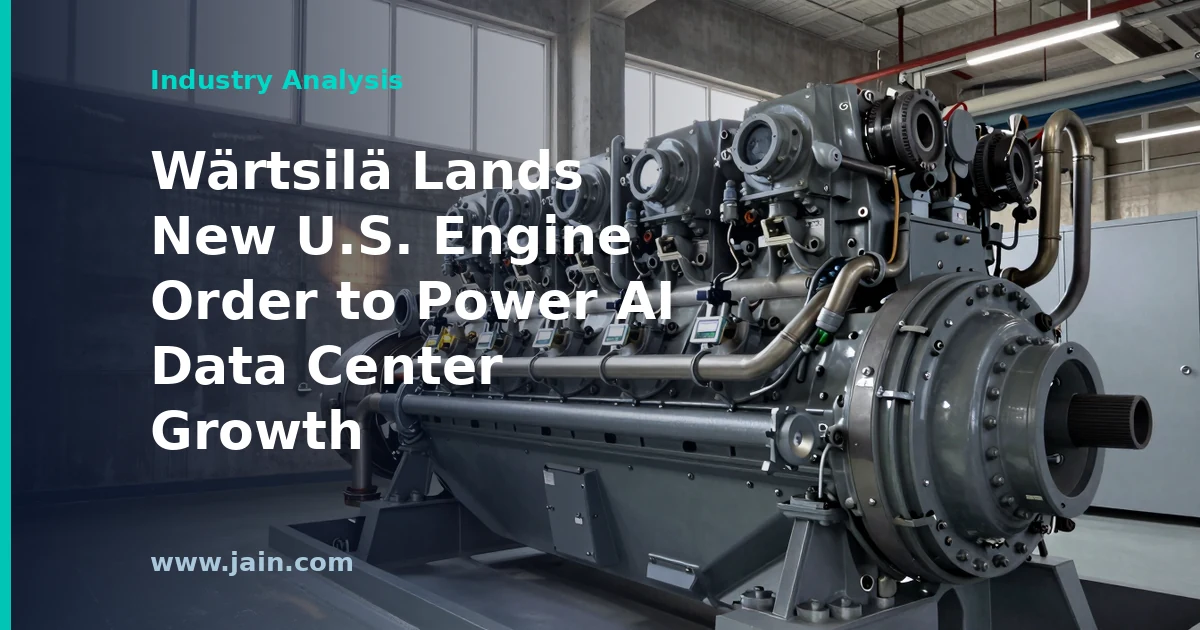
Wärtsilä, the Finnish energy and marine technology group, announced on June 28, 2026 that it has secured a new order in the United States to supply engine-based power generation supporting what the company calls the next wave of AI-driven data center growth. The announcement, distributed as a company release, positions the order within the surge of demand for on-site and grid-support power created by artificial intelligence computing facilities.
The release headline confirms the order’s existence, its U.S. location, and its data center orientation; the version of the announcement circulated via aggregators does not carry further specifics such as capacity, customer, or delivery schedule, which we flag below.
Executive Summary
The announcement is notable less for any single order than for the pattern it extends: reciprocating engine power — large, factory-built internal combustion generators that can be installed and running in months — is becoming a standard answer to the widening gap between when AI data centers need electricity and when utilities can deliver it. In much of the U.S., a new large load or generator can wait years in the interconnection queue, the utility process for studying and approving new grid connections. Data center developers racing to deploy AI capacity increasingly cannot wait, and engine plants offer a bridge: power that arrives on the developer’s schedule rather than the grid’s.
For Wärtsilä, one of the leading global suppliers of medium-speed engine power plants, the U.S. data center segment represents a growth market layered on top of its traditional utility, industrial, and grid-balancing business. The company framing this order explicitly around “AI-driven data center growth” signals that it now treats the segment as a named demand category, not incidental business.
What matters for the industry is the direction of travel: if flexible generation is the default bridge, then engine and turbine order books, gas supply logistics, and air-permitting timelines become part of the data center delivery critical path — alongside chips, land, and fiber.
The Interconnection Gap Is the Real Product
AI training and inference facilities are being planned at scales of hundreds of megawatts — comparable to small cities — and utilities in many U.S. regions cannot study, upgrade, and energize connections for loads of that size quickly. The mismatch between data center construction timelines, often 18 to 30 months, and grid timelines, often several years, has created a market for anything that closes the gap. Engine power plants fit because they are modular, factory-produced, and incremental: capacity can be added in blocks, started fast, and later kept as backup or grid-support assets once a utility connection arrives.
Wärtsilä’s order, as framed, is a data point confirming that this bridge model has moved from workaround to procurement strategy. When a major OEM headlines a U.S. order around AI data centers, it suggests buyers are specifying flexible generation at the planning stage, not scrambling for it after a queue delay.
Engines Versus Turbines Versus the Grid
The fast-power market splits mainly between reciprocating engines, which Wärtsilä and a small number of rivals supply, and gas turbines. Engines generally start faster, hold efficiency better at partial load, and tolerate frequent stop-start cycling — useful traits for a facility that may eventually shift to grid power and keep the engines for peaking or resilience. Turbines tend to win on the largest single-block capacities. Both now face extended delivery lead times as data center demand collides with utility and industrial orders, which means an OEM’s manufacturing slots have themselves become a scarce resource.
The strategic question for buyers is not engines versus grid, but sequencing: bridge generation first, interconnection later, with the on-site plant repurposed rather than stranded. Vendors that can credibly support that full lifecycle — including later conversion to balancing or backup duty, and potential future fuels — have an advantage beyond the initial sale.
What It Means for Data Center Economics
Self-supplied engine power costs more per megawatt-hour than typical utility rates once fuel, maintenance, and capital are counted. That premium is rational when the alternative is an idle, revenue-less AI facility waiting on a queue. In effect, developers are paying for schedule certainty, and the willingness to pay reveals how valuable early AI capacity is believed to be. The risks are real, however: on-site gas generation adds fuel-supply logistics, air-quality permitting, and emissions exposure, and a facility’s bridge plant can become a long-term cost if grid power arrives later than promised — or a stranded asset if the AI demand it serves shifts.
For utilities and regulators, each order like this one is also a signal: load that cannot be served promptly will increasingly self-serve, at least temporarily, which changes forecasting, gas demand, and local emissions profiles in the regions where AI construction concentrates.
Background
Wärtsilä traces its roots to 1834 in Finland and today operates two main businesses: marine propulsion and energy. Its energy arm supplies power plants built around large medium-speed reciprocating engines, along with energy storage and grid-management technology, and has historically served utilities, island grids, and industrial customers needing flexible or fast-starting capacity.
Since roughly 2024, U.S. electricity demand has resumed sustained growth for the first time in about two decades, driven substantially by AI data center construction. That demand surge, colliding with multi-year utility interconnection and transmission timelines, has created a rapidly growing market for on-site and fast-deploy generation — the market context in which this order was announced.
Reuters reported on June 27, 2026 that Chevron, the second-largest US oil and gas producer, is looking at more deals to supply electricity to American data centers. The report signals that Chevron intends to expand beyond its previously announced data-center power venture and treat AI-driven electricity demand as an ongoing line of business rather than a one-off experiment.
Executive Summary
According to the Reuters report, Chevron is actively seeking additional opportunities to power US data centers. The company had already staked out a position in this market: in early 2025 it unveiled a venture with investment firm Engine No. 1 and turbine maker GE Vernova to build natural-gas power plants co-located with data centers — so-called behind-the-meter generation that serves a facility directly rather than routing through the public grid — with a stated ambition of up to four gigawatts of capacity. A statement of appetite for “more deals” suggests that pipeline is progressing well enough for Chevron to widen it.
Why it matters: the binding constraint on AI infrastructure has shifted from chips to electricity. Utility interconnection queues in major US markets now stretch years, and hyperscalers and data-center developers are increasingly willing to contract directly with anyone who can deliver firm power on a faster clock. An integrated oil major brings its own fuel supply, engineering capability, and balance sheet to that problem — a combination few pure-play power developers can match.
From Barrels to Electrons: Why Oil Majors Want AI Load
Oil and gas companies have spent the past decade searching for growth businesses that fit their existing skills. Data-center power is unusually well matched: it monetizes natural gas — which Chevron produces in large volumes, particularly in the Permian Basin — through long-term contracts with creditworthy technology counterparties, and it uses project-development muscle the industry already has. Unlike many diversification bets, it does not require the company to learn an unfamiliar trade; it moves gas one step further down the value chain, from selling the fuel to selling the electricity made from it.
For Chevron, the strategic appeal is margin and duration. Spot gas prices are volatile, but a multi-year power contract with a data-center operator converts that volatility into something closer to an annuity. If AI demand projections hold, an oil major that locks in supply relationships now is positioning itself in one of the few large, growing markets for hydrocarbons in the developed world.
Behind-the-Meter Power: The Speed Play
The core product here is speed. Connecting a large new load to the grid in many US regions means joining an interconnection queue and waiting — often three to five years or more — while studies and upgrades grind forward. Behind-the-meter generation sidesteps much of that by building the power plant at the data-center site, dedicated to that customer. For an AI developer racing to energize capacity, shaving years off time-to-power can be worth paying a premium.
The trade-offs are real, though. On-site gas generation ties the facility’s economics to fuel prices and turbine availability, and gas turbines are themselves in short supply, with manufacturers reporting multi-year order backlogs. It also raises questions for local communities and regulators about emissions, water, and whether large loads that bypass the grid still contribute fairly to shared infrastructure costs. None of these is disqualifying, but each is a live negotiation in every deal of this kind.
The Competitive Field Is Crowding Fast
Chevron is not alone in this pivot. Rival Exxon Mobil has discussed plans for gas-fired plants with carbon capture aimed at data centers, and a broad set of players — independent power producers, private-equity-backed developers, nuclear operators, and the utilities themselves — are all courting the same hyperscale customers. The winners will likely be those who can credibly promise firm megawatts on the shortest timeline, which favors companies with secured turbine slots, owned fuel supply, and sites already in hand.
For data-center operators and their tenants, more competition among power suppliers is straightforwardly good news: more options, more negotiating leverage, and a wider menu of structures from full behind-the-meter islands to hybrid grid-plus-onsite designs. For utilities, it is more ambiguous — every gigawatt served behind the meter is load growth they do not capture, at a moment when load growth had finally returned to their business case.
Background
Chevron is one of the world’s largest integrated energy companies and the second-largest US oil and gas producer, with major positions in the Permian Basin of Texas and New Mexico. Like other oil majors, it has been searching for growth avenues as transportation-fuel demand matures; powering data centers emerged as a candidate in early 2025, when Chevron announced a venture with Engine No. 1 and GE Vernova to build gas-fired plants co-located with computing facilities.
The backdrop is a step-change in US electricity demand. After roughly two decades of flat consumption, AI training and cloud computing have driven forecasts of sustained load growth, while grid interconnection queues and equipment shortages slow conventional responses. That gap between demand and deliverable supply is the market opening that Chevron — and a growing list of competitors — is moving to fill.
Investor Stanley Druckenmiller has disclosed new equity positions in three publicly traded bitcoin miners — Hut 8, Riot Platforms and Bitdeer — according to a Yahoo Finance report dated June 27, 2026. All three companies have been actively repositioning parts of their energized data center footprints toward artificial intelligence and high-performance computing workloads.
Executive Summary
The disclosure matters less for its dollar size, which the source does not quantify, than for the pattern: a well-known macro investor concentrating on three miners that share a common pivot story. Hut 8, Riot Platforms and Bitdeer each control large blocks of contracted power and operational data center sites — assets that have become scarce in a market where AI training and inference demand is running ahead of grid interconnection queues.
For readers outside finance, a stake disclosure of this kind does not commit the manager to a long-term view, nor does it validate any specific company’s execution. It does, however, mark that a discretionary investor with a long macro track record sees enough upside in the miner-to-AI trade to take exposure to all three names rather than pick a single winner.
Why Miners Are Suddenly AI Real Estate Plays
Bitcoin miners spent the last decade acquiring something the AI industry now urgently needs: interconnected sites with signed power contracts, substations, cooling, and the permits to operate at hundreds of megawatts. Building that stack from scratch in the United States or Canada today typically takes three to seven years, dominated by utility interconnection studies rather than construction. Miners already have the electrons, even if their existing buildings were designed for air-cooled ASIC racks rather than liquid-cooled GPU clusters.
That gap — energized land versus AI-ready halls — is the core of the investment thesis. Retrofitting a mining shed for high-density GPU compute is expensive and technically demanding, but it is faster and cheaper than winning a new interconnection. Investors buying the miner-to-AI story are effectively paying for optionality on power, with bitcoin revenue as a floor while sites are converted or leased.
Three Companies, Three Different Bets
Grouping Hut 8, Riot and Bitdeer together is convenient but glosses over meaningful differences. Hut 8 has publicly pursued a diversified compute strategy that includes managed services and AI-oriented capacity. Riot Platforms has historically emphasized scale in Texas mining, with more recent signals toward HPC hosting. Bitdeer combines self-mining, hosting and its own ASIC design, with sites across multiple jurisdictions.
A basket approach — taking positions in all three rather than one — is consistent with an investor who believes the theme will work but is uncertain which operator will convert power into AI revenue most efficiently. It also spreads exposure across different regulatory regimes, customer mixes, and balance sheets, each of which will matter more than the bitcoin price if AI hosting becomes the primary revenue line.
What A 13F-Style Signal Does and Does Not Mean
Position disclosures by well-known investors routinely move share prices, and coverage of this kind tends to be read as endorsement. It is worth being precise about what such a filing conveys: it is a snapshot of holdings as of a past date, without cost basis, without hedges, and without the manager’s forward intent. A stake can be trimmed or exited before the market ever sees the next disclosure.
For infrastructure buyers evaluating these operators as potential AI capacity providers, the more relevant questions are contractual: what tenants have signed, at what power price, on what term, and with what service-level commitments around uptime and density. Those data points, not fund flows, determine whether a converted mining site is a credible enterprise-grade colocation offering.
Background
Publicly traded bitcoin miners emerged as a distinct equity category after 2017, scaling rapidly through the 2020-2021 crypto cycle by locking in long-term power contracts, often in Texas, the U.S. Midwest, Canada and Scandinavia. The 2024 bitcoin halving compressed mining margins and coincided with an unprecedented surge in AI compute demand, prompting several miners to publicly reposition energized sites toward AI and high-performance computing hosting.
Hut 8, Riot Platforms and Bitdeer are three of the most-watched names in that transition. Institutional investor attention to the group has grown as hyperscalers and AI-native tenants search for sites where power is already contracted, since new utility interconnections in North America can take years to secure.
Research firm Rystad Energy projects that investment in fuel cells by data-center operators will grow roughly tenfold, reaching $30 billion by 2030, according to a report published June 26, 2026. The forecast points to on-site power generation moving from a niche backup strategy to a mainstream way of energizing new data-center capacity as connections to the electric grid grow slower and harder to secure.
Executive Summary
Rystad Energy, a Norway-based energy research and intelligence firm, has put a headline number on a trend the data-center industry has been living with for several years: when the grid cannot deliver power on the timeline a project needs, operators increasingly buy their own generation. Its new forecast calls for data-center fuel cell investment to grow tenfold by 2030, reaching $30 billion — a figure that implies today’s spending is on the order of a few billion dollars a year.
Fuel cells convert a fuel — most commonly natural gas today, potentially hydrogen in the future — directly into electricity through an electrochemical reaction rather than combustion. That gives them attractive properties for data centers: they can be deployed in modular blocks at the site, run continuously as primary power rather than just backup, and generally face lighter air-permitting burdens than combustion turbines or diesel generators. A tenfold growth call, if it materializes, would make fuel cells one of the fastest-growing categories of behind-the-meter power — generation installed on the customer’s side of the utility connection — in the broader AI-infrastructure buildout.
The Grid Queue Is the Real Story
The most important context for this forecast is not the fuel cell itself but the waiting line in front of it. In many major data-center markets, utilities and grid operators have quoted multi-year waits for large new interconnections — the formal process of hooking a big load up to the transmission system. For an AI data center whose revenue depends on being energized quickly, a delay of several years is often more costly than paying a premium for on-site generation. That inversion of economics — time-to-power mattering more than cost-per-megawatt-hour — is what turns a niche technology into a $30 billion market forecast.
Fuel cells are one of several answers to that problem, alongside gas turbines, reciprocating engines, and eventually small modular nuclear reactors. Their particular appeal is speed and siting flexibility: modular units can be added in increments as a campus grows, they operate quietly with no combustion exhaust plume, and in many jurisdictions they clear environmental permitting faster than combustion alternatives. For operators, that can compress the gap between breaking ground and serving customers.
What Tenfold Growth Would Actually Require
Growing an equipment market tenfold in roughly four years is not just a demand question — it is a manufacturing and supply-chain question. Fuel cell systems depend on specialized components and materials, and stepping up output by an order of magnitude means new factory capacity, expanded supplier networks, and trained installation and service workforces. The release headline does not indicate whether Rystad’s forecast is constrained by manufacturing capacity or is a pure demand-side projection, and that distinction matters a great deal for whether the number is achievable.
The fuel supply side deserves equal scrutiny. Most commercially deployed data-center fuel cells today run on natural gas, which means large deployments need pipeline capacity and gas contracts — their own version of an interconnection queue. Operators are effectively trading one infrastructure dependency for another. That trade often still makes sense, because gas infrastructure can frequently be expanded faster than high-voltage transmission, but it is not a free pass around the physical world.
Winners, Losers, and the Emissions Question
If the forecast is directionally right, the clearest beneficiaries are fuel cell manufacturers and the developers who package on-site generation into ready-to-run power solutions for data centers, along with gas utilities that supply the fuel. Traditional electric utilities face a more nuanced picture: behind-the-meter generation can relieve pressure on constrained grids, but it also diverts what would have been decades of steady load growth — and the revenue that comes with it — away from the regulated system.
The environmental ledger is genuinely mixed and worth stating plainly. Natural gas fuel cells emit carbon dioxide, though generally with higher electrical efficiency and far lower local air pollutants than combustion generation. Advocates point to a future switch to hydrogen as a path to low-carbon operation; skeptics note that low-carbon hydrogen remains scarce and expensive. Buyers and communities evaluating these projects should ask which fuel is actually contracted today, not which fuel is possible in principle.
A Forecast Is a Scenario, Not a Commitment
It is worth being clear about what a research-firm projection is: a modeled scenario built on assumptions about data-center demand, grid-connection timelines, technology costs, and competing options. Rystad is a well-established energy intelligence firm, but the headline figure arrives without published methodology in the source at hand. If AI capacity growth slows, if utilities accelerate interconnections, or if gas turbine supply loosens, the fuel cell number could land well short of $30 billion. Conversely, if grid queues lengthen further, it could prove conservative. The forecast is best read as a signal about the direction and seriousness of the on-site power trend, not as a precise measurement of the future.
Background
Data-center electricity demand has surged with the AI buildout, and in several major markets the ability to get grid power — not land or capital — has become the binding constraint on new capacity. That has pushed operators toward on-site generation of many kinds, from gas turbines to fuel cells, and made “time to power” a core competitive metric. Fuel cells entered the data-center world primarily as clean backup and supplemental power, with a small number of vendors building a commercial track record over the past decade; the shift Rystad describes is their promotion to primary, at-scale power for new facilities.
Rystad Energy, founded in Oslo in 2004, built its reputation on oil and gas market intelligence and has since expanded into power, renewables, and energy-transition research, making it one of the more frequently cited independent forecasters in the energy sector.
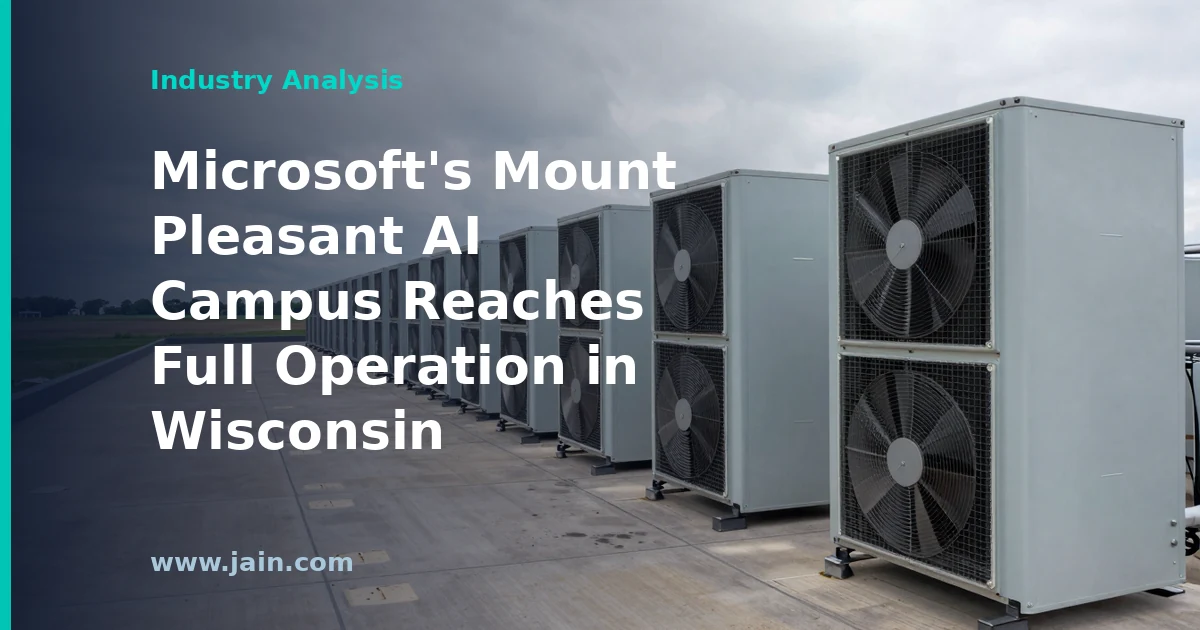
Microsoft’s AI data center campus in Mount Pleasant, Wisconsin is now fully operational, according to a June 24, 2026 report from Data Center Knowledge. The milestone marks the completion of the commissioning phase for one of the most closely watched hyperscale AI sites in the United States — a campus Microsoft has publicly positioned as a flagship of its AI infrastructure program since announcing a $3.3 billion investment there in May 2024.
Executive Summary
The report that Microsoft’s Wisconsin campus has gone fully operational converts years of announcements into working capacity. “Fully operational” in hyperscale terms means the facility has moved past construction and phased commissioning — the staged process of energizing electrical systems, validating cooling loops, and bringing compute halls online rack by rack — into steady-state production service.
It matters for three reasons. First, the site is a bellwether: Microsoft branded its Mount Pleasant build “Fairwater” and described it as among the most powerful AI data centers in the world, purpose-built for training large AI models on massive GPU clusters. Second, the location carries unusual economic symbolism, occupying land originally assembled for Foxconn’s largely unrealized 2017 manufacturing project. Third, it is a data point on whether the AI capital-expenditure cycle is delivering finished, revenue-generating infrastructure on schedule — a question investors and utilities are asking with increasing urgency.
One caveat readers should hold onto: the source is a headline-level trade report. Specific operational figures — megawatts energized, GPU counts in service, final headcount — are not independently confirmed in it, and we flag below what remains unverified.
From Foxconn’s Ghost Site to an AI Flagship
Few parcels of American industrial land carry as much narrative weight as Mount Pleasant. In 2017, Foxconn pledged a $10 billion LCD manufacturing campus there with talk of up to 13,000 jobs; the project was dramatically scaled back, leaving the village and Racine County with prepared land, water infrastructure, and unmet expectations. Microsoft’s arrival in 2023–2024 — culminating in the $3.3 billion commitment announced in May 2024 — recast the site as AI infrastructure rather than manufacturing.
Full operation closes that redemption arc, at least physically. For local officials who financed roads, water mains, and land assembly for Foxconn, a running hyperscale campus finally puts heavy, long-lived capital on the tax rolls. It is worth being precise about what changed, though: a data center campus employs far fewer people per dollar of investment than the factory once promised. The win for the region is tax base, grid and fiber investment, and anchor-tenant credibility — not mass employment.
What “Fully Operational” Actually Means at Hyperscale
Hyperscale campuses do not flip on like a light switch. They are commissioned in phases: substations and switchgear are energized, cooling plants are load-tested, and data halls are accepted one at a time, often over 12 to 24 months. A “fully operational” declaration means the last planned phase of the current build has passed acceptance and is carrying production workloads — in this case, most likely AI training and inference for Microsoft’s own models and its Azure cloud customers.
Microsoft has said the Wisconsin facility was designed around dense GPU clusters — the specialized processors that do the mathematical heavy lifting of AI — networked into effectively one giant computer for training large models. That design choice matters commercially: a training-oriented campus is measured less by how many customers it hosts and more by how fast it lets its owner iterate on frontier models. Full operation here is capacity Microsoft has been publicly hungry for throughout the AI demand surge.
Power and Cooling: The Real Constraints on the AI Buildout
The binding constraints on AI infrastructure are no longer chips alone but electricity and heat. Microsoft has described the Mount Pleasant design as using closed-loop liquid cooling — water is filled once and continuously recirculated to carry heat away from densely packed GPUs, rather than being evaporated and replaced as in traditional cooling towers. If it performs as described, that design substantially reduces ongoing water draw, a sensitive issue in any community hosting a large data center near the Lake Michigan basin.
Electricity is the harder question. Facilities of this class draw utility-scale power measured in the hundreds of megawatts, and Wisconsin utilities have been planning generation and transmission additions with data center demand explicitly in view. Who pays for that grid expansion — hyperscalers through special tariffs, or ratepayers broadly — is one of the live policy debates of the AI era, in Wisconsin as elsewhere. A fully operational campus moves that debate from the hypothetical to the measurable: actual load data now exists, even if it is not yet public.
A Bellwether for the AI Capex Cycle
The AI buildout is one of the largest private capital deployments in history, and skeptics reasonably ask whether announced projects become working assets or stall in permitting, power queues, and supply chains. Mount Pleasant going fully operational is evidence for the “it’s getting built” side of the ledger — a site that went from announcement to full operation in roughly two years, and which Microsoft subsequently doubled down on with a second announced facility that pushed its stated Wisconsin commitment past $7 billion.
For competitors and suppliers, the milestone sharpens the map. Rivals racing to stand up comparable training capacity now face a Microsoft with another flagship online. For the ecosystem of electrical contractors, cooling vendors, and fiber providers, a completed phase means crews and supply chains roll to the next site — including, presumably, the second Wisconsin building. And for enterprise buyers of AI services, more training capacity upstream generally translates, with a lag, into more capable models and more available GPU capacity downstream.
Background
Microsoft is one of the world’s largest cloud and AI providers, and since 2023 it has led one of the largest infrastructure buildouts in corporate history to supply computing capacity for AI model training and services delivered through its Azure cloud. Data centers — warehouse-scale buildings packed with servers, specialized AI processors, power distribution, and cooling — are the physical foundation of that effort, and Microsoft has announced multibillion-dollar campuses across the United States and abroad.
The Mount Pleasant, Wisconsin site carries particular history. It was assembled for Foxconn’s heavily subsidized 2017 manufacturing project, which largely failed to materialize. Microsoft began acquiring land there in 2023, announced a $3.3 billion AI data center investment in May 2024, later unveiled the campus under the “Fairwater” banner as a flagship AI training facility with closed-loop liquid cooling, and announced a second Wisconsin data center that raised its stated commitment in the state above $7 billion. The June 2026 report that the campus is fully operational marks the completion of that first flagship build.