IEEE Spectrum reported on April 29, 2026 that AI data center operators are adopting “smart buffer” technologies — on-site energy storage and power-management systems that sit between the utility grid and racks of GPUs — to smooth the sharp swings in electricity demand that large AI workloads create. The framing is notable: rather than another story about AI’s appetite for power, this one covers an emerging engineering fix that could make AI facilities “better grid citizens.”
Executive Summary
The problem being solved is real and increasingly well documented. When thousands of GPUs start or pause a synchronized AI training run, a facility’s power draw can swing by tens of megawatts in seconds — behavior that looks, to a utility, less like a steady industrial customer and more like a giant load that lurches unpredictably. Grid operators plan around stable, forecastable demand; loads that spike and sag rapidly can stress local equipment, complicate frequency regulation, and slow interconnection approvals.
Smart buffering attacks the problem at the meter. By placing fast-responding energy storage and intelligent power electronics between the grid connection and the compute floor, an operator can present the utility with a flattened, predictable demand profile while the GPUs behind the buffer surge and idle as the workload demands. If the approach matures, it addresses one of the sharpest objections utilities and communities raise against new AI capacity — and could shorten the interconnection waits that have become the industry’s biggest bottleneck.
Why AI Loads Misbehave on the Grid
Traditional data centers — the kind running websites, databases, and enterprise applications — are prized utility customers precisely because their demand is boringly flat. AI training clusters break that model. A large training job synchronizes thousands of accelerators: they compute in lockstep, pause together to exchange data, and can drop to a fraction of peak power in an instant if a job checkpoints or fails. The result is a load that oscillates on timescales of seconds to minutes, at magnitudes utilities historically associated with arc furnaces or industrial motors starting up.
Utilities engineer their networks — transformers, voltage regulation, frequency response — around expected load behavior. A customer whose demand swings violently forces conservative planning: bigger margins, more spinning reserve, longer studies before a connection is approved. That conservatism shows up for data center developers as multi-year interconnection queues, which today gate AI buildouts more tightly than chips or capital do.
Buffering as a Peace Treaty With Utilities
The smart-buffer concept is conceptually simple: put a shock absorber between the grid and the GPUs. Batteries, ultracapacitors, or other fast storage charge when the compute load dips and discharge when it spikes, so the grid sees a smooth draw while the cluster behind the buffer does whatever the workload requires. Layer in intelligent controls, and the same hardware can go further — capping peak demand, riding through brief grid disturbances, or even reducing draw on request when the grid is stressed, a capability utilities call demand response.
The business logic is compelling on paper. An operator that can credibly promise a flat or flexible load profile becomes a customer utilities want rather than one they study for years. That can translate into faster interconnection, access to sites previously deemed grid-constrained, and lower demand charges — the fees utilities levy based on a customer’s peak draw. In a market where time-to-power is the dominant competitive variable, anything that compresses the utility approval cycle has direct commercial value.
The Economics Cut Both Ways
Buffering is not free. Batteries sized to absorb tens of megawatts of swing add meaningful capital cost, consume space and cooling, introduce their own fire-safety and permitting considerations, and degrade with heavy cycling — and the rapid charge-discharge duty cycle of load smoothing is exactly the kind of use that ages battery cells fastest. Operators will weigh those costs against the value of faster grid access and lower peak charges, and the answer will differ by site: buffering pencils out most clearly where the grid is congested and interconnection is the binding constraint.
There is also a partial software alternative. Some of the same smoothing can be achieved by scheduling workloads intelligently — staggering job starts, injecting dummy computation to prevent sudden power drops, or throttling training slightly during grid stress. Software costs less than batteries but sacrifices some compute efficiency and cannot deliver the instantaneous response hardware can. The likely end state is hybrid: firmware and schedulers doing coarse smoothing, with electrical buffers handling the fast transients. Vendors of batteries, power electronics, and data-center power-management software all stand to gain if buffering becomes a standard requirement rather than an exotic add-on.
A Narrative Shift Worth Watching
Coverage of AI and electricity over the past two years has been dominated by alarm: rising demand forecasts, delayed fossil-plant retirements, and disputes over who pays for grid upgrades. A story centered on data centers becoming better grid citizens signals a maturing conversation — one where the industry is expected not merely to consume power but to actively support grid stability. Regulators are already moving in this direction; several jurisdictions have proposed requiring large new loads to be curtailable or to bring their own flexibility.
The strategic implication for operators is that grid behavior is becoming a design specification, not an afterthought. Facilities engineered from day one to present flexible, well-mannered load profiles will find friendlier utilities, faster approvals, and possibly favorable tariff treatment. Those that show up asking for hundreds of firm megawatts with volatile draw will increasingly wait at the back of the queue. Buffering technology, in that light, is less a gadget than an admission ticket.
Background
The collision between AI computing and the electric grid became one of the defining infrastructure stories of the mid-2020s. Data centers historically earned reputations as ideal utility customers — large but remarkably steady loads. Generative AI changed both variables at once: individual campuses grew from tens to hundreds of megawatts, and the synchronized nature of GPU training made demand volatile in ways the grid had rarely seen from digital infrastructure. Utilities responded with longer interconnection studies, and communities with growing skepticism about hosting new facilities.
IEEE Spectrum, the flagship publication of the IEEE (the world’s largest technical professional organization for engineering), has covered this tension extensively. Its April 2026 report on smart buffering reflects the industry’s response phase: rather than simply requesting ever more firm power, operators are investing in storage, power electronics, and workload-management techniques that make AI facilities easier for grids to accommodate — a shift from consuming grid capacity to actively managing their footprint on it.
Sherwood News reports that bitcoin mining economics “have gone from bad to worse,” and that mining companies are responding by pivoting their businesses — or selling assets outright — to survive. According to the report, publicly traded miners on investor watchlists, including names such as Riot Platforms and Hut 8, are redirecting attention from pure hashrate growth toward converting their power-rich sites into AI data-center capacity.
The story, published April 29, 2026, frames the shift not as opportunistic diversification but as a survival response: when the core business of minting bitcoin no longer covers its costs for many operators, the land, power contracts, and electrical infrastructure miners control become more valuable serving artificial-intelligence workloads than mining rigs.
Executive Summary
The announcement here is really a diagnosis: the economics of industrial-scale bitcoin mining have deteriorated to the point that pivoting and selling are now mainstream strategies, not edge cases. Bitcoin mining profitability is a squeeze between three variables — the price of bitcoin, the total computing power competing on the network (which rises relentlessly), and the cost of electricity. When the spread between what a miner earns per unit of computing power and what it pays for energy compresses, weaker operators run out of room. Sherwood’s reporting says that spread has kept compressing.
Why it matters to the infrastructure industry: bitcoin miners collectively control one of the scarcest assets in technology today — large blocks of grid-connected power with substations, transformers, and cooling already in place. AI data-center developers routinely wait years for utility interconnections. A distressed miner with hundreds of megawatts energized is, from an AI developer’s perspective, a shortcut through the single longest item on the construction schedule. That is why the pivot is happening, and why acquirers are circling the sellers.
The unresolved question is execution. A mining shed and an AI data center share a power feed and little else. Whether watchlist miners can finance and deliver true high-density AI facilities — or whether they simply become land-and-power sellers to better-capitalized buyers — will separate the survivors from the exits.
Why Mining Economics Keep Getting Worse
Bitcoin’s protocol is deliberately unforgiving. Roughly every four years, a “halving” cuts the new-coin reward miners receive in half, mechanically slashing industry revenue per unit of work unless the bitcoin price doubles to compensate. Meanwhile, network hashrate — the total computing power competing for those rewards — tends to grow as new, more efficient machines come online, which dilutes every incumbent’s share. The result is a treadmill that speeds up on a schedule: costs are largely fixed in electricity and debt service, while revenue per terahash structurally declines.
Sherwood’s “bad to worse” framing captures the position of miners caught between those forces without a low-cost energy advantage. In commodity industries — and bitcoin mining is one, producing an identical product where the only durable edge is cost — deteriorating unit economics do not punish everyone equally. They sort the industry into low-cost survivors, distressed sellers, and pivots. The report indicates all three categories are now visible.
The Real Asset Was Always the Power
The pivot toward AI data centers rests on a simple arbitrage. AI training and inference facilities need enormous amounts of electricity delivered through utility-scale interconnections — agreements with grid operators that can take years to secure. Bitcoin miners spent the last cycle acquiring exactly those assets, often in power-rich regions, because cheap electricity was their business model. A miner’s site with an energized substation can be worth more as an AI campus shell than it ever earned mining.
But the conversion is not cosmetic. Mining facilities are typically air-cooled warehouses running hardware that tolerates heat and interruption; AI data centers demand dense power distribution, liquid or precision cooling, redundant systems, and uptime guarantees written into contracts. The capital cost per megawatt of a genuine AI facility is a large multiple of a mining build-out. That gap is precisely why some miners pivot while others sell: the pivot requires capital and data-center operating credibility that a distressed balance sheet may not support.
Winners, Losers, and the Middle
The likely winners are miners holding large, well-located power positions and enough financial flexibility to either fund conversions or strike partnerships with hyperscalers and AI cloud providers on favorable terms. Buyers of distressed sites also win: acquiring energized capacity is faster than greenfield development. Utilities and communities hosting these sites may see steadier, longer-term tenants, since AI facilities sign multi-year commitments in a way price-sensitive mining loads generally do not.
The losers are miners with small sites, expensive power, or leveraged balance sheets — operators whose assets are not distinctive enough to attract AI tenants and whose mining margins no longer cover obligations. For them, “pivot or sell” can shade into “sell at whatever the market offers.” Investors should also note a subtler risk in the middle: a miner that announces an AI strategy has not yet built one. The industry has an incentive to rebrand faster than it can execute, and the market has at times rewarded the announcement before the revenue.
What This Means for the Broader Data-Center Market
Every mining megawatt that converts to AI use adds supply to a data-center market defined by power scarcity — but not always where AI customers most want it. Mining sites were chosen for cheap power, not proximity to network hubs or enterprise demand, so converted capacity will suit some workloads (large-scale training, which tolerates remote locations) better than others (latency-sensitive inference near population centers). The pivot wave is therefore additive to AI infrastructure supply, but selectively so.
It also serves as a market signal. When an entire adjacent industry concludes its power portfolio earns more serving AI than its original purpose, it confirms how deep the demand for energized capacity runs. The countervailing question — one worth asking of the AI build-out with the same rigor applied to mining — is what happens to converted sites if AI infrastructure demand ever cools. Assets that have been repurposed once can be repurposed again, but the capital sunk into the conversion cannot.
Background
Industrial bitcoin mining grew through the early 2020s into a public-company sector, with operators such as Riot Platforms and Hut 8 raising capital to build warehouse-scale facilities wherever electricity was cheap — Texas, the U.S. Midwest, Canada, and beyond. The business model was a leveraged bet on bitcoin’s price against relentlessly rising network competition and scheduled halvings that cut mining rewards in half roughly every four years, most recently in April 2024.
As generative AI ignited unprecedented demand for grid-connected data-center capacity, the industry discovered that miners’ real strategic asset was their power portfolios rather than their mining machines. Core Scientific’s high-profile agreements to host AI computing marked an early template, and by 2026 the question facing much of the sector had become not whether to engage with AI infrastructure, but whether each miner would be a converter, a landlord, or a seller.
Leopold Aschenbrenner, the former OpenAI researcher behind the widely read “Situational Awareness” essay, has built his AI-focused investment fund to roughly $13.6 billion and is placing a significant bet on cryptocurrency mining companies, according to an April 29 CoinDesk report. The wager is not on bitcoin itself, but on what miners already own: large, energized, grid-connected industrial sites that can be repurposed for AI computing.
Executive Summary
According to CoinDesk, Aschenbrenner’s fund — reported at approximately $13.6 billion in assets — is allocating capital to publicly traded crypto miners as part of a broader AI infrastructure thesis. The logic is straightforward: training and running large AI models requires enormous amounts of electricity delivered to a single campus, and the queue to get new large-scale power connections from U.S. utilities now stretches years. Bitcoin miners spent the last decade acquiring exactly those connections.
The move matters because it signals that sophisticated AI-native capital increasingly views the data center race as a power race. If the scarce asset is an energized site rather than chips or software, then companies holding hundreds of megawatts of contracted power — even ones built for an entirely different business — become strategic real estate. Several miners have already begun converting capacity to AI and high-performance computing hosting, and a large dedicated fund leaning into that trade could accelerate the sector’s transformation.
Power, Not Chips, Is the Chokepoint
For most of the AI boom, the story was about GPU scarcity — the specialized chips that train and run large models. By 2026, the constraint has visibly shifted upstream to electricity. A modern AI campus can draw hundreds of megawatts, comparable to a mid-sized city, and utilities cannot energize new connections of that size quickly. Interconnection queues, substation equipment lead times, and transmission upgrades routinely add years to a project schedule.
Bitcoin miners are an accident of history in this picture. To chase cheap electricity, they spent years locking up power contracts and building electrical infrastructure at industrial scale, often in locations other industries ignored. A miner’s site may lack the cooling, networking, and reliability engineering an AI facility needs — but it has the one thing that cannot be bought quickly: an energized grid connection. Aschenbrenner’s reported bet is a concentrated expression of that arbitrage.
The Conversion Trade and Its Economics
The financial case for miner-to-AI conversion rests on a valuation gap. Mining revenue is volatile, tied to bitcoin’s price and periodic “halving” events that cut mining rewards. AI hosting, by contrast, can be sold under multi-year contracts to well-capitalized customers, which markets typically reward with higher and steadier valuations. A miner that converts a site from speculative crypto revenue to contracted AI revenue can, in principle, re-rate substantially — and several miners that announced AI hosting deals in 2024 and 2025 saw exactly that kind of market response.
The conversion itself is not trivial. AI workloads demand dense liquid cooling, high-bandwidth networking, and far higher uptime standards than mining, which tolerates interruptions. Retrofit costs per megawatt can approach greenfield data center costs. The trade works best where the site’s power capacity is large, expandable, and located acceptably close to fiber routes — which is why investors in this theme tend to price the power asset, not the existing buildings.
A Hedge Fund as an Infrastructure Signal
Aschenbrenner is a distinctive figure to be making this bet. He left OpenAI in 2024 and published “Situational Awareness,” a lengthy essay arguing that AI capabilities — and the industrial buildout behind them — would scale far faster than consensus expected. His fund was founded explicitly to invest around that thesis, and its reported growth to $13.6 billion suggests substantial institutional appetite for it. When a fund built on an aggressive AI-scaling worldview concentrates on power-holding companies, it is effectively a public forecast: that demand for energized capacity will outrun supply for years.
For the infrastructure industry, the second-order effects are worth watching. Capital flowing into miners raises the price of power-rich sites for everyone, including traditional data center developers and hyperscale cloud providers pursuing the same locations. It may also pull marginal mining capacity out of crypto and into AI, tightening both markets. None of that requires the fund’s specific stock picks to be right; the flow itself moves prices.
What Could Go Wrong
The risks are real on both sides of the trade. If AI infrastructure demand moderates — because model efficiency improves faster than expected, or because financing conditions tighten — miners that pivoted may hold half-converted sites with neither strong crypto economics nor anchor AI tenants. Conversion timelines have already slipped at some operators, and AI customers demand delivery guarantees that mining-era organizations are not always built to meet.
There is also concentration risk inherent in a large fund pressing a single macro thesis. A $13.6 billion vehicle moving in and out of a relatively small universe of mining equities can move those markets on entry and exit alike. Investors reading this news as validation of the miner-conversion theme should remember that a prominent buyer is evidence of conviction, not proof of outcome.
Background
Leopold Aschenbrenner worked on OpenAI’s safety-focused research before departing in 2024, then published “Situational Awareness: The Decade Ahead,” a book-length essay forecasting rapid AI scaling and a trillion-dollar industrial buildout of computing and power. He launched an investment fund to trade that worldview, and its reported growth to $13.6 billion by April 2026 made it one of the more closely watched AI-thesis vehicles in public markets.
Bitcoin miners, meanwhile, entered the AI era almost by accident. Built to chase cheap electricity, the industry accumulated gigawatts of contracted, grid-connected capacity across North America. As AI demand collided with multi-year utility interconnection queues from 2023 onward, those sites acquired a second life: several miners struck AI and high-performance computing hosting deals, and the sector increasingly trades as power-infrastructure real estate rather than pure crypto exposure.
President Trump has declared a national emergency in order to bar certain foreign-made electrical grid equipment from the United States, according to reporting by The Hill published on April 28, 2026. Grid equipment in this context means the heavy hardware that moves electricity from generators to customers: transformers that step voltage up and down, switchgear that isolates faults, protective relays, and the control systems that coordinate them.
The reporting available at the time of writing establishes the action and its instrument — an emergency declaration used to restrict a category of imported equipment — but does not, in the headline summary reaching us, itemize which product categories, which countries of origin, or which effective dates are covered. Those details determine almost everything about the order’s practical effect.
Executive Summary
A national emergency declaration is a legal mechanism, not a policy in itself. It unlocks executive authority to restrict transactions that would otherwise be ordinary commerce. Applied to grid equipment, it signals that the administration views some imported transformers, switchgear, or control hardware as a security exposure serious enough to justify blocking purchases rather than merely inspecting or certifying them.
The timing is what makes this consequential for the technology-infrastructure sector. Electrical equipment for utility interconnections has been a bottleneck for new construction for several years, and the arrival of large AI and cloud campuses has added a class of buyer that needs tens or hundreds of megawatts per site and needs it on a schedule. Any measure that narrows the pool of eligible suppliers acts on a market where the constraint is already delivery time rather than price.
None of that makes the security rationale wrong. Grid hardware sits at the base of every other system — including the data centers running the economy’s compute — and equipment with remotely accessible firmware is a genuine attack surface. The honest read is that this is a real trade-off between two legitimate goods, and that the size of the trade-off cannot be assessed until the scope of the ban is published.
A Supply Chain That Was Already the Bottleneck
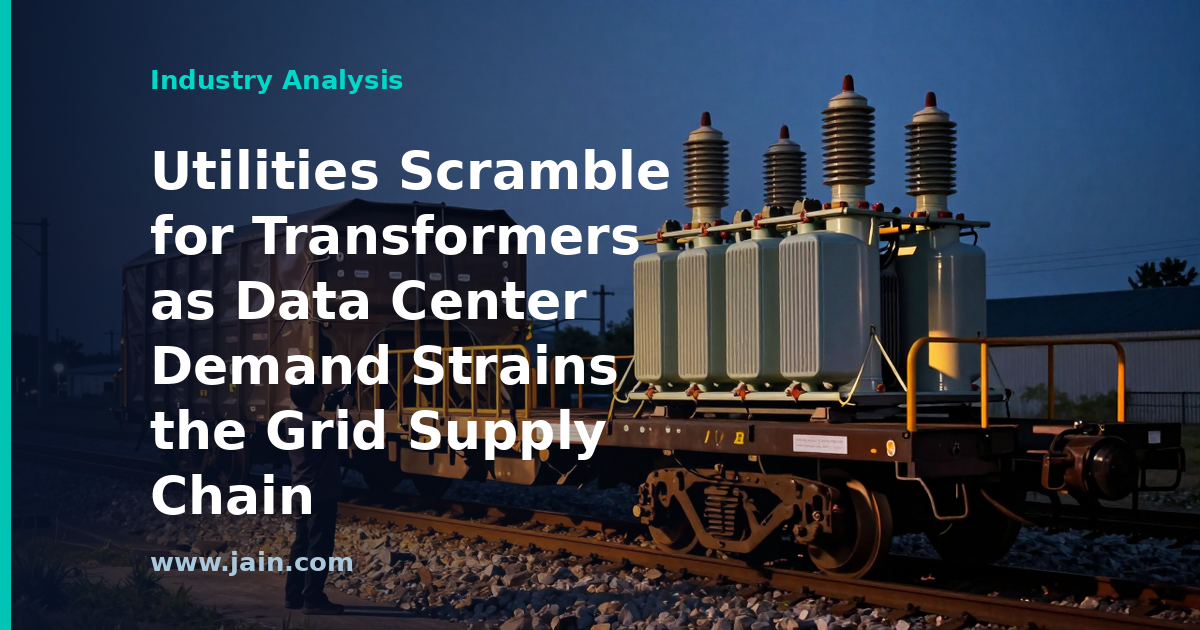
Large power transformers are a category of equipment that behaves almost nothing like the rest of the technology stack. They are custom-engineered for a specific site and voltage, built from specialized steel and copper by a small number of factories worldwide, shipped by rail or heavy haul because of their weight, and ordered years rather than months ahead. There is no spot market and very little interchangeability: a unit built for one substation is generally not a drop-in for another.
That structure means supply responds slowly to demand. When a new class of buyer appears — and hyperscale and colocation data centers are exactly that, requesting utility interconnections at industrial scale — the queue lengthens rather than the price simply clearing the market. Utilities, which need the same equipment for ordinary replacement and storm hardening, are competing in that same queue, and they generally have regulatory obligations that make waiting expensive in a different way.
Into that market comes a restriction on a subset of foreign-made equipment. The mechanical effect is straightforward even without knowing the specifics: fewer eligible suppliers for the same volume of orders means longer waits, more competition for domestic and allied production slots, and a stronger bargaining position for whoever already holds capacity. Whether that effect is small or severe depends entirely on how much of current supply falls inside the restricted category — which the available reporting does not tell us.
Security Logic and Delivery Logic Are Both Real
The case for restricting foreign grid hardware rests on a straightforward premise: modern transformers, breakers, and substation controllers contain firmware and often communications interfaces, and equipment installed at the base of the power system is difficult to inspect, expensive to replace, and long-lived. A component compromised at manufacture could sit in place for decades. This is not a novel concern invented for this order — a 2020 executive order on securing the bulk-power system pursued the same theory, and successive administrations have kept the underlying question open rather than settling it.
The fair question to put to that case is evidentiary: what specifically has been found, and does the response match the finding? Emergency authority is a blunt instrument, and the difference between “we have identified compromised units in service” and “we judge this supply route to be an unacceptable theoretical risk” is the difference between two very different policies. Declarations of this kind are frequently issued without a public factual record; that is normal for classified material and also normal for weak cases, and from the outside the two look identical.
The same scrutiny belongs on the industry side. Utilities and equipment buyers will argue that restrictions raise costs and delay projects, and that argument is both true and self-interested — it is the response any purchaser gives to any supplier restriction. The useful question for readers is not who is complaining but what the measurable effect is: how many units, from which sources, on what delivery schedules, and whether qualified alternatives exist at comparable lead times.
Who Gains and Who Absorbs the Cost
The clearest beneficiaries of a narrowed supplier pool are manufacturers already inside it. Domestic and allied-country producers of transformers and switchgear gain pricing power and order-book visibility, which is precisely the condition under which firms are willing to finance new plant capacity. If the restriction is durable and clearly scoped, it can function as the demand signal that domestic manufacturing has historically lacked. If it is ambiguous or expected to be reversed, it produces the price effect without the capacity investment — the worst of both outcomes.
The cost lands first on projects that have not yet locked their electrical equipment orders. In practice that means later-stage entrants to the data center buildout rather than the incumbents: operators who placed equipment orders early, or who acquired sites with interconnection agreements and equipment already secured, are insulated. Those competing for slots now face a smaller field of eligible vendors. This tends to advantage large, well-capitalized buyers who can pre-purchase inventory and absorb carrying costs, and to disadvantage smaller developers.
For end customers of infrastructure — enterprises buying colocation, cloud capacity, or connectivity — the effect arrives indirectly and with a lag, as availability rather than as a line item. Capacity that cannot be energized on schedule shows up as longer waits for space and power in constrained metros, and as more pressure to consider secondary markets where interconnection queues are shorter.
What Careful Buyers Do Before the Rules Firm Up
The practical response to an announced-but-unspecified restriction is not to rewrite procurement strategy on a headline. It is to establish exposure: which equipment on order originates where, which suppliers are subcontracting to manufacturers that might fall within scope, and what the contractual position is if a delivery becomes non-compliant mid-order. Many buyers do not have that visibility past their immediate vendor, and building it is useful regardless of how this particular order is written.
The second move is to check where risk sits in existing contracts. Force majeure and regulatory-change clauses in equipment and construction agreements determine who eats a delay caused by a government restriction, and those clauses vary widely. This is a cheap thing to review now and an expensive thing to discover later.
The third is patience about the analysis itself. Emergency declarations are typically followed by implementing rules, definitions, exemption processes, and often litigation — and the scope can change materially at each step. Until the implementing detail is published, the responsible position is that the direction of the effect on grid-equipment lead times is upward and the magnitude is unknown.
Background
The electrical grid runs on a class of equipment that is unglamorous, extremely long-lived, and produced by a concentrated global supplier base. Large power transformers in particular are engineered to order, take years to procure, and cannot be swapped between sites. Because replacement cycles are measured in decades, a decision about what equipment is allowed into the system today shapes the physical grid well past the term of any administration that makes it.
Concern about foreign-supplied grid hardware has been a recurring feature of U.S. policy rather than a new development, including a 2020 executive order aimed at securing the bulk-power system. What has changed is the demand side. Data centers built for AI and cloud workloads have become a significant new source of load growth, requesting utility interconnections at a scale and pace that the equipment supply chain was not sized for. Restrictions on supply and a surge in demand are now arriving in the same market at the same time, which is why a policy question that once concerned mainly utilities and regulators is now a scheduling question for anyone building compute.
The Tennessee Valley Authority (TVA) will charge data centers more for power under a separate rate, according to an April 28, 2026 report by the Chattanooga Times Free Press. The federally owned utility, which supplies electricity across Tennessee and parts of six neighboring states, is effectively carving hyperscale computing load out of its general commercial and industrial rate structure and pricing it as its own customer class.
Executive Summary
According to the report, TVA — the largest public power provider in the United States — is establishing a distinct rate under which data centers will pay more for electricity than they would under existing industrial tariffs. A “rate class” is the category a utility assigns to groups of customers with similar usage patterns; creating a new one for data centers means the utility believes this load is different enough in size, growth, and risk to deserve its own pricing.
Why it matters: this is one of the clearest signals yet that utilities are no longer treating gigawatt-scale computing demand as ordinary industrial load. When a system as large as TVA’s formalizes a premium rate for data centers, it sets a reference point that other utilities, regulators, and public power boards across the country can cite. For operators planning campuses in the Tennessee Valley — a region that has actively courted data center investment — the cost of power, typically the largest ongoing operating expense of a data center, just became a moving target.
Pricing Hyperscale Load as Its Own Risk Category
Utilities have historically loved large industrial customers: steady, predictable consumption spreads fixed grid costs over more kilowatt-hours, which can lower rates for everyone. Data centers complicate that logic. They arrive in enormous increments, request interconnection faster than generation and transmission can be built, and — critically — a project can be cancelled or relocated after a utility has committed capital to serve it. A separate rate class is the standard regulatory tool for isolating that risk: it lets the utility recover the cost of serving data centers from data centers, rather than socializing it across households and smaller businesses.
The reported move fits a broader pattern. Utilities and regulators in several U.S. markets have been developing large-load tariffs with features like minimum-demand charges, longer contract terms, and collateral requirements. TVA formalizing a higher rate suggests the debate has shifted from whether hyperscale load should be treated differently to how much more it should pay.
What a Premium Rate Means for Data Center Economics
Electricity is usually the single largest recurring cost of operating a data center, and for AI-oriented facilities running dense, power-hungry hardware, the sensitivity is even greater. A structurally higher rate changes site-selection math: the Tennessee Valley’s traditional pitch — abundant, relatively inexpensive, largely carbon-light power from a mix that includes nuclear and hydro — becomes less differentiated if data centers pay a premium over the headline industrial rate. The report does not disclose the size of the premium, so the practical impact could range from a rounding error to a genuine deterrent.
Operators have levers in response: negotiating long-term supply agreements, bringing their own generation or storage to the table, or shifting flexible workloads to hours when the grid has spare capacity. But each of those adds complexity and capital cost, and none fully escapes a tariff that applies by customer class. The likely near-term effect is that hyperscalers press for contract structures — rather than published rates — where their scale gives them negotiating room.
A Public Power Precedent With National Reach
TVA occupies an unusual position: it is a federally owned corporation that sets its own rates through its board rather than through a state public utility commission. That autonomy means it can move faster than investor-owned utilities, whose large-load tariffs must survive contested rate cases. If TVA’s data center rate takes effect as reported, it becomes an operating precedent other utilities can point to when they argue that hyperscale customers should carry a larger share of grid-expansion costs.
There is a fairness argument on both sides worth stating plainly. Ratepayer advocates contend that residential customers should not fund transmission and generation built for a handful of technology companies. Data center operators counter that they are long-tenured, high-load-factor customers whose demand justifies infrastructure the whole region eventually benefits from, and that punitive pricing simply pushes investment — and its tax base and jobs — to neighboring territories. The reported story does not resolve which framing TVA’s rate design reflects, and the details of the tariff will determine whether it reads as prudent risk allocation or as a growth deterrent.
Background
The Tennessee Valley Authority was created by Congress in 1933 and grew into the largest public power system in the country, serving roughly ten million people through a network of local power companies. Its generation mix — including nuclear, hydroelectric, gas, and coal — and its historically competitive industrial rates helped make the Tennessee Valley a magnet for energy-intensive industry, and more recently for data center development tied to cloud and AI growth.
That growth collided with a nationwide reality: electricity demand, flat for two decades, began rising sharply as hyperscale computing facilities requested interconnections measured in hundreds of megawatts. Utilities across the U.S. responded by rethinking how such load is priced and contracted, seeking to protect other ratepayers from stranded-cost risk. TVA’s reported creation of a separate, higher data center rate places it among the most prominent utilities to formalize that shift.
Commonwealth Fusion Systems (CFS) announced on April 27, 2026 that it has become the first fusion energy company to apply for interconnection with PJM Interconnection, the regional transmission organization that operates the largest wholesale electricity market in the United States. The application is a procedural but symbolically significant step toward connecting a commercial fusion power plant to a grid whose demand forecasts are being rewritten by data-center growth.
Executive Summary
An interconnection application is the formal request a power-plant developer files with a grid operator to study how, where, and under what upgrades a new generator can plug into the transmission system. By filing with PJM — the grid operator serving 13 states and the District of Columbia, including Virginia’s data-center corridor, the densest concentration of data centers in the world — CFS is putting a commercial fusion plant into the same planning machinery that governs gas turbines, solar farms, and batteries.
The move matters for two reasons. First, it converts fusion from a laboratory narrative into a grid-planning line item: PJM’s engineers will now study a fusion plant as a real prospective resource. Second, it lands in the middle of the defining energy story of this decade — surging electricity demand from AI data centers colliding with a constrained interconnection process. CFS has previously announced plans to build its first commercial plant, ARC, in Chesterfield County, Virginia, squarely inside PJM territory, so the filing is consistent with the company’s publicly stated roadmap rather than a change of direction.
What the announcement does not do is demonstrate fusion power. CFS’s demonstration machine, SPARC, is still working toward showing net energy gain from fusion, and an interconnection application is a request to be studied — not evidence that electrons will flow on any particular date.
Why PJM Is the Grid Fusion Wants to Join
PJM is not a random choice of market. It serves roughly 65 million people across the Mid-Atlantic and parts of the Midwest, and it contains Northern Virginia — the largest data-center market on the planet. PJM’s own load forecasts have swung sharply upward in recent years on data-center growth, and its capacity auctions (the market that pays generators to be available) have cleared at record prices, a signal that the system is tightening. For any company selling firm, carbon-free power, PJM is where scarcity, willingness to pay, and hyperscaler customers all converge.
That context explains the strategic logic. CFS has already named Chesterfield County, Virginia as the intended site for ARC, its first commercial plant, and in 2025 it announced that Google agreed to purchase a share of ARC’s planned output. An interconnection application is the necessary next link in that chain: no interconnection study, no grid connection; no grid connection, no power sales. Filing now starts a clock that famously runs long — PJM’s interconnection queue has been one of the most congested in the country, and reforms to speed it up are still working through a multi-year backlog.
A Milestone of Process, Not Yet of Physics
It is worth being precise about what “first fusion company to apply to PJM” establishes. It is a genuine first, and firsts in regulatory process have real value: they force grid operators to develop review practices for a new technology class, and they give financiers a concrete, dated artifact of commercial progress. But an application is an entry ticket to a study process, not a commitment by PJM, a permit, or a construction start. Thousands of megawatts enter regional interconnection queues every year and a large fraction never get built.
The deeper uncertainty is scientific and engineering risk. Fusion — fusing light atomic nuclei to release energy, the process that powers the sun — has never produced net electricity in a commercial setting. CFS’s approach uses high-temperature superconducting magnets to shrink the tokamak (a donut-shaped magnetic confinement device) to commercially plausible size, and its SPARC demonstration machine in Devens, Massachusetts is the intended proof point. Until SPARC demonstrates energy gain, every downstream commercial milestone, this filing included, is contingent. The release, appropriately read, is a statement of sequencing and seriousness rather than of achievement.
The Economics of Being First in Line
There is a rational commercial reason to file early even with technology risk unresolved: interconnection positions are time-consuming to obtain and increasingly valuable. In a market where new gas plants face turbine backlogs and new transmission takes a decade, a studied, approved grid position is itself an asset. If fusion works on anything like CFS’s timeline, holding a place in PJM’s process could compress years off commercialization. If it slips, the sunk cost of an application is modest relative to the company’s overall capital raise — CFS is among the best-funded private fusion companies, having raised on the order of billions of dollars from private investors.
For competitors — other fusion developers, but also advanced nuclear fission companies courting the same data-center buyers — the filing raises the bar on what “commercial traction” looks like. Announcing a site, an anchor customer, and now a grid application is a coherent commercialization story that rivals will be pressed to match. For utilities and grid planners, it is an early test case in how to underwrite a resource class with no operating history: what capacity value, what outage assumptions, what interconnection requirements apply to a first-of-a-kind fusion plant are all questions PJM now has to begin answering in practice.
What It Means for Data-Center Buyers
For data-center operators and the enterprises behind them, the practical takeaway is about the shape of the late-2020s and 2030s power market, not near-term procurement. Fusion, if delivered, is the profile hyperscalers say they want: firm, dense, carbon-free generation that can sit near load. Google’s early offtake commitment to ARC showed that large buyers are willing to pay today to option that future. This filing adds a data point that the pipeline behind such deals is advancing through real regulatory machinery. But no operator should plan capacity around fusion this decade; the sober read is that fusion is now competing in the same queues and processes as everything else — which is exactly where a maturing technology should be.
Background
Commonwealth Fusion Systems spun out of MIT’s Plasma Science and Fusion Center in 2018 with a bet that high-temperature superconducting magnets could shrink tokamak fusion reactors to commercially buildable size. Backed by billions in private capital, it is building SPARC, a demonstration machine in Devens, Massachusetts intended to show net energy gain, and has announced ARC, its first commercial plant, for Chesterfield County, Virginia — with Google signed on in 2025 as an early purchaser of a portion of ARC’s planned output.
The announcement lands amid a structural shift in U.S. electricity markets: after two decades of flat demand, load is growing again, driven substantially by AI data centers concentrated in PJM territory. Capacity prices have set records and interconnection queues are congested, making grid access itself a scarce, strategically valuable asset — the backdrop against which a pre-revenue fusion company filing a grid application is genuinely newsworthy.
An entity calling itself the Transatlantic Investment Group announced on April 27, 2026 a €50 billion AI data center and innovation campus in Croatia. The announcement describes the project as the largest investment in Croatian history and among the largest private U.S. investments in Europe. Beyond that headline framing, the release provides few operational details — no named site, power figure, timeline, or anchor tenant.
Executive Summary
The announcement positions Croatia — an EU, eurozone, and Schengen member on the Adriatic — as the destination for one of the largest AI infrastructure commitments ever declared in Europe. A €50 billion figure, if realized, would place the project in the same conversation as the multi-hundred-billion-euro wave of AI campus announcements that has swept the U.S. and, increasingly, Europe and the Gulf since 2024.
Why it matters: hyperscale AI buildout is going global. Power, land, and permitting constraints in Europe’s established data center markets — Frankfurt, London, Amsterdam, Paris, Dublin — have pushed developers toward secondary markets, and a commitment of this size in Croatia would be the strongest signal yet that the frontier has moved to Southeast Europe. But the announcement, as published, is a statement of intent. The distance between a declared figure and energized capacity is measured in grid connections, financing closes, and construction phases — none of which are detailed here. Readers should treat this as a significant claim awaiting substantiation, not a shovel-ready project.
Why Croatia? The Logic of AI’s Geographic Spillover
Europe’s traditional data center hubs are effectively full. Utilities in Dublin and Amsterdam have restricted new grid connections for large facilities, and Frankfurt and London face similar power and land pressure. That has redirected capital toward markets that can offer three things at once: available power, developable land, and EU regulatory standing. Croatia checks the third box cleanly — it is inside the EU single market, the eurozone, and Schengen — which matters for data sovereignty rules that push European enterprises and governments to keep AI workloads on EU soil.
The strategic framing as a “private U.S. investment in Europe” also fits a broader pattern: American capital funding AI capacity abroad, both to serve regional demand and to diversify away from congested U.S. power markets. For Croatia, a country whose economy leans heavily on tourism, an anchor investment in digital infrastructure would be transformative — which is precisely why the announcement’s superlatives deserve careful measurement against what has actually been committed.
What €50 Billion Buys — and What an Announcement Doesn’t
At current costs, hyperscale AI capacity runs very roughly in the tens of millions of euros per megawatt once you include the chips inside. A €50 billion program therefore implies gigawatt-class ambitions — a campus that would rank among the largest in Europe and consume electricity on the scale of a sizable city. Nothing in the announcement explains where that power comes from, and in AI infrastructure, power is the project. Grid interconnection queues, not capital, are the binding constraint almost everywhere.
Industry observers have also learned to discount announcement figures. Across the sector, headline commitments are typically phased over a decade, contingent on demand, and structured so that early phases are a small fraction of the total. That is not a criticism of this project specifically — it is how large campuses are legitimately built — but it means the meaningful milestones to watch are land acquisition, a signed grid agreement, a financing close, and a named hyperscale or AI-lab tenant. None appear in the source material.
Winners, Losers, and the Regional Ripple
If even a first phase proceeds, the beneficiaries are identifiable: Croatia’s grid operator and power producers (who would need to expand generation and transmission), regional construction and electrical trades, European chip-adjacent suppliers of cooling and power equipment, and connectivity providers building fiber routes to link the Adriatic to Frankfurt, Milan, and Vienna. An “innovation campus” component, if real, could seed a local AI workforce — though such components are also the easiest part of an announcement to promise and the last to be funded.
The competitive question is who this capacity would serve. Europe’s AI compute demand is growing, and the EU has actively courted large-scale AI infrastructure through initiatives like its AI gigafactory push. But Croatia would be competing with Spain, the Nordics, and Southern European markets that offer abundant renewables and established subsea connectivity. A project of this scale succeeds or fails on tenant demand, and the announcement names none.
Background
Croatia joined the European Union in 2013 and adopted both the euro and Schengen membership in 2023, completing its integration into the EU single market. Its economy has historically leaned on tourism and shipping, with a small but growing technology sector; it has not previously hosted hyperscale data center capacity, which in Europe has concentrated in the so-called FLAP-D markets — Frankfurt, London, Amsterdam, Paris, and Dublin.
That concentration is now breaking up. Power and land constraints in the established hubs, EU data sovereignty rules encouraging in-region AI capacity, and Brussels-backed initiatives to attract large-scale AI computing have pushed developers toward Southern and Eastern Europe. The Croatian announcement, if substantiated, would be the largest expression of that shift to date.
Latitude Media reports that the physical realities of the electric grid are “setting in” for the data center development pipeline. The April 26, 2026 piece frames a shift the industry has been circling for two years: the constraint on new AI-driven data center capacity is increasingly not capital, land, or chips, but whether the grid can physically deliver the power — and how long interconnection and transmission upgrades take.
Executive Summary
The report’s core observation is that the announced data center pipeline — the sum of projects developers have declared — is colliding with what the transmission system can actually serve. Interconnection (the formal process of connecting a large new load or generator to the grid) and transmission capacity (the physical ability of high-voltage lines to move power to a given location) operate on utility timescales measured in years, while hyperscale demand has been announced on timescales measured in quarters.
Why it matters: if grid physics is the binding constraint, then the familiar metrics of the buildout — megawatts announced, acres acquired, capital committed — stop predicting what actually gets energized and when. Siting strategy shifts from “where is land and fiber” to “where is deliverable power,” and the advantage moves to players who secured interconnection positions early or who can bring their own generation.
Announced Megawatts Are Not Energized Megawatts
A recurring pattern in this cycle is the gap between the announced pipeline and deliverable capacity. A developer can buy land, order equipment, and issue a press release in months; a utility must study the new load’s effect on the surrounding network, plan any needed substation and transmission upgrades, and build them — a sequence that routinely runs on multi-year timelines. The Latitude Media framing, that physical realities are “setting in,” suggests the market is starting to discount announcements accordingly. For readers of industry news, the practical takeaway is to treat energization dates, not announcement dates, as the real milestone.
Why Transmission Is the Hard Constraint
Transmission is unforgiving because it is physics plus process. Physically, a high-voltage line can carry only so much power before thermal and stability limits bind, and a concentrated gigawatt-scale load changes flows across an entire region, not just one feeder. Procedurally, upgrades require engineering studies, regulatory approvals, cost-allocation fights over who pays, and often new rights-of-way. None of these steps compresses easily with money. That is what distinguishes this bottleneck from earlier ones like GPU supply or land: you cannot pay a premium to make load-flow studies and line construction happen in a quarter.
Winners: Whoever Holds Deliverable Power
If interconnection position is the scarce asset, several groups benefit. Incumbent data center operators with existing utility relationships and already-energized capacity hold something new entrants cannot quickly replicate. Sites with surplus deliverable power — including brownfield industrial locations with legacy grid infrastructure — gain value relative to greenfield land. And “bring your own power” strategies, from on-site generation to co-location with existing plants, move from novelty to mainstream consideration, though they introduce their own permitting, fuel, and regulatory questions. Conversely, late-arriving developers whose projects sit deep in interconnection queues face the risk that their capacity arrives after the demand it was meant to serve has been placed elsewhere.
The Siting Map Is Being Redrawn
For two decades, data center geography followed fiber routes, tax incentives, and cheap land. A grid-constrained era redraws that map around electrical headroom: regions with spare transmission capacity, faster-moving utilities, or generation-rich locations become competitive even without a legacy data center cluster. This also raises a policy dimension — utilities and regulators must decide how much speculative load to plan for, and how to protect other ratepayers from paying for infrastructure serving projects that may not materialize. How that risk gets allocated will shape which regions court this demand and which slow-walk it.
Background
Data center development historically treated electricity as a routine input: sites were chosen for fiber connectivity, land cost, and tax treatment, and utilities absorbed the load growth without drama. The AI buildout that accelerated from 2023 onward broke that assumption, with individual campuses proposed at power levels comparable to heavy industry and developers announcing capacity far faster than grid infrastructure has historically been built.
By 2026 the conversation across the industry had shifted from chip supply and capital availability to power delivery — interconnection queues, transformer and equipment lead times, and transmission planning. The Latitude Media piece discussed here sits in that context: an energy-sector publication documenting the moment when the announced pipeline meets the grid’s physical and procedural limits.
A 9-gigawatt AI data center campus backed by investor Kevin O’Leary has been approved in Utah, according to an April 26, 2026 report from Tom’s Hardware. The project is described as generating and consuming more than twice the amount of power the entire state of Utah currently uses — placing it among the largest data center developments ever announced anywhere in the world.
Executive Summary
The headline fact is the scale: 9 gigawatts is not a data center in any conventional sense — it is a power project with computing attached. For perspective, 9GW is roughly the output of nine large nuclear reactors, and the report frames it as more than double Utah’s entire statewide electricity draw. Notably, the report says the campus will generate as well as consume that power, which signals a behind-the-meter model: building dedicated generation on site rather than asking the regional grid to supply it.
The second fact is the word “approved.” Some jurisdictional body has said yes to something — but at headline level, the report does not specify which approval this is: land-use zoning, an air-quality permit, a generation license, or a state economic-development agreement. In mega-project development, each of those is a different gate, and clearing the first one is a long way from moving dirt. What is substantiated here is an approval milestone for an extraordinarily ambitious plan; what is not yet substantiated is financing, customers, a construction timeline, or the generation technology behind the 9GW figure.
A Power Plant First, a Data Center Second
The most telling detail in the report is that the campus will “generate and consume” its power. AI campuses at gigawatt scale have collided with a hard constraint across the United States: utility interconnection queues — the waiting lines to connect large new loads to the grid — now stretch years in many regions. Developers who cannot wait are going behind the meter, building their own gas turbines, and in some proposals nuclear or geothermal capacity, dedicated to the site. A 9GW self-generation plan sidesteps the queue but inherits a different set of problems: gas turbine order books are backed up years, fuel supply must be contracted at enormous volume, and on-site generation still typically requires air-quality permits and some grid tie for backup and startup power.
For lay readers, the practical meaning is this: the binding constraint on AI infrastructure has shifted from chips and buildings to electricity. Projects are now sized and sited around where power can be created, not where fiber or customers happen to be. Utah — with land, gas access, and a development-friendly posture — fits that new map.
What “Approved” Does and Does Not Mean
Approval is a genuine milestone; it is also the cheapest one. The industry has spent the past two years in an announcement race, with proposed multi-gigawatt campuses in the U.S., Canada, and the Gulf states collectively promising far more capacity than the supply chain — turbines, transformers, switchgear, chips, and skilled labor — can deliver on the advertised timelines. Analysts increasingly distinguish between announced gigawatts and energized gigawatts, and the gap between the two is wide. Kevin O’Leary himself previously announced a separate multi-gigawatt AI data center park in Alberta, Canada, which illustrates the pattern: high-profile backers can secure land and early approvals quickly, while the capital-intensive middle of the project — measured in tens of billions of dollars for a campus this size — takes years and committed tenants to close.
None of that makes the Utah project unserious. It makes it unproven, which is the honest status of nearly every gigawatt-class announcement at the approval stage. The credible test will be what follows: named anchor tenants, equipment orders, and financing commitments, not renderings.
Winners, Losers, and the Utah Question
If the campus advances, the near-term winners are clear: turbine and electrical-equipment manufacturers with the scarcest order slots, construction and trades labor in Utah, and the state’s tax base. Hyperscalers and AI labs hungry for capacity gain another potential supply option in a market where powered land is the scarcest commodity. The open question is who bears the risks. Behind-the-meter gas generation at this scale raises air-quality and emissions questions; data centers in the arid West raise water and cooling questions; and residents near any 9GW generation complex will have views on all of it. A project sized at more than twice the state’s current consumption will, fairly or not, become a referendum on how Utah wants to participate in the AI buildout — and community sentiment has already slowed or stopped large data center proposals in other states. Developers who engage those concerns early, with specific commitments on emissions, water, and grid impact, have fared better than those who lead with the gigawatt number.
Background
The AI boom has turned electricity into the data center industry’s scarcest input. Training and running large AI models requires dense clusters of power-hungry chips, and since 2023 developers have raced to secure “powered land” — sites where gigawatt-scale electricity can be delivered or built. With utility interconnection queues stretching years, a new class of power-first campuses has emerged that builds its own generation on site, and announced capacity across North America and the Gulf now far outstrips what has actually been energized.
Kevin O’Leary, the investor and Shark Tank personality behind O’Leary Ventures, entered this race with a previously announced multi-gigawatt AI data center park in Alberta, Canada. The Utah campus extends that playbook to the U.S. at even larger scale: at 9GW, the approved plan would exceed the entire current power draw of the state that will host it — a first even by the standards of this buildout.
A project profile published April 25, 2026 by Northwise Project details a 310 megawatt (MW) data center in Lappeenranta, Finland attributed to Nebius Group, the Amsterdam-headquartered AI infrastructure company that trades on Nasdaq under the ticker NBIS. The report frames the facility as an “AI factory” — a data center purpose-built for training and running artificial-intelligence models rather than for general-purpose computing.
At 310 MW, the Lappeenranta site would sit firmly in the top tier of European data center projects by power capacity, and would extend Nebius’s existing Finnish footprint, anchored by its long-running campus in Mäntsälä.
Executive Summary
The headline fact is the number: 310 MW of power capacity dedicated to AI computing in a single Finnish location. Power capacity — the electricity a facility can draw and convert into computation — has become the standard yardstick for AI infrastructure because modern graphics processing units (GPUs) are constrained less by floor space than by the megawatts available to feed and cool them. A conventional enterprise data center might draw a few megawatts; 310 MW is the scale at which a facility can host tens of thousands of accelerators and compete for the largest AI training workloads.
The location is just as telling as the size. Finland offers a cool climate that slashes cooling costs, a grid that is among Europe’s most carbon-free, political stability inside the EU, and — in Nebius’s case — years of accumulated operating experience in the country. Lappeenranta, a university city in southeastern Finland, adds a local energy-engineering talent base.
What the profile does not settle is equally important: it is a single third-party report, and details on timeline, phasing, investment, power contracts, and customers are not substantiated in the source material. The scale claim is specific, but readers should treat the project’s parameters as reported rather than independently confirmed.
Why Finland Keeps Winning AI Capacity
Finland has quietly become one of Europe’s most competitive destinations for compute-intensive infrastructure, and the reasons are structural rather than promotional. Cooling is one of the largest operating costs in a data center, and Finland’s climate allows “free cooling” — using outside air or nearby water — for much of the year. The Finnish grid is also unusually clean, drawing heavily on nuclear, hydro, and wind, which matters both for operating economics and for AI customers facing sustainability reporting obligations in the EU.
Nebius knows this terrain better than most entrants. Its Mäntsälä campus, inherited from the company’s pre-2024 corporate history, is well known in the industry for piping waste heat from servers into the local district heating network — turning a cost center into community energy. A second, far larger Finnish site would suggest the company is doubling down on a playbook it has already proven, rather than experimenting in an unfamiliar market.
What 310 MW Actually Buys
For readers outside the industry: data centers are sized by power, not square footage, because electricity is the true scarce input. A 310 MW facility operates on a different plane from traditional colocation sites. Individual AI server racks now draw 100 kilowatts or more — ten times the density of conventional racks — so hundreds of megawatts translate into the tens of thousands of GPUs needed to train frontier-scale models.
The “AI factory” framing is more than marketing shorthand. Purpose-built AI facilities differ from general-purpose data centers in their electrical distribution, liquid-cooling infrastructure, and network fabric, which must move enormous volumes of data between GPUs at very low latency. Retrofitting a legacy facility to these specifications is often harder than building new — which is why the current AI cycle is producing greenfield gigascale campuses rather than expansions of existing colocation stock.
Nebius and the Neocloud Race
Nebius belongs to a category investors have taken to calling “neoclouds”: companies that rent GPU capacity for AI workloads, competing with the hyperscale clouds on price, availability, and specialization. The strategic logic of a 310 MW owned site is vertical integration — controlling land, power, and buildings rather than leasing from wholesale data center providers should yield structurally lower cost per GPU-hour, which is the metric on which this market ultimately competes.
The risk side of that logic is capital intensity. Facilities at this scale require investment in the billions of dollars before revenue arrives, and the GPU rental market is young, with demand concentrated among a relatively small set of AI labs and enterprises. A purpose-built AI factory is a leveraged bet that today’s extraordinary demand for training and inference capacity persists through the multi-year window it takes to permit, build, and fill such a site. That bet may well pay off — but it is a bet, and the source material offers no visibility into how this one is financed or contracted.
Europe’s Sovereignty Subtext
A gigascale AI facility on EU soil lands in the middle of Europe’s “sovereign AI” debate — the push to ensure European companies and governments can access frontier compute under European jurisdiction rather than depending entirely on U.S.-based capacity. An Amsterdam-headquartered operator building hundreds of megawatts in Finland fits that narrative neatly, and European AI startups and public-sector buyers are an obvious customer constituency.
Whether the project actually serves that market, or is absorbed by one or two large anchor tenants, is not something the source addresses. The distinction matters: a facility serving broad European demand changes the region’s compute landscape; a facility pre-committed to a single large customer changes one company’s supply chain. Both are legitimate businesses, but they have different implications for European AI buyers watching capacity announcements with interest.
Background
Nebius Group took its current form in 2024, when Yandex N.V. — the Dutch holding company of the Russian internet group — sold its Russia-based businesses and rebuilt itself around international assets, including a data center in Mäntsälä, Finland. Rebranded as Nebius and relisted on Nasdaq under the ticker NBIS in October 2024, the company positioned itself as a European-rooted provider of AI cloud infrastructure, backed by partnerships in the Nvidia ecosystem and an aggressive data center expansion program across Europe and beyond.
The broader backdrop is a global scramble for AI compute. Training and serving large AI models requires unprecedented concentrations of GPUs and electricity, and power availability has replaced land or fiber as the industry’s gating resource. The Nordics — with cool climates, clean grids, and supportive municipalities — have become one of the main theaters for this build-out, and Finland in particular has converted those advantages into a steady pipeline of hyperscale and AI-specialized projects.