Kentucky’s Public Service Commission has approved a power agreement covering 482 megawatts (MW) for TeraWulf’s Justified data center campus, according to reports from Spectrum News, Blockspace Media, and a Yahoo Finance industry roundup. TeraWulf (Nasdaq: WULF) is a power-focused digital infrastructure company that built its business on bitcoin mining and has been expanding into AI and high-performance computing hosting.
The same roundup that carried the approval also noted two related industry signals: Morgan Stanley sees an uptick in “powered shell” deals — transactions for buildings with power secured but computing equipment not yet installed — and mining-services firm Luxor is piloting GPU curtailment, the practice of throttling AI chips during grid stress. Together they sketch a market organizing itself around electricity, not hardware.
Executive Summary
The headline fact is regulatory, not technical: a state utility commission has signed off on nearly half a gigawatt of electric supply for a single data center campus. In most U.S. states, when an industrial customer of this size negotiates a supply arrangement with a utility, the deal must be approved by the Public Service Commission (PSC) — the state body that oversees utility rates — largely to ensure ordinary ratepayers are not left subsidizing a private buildout. Clearing that gate is what converts a data center site from a land parcel into a bankable project.
That is why this approval matters beyond TeraWulf. Across the AI infrastructure market, the binding constraint has shifted from acquiring GPUs to securing firm, utility-scale power on a defensible timeline. A 482 MW allocation — on the order of the electricity draw of a small city — is precisely the kind of milestone that lenders, tenants, and investors now treat as the real start line for a campus. The reports, however, are thin on terms: pricing, energization schedule, counterparty details, and tenant commitments are not disclosed, so the approval should be read as a necessary step, not a finished project.
Power, Not Silicon, Has Become the Scarce Input
Two years ago, the defining shortage in AI infrastructure was accelerator chips. Today, developers can generally buy or lease GPUs faster than they can energize buildings to run them. Grid interconnection queues, transmission upgrades, and utility rate proceedings run on multi-year timelines that no amount of capital compresses quickly. A regulatory order granting 482 MW is therefore a genuinely scarce asset — arguably scarcer than the computing hardware that will eventually sit behind it.
The market is pricing this in. Morgan Stanley’s reported observation of rising powered-shell deal activity — buyers paying for structures whose main value is a secured power allocation rather than installed equipment — is direct evidence that megawatts, not square footage or servers, carry the premium. When the shell is worth more powered than fitted out, the industry is telling you where the bottleneck is.
Why the Regulatory Approval Is the Real Milestone
Large power agreements between utilities and single customers typically require commission review because they can shift costs onto other ratepayers or strain regional supply. A PSC approval signals that regulators examined the arrangement and judged it consistent with the public interest — a de-risking event that private negotiations alone cannot provide. For project finance, an approved power agreement is the difference between a story and a schedule.
It also reflects a competition among states. Data center campuses bring construction activity, tax base, and some permanent jobs, and states with available generation and transmission capacity are positioned to win projects that power-constrained markets cannot host. Kentucky approving a deal of this size suggests its regulators concluded the grid can accommodate the load — a judgment other states are increasingly unable to make. What the reports do not show is the fine print of that judgment: rate design, curtailment obligations, and who pays for any grid upgrades all determine whether the deal is as good as the headline.
TeraWulf’s Pivot and the Miner-to-AI Playbook
TeraWulf is a case study in a broader migration. Bitcoin miners spent a decade acquiring exactly the assets AI now needs: large grid interconnections, industrial sites, and operational experience running dense computing loads. Converting or extending those assets to serve AI and high-performance computing tenants — who pay contracted, recurring rates rather than volatile mining rewards — has become the dominant strategic play for the sector. The Justified campus approval extends TeraWulf’s footprint beyond its established New York operations and adds to the inventory of power it can offer future tenants.
The Luxor GPU curtailment pilot mentioned in the same roundup is the other half of the playbook. Curtailment — voluntarily reducing power draw when the grid is stressed, a practice miners refined for years — is now being adapted to GPU fleets. If AI loads can flex, utilities and regulators can approve more of them; flexibility is effectively a currency data center operators can spend to win allocations like this one.
What Is Substantiated — and What Is Not
It is worth being plain about the sourcing: these are aggregated news reports of a regulatory action, not a detailed order or company filing presented with terms. The 482 MW figure and the PSC approval are consistently reported across outlets. What is not substantiated in the available material: contract pricing, the delivery timeline, the phasing of the load, financing for the campus buildout, and — critically — whether any tenant has committed to occupy the capacity. An approved power agreement creates the opportunity to build a revenue-generating campus; it does not by itself demonstrate demand, and readers should weight the milestone accordingly.
Background
TeraWulf went public in 2021 as a bitcoin miner differentiated by its focus on low-cost, predominantly zero-carbon power, with its flagship Lake Mariner facility on the site of a former coal plant in western New York. Like much of the mining sector, it has since repositioned toward AI and high-performance computing hosting, where long-term contracts with computing tenants offer steadier revenue than mining. The Justified campus in Kentucky represents an expansion of that strategy beyond its original footprint.
The broader backdrop is an unprecedented collision between AI demand and the U.S. electric grid. Data center power consumption is growing faster than transmission and generation can be added, pushing interconnection queues to multi-year waits and making state regulatory approvals — like this Kentucky PSC order — the decisive milestones in whether and where AI infrastructure gets built.
Vectris Labs, a Birmingham, Alabama startup incubated by Thumos Capital, announced on August 20, 2026 that its Waveform software — a “control plane” that sits between AI serving infrastructure and the GPU — recovered substantial unused capacity from GPUs already in production racks. In company-run tests of Mistral inference workloads on RunPod-hosted NVIDIA hardware, Vectris measured 30–73% higher throughput, 51–56% lower energy consumption, and 22–42% faster job completion, with no model retraining, weight changes, or GPU-kernel modifications.
Waveform launches October 1, 2026 to a limited set of design partners. The results are Vectris-measured and, by the company’s own disclosure, have not yet been independently reproduced in customer production.
Executive Summary
The announcement reframes the AI capacity crunch — the industry-wide shortage of GPUs, data-center space, and grid power — as partly a software-efficiency problem. Vectris claims to have found “deterministic structural patterns” in AI inference (the process of running a trained model to answer queries) that reveal where deployed GPUs are wasting cycles, and to have built software that captures that waste as productive output. The company brands the resulting metric Compute Yield™: how much quality-equivalent, accepted AI output an operator gets from infrastructure already in place.
If the numbers hold up outside Vectris’ own testing, the implications are significant. At even the conservative +30% end of its measured range, the company illustrates that a 10,000-GPU fleet would produce output comparable to 13,000 GPUs — capacity gained without new hardware, new power contracts, or new construction. Vectris is explicit that this is an extrapolation, not a measured deployment.
The caveats matter as much as the headline. The figures come from one model family (Mistral), one hosting environment (RunPod), and one measuring party (Vectris itself). The release is unusually candid about those limits, which is to its credit — but it also means the claim currently rests entirely on vendor-run benchmarks awaiting independent reproduction.
Efficiency Is the New Front in the AI Capacity War
For three years, the dominant response to surging AI demand has been construction: more GPUs, more data centers, more megawatts. But power availability, capital intensity, and build timelines have become structural constraints — a data center can take years to energize, while inference demand compounds monthly. That makes software that extracts more work from installed hardware strategically interesting regardless of which vendor ultimately delivers it. Vectris’ framing — that the binding economic question is shifting from “how many GPUs can you deploy?” to “how much useful output can deployed GPUs produce?” — is a fair description of where operator economics are heading, and it explains why the company says it has engaged a data-center advisory network representing roughly 300 MW of capacity.
The energy numbers may be the most consequential part of the claim for infrastructure operators. A 51–56% reduction in energy per unit of inference work, if reproducible, would ease the single tightest constraint in the industry — grid power — and change the calculus on every pending interconnection queue. That is precisely why the figure deserves the most scrutiny before anyone builds plans around it.
What’s Substantiated — and What Isn’t
The release is more disciplined than most in this category. It names the hardware (H100, H200, B200 on third-party RunPod infrastructure), the workload (Mistral inference), publishes per-GPU figures rather than a single cherry-picked number, labels the 10,000-GPU example as illustrative, and states plainly that results “have not yet been independently reproduced in customer production.” On Intel silicon, Vectris cites 67% energy savings and 32% faster time-to-result using MLPerf LoadGen, a recognized benchmark harness. AMD hardware has been “tested,” but no numbers are given.
What remains unsubstantiated is the core of the claim. The release does not describe the baseline configuration Waveform was compared against — a critical omission, because inference throughput varies enormously with batching strategy, serving stack, and tuning. A 73% gain over a poorly tuned baseline is a very different achievement than 73% over a well-optimized production stack. Vectris says Waveform targets waste “that remains after conventional optimization,” but offers no detail on what conventional optimization was applied. Nor does it explain the mechanism: “deterministic structural patterns” is evocative but not technical, and “quality-equivalent accepted output” — the foundation of the Compute Yield metric — is not defined in measurable terms. None of this means the claims are wrong; it means they are, for now, claims.
Winners, Losers, and the Demand Question
If Waveform performs as described, the clearest winners are inference-heavy operators who are power- or capital-constrained: neoclouds, enterprise AI platforms, and colocation tenants who could defer hardware purchases while serving more demand. Data-center operators face a more nuanced picture — efficiency software could modestly slow demand for new capacity, but historically, cheaper compute has expanded consumption rather than shrinking footprints, a dynamic economists call the Jevons effect. GPU vendors face the same ambiguity: software that makes an H100 do 30–73% more work makes existing fleets more valuable even as it potentially trims marginal unit demand.
Vectris also enters a genuinely crowded field. Inference optimization is one of the most active areas in AI infrastructure — serving frameworks, compilers, schedulers, and quantization techniques all chase the same waste. Vectris positions Waveform as complementary, a layer above the optimized stack rather than a replacement for it. Whether meaningful recoverable capacity really persists after state-of-the-art serving optimizations is exactly the question independent testing needs to answer.
From Benchmark to Business
The commercial plan is early-stage: an October 1, 2026 launch limited to design partners, technical demonstrations with unnamed “AI-infrastructure and channel leaders,” and no disclosed pricing, customers, or funding. The team’s stated pedigree — backgrounds spanning AMD, Graphcore, Oracle Cloud Infrastructure, ByteDance, the U.S. Department of Energy, and Oak Ridge National Laboratory — is relevant to credibility on low-level GPU behavior, but pedigree is not production validation. The supporting quote from Innovate Alabama Chairman Bill Poole speaks to regional economic-development enthusiasm rather than technical endorsement, and the release’s own disclosure notes that third-party names do not imply endorsement. The sensible read: a credible team making a large, testable claim that the market should now test.
Background
Vectris Labs is a newly announced entrant in AI infrastructure software, based in Birmingham, Alabama and incubated by venture firm Thumos Capital — a notable geography in an industry concentrated in traditional tech hubs, and one the release leans into with a supporting quote from Innovate Alabama Chairman Bill Poole. The company says it has completed technical demonstrations with AI-infrastructure and channel leaders and engaged a data-center advisory network representing roughly 300 MW of capacity.
The market context is the defining tension of the current AI buildout: inference — serving trained models to end users — is becoming the dominant AI workload, while power availability and capital costs constrain how fast new GPU capacity can come online. That squeeze has pushed the industry’s attention toward yield: getting more accepted output per deployed GPU, per megawatt, and per dollar, which is precisely the territory Vectris is staking out.
Two senators, one from each party, have proposed a law to prepare the power grid for quantum computers. These are a new kind of machine that could one day crack the digital locks protecting the grid’s control systems.
The bill gives the Energy Department one year to study the danger and set up a test lab where power companies can try stronger locks.
Why it matters: the huge computer warehouses that run artificial intelligence depend on the grid. If the grid’s security slips, their electricity is at risk too.
Legis1 reported that Sens. Chris Coons (D-DE) and Mike Rounds (R-SD) introduced the Quantum Grid Utility Assurance and Resilient Defense Act, or Quantum-GUARD Act, on August 14, 2026. The bill targets a future threat: quantum computers powerful enough to break the encryption that protects the electric grid’s IT and control systems.
The bill would require the Federal Energy Regulatory Commission (FERC) to weigh quantum risks when it reviews grid reliability standards. It would give the Department of Energy one year to stand up a post-quantum cryptography testing sandbox with utilities, grid operators and vendors, and one year to report to Congress on quantum risks to the bulk-power system. IonQ, American Binary, the Quantum Industry Coalition, the Quantum Economic Development Consortium and the Cyber Threat Alliance endorsed it.
Executive Summary
The Quantum-GUARD Act is the first bill aimed specifically at moving the electric grid onto post-quantum cryptography. These are encryption methods designed to withstand attacks from quantum computers. The bill does not order utilities to replace anything. It directs regulators to study the problem, build a joint testing environment and factor quantum risk into the rules that govern grid reliability. Sen. Rounds described it as codifying parts of President Trump’s June executive order on advanced cryptographic attacks, which set a federal policy of moving government systems to NIST-approved post-quantum standards and helping critical infrastructure owners do the same.
For the data center industry, the significance lies in the dependency, not the quantum computers themselves. AI campuses are among the largest new customers of the grid, and their uptime rests on utility control systems they neither own nor secure. Encryption upgrades to those systems are slow to plan and deploy. A bill that starts one-year federal clocks on assessment and testing marks the point at which grid cryptography becomes something power-hungry operators should track alongside capacity, interconnection and price.
Why Grid Encryption Belongs on the AI Power Risk List
A data center’s power is only as dependable as the systems that run the grid behind it. Those systems include substation controls, generator dispatch and the communications between control rooms and field equipment, which engineers call operational technology, or OT. Much of that traffic is protected by public-key cryptography, the same family of math that quantum computers are expected to threaten. The Quantum-GUARD Act names this directly: it would require FERC to consider post-quantum cryptography in both IT and OT systems, and it tasks the Energy Department with identifying obstacles to moving ‘high-value systems’ to new standards.
The one-year deadlines explain why operators should track this now rather than later. Under the bill, DOE’s Office of Cybersecurity, Energy Security, and Emergency Response would have twelve months to launch a testing sandbox and twelve months to deliver findings to the Senate Energy and Natural Resources and House Energy and Commerce committees. Those are the first steps of a migration, not the end of one. Grid control equipment often stays in service far longer than office IT, so any cryptographic change moves through procurement, testing and field replacement over years. For a company planning an AI campus that depends on a particular utility for a decade or more, how that utility handles the transition is a real long-term risk, even though the bill never mentions data centers.
In practice, this is a due-diligence item rather than an alarm. Large-load customers already question utilities about capacity, redundancy and restoration times. The bill’s framework makes it reasonable to add a question about cryptographic readiness, and to expect that the answer will be shaped by whatever the DOE study and sandbox produce.
What the Bill Does, and What It Leaves Open
The bill’s verbs matter. FERC would have to ‘consider’ quantum risk when reviewing proposed reliability standards. That makes quantum risk a factor in rulemaking but sets no deadline for migration. DOE would ‘study’ and ‘establish’ a sandbox, with no requirement that utilities adopt what it finds. This is a framework bill. It builds the evidence base that later mandates, if any, would rest on.
That restraint has advantages. Utilities run a very wide mix of legacy and modern equipment, and a mandate issued before anyone has tested post-quantum algorithms on real grid hardware could cause more reliability problems than it solves. The sandbox exists to test that, bringing utilities, vendors, federal agencies and state and local organizations into one environment to find where new cryptography breaks old equipment. The cost is time. By design, the bill’s first concrete output is a report, and the harder questions of who pays, on what schedule and under what enforcement come after it.
Why Now: The Standards Exist, the Threat Does Not Yet
The timing follows the standards. NIST finalized its first three post-quantum cryptography standards in August 2024 and has encouraged organizations to begin transitioning, which means there is now a defined target to migrate toward. Before that, a grid-specific migration bill would have had nothing concrete to point at.
The threat, by contrast, is still prospective. The bill is framed around protecting the grid ‘before sufficiently powerful quantum computers can undermine existing encryption,’ and it does not say when that might happen. That is the right way to frame it. The argument for starting early rests on how slowly large infrastructure changes its cryptography, not on any fixed date for when quantum machines will arrive. Readers should treat claims of an imminent quantum break, from any side, with the same caution the bill’s own wording shows.
A Quantum Industry Coalition Behind a Grid Bill
The endorsements come mainly from the quantum and cybersecurity sectors: IonQ, a quantum technology company; American Binary; the Quantum Industry Coalition; the Quantum Economic Development Consortium; and the Cyber Threat Alliance. Support from companies that build quantum and security technology is expected and does not weaken the bill’s reasoning, which rests on NIST’s published standards and an existing executive order. It does mean that the people who would carry out the migration, meaning utilities, grid operators and state regulators whose ratepayers ultimately fund utility upgrades, will shape how practical the plan turns out to be, and their public positions on the bill are worth watching.
Background
The US electric grid runs under mandatory reliability standards, including cybersecurity rules. These are largely developed by the North American Electric Reliability Corporation and approved by FERC. The Department of Energy’s Office of Cybersecurity, Energy Security, and Emergency Response (CESER) leads the department’s work on energy-sector security. Grid cybersecurity has historically focused on present-day threats such as intrusions and ransomware. Quantum computing adds a longer-horizon concern: that a sufficiently powerful machine could defeat the public-key encryption that protects much of the grid’s communications.
NIST’s finalization of its first three post-quantum cryptography standards in August 2024 gave organizations a concrete target for migration. Federal policy has since moved toward requiring that transition for government systems and supporting it for critical infrastructure. Meanwhile, rapid data center construction, driven largely by AI, has made grid reliability a central concern for the digital infrastructure industry.
A huge data center campus is being built in Port Washington, Wisconsin. To plug it into the electric grid, it needs new high-voltage power lines and substations costing $1.3 billion to $1.7 billion.
Wisconsin’s utility regulators just sent that power-line plan back to square one. The company behind it changed its paperwork so often, filing or refiling 564 documents, that officials and the public could not keep up.
The takeaway: a building can go up faster than the wires that power it.
Wisconsin’s Public Service Commission (PSC) voted unanimously on Thursday to revoke its “completeness” determination for American Transmission Co.’s application to build the Ozaukee County Distribution project, Wisconsin Public Radio reported. The project is a package of new substations, new high-voltage transmission lines and upgrades to existing infrastructure. ATC told regulators it is needed to serve the hyperscale data center campus under construction in Port Washington. A revised application filed in July put the cost at $1.3 billion to $1.7 billion, and the work would have spanned six counties.
The vote closes the current case and eliminates the December 2026 deadline for regulators to rule. ATC must now file a new application in a new proceeding. The commission did not deny the project. But the reset undercuts ATC’s plan to begin construction in December and finish by the end of 2027.
Executive Summary
The PSC withdrew its finding that ATC’s application was complete enough to review. Commission chair Summer Strand said ATC filed or refiled 564 application documents after the December 2025 completeness determination. She called the result a “moving-target application” that left staff unable to prepare evidence and kept intervening parties and the public from participating meaningfully. ATC and a ratepayer watchdog both said they could not recall the commission taking this step in recent decades, if ever.
The decision matters beyond the six counties the line would cross. It separates two things developers often treat as one schedule: building a data center and energizing it. The Port Washington campus is under construction. The $1.3 billion to $1.7 billion of grid work that ATC says the campus needs is now back at the start of state review, with no ruling deadline in place.
Vantage Data Centers, one of the campus developers, said it respects the commission’s role but is disappointed. ATC said it is “considering its options.” Neither company has said when a new application will be filed or how the reset affects the campus’s power-on dates.
The Campus Is Rising; Its Power Line Just Went Back to Start
The Port Washington case shows a data center moving faster than the infrastructure it depends on. ATC stated in PSC filings that the Ozaukee County Distribution project is needed to provide electric service to a data center that is already under construction. Under ATC’s plan, regulators would rule by December 2026, construction would begin in December, and the buildout would be complete by the end of 2027. Thursday’s vote removed the first step of that sequence, and the others depend on it. A new application means a new proceeding, a fresh completeness review, and a new statutory clock that starts only once regulators again find the filing complete.
Chair Strand was direct about the cost of that reset: “I recognize the impacts this decision will have on construction timelines and in-service dates for the project.” In-service date is utility shorthand for the day a line is energized and able to carry power. For a hyperscale campus, the kind of facility being built to meet cloud and AI computing demand, that date matters more than any other. Until it arrives, a finished data hall cannot run the servers it was built for.
The mechanism is two approval tracks moving at different speeds. The building advances on local approvals and private capital. The wires require a state certificate, reviewed in a contested proceeding in which staff, intervenors and the public all have a role. The size of the dependency is set by the $1.3 billion to $1.7 billion estimate: substations, new high-voltage lines and upgrades across Ozaukee, Washington, Sheboygan, Calumet, Fond du Lac and Manitowoc counties. When the grid track slips, the delay falls on the developers, on ATC’s capital plan, and on whichever tenants eventually expect to occupy the campus.
What 564 Filings Did to a Legal Clock
In Wisconsin, a major transmission project needs a certificate of public convenience and necessity (CPCN), the state’s permission to build a large utility facility. A completeness determination is the gate into that process. It confirms the application contains what regulators need, and it starts the deadline for a decision. Commissioner Marcus Hawkins described the logic: “We have strict timelines that are feasible only when we have a complete application.” If the application keeps changing after that gate, the deadline stays fixed while the thing being reviewed does not.
That was the commission’s core finding. According to Strand, ATC filed or refiled 564 documents after being found complete in December 2025. The commission’s administrative law judge had raised concerns last month about missing and changing information. All three commissioners criticized the volume of changes. The reasoning is procedural, not a verdict on whether the line is needed. Staff cannot build an evidentiary record, and parties cannot respond, when the proposal keeps moving.
ATC’s counterargument deserves a fair hearing. Its attorneys wrote that “in its entire history, the Commission has never revoked a determination that a CPCN application is complete,” and argued against doing so here. Large grid projects serving new, very large loads can change as the load itself is refined, and a restart is a costly remedy. The commission weighed that against the integrity of the review and chose reviewability. Both positions protect something real. The open question is which of them ATC’s revisions were actually driven by.
A Precedent That Will Shape the Next Filing
A first-ever revocation signals a lot to every utility preparing a large application in Wisconsin. The practical lesson for transmission owners and data center developers is to settle project scope before filing, not during review, because a regulator has now shown it will reset the clock rather than review a shifting target. That raises the value of early coordination between the developer’s load plans and the utility’s design. It also raises the cost of filing early to secure a place in the schedule.
The decision also landed amid visible public opposition. Residents and anti-data center activists pushed back on the project, and comedian Charlie Berens submitted comments to the PSC arguing it was “no longer clear to the public or public officials what their actual plans are.” Opponents framed the issue as transparency. The commissioners framed it as process integrity, grounding their vote in the volume of changes rather than in objections to the data center. The outcome addresses the transparency concern procedurally, by requiring a stable application the public can review. It says nothing yet about whether the project should ultimately be built.
For Vantage, the statement that it will pursue “responsible development” of the needed transmission suggests it expects to see the project through. How quickly that can happen now depends on how fast ATC can refile a fixed application and how long a restarted proceeding takes.
Background
American Transmission Co. is a transmission-only utility that builds and operates high-voltage power lines across much of Wisconsin. Major new lines require a certificate from the Public Service Commission of Wisconsin, the three-member state body that regulates utilities. The commission reviews applications in formal proceedings in which staff, intervening parties and the public can weigh in, under deadlines that begin once an application is found complete.
Port Washington, in Ozaukee County north of Milwaukee, is the site of a hyperscale data center campus. Vantage Data Centers is one of its developers. Campuses of this scale need far more electricity than local distribution networks were built to deliver. That is why ATC proposed the Ozaukee County Distribution project, which the PSC found complete in December 2025 before the application’s many subsequent revisions led to Thursday’s revocation.
A large investment firm, Cerberus, and a company that builds giant data centers, Yondr, bought 40 acres of land in Manassas, Virginia. They plan a computer campus that would use about 72 megawatts of electricity, roughly what tens of thousands of homes use.
The surprising part is what they chose to brag about. It was not the land. It was that they can get electricity relatively soon, and even “soon” means 2029. In the world’s busiest data center region, getting power hooked up is now the hard part, and whoever has it holds the valuable ticket.
Cerberus Capital Management and Yondr Group have acquired a 40-acre site in Manassas, Virginia, where they plan to build a 72-megawatt hyperscale data center campus expected to begin operating in 2029, citybiz reported on August 3, 2026. The project will be developed through a partnership between funds and accounts managed by Cerberus and Yondr, which develops, owns and operates large data centers for cloud providers. Financial terms were not disclosed.
The partners said the site benefits from near-term power availability in a market where utility constraints have delayed many proposed developments. The campus is intended for cloud computing, enterprise applications and artificial intelligence workloads.
Executive Summary
A private investment firm managing roughly $72 billion and a specialist hyperscale developer have teamed up to build a 72 MW campus in Northern Virginia, the world’s largest data center market. “Hyperscale” refers to facilities built for the biggest cloud operators, such as those running AI and cloud services at global scale.
The notable feature is how the deal was framed. The partners did not lead with location, fiber or acreage. They led with power, saying the site has near-term electricity access where others are waiting, and Cerberus’s Tom Wagner tied the project’s value directly to “available power and a planned 2029 delivery schedule.” That framing reflects a market in which demand for computing, sharpened by AI, has outrun the supply of sites a utility can actually energize.
For hyperscale buyers, the deal adds a prospective block of capacity with a stated delivery date. For competing developers and landowners, it is a reminder that a site’s worth in Northern Virginia increasingly depends on when electricity arrives, not on how much land comes with it.
Power Timing Is the Product Being Sold
The partners’ own description of the deal makes the argument. The announcement says demand for computing power “has outpaced the availability of power-ready development sites,” and that this campus “benefits from near-term power availability in a market where utility constraints have delayed many proposed developments.” Wagner’s quoted rationale pairs two things only: available power and a 2029 delivery date. The acreage, 40 acres, gets a single mention. The land price is not disclosed at all.
That is the mechanism behind the headline. In Northern Virginia, raw land zoned for data centers is scarce but obtainable. A confirmed path to a utility connection on a known date is much scarcer, because substations, transmission lines and grid-operator studies take years. Dominion Energy, the main utility across much of the region, warned in 2022 that transmission limits could delay new data center connections in parts of Loudoun County. Since then, the regional grid operator, PJM, has been dealing with the load growth data centers bring. A site that can credibly promise electricity by a fixed year is effectively a place near the front of that line, and that is what the partners are marketing to prospective tenants.
Who feels it: hyperscale cloud and AI operators planning 2029 capacity get another option with a date attached. Developers holding land without a firm power timeline are at a disadvantage in the same tenant conversations. And landowners learn that the premium in this market attaches to power certainty, not to dirt.
What “Near-Term” Means in Data Center Alley
The phrase “near-term power availability” sits next to an operational date roughly three years after the announcement. That gap is instructive. In today’s Northern Virginia market, three years from land purchase to operation is being presented as an advantage. The partners have not broken down how much of that runway goes to permitting, construction, equipment delivery or utility work. But the framing implies that faster is not readily available locally.
The density is also worth noting. At 72 MW on 40 acres, the plan works out to about 1.8 MW per acre. That is consistent with multi-story or tightly packed campuses in a land-constrained region, where developers try to extract as much capacity as possible from each approved, power-served parcel.
A 72 MW Campus in a Gigawatt-Scale Conversation
AI infrastructure headlines increasingly feature campuses planned in the hundreds of megawatts or more. At 72 MW, this project is modest by that standard. That scale is not a weakness in this market. In Northern Virginia, a smaller campus close to dense fiber networks and existing cloud regions can be worth more to a tenant than a larger one far from users. The release describes a mix of cloud, enterprise and AI workloads, which suggests capacity aimed at serving customers and running trained models, rather than at a single enormous training cluster.
What remains open is how AI-ready the design will be. Modern AI servers pack far more power into each rack than traditional cloud equipment and often require liquid cooling. The partners have not said what rack densities or cooling approach the campus will support. That will determine how much of the 72 MW is truly suited to the AI demand the announcement cites.
Financial Sponsor Plus Specialist Developer
The structure pairs capital from funds and accounts managed by Cerberus, a firm founded in 1992 that manages approximately $72 billion across credit, private equity and real estate, with Yondr’s development and operating expertise. This division of labor, in which investors supply money and a developer supplies delivery, has become a common route for financial firms seeking exposure to digital infrastructure without building an operating platform themselves.
The risk profile depends on facts not yet public. If a hyperscale tenant is already committed, the project is closer to a financed build-to-suit, meaning a facility built for a known customer. If not, the partners are betting that power-ready capacity in Northern Virginia will find a buyer by 2029. Given the demand the release describes, that bet is reasonable, but it is still a bet.
Background
Northern Virginia, centered on Loudoun County’s “Data Center Alley” and extending into Prince William County and the Manassas area, hosts the world’s largest concentration of data centers. Its dense fiber networks and proximity to East Coast population centers made it the default home for cloud regions. In recent years, however, growth has run into limits on land and electrical infrastructure, with utility connection timelines becoming a central constraint on new projects.
Cerberus Capital Management, founded in 1992, manages approximately $72 billion across credit, private equity and real estate. Yondr Group develops, owns and operates hyperscale data centers globally, building purpose-designed campuses for large cloud providers and AI infrastructure operators. Their partnership follows a common model in which investment capital is paired with a specialist developer to deliver large-scale capacity.
Texas regulators approved a giant artificial intelligence computing center, essentially a warehouse full of computers, built right beside a wind farm. The catch: whenever the state’s power grid is in trouble, the center must shut off completely within 30 minutes, even if that means flipping its main breakers.
The center uses roughly as much electricity as the wind farm produces, about what a small city draws. Its builders called the rule excessive. Regulators disagreed, because in an emergency the grid needs that wind power. The message to everyone else: building next to a power plant does not free you from the grid’s rules.
The Public Utility Commission of Texas has approved a net metering arrangement for a 260 MW AI data center co-located with a wind farm of 265.5 MW, Utility Dive reported. Net metering here means the data center draws power directly from the adjacent generator, with only the difference between the two settled against the grid. The project is developed by Crusoe and will be operated by Ensign, the large-load customer. It is the second data center planned at the site, bringing combined load to about 525 MW.
In an order dated July 23, 2026, the commission required the new facility to be able to curtail its full load within 30 minutes during grid emergencies, by physical breaker disconnection if necessary. It also barred the project from paid demand response programs tied to the arrangement. The commission rejected the developer’s argument that the second facility should be exempt from the curtailment conditions applied to the first.
Executive Summary
Texas has approved one of the first behind-the-meter AI data centers under SB 6, the 2025 state law that set new rules for large electricity users on the ERCOT grid and gave the grid operator authority to disconnect data centers during emergencies. Behind-the-meter means the load sits on the generator’s side of the grid connection and consumes its output directly. The approval lets the project proceed, but on terms that commissioners largely adopted from ERCOT’s proposed reliability conditions rather than writing a project-specific exception.
Those terms matter well beyond one site. Because the commission chose a general framework over a bespoke deal, the order is likely to serve as a reference point for other co-located loads in Texas. They include a pending application from Amazon and Vistra for a data center campus beside the Comanche Peak nuclear plant southwest of Fort Worth.
The practical takeaway for developers is that sitting next to a generator secures a power supply in normal conditions. It does not remove the load from the grid’s emergency claims. In a grid emergency, the wind farm’s output is treated as a grid resource, and the data center must be able to step aside quickly and without payment.
Why the Commission Counted Both Buildings
The heart of the dispute is simple arithmetic. The wind farm is rated at 265.5 MW. The first data center at the site accounts for roughly 265 MW, and the new one adds 260 MW, for a combined load of about 525 MW. Crusoe and Ensign argued that the first facility was already subject to curtailment and that the earlier reliability condition on the co-located wind project made further curtailment unnecessary. In their view, forcing the entire site offline was disproportionate.
The commission saw the mechanism differently. If the first facility were curtailed during an emergency while the second stayed online, the second facility’s 260 MW could absorb nearly all of the wind farm’s 265.5 MW nameplate output on-site. Almost nothing would reach the grid at the moment the grid most needed it. Commissioners, adopting the administrative law judge’s recommendation with revisions from Chairman Thomas Gleeson, concluded that this would undermine the goal of keeping generation available to the grid during emergencies. That reasoning is what turns co-location from a private supply arrangement into a conditional deal with the grid: the load gets the generator’s output in ordinary hours, and the grid gets it back when reliability is at stake.
This is the substance behind the headline. The order does not treat an adjacent wind farm as a private power plant that exits the data center from ERCOT’s reliability regime. The generator remains, in the commission’s framing, capacity the grid can call on. Any co-located load large enough to consume that capacity must be able to get out of the way.
The 30-Minute Clock and the Backup-Power Question
The operating requirements are specific. The data center must be able to shed its full load within 30 minutes, including by physically opening breakers. ERCOT should give 60 minutes’ advance notice when practicable, and the operator may voluntarily commit to a faster 10-minute response. This is more flexibility than traditional industrial loads have been asked to provide, and it reframes the ability to shut down rapidly as a condition of operating behind generation rather than an optional grid service.
For an AI operator, disconnection means lost compute time unless something else carries the load. Chris Talley, co-founder of GridTracker, wrote after the decision that the order is not a “death blow” to co-location in ERCOT but that “this architecture now essentially requires full backup capacity.” He later clarified that he meant resources able to carry the load off-grid for a meaningful period, not just ride through a brief interruption, and he called this an “untested assumption.” That caveat is worth keeping. The order sets a curtailment obligation; it does not mandate backup generation. Whether operators respond by building on-site capacity, by accepting downtime, or by designing workloads that tolerate interruption is a commercial choice the ruling leaves open.
What the ruling does settle is that the cost of staying online through an emergency now sits with the developer. For any co-location pitch built on the idea that an adjacent generator guarantees uninterrupted power, that is a material change in the assumptions.
Emergency Duty Is Not a Paid Service
The ban on paid demand response programs tied to the arrangement is the order’s quieter economic lever. Demand response programs typically pay large users to reduce consumption when the grid is stressed, and flexible loads can earn meaningful revenue from them. By prohibiting compensation here, the commission drew a line between mandatory emergency curtailment, which is a condition of the co-location arrangement, and voluntary grid services, which can be sold.
The effect is to remove an offsetting revenue stream from the project’s economics. A developer cannot count the same flexibility twice: once as the price of permission to co-locate and again as a product sold back to the grid. For project finance models that assumed curtailment could be partly monetised, that assumption no longer holds under this framework.
A Template Under SB 6, With Comanche Peak as the Next Test
Because commissioners largely adopted ERCOT’s proposed conditions rather than negotiating a one-off exception, the order reads as a template for future behind-the-meter projects in Texas. Utility Dive has reported that Texas faces a large-load interconnection queue of 438 GW, so the rules governing how big loads connect, and how they behave in emergencies, affect a very large pipeline of proposed projects.
Not every stakeholder agrees the template is sound. The Texas Competitive Power Advocates and natural gas producer BKV filed arguments that the framework could discourage future co-location. PUCT staff contended those parties lacked standing under the governing statute, and the final order did not address their arguments on the merits. Their concern therefore remains an open policy question rather than a resolved one. The next data point will likely be the Amazon and Vistra application at Comanche Peak, a co-location next to nuclear generation rather than wind. Talley said that how ERCOT and the commission treat that arrangement “will be very telling.”
Background
Texas runs most of its electricity through ERCOT, a grid largely separate from the rest of the US, and it has become a leading destination for large AI data centers because of available land and generation. That demand has pushed lawmakers and regulators to write rules specifically for very large loads. SB 6, enacted in 2025, set requirements for such loads and gave ERCOT authority to disconnect data centers during grid emergencies.
Co-location, placing a data center directly beside a power plant, has attracted developers as a way to secure supply faster than a conventional grid connection allows. Regulators, however, have had to decide whether generation consumed on-site should still count toward the grid’s reliability during emergencies. The Crusoe and Ensign case is among the first to answer that question under SB 6.
Every solar panel and battery farm needs a box called an inverter, which turns its power into the kind your sockets use. Many are connected to the internet, so a hacker could in theory take control of them.
China has the factories to make about four in every five of the world’s inverters. Europe plans to stop funding big solar and battery farms that use inverters from countries it considers risky, including China.
The International Energy Agency found switching adds only about 2% to a large solar farm’s cost. The harder part is time, as factories retool while artificial intelligence data centers need ever more power.
In a commentary published July 29, 2026, the International Energy Agency (IEA) reported that China accounted for around 80% of global manufacturing capacity for the inverters used in solar and battery installations in 2025, and assessed the cost of moving away from suppliers that governments now classify as security risks. The analysis follows a European Commission decision to restrict EU funding, including through the European Investment Bank and European Investment Fund, for solar, wind and storage projects that use inverters from “high-risk” countries: China, Russia, Iran and North Korea.
The IEA estimates that buying a utility-scale inverter from a manufacturer headquartered in the EU or another non-high-risk country costs about USD 13/kW more, roughly 75% above Chinese pricing, but adds just under 2% to total project cost. Europe’s inverter factories, at around 95 GW a year, already exceed its roughly 90 GW of annual shipments, though the IEA warns the models built locally may not match the models in demand.
Executive Summary
Inverters are the control layer of modern renewable power: the electronics that convert direct current from solar panels, batteries and many wind turbines into grid-ready alternating current, and that manage power flow, monitoring and grid safety. Because most are networked and remotely controllable, governments increasingly treat them as a cybersecurity exposure, with risks ranging from compromised passwords to back doors planted during manufacturing or malicious software updates.
The policy response is spreading. Beyond the new EU funding restrictions, the US National Defense Authorization Act passed in December 2025 bars its funds from buying inverters from designated Foreign Countries of Concern, including China; Lithuania restricts remote control of inverters and now applies those rules to existing installations; and India requires inverters in a subsidised rooftop scheme to send data only to servers in India.
The IEA’s central finding is that the price of de-risking is modest at the project level. That matters for anyone financing or buying power from new solar and storage, including the large electricity buyers behind AI data center growth: the binding constraint looks less like cost and more like whether the right inverter models can be produced in time.
The Premium Is Real, but It Shrinks at Project Scale
On a per-unit basis, the gap between Chinese and non-Chinese inverters is large. The IEA puts the average global inverter shipment price at around USD 28/kW, with high-power three-phase units near USD 25/kW and microinverters near USD 180/kW. For the systems typically used in utility-scale projects, shipments in key EU markets carried a premium of about USD 13/kW (EUR 12/kW) over Chinese prices, roughly 75% higher. The IEA attributes China’s lower prices to economies of scale, higher automation and intense price competition.
Measured against the whole project, though, that premium is small. Utility-scale solar in the EU cost around USD 760/kW in 2024, so a USD 13/kW inverter premium works out to just under 2%. Small residential and commercial systems are more exposed: at around USD 1,000/kW installed, the IEA estimates a 3-4% premium for string inverters and about 20% for hybrid inverters and microinverters. In other words, the cost burden of the security push falls most heavily on rooftop segments the EU rules are not expected to cover, and least heavily on the utility-scale projects they are.
Why the Constraint for AI-Era Power Is Timing, Not Price
The headline aggregate looks comfortable: Europe could make around 95 GW of inverters a year in 2025, against total shipments of about 90 GW. Inverters are the one step of Europe’s solar supply chain where capacity exceeds demand, compared with just 33 GW of module capacity, 10 GW of cells and 1.5 GW of wafers against roughly 70 GW of module demand. Even adding around 17 GW of stationary battery deployment, which needs bidirectional power conversion, the IEA judges domestic capacity to be in excess of demand.
The catch is fit. The IEA expects a likely mismatch between the models Europe produces and the models its market wants, noting that string and microinverters are often imported from China, and that retooling production lines to close those gaps is possible but would take some time. It says the mismatch could lead to project delays and cost increases. For utility-scale solar and storage developers, that is the operational risk: a sub-2% cost line is easy to absorb in a financial model, but a procurement delay on a power-conversion package can push back energisation dates.
That sequencing matters to the buyers of that power. Data center operators expanding capacity for AI workloads are among the largest contracted buyers of new utility-scale solar and battery output, and utility-scale projects are expected to make up around half of global capacity additions over the coming decade in the IEA’s exploratory scenario projections. Where those projects rely on EU financing, the practical question for a data center’s power team is not whether compliant inverters cost more, but whether suppliers can deliver the specific models on schedule. The IEA points to partial relief: redistributing European output between exports and domestic demand, and higher imports from non-high-risk producers, notably in Southeast Asia.
Security Rules Are Landing Where Controls Are Already Strongest
The IEA describes how an attacker who gains access to an inverter could control and alter the equipment connected to it, with consequences ranging from localised disruption to lengthy blackouts. The threat can come through weak online connections and passwords, through back doors built in at the factory, or through malicious software updates from the manufacturer.
The anticipated scope of the EU rules raises a fair question about fit between risk and remedy. Based on currently available information, the restrictions are widely expected to apply directly only to EU-funded utility-scale projects, which the IEA notes are professionally operated under stringent cybersecurity protocols. Most smaller rooftop installations in homes and businesses are not expected to be covered. Existing EU instruments, including the NIS2 directive, the Cyber Resilience Act and the Network Code on Cybersecurity, already address equipment security; how the new funding rule adds to them will depend on details the Commission has yet to publish.
A Trade Dispute Layered on an Engineering Problem
China is the only major inverter supplier among the four countries the EU designates as high-risk, and on May 8, 2026, China’s Ministry of Commerce criticised the restrictions, warning they could damage trade relations, supply chain security and Europe’s energy transition. Other markets face sharper exposure than Europe: Korean inverter manufacturers have raised concerns about the country’s more than 90% dependence on Chinese suppliers.
The policy tools differ. The US approach restricts federally funded procurement, the EU’s restricts funding eligibility, Lithuania’s governs remote control and requires retrofits of some existing installations, and India’s targets where data is stored. For developers and equipment buyers operating across several markets, the likely outcome is not one standard but a patchwork of compliance regimes, each with its own implications for vendor selection and project timelines.
Background
Solar power has become one of the largest sources of new electricity worldwide: the IEA counts almost 3 TW of installed solar capacity supplying nearly 9% of global electricity, none of which could function without inverters. Battery storage and many modern wind turbines depend on the same power-conversion electronics, and inverters increasingly coordinate with connected loads such as electric car chargers, heat pumps and air conditioners.
Chinese manufacturers have come to dominate inverter production through scale, automation and price competition, offering what the IEA describes as typically the lowest-cost option in most major markets with high performance and reliability. Europe is the second-largest producer, with about 8% of global capacity, and inverters are the one stage of its solar supply chain where domestic manufacturing exceeds demand.
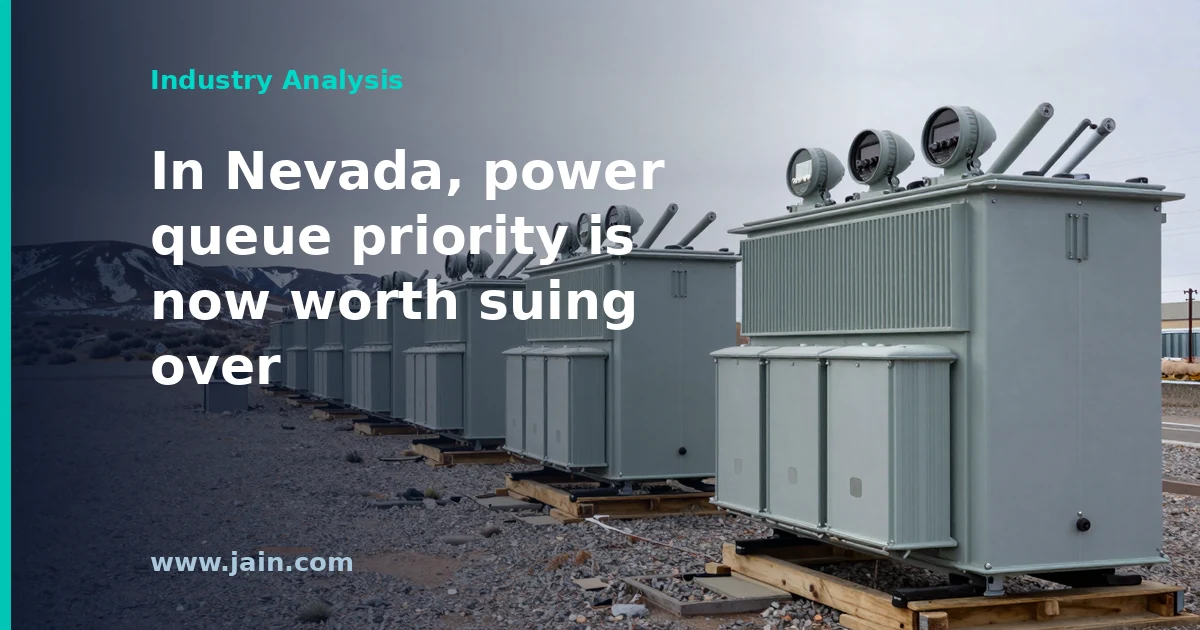
Nevada’s main electric company, NV Energy, is suing Tract, a company that builds huge campuses for data centers. Data centers are the warehouse-sized buildings full of computers that run websites, apps and artificial intelligence.
The fight is over who gets electricity first, how much, and who pays for new power plants and lines. Requests for new power, driven largely by data centers, already add up to more than twice what the utility’s whole system uses on its busiest day.
The utility says households could get stuck with the bill. Tract says it has promised nearly $1 billion toward the utility’s equipment and is paying its fair share.
NV Energy, Nevada’s primary electric utility, has sued data center developer Tract in Washoe County’s Second Judicial District Court, The Nevada Independent reported on July 28, 2026. The complaint was filed Friday, July 24, and much of it is redacted because it was filed under seal. It alleges that Tract started private arbitration over when and how much power the utility must provide to its Peru Shelf and South Valley projects at the Tahoe Reno Industrial Center, and that this bypasses the Public Utilities Commission of Nevada (PUCN).
NV Energy says Tract’s demands would shift infrastructure and energy costs onto existing customers. Tract says the complaint “seriously misstates the issues, the facts, and the contracts NV Energy signed.” It also says it has never sought subsidies, that it has committed nearly $1 billion to support NV Energy’s infrastructure, and that those contracts commit the dispute to arbitration.
Executive Summary
The suit pits Nevada’s dominant utility against one of the largest landholders in the state’s data center market. It turns on a question every fast-growing power market will eventually face: when a developer’s contract and a utility’s regulated resource plan collide, who decides the order in which new loads get electricity? NV Energy says only the PUCN can. Tract says the parties agreed to arbitrate.
The backdrop explains the stakes. NV Energy’s latest integrated resource plan says it would need about 22 gigawatts (GW) just to serve existing requests for service, more than twice its current system peak, and it attributes that demand largely to data centers. When the grid is oversubscribed by that margin, a place in the queue has real economic value. Tract is already planning 362 megawatts (MW) of temporary gas and diesel generation because the grid cannot serve its projects right away.
For ratepayers, the dispute is about who pays for growth. For developers and their financiers, it tests whether a large-load contract signed with a utility can be enforced on its own terms, or whether it stays subordinate to the regulator’s planning process.
Twice the Peak: Why Queue Position Is Now the Prize
NV Energy’s most recent integrated resource plan (IRP) says the utility would need roughly 22 GW of capacity just to meet requests for service already on file. That is more than twice the current system’s peak demand, and the utility says data centers are the main driver. A gigawatt is a thousand megawatts, and a single megawatt is a large industrial load on its own. When requests exceed what the grid can deliver by that much, the utility cannot connect everyone at once. The order of service then decides whether a campus opens on schedule, and it matters as much as the price of power.
That order is exactly what this dispute concerns. According to the complaint, Tract’s arbitration seeks to settle when and how much power NV Energy should provide, how the utility generates and buys that power, and the priority of service among customers in its queue. Tract’s own contingency plan shows what a later place in line costs. NV Energy cannot serve the projects immediately, so Tract has proposed temporary natural gas and diesel plants: 144 MW for South Valley and 218 MW at Peru Ridge. These would be “behind-the-meter,” meaning on-site generation that feeds the campus directly rather than power drawn from the utility’s regulated grid.
Three groups are affected. Other large customers in the queue are affected because capacity promised to one developer is capacity another does not get on that date. Existing ratepayers are affected if accelerated grid upgrades end up in general rates. Developers and their lenders are affected because a campus’s value depends heavily on when it can be energised. With that much at stake, both sides have escalated. Tract has gone to arbitration, and NV Energy has gone to court to stop the arbitration from deciding matters it says belong to the regulator.
Contract Forum Versus Regulatory Forum
NV Energy’s legal theory rests on jurisdiction. Generation, power purchasing and service priority are set through IRPs, which the utility must file with the PUCN and have approved at least every three years. The utility argues that an arbitrator cannot decide those questions outside that framework, especially while the Commission is weighing the same issues. That includes NV Energy’s proposal for a uniform large-load service agreement meant to standardise terms across data center customers. “Defendants cannot now short-circuit that regulatory process,” the filing says.
Tract’s position rests on contract. It says the agreements NV Energy negotiated commit disputes to arbitration, and that it simply wants the utility “to live up to the commitments it made.” The agreements were executed under Rule 9, which governs how construction costs and responsibility are split between the utility and a new customer, weighing the project’s size, duration and risk. NV Energy says Rule 9 does not address the supply of electricity. The unresolved question is therefore whether the utility made supply or timing commitments in those contracts, and if it did, whether they can be enforced privately. With the agreements sealed, neither side’s reading can yet be checked publicly.
The implications reach beyond Nevada. If construction-cost agreements can carry enforceable supply priority through arbitration, large-load contracts become a channel that runs parallel to resource planning. If they cannot, developers get less contractual certainty at the moment they are raising capital for multi-hundred-megawatt campuses. Either outcome carries costs for someone.
Same Principle, Different Math
Both parties invoke the same principle. “Customers that create new costs should cover new costs, and those costs should not be shifted,” said a person familiar with the matter. Tract says it “has committed to paying our fair share for infrastructure and generation needs” and never asked to be subsidised. The disagreement is not about whether growth should pay for itself. It is about what a fair share amounts to, and what the nearly $1 billion Tract cites actually buys in capacity, timing and priority.
The growth figures explain why that math is contested now. NV Energy estimates it needs 52 percent more energy statewide than it forecast only two years ago. Data centers account for about 5 percent of its sales today, and the utility projects that share will reach 64 percent by 2046. On that trajectory, cost-allocation rules written now will govern who pays for most of the system’s future expansion. Questions that are traditionally settled in rate cases and resource plans are here being argued in court over the terms of a contract. That is one case, not yet a pattern, but it is a sign of how much weight these contracts now carry. The lawsuit also places the utility’s stated position near local concerns about data center electricity and water use, a shift in public posture for a utility that is simultaneously planning to serve that load.
Land Is Not Power
Tract has assembled more than 12,000 acres in Northern Nevada, including 1,060 acres in Lyon County that it says can support 1.6 GW of data center capacity. Land has not been the constraint, and grid access keeps proving to be one. Last year, Switch sued Tract to block certain developments on the same Peru Shelf parcels, arguing they would affect Switch’s ability to connect future projects to utilities. The court ruled in Tract’s favour. Two separate lawsuits over the same ground have now turned on access to power.
For site selectors, investors and tenants, the practical lesson is that acreage, zoning and even signed construction agreements do not establish an energisation date. On-site gas and diesel generation is becoming part of the plan rather than an emergency fallback. That brings its own permitting, fuel and emissions questions, and it does not settle when the grid will take over.
Background
NV Energy is Nevada’s primary electric utility and a subsidiary of Berkshire Hathaway Energy. Like other regulated utilities, it plans new generation and power purchases through integrated resource plans filed with and approved by the PUCN at least every three years. It already has large-load agreements with multiple data centers. In its current plan it is asking regulators to approve a uniform service agreement for large-load customers, consistent with those existing contracts.
Tract develops master-planned data center parks and has bought more than 12,000 acres across Northern Nevada. In 2024 it acquired 8,600 acres in Storey County between the Tahoe Reno Industrial Center (TRIC) and the Virginia City Highlands, bringing its holdings to 11,000 acres. It later added 1,060 acres in Lyon County just south of TRIC, which it says can support 1.6 GW of capacity. Last year Tract prevailed in a lawsuit brought by Switch, a longtime TRIC operator, over development of Tract’s Peru Shelf parcels.
Israel has stopped accepting new requests from large data centers to connect to the power grid for about four and a half months. Data centers are the warehouse-sized buildings full of computers that run cloud services and artificial intelligence.
The reason: builders have asked for nearly three times as much electricity as the whole country normally uses. Officials want time to separate real projects from ones that may never be built.
At least one developer has already dropped its plans. How Israel sorts this out will decide who gets power, and when.
Israel’s Electricity Authority has frozen the processing of new applications to connect data centers of 8 megawatts (MW) or more to the power grid for 140 days, DatacenterDynamics reported on July 28, 2026. The authority described the pause as an “emergency brake” to prevent the system from making connection commitments it may not be able to fulfill. The freeze is expected to run until early December.
The country’s transmission operator, Israel Independent System Operator (NOGA), received 19 gigawatts (GW) of new data center connection requests within two months, bringing the pending total to roughly 27GW, nearly triple Israel’s average baseline electricity consumption. During the pause, the Electricity Authority, the Ministry of Energy and NOGA will jointly develop a new policy for allocating electricity between data centers and the rest of the economy.
Executive Summary
Israel has imposed a national pause on new grid connection processing for data centers of 8MW and above, one of the clearest cases yet of a grid operator stopping the queue rather than working through it. The trigger is scale: roughly 27GW of pending requests against a grid whose average baseline consumption is about a third of that.
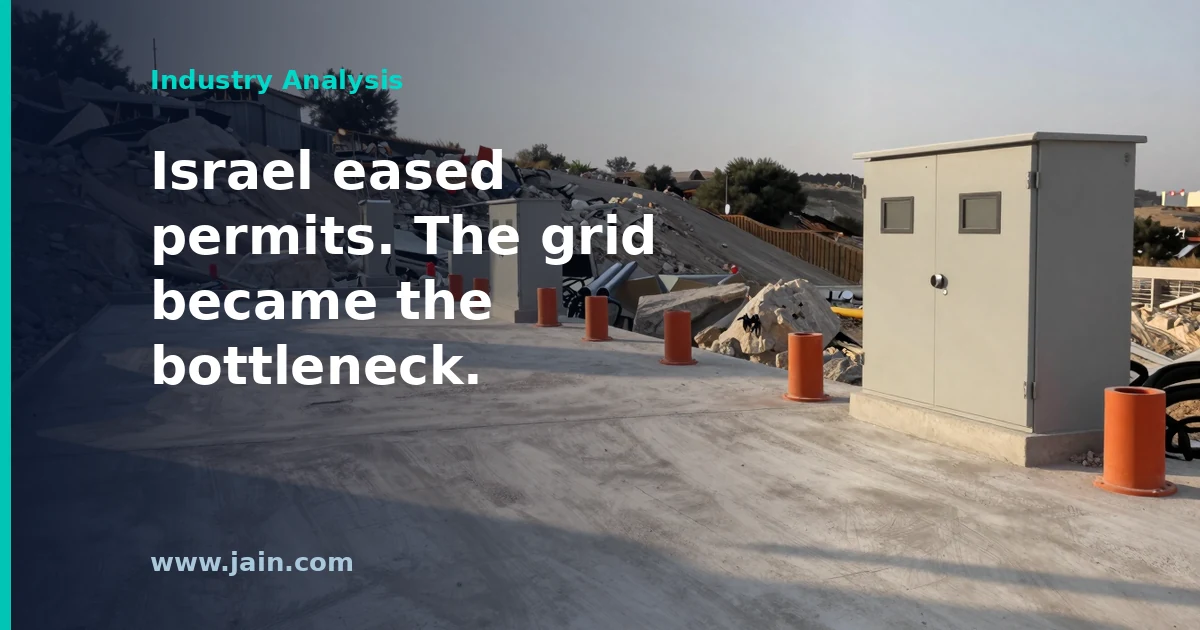
The surge followed the National Cyber Defense Bill, passed by the Knesset in February, which designated data centers as national infrastructure to remove planning and construction constraints. With those hurdles lowered, the grid connection became the constraint that still binds, and it absorbed the full weight of demand, speculative filings included.
The 140-day review is meant to map the requests, set eligibility criteria and build a mechanism to tell legitimate projects from speculative ones. The outcome will shape which developers can build in Israel, how quickly, and on what terms. VisionWave has already abandoned a hyperscale project, citing the pause.
Easing Planning Moved the Bottleneck to the Grid
In February, Israel’s parliament passed the National Cyber Defense Bill. The law classified data centers as national infrastructure specifically to remove planning and construction constraints, with the aim of speeding up an industry the government considers strategic. What followed was a flood of grid applications. NOGA received 19GW of new data center connection requests within two months, and the pending total now stands at roughly 27GW, nearly triple the country’s average baseline consumption. For scale, a gigawatt is roughly the output of a large power station.
The mechanism is straightforward. A data center project passes through several filters: land, zoning, construction permits, financing, customers and power. Lower the planning filters and it becomes cheaper to put a project into the pipeline, while a place in line for scarce electricity stays just as valuable. The grid connection becomes the one gate that still binds, so it absorbs all of the demand, including requests from projects that may never be built. A planning rule can be rewritten in a single legislative session. New transmission lines and generation take years.
That is the logic behind the authority’s “emergency brake” framing. A connection offer is a promise to deliver power years from now. Issued against a queue that far exceeds national demand, such promises would either go unkept or crowd out other users. The review’s stated purpose, allocating electricity between data centers and the economy at large, puts that trade-off in plain terms: every megawatt reserved for a server hall is a megawatt not available to homes, factories or transport.
A 27GW Queue Is a Signal, Not a Forecast
No grid adds three times its existing load in a few years, and nothing in the announcement suggests Israel expects to. A queue of this size says more about the incentives facing developers than about the power that will eventually be consumed. Developers often file for several sites at once to keep their options open, and an early filer can hold capacity that a better-financed project later needs. The government’s plan to map requests, set eligibility criteria and separate legitimate projects from speculative ones amounts to an acknowledgment that the queue, in its current form, cannot guide grid planning.
The hard part is that genuine demand is buried inside the inflated number. The pause comes as AI training and inference reshape data center demand worldwide. These workloads concentrate large, steady power draws on single campuses, which is exactly the profile that stresses transmission planning. Last month Crusoe, a developer focused on AI infrastructure, said it would invest around $10bn in Israeli data centers over ten to 15 years through leases. Commitments of that kind compete for the same limited grid capacity as filings with little behind them, and that is the problem the sorting exercise is meant to solve.
Who Wins and Who Waits
The 8MW threshold matters. Enterprise server rooms and smaller edge facilities fall below it. Hyperscale and AI campuses sit well above it. The freeze therefore lands on the segment the February law was designed to encourage. For those developers, 140 days carries a real cost. Land options, equipment reservations and tenant negotiations all lose value over time, and a project without a connection date is hard to finance or lease.
VisionWave has already dropped plans for a hyperscale data center in Israel and cited the pause as a key factor. Other developers may choose to wait rather than leave. Rules built to separate legitimate from speculative projects would favor applicants that can show land, financing and customers. That would benefit mature developers and well-capitalized tenants over applicants holding queue positions on the chance that one becomes valuable.
The broader lesson is not that Israel is closing to data centers. It is that easing one constraint without adding grid capacity moves the queue somewhere else. Israel’s experience suggests that any market courting AI infrastructure needs a clear, enforceable rule for allocating power alongside its permitting reforms.
Background
Israel’s Electricity Authority is the power sector’s regulator and sets the rules for how customers connect to and pay for the grid. NOGA, the Israel Independent System Operator, runs the transmission network and processes connection requests for large loads. Israel’s grid is largely isolated from its neighbors’, so electricity demand has to be met mainly by generation inside the country. That makes a sudden surge in requested load especially hard to accommodate.
Israel has been positioning itself as a regional data center hub. In February the Knesset passed the National Cyber Defense Bill, which designated data centers as national infrastructure to ease planning and construction. Developers followed: Crusoe announced in June a roughly $10bn lease-based investment plan over ten to 15 years. The grid freeze is the first major check on that expansion.
Google is planning a $3 billion computer-server complex in rural southwest Virginia. A water deal signed last year allowed it to eventually draw up to 8 million gallons a day, roughly a dozen Olympic swimming pools, while the region faces drought.
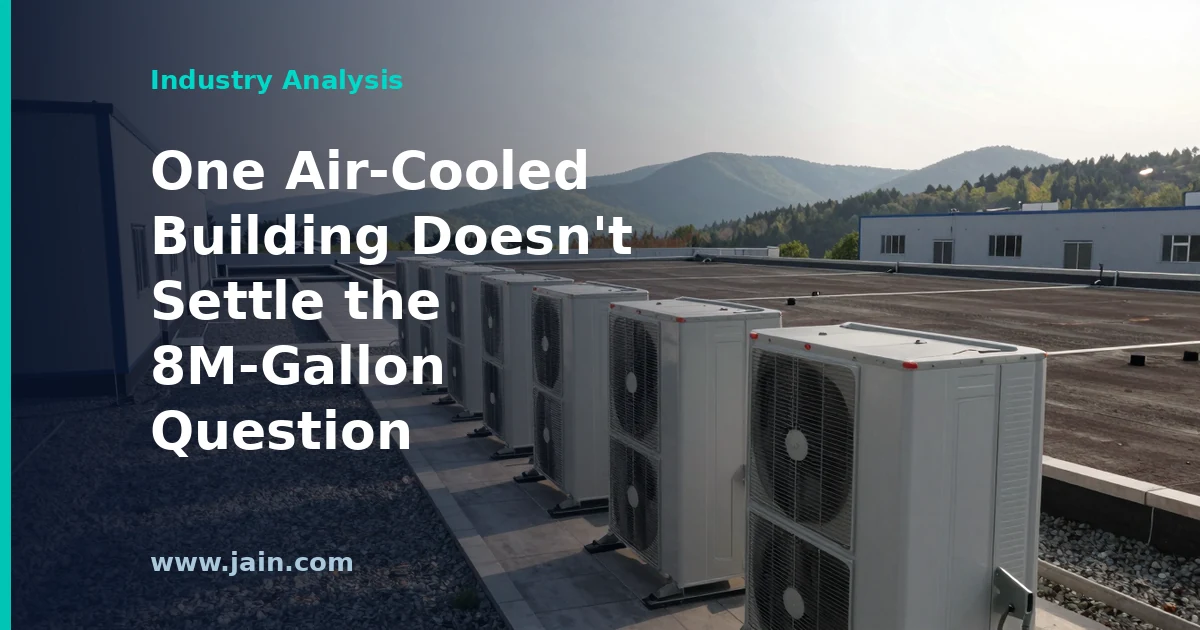
After local pushback, Google says its first building will be cooled with air instead of water. But that covers only one of three buildings, and air cooling usually burns more electricity. Residents now want to know how much, and where that power comes from.
Google confirmed on Friday, July 24, 2026, that the first building of its proposed $3 billion data center campus at the Botetourt Center at Greenfield in Botetourt County, Virginia, will use air cooling rather than water to keep its equipment cool, Virginia Business reported. Cooling for the campus’s two other planned buildings “remains under active evaluation,” according to an update on botetourtcountydatacenter.com.
The decision follows community concern over Google’s October 2025 utility services funding agreement with the Western Virginia Water Authority, which anticipated up to 8 million gallons of water per day at full buildout and no more than 2 million gallons per day initially.
Executive Summary
Google has chosen air cooling for the first of three buildings on its Botetourt County campus. A Google spokesperson said the company “determined that air cooling was the appropriate solution based on the facility’s needs and our focus on operating efficiently and responsibly,” and the project website described the choice as “driven by business demand and infrastructure requirements.”
The announcement is a meaningful concession to local water concerns, arriving as the neighboring Roanoke drought region sits at emergency status. But it is scoped narrowly. It settles one building, not the campus, and Google has not published a revised water estimate or said whether the 8-million-gallon full-buildout figure in its water agreement still reflects its plans.
It also shifts the debate rather than ending it. Cooling a data center without water generally means spending more electricity, and a local group, the Southwest Virginia Data Center Transparency Alliance, is now asking how much power the facility will need and where it will come from.
One Building of Three Doesn’t Move the Ceiling
The number that alarmed residents was 8 million gallons a day, the full-buildout figure in Google’s October 2025 agreement with the Western Virginia Water Authority. That figure describes the whole campus. The July 24 decision covers only the first building, and the project website says the other two remain under evaluation. Nothing in Google’s statement revises the agreement’s terms or offers a new campus-wide estimate.
That matters because of how utility planning works. A water authority sizing pipes, treatment and supply commitments plans against the maximum a customer is entitled to draw, not the amount the first phase happens to use. As long as the agreement anticipates up to 8 million gallons at buildout, the authority, local officials and neighboring communities are still planning around that ceiling. The first building likely draws well under the agreement’s 2-million-gallon initial limit, but Google has not said by how much.
So the practical effect is a deferral. The first phase gets lighter on water; the larger question of what the finished campus will consume moves to the decision on buildings two and three, which has no announced timeline.
Water Saved Is Power Spent
Data centers turn nearly all the electricity they use into heat, and that heat has to go somewhere. Evaporative, or water-based, cooling removes it efficiently by evaporating water, much as sweat cools skin. Air-based systems avoid that water loss but generally rely more heavily on fans and mechanical chillers, which consume electricity. Operators track the two sides with separate yardsticks: water usage effectiveness (litres per unit of computing energy) and power usage effectiveness (total facility energy divided by what the servers use). Improving one often worsens the other.
That is the trade-off the Transparency Alliance flagged. Co-founder Julie Bivins asked how much power the facility will now use and whether it will come from fossil fuels, natural gas or nuclear. Those are fair questions, and they apply symmetrically: Google has not quantified the added energy draw, and the alliance has not quantified it either. Whether the swap is a net environmental gain depends on the local grid’s generation mix and on how water-stressed the region is, and neither side has put those numbers on the table.
The density of the hardware inside also shapes the choice. Air cooling suits lower-density server halls; the most power-hungry equipment, including the accelerators used for AI workloads, increasingly pushes operators toward liquid cooling. Google has not said what the Botetourt buildings will host, but the website’s reference to “business demand and infrastructure requirements” suggests the cooling decision for later buildings will turn on what they are built to run, not only on water.
A Cooling Decision Made in a Drought
The timing is hard to separate from the local climate. On July 15, Gov. Abigail Spanberger announced that the Roanoke Drought Evaluation Region, which includes Roanoke city and Roanoke County next to Botetourt, had reached emergency status, while most of Virginia sat under drought warnings or watches.
Local governance has been strained as well. Botetourt County said on July 3 that its planning commission lacks legal authority to independently convene public hearings, and The Roanoke Times described tense proceedings at the commission’s July 13 meeting, where members voted to recommend that the Board of Supervisors direct them to organize a meeting on water supply.
For developers elsewhere, the lesson is that cooling architecture is no longer purely an engineering decision made late in design. Water commitments negotiated early, and disclosed later through public-records requests, can become the defining public fact about a project. Publishing water and power estimates together, per building and at buildout, is the clearest way to show what a cooling trade-off actually saves.
Background
Google’s planned campus sits at the Botetourt Center at Greenfield, an industrial park in Botetourt County, just north of Roanoke in southwest Virginia. The company has proposed a $3 billion investment across three buildings, part of a broader push of large data center projects beyond Virginia’s established hub in the northern part of the state.
Data centers house the servers behind cloud services, search and AI, and they need continuous cooling. Many large facilities use evaporative systems that consume significant water; others use air-based or closed-loop designs that use less water but more electricity. That choice has become a central point of negotiation between developers and host communities, particularly in areas facing drought.