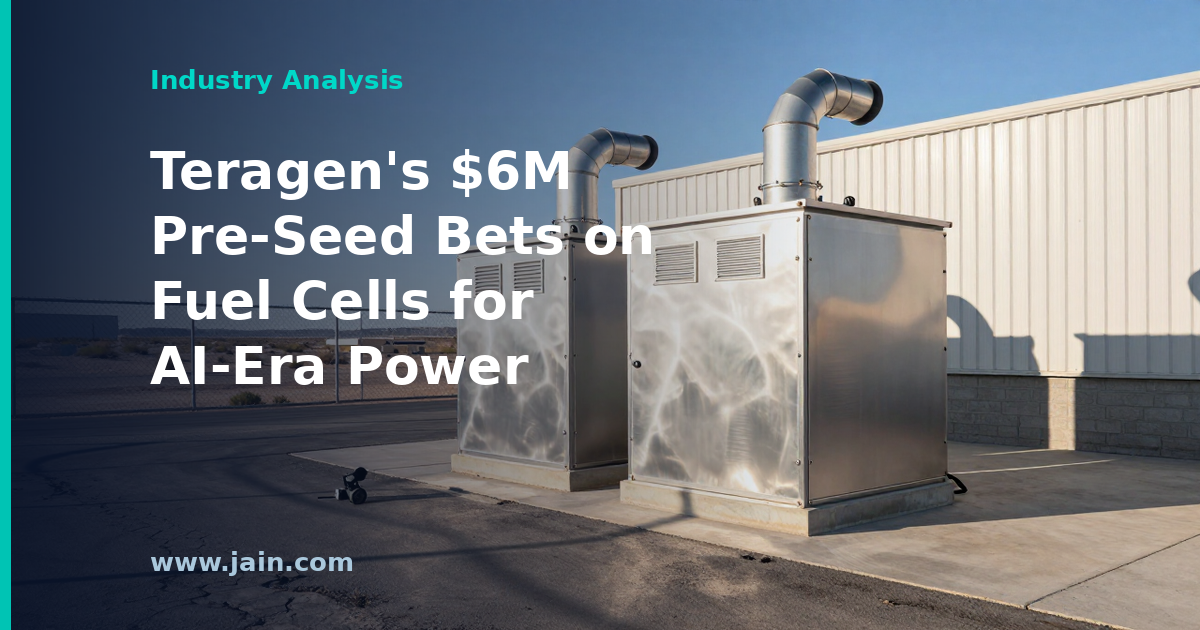
Cummins announced on June 15, 2026 that its natural gas generators will power large-scale data centers in West Texas. The announcement, issued by the engine and power-systems maker itself, confirms a supply arrangement for on-site power generation but does not disclose the customer, the number of units, the total generating capacity, or the delivery schedule.
Executive Summary
Cummins, the Indiana-based manufacturer best known for diesel engines and generator sets, says its natural gas generators have been selected to power large-scale data center development in West Texas. Stripped to its substantiated core, the announcement establishes three facts: the vendor (Cummins), the fuel (natural gas), and the setting (large-scale data centers in West Texas). Everything else — megawatts, dollars, dates, and the developer’s name — is left unstated.
Even so, the deal is worth attention because of what it represents. Data center developers are increasingly buying their own power plants rather than waiting years for utility interconnections, and West Texas — with abundant natural gas, cheap land, and a congested grid — has become the proving ground for that model. A generator manufacturer announcing data-center-scale natural gas orders is a data point in one of the most consequential shifts in how digital infrastructure gets energized.
Why Data Centers Are Buying Their Own Power Plants
The traditional model — build a data center, plug it into the utility grid — is breaking down under AI-era demand. Requests for new grid connections in fast-growing markets can take several years to fulfill, because utilities must study, permit, and build transmission lines and substations before energizing a large new load. For developers racing to deliver capacity to cloud and AI tenants, that queue is often the single longest item on the schedule.
On-site generation — sometimes called behind-the-meter power, because it sits on the customer’s side of the utility meter — collapses that timeline. Reciprocating natural gas generators of the kind Cummins builds can be manufactured, shipped, and commissioned far faster than a transmission project, and they can be added in increments as a campus grows. What was once purely backup equipment, sized to ride through rare outages, is increasingly being specified as primary or bridge power that runs for thousands of hours a year.
West Texas: Abundant Gas, Strained Wires
West Texas is a logical setting for this model. The region sits atop the Permian Basin, one of the most productive oil and gas regions in the world, where natural gas is plentiful and pipeline infrastructure is dense. Land is inexpensive, and the area already hosts substantial wind and solar development. What the region lacks is transmission: moving power across the Texas grid, operated by ERCOT (the Electric Reliability Council of Texas), is constrained by long distances and congested lines.
For a data center developer, that combination — fuel at the wellhead, but a bottlenecked grid — makes on-site gas generation attractive. Rather than exporting the region’s energy as electrons over strained wires, the data center effectively moves the demand to the fuel. The announcement does not say whether these facilities will also seek grid connections later, a common strategy in which on-site generation serves as a bridge until utility service arrives.
What It Means for Cummins and the Genset Market
For Cummins, data-center demand is reshaping a business that historically sold generators as insurance. Backup generators run perhaps a few dozen hours a year; prime-power installations run continuously, which means more units, larger service contracts, and steadier parts revenue. Major engine and turbine makers across the industry have reported stretched lead times for large power equipment as data-center orders stack up, so a manufacturer publicizing a West Texas win is competing for position in a genuinely supply-constrained market.
The competitive backdrop matters too. Data center developers weighing on-site power can choose among reciprocating gas engines, gas turbines, and, eventually, small modular nuclear or fuel-cell options. Reciprocating engines like Cummins’ occupy a middle ground: faster to deploy and more modular than turbines, though generally better suited to incremental capacity than to single gigawatt-scale blocks. Which architecture wins at a given site depends on scale, gas supply, and air-permitting headroom — none of which this announcement details.
The Trade-Offs the Headline Skips
Natural gas generation is cleaner than the diesel that has long dominated data-center backup — it burns with lower particulate and sulfur emissions — but it is still a fossil-fuel source with carbon dioxide and nitrogen oxide emissions, and large installations require air-quality permits from Texas regulators. Hyperscale tenants with public net-zero commitments will want to know whether gas-powered campuses fit their carbon accounting, whether the plants are bridge or permanent solutions, and whether the equipment can later run on lower-carbon fuels.
Reliability cuts the other way: a well-designed fleet of gas generators with firm fuel supply can rival or exceed grid reliability, and it insulates the tenant from ERCOT’s scarcity-priced energy market during extreme weather. The honest framing is that on-site gas is a pragmatic trade — speed and control in exchange for emissions and fuel-price exposure — and this release, as circulated, makes the case for the first half without quantifying the second.
Background
Founded in 1919 in Columbus, Indiana, Cummins built its reputation on diesel engines for trucks and heavy equipment, and its power systems division has long been a leading supplier of standby generator sets for data centers, hospitals, and industry. In recent years the company has expanded its natural gas engine lineup as customers seek lower-emission alternatives to diesel.
The backdrop is a historic surge in electricity demand from AI and cloud computing that has outpaced utilities’ ability to connect new loads. Texas has emerged as a leading destination for this buildout, and West Texas in particular — sitting atop the Permian Basin’s gas supply but far from major transmission corridors — has become a testbed for data centers that generate their own power on-site rather than waiting for the grid.
Research and advisory firm Gartner has published a forecast projecting that data-center electricity consumption will grow 26% in 2026. The figure, released in June 2026, puts a number on what utilities, grid operators, and data-center builders have been experiencing on the ground: power — not land, capital, or chips — has become the binding constraint on digital-infrastructure growth.
Executive Summary
Gartner’s headline claim is simple: the electricity consumed by data centers will rise 26% in 2026. For context, most mature electricity systems in developed economies have spent two decades planning around annual demand growth in the low single digits. A single customer class growing 26% in one year is the kind of step-change that utility resource plans — documents typically written on five-to-fifteen-year horizons — were not designed to absorb.
The forecast matters less as a precise number than as a planning signal. If even a substantial fraction of that growth materializes, it shapes generation procurement, transmission buildout, interconnection queues, and electricity rates for every other customer sharing the grid. For data-center operators and their customers, it also signals that access to secured, deliverable power will continue to separate projects that get built from projects that wait.
A 26% Jump Is a Planning Problem, Not Just a Number
Electric utilities plan in decades. Building a new gas plant, a transmission line, or a large substation typically takes years of permitting, procurement, and construction. Demand that grows 26% in a single year — even within one customer segment — compresses those timelines past what traditional integrated resource planning can handle. The practical consequence is already visible across the industry: multi-year interconnection queues (the waiting list to connect large new loads or generators to the grid), utilities demanding long-term take-or-pay commitments from data-center customers, and regulators debating who bears the cost if forecast demand fails to show up.
The forecast, in other words, is best read as a statement about mismatch: digital infrastructure now moves at software-industry speed, while the electricity system that feeds it still moves at heavy-civil-engineering speed. Closing that gap — through faster permitting, on-site generation, or demand flexibility — is the defining infrastructure challenge the number points to.
AI Is Rewriting the Load Curve
Growth of this magnitude is not organic expansion of traditional enterprise computing. Conventional data-center workloads — web serving, databases, storage — grew steadily for years while efficiency gains (better chips, better cooling, higher utilization) kept electricity demand roughly flat. What changed is accelerated computing: AI training and inference run on dense GPU racks that can draw several times the power of traditional server racks and tend to run at sustained high utilization rather than in daily peaks and troughs.
That load profile is a mixed blessing for utilities. Flat, predictable, around-the-clock demand is easier to serve than spiky demand and can improve grid economics by spreading fixed costs over more kilowatt-hours. But it also removes slack: a grid serving large always-on loads has less headroom for extreme weather events and less tolerance for generation shortfalls. How much of Gartner’s projected growth is firm, flexible, or interruptible will matter as much as the total.
Winners, Losers, and the Power Value Chain
If the forecast is directionally right, the beneficiaries extend well beyond data-center operators. Makers of transformers, switchgear, generators, and cooling equipment — many already quoting extended lead times — see demand visibility measured in years. Generation developers, from gas turbines to nuclear restarts to utility-scale renewables paired with storage, gain a creditworthy customer class willing to sign long-dated contracts. Utilities in data-center-heavy regions gain load growth after decades of stagnation, though with real execution and rate-design risk.
The squeezed parties are those competing for the same electrons and equipment: other large industrial loads, smaller colocation players without utility relationships, and — if cost allocation is handled poorly — residential ratepayers. For data-center operators themselves, the forecast reinforces an emerging hierarchy: companies holding contracted, deliverable power capacity own an appreciating asset, while those still in interconnection queues hold an option of uncertain value.
Treat the Number as a Signal, Not a Certainty
A forecast is a model, and this one — as syndicated — arrives without its assumptions attached. Projections of AI-driven power demand have varied widely across analysts, and history urges caution: early-2000s forecasts of runaway internet power consumption overshot badly because they underestimated efficiency gains. Chip-level performance-per-watt improvements, smarter model architectures, and rising inference efficiency could all bend the curve; conversely, faster-than-expected enterprise AI adoption could steepen it.
The even-handed reading is that Gartner’s 26% figure is a credible-sounding midpoint from an established research house, but its value depends on methodology the public headline does not disclose — baseline year, geographic scope, and workload assumptions among them. Planners should treat it as one scenario input, not a settled fact.
Background
Data-center electricity demand was, for roughly a decade before the AI era, a story of successful restraint: workloads migrated into ever-more-efficient hyperscale facilities, and total consumption grew far more slowly than computing output. That equilibrium broke with the generative-AI buildout that began in earnest in 2023, as operators raced to deploy GPU clusters whose power density and utilization patterns overwhelmed the old efficiency offsets. Since then, power availability has displaced real estate as the industry’s primary constraint, and forecasts from analysts, utilities, and government agencies have been repeatedly revised upward.
Gartner, a research and advisory firm whose projections are widely used in enterprise technology planning, publishes recurring forecasts on data-center spending and infrastructure. Its June 2026 electricity-consumption forecast lands amid active debate among utilities, regulators, and operators over how much of the projected AI load will actually materialize — and who should pay to serve it.
The Federal Energy Regulatory Commission (FERC) has approved a temporary process that allows PJM Interconnection — the operator of the largest wholesale electricity market in the United States, serving 13 states and the District of Columbia — to fast-track large capacity projects, according to a June 10, 2026 report from PJM’s Inside Lines publication. The measure is expressly temporary, aimed at accelerating the arrival of sizable new power resources at a moment when the region’s demand outlook is being reshaped by electrification and data center growth.
Executive Summary
FERC’s approval gives PJM a sanctioned shortcut: a temporary pathway to move large capacity projects — power resources big enough to matter for regional reliability — through its processes faster than the standard sequence would allow. In a system where a generation project can spend years in the interconnection queue before delivering a single megawatt, the ability to pull select large projects forward is one of the most consequential levers a grid operator can hold.
The details published in the brief report are limited, but the direction is unmistakable and consistent with PJM’s recent trajectory: regulators and the grid operator are prioritizing speed-to-power for large resources. For data center developers, utilities, and generation investors across the mid-Atlantic and Midwest, the practical question is no longer whether PJM will triage its pipeline, but which projects benefit, on what criteria, and for how long the temporary window stays open.
Why the Queue Became the Bottleneck
To connect a new power plant to the high-voltage grid, a developer must pass through the grid operator’s interconnection queue — the engineering and cost-allocation study process that determines what network upgrades a project needs before it can safely deliver power. Across the U.S., and acutely in PJM, that process became a multi-year bottleneck as applications surged past the pace of study work. Projects that are financed, sited, and ready to build can still sit waiting for paperwork and grid studies.
Meanwhile, PJM’s supply-demand picture has tightened from both directions: older fossil plants are retiring while forecast demand climbs, driven in significant part by data center construction in places like Northern Virginia, the densest data center market in the world. When ready supply can’t get connected but demand keeps arriving, prices and reliability risk both rise. A fast-track for large capacity projects attacks that mismatch at its procedural source.
A Temporary Lever, Not Structural Reform
The word “temporary” is doing real work here. FERC has not rewritten PJM’s standard interconnection or capacity rules; it has approved a time-bounded exception that pulls certain large projects ahead. That framing matters for two reasons. First, it signals that regulators see the current situation as an emergency-adjacent gap — a bridge measure until broader queue reforms and new supply catch up. Second, it leaves the durable rules of the road intact, which limits how much long-term investment behavior the order alone can change.
Bridge measures carry their own risk: if the underlying study backlog and construction constraints (transformers, turbines, skilled labor, transmission upgrades) don’t ease, a temporary fast-track can become a recurring one. Market participants will reasonably ask whether this is a one-time triage or the first installment of a standing priority lane for large resources.
Winners, Losers, and the Fairness Question
Any fast-track creates a queue-jumping question. Projects selected for expedited treatment gain a material commercial advantage — earlier revenue, earlier capacity market participation, and first claim on scarce grid headroom. Projects that remain in the standard process, including many smaller renewable and storage developments, effectively wait longer in relative terms even if their absolute timelines don’t change. FERC approvals of this kind typically turn on whether the selection criteria are transparent and non-discriminatory, and that is exactly where scrutiny from developers and consumer advocates will concentrate.
There is also a resource-mix dimension. “Large capacity projects” tends, in practice, to favor big dispatchable plants — the kind that can be counted on during peak demand — over distributed or intermittent resources. That is defensible on reliability grounds, but it shapes the competitive landscape, and the release gives no detail on how technology-neutral the criteria are.
What It Means for the Data Center Buildout
For the digital infrastructure industry, this is a supply-side answer to a demand-side surge. Data center campuses now routinely request hundreds of megawatts — utility-scale loads — and the pace at which PJM can connect new generation directly governs how fast those campuses can energize. A credible fast-track for large supply projects modestly improves the odds that new load and new generation arrive in the same timeframe rather than years apart.
It is not, however, a cure. Interconnecting a power plant faster does not by itself build the transmission lines, substations, and transformers that both generators and large loads need. Operators and their customers should read this as one favorable policy data point in a long chain — permitting, equipment lead times, and local siting fights still set the real clock.
Background
PJM Interconnection dispatches power and runs wholesale electricity markets for roughly 65 million people across a footprint stretching from the mid-Atlantic into the Midwest. Over the past several years, the region has become the epicenter of the U.S. power-demand story: an enormous backlog of projects in the interconnection queue, accelerating retirements of older generation, and surging load forecasts driven heavily by data center construction — most visibly in Northern Virginia’s “Data Center Alley.” Those pressures have pushed PJM’s capacity market prices sharply higher and made speed-to-power a central policy concern.
Against that backdrop, PJM and FERC have pursued a series of reforms to modernize the interconnection process and, where necessary, create expedited pathways for resources deemed critical to reliability. The temporary fast-track approved here is the latest step in that sequence, extending the theme of triaging a congested pipeline so the largest, most reliability-relevant projects reach the grid sooner.
Bloomberg Government reported on June 8, 2026 that lawmakers are floating solutions to the rising power costs associated with data centers — a signal that the electricity-bill impact of the computing buildout has moved from utility commission dockets into the legislative arena. The report’s headline frames the issue squarely as a cost problem in search of a policy fix.
The report arrives amid an unprecedented wave of data center construction driven by artificial intelligence workloads, which has made large computing facilities one of the fastest-growing sources of new electricity demand in the United States.
Executive Summary
The core news, per Bloomberg Government’s June 8 report, is that the cost side of the data center boom — specifically, who pays for the power infrastructure these facilities require — is now attracting active legislative attention, with lawmakers proposing potential solutions rather than merely holding hearings. The report itself is headline-level; the specific proposals, sponsors, and legislative vehicles are not detailed in the material available to us, and we flag that below.
Why it matters: for the past two years, the fight over data center power costs has largely played out state by state, before public utility commissions — the regulators who approve electricity rates. When lawmakers start floating statutory fixes, the rules of the game can change faster and more broadly. Rate design — the technical framework that decides how a utility’s costs are divided among households, businesses, and large industrial customers — is the lever most often discussed, because it determines whether a new transmission line or power plant built substantially to serve a data center is paid for by that data center or spread across everyone’s bills.
For data center developers, utilities, and the customers signing multi-hundred-megawatt capacity deals, this is policy risk in its early, formative stage — the moment when engagement matters most and outcomes are least predictable.
Why Electricity Bills Became a Data Center Story
Data centers concentrate enormous electrical demand in single locations: a large AI campus can draw as much power as a mid-sized city. Serving that demand often requires new generation, new transmission lines, and substation upgrades. Under traditional utility rate-making, much of that infrastructure cost goes into the utility’s general ‘rate base’ — the pool of investment recovered from all customers over decades. When the new demand comes overwhelmingly from one class of customer, other ratepayers can end up subsidizing infrastructure they did not ask for and do not use.
That cost-shifting question is what turns an infrastructure story into a kitchen-table story. Household electricity bills are politically salient in a way that interconnection queues are not, and the Bloomberg Government headline — lawmakers floating solutions to data center power costs — suggests elected officials now see both a genuine allocation problem and a constituency that cares about it. It is worth being even-handed here: data centers also bring tax revenue, jobs during construction, and in some regions have funded grid upgrades that benefit all users. The policy question is not whether data centers are good or bad, but whether the current rules assign their costs accurately.
The Rate-Design Toolkit Lawmakers Are Reaching For
Although the report does not specify which solutions are on the table, the toolkit in active discussion across the industry is well established. It includes creating dedicated tariff classes for very large loads, so data centers pay rates reflecting their actual cost to serve; minimum-take or long-term contract requirements, which protect other customers if a data center closes or scales back before its infrastructure is paid off; and ‘bring your own power’ frameworks that push hyperscale customers toward self-supplied or co-located generation. Each approach shifts risk between the data center customer, the utility’s shareholders, and the general ratepayer base — and each has trade-offs in speed, cost, and legal durability.
The federal-versus-state dimension matters too. Retail rate design is traditionally state territory, while interstate transmission costs and wholesale market rules sit with federal regulators. Legislative proposals could target either layer, and the editorial significance of lawmakers entering the fray is that statutes can override or standardize what has so far been a patchwork of case-by-case commission rulings.
Policy Risk Meets the AI Buildout
For the data center industry, the emergence of legislative interest is a double-edged development. On one hand, clear statutory rules could reduce uncertainty: developers currently face a different rate fight in every state, and a predictable large-load tariff framework can actually accelerate siting decisions. On the other hand, rules written in a politically charged environment — where rising bills are the headline — could impose costs, contract terms, or delays that change project economics, particularly for speculative capacity built ahead of signed tenants.
Utilities sit in the middle. Load growth is the best news the regulated utility sector has had in decades, but only if regulators and legislators let them recover the associated investment without triggering a ratepayer backlash. Expect utilities to support frameworks that lock in long-term commitments from data center customers, and expect hyperscale buyers with strong credit to accept them in exchange for speed. The parties most exposed are smaller developers and enterprises without the balance sheet to sign decade-long minimum-payment contracts. For everyone in the buildout, the practical takeaway is that power procurement is no longer just an engineering and price question — it is now a regulatory and legislative one.
Background
Electricity demand from data centers has grown rapidly since the generative-AI boom began in late 2022, ending roughly two decades of flat U.S. power demand and making computing facilities one of the largest sources of new load on the grid. Individual AI campuses now request capacity measured in the hundreds of megawatts — comparable to small cities — concentrated in hubs such as Northern Virginia, Texas, and the Midwest.
The cost question has followed the demand. Since 2024, state utility commissions have fielded a growing number of cases over how to charge very large loads, and several utilities have proposed dedicated data center tariffs. Bloomberg Government, the source of this report, is a policy-focused news service covering Congress and federal agencies, which itself suggests the issue has reached the national legislative agenda rather than remaining purely a state regulatory matter.
Crusoe, the energy-focused AI infrastructure company, announced on June 8, 2026 that its contracted pipeline of AI data center capacity is approaching 5 gigawatts (GW). For scale, 5 GW is roughly the output of five large nuclear reactors — a volume of power commitments that until recently was associated only with the largest cloud providers, not venture-backed startups.
Executive Summary
The announcement is a milestone marker rather than a single project reveal: Crusoe is telling the market that the sum of its contracted AI infrastructure — data center capacity it has agreements to build and power, though not necessarily capacity that is built and running today — now approaches 5 GW. The company rose to prominence as the developer of the massive Abilene, Texas campus associated with the Stargate initiative and OpenAI workloads, and has positioned itself as an ‘energy-first’ builder that secures power before it builds compute.
Why it matters: power, not chips or land, has become the binding constraint on AI buildout. A 5 GW contracted pipeline would place Crusoe among a very small group of companies — hyperscalers like Microsoft, Google, and Amazon, plus a handful of neoclouds and developers — able to credibly promise gigawatt-scale capacity to AI customers. It is also a signal to capital markets that Crusoe’s backlog, and therefore its future revenue base, is growing faster than its operational footprint. The distinction between contracted and energized capacity is the key to reading this announcement critically, and the release (as distributed) offers little detail to close that gap.
Five Gigawatts Puts a Startup in Hyperscaler Company
A gigawatt is a billion watts — enough electricity to supply hundreds of thousands of homes. Traditional enterprise data centers were measured in single-digit megawatts; a 5 GW pipeline is three orders of magnitude larger, and it puts Crusoe’s commitments in the same conversation as the multi-gigawatt expansion programs of the hyperscale cloud providers. That a company founded in 2018 can plausibly claim this scale says as much about the AI market as about Crusoe: frontier-model training and large-scale inference have created demand for campuses of a size that the industry simply did not build five years ago.
The strategic logic of announcing the number is straightforward. In today’s market, customers signing multi-year AI capacity deals care less about a provider’s current server count than about its ability to deliver power-secured capacity on a schedule. A large contracted pipeline is the sales asset. It is also the financing asset: infrastructure lenders and joint-venture partners underwrite backlog, and Crusoe has previously worked with institutional capital partners to fund construction at its flagship sites. A bigger contracted number supports bigger project-finance facilities.
The Energy-First Playbook
Crusoe’s differentiation has always been that it approaches computing from the energy side. The company began by capturing natural gas that oil producers would otherwise flare (burn off as waste) and using it to power computing on site — first cryptocurrency mining, a business it later divested to focus entirely on AI. That origin shaped a playbook the company now applies at campus scale: go where energy is available or can be generated, secure it under contract, and build compute there, rather than queuing for grid connections in saturated data center markets like Northern Virginia.
Nearing 5 GW of contracted capacity suggests the playbook is compounding. Grid interconnection queues in the United States can run five years or longer, so developers who can bring their own generation, or who locked in positions early, hold a genuine scarcity asset. The open question — one the announcement does not answer — is what the 5 GW’s energy mix looks like: how much is grid-connected utility power, how much is behind-the-meter gas generation, and how much depends on transmission or generation that still needs permits. Each of those paths carries very different timelines, costs, and emissions profiles.
Contracted Is Not Energized: Reading the Number Critically
The headline verb matters. ‘Contracted’ capacity is a pipeline metric: it typically bundles signed customer commitments and power agreements across facilities in various states of completion, from operational halls to sites that are years from first power. It is a legitimate and widely used industry measure — hyperscalers and developers alike tout pipeline gigawatts — but it is not the same as capacity serving customers today, and the announcement as distributed does not break down how much of the 5 GW is energized versus under construction versus signed-but-unbuilt.
The gap between contracted and delivered is where AI infrastructure risk lives. Turbines, transformers, and switchgear have multi-year lead times; skilled construction labor is scarce; and a pipeline concentrated in a small number of anchor customers is only as strong as those customers’ own capital plans. None of this is a criticism specific to Crusoe — every gigawatt-scale developer faces the same execution stack — but it is the correct lens for a pipeline announcement: the 5 GW figure describes obligations and opportunity, and the value is realized only as sites reach commercial operation.
What It Means for the Neocloud Race
Crusoe sits in the cohort commonly called neoclouds — specialized providers such as CoreWeave, Nebius, and others that build GPU-centric infrastructure outside the traditional hyperscale clouds. The cohort is stratifying fast: a handful of players are reaching multi-gigawatt scale with deep capital partnerships, while smaller GPU renters compete on price for commodity workloads. A near-5 GW pipeline would place Crusoe firmly in the first group, and its energy-development capability distinguishes it even within that group, since most rivals lease capacity from third-party data center developers rather than originating power themselves.
For the broader market, the announcement is another data point that AI power demand continues to translate into signed commitments, not just projections — relevant to utilities planning generation, to equipment suppliers sizing order books, and to competitors deciding whether to build or buy capacity. For customers, more credible gigawatt-scale suppliers means more negotiating options beyond the big three clouds. The caveat for all parties is the same: announced pipelines across the industry now sum to far more capacity than supply chains and grids can deliver on advertised schedules, so delivery track record — not pipeline size — will decide the winners.
Background
Crusoe was founded in 2018 around an unusual thesis: capture natural gas that oil producers flare off as waste and use it to power computing at the wellhead. That ‘digital flare mitigation’ business initially ran cryptocurrency mining, which Crusoe divested in 2025 to concentrate entirely on AI infrastructure. The pivot proved well timed — the company became the developer of the multi-gigawatt Abilene, Texas campus tied to the Stargate AI initiative and OpenAI workloads, raised successive large venture rounds that reportedly valued it around $10 billion by late 2025, and built out an AI cloud offering alongside its data center development arm.
The market context is a historic collision between AI demand and electric-power supply. Data center development, long measured in tens of megawatts, is now planned in gigawatts, and US grid interconnection backlogs have made secured power the industry’s binding constraint. That environment created the ‘neocloud’ category of specialized AI providers and made contracted-gigawatt milestones — like the one Crusoe announced here — the yardstick by which the buildout race is measured.
Source: Crusoe’s contracted AI infrastructure nears 5 GW — company announcement, published June 8, 2026, stating that Crusoe’s contracted AI infrastructure pipeline is approaching 5 gigawatts.
Utility Dive reported on June 7, 2026 that behind-the-meter gas plants — power generation built on a data center’s own site, outside the utility’s meter — will raise US energy bills. The finding lands as AI data center developers increasingly turn to on-site gas turbines to sidestep multi-year grid interconnection queues, raising the question of who ultimately pays for the workaround.
Executive Summary
The report’s headline claim is direct: the wave of behind-the-meter (BTM) gas generation being planned for US data centers will not insulate ordinary consumers from AI’s power demand — it will add to their bills. “Behind the meter” means the plant serves the facility directly, bypassing the utility grid for most or all of its supply, and often bypassing the retail rates, transmission charges, and regulatory review that grid-served customers face.
Why it matters: BTM gas has been marketed as the pressure-release valve for the AI boom — a way for hyperscalers to get hundreds of megawatts energized in two or three years instead of waiting five or more for grid interconnection, without burdening other customers. If independent analysis concludes the opposite — that these plants raise systemwide costs anyway — it undercuts a central argument utilities, developers, and some policymakers have used to wave the projects through, and it strengthens the hand of regulators pushing for special large-load tariffs and cost-allocation rules.
Why Data Centers Are Building Their Own Power Plants
The context for this report is the collision between AI-driven load growth and a grid that cannot connect large customers quickly. Interconnection queues in major US markets stretch years, and transmission upgrades longer still. For a hyperscaler racing to deploy GPUs, a gas turbine on-site — behind the meter — converts an electricity problem into a procurement problem: buy the turbine, permit the plant, burn the fuel, skip the queue. That speed premium is why BTM gas has moved from a niche arrangement to a defining feature of the current data center buildout.
The pitch to regulators has been that this is self-contained: the data center pays for its own generation, so other ratepayers are held harmless. The Utility Dive report’s conclusion — that these plants will raise US energy bills — challenges that framing at its core.
How a Private Power Plant Can Raise Everyone Else’s Bill
With only the headline finding available, the report’s specific modeling cannot be evaluated here, but the mechanisms by which BTM generation can raise systemwide costs are well understood in utility economics. First, natural gas markets are shared: a fleet of new gas plants competing for fuel, pipeline capacity, and turbines can push up gas prices, and because gas units set the marginal price of electricity in much of the country, higher gas costs flow into wholesale power prices for everyone. Second, BTM facilities typically still rely on the grid for backup and startup power while contributing little to the fixed costs of the wires — costs that get spread across remaining customers. Third, if BTM load later converts to grid service, the system must absorb a large customer it never planned for.
Each of these is a cost-shifting channel, not a conspiracy: individually rational decisions by data center developers can still produce a collectively expensive outcome. That is precisely the kind of externality utility regulation exists to police.
Winners, Losers, and the Regulatory Stakes
The near-term winners of the BTM boom are clear regardless of the report’s conclusion: gas turbine manufacturers with multi-year order books, gas producers and pipeline owners, and developers who can monetize speed-to-power. The contested question is who bears the residual cost. If the report’s finding holds, the losers include residential and small-business ratepayers — and, notably, utilities’ own political capital, since public backlash over rising bills tends to land on the regulated utility whether or not it caused the increase.
For the data center industry, the strategic risk is regulatory: findings like this one give state commissions ammunition to impose standby charges, minimum-take tariffs, exit fees, or cost-allocation rules on large loads. Several states were already moving in that direction before this report. Operators that get ahead of the issue — structuring deals that demonstrably cover their grid costs — will face less friction than those that treat BTM as a permanent regulatory bypass.
Background
The US data center industry entered a period of unprecedented power demand growth in the mid-2020s, driven by AI training and inference workloads. After two decades of roughly flat US electricity consumption, utilities began forecasting sustained load growth, with data centers the largest single driver. Grid interconnection processes designed for a slower era became the bottleneck, and “speed to power” replaced land and fiber as the industry’s scarcest resource.
Behind-the-meter generation — long a niche arrangement for industrial plants with steam needs or reliability concerns — was repurposed as the fast lane: developers began pairing data center campuses with dedicated on-site gas turbines, sometimes at gigawatt scale. Utility Dive, a trade publication covering the US electric power sector, has tracked the resulting policy fight over who pays for AI’s power appetite; this report is part of that running debate.
Utah’s Republican governor has publicly rejected plans to run what has been billed as the world’s largest data center entirely on natural gas, declaring the state will “never” accept a 100% gas-fired power plan for the project, according to a report published by the environmental news outlet Grist on May 29, 2026.
The rebuke turns one of the AI era’s biggest proposed construction projects into a test case for a question hanging over the entire industry: when a data center needs power on the scale of a city, who gets to decide where that power comes from?
Executive Summary
According to Grist’s reporting, a data center project described as the largest in the world was planned around a 100% natural gas power supply — and Utah’s governor has now said that will not happen. The report frames a direct collision between a developer’s fastest path to energization and a state’s view of how its energy system should grow.
The announcement matters well beyond Utah. On-site gas generation has become the default answer for AI campuses that cannot wait years in utility interconnection queues — the waiting lines to connect large new loads to the grid. A high-profile state-level veto of a gas-only design, delivered by a Republican governor in an energy-producing state, signals that political consent is now as much a project input as land, fiber, and turbines.
For developers, utilities, and the hyperscale tenants who ultimately lease this capacity, the message is that power sourcing has become a negotiation with the state, not a private procurement decision — and that even in gas-friendly territory, “100% gas, permanently” may be a plan that cannot get to yes.
“Bring Your Own Power” Collides With State Politics
The past two years of AI buildout produced a clear playbook: when the grid can’t deliver gigawatts on the developer’s schedule, build generation on-site. This is called behind-the-meter power — electricity produced and consumed at the campus itself rather than drawn from the utility grid — and natural gas turbines have been the go-to technology because they are dispatchable (they run whenever needed, not just when the sun shines or wind blows) and, on paper, faster than waiting in an interconnection queue.
Utah’s pushback exposes the flaw in treating self-supply as an end-run around public process. Even a fully private power plant still needs air-quality permits, water, land-use approvals, fuel pipelines, and — as this episode shows — the political blessing of state leadership. A governor saying “never” is a reminder that social license is a real project dependency, and one that no amount of capital can simply purchase.
A Red-State “No” Scrambles the Expected Script
The conventional assumption is that Republican-led, energy-producing states welcome gas-fired development. That a Republican governor is the one drawing this line is the most analytically interesting fact in the report, and it deserves a careful reading rather than a partisan one. The headline-level material available does not spell out his reasoning, so the fair questions run in every direction: Is the objection environmental, or about reserving finite gas supply and pipeline capacity for residents and existing industry? Is it about local air quality, ratepayer exposure, or a preference that a marquee project help finance next-generation resources instead?
Utah’s state energy agenda in recent years has emphasized expanding total power production — including nuclear and geothermal alongside existing resources — which suggests the governor’s objection may be to gas as a permanent, sole source rather than to gas playing any role at all. That distinction matters enormously to the project’s fate, and the source material leaves it unresolved.
The Economics of Gas-Only at Gigawatt Scale
Even setting politics aside, a 100% gas design concentrates risk. Large gas turbines are the industry’s current chokepoint, with manufacturer order books stretched years out, so a gas-only campus carries delivery-schedule risk on its single critical component. A sole-fuel plant also locks decades of operating cost to one commodity price, and it must find tenants: the hyperscale cloud and AI companies that lease this kind of capacity have, to varying degrees, public carbon commitments that make gas-only sites harder to underwrite.
If gas-only designs start failing politically, the beneficiaries are developers of firm, cleaner alternatives — geothermal, nuclear, and gas blended with storage and renewables — along with utilities that can offer structured large-load tariffs, and states that can credibly deliver clean firm power. The cost is time: every resource in that alternative set is slower or scarcer today than a gas turbine, which is exactly why developers reached for gas in the first place. The Utah standoff is, at bottom, a fight over who absorbs that time penalty.
Background
The AI boom has turned electricity into the data center industry’s scarcest input. Campuses that once drew tens of megawatts now plan for gigawatts, and with utility interconnection queues stretching years, developers across the U.S. have increasingly proposed building their own on-site gas generation to power sites directly. That workaround has begun colliding with state governments, which control permitting and worry about fuel supply, air quality, and electricity costs for existing customers.
Utah has positioned itself as a growth-friendly energy state, with its leadership publicly championing a major expansion of in-state power production — including next-generation nuclear and geothermal — to attract exactly this kind of investment. That makes the governor’s reported refusal of a gas-only plan less a rejection of data centers than a statement about the terms on which the state will host them.
Nebius, the AI infrastructure company spun out of the former Yandex, has agreed to deploy up to 328 megawatts of Bloom Energy solid-oxide fuel cells to power its U.S. AI data center expansion, according to a report published May 24, 2026.
The arrangement positions on-site fuel cells as a bridge power source while Nebius scales GPU capacity in a market where utility interconnection timelines routinely stretch to five years or more.
Executive Summary
The 328 MW figure is significant. It is roughly the electrical draw of a mid-sized hyperscale campus, and it lands at a moment when AI-driven compute demand is outrunning the pace at which U.S. utilities can deliver new substations and transmission upgrades. By procuring behind-the-meter generation, Nebius is buying schedule certainty — trading potentially higher lifetime energy costs for the ability to energize racks on its own timetable.
For Bloom Energy, a Nebius commitment at this scale reinforces a thesis the company has pitched to Wall Street for two years: that fuel cells, historically a niche resiliency product, have found a mainstream buyer in AI. The deal also plants a flag for gas-fueled distributed generation in a segment often assumed to be dominated by renewables and long-duration storage.
Nebius is a watchlist name for infrastructure investors precisely because it is trying to establish itself as a Western pure-play AI cloud without the balance sheet of a hyperscaler. Power procurement is one of the clearest tests of whether that plan can scale.
Why Fuel Cells, Why Now
Solid-oxide fuel cells convert natural gas — or, in principle, hydrogen or biogas — into electricity through an electrochemical reaction rather than combustion. That makes them quieter than reciprocating engines, cleaner than diesel generators on criteria pollutants, and, crucially, deployable in modular blocks over months rather than the years it takes to build a substation. For an AI operator racing to install GPUs before the next model generation renders current capacity uncompetitive, that speed premium can justify a higher levelized cost of energy.
The economics still depend on assumptions the release does not spell out: gas prices at the delivery site, capacity factor, whether the fuel cells serve as primary power or bridge to a future grid tie, and how carbon is accounted for. Fuel cells emit CO2 when fed pipeline gas, even if they avoid the NOx penalties of engines. That matters for customers with science-based targets and for regulators in states tightening data center emissions rules.
The Nebius Growth Story Gets Its Power Test
Nebius has positioned itself as a neocloud — a category of GPU-first infrastructure providers, including CoreWeave and Crusoe, competing to rent Nvidia capacity to model developers and enterprises. The market rewards these names for signed capacity and rewards them further for capacity that is actually energized and generating revenue. Announcements of GPU orders without a credible power path have grown less impressive to investors over the past year.
A 328 MW behind-the-meter arrangement addresses that skepticism directly. It does not, however, resolve questions about financing structure, siting, or whether the megawatts are contracted, optioned, or contingent on further milestones. Investors will want to see how the commitment is reflected in Nebius’s capex guidance and whether Bloom is a supplier, a project partner, or both.
Winners, Losers, And The Grid Question
The clearest short-term winner is Bloom Energy, which converts a marquee AI reference into a validation point for future data center pursuits. Gas producers and midstream operators benefit indirectly if the pattern spreads. Utilities are more ambiguous: they lose a large potential load in the near term, but they also lose the political burden of finding transmission capacity for it.
The loser, if any, is the tidy narrative that AI infrastructure will be powered predominantly by new renewables plus storage. On-site gas generation is expedient, and expedient often wins when demand is measured in quarters. The counter-argument — that fuel cells can eventually run on hydrogen or biogas — is technically valid but depends on fuel supply chains that do not yet exist at scale.
Background
Nebius is one of a handful of pure-play AI infrastructure companies competing with hyperscalers to lease Nvidia GPU capacity to model developers. Its scale ambitions in the United States hinge on securing power quickly in a market where utility interconnection timelines have become the binding constraint on data center growth.
Bloom Energy has sold solid-oxide fuel cells for more than a decade, initially as resiliency and prime-power equipment for enterprises and utilities. Over the past two years the company has repositioned as a data center power supplier, arguing that its modular systems can be deployed years faster than new grid capacity.
The U.S. Army has awarded contracts worth $2.2 billion for “microreactors” — very small nuclear power units intended to be installed at domestic military bases, according to a report published on May 20, 2026. The awards represent one of the largest federal procurements to date aimed specifically at putting nuclear generation directly on the site that consumes the power.
The reported figure covers the award value; the underlying source available to us does not enumerate the winning vendors, the number of reactors, the installations selected, or the delivery schedule. What is established is the buyer (the Army), the technology class (microreactors), the siting (U.S. bases), and the headline dollar figure.
Executive Summary
Announcements of this size change a technology’s status. Microreactors — reactors typically rated in the single-digit to low-tens of megawatts, small enough to be factory-built and trucked to site — have for a decade been a demonstration-stage technology with more design concepts than operating units. A $2.2 billion award from a single customer with a credible need and a long procurement horizon converts that from a research question into an industrial one.
The Army’s motivation is straightforward and does not require any speculation about climate or commercial policy: military installations depend on commercial electric grids they do not control, and a base that cannot power its mission during a prolonged regional outage is a base with a capability gap. On-site generation that runs for years without refueling addresses that gap in a way diesel gensets, which need continuous fuel convoys, do not.
The reason this matters far beyond the Department of Defense is that the fastest-growing category of commercial electricity demand — AI and high-density computing facilities — has almost exactly the same problem statement: large, constant, uninterruptible load, sited where the grid cannot deliver new capacity quickly. If the Army’s program produces licensed, delivered, operating units, it will have de-risked a supply chain that data center developers have so far been able to talk about but not buy from.
The Military Is Buying Resilience, Not Cheap Electricity
It is important to read a defense energy procurement on its own terms. The Army is not primarily optimizing for the lowest cost per megawatt-hour; it is buying assurance that a specific set of missions keeps running when the surrounding civilian infrastructure does not. That changes the arithmetic entirely. A commercial buyer compares a new generation source against the utility tariff it would displace. A defense buyer compares it against the cost of mission failure, which is not denominated in dollars per megawatt-hour at all.
This is the same logic that makes the federal government a recurring first customer for expensive, immature technologies — jet engines, satellite navigation, integrated circuits. The government tolerates first-of-a-kind cost because it values a capability that markets do not yet price. The commercial spillover comes later, once volume has driven the learning curve down. Whether that pattern repeats here is the entire investment thesis for the microreactor sector, and this award is the first data point large enough to argue from.
A note of proportion is warranted. $2.2 billion is a serious sum, but it is a program-scale commitment, not an industry-scale one. It is roughly the order of magnitude of a single large gas-fired combined-cycle plant or a mid-sized hyperscale data center campus. It is enough to fund a real fleet of first units; it is not enough, by itself, to build the factory-scale production that microreactor economics ultimately depend on.
What $2.2 Billion Buys — and What the Number Does Not Tell You
Large defense award figures are frequently ceilings on multi-year vehicles rather than cash obligated on day one. Without the contract documents, we cannot say whether this $2.2 billion is committed funding, a maximum value across option years, or a shared ceiling across multiple competing vendors who will each draw against it as they hit milestones. Each of those reads implies a very different near-term revenue picture for the winners, and readers evaluating suppliers should insist on that distinction before treating the number as booked business.
The second unknown is unit economics. First-of-a-kind nuclear construction has a long and well-documented history of cost growth, and microreactors are not exempt from it simply because they are small. The sector’s cost argument rests on repetition: build the same unit many times in a factory, and per-unit cost falls. That argument only becomes testable once the first several units are delivered and their actual costs are visible. A single award, however large, does not settle it.
The third is fuel. Many — though not all — advanced microreactor designs are specified for high-assay low-enriched uranium (HALEU), a more concentrated fuel than the enriched uranium that powers today’s commercial reactor fleet, and Western commercial HALEU production capacity has been limited. Because the source does not identify which designs were selected, we cannot say whether these particular awards depend on that fuel supply. If they do, fuel availability — not reactor manufacturing — becomes the schedule-defining constraint, and it is one no single contract can resolve.
The Read-Across to AI Data Centers
The power constraint facing AI infrastructure is not, at root, a shortage of generation. It is a shortage of interconnection — the transmission capacity, substation equipment, and regulatory approvals needed to deliver large blocks of power to a specific location on a specific date. Queue times for large new grid connections in constrained regions are commonly measured in years, and the AI buildout is operating on a procurement cycle measured in quarters. That mismatch is why developers have been chasing power that sits behind the meter: generation built on the customer’s own site, feeding the load directly, without waiting in the interconnection line.
Microreactors are attractive in that frame because they are firm and dense. Unlike solar or wind, their output does not depend on weather, so they can serve a load that runs at high utilization around the clock. Unlike on-site gas turbines, they carry no fuel-delivery dependency and no combustion emissions, which matters for operators with corporate carbon commitments and for siting in air-quality-constrained regions. And their footprint is small relative to output, which suits campuses where land is already spoken for.
The honest caveat is timing. Nothing in this award suggests microreactors will relieve data center power scarcity in the current capacity cycle; the facilities being financed in 2026 will be energized long before any of these units are. The realistic read is that the Army program functions as a de-risking exercise for the 2030s: it funds first units, exercises the licensing pathway, and gives suppliers a reference customer. Commercial buyers benefit from that groundwork later, not now. Winners, if the program executes, are the selected reactor vendors, the fuel-cycle and component suppliers beneath them, and eventually data center developers in power-constrained markets. The pressure lands on incumbent generation and on utilities whose value proposition assumes large loads must come to the grid rather than build around it.
The Failure Modes Worth Watching
The most likely way this template disappoints is schedule slip rather than outright failure. Nuclear projects rarely get cancelled loudly; they get delayed quietly, and each year of delay compounds against the commercial window in which the technology would have been most useful. Any credible assessment of the sector should treat announced in-service dates as the optimistic bound.
Regulatory pathway is the second variable. Reactors on federal military property may be authorized through a different mechanism than a commercial power plant serving the public grid, and if that is the case here, it is a genuine advantage for the Army program — and a genuine limit on how directly the precedent transfers. A commercial data center operator does not get the Department of Defense’s siting posture. Any read-across that skips this distinction is overstating the case, and the specific authorization route for these awards is not something the available source establishes.
Third is public and local acceptance, which is a real cost driver even where it is not a legal barrier. Military installations are comparatively controlled environments with existing security perimeters and a workforce accustomed to sensitive operations. A merchant data center campus outside a metro area is not, and the community engagement burden there is materially heavier. That asymmetry is one of the strongest reasons to treat the Army as a proving ground rather than a direct commercial analogue.
Background
Microreactors sit at the small end of the advanced nuclear sector, below the small modular reactors (SMRs) that have received most public attention. The commercial pitch has always been standardization: instead of building each reactor as a bespoke civil-engineering project, build the same small unit repeatedly in a factory and drive cost down through repetition. That pitch has attracted substantial private capital and considerable federal research support over the past decade, but the sector has produced far more designs than operating units, and its cost claims remain largely untested against delivered hardware.
The demand side has shifted sharply in the same period. The buildout of AI and high-density computing has created large blocks of new electricity demand concentrated in specific locations, colliding with grid interconnection processes and transmission construction timelines that move far more slowly. That collision has pushed hyperscale and colocation operators toward on-site generation, long-term power purchase agreements with existing nuclear plants, and other arrangements that secure firm capacity outside the normal utility queue. Defense energy resilience and commercial data center power have therefore converged on a similar requirement — dense, firm, on-site generation — which is why a military procurement is being read closely by an industry that does not wear a uniform.
Source: Army Awards $2.2 Billion for ‘Microreactors’ On U.S. Bases — The New York Times, May 20, 2026, reporting the Army’s award of $2.2 billion in contracts for small nuclear reactors to be sited at domestic military installations.
Energy storage company Fluence has signed agreements with two hyperscale data center operators, according to a report by Data Center Dynamics published May 18, 2026. The customers, deal values, and capacities were not disclosed in the source material, but the reported agreements mark a notable step: battery storage being procured directly in connection with hyperscale data center operations rather than solely by utilities and power producers.
Executive Summary
Fluence, one of the largest global suppliers of grid-scale battery energy storage systems, has reportedly landed two hyperscale data center customers — a category of buyer that historically purchased backup diesel generators and grid power, not utility-scale batteries. Hyperscale operators are the companies that run the world’s largest cloud and AI computing campuses, and their electricity demand has become one of the defining forces in power markets.
The significance is less about the (undisclosed) size of these specific deals and more about the buyer category. When hyperscalers begin contracting directly with storage integrators, batteries stop being purely a grid asset — something utilities install to balance supply and demand — and become part of the data center’s own power strategy: a tool for securing grid interconnection, riding through disturbances, and shaping when and how a facility draws power. If the pattern holds, it opens a substantial new demand channel for the storage industry and a new procurement lever for data center developers stuck in multi-year grid connection queues.
Why Hyperscalers Are Buying Batteries
The immediate driver is the collision between AI-era data center demand and a slow-moving grid. In many major markets, new large loads face interconnection waits measured in years, and utilities increasingly ask big customers to demonstrate they can soften their impact on the system. A battery energy storage system (BESS) — essentially a warehouse-scale bank of lithium-ion cells with power electronics — lets a data center reduce its peak draw, absorb power when it is cheap and plentiful, and present a more flexible, grid-friendly load. That flexibility can be the difference between an energization date in 2027 and one in 2030.
Batteries also address power quality. AI training clusters create fast, large swings in electricity demand that stress both on-site infrastructure and the surrounding grid; storage can buffer those swings. And for operators with public clean-energy commitments, batteries paired with wind and solar contracts help match consumption to carbon-free supply hour by hour, rather than only on an annual-average basis.
What Hyperscaler Customers Mean for Fluence
Fluence built its business selling storage systems and services to utilities, independent power producers, and renewable developers. Data centers represent diversification into a customer class with deep balance sheets, urgent timelines, and — critically — willingness to pay for speed and reliability rather than shopping purely on cost per megawatt-hour. For a storage integrator, that is an attractive shift in buyer mix, and landing two hyperscale names at once suggests deliberate strategy rather than a one-off win.
That said, the report gives no deal sizes, so the revenue significance cannot be assessed. Two agreements could range from pilot installations at single campuses to multi-site framework deals. The storage industry has seen announcements in both categories, and they carry very different weight. Until capacities and terms are disclosed, this is best read as a directional signal about the market, not a measurable change in Fluence’s book of business.
Batteries Versus Diesel — and Versus Gas Turbines
Data centers have long relied on diesel generators for backup: cheap to install, proven, but polluting, increasingly hard to permit, and useless for anything except emergencies. Batteries invert that profile. They are cleaner and can earn their keep daily — shaving peaks, providing grid services, arbitraging power prices — but standard four-hour lithium-ion systems cannot carry a facility through a multi-day outage. In practice, storage today complements rather than replaces backup generation, and the interesting design question is how large a battery a hyperscaler buys and what jobs it is asked to do.
The competitive backdrop matters too. Some data center developers are answering the power crunch with on-site gas turbines or fuel cells; others are betting on storage-plus-renewables or, further out, small modular reactors. Each path trades off speed, cost, carbon, and permitting risk differently. Hyperscalers signing with a storage integrator indicates that, at least for some sites, batteries have won a seat at that table — a meaningful endorsement in a market where Fluence competes with Tesla’s Megapack business, Sungrow, and a field of Chinese and Western integrators.
What Is Substantiated — and What Isn’t
It is worth being plain about the evidentiary base. The source is a single trade-press headline reporting that deals were signed; no capacities, locations, customer names, financial terms, or delivery dates accompany it. The trend it points to — storage converging with data center power strategy — is real and independently visible across the industry, but the specific commercial weight of these two agreements is unverified. Readers should treat the announcement as evidence of demand-side interest, not as proof of deployed megawatts.
Even so, thin announcements can be leading indicators. Hyperscalers rarely allow their names near a vendor’s deal news without internal conviction, and storage suppliers rarely publicize data center wins unless they expect the category to grow. The claims worth watching for next are concrete ones: megawatt-hours under contract, energization dates, and whether the systems sit behind the meter at the data center or in front of it on the grid.
Background
Fluence was created in 2018 as a joint venture between industrial group Siemens and global power company AES, combining their early battery storage businesses into a dedicated integrator. It listed on Nasdaq in 2021 and has since deployed grid-scale storage across the Americas, Europe, and Asia-Pacific, selling systems, services, and operational software primarily to utilities, independent power producers, and renewable developers.
The storage market it serves has grown rapidly as falling lithium-ion costs and rising renewable penetration made batteries a standard grid resource. What is newer is the demand side of this story: hyperscale data center operators, whose electricity needs have surged with AI computing, emerging as direct buyers of storage — a convergence of two of the fastest-growing segments in energy and digital infrastructure.