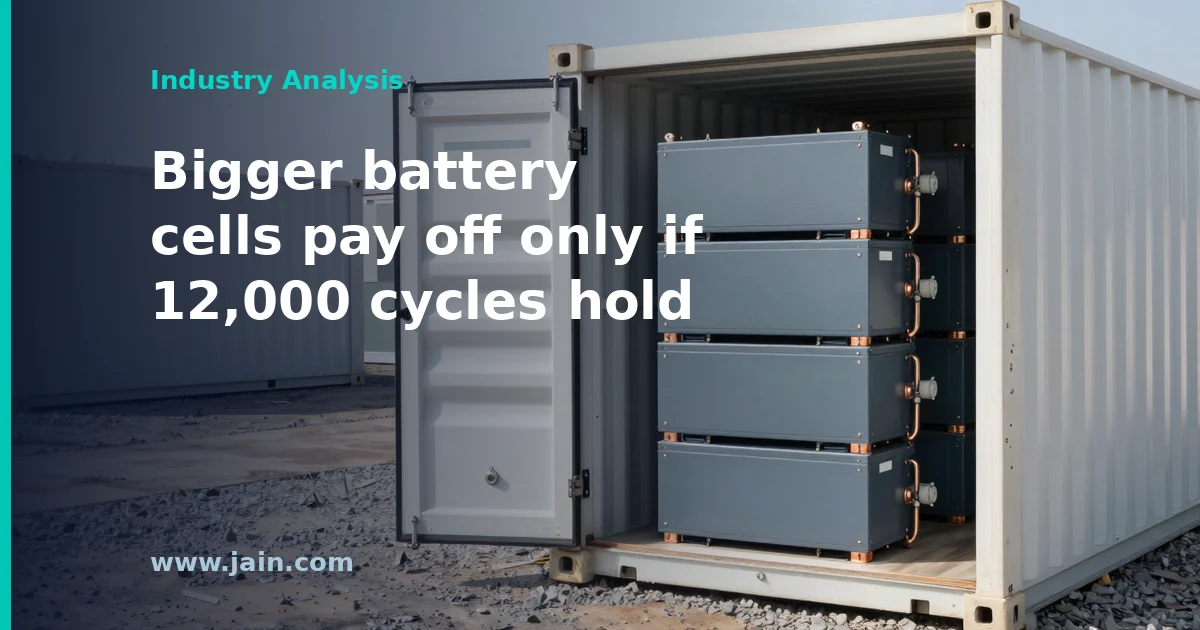
A Chinese battery maker, Pylontech, has started mass-producing unusually large battery cells. Cells are the building blocks inside the giant batteries that power companies use to store electricity.
Bigger cells mean fewer pieces to wire together, so each battery can hold more in less space. The company says each cell can be charged and drained more than 12,000 times, enough for one cycle a day for over 30 years.
That lifespan promise, more than the size, decides whether these batteries are cheap over their lifetime. Big batteries also help power grids keep up as artificial intelligence data centers push electricity demand higher.
Pylontech (688063:SH) began serial production of 588 Ah and 601 Ah prismatic lithium iron phosphate (LFP) cells on September 21 at its plant in Hefei, China. The company announced the milestone in a release distributed via PR Newswire on September 23. The cells are designed for large, grid-scale battery energy storage systems (BESS). Prismatic means the cells are flat, rectangular blocks rather than cylinders.
Pylontech says cumulative output of the new cells has already passed 100 MWh. The cells will go into its next-generation PyOcean storage systems, rated at 6.25 MWh and 8 MWh. For the 601 Ah cell, the company cites an energy density of 425.8 Wh/l, a cycle life above 12,000 cycles and 96.5% energy efficiency.
Executive Summary
Pylontech has moved its largest energy-storage cells from development into serial production at an automated line in Hefei. The pitch is straightforward. A bigger cell means fewer cells and fewer electrical connections per system, which the company says allows a more compact design, simpler assembly and lower costs over a system’s operating life. The first products to use the cells are PyOcean units of 6.25 MWh and 8 MWh.
For anyone building or financing power capacity, including capacity for AI-driven load growth, the cell size is the least decisive number here. Larger cells reduce the parts count once, at construction. Cycle life and efficiency determine how much energy a system delivers over the years that construction cost is spread across. Pylontech’s claim of more than 12,000 cycles at 96.5% efficiency is therefore the figure that matters most. It is also the figure that production volumes of around 100 MWh cannot yet prove in the field.
Bigger Cells Shrink the Parts Count, Not Just the Box
Amp-hours (Ah) measure how much electric charge a cell holds. For cells of the same chemistry and voltage, doubling the amp-hours doubles the stored energy. A storage system built on 601 Ah cells therefore needs roughly half as many cells as one built on cells of half that capacity for the same total energy. It also needs correspondingly fewer busbars, welds and bolted joints tying them together. Pylontech says this is the point: fewer cells and connections allow a more compact design, simpler assembly and lower lifetime costs. The 6.25 MWh and 8 MWh PyOcean systems are where buyers should look for that claim to show up in real hardware.
The 425.8 Wh/l figure is volumetric energy density, meaning how many watt-hours fit in a liter of cell. Denser cells help, but at system level the gain is diluted by cooling equipment, fire suppression, power electronics and required spacing. Footprint still matters to developers wherever pad space is limited or expensive, such as sites next to substations and large industrial loads.
Size alone is unlikely to be a lasting advantage. Several Chinese cell makers are pursuing the same 500-plus amp-hour class. What will separate suppliers is manufacturing yield, consistency from cell to cell, and field performance data.
Why 12,000 Cycles Matters More Than 601 Ah
The economics of a storage battery come down to a ratio. The numerator is what it costs to build and run. The denominator is how much energy it delivers over its life. Larger cells trim the numerator once, at construction. Cycle life and efficiency set the denominator for every year afterward. The arithmetic behind Pylontech’s claim is simple. At one full cycle a day, 12,000 cycles works out to about 33 years. At two cycles a day, it is about 16 years. Whether the cells outlast the rest of the system, or become the limiting component, shapes replacement costs and project returns.
The headline number needs context that Pylontech has not supplied. Cycle life is always measured under specific conditions: how deeply the cell is discharged, at what temperature, at what charge rate, and down to what remaining capacity before the cell counts as worn out. Without those conditions, 12,000 cycles cannot be compared cleanly with rival cells. Lenders, insurers and project owners typically price degradation through warranty terms, so the warranty attached to PyOcean systems will say more than the lab figure.
The 96.5% energy efficiency figure means about 3.5% of the energy passing through the cell is lost, mostly as heat, on each round trip. Whole-system efficiency will be lower once inverters, transformers and thermal management are included. For a battery cycled daily to buy power cheaply and sell it when prices are high, small efficiency differences compound into meaningful revenue over decades. That makes this figure, alongside cycle life, the one that developers and financiers should test hardest.
Where AI Load Meets Grid Batteries
Pylontech markets these cells for grid-scale storage and has not tied them to data centers. The link to AI infrastructure is indirect but real. Grid operators facing new large loads, including AI data centers, use batteries to shift solar output into evening hours, hold reserves for sudden supply drops, and relieve congested lines while new transmission is built. Standalone systems like Pylontech’s 200 MW/400 MWh Ningxia project, which connect to the grid rather than to a single power plant, do exactly this kind of work.
A data center operator weighing on-site storage has different priorities from a utility. That storage might provide backup, or it might let the operator agree to reduce grid draw at peak times in exchange for a faster connection. In either case, a denser, simpler system helps on a constrained campus. For that buyer, though, the deciding questions are fire-safety certification, warranty terms and degradation over the facility’s life. Those questions bring the analysis back to the 12,000-cycle claim rather than the cell size.
From 100 MWh to Project Scale
Serial production is a milestone, but the ramp is the real test. More than 100 MWh of cumulative output is a meaningful start. It equals about twelve 8 MWh PyOcean units, and it is a quarter of the capacity of the single Ningxia project. Pylontech’s reference projects show it has delivered at scale, including a 120 MW/240 MWh system in Yangzhou, Jiangsu province, the Ningxia installation and projects in Europe. The company has not said whether those projects use the new cells.
The factory details carry more weight than they might appear to. Pylontech says key stages in Hefei are fully automated, using more than 120 industrial robots and 180 intelligent production devices. A manufacturing execution system (MES), software that logs process and quality data at each step, gives every cell a traceable record. For owners, traceability means a failing cell can be tied back to its production batch. That shortens failure investigations and strengthens warranty claims, which matters as much to a lender as the cycle-life figure itself.
Background
Pylontech is a Chinese lithium battery company listed in Shanghai under the code 688063. Internationally it is best known for battery packs used in homes and small businesses. It has been pushing into large-scale storage, the multi-megawatt systems that utilities and developers connect to the grid, with reference projects in Jiangsu, Ningxia and Europe. Its Hefei plant, where the new cells are made, is highly automated.
Lithium iron phosphate (LFP) has become the dominant chemistry for stationary storage because it is thermally stable and long-lived. Across the industry, cell makers have been racing to build larger cells so that each storage container holds more energy with fewer parts. Grid-scale batteries are one of the tools utilities use to integrate renewable power and absorb new demand, including demand from data centers.
Amazon agreed to buy backup generators from Generac, the company best known for the generators that keep homes running during blackouts. These machines do the same job for the giant computer buildings behind online services, starting up when the regular power fails.
About $2.4 billion worth is expected to be delivered in 2027 and 2028. Amazon also gets the right to buy Generac stock at a fixed price, and that right grows the more generators Amazon buys, up to $8 billion.
The first $2.4 billion has a date on it. The rest only happens if Amazon keeps building.
On September 16, 2026, Generac Holdings (NYSE: GNRC) and Amazon.com signed a long-term supply agreement for backup power generators for Amazon data centers, according to an 8-K Generac filed the same day. Initial deliveries are expected to total $2.4 billion across 2027 and 2028. Alongside the supply deal, Generac issued an Amazon subsidiary a warrant to buy up to 1,693,745 Generac shares at $200.9266 each. Some of those shares vested immediately, and the rest vest as Amazon’s generator payments accumulate, up to a total of $8 billion.
Yahoo Finance reported that Generac shares rallied on the news.
Executive Summary
Generac’s filing makes Amazon a named buyer of data-center backup power, the generators that carry a facility through a grid outage once its batteries run down. It puts two numbers on the relationship. The first is $2.4 billion in expected deliveries over two years. The second is an $8 billion ceiling on the purchases that can unlock Amazon’s equity stake.
Those two figures measure different things. The $2.4 billion is a delivery expectation with dates attached. The $8 billion is the spending level at which Amazon’s warrant fully vests, and the warrant runs until September 2033. Most of the headline figure is therefore contingent: it turns into revenue only if Amazon keeps building data centers that need Generac equipment.
The structure also shows who is paying for what. Generac is giving its customer equity upside in return for volume. For Generac shareholders, that is a trade of some future dilution for a large anchor buyer. For the wider data-center supply chain, it signals that backup generation is now valuable enough to be locked in years ahead with financial ties that go beyond a purchase order.
The $8 Billion Is a Ceiling, Not an Order
The 8-K describes two separate instruments. The long-term supply agreement governs what Amazon buys, and the only scheduled volume it discloses is the $2.4 billion in initial deliveries expected in 2027 and 2028. The warrant governs what Amazon earns, and it vests in tranches “contingent upon aggregate gross payments, net of certain offsets” from Amazon for data-center backup generators, “up to a total of $8 billion.” The $8 billion is the point where the incentive stops growing. It is not a commitment to spend that much.
Scheduled deliveries cover 30% of that ceiling. The remaining $5.6 billion has no timetable in the filing, only an outer boundary: the warrant can be exercised on or before September 16, 2033. Every new hyperscale data center needs its own backup generation, sized to its electrical load. Whether Generac’s revenue approaches the $8 billion mark therefore depends on how many facilities Amazon builds over the next seven years, how large they are, and how much of that generator demand Generac wins against other suppliers.
This matters to three groups. Investors should model $2.4 billion as the disclosed baseline and treat anything above it as dependent on Amazon’s construction pace. Generac’s factory planning has to support a two-year delivery ramp without knowing what comes after 2028. Other generator suppliers now face a buyer that has a financial incentive to direct its volume toward one vendor.
Generac Is Paying for Volume in Equity
A warrant is the right to buy shares later at a fixed price. Here the supplier grants it to the customer. That makes it a volume incentive paid in stock rather than cash. Of the 1,693,745 warrant shares, 307,954 (about 18%) vested at signing, which works as an upfront signing incentive. The other 1,385,791 unlock only as Amazon’s payments grow. Spread evenly across $8 billion, that would be roughly one share for every $5,770 of generator purchases. The filing says only that vesting occurs in “multiple tranches” and does not give the actual schedule.
The economics favor Amazon when Generac’s stock trades above the $200.9266 strike price. Buying all 1,693,745 shares would cost about $340 million at that price. However, Amazon can choose a cashless exercise, receiving the net value in shares without paying cash. Generac has also granted registration rights, which make it easier for Amazon to sell those shares later. The result ties part of Amazon’s return to Generac’s share price, and that price should rise as Amazon buys more generators. Existing Generac shareholders bear the cost through potential dilution. The warrant’s strike price and share count are also subject to anti-dilution adjustments.
A Home-Standby Brand Takes a Hyperscale Test
Generac built its name on home standby generators. Data-center backup is a different business. The units are larger, reliability requirements are strict, and a hyperscaler’s construction schedule does not move because a supplier fell behind. Having Amazon as a named, contracted buyer is the clearest external validation of Generac’s data-center push so far. It also exposes Generac to a direct test: delivering $2.4 billion of equipment within two calendar years, to a customer that can measure its performance precisely.
Amazon’s broader funding shows how much money is flowing into these projects. Two days before the Generac agreement, Amazon’s own 8-K reported that it closed a £4.25 billion sterling bond sale, with coupons ranging from 5.200% on notes due 2029 to 6.650% on notes due 2045. Nothing in that filing links the proceeds to Generac or to data centers in particular. What it does show is a buyer raising capital at a scale where multi-year equipment commitments are routine. For Amazon, a warrant that pays off only if Generac performs is an inexpensive way to secure a supply chain it will need regardless.
Background
Generac Holdings, which trades as GNRC, is best known for home standby generators, the units that switch on automatically when a house loses power. Data-center backup power is a larger, more demanding version of the same product. Each facility needs enough on-site generation to carry its full electrical load through a grid outage, and hyperscale operators such as Amazon buy these systems in volume as they build new campuses.
Warrants tied to a customer’s purchases are an established way for suppliers to secure large buyers. The supplier grants equity upside that grows as the customer spends. Generac’s agreement follows that model, pairing a long-term supply contract with a warrant that vests against Amazon’s generator payments.
A small energy and data center developer, New Era Energy & Digital, agreed to buy electricity from Vistra, one of the largest private power generators in the United States, for the next twenty years.
The amount is 207 megawatts — roughly the electricity a small city uses, running day and night.
New Era’s share price jumped 16 percent on the news.
Why it matters: computer warehouses that run artificial intelligence need enormous, uninterrupted power. Locking in a supply for two decades is increasingly what banks require before they will lend the money to build one.
New Era Energy & Digital has signed a 20-year power purchase agreement with Vistra Corp. covering 207 megawatts of electricity, the company announced in a release distributed through GlobeNewswire. A power purchase agreement, or PPA, is a long-term contract under which a buyer commits to purchase a set volume of electricity from a generator, usually at a pre-agreed price structure.
Investing.com reported that New Era’s stock rose roughly 16% on the announcement. Vistra, an NYSE-listed independent power producer with a large fleet of generating plants and a retail electricity business, sits on the supply side of the contract. The announcement disclosed the counterparty, the contract term and the contracted capacity; it did not attach a price, a delivery start date or a named end user for the power.
Executive Summary
Two numbers define this deal: 207 and 20. The first is the capacity — enough to power a campus-scale data center, not a pilot. The second is the term, and it is the one that matters more to anyone financing digital infrastructure. Twenty years sits at the long end of the range for corporate power contracts, which more commonly run ten to fifteen years.
The significance is structural. Over the past two years, the binding constraint on new AI-capable data center capacity has moved from chips to land to interconnection to, now, contracted electricity. A developer that can show a lender a two-decade supply agreement with a creditworthy generator has converted its single largest and most volatile operating input into something closer to a fixed cost. That is the document that makes a construction loan underwritable.
For Vistra, the transaction is an example of the trade that has re-rated the independent power sector: selling long-dated output to digital load instead of leaving it exposed to wholesale market swings. For New Era — a far smaller company, judging by the size of the share-price reaction — it is a credential as much as a commodity purchase.
Why the Term Sheet, Not the Megawatts, Clears the Financing
Lenders to data center projects underwrite two things above all: revenue certainty on the customer side and cost certainty on the input side. Power is typically the largest recurring operating expense in a high-density computing facility, and in wholesale markets it is also the most volatile. A project that buys electricity at spot or on a short rolling contract carries an open-ended cost exposure across a 15-to-20-year debt tenor — precisely the mismatch that credit committees discount hardest.
A 20-year PPA closes that gap. It matches the electricity contract to the useful life of the building and, more importantly, to the amortisation schedule of the debt. At 207 megawatts of contracted capacity, the annual electricity spend is large enough that a few cents per kilowatt-hour of price movement swings project economics materially; fixing or collaring that number is what allows a sponsor to model a debt service coverage ratio a lender will accept. This is the mechanism behind the headline: the deal that clears financing is not the one with the most megawatts, it is the one with the longest defensible price.
The people affected sit well beyond the two counterparties. Developers competing for the same capital are now benchmarked against this structure. Generators with dispatchable fleets gain a new class of long-duration offtaker. And prospective data center tenants — the hyperscalers and AI companies that ultimately lease the space — inherit whatever price the developer locked in, for two decades.
207 Megawatts Is a Campus, Not a Pilot
Capacity figures in this sector are easy to misread. A single enterprise server hall might draw a handful of megawatts. A 207-megawatt commitment is campus scale — the order of magnitude associated with multi-building developments serving large cloud or AI tenants, drawing power continuously rather than at a daytime peak.
Loads of that size cannot simply be requested from a utility on a normal timetable. Interconnection queues — the waiting lists grid operators maintain for new large connections — now run years in many US markets, and queue position has become a genuine asset. Contracting with an existing independent power producer that already owns generating plants is one of the few routes that does not begin with building something new. It does not eliminate the need for transmission and interconnection work, but it does change what the developer has to prove to get there.
What a 16% Move Prices In, and What It Doesn’t
A double-digit single-day move tells you something about relative scale: 207 megawatts is transformative for New Era in a way it is unlikely to be for Vistra’s consolidated results. Equity markets are reacting to the credibility conferred by the counterparty as much as to the contract’s economics, which were not disclosed.
It is worth stating plainly what a PPA is and is not. It is an obligation as well as an enabler. Depending on structure, the buyer may owe payment for contracted volumes whether or not the load materialises — the same term that protects the project against price risk creates exposure if the data center is delayed, downsized, or never leased. Until the price, the shape of delivery and the identity of the end customer are known, the market is pricing a durable input at an unknown cost against demand that has not been publicly contracted. That is a reasonable thing to be optimistic about; it is not yet a verified margin.
Background
Over the past two years, the constraint on building AI-capable data centers has migrated. First it was chips, then suitable land and buildings, then grid interconnection — the queue of applications that grid operators process before a large new load can be energised. The current binding constraint for many developers is securing firm, long-dated electricity at a price they can underwrite, which has pushed independent power producers into direct, multi-decade contracts with digital infrastructure companies.
Vistra is among the US generators that own dispatchable plants and sell their output into wholesale markets and to retail customers. For companies with that profile, contracting output to data centers trades merchant price upside for revenue visibility. On the other side, developers such as New Era Energy & Digital — which positions itself at the intersection of energy and digital infrastructure — treat a signed supply contract as a prerequisite for raising the capital to build.
Lawmakers are moving a bill that would make large data centers pay the full cost of the power lines and grid upgrades they need, rather than spreading that cost across everyone’s electricity bills.
Shares of small nuclear companies jumped when the bill advanced, then handed the gains straight back. NuScale Power finished down about 7 percent, Oklo about 5 percent and Centrus Energy about 3 percent.
Why it matters: these companies pay for new reactors and fuel plants largely by selling shares. When the share price swings on a vote, so does the money available to build.
Shares of small-reactor and nuclear fuel companies rallied and then reversed around a House bill that would require data centers to cover the power costs their own loads create. According to reporting on the session that followed, NuScale Power fell about 7%, Oklo about 5% and Centrus Energy about 3%, giving back the gains the group had made when the measure advanced.
The move landed in a week in which two of the three companies were actively raising money against their share prices. Oklo disclosed in an 8-K filed September 11 that it had entered an at-the-market equity program of up to $1 billion, and Centrus disclosed in an 8-K filed the same day that it had priced a $500 million offering of stock and warrants on September 9. Centrus followed on September 17 with an 8-K reporting a multi-year high-assay low-enriched uranium supply contract with Antares Nuclear.
Executive Summary
The underlying policy question is narrow and consequential: when a data center of several hundred megawatts connects to the grid, who pays for the transmission upgrades, generation reserves and network reinforcement that load requires — the data center, or the utility’s general ratepayer base? A House bill assigning those costs to the load itself reads, at first glance, as a tailwind for dedicated on-site generation, including small modular reactors, because it raises the cost of taking power from the public grid.
The market tested that logic and then partly withdrew it inside a session. That is worth taking seriously rather than dismissing as noise, because the same rule that makes grid power more expensive also makes the buyers of small-reactor power more expensive to operate — and a bill that has cleared one chamber is not a tariff, a rule or a contract.
What makes the swing operationally relevant is that valuation in this sector is not a scoreboard. It is working capital. Oklo’s $1 billion at-the-market program converts share price directly into build funding, and roughly $2 billion of Centrus’s potential proceeds sits in warrants that only pay out if the stock trades well above where the September offering priced.
Cost Allocation Is the Real Variable Behind AI’s Power Demand
Interconnecting a large load is not simply a matter of running a wire. A multi-hundred-megawatt data center — a megawatt is roughly the steady draw of several hundred homes — typically triggers network upgrades, new substations and reserve capacity that cost hundreds of millions of dollars and take years to build. The question of who pays for that has, until recently, been handled case by case by state regulators and grid operators, often with a meaningful share landing in the rates everyone pays. A federal rule assigning those costs to the load that caused them changes the arithmetic of every site selection decision in the industry.
That is why the initial read was bullish for nuclear developers. If grid-delivered power carries the full loaded cost of the upgrades it requires, plus the multi-year queue wait, then dedicated generation sited at or near the campus stops competing against the cheap headline price of grid power and starts competing against the true all-in cost. Small modular reactors — factory-built units in the tens to few hundreds of megawatts, designed to be sited next to the customer — are positioned precisely for that comparison.
The give-back is the part worth explaining, because it is where the simple version of the thesis breaks. NuScale’s roughly 7% decline, Oklo’s 5% and Centrus’s 3% came without any company-specific bad news attached to them. The plainest reading is that the same rule cuts in two directions at once: it raises the cost of grid supply, but it also raises the total cost of building and operating the data centers that are the presumed offtakers for on-site nuclear. A hyperscaler facing a larger interconnection bill has less budget, not more, and may respond by siting fewer campuses rather than buying more reactors. Whichever way that nets out, the affected parties are the same: data center developers pricing new sites, utilities and their regulators deciding what the general ratepayer absorbs, and the reactor and fuel companies whose demand case is built on the gap between those two answers.
A Bill That Passed One Chamber Is Not a Tariff
There is a second reason a policy rally can evaporate in a session. Legislation of this kind does not usually land as a self-executing rule. Cost responsibility for large loads sits across federal and state jurisdictions, and translating a statutory instruction into actual large-load tariffs, deposit and collateral requirements, minimum-take terms and network upgrade cost assignments is a rulemaking-and-litigation process measured in years — comfortably longer than the development timeline of most of the reactors being valued against it.
None of that makes the bill unimportant. It means the market is pricing a direction of travel, not a set of terms, and direction-of-travel trades are exactly the ones that reverse when the second-order effects get counted. For readers evaluating these companies, the useful discipline is to ask what changed in contracted capacity, licensing position or customer commitments on the day — and in this case, for the reactor developers, nothing did.
When Share Price Is the Construction Budget
Here is where a one-session swing stops being abstract. Pre-revenue nuclear developers and capacity-expanding fuel suppliers fund themselves substantially by issuing equity, which makes the share price an input to the build, not a commentary on it.
Oklo’s 8-K filed September 11 discloses an equity distribution agreement with ten sales agents — Goldman Sachs, BofA Securities, Citigroup, J.P. Morgan, Morgan Stanley, Barclays, Cantor Fitzgerald, Guggenheim, Canaccord Genuity and B. Riley — permitting up to $1 billion of Class A common stock to be sold at the market over time, at a commission of up to 1.5%, off a shelf registration declared effective December 4, 2025. An at-the-market program dispenses stock into the open market at prevailing prices at the company’s discretion; the dollar ceiling is fixed, so the number of shares required to reach it moves inversely with the price. A 5% lower share price means roughly 5% more dilution for the same construction dollar.
Centrus shows the sharper version. Its September 11 filing and the accompanying release disclose an offering priced September 9 at a combined $199.64 per share of Class A common stock and accompanying warrants, comprising 500,000 shares, pre-funded warrants over 2,005,513 shares and common warrants over as many as 6,992,382 shares, for gross proceeds of approximately $500 million. The common warrants come in four series struck at $226.8625, $272.2350, $317.6075 and $362.9800 — between roughly 14% and 82% above the offering price — each series carrying an aggregate exercise price of about $500 million. That is roughly $2 billion of additional funding for domestic enrichment capacity that arrives only if the stock trades and holds well above where it priced, within tranches expiring between the second and fifth anniversaries of September 10, 2026. Policy-driven round trips of 3% to 7% do not decide that outcome on their own, but they are the increments that determine whether a strike price is reached, and they are the reason the grid cost-allocation debate has a direct line to how much enrichment and reactor capacity actually gets financed.
The Part of the Chain That Isn’t Priced on Votes
Centrus’s September 17 8-K and the attached release describe a different kind of event: a definitive multi-year contract to supply Antares Nuclear with high-assay low-enriched uranium — fuel enriched above the level used in conventional reactors, which most advanced designs require — with deliveries commencing before the end of the decade and prepayments from Antares to support expanded capacity. Prepayments are the operative detail. They are customer cash committed ahead of delivery, which is a materially firmer demand signal than a legislative headline.
Two caveats keep this even-handed. First, the release positions the contract around defense and space missions: Antares, founded in 2023 and described as backed by over $600 million in funding, was selected for the U.S. Army’s Janus Program at Fort Bragg, the Air Force’s Advanced Nuclear Power for Installations program at Joint Base San Antonio and a Space Force award, with initial military deployments stated for 2028. It is not evidence of data center demand. Second, the contract’s value, volumes and prepayment amounts are not disclosed, so “adds another HALEU customer to the backlog” cannot yet be sized.
Still, the contrast is the useful takeaway for anyone underwriting this sector. Centrus operates the American Centrifuge Plant at Piketon, Ohio, described in its release as the only licensed HALEU production facility in the western world, and is converting that position into binding orders with cash attached. That is a different asset class from a valuation that moves 3% on a chamber vote — and over time it is the one that determines whether AI-adjacent nuclear capacity gets built.
Background
The three companies sit at different points of the same chain. NuScale Power and Oklo are developers of small modular and advanced reactors, pre-revenue businesses whose value rests on licensing progress and future customer commitments. Centrus Energy is a fuel supplier, operating the American Centrifuge Plant in Piketon, Ohio, which its release describes as the only licensed high-assay low-enriched uranium production facility in the western world; the company says it has supplied more than 1,850 reactor years of fuel since 1998 and launched a multi-billion-dollar enrichment expansion last year.
All three have been repriced repeatedly over the past two years by the same underlying story: data center electricity demand growing faster than grids can be upgraded, and hyperscale operators signing power agreements with nuclear suppliers to secure firm, carbon-free capacity. Because reactor and enrichment capacity takes years and large capital outlays to build, and because these companies fund much of that through equity issuance, policy headlines that move sentiment also move the practical cost of building.
A batch of specially made salt just changed hands in Texas. The federal Department of Energy shipped it to Natura Resources, a company building a small nuclear reactor on a university campus in Abilene.
The salt is the reactor’s coolant. Instead of water held under enormous pressure, this design runs on hot liquid salt — made from a rare, highly purified form of lithium that hardly anyone produces.
Why care: Texas needs round-the-clock electricity for the giant computer warehouses that run artificial intelligence. Reactors like this are one proposed answer, and one of their hardest-to-source ingredients is now in hand.
Natura Resources LLC announced on September 18 that it has received FLiBE salt — a fluoride mixture of lithium and beryllium used as a molten-salt reactor coolant — from the U.S. Department of Energy’s Oak Ridge National Laboratory, routed through Idaho National Laboratory. The material is destined for the MSR-1, a molten salt demonstration reactor the company is building at Abilene Christian University in Abilene, Texas.
Natura said it won the salt through a competitive DOE solicitation facilitated by Idaho National Laboratory and issued in August 2025. The company said the salt contains 99.99% enriched lithium-7, an isotopic purity that suppresses the formation of tritium inside the coolant loop. Natura describes itself as privately owned, with more than $120 million in private funding and a $120 million commitment from the State of Texas, and holds what it says is the first Nuclear Regulatory Commission construction permit issued for a liquid-fueled reactor.
Executive Summary
The headline event is a shipment, not a groundbreaking — but shipments are where advanced nuclear schedules actually slip. Molten salt reactors substitute a liquid salt for the pressurized water used in conventional plants, which is what lets them run hot and near atmospheric pressure. That coolant is not a commodity. Getting it right requires lithium enriched to a specific isotope, lithium-7, at a purity Natura puts at 99.99%.
The reason the purity matters is operational rather than ceremonial. Natural lithium contains a meaningful fraction of lithium-6, which absorbs neutrons and produces tritium — a radioactive hydrogen isotope that migrates readily through hot metal and creates containment, monitoring and worker-protection burdens for the life of the plant. Stripping the lithium-6 out up front converts a permanent operating problem into a one-time procurement problem. That procurement, on Natura’s own account, was resolved by winning a federal allocation rather than placing an order.
For the Texas power market the relevance is indirect but real. Data center load growth in the state has made any firm, siteable generation valuable, and advanced nuclear is one of the options developers keep on the table. The MSR-1 is a demonstration unit intended to generate data for Natura’s commercial reactors; the company disclosed no capacity rating, no in-service date and no customer alongside the salt delivery.
The Scarce Input Is the Coolant, Not the Paperwork
Advanced nuclear coverage tends to track licensing milestones, because licenses are public, dated and easy to compare. Natura has one of the notable ones — it says it holds the first NRC construction permit for a liquid-fueled reactor. But a permit authorizes construction; it does not conjure the materials the design requires. This week’s event is the quieter constraint clearing, and the structure of the transaction tells you how tight it is.
Consider what Natura describes: salt held at a national laboratory, released through a competitive solicitation issued in August 2025, facilitated by a second national laboratory, and delivered more than a year later. That is the procurement pattern of an allocated stockpile, not a supply chain. Enriched lithium-7 at 99.99% is a Cold War-era product of isotope separation programs, and a developer that wins a tranche of it has removed a risk that competitors bidding on the same solicitation did not. Natura’s own framing — that the delivery secures “one of the most specialized inputs required” and reduces supply-chain risk — is an unusually direct admission that the material was a gating item.
The downstream implication is the part that matters for anyone financing or contracting firm power. If the coolant for a first-of-a-kind unit has to come from a federal solicitation, then the question for every molten salt program is what happens at unit two, unit ten, and at commercial scale, when legacy inventory cannot cover the order book and someone has to build enrichment capacity. That is a multi-year industrial problem with its own permitting, capital and workforce constraints, and it sits upstream of every megawatt these designs promise. Developers, utilities and data center buyers evaluating molten salt timelines should be asking about lithium-7 supply with the same seriousness they ask about NRC dockets.
Texas Is Buying Optionality on Firm Power
Natura discloses a $120 million commitment from the State of Texas alongside more than $120 million in private funding. That pairing is the more revealing number in the release. Texas has watched data center interconnection requests pile up against a grid that must serve them on the hottest and coldest days, and firm generation — power that runs regardless of weather — is the scarce commodity. State money in a pre-commercial reactor developer is not an energy purchase; it is a call option on a technology that, if it works, can be sited near industrial load without a transmission build.
What the announcement does not do is connect that option to load. The MSR-1 is a demonstration reactor on a university campus, and Natura says plainly that its purpose is to generate data for commercial reactors. No capacity figure, no offtake agreement and no data center customer appears anywhere in the disclosure. Readers evaluating this as an AI-power story should hold both facts: the material bottleneck is genuinely smaller today, and the distance between a campus demonstration unit and a contracted megawatt on an industrial site remains long.
A 13,000-Hour Precedent Is Heritage, Not Qualification
Natura leans on the Molten Salt Reactor Experiment, which ran at Oak Ridge from 1965 to 1969 and logged more than 13,000 operating hours demonstrating passive safety, high-temperature performance and fuel flexibility. The lineage is real, and receiving MSRE-era salt from the laboratory that ran the experiment makes for a legitimate through-line. It is also a reason the material exists at all.
The analytical caution is that operating hours from the 1960s are evidence the physics works, not evidence that a modern commercial unit will license, build and run on schedule. The MSRE was a research reactor with no requirement to sell power, meet a modern regulatory framework, or hit a cost of capital. Sixty years of institutional memory attrition sits between that program and this one, which is precisely why demonstration units like the MSR-1 exist. The honest read of this week’s news is narrow and still meaningful: one specialized input is secured, one category of schedule risk is retired, and the rest of the program is still ahead of the company.
Background
Molten salt reactors are an old idea with a short operating record. The Molten Salt Reactor Experiment at Oak Ridge National Laboratory ran from 1965 to 1969 and accumulated more than 13,000 hours, establishing that a reactor could run with its fuel dissolved in circulating salt at high temperature and low pressure. The program ended without commercialization, and the technology sat largely dormant for decades while the industry standardized on pressurized and boiling water designs.
Natura Resources LLC, based in Abilene, Texas, is one of the developers attempting to carry the concept into commercial service. It is privately owned, reports more than $120 million in private funding plus a $120 million commitment from the State of Texas, and says it holds the first NRC construction permit granted for a liquid-fueled reactor. Its first unit, the MSR-1, is under construction at Abilene Christian University and is intended to produce the operating data that commercial designs will be built on. Jordan Robison was named chief executive officer ahead of this phase of the program.
Sources
Source: Natura Receives Historic Molten Salt Reactor Coolant from Department of Energy — Natura Resources’ September 18, 2026 announcement that it received FLiBE salt from the Department of Energy’s Oak Ridge National Laboratory, via Idaho National Laboratory, for its MSR-1 demonstration reactor in Abilene, Texas.
A giant battery site in Moss Landing, California, caught fire again on Friday. The owner is Vistra, a large power company. The site uses batteries to store electricity for the grid, and it already burned badly in January 2025.
This time about 1,500 battery packs caught fire. They had been unplugged from the grid after the last fire, but they still held a charge. About 106 nearby residents were told to stay indoors.
This matters because power companies and huge computing centers are counting on big batteries to keep the lights on. A battery that has been switched off can still catch fire.
A fire broke out shortly after 6:15 a.m. on Friday, September 18, 2026, at Vistra’s battery storage facility in Moss Landing, California, the Salinas Californian reported. It started in the Moss 300 building, the same structure heavily damaged in the January 2025 fire. North Monterey County Fire District Chief Jess Cortez said the fire involved the roughly 1,500 battery modules left on the building’s north side. By a noon briefing there was no active flame. The site was “hot and smoldering” and expected to burn out within 24 hours, with drones checking battery temperatures.
A shelter-in-place order covered about 106 residents within a third of a mile of the plant, and Dolan Road stayed closed near the site. Vistra temporarily shut down the natural gas plant on the same property as a precaution. No injuries were reported. Air monitors detected some fine particulate matter (PM 2.5), but none above screening levels, and no hydrogen fluoride.
Executive Summary
This is the second fire in about 20 months at one of the world’s best-known grid-scale battery sites. The detail that matters most is where it happened. Vistra plant manager Ron George said the modules that burned were idle and disconnected from the grid, but still energized, inside a unit Vistra has already retired and is remediating with the U.S. Environmental Protection Agency.
For utilities and data-center developers who plan to use large batteries as “firming” capacity, meaning storage that fills gaps when solar, wind or other supply falls short, the lesson is about the full life of the asset. A battery that has left service can still hold energy and still ignite. The cleanup phase therefore carries its own safety, siting and insurance risk. Vistra also shut down the neighboring gas plant as a precaution, which shows how a battery incident can reach other generation on the same site.
Both Vistra’s investigation into the cause of the January 2025 fire and a California Public Utilities Commission investigation are still open. A second fire has now occurred before either has reported a root cause.
Retired Is Not the Same as Safe
The headline fact is simple. The 1,500 modules that burned on September 18 were not delivering power to anyone. George said they were idle and disconnected from the grid but still energized. The Moss 300 unit was retired after the 2025 fire, and Vistra is working with the EPA on remediation. The modules that burned were sitting in a damaged building while that cleanup was under way.
This is how lithium-ion storage behaves in general. Unplugging a battery from the grid stops it from trading power, but it does not remove the chemical energy stored in its cells. Until modules are discharged, removed or otherwise made safe, a damaged battery building remains a hazard. Operators usually model safety risk during commercial operation. Moss Landing shows that the period after an asset stops earning revenue can carry comparable risk, and the local community still bears it.
That changes the math for anyone buying storage-backed power. A data-center operator or utility signing a long-term capacity contract is exposed to more than the chance that a battery fails during its service life. It is also exposed to how long a failed asset takes to wind down, and to what happens to neighboring assets while it does.
One Fire, Two Assets Offline
Vistra shut down the onsite natural gas plant “out of an abundance of caution.” Co-locating batteries with existing generation is attractive because it reuses grid connections, land and permits that took years to secure. Moss Landing shows the other side of that choice. An incident at the battery portion of a site can take down generation that has nothing to do with the batteries, at least temporarily.
This correlation is directly relevant to AI infrastructure planning. Large computing campuses increasingly look for power from sites that pair several resources: gas, storage and solar. The goal is reliability through diversity. If one resource’s safety incident forces a precautionary shutdown of another, the reliability benefit of pairing them is smaller than it appears on paper. Buyers need to know how often that can happen and how long it lasts.
Safeguards Worked, but Answers Are Still Pending
Parts of the response went well. After the 2025 fire, the Monterey Bay Air Resources District oversaw installation of six additional air sensors. Four sit at the facility fence line, one at Elkhorn Elementary School and one at a nearby boatyard. Officials reported fine particulate readings within health standards and no hydrogen fluoride, a toxic gas that burning lithium-ion cells can release. Schools outside the shelter zone lifted their own orders the same day. No one was hurt.
The monitoring also has limits. The air district’s Richard Stedman said the sensors are not testing for heavy metals, “although we would expect that to be in the smoke.” And the core question from 2025, why the original fire started, remains open in both Vistra’s investigation and the CPUC’s. Without a published root cause, other operators, insurers and permitting authorities cannot yet say which design, spacing or suppression changes would prevent a repeat. The industry is still waiting for that input to its siting and insurance decisions.
Background
Vistra Corp. is a large U.S. power producer. At Moss Landing on California’s Monterey Bay, it built one of the world’s largest battery energy storage installations next to an existing natural gas power plant, reusing the site’s grid connections. The batteries charge when power is abundant and discharge when California’s grid needs extra supply, often in the evening as solar output fades.
In January 2025 a major fire damaged the facility’s Moss 300 building, which Vistra has since retired. After that fire, the Monterey Bay Air Resources District oversaw installation of six additional air monitoring sensors around the site and the community. Vistra and the California Public Utilities Commission are each still investigating the 2025 fire’s cause.
Shares in two companies building small, factory-made nuclear reactors jumped on Thursday. Oklo rose about 13% and NuScale about 10%.
The trigger was a vote in the US House of Representatives on how to power the huge computer warehouses behind artificial intelligence. The bill does not require anyone to use nuclear power.
That gap matters. Oklo had just arranged to sell up to $1 billion of new stock to fund its reactors. A higher share price means it can raise that money while handing out fewer new shares.
Shares of small modular reactor developers Oklo and NuScale Power rose sharply on Thursday after the U.S. House voted on legislation addressing electricity supply for data centers. Yahoo Finance and 24/7 Wall St. reported Oklo up 13% and NuScale up 10%. TechStock² put the gains at 11% and 9% and reported that the measure stops short of ordering the use of nuclear power. Other nuclear names, including NANO Nuclear Energy and fuel supplier Centrus Energy, also rose.
The rally came one week after Oklo disclosed, in an 8-K filed September 11, an equity distribution agreement with ten banks. The agreement lets it sell up to $1 billion of Class A common stock “at the market,” meaning gradually and at prevailing share prices.
Executive Summary
The House vote gave nuclear equities a policy signal, not a purchase order. The bill as reported does not compel data centers or utilities to buy nuclear power. It does not fund a reactor. It does not change how quickly the Nuclear Regulatory Commission licenses one. Even so, investors marked up the whole small-reactor group in a single session. That shows how much of these companies’ value rests on expectations about Washington’s direction rather than on operating assets. Neither Oklo nor NuScale yet runs a commercial reactor in the United States.
For Oklo, the timing turns a sentiment move into a financing variable. Its new at-the-market program sells shares at whatever the market is paying. A higher price lets the company raise the same dollars while issuing fewer shares, which means less dilution for existing holders. The company can also choose to raise more. For AI data-center developers hoping small reactors will eventually supply firm power, a well-funded developer matters. The capital to build is the first thing between a reactor design and a delivered megawatt.
A Rally on a Signal, Not a Mandate
The central fact of Thursday’s trade is the mismatch between the policy and the price move. The House measure concerns power for data centers, the warehouse-scale computing sites whose electricity demand has climbed with AI training and inference. The measure reportedly does not order that any of that power come from nuclear plants. Investors bid the sector up anyway. The best reading is that the market is pricing direction: Congress is treating data-center power as a legislative priority, and nuclear is the carbon-free, always-on source most often named alongside it.
That is a reasonable thing to be optimistic about, but it is not a revenue event. Small modular reactors (SMRs) are nuclear units far smaller than conventional plants, designed to be built in factories and installed in modules. They still have to clear licensing, secure fuel, finance construction and sign binding power contracts before they produce anything a data center can buy. A vote that addresses none of those steps directly moved the stocks by roughly a tenth. That tells readers more about how these valuations are built than about how soon reactors will run.
Why the Jump Matters Most to Oklo’s Share Sales
Oklo’s September 11 8-K sets out the mechanism. Under the equity distribution agreement, ten banks, including Goldman Sachs, BofA Securities, Citigroup, J.P. Morgan and Morgan Stanley, can sell Class A shares for Oklo in ordinary market trades, block trades or negotiated deals. Sales happen “at market prices prevailing at the time of sale,” up to $1 billion in gross proceeds. Oklo sets a daily maximum and a minimum acceptable price, and pays commissions of up to 1.5%. On the full $1 billion, that would be up to $15 million.
Because the price floats, the share price directly sets the cost of this capital to existing owners. Take any fixed dollar amount raised at a price 13% higher: it requires about 11.5% fewer new shares than it would have the day before (1 divided by 1.13). A policy-driven rally therefore does something concrete for Oklo that it does not do for a company without an open program. It cuts the dilution attached to funding reactor development, or lets Oklo raise more for the same dilution. The 8-K describes the shares as issued off a shelf registration declared effective in December 2025. That means Oklo can act on the higher price without a fresh registration process.
Two caveats keep this honest. Oklo has not said whether it has sold any shares under the program or at what prices. And a price gain built on a signal can reverse as quickly as it came. The benefit is real only for sales made while the higher price holds. Existing shareholders are the other affected party. Every share sold dilutes them, whatever the price.
A Basket Move, Not Company News
The breadth of the rally points to sector sentiment rather than company-specific developments. NuScale filed no material report with the SEC in the days around the vote. NANO Nuclear Energy’s most recent 8-K, filed September 17, reports only routine results from its September 15 annual meeting: six directors re-elected and Withum ratified as auditor. Nothing in that filing concerns the House bill, customers or reactors. When developers at different stages, and a fuel supplier, rise together on the same day, the market is repricing the theme, not the individual businesses.
For data-center developers and hyperscalers, the largest cloud operators, the practical lesson is to separate equity momentum from procurement reality. The gating items for nuclear-supplied AI capacity have not moved: licensed designs, fuel supply, construction financing and signed offtake agreements. Offtake agreements are long-term contracts to buy a plant’s output. A stronger share price can help with one of these, financing, and only for companies positioned to tap it.
Background
Oklo went public in 2024 through a merger with AltC Acquisition Corp., a blank-check company co-founded by Sam Altman. It is developing the Aurora, a compact fast reactor. Its first combined license application was denied by the Nuclear Regulatory Commission in 2022, and it has since been working back through licensing. NuScale Power’s design was the first small modular reactor design certified by the NRC. Its flagship Carbon Free Power Project with Utah municipal utilities was cancelled in 2023 after subscriptions fell short.
Both companies have positioned themselves as future suppliers of firm, carbon-free electricity to data centers, whose power needs have grown quickly with AI workloads. Both remain pre-revenue on commercial reactor sales. That leaves their share prices sensitive to policy news, to financing conditions and to any sign that large power buyers will commit.
Nvidia, the company whose chips run most of today’s artificial intelligence systems, says it will sell twice as many chips next year as it does this year.
That sounds like it means twice as many data centers, twice the electricity and twice the cooling. It may not. Nvidia’s chips include the one inside the Nintendo Switch 2, plus chips for laptops and robots, and the company does not say how many of each it sells.
The businesses that must supply the power and cooling need that breakdown before they can plan.
Nvidia chief executive Jensen Huang said on Thursday, September 17, that the company will double the number of chips it sells next year, CNBC reported. “I expect Nvidia to sell twice as many chips as this next year as we do this year,” Huang said at a summit on AI safety with King Charles III in Scotland, attended also by representatives of Google DeepMind, OpenAI and Anthropic.
The remark follows Nvidia’s forecast of 70% growth for the fiscal year ending January 2028, a figure CNBC put at about $673 billion. Nvidia does not disclose how many chips it sells in total; last fall Huang said the company had shipped 6 million Blackwell GPUs in four quarters.
Executive Summary
Huang’s forecast is a headline-friendly number: twice as many chips in a single year. For the companies that build and supply AI data centers, it reads as a demand signal for everything a chip needs to run: electricity, cooling, high-bandwidth memory and the networking that links processors together.
The number is less precise than it sounds. Nvidia sells far more than data center graphics processing units (GPUs, the accelerators that train and run AI models). Its lineup includes central processors, network switch chips, optical networking chips, laptop chips, Jetson modules for robots and cars, and the processor in Nintendo’s Switch 2. A doubling of total units says nothing on its own about how many high-power data center accelerators are in the mix.
That matters because infrastructure is planned in megawatts and racks, not in chip counts. The direction of Huang’s forecast is clear; the load it places on grids and cooling plants is not yet specified.
A Unit Count Is Not a Load Forecast
A data center’s electricity and cooling needs are set by the accelerators and servers installed in it. A Blackwell or Rubin GPU sits in a liquid-cooled rack drawing power continuously; a Switch 2 processor sits in a handheld console on battery. Both count as one chip in a total unit figure. Doubling a blended count could therefore mean data center shipments doubled, or rose less while consumer and embedded lines rose more, or any combination in between.
The people who must translate Huang’s number into physical capacity — utilities fielding interconnection requests (applications to connect new load to the grid), developers securing sites, cooling-equipment makers, and memory suppliers allocating production — plan against deliveries of data center systems. Huang’s statement does not give them that figure. It confirms that demand is rising; it does not tell them by how much in the category that consumes the power.
That is the practical risk on both sides. Suppliers who read “twice the chips” as “twice the megawatts” could overbuild if the growth skews toward low-power parts. Suppliers who discount the statement could fall short if the growth is concentrated in data center accelerators. Either error is expensive in a business where transformers, cooling plants and memory lines take long lead times to add.
The Revenue Forecast Tells a Different Story Than the Unit Forecast
Nvidia’s own dollar guidance offers a cross-check. The company expects 70% growth in the fiscal year ending January 2028, which CNBC put at about $673 billion. That fiscal year broadly overlaps calendar 2027, the “next year” Huang appears to be describing.
If the two forecasts cover comparable periods, units growing 100% while revenue grows 70% implies average revenue per chip falls. One reading is a mix shift toward lower-priced parts; another is that the two figures simply measure different things over slightly different windows. Either way, the gap between them is a reason not to treat the unit figure as a proxy for data center buildout. The revenue figure, heavily weighted to data center products, is the better, though still indirect, gauge of the infrastructure load ahead.
What Power, Cooling and Networking Suppliers Can Still Take From It
The statement is not empty. Huang tied it to broad demand — “almost every single country that we’re in, people want to invest in AI” — and it extends a run of forecasts that, CNBC noted, pushed analyst expectations up and point to continued growth over the next six quarters. Nvidia’s list of product lines also includes switch chips and optical networking chips, so growth in AI clusters carries a networking and fiber component alongside compute.
For power equipment makers, cooling vendors, memory producers and data center landlords, the sensible reading is directional: demand for AI capacity continues to grow, and at a pace Nvidia expects to exceed this year’s. The sizing — how many megawatts, how many racks, how much memory — still depends on figures Nvidia has not broken out.
Background
Nvidia began as a graphics-chip company and became the dominant supplier of the accelerators used to train and run AI models. Its data center GPU families, Blackwell and now Rubin, are deployed in dense, often liquid-cooled racks whose power and cooling needs have reshaped how data centers are designed and where they are built.
The company also sells a wide range of other semiconductors, from networking and optical chips that link AI clusters together to processors for laptops, robots, cars and Nintendo’s Switch 2. That breadth is why a company-wide chip count and a data center buildout forecast are not the same thing.
Eaton, a long-established maker of the equipment that moves electricity safely through buildings, says its best years are still ahead.
The reason is data centers: the giant warehouses of computers behind apps, online search and chatbots. Each one needs enormous amounts of electricity switched, routed and backed up in case the power fails, and Eaton sells much of that equipment.
The companies supplying the wiring behind the artificial intelligence boom can profit no matter which tech giant wins. The big open question is how long the building spree lasts.
Yahoo Finance reported that Eaton Corporation (NYSE: ETN), the power management company, sees its best years ahead, with demand from data centers powering its growth. The outlook ties Eaton’s trajectory directly to the electrical infrastructure needed by the facilities that run cloud computing and artificial intelligence (AI) workloads.
Executive Summary
Eaton is signaling confidence that data center construction will drive growth beyond anything in its recent history. The company makes the electrical backbone of these facilities: switchgear that routes and protects high-voltage power, uninterruptible power supplies (UPS) that keep servers running through outages, and power distribution units that deliver electricity to server racks.
The outlook matters because it points to where AI spending ultimately lands. Chips and cloud platforms get most of the attention, but every new data center hall needs power equipment before a single server can be switched on. That puts electrical suppliers among the most direct beneficiaries of the buildout, whichever chipmaker or cloud provider comes out ahead.
A forward-looking claim is not a result, though. A “best years ahead” view depends on data center spending staying strong, on Eaton’s ability to manufacture enough equipment, and on customers securing the grid power they need to finish their projects.
Selling Picks and Shovels for the AI Power Crunch
A data center is, at its core, a building that turns electricity into computation. Power arrives from the utility at high voltage, then passes through transformers, switchgear, backup systems and distribution equipment before it reaches the servers. Each stage is a purchase, and Eaton competes in many of them.
This is the classic picks-and-shovels position. Eaton does not need to predict which AI model, chip architecture or cloud provider will dominate. It needs data centers to keep getting built, and it needs those facilities to keep drawing more power. The industry trend toward denser server racks, where more computing and more electricity are packed into the same floor space, tends to raise the amount of electrical equipment each facility requires.
That makes the claim structurally credible. Unlike speculative software revenue, electrical infrastructure is a physical requirement: a facility cannot operate without it, and none of it can be skipped to save money.
Why Electrical Gear Holds Its Value
Power distribution equipment is often engineered to order, has to meet strict safety and reliability standards, and must be qualified by operators before it goes into a live facility. Large data center operators tend to standardize designs across many sites, so a supplier that wins a place in a reference design can see repeat orders as the design is rolled out.
Those features give incumbents such as Eaton real advantages over new entrants. They also help explain why established rivals, including Schneider Electric, Vertiv, ABB and Siemens, are chasing the same demand. The market is large enough to lift several suppliers, but competition over pricing, delivery slots and new designs will likely sharpen as manufacturing capacity catches up.
For data center developers, the practical result has been a supplier’s market for critical electrical equipment. Buyers who reserve manufacturing capacity early are generally better placed than those who order once a site is ready to build.
The Risks Beneath a Bullish Outlook
The most obvious risk is concentration. If much of Eaton’s growth depends on a few very large buyers of data center capacity, a slowdown in their capital spending would show up quickly in new orders. Infrastructure booms have historically been followed by periods of digestion, when customers pause to absorb capacity they have already built.
A less obvious risk is power itself. In many markets, data centers are limited less by equipment than by how quickly utilities can connect them to the grid. If projects stall while waiting for electricity, orders for the gear that distributes that electricity can slip too. Eaton’s fortunes are therefore tied partly to utility and grid timelines it does not control.
Execution matters as well. Meeting surging demand requires factory expansion, skilled labor and reliable component supply. Growth that outpaces manufacturing capacity can lead to delivery delays that push customers toward competitors.
What It Means for Buyers and Investors
For data center operators and developers, a supplier this confident in demand is a signal to lock in procurement early and to qualify more than one vendor for critical equipment. Lead times and pricing are likely to remain a negotiation shaped by how tight the market stays.
For investors, Eaton’s outlook reinforces the view that power infrastructure is one of the more direct ways to gain exposure to the AI buildout. The durability of that thesis rests on the questions below: how much demand is actually contracted, and how long it lasts.
Background
Eaton Corporation is a long-established industrial company that has repositioned itself around power management. Its electrical business makes the equipment that carries electricity from the utility connection to the point of use, including switchgear, uninterruptible power supplies, power distribution units and related controls. The company also serves the aerospace, vehicle and industrial markets, and it trades on the New York Stock Exchange as ETN.
Data centers have become one of the most important markets for electrical equipment suppliers. The spread of cloud computing, and more recently the rapid growth of AI, has driven large technology companies and data center developers to build bigger, more power-hungry facilities. That has strained both equipment supply chains and utility grids, turning electrical infrastructure from a background purchase into a strategic bottleneck.
A startup called Blue Energy asked federal nuclear regulators for permission to build a power plant on the Texas coast that runs on both natural gas and small nuclear reactors.
The electricity would feed a computing site built by Crusoe for artificial intelligence — buildings full of computers that need power around the clock.
Here is the catch: the gas part gets built first, by around 2030. The reactors come later, in the 2030s.
So the plant sold as nuclear will spend its early years running mostly on gas.
EnergyTech reported that North Carolina-based startup Blue Energy has submitted its first construction permit application to the U.S. Nuclear Regulatory Commission for a hybrid gas-and-nuclear generating station at the Port of Victoria, Texas. The project would pair a GE Vernova 7HA.02 gas turbine with the GE Vernova-Hitachi BWRX-300 small modular reactor, building toward a 2.5-gigawatt plant by the early 2030s that would serve an AI data center — an “AI factory” — developed by Crusoe, along with other loads.
The build is staged. Phase one centers on the gas turbines, which the company says are the quickest to install and commission, targeted for the end of this decade. Phase two would add perhaps five BWRX-300 units, each generating close to 300 megawatts at capacity, with the gas units eventually phased out or reduced. Blue Energy estimates project cost at more than $6 billion, with Société Générale acting as lead financial advisor.
Executive Summary
The filing is a procedural milestone rather than a construction start, and that distinction matters. No small modular reactor has been fully approved or begun construction in the United States. Federal applications of this kind typically take years to move through technical and environmental review before a permit issues. Blue Energy is entering a queue that also contains the Tennessee Valley Authority’s BWRX-300 application at Clinch River — which GE Vernova Hitachi says is approaching a decision — and applications from other developers including X-energy.
What makes the Victoria project analytically interesting is not the reactor. It is the sequencing. A 2.5-gigawatt site whose first phase is combustion turbines and whose second phase is five reactors is, for the first several years of its operating life, a gas plant with a nuclear option attached. If roughly five units at close to 300 megawatts each eventually arrive, that implies on the order of 1.5 gigawatts of nuclear capacity and the balance from gas — meaning the gas fleet is not a token bridge but a substantial share of the nameplate.
For GE Vernova, the strategic value is fleet economics: the same reactor design, the same licensing work and the same supply chain applied across multiple sites, so that each project is cheaper and faster than the last. For data center developers, the practical value is that a credible nuclear pathway may make a gas-first interconnection easier to defend to customers and communities that have made carbon commitments.
The Permit Is Nuclear. The First Electrons Are Gas.
Read the phasing literally. Blue Energy says phase one focuses on the gas turbines because they are the quickest to install and commission, with a target of the end of this decade. Phase two would add perhaps five BWRX-300 reactors, each producing close to 300 megawatts — a megawatt being roughly the power draw of a few hundred homes, and 300 megawatts being enough for a serious data center campus on its own. The total plant is described as 2.5 gigawatts by the early 2030s. Subtract the nuclear arithmetic from the total and roughly a gigawatt of gas-fired capacity is carrying the site before the reactors show up, and continuing alongside them after.
That is the operational conclusion buried in an otherwise routine regulatory filing. Crusoe’s AI factory, if it energizes on the announced schedule, will be a nuclear-adjacent load long before it is a nuclear-powered one. Nobody has misstated this — the release is explicit that gas comes first and that the gas units would later be “phased out or reduced.” But the framing of hybrid gas-nuclear projects generally, and the headlines they generate, tend to lead with the reactor rather than with the turbine that will actually be spinning in 2030.
Who this affects: any hyperscaler or AI developer signing power agreements against projects like this one needs to price two different assets. The near-term asset is dispatchable gas generation with commodity and emissions exposure. The long-term asset is a first-of-a-kind reactor deployment with schedule and licensing risk. Blending them into one “clean firm power” line item on a sustainability disclosure understates the first and overstates the certainty of the second. The honest version is that gas is buying time for nuclear to clear regulatory review — which is a defensible strategy, just not the same claim.
Fleet Licensing Is the Product GE Vernova Is Actually Selling
Jason Cooper, CEO of GE Vernova Hitachi Nuclear Energy, framed the Blue Energy filing around repeatability: “This is what fleet deployment looks like: projects advancing on common technology, licensing work and supply chain capabilities, allowing us to apply lessons from one project to the next.” That sentence is the commercial thesis of the entire small modular reactor category, compressed.
Conventional nuclear construction in the United States has been defeated less by physics than by one-off engineering. Every plant a bespoke design, every licensing review starting near zero, every supply chain assembled and then dispersed. The BWRX-300 bet is that if the same design goes through the Nuclear Regulatory Commission repeatedly — Clinch River with the Tennessee Valley Authority, now Victoria with Blue Energy — the review gets shorter, the vendors keep their tooling, and the crews carry experience forward. Blue Energy’s Jake Jurewicz echoed the point, saying the team moved from technology selection to construction permitting “in a matter of months.”
The claim is plausible and, so far, unproven at the only point that counts: a completed unit. Nothing in the release establishes that the second application will be reviewed faster than the first, or that fabrication cost falls on unit two. Investors and buyers should watch the Clinch River decision closely, because it is the first real data point on how much of the fleet argument the regulator is prepared to credit.
More Than $6 Billion, and the Project-Finance Test
Blue Energy puts the project above $6 billion and has engaged Société Générale as lead financial advisor. Kim Hill, the bank’s transaction lead, described the mandate as a step toward deploying private capital markets for advanced nuclear “just like it has for wind, solar, and battery technologies.” That comparison is the tell. Wind, solar and storage became bankable because their capital costs are predictable, their construction windows are short, and their revenue is typically locked to long-term contracts before anyone breaks ground.
Advanced nuclear does not yet satisfy the first two conditions in the United States — no unit has been built to prove them. Which is another reason the gas-first phasing is more than an engineering convenience: turbines are a financeable, well-understood asset class with an established construction schedule, and early cash flow from gas generation changes the risk profile a lender sees when it underwrites the reactors behind it. The strategic investor list, which includes Constellation Technology Ventures, VXI, Engine Ventures, At One Ventures and Tamarack Global, reflects venture-stage risk tolerance; a $6 billion project needs a different class of capital entirely.
Why the Load Growth Argument Has Real Force — and Its Limits
Nuclear supplies about 18% of the U.S. utility-scale electricity mix, and the fleet spent years under pressure from operating costs, cheap gas, renewables and, critically, flat demand. Data center growth has reversed the demand assumption, and the industry’s argument is that carbon-free baseload — power that runs continuously rather than when the wind blows — is the natural answer for loads that run at high utilization around the clock.
The counterargument, which the release also records, is that nuclear projects remain expensive, slow and contested on health and safety grounds. Both positions can be evaluated on evidence rather than assertion, and the evidence arrives on a schedule: permit decisions, construction starts, and the first concrete date. Until then, the sharpest thing to say about Victoria is that it is a credible attempt at a genuinely difficult sequencing problem — build generation fast enough for AI load that exists now, while licensing generation clean enough for the commitments that load has already made.
Background
Blue Energy is a North Carolina-based startup pursuing what it describes as a repeatable, rapidly built approach to new nuclear construction — EnergyTech has previously reported the company raised $380 million to advance prefabricated reactor construction. It selected the BWRX-300 design earlier this year for co-location with gas turbines and, by its own account, moved from technology selection to federal construction permitting within months.
The BWRX-300 is a boiling water small modular reactor from GE Vernova Hitachi Nuclear Energy, a joint venture between GE Vernova and Hitachi. It is the design furthest along in the U.S. licensing process, through the Tennessee Valley Authority’s Clinch River project, and has been selected by several developers internationally. The broader context is a U.S. power sector that spent a decade planning around flat demand and is now contending with data center and AI load growth that has made firm, round-the-clock generation scarce and valuable again.