Tag: data center power

  • Core Scientific’s AMD Bet and the Non-Nvidia AI Question

    Core Scientific’s AMD Bet and the Non-Nvidia AI Question

    A Stocktwits headline reports that shares of Core Scientific (Nasdaq: CORZ) rebounded after a partnership with chipmaker AMD was said to unlock a multi-gigawatt artificial-intelligence expansion. Core Scientific is a US operator of large-scale data centers that grew up hosting bitcoin mining and has been repositioning those sites toward AI and high-performance computing workloads.

    The item circulated as a market-commentary story rather than a company press release. Beyond the headline claim — an AMD tie-up, a multi-gigawatt ambition, and a positive share-price reaction — no financial terms, site locations, delivery schedule or customer names accompany it in the source material available to us.

    Executive Summary

    The announcement, as reported, matters for one reason above all: it attaches a named silicon partner to the largest open question in digital infrastructure right now — whether the wave of bitcoin miners converting their power-rich campuses into AI data centers can build a durable business on chips other than Nvidia’s. Nvidia’s accelerators and its CUDA software ecosystem have been the default for AI training and inference. A credible AMD-based buildout at gigawatt scale would be a meaningful data point that the market has a second viable supply chain.

    For Core Scientific specifically, the strategic logic is straightforward. Its scarce asset is not chips; it is interconnected electrical capacity, land, substations and the operating experience to run dense, hot racks. Those assets are chip-agnostic. If AMD accelerators can be pointed at them under contract, the company converts a commodity-priced, halving-exposed mining business into contracted infrastructure revenue.

    The caution is equally straightforward. “Unlocks multi-gigawatt expansion” is an ambition statement, not a delivered megawatt. Gigawatts of AI capacity require utility interconnection agreements, transformers and switchgear with long lead times, liquid cooling, capital measured in billions, and — decisively — signed customers willing to commit for years. None of that is evidenced in the source item, and readers should treat the share-price move as a reaction to a narrative rather than to disclosed terms.

    What the Headline Substantiates, and What It Doesn’t

    Good analysis starts with sourcing. The item here originates from Stocktwits, a social platform oriented to retail investors, and it summarises a market move. That is a legitimate category of financial reporting, but it is a different evidentiary class from a company press release, an SEC filing or a joint statement from both parties. What is asserted: a partnership with AMD, a multi-gigawatt expansion framing, and a rebound in CORZ shares. What is absent: contract value, contracted capacity in megawatts, which sites, what timeline, who the end customer for the compute is, and whether AMD’s role is as a chip supplier, a co-investor, an anchor tenant, or some combination.

    Those distinctions are not pedantry — they determine the economics entirely. A supply agreement to buy accelerators is a cost commitment for Core Scientific. An arrangement in which AMD or an AMD-aligned cloud partner takes capacity is a revenue commitment. The two have opposite balance-sheet signatures, and the headline as written does not distinguish between them. Until a filing or joint release clarifies the structure, the honest position is that the direction of travel is clear and the magnitude is not.

    None of this implies the reporting is wrong. It is a reminder that in a sector where announcements routinely precede shovels by years, the market often prices the press release and then re-prices the execution.

    Why the Non-Nvidia Question Is the Real Story

    AI accelerators are the specialised processors that do the mathematics behind model training and inference. Nvidia has held the dominant position not only on raw silicon but on software: CUDA, its programming layer, is where most AI code was written, and rewriting or recompiling for another vendor carries real engineering cost. AMD’s competing line, paired with its open ROCm software stack, has been the most credible challenger, and every large deployment that runs production workloads on it chips away at the switching-cost objection.

    For a data center operator, a second serious supplier is strategically valuable regardless of which chip wins. It improves negotiating leverage, it hedges allocation risk when the leading vendor’s capacity is oversubscribed, and it widens the pool of potential tenants — some AI companies actively want a non-Nvidia option for cost or supply-security reasons. Operators that can present themselves as multi-vendor rather than single-vendor facilities are, in principle, more resilient.

    The risk cuts the other way too. If a facility is engineered around one accelerator family’s power density, cooling profile and rack geometry, and demand consolidates elsewhere, the operator holds a purpose-built asset with a narrower tenant pool. This is the underappreciated tension in every AI-conversion story: the more you optimise for a specific chip generation, the less fungible your capital becomes.

    Gigawatts Are a Power Story Before They Are a Chip Story

    A gigawatt is roughly the output of a large power station — enough for hundreds of thousands of homes. When operators talk in gigawatts, the binding constraint is almost never chips; it is grid interconnection. Utilities must study, approve and physically connect that load, and queues in several US markets run for years. Behind interconnection sit long-lead-time components: high-voltage transformers, switchgear, generators. Then comes cooling, because AI racks draw far more power per cabinet than the air-cooled halls built for mining or conventional cloud, which typically forces a shift to liquid cooling and a substantial retrofit.

    This is precisely where former bitcoin miners have a genuine, non-trivial advantage. They sited themselves near cheap and abundant power, they already hold interconnection rights, and they have operational muscle memory for managing large, variable electrical loads. That is a real head start, and it explains why this cohort has attracted AI-era capital at all. It is also why “multi-gigawatt” claims from miners are more plausible than the same claim from a greenfield developer.

    The advantage is partial, though. Mining sheds tolerate downtime and temperature swings that AI training clusters do not. Converting a site means adding redundancy, network fabric, security posture and service-level guarantees that mining never required — a capital and cultural upgrade, not a relabelling. Investors should ask how much of any announced gigawatt figure is energised, contracted capacity versus a pipeline of sites at various stages of study.

    Winners, Losers and the Financing Question

    If a deal of this shape proceeds and delivers, the clear winners are AMD, which gains a large-scale reference deployment and a credibility argument against Nvidia’s ecosystem lock-in, and power-rich operators generally, whose land-and-electrons position gets re-rated. AI customers benefit from a wider supply base. Utilities in the relevant regions gain a large, creditworthy load — though local ratepayers and permitting bodies increasingly ask, reasonably, who pays for the grid upgrades.

    The pressure falls on operators without secured power, and on any miner attempting the same pivot without contracted offtake. The AI-conversion trade only works if compute demand at these scales persists through the buildout period, which is typically years. If demand growth moderates or hyperscalers bring more capacity in-house, capacity built speculatively becomes an expensive vacancy problem.

    Finally, financing. Multi-gigawatt programmes are financed, not funded from cash flow, and the terms matter enormously to existing shareholders — vendor financing, project debt, equity issuance and equipment leases distribute risk very differently. A share-price rebound on a partnership headline tells you the market likes the story. It does not tell you the cost of capital behind it, and that is usually where these projects are ultimately won or lost.

    Background

    Core Scientific is among the larger US operators of power-intensive data centers, a business it built around bitcoin mining. That industry’s economics — thin margins tied to a volatile asset and periodic supply halvings — pushed operators to secure very cheap electricity and very large grid connections, which is exactly the asset base the AI boom later made scarce. Since generative AI demand accelerated, a number of listed miners have sought to convert or expand their campuses into AI and high-performance computing hosting, a shift the market has watched closely because it changes the revenue model from commodity exposure to contracted infrastructure.

    The wider context is a global shortage of two things at once: AI accelerators and the power to run them. Nvidia has supplied most of the former; AMD has positioned itself as the principal alternative, pairing competitive silicon with the open ROCm software stack against Nvidia’s entrenched CUDA ecosystem. Announcements pairing an accelerator vendor with a power-rich site owner therefore sit at the intersection of both bottlenecks, which is why they move markets — and why the operational detail behind them deserves scrutiny.

    Source: CORZ Stock Rebounds After AMD Partnership Unlocks Multi-Gigawatt AI Expansion — Stocktwits report on Core Scientific’s share-price reaction to a reported AMD partnership tied to a multi-gigawatt AI data center expansion.

  • nVent’s $1.75B Maverick Power Deal Targets AI’s Real Bottleneck

    nVent’s $1.75B Maverick Power Deal Targets AI’s Real Bottleneck

    nVent Electric (NYSE: NVT) has agreed to acquire Maverick Power for $1.75 billion, according to a deal roundup published by Benzinga and distributed via Google News. Maverick Power is positioned in the market as a maker of modular, factory-assembled power distribution equipment — the switchgear and enclosures that take utility-scale electricity and split it safely into the feeds a building actually uses.

    The item appeared in a multi-company “Deal Dispatch” column that also noted Carets Corp exploring strategic alternatives, a formal phrase companies use when they open a review that can end in a sale, merger, spin-off or nothing at all. Beyond the buyer, the target and the headline price, the aggregated summary carries no further detail: no closing date, no financing structure, no management commentary and no stated revenue or earnings contribution.

    Executive Summary

    The transaction, as reported, is a straightforward statement of strategic intent. nVent’s core business is electrical connection and protection — enclosures, cable management, thermal management and electrical fastening. Adding a modular power distribution manufacturer moves the company further up the value chain, from housing and protecting electrical equipment toward supplying the switching and distribution gear itself, pre-integrated at a factory rather than assembled on site.

    Why it matters is a question of sequencing. For three years the popular account of the AI buildout has centred on accelerators and high-bandwidth memory. Increasingly, the binding constraint sits earlier and lower in the stack: interconnection queues, transformers, breakers and medium-voltage switchgear. A campus with chips on order and no energised switchgear is not a data center; it is a warehouse. Capital is flowing accordingly, and a $1.75 billion cheque for distribution equipment capacity is a clear expression of that repricing.

    A caution on evidence. The source here is a wire-service roundup, not a full company release, and the aggregated headline renders the price as “$1.75” without a unit; the billion-dollar reading is the one carried in the market framing of the deal. Everything in this article about strategic rationale, synergies and market position is analysis of a thinly documented item, not a summary of disclosed company statements. Readers should treat the price and parties as the reported facts and the rest as interpretation pending nVent’s own filings.

    The Bottleneck Moved Downstream From the Chip

    Every data center is, electrically, a funnel. High-voltage power arrives from the grid, a substation steps it down, medium-voltage switchgear divides and protects the resulting circuits, and transformers and low-voltage gear deliver usable power to racks. Medium voltage — broadly, the range between utility transmission levels and the volts running to equipment — is where a campus is actually carved into feeds. That equipment is heavy, custom-configured, safety-critical and made by a small number of qualified manufacturers.

    AI campuses have made this segment structurally scarce in a way ordinary commercial construction never did. Density is the driver: an AI hall draws far more power per square foot than a traditional enterprise facility, so a given plot of land now demands vastly more switching apparatus. Demand for gear scaled with power draw, while the factories that build it scaled with the slower rhythms of industrial capital expansion. When order books lengthen faster than plants can be added, buying an existing manufacturer is often quicker than building one — which is a reasonable read of the logic behind a deal of this size.

    The honest caveat is that no lead-time or backlog figures accompany this report. The scarcity argument is well established across the electrical equipment sector, but the specific pressure inside Maverick Power’s order book is not disclosed here, and it is the single number that would most affect how the price should be judged.

    Why Factory-Built Beats Site-Built in a Labour-Constrained Market

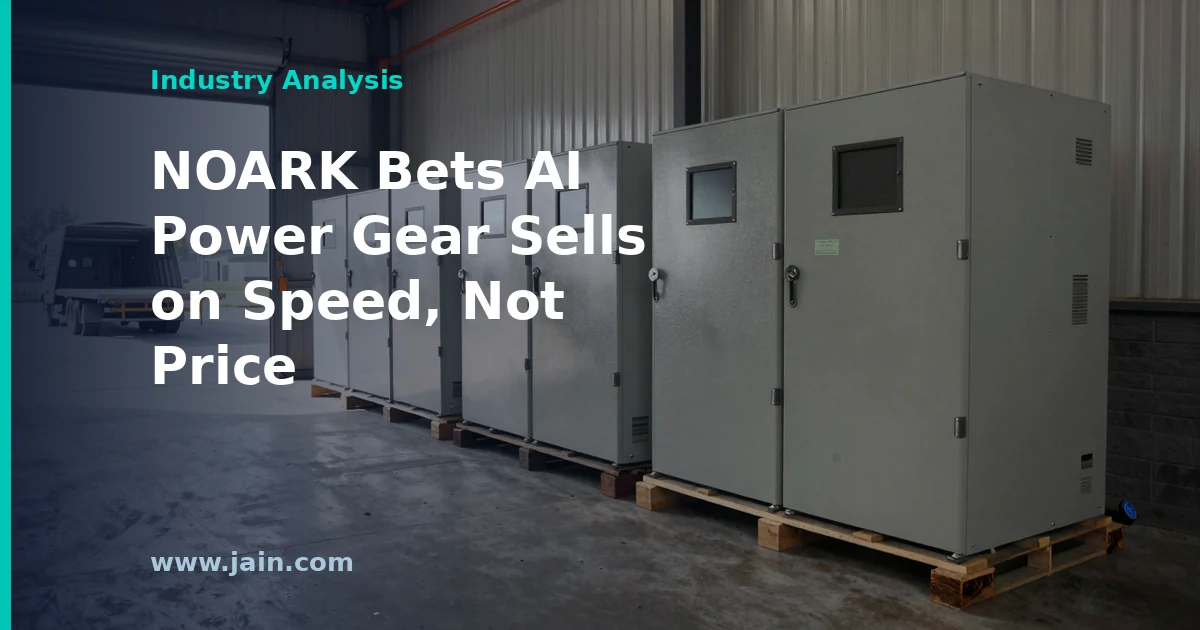
    The modular element deserves more attention than the price tag. Traditional electrical rooms are built on site: gear is delivered as components, and licensed electricians assemble, wire and commission it in place. Modular power distribution inverts this. Equipment is integrated, wired and tested in a controlled factory, then shipped as a completed unit — often an “e-house” or skid, essentially a prefabricated power room delivered on a truck — and connected on arrival.

    The economics are compelling wherever skilled labour is the constraint rather than capital. Factory environments allow parallel production, repeatable quality control and testing before shipment; site work is sequential, weather-exposed and dependent on trades that are in demand across every construction sector simultaneously. For a hyperscale developer racing to energise capacity, compressing months of on-site electrical work into a delivery and a connection has value that can exceed the equipment premium several times over.

    There is a trade-off buyers should weigh. Modular units are standardised by design, which limits customisation, concentrates dependency on a single supplier’s engineering, and shifts risk toward logistics — a delayed or damaged e-house is a bigger single point of failure than a delayed pallet of breakers. Whether prefabrication genuinely shortens total schedules also depends heavily on utility interconnection, which no manufacturer controls.

    What nVent Gains, and What It Now Has to Prove

    Strategically, the acquisition would broaden nVent from a components-and-enclosures supplier into a provider of larger integrated power blocks. That matters commercially because it changes who nVent sells to and how. Components are typically specified by engineers and bought through distribution; integrated power rooms are sold into capital projects, negotiated with developers and EPC firms — the engineering, procurement and construction contractors that build facilities — with longer cycles, larger orders and closer customer relationships.

    Larger content per project also means larger exposure per project. Component suppliers are diversified across thousands of buildings; integrated-equipment suppliers concentrate revenue in a smaller number of very large customers. If AI capital expenditure moderates, or if a handful of hyperscalers reschedule campuses, that concentration cuts both ways. The premium being paid across the electrical equipment sector implicitly assumes that today’s demand curve holds long enough to earn it back.

    The competitive backdrop is a field of much larger diversified electrical firms — the established switchgear incumbents — alongside specialist modular builders that emerged specifically to serve data center schedules. nVent’s plausible claim is speed and focus rather than scale. Validating it requires evidence not yet in the public record: production capacity, qualification status with major buyers, and whether the acquired plants can be expanded faster than competitors can add their own.

    Reading a Thin Source Carefully

    This story arrives through an aggregated deal column rather than a company announcement, and the difference is worth stating plainly for readers who track infrastructure capital flows. What is reported is the buyer, the target and a price. What is not reported — and therefore not something any analysis should assume — includes consideration mix, expected close, regulatory conditions, retained management, financial contribution and any stated synergy targets.

    None of that implies anything is amiss; roundup formats simply compress. But it does mean the appropriate posture is provisional. The clean test of the thesis advanced here will be nVent’s own disclosure: if the company frames the deal around data center power capacity and order visibility, the scarcity reading is supported. If it frames it around channel breadth or industrial end markets, the AI-bottleneck framing is the market’s interpretation more than the buyer’s.

    Background

    nVent Electric became a standalone public company in 2018 when Pentair separated its electrical business, and it has since grown through acquisitions in enclosures, thermal management and electrical infrastructure. Its products are the unglamorous connective tissue of electrified buildings — the cabinets, mounts, heat-tracing and protection systems that let power reach equipment safely — which places it directly in the path of two structural trends: electrification of industry and transport, and the power-intensive expansion of computing.

    The wider context is a repricing of the electrical supply chain. Data center construction historically consumed a modest share of global electrical equipment output; AI training and inference clusters changed that by raising power density per rack sharply. Manufacturers of transformers, breakers and switchgear moved from a slow-growth industrial category to one facing extended order books and rising valuations, prompting an active period of consolidation as suppliers buy capacity rather than wait to build it.

    Source: Deal Dispatch: Carets Corp Explores Strategic Alternatives, nVent Electric Buys Maverick Power for $1.75 — a Benzinga deal roundup, distributed via Google News, reporting nVent’s agreement to acquire Maverick Power alongside other corporate transactions.

  • SWI Joins NVIDIA Cloud Partner Program With 3.6 GW Behind It

    SWI Joins NVIDIA Cloud Partner Program With 3.6 GW Behind It

    SWI Group (Euronext Amsterdam: SWICH), an Amsterdam-listed private-markets investment firm with 3.6 gigawatts of electrical capacity across Europe and the United States, announced on 31 August 2026 that it has joined the NVIDIA Cloud Partner (NCP) program as a preferred partner. The certification covers validated competencies in compute, networking and enterprise software, and gives SWI access to NVIDIA reference architectures and validated configurations as it builds out GPU capacity.

    The announcement sits on top of two recently assembled asset bases: AiOnX, a 2.3 GW European development portfolio spanning Ireland, the UK, Spain, Denmark and Italy, with one site already leased to a hyperscaler; and SWI Digital, the renamed Genesis Digital Assets business in which SWI recently acquired a majority stake, operating 1.3 GW of data center power as the group’s US anchor.

    Executive Summary

    The substance of the announcement is a partner certification, not a capital commitment or a customer contract. NCP membership means NVIDIA has validated that SWI has the technical competencies to deploy accelerated computing infrastructure to a defined standard, and that SWI can use NVIDIA’s reference designs — the pre-tested blueprints that specify how GPUs, networking and cooling should be assembled — rather than engineering each cluster from scratch. For a newcomer, that compresses design cycles and reduces the risk of building something NVIDIA’s software stack will not run well on.

    What makes it notable is the asset base behind it. SWI is describing a move up the value chain from land, power and buildings to “chips, tokens and applications,” in the words of founder and CEO Max-Hervé George. That is the neocloud playbook: rather than lease shells to hyperscalers at real-estate returns, own the GPUs and sell compute by the hour at technology-service margins. It is a fundamentally different business, with different capital intensity, different customer risk and different depreciation.

    The wider signal is about scarcity. Securing 3.6 GW of grid capacity in Europe and the US is now harder and slower than buying GPUs, and the release positions that capacity — not the chip relationship — as SWI’s differentiator. Access to NVIDIA’s partner program is available to many firms; multi-gigawatt interconnection positions in five European markets are not.

    Power Access Has Become the Entry Ticket

    For most of the cloud era, the binding constraint on capacity was capital and construction. In 2026 it is electricity. Grid connection queues in Ireland, the UK and parts of continental Europe now stretch for years, and in several markets utilities have restricted or paused new large-load connections in the densest data center clusters. That inverts the traditional sequencing: a developer that already holds firm capacity can move quickly, while a better-capitalised rival without it cannot buy its way to the front of the queue.

    SWI’s headline number resolves neatly into its two platforms — 2.3 GW at AiOnX in Europe and 1.3 GW at SWI Digital in the US. The strategic logic of the pairing is geographic hedging. European AI capacity carries a data-sovereignty premium, as public-sector and regulated customers increasingly require that training and inference stay within specific jurisdictions, but it is slower and more expensive to energise. US capacity, particularly capacity originally built for other high-density loads, is faster to bring online but competes in a far more crowded market.

    The important caveat is definitional. “Power capacity” in this sector spans everything from a signed and energised connection agreement to a queue position or an option on a site. The release does not break the 3.6 GW into energised, contracted and pipeline megawatts, and that distinction determines whether this is a near-term revenue story or a decade-long development programme.

    What an NCP Certification Does and Does Not Confirm

    The NVIDIA Cloud Partner program is best understood as a quality-assurance and go-to-market channel rather than a supply guarantee. It confirms that a provider’s designs meet NVIDIA’s specifications across compute, networking and software, and it grants access to validated configurations and to NVIDIA AI Enterprise — the commercially supported software layer that packages the frameworks and management tools enterprises need to run models in production. For buyers, that materially reduces integration risk: a certified cluster should behave predictably with standard tooling.

    What certification does not confirm is equally important, and the release is silent on all of it. It does not disclose how many GPUs SWI has been allocated, when they arrive, or at what price. It does not name a launch customer for the AI cloud, publish a service catalogue, or state a target date for commercial availability. Nor does the release detail what NVIDIA’s “preferred partner” designation requires relative to other tiers. Certification is a necessary condition for competing in this tier; it is not evidence of demand.

    This is the central even-handed reading of the announcement. The technical claims are specific and verifiable in principle — named competency domains, a named software platform, named workload types from training and fine-tuning through production inference and agentic AI. The commercial claims are aspirational and, as presented, unquantified.

    From Landlord to Operator: A Deliberate Change of Business Model

    SWI already demonstrates the conventional model works for it: one AiOnX site is leased to a hyperscaler. That is a powered-shell arrangement in which the tenant absorbs equipment risk and the landlord earns contracted, long-duration rent. Moving to owning GPUs and selling compute changes the risk profile in three ways. Capital intensity rises sharply, because accelerators cost more than the building that houses them. Asset life shortens, because GPU generations turn over far faster than concrete and switchgear. And revenue shifts from contracted leases to a rate that has historically been volatile.

    The offsetting case for vertical integration is margin capture and utilisation control. An operator that owns land, power, buildings and silicon captures the full spread rather than passing most of it to a tenant, and can prioritise its own capacity. Whether that pays depends almost entirely on contract structure. Neoclouds with multi-year, prepaid commitments from creditworthy counterparties have financed themselves comfortably; those selling primarily on the spot market have been exposed when demand for any one model generation cooled.

    There is also an integration question specific to the US anchor. Genesis Digital Assets is publicly known as a large-scale bitcoin mining operator, and mining halls are engineered for very different power density, cooling and network characteristics than GPU training clusters. Converting such capacity is a well-trodden path in the industry, but it is a retrofit rather than a switch, and the release does not describe the scope, cost or schedule of any conversion work.

    Balance Sheet Discipline Versus AI Capital Intensity

    SWI describes itself as investing its own capital across digital infrastructure, real estate and other private-market opportunities. That balance-sheet model gives it flexibility a pure-play GPU operator lacks — it can fund early buildout without immediately raising project debt against uncontracted capacity. The release explicitly signals that other business lines continue, citing a $693.9 million joint venture between SWI-managed Varia US and Brookfield Asset Management.

    The same diversification is also the open question for investors. Capital allocated to GPUs is capital not allocated elsewhere, and AI infrastructure absorbs it at a rate that few real-estate strategies do. A listed vehicle pursuing both a real-estate programme and a multi-gigawatt AI buildout will face reasonable questions about the split, the return thresholds applied to each, and whether AI capex will be funded on balance sheet, through project finance, through partners, or through further equity.

    For prospective customers, the practical implications are more immediate. European buyers with sovereignty requirements gain a credible additional bidder in five markets, which over time should improve pricing and availability in a segment that has been supply-constrained. But procurement teams should treat this announcement as a statement of capability, not availability, and press for the specifics the release omits: energised megawatts, delivery dates, GPU generations, and the terms on which capacity can actually be booked.

    Background

    SWI Group is an Amsterdam-listed private-markets investment firm formed from the merger of Icona and Stoneweg, investing its own balance sheet across digital infrastructure, real estate and other private-market strategies. Its digital infrastructure position has been assembled quickly through two routes: developing the AiOnX portfolio organically across five European countries, and acquiring a majority stake in Genesis Digital Assets — publicly known as a large-scale bitcoin mining operator — which it has rebranded SWI Digital and positioned as its US anchor.

    The move reflects a broader industry shift. A tier of so-called neoclouds has emerged over the past three years, specialising in GPU capacity rather than general-purpose cloud services and competing against hyperscalers on price, availability and, in Europe, data sovereignty. Entry to that tier increasingly depends less on cloud engineering heritage than on two scarce inputs: an allocation of current-generation accelerators and firm access to grid power at gigawatt scale. Investment firms holding land and interconnection rights are consequently moving up the stack into operations — a transition that trades stable, contracted real-estate returns for higher-margin but more volatile technology-service revenue.

    Source: SWI devient un NVIDIA Cloud Partner (NCP) — PR Newswire release dated 31 August 2026, in which SWI Group announces preferred-partner status in the NVIDIA Cloud Partner program alongside its 3.6 GW European and US power portfolio.

  • Bloom Energy’s Power Connect Sells Speed, Not Fuel Cells

    Bloom Energy’s Power Connect Sells Speed, Not Fuel Cells

    Bloom Energy (NYSE: BE) has launched Power Connect, an offering the company positions as a way to accelerate data center deployments by delivering on-site electricity without waiting for a utility grid connection. Shares in the company rose 7.6% in the session following the launch, according to the Yahoo Finance report that carried the news.

    The coverage available at the time of writing establishes the product name, its stated purpose and the market’s same-day reaction. It does not disclose contracted capacity, pricing, named launch customers, fuel arrangements or delivery timelines — so the scale of the initiative remains unquantified in the public record.

    Executive Summary

    The announcement is best read as a packaging decision rather than a technology one. Bloom Energy already sells solid oxide fuel cells — refrigerator-sized units that convert natural gas or hydrogen into electricity through an electrochemical reaction instead of combustion. Power Connect reframes that hardware as an answer to a procurement problem: the multi-year queue data center developers face when they ask a utility for hundreds of megawatts.

    That reframing matters because the scarce commodity in the AI build-out is no longer chips or land. It is energized capacity on a defensible schedule. Selling “speed to power” as the product, with the generating equipment as an implementation detail, targets the buyer who has already concluded that the grid cannot serve their timeline and is comparing on-site options on delivery date first and cost second.

    The market response — a 7.6% move — reflects enthusiasm for that positioning, not evidence of demand. No revenue, backlog or customer commitment has been attached to Power Connect in the reporting reviewed here. The commercial test is whether the offering converts into signed, deliverable capacity, and that evidence does not yet exist publicly.

    The Product Is the Wait, Not the Watt

    Every megawatt sold into a data center competes on three axes: cost per megawatt-hour, reliability, and time to first power. For most of the past decade, the first axis dominated, and on that axis fuel cells have historically been a premium product — they cost more per unit of electricity than grid power in most US markets. Power Connect implicitly concedes that contest and moves the argument to the third axis, where the value of arriving eighteen or twenty-four months earlier can dwarf a per-kilowatt-hour premium.

    The arithmetic behind that is straightforward for anyone building AI capacity. A hall of accelerators that sits dark is depreciating hardware and idle contracted demand. If on-site generation lets a facility monetize that hardware materially sooner, the developer is effectively buying calendar time, and the fuel cell is the delivery mechanism. Framing the offering around the interconnection queue — the line of projects waiting on utility studies, upgrades and approvals — is a recognition that the buyer’s pain is administrative and physical, not thermodynamic.

    What the naming does not change is the underlying engineering and permitting reality. On-site generation still requires gas supply, air permits in many jurisdictions, local approvals and interconnection of a different kind. A product name can compress the sales cycle; it cannot by itself compress a permitting authority’s review. Whether Power Connect bundles any of that regulatory and logistical work into a single contractual commitment is precisely the detail the available coverage does not settle.

    Why the Interconnection Queue Became a Product Category

    Bloom is not inventing this market, it is naming its position in one that has formed rapidly. Reciprocating-engine generator fleets, aeroderivative and industrial gas turbines, linear generators and utility bridge-power arrangements are all being sold into the same gap. Large-frame turbine manufacturers have order books stretching years out, which pushes developers toward whatever can be built and commissioned faster, and pushes suppliers to compete on schedule certainty rather than efficiency curves.

    Fuel cells bring genuine advantages into that comparison. Because they generate electricity electrochemically rather than by burning fuel, they emit negligible nitrogen oxides and particulates, which is often the binding constraint for siting thermal generation near populated areas or in regions with strained air quality permitting. They are modular, so capacity can be added in increments that track a phased data center build rather than requiring a single large commitment up front. They are also quiet, which matters for community acceptance.

    The offsetting realities are equally concrete. Fuel cells generally carry higher capital cost per kilowatt than reciprocating engines, they consume natural gas and therefore expose the buyer to commodity and pipeline-capacity risk, and stack replacement over the life of the asset is an operating cost that must be underwritten. None of that disqualifies the approach — it does mean that any comparison should be made on a full lifecycle basis, and that a launch announcement is not the place to find those numbers.

    Winners, Losers and the Utility Question

    The clearest beneficiary of a productized speed-to-power offer is the developer with a signed tenant and no energization date. The clearest loser is not the utility, at least not immediately. Behind-the-meter generation in this cycle is more often a bridge than a divorce: developers energize early on site, then transition to grid supply when the interconnection completes, sometimes retaining the on-site plant for resilience or peak-shaving. Utilities lose near-term load but frequently retain the customer, and in some cases gain a dispatchable resource on their system.

    The more exposed parties are competing on-site generation vendors and, over a longer horizon, developers who bet on grid timelines they cannot control. There is also a policy dimension worth watching without overstating it: as more large loads self-supply, the cost of shared transmission infrastructure is spread across a smaller base, and regulators in several markets are actively examining how large-load tariffs should handle that. This is a live question, not a settled criticism, and it applies to every on-site generation vendor rather than to Bloom specifically.

    Reading the 7.6% Move Honestly

    A same-session gain of 7.6% is a real data point about sentiment and a weak one about fundamentals. Bloom trades as a high-expectation name tied to AI power demand, and in that regime announcements that connect a company to the scarcest input in the sector tend to move the stock regardless of disclosed economics. The move tells us investors found the positioning credible. It does not tell us that anyone has bought anything.

    The disciplined way to track this is to look for the follow-through that a genuine product launch produces: named customers, contracted megawatts, revenue recognized under the offering, or backlog disclosed in subsequent quarterly reporting. Those are falsifiable. Until at least one of them appears, Power Connect is a well-aimed go-to-market motion addressed to a real and demonstrable market constraint — which is a reasonable thing to be, and less than a booked order.

    For buyers, the practical read is simpler. A vendor competing explicitly on schedule invites schedule-based diligence: what is contractually guaranteed, what remedies attach to a missed energization date, and which dependencies — gas service, permits, grid backup — remain the buyer’s risk. Those questions are answerable in a term sheet even when they are absent from a press release.

    Background

    Bloom Energy manufactures solid oxide fuel cell systems that generate electricity on site from natural gas, biogas or hydrogen without combustion. The company sells to commercial, industrial and data center customers who want power that is independent of, or supplementary to, the local grid, and it has traded publicly on the New York Stock Exchange under the ticker BE since its 2018 listing.

    The market context has shifted sharply in its favor. AI computing has driven data center power requirements to a scale that utilities in many regions cannot serve on developers’ timelines, with interconnection studies and transmission upgrades stretching over years and large turbine manufacturers carrying multi-year order backlogs. That bottleneck has created a distinct commercial category — generation that can be sited and commissioned quickly next to the load — and Power Connect is Bloom’s explicit entry into it.

    Source: Bloom Energy (BE) Is Up 7.6% After Launching Power Connect To Speed Data Center Deployments — Yahoo Finance reports Bloom Energy’s launch of Power Connect for faster data center power delivery and the resulting share-price move.

  • Surplus Interconnection: 800 GW Waiting on Existing Grid Ties

    Surplus Interconnection: 800 GW Waiting on Existing Grid Ties

    In a Utility Dive opinion piece published Feb. 21, 2025, GridLab technical education director Cassady Craighill argued that the United States is sitting on a near-term fix for its interconnection backlog: reusing the grid connections that already exist at aging power plants. Citing research from GridLab and the University of California, Berkeley, the piece says about 800 GW of clean energy projects could be plugged into the interconnection infrastructure at more than 1,000 existing thermal plants, with roughly another 200 GW available by 2030 — a combined figure the author describes as roughly equivalent to today’s total US installed generating capacity.

    The piece points to regulatory movement already underway: FERC approved a PJM Interconnection proposal to update its surplus interconnection rules, the Southwest Power Pool expanded its surplus interconnection service, MISO is cited as having roughly 4,000 MW in its queue tied to the approach, and Xcel Energy and PacifiCorp have used it to deploy solar and storage in the Western Interconnection. The author estimates the approach could avoid about $200 billion in new infrastructure spending.

    Executive Summary

    Interconnection — the process of getting a new power plant physically and contractually attached to the transmission grid — has become the binding constraint on US electricity supply. Queues run years long, and the network upgrades assigned to new projects can cost more than the projects themselves. Surplus interconnection sidesteps much of that by letting a new resource share the interconnection rights of a generator that is already connected but rarely runs. The op-ed’s analogy is a mall leasing out floor space it is not using.

    The economics are straightforward and, on their face, hard to argue with. The op-ed states that thermal plants around the country operate at less than 20% capacity factor — meaning their transformers, substations and transmission ties sit idle most of the year while fully paid for. Adding solar or batteries behind that same connection point uses an asset ratepayers have already funded, and it puts new supply on sites that have land, water rights, roads and a local workforce.

    What makes this worth tracking rather than simply celebrating is the gap between a tariff change and an energized megawatt. FERC has approved rule updates and several RTOs have created surplus interconnection products, but surplus service is typically subordinate to the host generator’s rights — which raises real questions about how bankable it is. The measure that matters over the next two years is not technical potential; it is signed interconnection agreements and steel in the ground.

    Reusing the Wire Is Cheaper Than Building the Wire

    When a developer requests interconnection the conventional way, the grid operator studies what the addition does to power flows across the network and assigns the developer a share of any upgrades required — new transformers, reconductored lines, sometimes entirely new substations. Those studies take years, the cost estimates move as neighboring projects drop out, and the resulting bill routinely kills otherwise viable projects. Surplus interconnection changes the question being asked. Instead of “what does the network need in order to accept this plant,” the question becomes “can the connection already built at this site accommodate another resource behind it.” That is a far narrower study.

    The physical logic rests on capacity factor — the share of the year a plant actually generates versus its theoretical maximum. A gas peaker rated at 500 MW that runs a few hundred hours a year still holds a 500 MW connection to the grid for all 8,760 of them. The op-ed’s claim that US thermal plants collectively operate below 20% capacity factor is the entire basis of the opportunity: the wire is the scarce asset, and it is mostly empty. Pairing an underused thermal plant with solar or storage also has a seasonal complementarity argument in its favor, since gas units are most exposed during extreme winter conditions.

    The winners here are specific and identifiable. Owners of aging coal and gas plants hold something the market now prices very highly — a permitted site with an existing grid connection — and surplus interconnection lets them monetize it without retiring the host unit first. Developers who can strike site deals with incumbents get to skip the queue. Ratepayers benefit if new low-marginal-cost output displaces expensive thermal running hours. The parties with less to gain are developers holding greenfield land with no interconnection position, who now compete against rivals with a structural head start.

    The Capacity Number Deserves an Asterisk

    The article’s framing moves between two different units in a way readers should catch. It says surplus interconnection “could nearly double the generation in the United States by 2030,” then notes that 1,000 GW “is roughly equivalent to the installed generating capacity in the United States today.” Those are not the same claim. Capacity is how much a fleet can produce at one instant; generation is how much energy it delivers over a year. A gigawatt of solar produces materially less annual energy than a gigawatt of combined-cycle gas, so 1,000 GW of predominantly solar and storage nameplate would not double US electricity output. The technical potential figure may well be sound; the doubling-of-generation phrasing overstates what it means.

    A second asterisk applies to the nature of the interconnection right itself. Surplus interconnection generally gives the new resource conditional access that is subordinate to the host generator — if the existing plant dispatches, the newcomer may have to back down. That is exactly what makes the study process fast, because nothing new is being promised to the network. But conditional output is harder to finance than firm output. Lenders and offtakers price curtailment risk, and how each RTO defines the sharing arrangement will determine whether these projects clear investment committees or stall at the term-sheet stage.

    None of this is a reason to dismiss the analysis, and it is worth being explicit that this is an advocacy piece from an organization that works on clean energy deployment. The underlying mechanism has been endorsed by a notably broad coalition — the op-ed notes the PJM proposal was backed by utilities, clean energy advocates, environmental groups and independent power producers alike, and frames the concept as consistent with Energy Secretary Chris Wright’s “energy addition” order and his stated aim to “expand energy production and reduce energy costs.” Broad support is meaningful evidence. It is not the same as evidence about deliverable megawatt-hours, and the op-ed does not publish the methodology behind either the 800 GW estimate or the roughly $200 billion in avoided infrastructure costs.

    Why Data Center Developers Should Be Paying Attention

    The load growth story running through the entire US power sector — data centers, electrification, reshored manufacturing — is currently gated by interconnection, not by the availability of generating equipment on paper. The op-ed puts the tension plainly: clean electricity sits in queues waiting for new interconnection while utilities turn away technology companies seeking power for new data centers. Both problems have the same root cause, and surplus interconnection addresses it from the supply side without requiring a new transmission corridor to be sited, permitted and built.

    Timing is what makes this relevant to infrastructure buyers right now. Utility Dive has separately reported that GE Vernova’s gas turbine backlog reached 116 GW with reservations being taken for 2031 deliveries — a queue of its own, and one that no regulatory filing can shorten. Against that, a solar-plus-storage installation behind an existing interconnection point is one of the few supply options with a realistic path to energization inside a typical data center construction cycle. Sites with existing grid rights have become a category of real estate in their own right.

    Demand-side discipline is tightening at the same time, which cuts both ways. Exelon has told investors there is a “high probability” its data center load pipeline falls about 40%, to 11 GW, as transmission security agreements screen out speculative projects; and PJM’s market monitor found data center load accounted for 9% of PJM wholesale costs so far in 2026. For operators, the message is that speculative queue positions are losing value while genuinely deliverable power is gaining it — which is precisely the arbitrage surplus interconnection targets.

    From Tariff Language to Energized Megawatts

    The real test of this proposal is administrative, and it is already running. FERC’s approval of PJM’s updated surplus rules, SPP’s expanded service, MISO’s cited pipeline and the Xcel and PacifiCorp deployments are the input side of the ledger. The output side — interconnection agreements executed, projects financed, capacity energized — is what will show whether surplus interconnection is a structural unlock or a niche product used by a handful of vertically integrated utilities that happen to own both the host plant and the new resource.

    Three implementation details will decide it. First, whether host plant owners have any incentive to lease their surplus to a third party that would compete against them in the same market, or whether uptake concentrates among owners developing on their own sites. Second, how curtailment and cost allocation are written into each RTO’s tariff, since that determines financeability. Third, how the process interacts with queue reform generally — a fast lane only stays fast if it does not fill up with the same volume of speculative requests that clogged the main queue.

    There is also an honest limitation worth stating: surplus interconnection reuses capacity at fixed points on the network. It does not move power between regions, relieve congestion between load pockets and generation, or serve load that happens to be nowhere near a retiring coal plant. It is a complement to transmission expansion, not a substitute for it, and the strongest version of the argument is the modest one — that it is among the very few levers that can add meaningful supply inside a few years rather than a decade.

    Background

    Interconnection is the regulated process by which a new generator joins the transmission grid. In most of the country it is administered by regional transmission organizations — PJM in the mid-Atlantic, MISO across the Midwest, SPP in the central plains — under rules set by the Federal Energy Regulatory Commission. Over the past decade those queues have swelled with far more proposed projects than can be studied, and the network upgrade costs assigned to individual developers have grown large enough to cancel projects outright. Queue reform has been a central FERC preoccupation as a result.

    Surplus interconnection service is a tool within that framework rather than a workaround of it: it allows an existing interconnection customer to make unused portions of its connection rights available to another resource at the same point. GridLab, a nonprofit that provides technical analysis on grid and clean energy questions, has advocated for wider use of the mechanism alongside researchers at the University of California, Berkeley. The urgency behind that advocacy is the load growth now arriving from data centers, electrification and manufacturing — the first sustained increase in US electricity demand in roughly two decades.

    Source: Leveraging surplus interconnection could unleash 800 GW of energy the US needs today — a Utility Dive opinion piece by GridLab’s Cassady Craighill, published Feb. 21, 2025, citing GridLab and UC Berkeley research on reusing existing grid connections at underused thermal plants.

  • Laminated Busbar Market Nears $2.13B as Power Density Rises

    Laminated Busbar Market Nears $2.13B as Power Density Rises

    Research firm MarketsandMarkets said on August 28, 2026 that the global laminated busbar market will grow from USD 1.13 billion in 2026 to USD 2.13 billion by 2035, a compound annual growth rate (CAGR) of 7.3%. The firm puts the 2025 base at USD 1.02 billion and covers the years 2022 through 2035 in a 295-page report containing 195 data tables and 75 figures.

    Within that forecast, North America is called the fastest-growing region at a 7.8% CAGR, Europe the second-largest region overall. Copper led by conductor material in 2025 and polyester by insulation material, while polyimide insulation is projected to grow fastest at 9.7%. Switchgear and power distribution was the largest application segment in 2025; utilities and grid infrastructure accounted for 20.6% of the market by end-user industry. Named suppliers include Amphenol, Methode Electronics, Mersen, Rogers, Sun King Technology Group, Zhuzhou CRRC Times Electric and Ryoden Kasei.

    Executive Summary

    A laminated busbar is not a glamorous product. It is a stack of flat copper or aluminium conductors separated by thin insulating film and bonded into a rigid sandwich, used in place of a bundle of cables to carry current between power-electronic components. Because the conductors sit close together in parallel planes, the assembly has very low inductance — meaning it resists sudden changes in current far less than a cable loop does — which lets switching devices run faster and cooler. That physics is why the part is quietly becoming a design constraint rather than a catalogue purchase.

    The headline forecast is a near-doubling of a small market: roughly $1 billion today to roughly $2 billion in a decade. The more interesting content sits in the segment detail. The above-3,000-amp current-rating band is projected to grow at 8.3%, faster than the market as a whole, and polyimide — a high-temperature insulating film used where polyester film would soften — at 9.7%. Both are thermal signals. They say that a growing slice of demand is coming from equipment running hotter and harder than the average installed base.

    For infrastructure buyers, the practical reading is about supply relationships rather than market size. The release describes a shift toward co-engineered busbars designed around a specific customer’s mechanical layout, which converts a commodity part into a single-sourced, tooling-bound component with real switching costs. That is a procurement and continuity question worth asking before the part is designed in, not after.

    The Conductor Becomes a Design Decision

    The economic argument for a laminated busbar has always been assembly, not electricity. Replacing a hand-built harness of cables, lugs and terminals with one bonded plate removes labour hours, removes the variance between one technician’s build and the next, and removes the tolerance stack-up that makes high-volume electrical assembly expensive to test. The release frames this directly: manufacturers want solutions that simplify assembly, improve consistency and use space efficiently. In a factory producing thousands of identical power converters, repeatability is worth more than copper savings.

    The second argument is electrical, and it is the one that scales with power density. Parallel plate geometry cancels much of the magnetic field between the conductors, cutting stray inductance. Lower inductance means lower voltage overshoot when a semiconductor switches off, which means the designer can either switch faster, run at higher voltage, or specify a smaller and cheaper device for the same job. As silicon carbide and other wide-bandgap semiconductors push switching frequencies up, the interconnect stops being neutral plumbing and starts setting the ceiling on what the rest of the design can do.

    That is the structural reason a low-single-digit-billion component market is worth watching from an infrastructure seat. The busbar is a small line item that gates the performance of a much larger one. Buyers who treat it as a commodity late in the design cycle tend to discover the constraint at thermal validation, when changing it is most expensive.

    What the Forecast Actually Supports

    The arithmetic is internally consistent: $1.13 billion compounding at 7.3% over the nine years to 2035 does land near $2.13 billion, so the headline is not a rounding artefact. The segment CAGRs are also coherent with each other — high-current, high-temperature and North American growth all running above the blended rate is the pattern you would expect if electrification and power-electronics density are the underlying drivers.

    Two things are worth flagging plainly. First, the step from the stated 2025 base of $1.02 billion to $1.13 billion in 2026 is about 10.8% growth, noticeably above the 7.3% rate forecast for the following decade. That implies a near-term acceleration followed by moderation, which may well be the firm’s considered view, but the release does not explain it. Second, the release names an application segment — EV chargers — as the fastest-growing, but gives the window as 2026–2031 in the subheading and 2026–2035 in the body. One of those is a typographical slip; a reader cannot tell which, and the two imply different demand curves.

    None of this makes the forecast wrong. It makes it unverifiable from the material provided, which is the normal condition for a press release whose function is to sell a 295-page report. The honest position is that the segment mix is a plausible and useful directional signal, and the specific dollar figures are a vendor estimate that no reader can independently reconstruct.

    Above 3,000 Amps: Reading the Thermal Signal

    The single most informative number in the release may be the 8.3% CAGR attached to the above-3,000-amp current-rating band. Very high current at modest voltage is the signature of DC distribution inside dense equipment — battery systems, energy storage, fast-charging stacks, and the low-voltage DC rails that feed racks of processors. Current heats a conductor in proportion to the square of its magnitude, so every step up in amperage makes the conductor’s cross-section, surface area and thermal path a harder problem than the step before it. Polyimide’s projected 9.7% growth points the same way: designers reach for a costlier, higher-temperature film when they have run out of thermal headroom, not when they have plenty.

    It is worth being precise about what the release does and does not say here. It does not mention data centres or AI infrastructure anywhere. The named end-user concentration is utilities and grid infrastructure at 20.6% in 2025, with switchgear and power distribution the largest application and EV charging the fastest-growing one. The connection between rising rack power density and high-current busbar demand is an inference drawn from the shared physics and the shared supplier base, not a claim the report makes.

    That inference is still worth making, because the constraint travels. Whoever is building 350 kW charging stalls, grid-scale storage inverters and high-current server power shelves is buying from an overlapping pool of copper, polyimide film, lamination presses and press-brake capacity. If charging and storage demand grows at the rates forecast here, data-centre power teams will feel it as lead times and qualification queues in a component category most of them have never had to plan around.

    Co-Engineering Rewrites the Supplier Relationship

    The release’s clearest strategic claim is that demand is shifting toward co-engineered busbars developed around a customer’s specific mechanical layout, conductor arrangement and insulation requirements, with competition moving to design support, prototyping, testing and production scalability. That description matters more than the market size. A part designed around one enclosure is, in practice, single-sourced. Requalifying a second supplier means new tooling, new dielectric and thermal validation, and often a schedule slip measured in quarters.

    The winners in that model are suppliers with engineering staff sitting alongside customer design teams early — which favours incumbents with scale, and the named list spans the US (Amphenol, Methode Electronics, Rogers), France (Mersen), China (Sun King Technology Group, Zhuzhou CRRC Times Electric) and Japan (Ryoden Kasei). The release gives no revenue or share figures for any of them, so the competitive ranking within that group is not established by this material. The losers are generic fabricators competing on price per kilogram of copper, and buyers who let a sole-source dependency form without pricing it.

    There is a geographic dimension too. Design-stage collaboration is easier when the supplier is reachable, which is one plausible reason North America is forecast to grow fastest, alongside its build-out of charging and grid equipment. But co-engineering also deepens exposure: a supplier chosen for its engineering depth is harder to replace if tariffs, export controls or a plant outage intervene. The mitigation is unromantic and should happen at design time — dual-qualify where volume justifies it, keep the mechanical interface documented independently of the supplier’s CAD, and price continuity into the award rather than the unit cost alone.

    Background

    Busbars are the workhorses of electrical distribution: solid conductors that carry current between components where cables would be bulky, lossy or hard to route. Laminated busbars are the engineered end of that category, developed originally for aerospace and traction applications where space, weight and switching performance all mattered at once. They spread into industrial drives, then into electric vehicles, renewable inverters, battery storage and switchgear as power electronics moved to higher voltages and faster semiconductor switching.

    MarketsandMarkets is a business-to-business research and growth-consulting firm that publishes syndicated market forecasts across technology and industrial sectors, promoting them through wire releases like this one. Its figures are vendor estimates rather than audited or regulatory data; the value to a general reader lies mainly in the segment structure and directional signals, which should be weighed alongside supplier disclosures and buyers’ own procurement experience.

    Source: Laminated Busbar Market worth $2.13 billion by 2035 | MarketsandMarkets™ — an August 28, 2026 PR Newswire release summarising the research firm’s paid forecast of the global laminated busbar market through 2035.

  • Kronos Data Center Deal Meets the Army’s $2B Microreactor Bet

    Kronos Data Center Deal Meets the Army’s $2B Microreactor Bet

    Nano Nuclear Energy (Nasdaq: NNE) has signed an agreement covering deployment of its Kronos reactor for US data centres, according to a report by nuclear trade outlet NucNet. In the same news cycle, the Associated Press reported that the US Army plans to spend $2 billion building nuclear microreactors at five military bases, part of a broader federal push to expand domestic nuclear generation.

    Neither report, as circulated, disclosed the counterparty for the Kronos data centre agreement, the sites involved, the electrical capacity contracted, or a commercial-operation date. The Army figure and the five-base scope are the most concrete numbers in either story.

    Executive Summary

    For roughly three years, “nuclear-powered data centre” has been a phrase that lived mostly in investor presentations and conference keynotes. Two items landing in the same week move it, at least partially, into the world of signed paper: a reactor developer with a named product and a named end market, and a defence customer with an appropriated dollar figure and a fixed number of sites.

    The significance is less about either deal in isolation than about the sequencing. Microreactors — small nuclear units, typically measured in single or low double-digit megawatts rather than the ~1,000 MW of a conventional plant — face a classic first-of-a-kind problem. Nobody wants to buy unit number one, because unit number one absorbs the licensing delays, the construction learning curve, and the cost overruns. The Army, buying resilience rather than cheap electrons, is a plausible buyer of unit number one. Commercial data centre operators, who answer to cost-per-megawatt-hour and to uptime SLAs, generally are not.

    That said, the substance available in these reports is thin. A deployment agreement is not a construction contract, a construction contract is not an operating licence, and a $2 billion programme figure is not a delivered megawatt. Buyers and investors should read both items as directional evidence that the procurement channel is opening — not as evidence that reactor-powered compute is priced, permitted, or scheduled.

    Defence Budgets Are Buying Down First-of-a-Kind Risk

    The economics of new nuclear technology are dominated by a single question: who pays for the first one? Engineering studies, licensing submissions, fuel qualification, and the initial build all get amortised across a fleet that does not exist yet. The first customer therefore pays a per-megawatt price that would never clear a competitive procurement, and takes schedule risk that no data centre operator can put in front of a board.

    Military procurement solves this differently because it is buying a different product. A forward or domestic base that can generate its own power through a grid outage, a storm, or a deliberate attack is buying assured energy, and assurance is valued on a mission basis rather than a cents-per-kilowatt-hour basis. The AP report puts $2 billion behind five sites — a number that, whatever the eventual capacity, is large enough to fund real hardware, real licensing work, and a real supply chain rather than another round of paper studies.

    The commercial spillover is the part that matters to infrastructure buyers. Every regulatory precedent set, every fuel-fabrication line stood up, and every construction crew trained on a defence unit lowers the cost and the uncertainty of the next civilian unit. That is the mechanism by which the Army programme, which mentions no data centres at all, is arguably the more consequential of the two stories for the data centre industry.

    Why Compute Operators Are Shopping Outside the Grid

    Data centre demand growth driven by AI training and inference has collided with utility interconnection queues that in many US markets are measured in years. The constraint has quietly shifted from capital — there is abundant capital — to energised megawatts at a specific location on a specific date. When the grid cannot deliver on schedule, operators look at what is called “behind-the-meter” generation: power produced on the customer’s own side of the utility meter, dedicated to the load rather than sold into the wholesale market.

    Behind-the-meter options today are mostly gas turbines and fuel cells, which are fast to deploy but sit awkwardly against corporate carbon commitments, and increasingly against local air-permitting resistance. A microreactor promises firm, carbon-free, siteable power with a multi-year refuelling interval — attractive on paper for exactly the reason gas is attractive, minus the emissions profile. That is the thesis Kronos and its peers are selling, and it is a coherent one.

    The gap between thesis and procurement is timing. Grid-scale AI campuses are being committed now, for energisation within a few years. A reactor design that has not completed licensing is not competing for those loads; it is competing for the loads after them. Anyone evaluating a nuclear-adjacent site announcement should ask which vintage of demand it actually serves, because the answer materially changes how much weight the announcement deserves.

    What an “Agreement” Does and Does Not Commit

    Announcements in this sector span a wide spectrum that press coverage tends to flatten. At the loose end sits a memorandum of understanding: a statement of mutual interest with no purchase obligation and no penalty for walking away. In the middle sit site-assessment agreements, letters of intent, and conditional capacity reservations. At the firm end sit engineering, procurement and construction contracts and power purchase agreements with take-or-pay obligations and liquidated damages.

    The available reporting on the Kronos data centre agreement does not place it on that spectrum, and the distinction is the whole story from an investor’s perspective. A binding offtake with a named hyperscaler would be a genuine milestone for the sector. A framework agreement to explore deployment is normal early-stage business development — worth doing, worth announcing, and worth roughly a fraction of what a headline implies. Neither reading is available from the coverage as circulated, which is a reason for caution rather than an accusation.

    The same discipline applies to the Army figure. Two billion dollars committed to a programme is a real signal of intent, but programme funding, contract award, licence approval, and criticality are four distinct events separated by years. The honest position on both items is that the direction of travel is clear and the delivery schedule is not.

    Winners, Losers, and the Constraints Nobody Has Solved

    If microreactors do reach commercial deployment on anything like the timelines their developers describe, the clearest winners are operators of large, power-constrained campuses in markets where interconnection is the binding constraint, and developers who secured early positions in the licensing queue. Utilities in those same markets face a more complicated picture: losing the largest, highest-load-factor customers to self-generation weakens the ratepayer base that funds transmission investment, a dynamic regulators in several states are already examining.

    The unresolved constraints are physical rather than financial. Fuel supply is the tightest: several advanced designs depend on enriched fuel whose domestic production capacity is still being built out, and a reactor without qualified fuel is a very expensive building. Licensing throughput is the second — the regulator’s capacity to review a wave of novel designs is finite. Skilled construction and operating labour is the third, and it competes directly with the conventional generation buildout.

    For buyers evaluating a site marketed as nuclear-adjacent, the practical test is simple and unglamorous: what is the interim power source, what happens to the deal if the reactor slips three years, and who bears that cost? A site with credible grid or gas capacity plus a nuclear option is a genuinely differentiated asset. A site whose entire power case rests on a reactor that has not been licensed is a land position with a story attached.

    Background

    Advanced nuclear has been positioned as a data centre power solution since roughly 2023, when AI-driven load growth began outrunning the pace at which US utilities could energise new large-load interconnections. Since then, the industry has seen a steady flow of announcements pairing compute operators with nuclear developers — existing plant power purchase agreements, restart projects, and forward commitments to small modular and microreactor designs that have not yet been built. The commercial reality has consistently lagged the announcement cadence, because reactor licensing, fuel qualification and construction operate on timelines measured in years while data centre commitments are made in quarters.

    The federal government has meanwhile pushed to expand domestic nuclear capacity through a mix of funding programmes, licensing reform efforts and defence procurement. Military installations are a natural early market: they place a high value on energy assurance that is independent of the commercial grid, and defence budgets can carry first-unit costs that a competitive commercial procurement would reject. Nano Nuclear Energy is one of several US-listed developers competing across both the defence and commercial channels.

    Source: Army to spend $2B to build nuclear microreactors at 5 bases as US seeks to ramp up nuclear power — AP News reporting on the US Army’s microreactor programme, read alongside NucNet’s report that Nano Nuclear Energy signed an agreement on Kronos reactor deployment for US data centres.

  • AWS and NVIDIA’s 2 Million GPUs: Power Is the New Constraint

    AWS and NVIDIA’s 2 Million GPUs: Power Is the New Constraint

    NVIDIA and Amazon Web Services have announced an expanded partnership to deliver 2 million additional GPUs and next-generation infrastructure aimed at agentic AI (software that plans and executes multi-step tasks rather than just answering prompts) and physical AI (robotics, autonomous machines and industrial systems). Both companies published the news through their own newsrooms.

    The announcement lands alongside two related data points: TechCrunch reports that Amazon has tripled its order of Nvidia chips, citing “surging demand,” and the Associated Press reports that Nvidia’s second-quarter results came in well beyond Wall Street’s expectations on the strength of AI chip demand. Together they describe one buyer, one supplier, and a step-change in contracted volume.

    Executive Summary

    The headline number — 2 million GPUs — matters less for what it says about Nvidia’s order book than for what it implies about the physical plant required to land it. A GPU is a graphics processing unit: a chip built for massively parallel math, and the workhorse of AI training and inference. Two million of them is not a purchase order; it is a multi-year industrial programme that has to be matched by buildings, substations, transformers, switchgear, water or refrigerant loops, and fibre.

    Read together with Amazon’s tripled chip order and Nvidia’s Q2 beat, the pattern is a shift in how hyperscalers buy. Opportunistic, quarter-by-quarter allocation chasing has given way to committed, long-horizon supply agreements — the procurement posture of an airline ordering airframes, not a retailer restocking shelves. That change is rational when lead times on the surrounding infrastructure run longer than the lead time on the chips themselves.

    For anyone who builds, powers or cools digital infrastructure, the strategic reading is straightforward: the scarce input is migrating downstream. When silicon supply is contracted years ahead, the question that determines whether capacity actually arrives on schedule is no longer “can you get the accelerators?” but “where will you land them, what feeds them, and what carries the heat away?”

    Procurement Has Gone Industrial

    A commitment expressed in millions of units, spanning generations of hardware, behaves differently from a spot purchase. It requires the supplier to reserve foundry capacity, advanced packaging and high-bandwidth memory allocation well in advance, and it requires the buyer to commit capital before the demand it serves is fully booked. Both sides are trading flexibility for certainty — the classic structure of industrial supply contracts in aerospace, energy and heavy manufacturing.

    That framing explains why Amazon tripling its order and Nvidia beating expectations are the same story told from two ends of the same contract. The supplier’s revenue recognition and the buyer’s capital plan are now coupled over a multi-year horizon. The upside is predictability: fabs can plan, and data centre teams can sequence construction against known delivery windows. The downside is that a demand forecast, once converted into contracted volume, is expensive to be wrong about.

    It also raises the entry price for everyone else. When a large share of leading-edge accelerator output is spoken for by a handful of buyers with balance sheets to match, smaller clouds, enterprises and national programmes are not competing on price so much as on queue position — and increasingly on whether they can offer the supplier something the hyperscalers cannot.

    The Binding Constraint Moves From Silicon to the Envelope

    AI accelerators concentrate far more power into a rack than the general-purpose servers most existing data centre halls were designed around. That concentration is what forces the shift from air cooling to liquid — direct-to-chip cold plates or immersion — and what turns electrical distribution, from the utility interconnect down through transformers, switchgear and busway, into the pacing item of a build. None of that is fast. Utility interconnection studies, transformer manufacturing and high-voltage equipment orders routinely take longer than a chip generation.

    This is the practical significance of a 2-million-GPU commitment for infrastructure operators. The chips have a delivery schedule; the power envelope has a permitting, procurement and construction schedule; and the two only intersect if someone sequenced them together years earlier. Capacity that cannot be energised and cooled on time is not capacity — it is inventory.

    The physical-AI element of the announcement adds a second dimension. Robotics and autonomous systems generate inference demand at the edge and in regional facilities, not only in a handful of mega-campuses. If that materialises at scale, it argues for distributed, latency-sensitive capacity in metros — a different real-estate and connectivity problem from the remote gigawatt campus, and one where existing colocation footprints and dense fibre routes have a genuine structural advantage.

    Who Benefits, and Where the Risk Sits

    The clearest beneficiaries beyond the two named parties are the suppliers of the envelope: power developers and independent producers, electrical equipment manufacturers, liquid-cooling vendors, mechanical and electrical contractors, and colocation operators with energised, high-density-ready shells. Scarcity in those categories is not a temporary shortage caused by one deal; it is a structural mismatch between how quickly chips can be fabricated and how slowly grid infrastructure can be built.

    The risk is concentration and timing. A programme sized in millions of units assumes sustained demand for agentic and physical AI workloads that are, today, earlier in commercial adoption than large language model inference. If adoption arrives more slowly than the delivery schedule, the exposure is not primarily in the chips — which can be redeployed to other workloads — but in the long-lived, single-purpose assets built to host them, and in the power contracts signed to feed them.

    For enterprise buyers, the near-term implication is capacity planning, not panic. More contracted supply should, over time, ease the availability constraints that have shaped GPU cloud pricing. But it will not ease them uniformly: availability will follow where power and cooling land first, which makes region selection, interconnection and committed-use terms more consequential in procurement than headline instance pricing.

    What These Announcements Do and Do Not Substantiate

    It is worth being precise about the evidentiary base. What is on the record is a stated intent to deliver 2 million additional GPUs and next-generation infrastructure, a reported tripling of Amazon’s chip order attributed to surging demand, and a quarterly result that exceeded analyst expectations. Those are meaningful, and the financial result in particular is an audited, externally verifiable data point rather than a marketing claim.

    What is not established by these announcements is the delivery schedule, the capital commitment, the split between training and inference capacity, the regions involved, or the power procurement behind them. “Additional” is doing real work in the headline and is not defined against a stated baseline. A vendor-and-customer joint announcement is, by construction, the parties’ own account of their arrangement; it is a statement of direction, not a disclosure document.

    None of this makes the announcement thin — the direction it signals is consistent with the independently reported financial results. But the useful posture for infrastructure planners is to treat the 2-million figure as a demand signal for power, cooling and land, and to wait for filings, permit applications, interconnection queue entries and utility disclosures for the details that determine when and where the capacity actually appears.

    Background

    NVIDIA designs the GPUs and accompanying networking and software that underpin most large-scale AI training and a growing share of inference. Amazon Web Services is the largest public cloud provider and has long combined third-party accelerators with silicon of its own design. The two have partnered on AI infrastructure for years; this announcement extends that relationship rather than establishing it.

    The context is a multi-year build-out in which cloud providers have committed unprecedented capital to AI capacity. Early in that cycle, the scarce resource was the accelerators themselves, and access to allocation was a competitive differentiator. As supply agreements have lengthened and volumes have grown, attention across the infrastructure industry has moved to the constraints that cannot be solved by a purchase order: grid capacity, interconnection queues, long-lead electrical equipment, and the retrofit or replacement of facilities designed for a lower power density than AI hardware demands.

    Source: Strong AI chip demand fuels Nvidia’s Q2 results well beyond Wall Street’s expectations — AP News reporting on Nvidia’s quarterly results, read alongside the AWS–NVIDIA announcement of 2 million additional GPUs and reports of Amazon tripling its chip order.

  • Teragen’s $6M Pre-Seed Bets on Fuel Cells for AI-Era Power

    Teragen’s $6M Pre-Seed Bets on Fuel Cells for AI-Era Power

    Teragen Energy, a Boston-based advanced fuel cell company, announced on August 26, 2026 that it has closed an oversubscribed $6 million pre-seed funding round. The round was co-led by BEVC and Energy Capital Ventures, with participation from AP Ventures, AIC Ventures, the Massachusetts Clean Energy Center (MassCEC) and UntroD Capital Asia.

    The company builds modular onsite power systems for data centers, industrial sites and utilities using a solid oxide fuel cell architecture co-invented by chief executive Dr. Ruofan Wang at Berkeley Lab. The capital is earmarked to expand testing and manufacturing infrastructure, grow the engineering team, scale the core technology, and carry it from prototypes to first commercial pilot projects.

    Executive Summary

    A fuel cell is a device that converts fuel directly into electricity through an electrochemical reaction rather than by burning it to spin a turbine, which is why fuel cells can be quieter, cleaner at the point of use, and more efficient than combustion for the same fuel. A solid oxide fuel cell — the class Teragen is working in — runs hot and can accept several different fuels, which is the property the company describes as “fuel-flexible.” Teragen says its architecture also produces near-zero local pollutants and can optionally be configured for energy storage or carbon capture.

    The reason a $6 million pre-seed round in this category is worth an industry reader’s attention has little to do with the dollar figure, which is small by infrastructure standards and normal by venture standards. It matters because of what the buyer side now looks like. Utility interconnection — the permission and physical connection required to draw large loads from the public grid — has become the binding constraint on new data center capacity in many markets. Operators that cannot secure an interconnect on a schedule that matches their AI deployment plans are increasingly willing to fund generation on their own site.

    That shift turns behind-the-meter power from a facilities line item into a venture-backed product category. The investor syndicate here reflects it: a clean-energy state agency, a natural-gas-oriented fund, a materials-and-hydrogen specialist, and an Asia-based investor all underwriting the same early-stage hardware bet. What the release does not provide is the evidence layer — no efficiency figures, no module ratings, no named pilot customer and no pilot date.

    The Interconnect Queue Is the Real Product Market

    For most of the past two decades, an onsite generator at a data center was insurance. It existed to bridge the seconds and hours between a utility outage and its restoration, and its economics were judged as an insurance premium: what does it cost to never lose the load? The grid was the primary source, and nobody wrote a venture check against backup diesel.

    AI training and inference capacity has inverted that logic in specific markets. When the constraint is not the price of power but the availability of a connection on a workable schedule, onsite generation stops being insurance and becomes the primary supply for some portion of the facility. That is a materially different purchase. It has to run continuously rather than a few dozen hours a year, it has to clear local air-permitting for continuous operation rather than emergency operation, and its fuel cost becomes a line in the operating model rather than a rounding error.

    Teragen’s framing points directly at that market. The release argues that existing onsite options carry “high costs, high emissions, large footprints, and limited flexibility” — a fair description of why continuous-duty reciprocating engines and turbines are an awkward fit for a dense urban or suburban data center campus. Whether Teragen’s architecture actually clears those four hurdles simultaneously is exactly what a pilot is supposed to demonstrate, and the pilots have not happened yet.

    What $6 Million Buys, and What It Does Not

    Pre-seed is the earliest institutional stage of venture funding, typically covering the work required to prove that a technology can leave the lab. Teragen’s stated use of proceeds is consistent with that: testing and manufacturing infrastructure, engineering headcount, scale-up of the core technology, and commercialization work with partners. Those are the right things to spend early money on.

    The gap between that and a data center power contract is wide, and it is worth being explicit about it rather than letting the AI-demand narrative paper over it. Power hardware sold into critical facilities is bought on demonstrated reliability over years, not on architecture claims. Buyers ask for run-hour data, degradation curves, service networks, spare-parts logistics and a balance sheet that will still exist when a warranty is called. Solid oxide systems in particular have historically had to prove out stack lifetime and thermal cycling behavior — the wear that comes from running very hot and from starting and stopping. None of that is a criticism of Teragen; it is the standard gauntlet, and $6 million is the ticket to enter it, not to finish it.

    The practical read for a data center buyer is therefore patience. A pre-seed announcement is a signal about where capital and talent are moving, not a procurement option. The nearer-term relevance is to developers and investors mapping which onsite-power approaches might be commercially available in the second half of this decade.

    The Syndicate Tells You What the Bet Actually Is

    Investor composition in a hardware round is usually more informative than the headline number. Energy Capital Ventures’ managing general partner, Victor Pascucci III, framed the investment squarely around natural gas, describing that industry as “the backbone of the energy expansion” and calling for “more modular and scalable technology.” AP Ventures is known in the industry for hydrogen and platinum-group-metals-adjacent investing. MassCEC is a Massachusetts state clean-energy agency, which ties some of the value here to in-state development. UntroD Capital Asia brings a non-U.S. vantage point.

    Read together, that syndicate is underwriting fuel flexibility itself as the asset — a machine that can run on today’s abundant gas infrastructure and, in principle, on cleaner fuels later, without replacing the installed base. That is a coherent thesis, and it is also where the environmental claims need careful parsing. The release says the technology produces “near-zero local pollutants,” which refers to things like nitrogen oxides and particulates that affect air quality around the site. That is a genuine and meaningful advantage over combustion. It is not the same as being carbon-free: burning or electrochemically converting natural gas still yields carbon dioxide, and the release describes carbon capture as an optional configuration rather than a standard one.

    An even-handed summary, then: Teragen is credibly positioned as a cleaner and more flexible alternative to onsite combustion, and the release does not claim otherwise. Readers should simply avoid collapsing “near-zero local pollutants” into “zero emissions,” because those are different measurements answering different questions.

    Claims Made Versus Claims Substantiated

    The release asserts a “path to best-in-class cost, efficiency, power density, and responsiveness.” The word doing the work in that sentence is “path.” No efficiency percentage, module power rating, capital cost per kilowatt, or ramp-rate figure appears anywhere in the announcement. That is normal for a pre-seed company protecting its position, and it is also the reason the claim cannot yet be evaluated on its merits by anyone outside the company.

    The credential that carries the most independent weight is the Berkeley Lab origin. National-laboratory co-invention means the underlying architecture went through a research environment with peer review and technology-transfer processes attached — a meaningfully higher bar than a claim asserted in a press release alone. It does not, by itself, establish manufacturability or cost at scale, which is the failure mode that has claimed a long list of promising energy hardware over the years.

    For competitors, the strategic signal is straightforward. Solid oxide fuel cells already have a commercial incumbent presence in the data center market, most visibly through Bloom Energy, and gas turbine manufacturers are actively selling into the same shortage. A well-funded newcomer with a laboratory pedigree does not disturb that in the near term, but it does confirm that investors see room for a next architecture rather than treating the category as settled.

    Background

    Fuel cells have been commercially deployed at data centers and industrial sites for years, most visibly through solid oxide systems sold as primary or supplemental onsite power. Their appeal has always been the same: converting fuel to electricity electrochemically avoids the noise, local air pollution and efficiency losses of combustion, and modular units can be added incrementally as load grows. The persistent obstacles have been capital cost per kilowatt, the operating lifetime of the cell stacks, and the service infrastructure needed to support machines running continuously in mission-critical facilities.

    What changed recently is demand. The buildout of AI compute has pushed electricity requirements for new data center campuses well beyond what many local grids can connect quickly, making the interconnection queue — the waiting line for permission and physical connection to the public grid — a gating factor on project schedules. That has reopened onsite generation as a primary supply strategy rather than a backup one, and pulled venture capital, state clean-energy agencies and gas-industry investors into the same early-stage deals. Teragen Energy, founded on Berkeley Lab research and based in Boston, is one of the companies formed against that backdrop.

    Source: Teragen Energy Raises Oversubscribed $6M Pre-Seed Round to Power Today’s Frontier Industries — PR Newswire announcement of Teragen Energy’s $6 million pre-seed round, co-led by BEVC and Energy Capital Ventures, to advance its solid oxide fuel cell technology toward first commercial pilots.

  • Kentucky Approves 482 MW Power Deal for TeraWulf’s Justified AI Campus

    Kentucky Approves 482 MW Power Deal for TeraWulf’s Justified AI Campus

    Kentucky’s Public Service Commission has approved a power agreement covering 482 megawatts (MW) for TeraWulf’s Justified data center campus, according to reports from Spectrum News, Blockspace Media, and a Yahoo Finance industry roundup. TeraWulf (Nasdaq: WULF) is a power-focused digital infrastructure company that built its business on bitcoin mining and has been expanding into AI and high-performance computing hosting.

    The same roundup that carried the approval also noted two related industry signals: Morgan Stanley sees an uptick in “powered shell” deals — transactions for buildings with power secured but computing equipment not yet installed — and mining-services firm Luxor is piloting GPU curtailment, the practice of throttling AI chips during grid stress. Together they sketch a market organizing itself around electricity, not hardware.

    Executive Summary

    The headline fact is regulatory, not technical: a state utility commission has signed off on nearly half a gigawatt of electric supply for a single data center campus. In most U.S. states, when an industrial customer of this size negotiates a supply arrangement with a utility, the deal must be approved by the Public Service Commission (PSC) — the state body that oversees utility rates — largely to ensure ordinary ratepayers are not left subsidizing a private buildout. Clearing that gate is what converts a data center site from a land parcel into a bankable project.

    That is why this approval matters beyond TeraWulf. Across the AI infrastructure market, the binding constraint has shifted from acquiring GPUs to securing firm, utility-scale power on a defensible timeline. A 482 MW allocation — on the order of the electricity draw of a small city — is precisely the kind of milestone that lenders, tenants, and investors now treat as the real start line for a campus. The reports, however, are thin on terms: pricing, energization schedule, counterparty details, and tenant commitments are not disclosed, so the approval should be read as a necessary step, not a finished project.

    Power, Not Silicon, Has Become the Scarce Input

    Two years ago, the defining shortage in AI infrastructure was accelerator chips. Today, developers can generally buy or lease GPUs faster than they can energize buildings to run them. Grid interconnection queues, transmission upgrades, and utility rate proceedings run on multi-year timelines that no amount of capital compresses quickly. A regulatory order granting 482 MW is therefore a genuinely scarce asset — arguably scarcer than the computing hardware that will eventually sit behind it.

    The market is pricing this in. Morgan Stanley’s reported observation of rising powered-shell deal activity — buyers paying for structures whose main value is a secured power allocation rather than installed equipment — is direct evidence that megawatts, not square footage or servers, carry the premium. When the shell is worth more powered than fitted out, the industry is telling you where the bottleneck is.

    Why the Regulatory Approval Is the Real Milestone

    Large power agreements between utilities and single customers typically require commission review because they can shift costs onto other ratepayers or strain regional supply. A PSC approval signals that regulators examined the arrangement and judged it consistent with the public interest — a de-risking event that private negotiations alone cannot provide. For project finance, an approved power agreement is the difference between a story and a schedule.

    It also reflects a competition among states. Data center campuses bring construction activity, tax base, and some permanent jobs, and states with available generation and transmission capacity are positioned to win projects that power-constrained markets cannot host. Kentucky approving a deal of this size suggests its regulators concluded the grid can accommodate the load — a judgment other states are increasingly unable to make. What the reports do not show is the fine print of that judgment: rate design, curtailment obligations, and who pays for any grid upgrades all determine whether the deal is as good as the headline.

    TeraWulf’s Pivot and the Miner-to-AI Playbook

    TeraWulf is a case study in a broader migration. Bitcoin miners spent a decade acquiring exactly the assets AI now needs: large grid interconnections, industrial sites, and operational experience running dense computing loads. Converting or extending those assets to serve AI and high-performance computing tenants — who pay contracted, recurring rates rather than volatile mining rewards — has become the dominant strategic play for the sector. The Justified campus approval extends TeraWulf’s footprint beyond its established New York operations and adds to the inventory of power it can offer future tenants.

    The Luxor GPU curtailment pilot mentioned in the same roundup is the other half of the playbook. Curtailment — voluntarily reducing power draw when the grid is stressed, a practice miners refined for years — is now being adapted to GPU fleets. If AI loads can flex, utilities and regulators can approve more of them; flexibility is effectively a currency data center operators can spend to win allocations like this one.

    What Is Substantiated — and What Is Not

    It is worth being plain about the sourcing: these are aggregated news reports of a regulatory action, not a detailed order or company filing presented with terms. The 482 MW figure and the PSC approval are consistently reported across outlets. What is not substantiated in the available material: contract pricing, the delivery timeline, the phasing of the load, financing for the campus buildout, and — critically — whether any tenant has committed to occupy the capacity. An approved power agreement creates the opportunity to build a revenue-generating campus; it does not by itself demonstrate demand, and readers should weight the milestone accordingly.

    Background

    TeraWulf went public in 2021 as a bitcoin miner differentiated by its focus on low-cost, predominantly zero-carbon power, with its flagship Lake Mariner facility on the site of a former coal plant in western New York. Like much of the mining sector, it has since repositioned toward AI and high-performance computing hosting, where long-term contracts with computing tenants offer steadier revenue than mining. The Justified campus in Kentucky represents an expansion of that strategy beyond its original footprint.

    The broader backdrop is an unprecedented collision between AI demand and the U.S. electric grid. Data center power consumption is growing faster than transmission and generation can be added, pushing interconnection queues to multi-year waits and making state regulatory approvals — like this Kentucky PSC order — the decisive milestones in whether and where AI infrastructure gets built.

    Source: TeraWulf Secures 482 MW for Justified, Morgan Stanley Sees Powered Shell Deal Uptick, Luxor Pilots GPU Curtailment — Yahoo Finance industry roundup, with corroborating reports from Spectrum News and Blockspace Media on the Kentucky PSC approval.