Tag: data center power demand

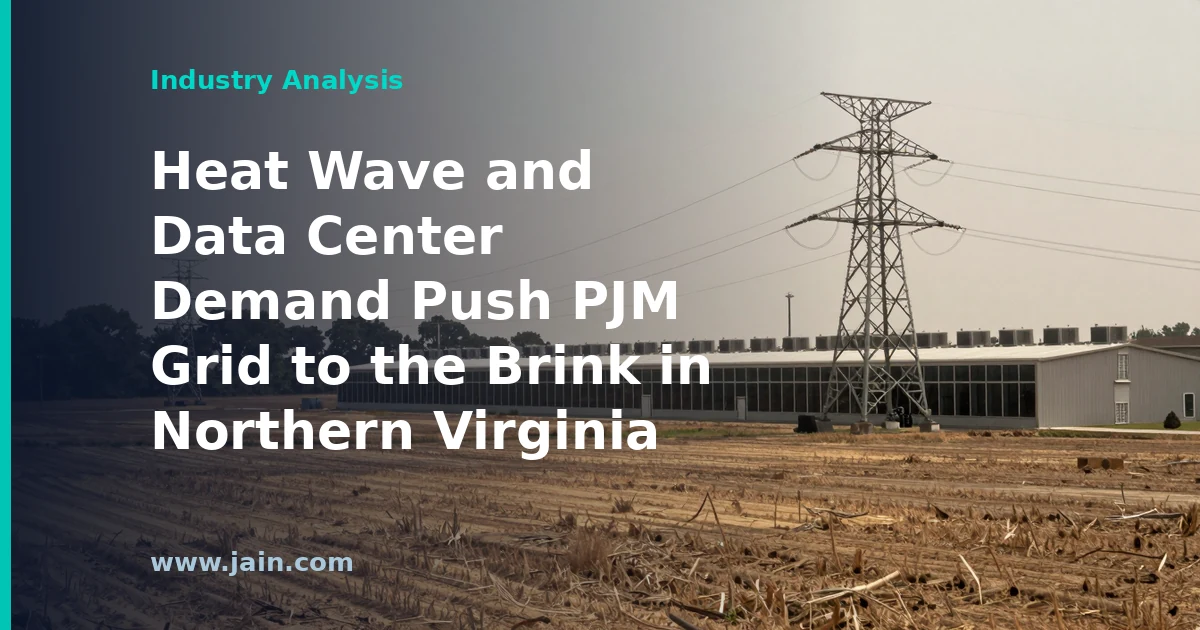
  • Heat Wave and Data Center Demand Push PJM Grid to the Brink in Northern Virginia

    Heat Wave and Data Center Demand Push PJM Grid to the Brink in Northern Virginia

    The Prince William Times reported on July 4, 2026 that a summer heat wave, layered on top of the enormous electricity appetite of the region’s data centers, pushed the regional power grid “to the brink.” The grid in question is operated by PJM Interconnection, the regional transmission organization that coordinates electricity across all or parts of 13 states and the District of Columbia — including Northern Virginia, home to the largest concentration of data centers in the world.

    The report frames a collision that grid planners have warned about for years: weather-driven peak demand from air conditioning arriving at the same moment as a structural, around-the-clock load from data centers that has grown far faster than new generation and transmission have been built.

    Executive Summary

    According to the report, the stress event unfolded in Prince William County, Virginia and the surrounding region — the heart of “Data Center Alley,” where Prince William and neighboring Loudoun County host an unmatched density of hyperscale and colocation facilities. During a heat wave, residential and commercial air conditioning drives electricity demand to its annual peaks; data centers, unlike air conditioners, draw near-constant power day and night, so their load sits underneath the weather peak rather than replacing it.

    Why it matters: grid operators plan for the single worst hour of the year. When a fast-growing baseload (data centers) raises the floor and a heat wave raises the ceiling, the margin between available supply and peak demand — the buffer that prevents emergency measures like conservation appeals or rolling outages — shrinks. A “to the brink” event is a concrete, dated data point in a debate that is often conducted in abstractions about future AI load forecasts.

    A caveat on sourcing: this is a single local-newspaper account, and the headline-level material available does not specify which emergency procedures, if any, PJM invoked, what demand peaked at, or how close reserves actually came to exhaustion. Those specifics matter, and we flag them below.

    The Peak Problem: Flat-Out Air Conditioning Meets Always-On Compute

    Electric grids are sized for their worst hour, not their average one. In PJM territory that worst hour almost always occurs on a hot summer weekday afternoon, when tens of millions of air conditioners run simultaneously. Data centers change the arithmetic because they are effectively a new floor under demand: a large AI training or cloud facility draws a high, steady load 24 hours a day, in fair weather and foul. When a heat wave arrives, that steady draw does not politely step aside — it stacks. The result is that the same heat wave that a decade ago would have been routine can now push a region toward its limits, which is precisely the dynamic the Prince William Times describes.

    For lay readers, “to the brink” typically means the grid operator is working through its escalation ladder — asking generators to defer maintenance, importing power from neighbors, calling on demand-response customers who are paid to curtail, and in the worst case shedding load (rolling blackouts). The available reporting does not tell us how far down that ladder PJM went in this event, and that distinction — between a tight day and a genuine emergency — is the difference between a warning sign and a crisis.

    Northern Virginia Is the Stress Test the Rest of the Country Is Watching

    Prince William County is not a random dateline. Northern Virginia is the world’s largest data center market, and the AI buildout has accelerated demand there just as it has become harder to site new transmission lines and generation. PJM’s own capacity auctions — the mechanism by which the operator procures commitments of future power supply — have cleared at sharply higher prices in recent cycles, a market signal that supply is not keeping pace with projected demand. A heat-wave near-miss in this region is therefore a preview: other fast-growing data center corridors in Texas, Georgia, Ohio, and Arizona face versions of the same squeeze.

    The economics cut in several directions. Utilities and independent power producers benefit from higher capacity prices and large, creditworthy new customers. Data center operators face rising power costs and, increasingly, multi-year waits for grid connections — which is pushing some toward on-site generation, long-term nuclear and renewable contracts, and demand-flexibility commitments. Residential ratepayers, meanwhile, worry about absorbing the cost of grid upgrades driven by industrial customers, a tension that is now a live political issue in Virginia and across PJM’s footprint.

    Who Bears the Risk — and Who Blinks First in the Next Heat Wave

    Events like this sharpen a policy question that regulators have so far answered only partially: when supply gets tight, whose power is interruptible? Data centers have historically demanded — and paid for — extreme reliability, backed by on-site diesel or battery backup. That backup capacity is mostly idle during grid emergencies. Proposals to enroll data centers in demand-response programs, require flexible-load commitments as a condition of interconnection, or price peak consumption more aggressively all gain momentum every time a grid operator has a bad afternoon.

    There is also a reputational dimension. The data center industry argues, with some justification, that it pays substantial sums into the grid and that load growth also comes from electrification of homes, vehicles, and factories. But headlines that pair “heat wave” with “data centers” and “brink” land hard with the public regardless of the precise load attribution. Operators that can document flexibility — shifting deferrable computing work away from peak hours, dispatching backup assets to support the grid — will have an easier time in siting battles than those that cannot.

    Background

    Northern Virginia became the world’s data center capital over two decades, thanks to early internet exchange points, cheap land, favorable tax treatment, and proximity to federal and enterprise customers. Loudoun County led the first wave; Prince William County became the frontier of the next one, with the AI boom driving proposals for ever-larger campuses. PJM Interconnection, formed from a power pool dating to 1927, operates the transmission grid across the Mid-Atlantic and parts of the Midwest and has repeatedly flagged accelerating load growth — led by data centers — as a central reliability challenge of the coming decade.

    The tension surfaced well before this heat wave: PJM’s recent capacity auctions cleared at dramatically higher prices, utilities in Virginia have proposed new rate structures for large loads, and local land-use fights over data center siting in Prince William County have become some of the most contentious in the country. A dated, weather-driven stress event adds an operational exclamation point to what had largely been a forecasting debate.

    Source: Heat wave, data centers’ huge demand push regional power grid to the brink — Prince William Times, July 4, 2026, reporting on grid strain in the PJM region amid a heat wave and data center load growth.

  • Goldman Sachs: US Data-Center Power Demand to Double by 2027

    Goldman Sachs: US Data-Center Power Demand to Double by 2027

    Goldman Sachs, the US investment bank, has published a projection that electricity demand from US data centers will double by 2027, according to a report circulated on May 19, 2026. The forecast frames the artificial-intelligence computing buildout not as a niche technology story but as one of the largest near-term drivers of US electricity consumption.

    Executive Summary

    The headline claim is simple and stark: the amount of power consumed by US data centers — the facilities that house the servers behind cloud services and AI models — is projected by Goldman Sachs to double by 2027. A doubling over such a short horizon is extraordinary for electricity demand, a category that in the US grew slowly or stayed flat for most of the two decades before the AI boom.

    Why it matters: power, not land or chips, has become the binding constraint on data-center expansion. If a major financial institution’s base case is a doubling within roughly a year and a half of the report’s publication, then utilities, grid operators, regulators, and data-center developers are all planning against a demand curve steeper than anything the sector has seen. Forecasts like this one shape capital allocation — transmission projects, generation buildouts, and multi-year power purchase agreements are being underwritten on the strength of exactly this kind of projection.

    Power Is Now the Product

    For most of the industry’s history, data-center capacity was measured in square feet; today it is measured in megawatts. The Goldman Sachs projection captures that shift: the constraint on AI infrastructure growth is no longer how fast servers can be manufactured, but how fast electricity can be generated and delivered. AI training and inference clusters draw far more power per rack than traditional enterprise computing, which is why demand can double even if the number of buildings grows much more slowly.

    A doubling forecast, if it holds, effectively converts every data-center siting decision into an energy-procurement decision. Markets with available grid interconnection — the formal process of connecting a large load to the transmission system — gain a decisive advantage over markets with cheaper land or better fiber routes. That reorders the competitive map for developers and colocation providers alike.

    Who Absorbs the Demand — and Who Profits

    Utilities and independent power producers are the most direct beneficiaries of a demand doubling: large, creditworthy, around-the-clock loads are the customers grid operators dream of. Transmission builders, transformer and switchgear manufacturers, and backup-power suppliers sit next in line, since delivering twice the load requires physical equipment that is already supply-constrained industry-wide.

    The cost side is less comfortable. Rapid demand growth tends to push up wholesale power prices and interconnection wait times, which raises operating costs for every data-center operator — including those serving ordinary cloud and enterprise workloads rather than AI. Residential and industrial ratepayers in data-center-heavy regions may also bear part of the grid-upgrade cost, a tension that is already a live regulatory debate in several US states.

    Reading a Bank Forecast Critically

    It is worth being precise about what this is: a projection by an investment bank, not a measurement. Demand forecasts for AI infrastructure have varied widely across analysts, and they are sensitive to assumptions about chip efficiency, model sizes, and how much announced capacity actually gets energized on schedule. Goldman Sachs has a research franchise in this area, but banks also have commercial exposure to the energy and technology sectors they cover, so the appropriate posture is neither dismissal nor uncritical adoption.

    The strongest reason to take the direction of the forecast seriously — even if the exact multiple proves off — is that it aligns with observable behavior: hyperscale operators signing long-dated power agreements, utilities revising load forecasts upward, and interconnection queues lengthening. Forecasts can be wrong on timing and still be right about the trend that planners must build for.

    Background

    US data centers spent two decades as a quiet, efficient corner of the electricity system: demand grew, but efficiency gains in servers and facility design largely kept national consumption in check. The generative-AI boom that began in late 2022 broke that equilibrium. AI clusters concentrate enormous electrical loads in single campuses, and cloud providers and specialized developers have been racing to build capacity, turning power availability into the industry’s defining constraint.

    Goldman Sachs is one of several major financial institutions now publishing recurring research on data-center energy demand, reflecting how central the topic has become to utility planning, energy markets, and technology investment. Its projections are widely cited by developers, utilities, and policymakers — which is precisely why the assumptions behind them merit as much attention as the headlines.

    Source: US Data Center Power Demand Projected to Double by 2027 – Goldman Sachs, a report published May 19, 2026, projecting a doubling of US data-center electricity demand by 2027.

  • US Data Center Power Demand Is Testing Utility and Hyperscaler Climate Targets

    US Data Center Power Demand Is Testing Utility and Hyperscaler Climate Targets

    S&P Global reported on May 6, 2026 that surging power demand from US data centers is testing the sustainability targets of both the electric utilities that serve them and the hyperscale cloud companies that operate them. The analysis frames a growing tension at the heart of the AI build-out: electricity consumption from data centers is rising faster than clean-energy supply is being added to the grid.

    Executive Summary

    The core of the S&P Global analysis, as reflected in its headline finding, is a collision between two commitments the industry made in different eras. Utilities and hyperscale operators — the largest cloud and AI platform companies — spent the last decade setting public decarbonization goals, from renewable procurement pledges to net-zero roadmaps. Those goals were set before the current wave of AI-driven data center construction dramatically changed electricity demand forecasts across US utility territories.

    Why it matters: when demand grows faster than carbon-free generation can be permitted, financed, and interconnected, something gives. Either new load gets served by existing fossil generation and new gas capacity, pushing emissions targets out of reach, or load growth itself gets constrained by interconnection queues and utility caution. Either outcome reshapes the economics of data center siting, power procurement, and the credibility of corporate climate commitments — which is why a ratings and market-intelligence firm like S&P Global is watching it.

    Two Sets of Promises, One Grid

    Utilities and hyperscalers made their sustainability commitments to different audiences — regulators and investors on one side, customers and shareholders on the other — but both sets of promises draw on the same physical grid. A utility that pledged to retire coal plants and cut carbon intensity now faces load-growth forecasts that argue for keeping dispatchable generation online longer. A cloud operator that pledged to match its consumption with carbon-free energy now needs far more of that energy than its original models assumed. The S&P Global framing — demand “testing” targets — captures the fact that neither side has formally abandoned its goals, but both are under measurable strain.

    For lay readers, the mechanism is simple: data centers are among the few loads that run at high utilization around the clock. Solar and wind are intermittent, meaning they produce only when weather allows. Matching a 24/7 load with intermittent supply requires overbuilding renewables, adding storage, or leaning on always-available sources — nuclear, hydro, geothermal, or fossil gas. The first three are slow and capital-intensive to expand; gas is fast but carbon-emitting. That is the whole tension in one paragraph.

    The Economics of Serving New Load

    Utilities generally welcome large new customers because load growth spreads fixed costs over more kilowatt-hours and justifies rate-base investment, the regulated asset spending on which utilities earn returns. But data center load arrives lumpy and fast — a single campus can demand as much power as a small city — and the transmission, substation, and generation investment to serve it takes years to build. Regulators must decide who bears the cost and the risk if forecast demand does not materialize, a question that has become central to rate cases in data center–heavy states.

    For hyperscalers, the strain shows up in procurement. Power purchase agreements for new renewable projects, once a reliable tool for matching growth with clean supply, now compete with interconnection backlogs and rising equipment and financing costs. The practical result across the industry has been a broadening of the procurement toolkit — longer-dated contracts, interest in nuclear and next-generation firm power, and on-site or co-located generation — because annual renewable matching alone no longer keeps pace with load.

    Winners, Losers, and Repriced Risk

    If the S&P Global thesis holds, the beneficiaries are owners of existing firm, low-carbon generation — nuclear plants above all — along with developers who control grid interconnection positions and utilities in regions with spare transmission capacity. Markets and sites that can actually deliver power on data center timelines gain pricing leverage. The squeezed parties are late-arriving developers facing multi-year interconnection queues, and ratepayer advocates worried that infrastructure costs for serving digital-industry load could shift onto households if regulatory structures are not designed carefully.

    There is also a reputational ledger. Corporate climate targets are voluntary, but they are priced into ESG ratings, financing terms, and procurement relationships. A hyperscaler that visibly misses or restates a sustainability target pays a credibility cost; a utility that delays coal retirements to serve data centers invites regulatory and community pushback. The measured takeaway is not that either group’s targets were insincere, but that targets set under one demand forecast are now being stress-tested by a very different one — and how each company responds will differentiate the sector.

    Background

    US data centers spent two decades growing steadily while efficiency gains kept their share of national electricity use roughly flat — a balance that broke when the generative-AI investment cycle began driving unprecedented orders for power-dense computing capacity. Utilities across data center–heavy regions have since raised long-term demand forecasts substantially, ending an era in which US electricity demand was assumed to be essentially flat.

    That earlier flat-demand era is also when today’s sustainability commitments were made: hyperscalers became the world’s largest corporate buyers of renewable energy, and utilities filed resource plans built around coal retirements and emissions reduction. S&P Global, a major ratings and market-intelligence firm, has been tracking how the new demand outlook interacts with those inherited commitments — the tension its May 2026 analysis distills.

    Source: Surging US data center power demand tests sustainability targets — S&P Global, an S&P Global analysis published May 6, 2026, examining how data center load growth is straining utility and hyperscaler climate commitments.

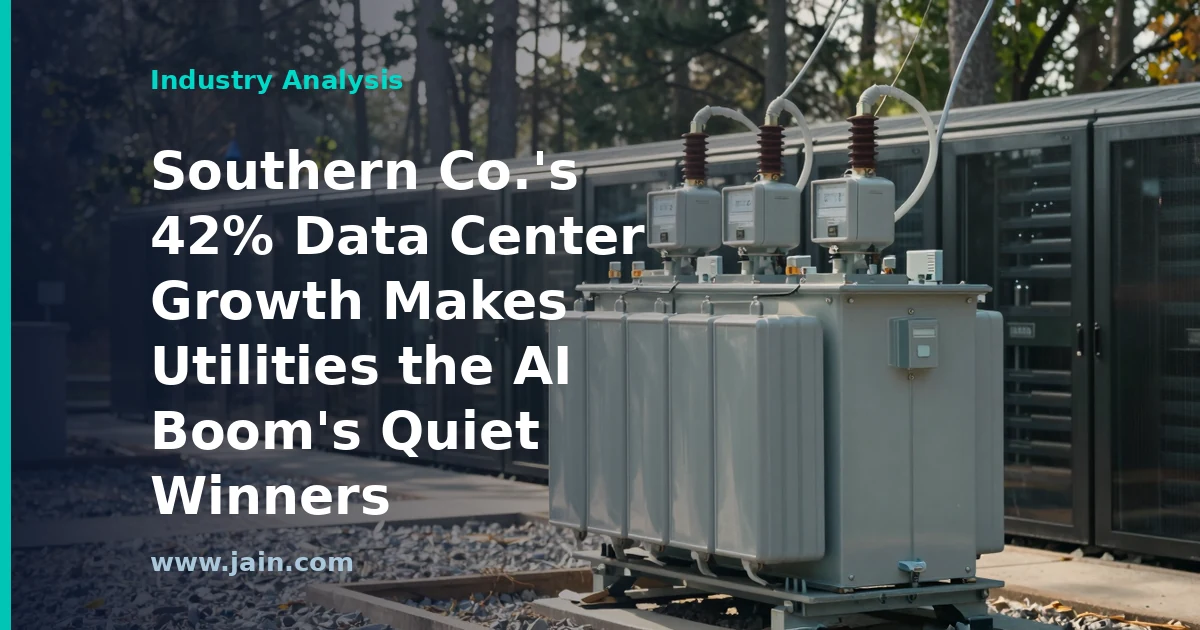
  • Southern Co.’s 42% Data Center Growth Makes Utilities the AI Boom’s Quiet Winners

    Southern Co.’s 42% Data Center Growth Makes Utilities the AI Boom’s Quiet Winners

    Southern Company, the Atlanta-based utility holding company whose subsidiaries include Georgia Power, Alabama Power, and Mississippi Power, reported soaring electricity sales driven by 42% growth in its data center segment, according to a May 1, 2026 report from Utility Dive. The figure stands out because it converts years of talked-about AI demand projections into a number showing up in an actual utility’s actual sales.

    Executive Summary

    For two years, the electricity industry has debated whether the enormous data center load forecasts attached to the AI build-out would materialize or evaporate. Southern Company’s reported 42% growth in data center electricity sales is one of the clearest signals yet that, at least in the Southeast, the demand is real, metered, and being billed. Electricity sales — as opposed to interconnection requests or load forecasts — represent power actually delivered to operating facilities.

    The announcement matters beyond Southern’s own territory. Utilities have quietly become one of the most durable beneficiaries of the AI infrastructure cycle: unlike chipmakers or cloud providers, they sell a regulated, contracted product to customers who cannot easily relocate once a facility is energized. A 42% jump in one demand segment, if sustained, reshapes how regulators, investors, and data center developers should read utility growth plans across the Sun Belt.

    From Forecast to Booked Revenue

    The data center power story has been dogged by a credibility gap: interconnection queues across the United States are stuffed with speculative and duplicate requests, as developers file with multiple utilities for the same project. Skeptics have reasonably asked how much of the forecast load is real. Sales figures cut through that noise. When a utility reports 42% growth in data center electricity sales, it is describing megawatt-hours delivered to energized buildings and invoiced to customers — not letters of intent.

    That distinction matters for how the market prices the AI build-out. Forecasts can be revised down quietly; delivered sales cannot. Southern’s number suggests that in its Southeast footprint, the pipeline of announced hyperscale and colocation projects is converting into operating load at pace. It also implies that the facilities energized in recent quarters are ramping utilization, since sales growth reflects consumption, not just connection.

    Why Utilities Are the AI Build-Out’s Quiet Winners

    The AI investment narrative has centered on GPU vendors and hyperscalers, but the utility position in the value chain is structurally attractive in a different way. Data centers are among the most creditworthy, longest-duration customers a utility can sign, and once built they are effectively immobile — a facility with hundreds of millions of dollars in the ground does not switch power providers. For a vertically integrated, rate-regulated utility like Southern’s subsidiaries, growing load also supports the case for new generation and transmission investment, on which regulated utilities earn an authorized return.

    Southern is also unusually well positioned on supply. Its Georgia Power subsidiary completed Vogtle Units 3 and 4 — the first newly constructed nuclear reactors in the U.S. in decades — giving it firm, carbon-free baseload capacity precisely as large-load customers began demanding both reliability and clean-energy attributes. The Southeast’s combination of available land, water, fiber routes, and historically constructive regulation has made Georgia in particular one of the fastest-growing data center markets in the country.

    The Ratepayer and Capacity Question

    Rapid large-load growth is not an unalloyed good, and regulators know it. The central policy question is cost allocation: who pays for the new generation and grid capacity that data centers require? If a hyperscaler’s load justifies a new gas plant or transmission line and that customer later scales back, ordinary households and small businesses could be left carrying the cost. Several states, including Georgia, have been developing special rate structures and minimum-take contract terms for very large customers to insulate other ratepayers from exactly this risk.

    There is also a physical question. A 42% growth rate in any demand segment tests reserve margins — the cushion of spare generating capacity utilities maintain for peak conditions. Sustained growth at anything like this pace forces choices among new gas capacity, renewables paired with storage, nuclear uprates, and demand flexibility, each with different cost, carbon, and timeline profiles. How Southern and its regulators sequence that build will determine whether today’s sales growth becomes tomorrow’s reliability headline.

    What It Signals for the Data Center Market

    For data center developers and tenants, the signal is double-edged. Confirmation that Southeast load is materializing validates the region’s status as a top-tier market — but it also means the easy capacity is being absorbed. As delivered load climbs, utilities gain leverage: expect longer interconnection timelines for new requests, stricter contract terms, larger upfront commitments, and less tolerance for speculative reservations. Power availability, not land or fiber, remains the binding constraint on where the next wave of AI capacity gets built.

    For investors, the takeaway is that utility exposure to AI is no longer hypothetical. The sector’s traditional appeal was stability rather than growth; a demand segment compounding at double-digit rates changes that math for the handful of utilities sitting under major data center clusters — while raising the stakes on execution, since regulated returns depend on building capacity on time and on budget.

    Background

    Southern Company traces its roots to the early twentieth-century electrification of the American Southeast and today ranks among the largest U.S. utility holding companies, operating primarily through state-regulated subsidiaries Georgia Power, Alabama Power, and Mississippi Power. Its highest-profile recent undertaking was the expansion of Plant Vogtle in Georgia, where Units 3 and 4 — the first newly constructed nuclear reactors completed in the United States in a generation — entered service after years of delays and cost overruns, ultimately giving the company scarce firm, carbon-free capacity.

    That capacity arrived just as the generative-AI boom transformed electricity demand. After roughly two decades of flat U.S. load growth, utilities began reporting surging interconnection requests from hyperscale data center developers around 2023, with Georgia emerging as a leading destination. The open question has been how much of that forecast demand would become real consumption — which is what makes delivered-sales figures like this one significant.

    Source: Southern Co. electricity sales soar on 42% data center growth — Utility Dive’s May 1, 2026 report on Southern Company’s data-center-driven electricity sales growth.

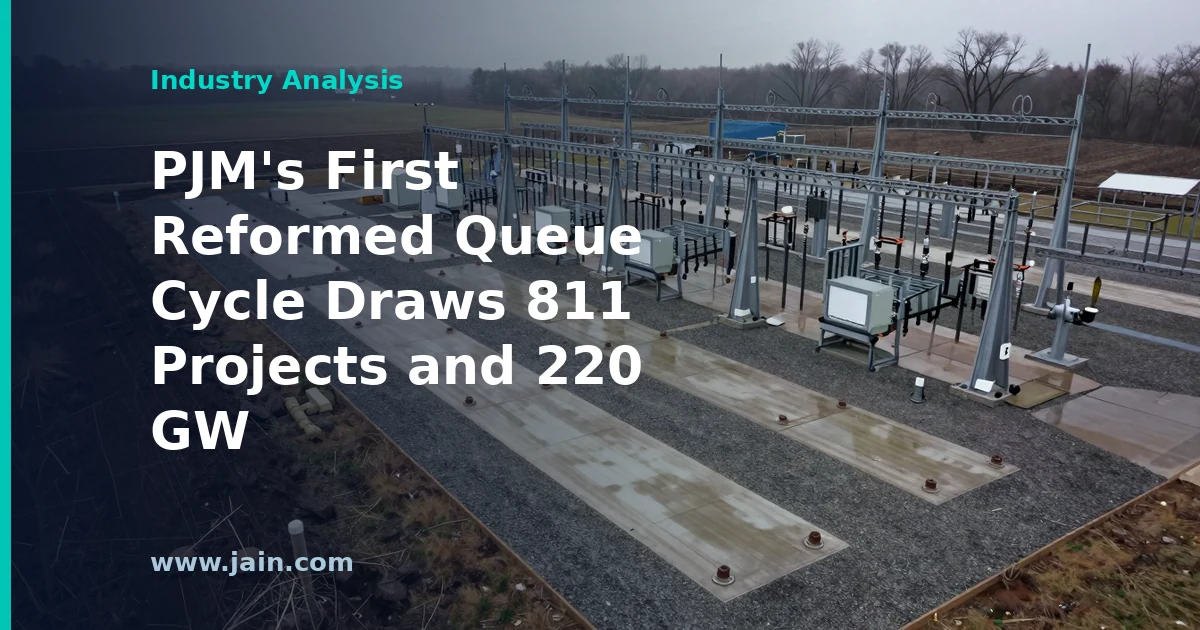
  • PJM’s First Reformed Queue Cycle Draws 811 Projects and 220 GW

    PJM’s First Reformed Queue Cycle Draws 811 Projects and 220 GW

    PJM Interconnection, the grid operator for the largest wholesale electricity market in the United States, has closed the application window for the first cycle of its reformed interconnection queue with 811 project applications totaling roughly 220 gigawatts (GW) of proposed capacity, according to an April 30, 2026 report in POWER Magazine. The interconnection queue is the formal process through which new power plants, storage facilities, and other resources apply to connect to the high-voltage grid.

    The cycle is the first to run entirely under PJM’s overhauled “first-ready, first-served” cluster study rules, replacing the serial, first-come-first-served process that had produced multiyear backlogs.

    Executive Summary

    The headline numbers are striking on their own terms: 811 projects and about 220 GW of proposed capacity entered a single study cycle — a volume on the same order as the entire existing generating fleet serving PJM’s 13-state-plus-D.C. footprint. That developers are willing to post the deposits and demonstrate the site control the reformed process demands, at that scale, is a concrete market signal rather than a speculative one.

    The timing matters. PJM has spent recent years warning of tightening supply as older plants retire while demand — led by AI and data center load growth concentrated in places like Northern Virginia — climbs after decades of flat consumption. A deep pipeline of proposed generation is the necessary first step toward closing that gap.

    The essential caveat is that a queue application is not a power plant. Historically, only a fraction of projects that enter U.S. interconnection queues ever reach commercial operation, and the reformed process is designed to study projects faster, not to guarantee they get financed and built. The 220 GW figure measures developer appetite and process throughput — not committed steel in the ground.

    A 220-GW Referendum on Electricity Demand

    For most of the 2010s, U.S. electricity demand was essentially flat, and grid planning was an exercise in managing retirements and replacement. The 220 GW that flowed into PJM’s first reformed cycle reflects a different era: hyperscale data centers, AI training and inference clusters, electrified transport, and reshored manufacturing have turned load growth from a rounding error into the central planning problem in the nation’s largest power market.

    Because the reformed process requires real financial commitments and demonstrated site control up front, this cycle’s volume is a cleaner demand signal than the old queue ever provided. Under the prior serial process, speculative placeholder projects could sit in line for years at little cost, inflating queue totals. A 220-GW cycle under stricter entry rules suggests developers see durable, creditworthy demand — much of it from data center operators willing to sign long-term commitments — rather than a bubble of free options.

    What Queue Reform Fixed — and What It Cannot

    PJM’s old process studied projects one at a time in the order they arrived, so a single stalled or withdrawn project could force costly restudies of everyone behind it. The reformed approach, approved by federal regulators as part of a broader national shift toward cluster studies, batches projects into cycles, studies them together, and allocates shared network-upgrade costs across the group. Projects that are not ready — lacking land rights or deposits — are filtered out early instead of clogging the line.

    What reform cannot do is build anything. Study speed is only one bottleneck among several: transformer and switchgear lead times remain long, skilled-labor markets are tight, local permitting is contested, and network upgrade costs identified in cluster studies can still kill marginal projects. The queue’s completion rate — nationally, often cited at roughly one in five projects historically — is the number that ultimately matters, and this announcement tells us nothing about it yet.

    Winners, Losers, and the Shape of the Pipeline

    The reformed rules structurally favor well-capitalized developers who can post deposits, secure land early, and absorb study-phase risk — utilities, large independent power producers, and infrastructure-fund-backed platforms. Smaller and more speculative developers, who thrived under the low-cost old queue, face a higher bar. That consolidation cuts both ways: it should raise the fraction of queued projects that actually get built, but it also concentrates the development pipeline in fewer hands.

    For large power buyers — data center operators above all — a deep, better-qualified queue is medium-term good news, since it is the raw material for future supply. But the near-term picture is unchanged: projects entering study now are years from commercial operation, so tight capacity conditions and elevated prices in PJM are likely to persist until this pipeline starts delivering. The gap between when demand arrives and when supply can physically connect remains the defining tension in the market.

    Background

    PJM traces its roots to 1927, when utilities in Pennsylvania and New Jersey first pooled their generation, and it has grown into the largest wholesale power market in North America. In the early 2020s its interconnection queue became a symbol of national gridlock: thousands of projects languished in a serial study process while wait times stretched toward half a decade, prompting a federally approved overhaul that paused new entries while PJM worked through the backlog and transitioned to clustered, readiness-based study cycles.

    The reform arrives just as PJM’s supply-demand balance has tightened. Plant retirements, sharply rising data center load, and record-setting capacity market results have made the pace of new generation buildout the market’s defining question — which is why the volume of this first reformed cycle is being read as a bellwether well beyond PJM’s borders.

    Source: PJM’s First Reformed Queue Cycle Draws 811 Projects, 220 GW — POWER Magazine report on the close of the first study cycle under PJM’s reformed interconnection process, April 30, 2026.