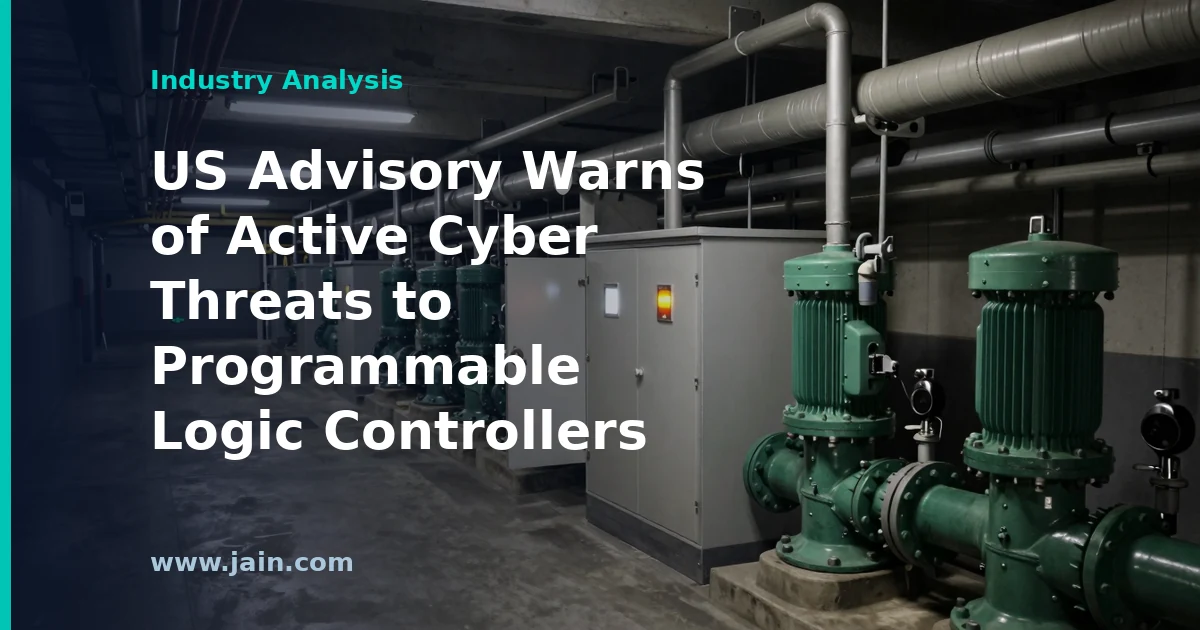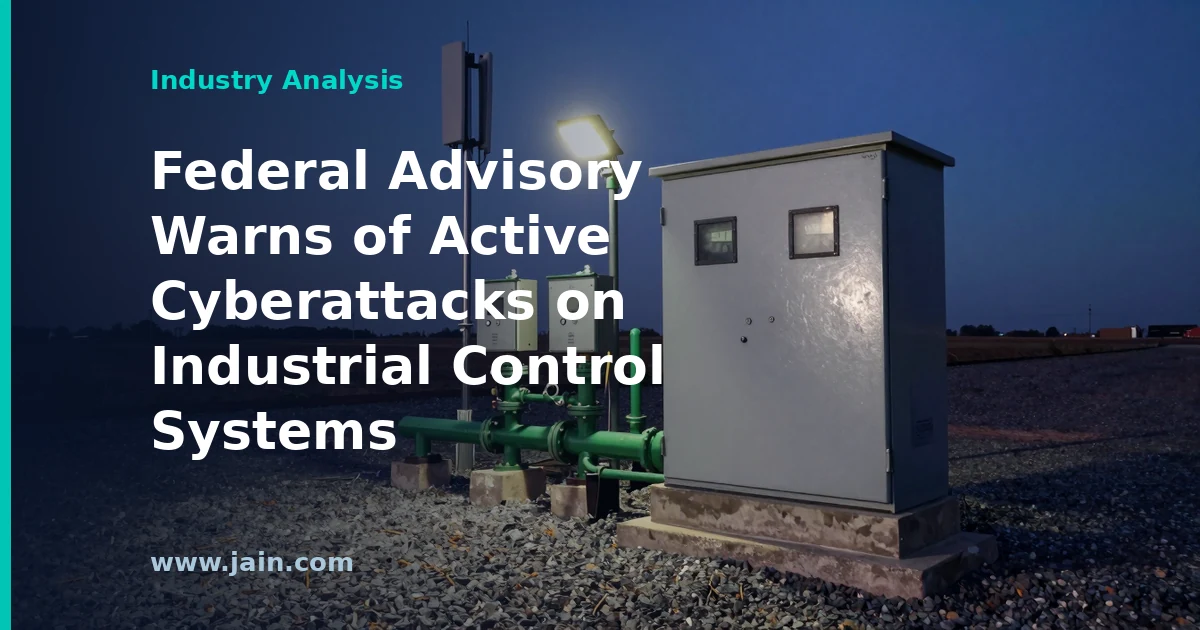
U.S. federal authorities have issued a warning about an active cyber threat targeting critical infrastructure, according to an April 27, 2026 report from Fox Business. The advisory centers on programmable logic controllers (PLCs) — the ruggedized industrial computers that directly operate physical equipment such as pumps, valves, breakers, and chillers across the power, water, and facility-cooling systems the country depends on.
The key word is active: this is framed not as a theoretical vulnerability disclosure but as a warning about attacks currently underway against operational technology (OT), the layer of computing that touches the physical world.
Executive Summary
The reported advisory warns that attackers are actively targeting the control-system layer of American critical infrastructure. PLCs sit at the bottom of that stack: they read sensors and command machinery, often using decades-old protocols that were designed for reliability on closed networks, not for authentication on the open internet. When a PLC is compromised, the consequence is not stolen data — it is the potential manipulation of physical processes like water treatment chemistry, electrical switching, or the cooling plant that keeps a data hall alive.
For operators of data centers, utilities, and industrial facilities, an advisory of this kind matters even when it is short on public detail. Federal agencies generally reserve “active threat” language for cases where compromise activity has actually been observed, and prior advisories in this vein — most notably the late-2023 wave of attacks on internet-exposed PLCs at U.S. water utilities — were followed by confirmed intrusions at real facilities. The prudent reading is that internet-reachable, weakly authenticated controllers are being probed and, in some cases, accessed right now.
Based on the material available, however, readers should note that the Fox Business report is a brief news item, and the specifics — which agency issued the warning, which sectors or device vendors are affected, and whether any disruption has occurred — are not spelled out in the source. Our analysis below separates what the warning signals from what remains unverified.
The OT Layer Is Where Cyber Risk Becomes Physical Risk
Most cybersecurity coverage concerns information technology (IT): servers, laptops, email, databases. Operational technology is different. A PLC is a small industrial computer, typically bolted inside an electrical cabinet, that runs a fixed control program — open this valve when the tank hits a setpoint, start this pump, trip this breaker. PLCs and the human-machine interfaces (HMIs) that supervise them were engineered for uptime measured in decades, in an era when the control network was assumed to be physically isolated.
That assumption has quietly eroded. Remote-monitoring requirements, vendor maintenance access, and cost pressure have connected many control networks — directly or indirectly — to the internet. Security researchers routinely find thousands of controllers reachable online with default or absent passwords. An advisory about “active” attacks on this layer is therefore credible on its face: the attack surface is real, well documented, and historically exploited.
Why This Warning Should Resonate in the Data Center Industry
Data centers are usually discussed as the thing being protected, but every data center is itself an industrial facility. Building management systems, chiller plants, computer-room air handlers, generators, switchgear, and uninterruptible power supplies are all orchestrated by the same class of controllers this advisory concerns. A facility can have immaculate IT security and still be exposed through a BMS controller a mechanical contractor connected to the internet for convenience.
The dependency also runs outward. A data center’s availability ultimately rests on the utility grid and, for cooling, often on municipal water. An attack that degrades a regional utility degrades every facility downstream of it. This is why OT threat advisories are relevant to cloud and colocation buyers, not just plant engineers: the resilience story a provider tells should extend below the operating system, into the physical plant and the controllers that run it.
The Economics of an Unfixable-by-Patching Problem
OT security is hard for structural reasons, not because operators are careless. Controllers frequently cannot be patched without shutting down the process they run, and many run vendor firmware that no longer receives updates at all. Replacement cycles for industrial equipment run fifteen to thirty years, so devices designed before modern security practices will remain in service well into the 2040s. The practical playbook — inventory every device, remove direct internet exposure, segment control networks from corporate networks, require multi-factor authentication on remote access, and monitor for anomalous commands — is compensating architecture, not a patch.
That reality shapes the market response. Each federal warning of this kind tends to accelerate spending on network segmentation, OT-specific monitoring, and secure remote access, and to sharpen insurer and regulator attention on control-system hygiene. For infrastructure operators, the cost of that program is increasingly best understood not as discretionary security spend but as a component of availability engineering — the same budget line as redundant power and cooling.
What the Report Substantiates — and What It Doesn’t
Even-handedly: the source here is a brief news report of a federal warning, and it leaves most operational detail unstated. It does not, in the material we reviewed, identify the issuing agency by name, attribute the activity to a specific actor, enumerate affected vendors or sectors, or confirm any successful disruption. The pattern is consistent with prior joint advisories from U.S. cyber agencies about internet-exposed controllers, but consistency is not confirmation.
What the warning does establish is direction: the U.S. government judged the threat to the control-system layer serious enough to warn publicly and to characterize it as active. Operators should treat the underlying advisory — not press coverage of it — as the actionable document, and pull the technical indicators and mitigations directly from the issuing agency once identified.
Background
Warnings about cyberattacks on industrial control systems have escalated steadily over the past decade. Stuxnet demonstrated around 2010 that malicious code could physically damage industrial equipment, and subsequent incidents — attacks on Ukraine’s power grid in 2015 and 2016, the 2021 tampering attempt at a Florida water treatment plant, and the late-2023 compromises of internet-exposed PLCs at multiple U.S. water utilities — moved the threat from theory to record. U.S. agencies led by CISA have responded with a cadence of joint advisories urging operators to disconnect controllers from the public internet and harden remote access.
The April 2026 warning arrives amid that trajectory and amid unprecedented growth in physical infrastructure itself: the AI-driven data center buildout is adding enormous new electrical and cooling capacity, all of it orchestrated by the same operational-technology layer this advisory concerns. As the footprint of controller-run infrastructure grows, so does the attack surface — which is why federal OT warnings increasingly speak to the digital-infrastructure industry as much as to traditional utilities.
Source: US warns of active cyber threat targeting critical infrastructure — Fox Business report, April 27, 2026, on a federal warning of active cyberattacks against U.S. critical-infrastructure control systems.