Applied Digital just finished switching on a huge computing building for artificial intelligence. Its electricity capacity is comparable to a small city’s demand.
Its main customer, CoreWeave, rents out artificial intelligence computing power. CoreWeave is reported to have signed 15-year rental deals worth about $7 billion in total.
Signing a deal is not the same as getting paid. Rent usually starts once the space is powered and ready, and this building now is.
Investors remain cautious. The shares are down nearly a quarter in three months, and the company carries heavy debt.
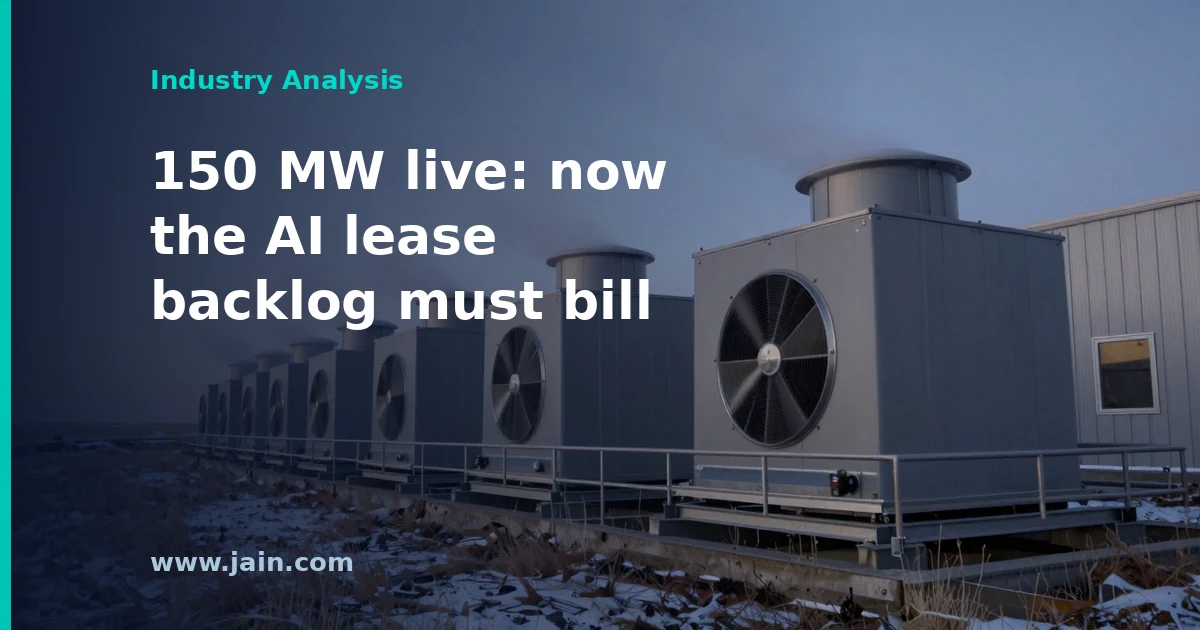
Applied Digital (Nasdaq: APLD) has switched on the second phase of Building 2 at Polaris Forge 1, its campus purpose-built for artificial intelligence and high-performance computing (HPC), Simply Wall St reported on October 2, 2026. The phase adds 75 megawatts (MW) of IT capacity. IT capacity is the power available to run servers and GPUs, as distinct from cooling and other building loads. The phase completes the facility’s 150 MW buildout.
The shares rose 5.05% on the day to US$25.38. They remain down 23.23% over three months, though the three-year total shareholder return is still roughly fourfold.
Executive Summary
The milestone itself is simple. A second 75 MW block is now live at Building 2, and the facility’s planned 150 MW is complete. Its significance lies in what it does to the company’s revenue story. Polaris Forge 1 is tied to long-term leases with CoreWeave, a cloud provider that rents out AI computing power. Those leases are described as 15-year agreements worth $7 billion in total contracted revenue. A contract of that kind is a promise to pay. Energized, delivered capacity is generally what turns the promise into rent that appears on an income statement.
That conversion is where the valuation debate now sits. On a price-to-sales basis, the stock trades at about 12.1 times revenue, against roughly 1.9 times for the broader US IT sector. Bullish valuation models put fair value well above the current price, but they depend on revenue that has not yet been reported. With the 150 MW buildout finished, the coming quarters should begin to show how much of the backlog is converting into revenue, and on what timetable.
The risks are the ones an energization milestone does not remove. The company depends on a small number of hyperscale tenants, meaning very large cloud and AI compute buyers, and it carries a sizeable debt load. If contracts slip or financing tightens, the upside case is exposed quickly.
Contracts Are Promises. Energized Megawatts Are Invoices.
In wholesale data center leasing, rent typically starts when a tenant’s capacity is delivered and accepted, not when the contract is signed. A signed lease establishes backlog, the revenue a company is entitled to over time. Building, powering and handing over the space is what starts the billing clock. Switching on the second 75 MW phase of Building 2 completes the 150 MW facility at Polaris Forge 1. The question for Applied Digital is no longer whether it can finish this building. It is how fast the capacity turns into recognized revenue.
The scale of that backlog gives the milestone its weight. The most-followed valuation narrative on Applied Digital describes the CoreWeave agreements as 15-year leases totalling $7 billion in contracted revenue. Spread evenly, that works out to roughly $467 million a year. That figure is simple arithmetic, not a disclosed payment schedule, and real lease revenue usually ramps as phases come online. It still shows the size of the revenue stream that delivered capacity is meant to unlock. Until the building is live, that stream exists only on paper.
Three groups are most directly affected. Shareholders are paying today for revenue that energization begins to release. Lenders’ repayment depends on that rent arriving on schedule. CoreWeave depends on Applied Digital to house the computing capacity it in turn rents to its own customers.
Why a 12.1x Sales Multiple Rides on Delivery
Simply Wall St’s own price-to-sales comparison puts the stock at about 12.1 times sales. That compares with roughly 1.9 times for the wider US IT group and a 5.5 times multiple the publication treats as a fair ratio. A high price-to-sales ratio means investors are paying for revenue they expect rather than revenue already booked. As the publication notes, a gap like this can close through stronger fundamentals, a lower share price, or both. Delivered megawatts are the most direct route to stronger fundamentals. Each phase that starts paying rent raises the sales line without the share price having to fall.
The bullish narrative assumes much more than one campus. Its US$68.35 fair value, about 63% above the US$25.38 close, rests on an 11.07% discount rate. It also assumes Applied Digital reaches roughly US$3.0 billion in revenue and US$295.0 million in earnings by around 2029, which still implies a forward price-to-earnings multiple near 104.7 times. Against that US$3.0 billion target, the CoreWeave leases at their simple annual average would cover only about a sixth. The remainder of the bull case therefore depends on capacity beyond this 150 MW facility, along with the financing and tenants needed to fill it.
A fair reading cuts both ways. Completing the facility is real execution, and it narrows the gap between contracted and earned revenue. It does not, by itself, validate a valuation built on several times more revenue than this campus is reported to be contracted for.
The Risks Energization Does Not Retire
Bringing capacity online moves risk without eliminating it. Construction and delivery risk on this building falls away. Counterparty risk, the chance a tenant pays late, renegotiates or fails to take full occupancy, becomes more prominent as revenue concentrates on the leases now running. The valuation commentary flags dependence on a few hyperscaler tenants as a central risk. With CoreWeave named as the anchor customer at Polaris Forge 1, much of the campus’s near-term revenue rests on one counterparty.
The balance sheet is the other pressure point. Data center campuses are capital-intensive, and the sizeable debt load cited in the valuation commentary must be serviced whether or not rent ramps on schedule. The recent three-month decline of 23.23%, after a roughly fourfold three-year return, suggests the market is giving more weight to these execution and funding questions than it did earlier in the cycle. A completed building is a necessary condition for the bull case, but not a sufficient one.
Background
Applied Digital designs, develops and operates digital infrastructure for high-performance computing and artificial intelligence customers in North America, and trades on the Nasdaq Global Select Market under the ticker APLD. Its fiscal year runs from June 1 to May 31, according to the definitive proxy statement it filed with the SEC on September 25, 2026.
The company has positioned Polaris Forge 1 as a purpose-built AI campus anchored by long-term leases with CoreWeave. CoreWeave is one of the specialist cloud providers, often grouped with hyperscalers, the largest buyers of data center capacity, that rent GPU computing to AI developers. Investors have rewarded that strategy with a roughly fourfold three-year shareholder return, though the shares have cooled sharply in recent months as attention has shifted to execution and funding.
A company called Brightray wants to build a five-storey data center in Macao, the small, crowded territory next to Hong Kong. A data center is a building packed with computers, and this one would run artificial intelligence. More than nine-tenths of it would be made in a factory and stacked together on site like giant building blocks.
It would use about as much electricity as a small town. But nobody has agreed to buy anything yet. The deal only becomes real if a business signs up to rent the space. If none does by the end of September 2027, the deal simply expires.
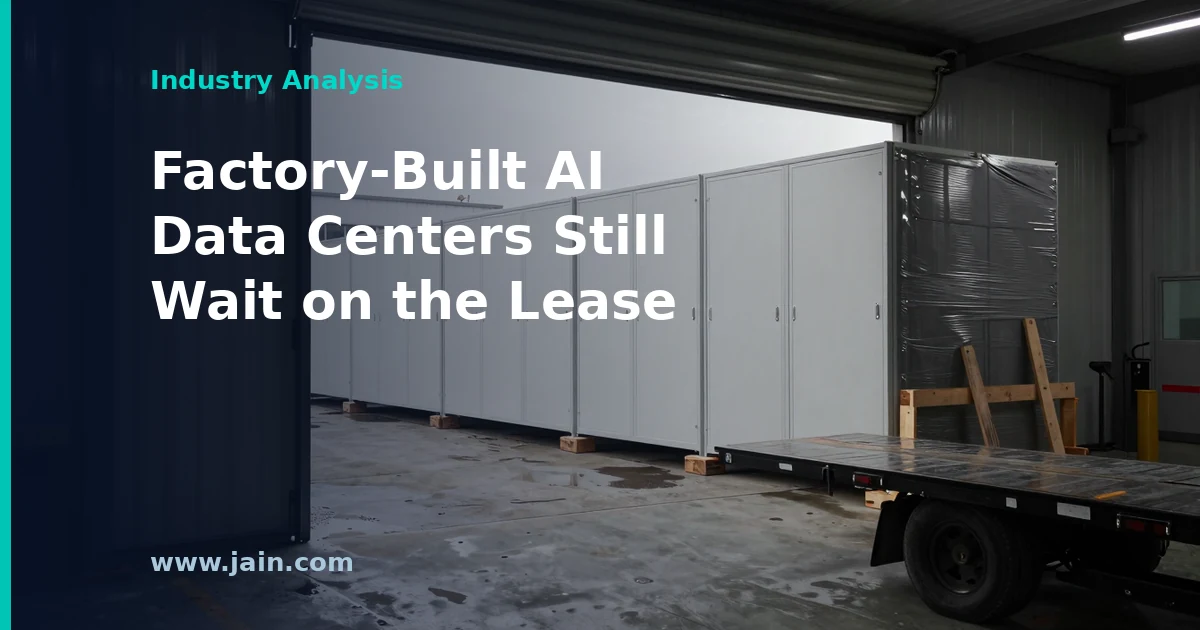
On September 25, 2026, Brightray Veridian Pte. Ltd., a wholly owned subsidiary of Brightray Science Inc., signed a Prefabricated Module Sales Framework Agreement with an unnamed developer planning an AI data center in Coloane, Macao. Brightray is 60% owned by Nasdaq-listed BUUU Group Limited, which furnished the announcement as Exhibit 99.1 to a Form 6-K filed with the SEC the same day. Under Brightray’s current design, the campus would deliver about 40MW of IT capacity (the power available to the servers themselves) in a building of up to five storeys on a site of roughly 9,000 square meters. Delivery is targeted for the third quarter of 2027.
The agreement is conditional. It creates no obligation to buy or supply modules, its pricing is provisional and non-binding, and the parties must negotiate a definitive sales contract only after Brightray Veridian secures a tenant and the developer signs a legally binding lease with that tenant. If that does not happen by September 30, 2027, the agreement terminates automatically.
Executive Summary
Brightray is proposing to build Macao’s first modular AI data center using its FPD system. FPD is a fully prefabricated approach in which steel-structure modules form the permanent building. Power distribution, cooling, cable trays and piping are installed and inspected in the factory before the modules ship. The company puts its factory prefabrication rate above 90%. It says the approach is designed to deliver construction efficiency gains of more than 30% compared with data centers of the same class. The design supports racks drawing anywhere from 10kW to 500kW, which covers conventional servers through to dense AI clusters. It also targets an average power usage effectiveness (PUE) below 1.35 at full load.
The more consequential detail is contractual rather than technical. Every speed advantage Brightray claims applies to the construction phase. Under the agreement’s own terms, the path to a construction contract runs first through a tenant lease that does not yet exist. The lease deadline, September 30, 2027, is also the last day of the quarter in which delivery is targeted.
For the industry, the project is a useful test of whether factory-built, multi-storey AI facilities can unlock capacity on land-constrained sites. For BUUU, which moved into AI data center delivery only this month, it is an early signal of pipeline. It is not yet a booked order.
The Critical Path Runs Through a Lease, Not a Factory
Prefabrication shortens the part of a project that happens after someone commits to building it. Brightray describes that part in detail. Modules are fabricated while foundations and minor municipal works proceed in parallel, then lifted, joined and commissioned on site. That sequence is where the claimed 30%-plus efficiency gain lives. Under the framework agreement, however, none of it is triggered by signing. There is no obligation to purchase or supply modules, and the price is provisional. Talks on a definitive contract begin only once a tenant is secured and a binding lease is signed.
That makes the lease, not the factory, the first item on the project’s critical path. The dates sharpen the point. BUUU’s 6-K sets the long-stop date at September 30, 2027, and the targeted delivery window is the third quarter of 2027. The agreement technically allows the tenant condition to be met at almost the same moment the building is supposed to be handed over. In practice, any Q3 2027 delivery requires a lease, then a negotiated contract, then factory production, then on-site assembly, all ahead of that deadline. Brightray has not disclosed its manufacturing lead time, so the latest workable lease date cannot be calculated. It must, however, fall well before the long-stop date.
The allocation of that risk is also unusual. The agreement makes Brightray Veridian, the module seller, responsible for securing the tenant. The developer’s role is to sign the lease. In effect, the supplier is also acting as the project’s leasing engine. That aligns incentives, because Brightray only sells modules if the building is let. It also means Brightray’s revenue here depends on its ability to find AI demand in Macao, not only on its ability to manufacture. The affected parties are Brightray and BUUU shareholders, whose order depends on the lease; the developer, whose schedule depends on it; and any prospective tenant, whose requirements will shape the final design.
Why Macao Turns Density Into the Selling Point
Macao is one of the most densely built places on earth, and Brightray’s founder, Bin Wang, framed the project around that constraint. In the company’s announcement he said the territory’s limited space places higher demands on land-use efficiency and on how on-site construction is organized. Municipal height rules cap the building at five storeys. Fitting about 40MW onto roughly 9,000 square meters works out to around 4.4 kilowatts of IT capacity per square meter of site. Reaching that figure depends on stacking floors rather than spreading out across a campus.
This is where the design choices matter to technical buyers. Brightray says the building can be configured for fully air-cooled, fully liquid-cooled or hybrid deployments, and can move across power configurations, including AC/DC upgrades. It also says it can support racks from 10kW to 500kW, deployed in phases. Liquid cooling pipes coolant directly to hot chips instead of relying only on moving air. It becomes necessary at the densities modern AI accelerators demand. Designing a multi-storey steel structure to carry both that equipment weight and that cooling plant is a real engineering problem. Solving it in a factory, where tolerances are easier to control, is the core of Brightray’s pitch.
The flexibility also reflects where the project stands. The final design will depend on tenant requirements, so offering a wide envelope of rack densities and cooling types keeps the building marketable to the widest range of potential occupants. That flexibility is useful. The width of the range is also a reminder that no single anchor workload has yet been identified.
What the Performance Claims Establish, and What They Don’t
Several of Brightray’s figures are design targets, and they deserve to be read that way. The 30%-plus construction efficiency gain is measured against data centers of the same class, but the company has not specified the baseline or the metric. Time, labor, cost and schedule certainty would each produce a different number. The sub-1.35 PUE figure is an average at full IT load. PUE compares total facility power with the power reaching the computers, so 1.35 implies about 0.35 watts of cooling and electrical overhead per watt of compute. A facility running below full load, as a phased build would for some time, typically performs differently from its full-load design point. The building is designed to meet Tier III standards, meaning it can be maintained without shutting down IT equipment. Brightray has not said whether it will seek formal certification.
The company’s main reference point is Johor, Malaysia. Wang said Brightray’s project there has 70MW in operation and a further 50MW planned. If that holds up in detail, it is meaningful evidence that Brightray can deliver at scale. Brightray has not published the Johor customer, the construction timeline, or whether that site used FPD specifically or one of its other product lines: in-building prefabrication (IPD) or containers (CPD). Those details would make the Johor record a much stronger proof point for a five-storey Macao build.
A New Business Line Under a Nasdaq Parent
BUUU’s core business was meetings, incentives, conferences and exhibitions (MICE) services, including event management and stage production. According to the company, it acquired its controlling interest in Brightray in September 2026 and now describes industrialized AI data center delivery as its core growth business. The Macao agreement is therefore among the first commercial announcements under the new structure. The forward-looking statements in the filing flag Brightray’s integration into BUUU as a risk. They also flag the project’s land rights, approvals, financing, and trade and export control measures.
For investors, the correct reading is pipeline, not revenue. A framework agreement with no purchase obligation, a provisional price and an automatic termination date is an option on a future contract. It could become a substantial order if a tenant signs. BUUU’s future filings will show whether it converts.
Background
Brightray Science Inc. describes itself as an AI infrastructure industrialization company. It sells prefabricated data center solutions in three forms: fully prefabricated buildings (FPD), prefabricated systems installed inside existing buildings (IPD) and containerized units (CPD). Its services cover design, manufacturing, delivery and lifecycle support. BUUU Group Limited, a Hong Kong-based Nasdaq issuer previously focused on event and exhibition services, acquired its 60% controlling stake in September 2026.
Prefabricated and modular construction has gained ground in the data center industry as operators race to add AI capacity. Factory assembly can shorten on-site schedules and improve quality consistency, though it shifts the work into manufacturing and logistics. Macao, a compact special administrative region whose economy has long centered on tourism and gaming, has pursued greater industrial diversification. The project pitches AI computing capacity as part of that effort.
Hut 8, a company that used to make most of its money mining bitcoin, has reportedly signed a $9.8 billion, 15-year deal to rent out a giant Texas building complex for artificial intelligence computers.
The surprise is the price. Measured per unit of electricity, it pays about the same as a similar deal a rival, CleanSpark, signed with Facebook’s parent company Meta.
If landlords like these all charge roughly the same rent, the winners will be whoever builds cheapest and borrows cheapest. That matters for the investors, towns and power grids hosting them.
StocksToTrade reported on September 18, 2026 that Hut 8 Corp. (Nasdaq: HUT) has signed a second 15-year lease worth about $9.8 billion for 352 megawatts (MW) of IT capacity at Beacon Point, its 1-gigawatt AI data center campus in Texas, with an investment-grade tenant. The lease fully commercializes the campus, doubles contracted capacity there to 704 MW and brings Hut 8’s contracted IT capacity across two campuses to 949 MW. The same report said Wells Fargo initiated coverage with an Overweight rating and a $175 price target, and that the shares rose 8.15% on the day.
The deal lands the same week CleanSpark priced $2.276 billion of 7.875% senior secured notes due 2031 to finish its Sandersville, Georgia campus, a 175 MW facility leased to a wholly owned Meta subsidiary, according to CleanSpark’s 8-K filings of September 17 and 18.
Executive Summary
Hut 8’s second Beacon Point lease is, at $9.8 billion, one of the largest contracts yet signed by a former bitcoin miner converting power and land into AI data center capacity. Its significance is less the headline total than what it implies about price: spread over 15 years and 352 MW, the lease works out to roughly $1.86 million per megawatt per year, almost exactly the rate implied by CleanSpark’s Meta-guaranteed Sandersville lease.
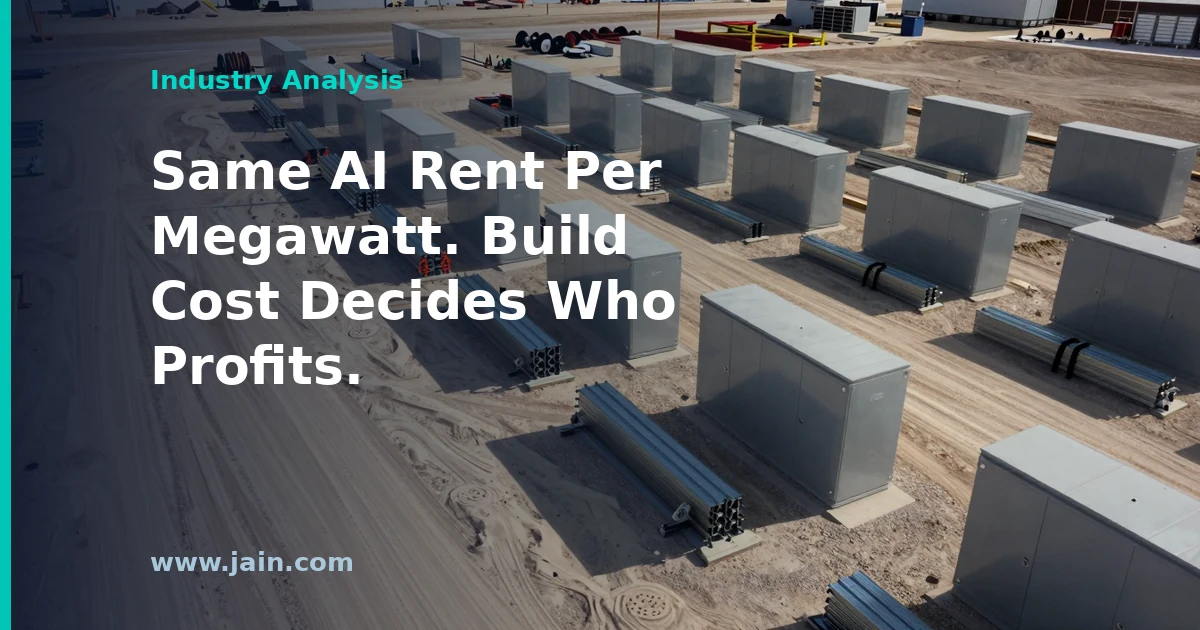
If long-term AI capacity from miners is clearing at a similar rent per megawatt, the lever that separates one landlord’s returns from another’s shifts from pricing to cost: what it takes to build each megawatt, and what it costs to borrow the money. CleanSpark’s filings put numbers on both for Sandersville, roughly $11.9 million of development cost per IT megawatt financed with 7.875% secured notes, which gives the industry a public benchmark against which Hut 8’s still-undisclosed build and financing terms will be judged.
Two Leases, One Price per Megawatt
Data center leases for AI are usually quoted by total contract value, which makes deals of different sizes and lengths hard to compare. Normalising them to dollars per megawatt of IT capacity per year (a megawatt is roughly enough power for several hundred homes; IT capacity is the power available to the servers themselves, excluding cooling and other overhead) puts them on the same footing.
Hut 8’s lease, at $9.8 billion over 15 years, implies about $653 million a year; divided across 352 MW, that is about $1.86 million per megawatt-year. CleanSpark’s September 17 investor presentation, filed as an exhibit to its 8-K, describes Sandersville as 175 MW of critical IT load under a 20-year base term with about $6.6 billion of contracted base-term value and about $330 million of average annual net operating income on a triple-net basis. That is about $1.89 million per megawatt-year. The two figures are within roughly 2% of each other.
Two leases do not make a market index, and the comparison has limits: CleanSpark discloses a 3% annual rent escalator, while Hut 8’s escalator, if any, has not been published, and both totals are nominal. Still, two investment-grade AI tenants contracting miner-built capacity at near-identical unit rents in the same month is a useful signal. It suggests tenants are paying for megawatts of ready capacity at something close to a going rate, rather than awarding premium pricing to any one developer.
When Rent Is Fixed, Capital Cost Is the Margin
Once rent per megawatt is set by the market, a landlord’s return is determined by what sits underneath it. CleanSpark’s presentation gives a rare public breakdown: about $11.9 million of development cost per IT megawatt, which at roughly $1.89 million of annual net operating income per megawatt implies a yield on cost of around 16% before financing. It then priced its notes at 98.5% of face value with a 7.875% coupon, so the effective borrowing cost is slightly above the coupon. The spread between those two figures is the project’s economic engine.
That arithmetic shows why build cost matters so much at a fixed rent. At the same $1.86 million per megawatt-year, every extra $1 million of build cost per megawatt lowers yield on cost by more than a percentage point, and across 352 MW it adds about $352 million of capital to be raised. Term length matters too: Hut 8’s 15-year term gives it five fewer years of contracted rent than CleanSpark’s 20-year base term to recover a comparable investment, making renewal options and the facility’s residual value more important to its returns.
Hut 8 starts from a leveraged position. StocksToTrade’s report cited roughly $7.4 billion of long-term debt, trailing revenue of about $235.1 million and a recent quarterly net loss of about $150.2 million. Contracted rent from an investment-grade tenant is exactly the collateral lenders want for project-level bonds like CleanSpark’s, but the price Hut 8 pays for that money, and the build cost it must fund, will determine whether the Beacon Point rent translates into margin.
From Mining Sites to Contracted Backlog
The broader shift is that bitcoin miners’ most valuable asset has turned out to be their grid connections and land, not their mining machines. Power interconnections for large loads can take years to secure, and miners already hold them. Hut 8 reports 949 MW of contracted IT capacity across two campuses, which by subtraction leaves 245 MW at the campus outside Beacon Point. CleanSpark says it controls about 1.8 GW of power, land and data centers across the United States.
For AI tenants and the cloud providers serving them, this cohort widens the pool of sites that can be delivered faster than a greenfield project. For the miners, long-term leases replace revenue tied to bitcoin prices with contracted rent from creditworthy counterparties, which is why an analyst like Wells Fargo can point to backlog and tenant quality rather than coin prices. StocksToTrade also linked Hut 8 to hosting hardware for Anthropic’s reported $35 billion compute arrangement with Lambda; Hut 8 has not published the terms of that role.
Execution Risk Moves to Power, Permits and Delivery Dates
Contracted rent only turns into cash once a facility is energised and handed over. CleanSpark targets initial rent commencement at Sandersville in Q4 2027 and has promised a completion guarantee to fund any shortfall if note proceeds prove insufficient, which shows how much of the risk remains with the developer until delivery. A 1-gigawatt campus in Texas carries the same exposure at larger scale: power delivery, equipment lead times for transformers and switchgear, and construction labour all have to line up on schedule.
Policy is a further variable. The StocksToTrade report noted a Massachusetts executive order requiring community approval, stricter environmental rules and clean energy or payments into a protection fund for new data centers. Hut 8’s growth is in Texas, but states are increasingly attaching conditions to large AI loads, and those conditions add cost to developers whose rent is already fixed for 15 or 20 years.
Background
Hut 8 Corp., listed on Nasdaq as HUT, built its business on bitcoin mining and has been repositioning its power and land portfolio toward AI data centers. Beacon Point, its 1-gigawatt campus in Texas, is now fully leased across two 15-year contracts, and the company counts 949 MW of contracted IT capacity across two campuses.
Hut 8 is part of a wider group of public miners converting their sites into AI capacity. CleanSpark, which describes itself as a data center developer controlling more than 1.8 GW of power, land and data centers, is building its 175 MW Sandersville campus in Georgia for a Meta subsidiary and financing it with $2.276 billion of project-level secured notes. Both companies are betting that grid-connected sites, not mining machines, are their most valuable assets.
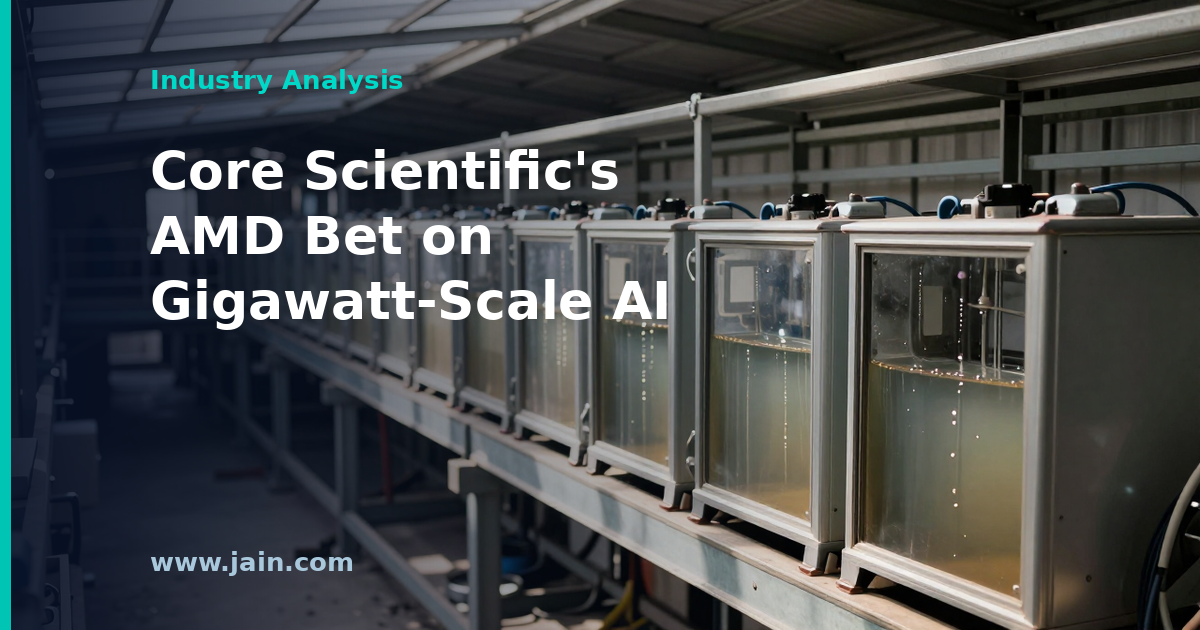
On July 27, 2026, Core Scientific (NASDAQ: CORZ) executed lease agreements covering 377 MW of critical IT capacity with AMD at its Pecos, Texas; Muskogee, Oklahoma; and Hunt County, Texas sites, plus 152 MW with an unnamed “Neocloud” at Auburn, Alabama and Dalton Phase 3, Georgia. Each lease runs fifteen years with three five-year renewal options. The AMD leases also grant AMD the right to reserve an additional 1,925 MW through December 28, 2028 — the arithmetic behind the “up to 2.5 gigawatts” headline in the two companies’ joint announcement of July 28. Core Scientific issued AMD a warrant for up to 30 million shares at $23.47, of which roughly 6.5 million vested on signing.
Credit where it is due: Stocktwits surfaced the market reaction to the partnership, and that pointer led us to the underlying filings, where the actual terms sit. What follows is built on those documents — the July 28 8-K, the same-day Q2 2026 results, the August 14 and August 27 8-Ks, and AMD’s own second-quarter report.
Executive Summary
The announcement matters because of what is contracted versus what is merely available. Approximately 530 MW across five sites is under signed fifteen-year leases, which Core Scientific told investors represents more than $14 billion of potential base contracted revenue. The remaining 1,925 MW is a reservation right — an option AMD may exercise “at certain times and under certain circumstances” before the end of 2028. Both numbers are real; they are not the same kind of real, and the gap between them is the single most important thing to understand about the deal.
The transaction lands on a company in the middle of a fast pivot. Core Scientific’s Q2 2026 colocation revenue was $136.7 million, up from $10.6 million a year earlier, on total revenue of $164.2 million and adjusted EBITDA of $41.1 million. Total leased customer power now stands at roughly 1.1 GW, which the company frames as more than $24 billion of potential contracted revenue. It also reported a net loss of $1,155.3 million, attributed primarily to the change in fair value of warrants as its share price appreciated — an accounting outcome, not a cash one, but one the AMD warrant will keep producing.
For AMD, this is ecosystem construction. Data Center revenue was $6.7 billion in Q2 2026, up 107% year over year and 58% of a company that grew total revenue 50% to $11.5 billion. Securing megawatts where Instinct GPUs and EPYC CPUs can land is a way of removing the physical bottleneck between a chip roadmap and a customer deployment. It also commits a semiconductor company to fifteen-year real-estate obligations, which is not a normal item on a fabless balance sheet.
Five Sites Signed, Four Times That Reserved
The joint press release says AMD “secures more than 500 megawatts of U.S. capacity.” The 8-K filed the same week is more precise: AMD itself is the tenant on 377 MW. The balance that gets the figure over 500 — 152 MW at Auburn and Dalton Phase 3 — is leased by an unnamed Neocloud, industry shorthand for a specialist cloud provider that rents out GPU compute rather than a general-purpose cloud. AMD’s involvement there is indirect: a tri-party Credit Support Agreement among Core Scientific, the Neocloud and AMD that protects AMD equipment on the premises and gives AMD the right, but not the obligation, to cure certain Neocloud defaults.
That structure is sensible and common — a chip vendor backstopping a smaller customer’s lease so the landlord will sign it — but it should be read for what it is. The Credit Support Agreements terminate automatically on the earliest of lease expiration, fifteen years, or “specified circumstances relating to the insolvency or default” of the Neocloud, and AMD may terminate on a material misrepresentation by Core Scientific after a cure period. The filing does not spell out which insolvency circumstances end the support. The protection is therefore strongest in the ordinary case and least defined in the scenario where it would matter most.
The 1,925 MW reservation right deserves equally plain language. It is not a lease, not a commitment to lease, and carries no disclosed reservation fee, exercise price or trigger. What it does is hold Core Scientific’s future development pipeline for AMD’s ecosystem through December 28, 2028. For a landlord in a market where power is the scarce input, exclusivity of that duration has a cost, and the filings do not say what AMD paid for it.
The Warrant Is the Deal’s Second Currency
AMD received a warrant for up to 30 million Core Scientific shares at $23.47 — the five-day volume-weighted average price before execution, so struck at market rather than at a discount. It vests at 12,222 shares per megawatt of critical IT load contemplated by the leases, which is why roughly 6.5 million shares vested immediately against the ~530 MW signed. Run the arithmetic in the other direction and the full 30 million shares correspond to about 2,455 MW: the 530 MW leased plus the 1,925 MW reserved, almost exactly. The warrant is calibrated to the whole 2.5 GW ambition, and it expires July 27, 2031.
This is a well-designed alignment mechanism. AMD only earns equity as it fills halls, and Core Scientific only dilutes as contracted revenue arrives. It is also genuine dilution, and it creates an unusual reporting artifact. Core Scientific carries warrants as liabilities — $1.81 billion in current warrant liabilities at June 30, against $1.77 billion of cash — and marks them to fair value each quarter. When the shares rise, the liability rises and the income statement records a loss. The company’s $1,155.3 million Q2 net loss was, on its own account, primarily that mechanism at work.
The practical consequence for anyone reading future quarters: good news about the stock will keep manufacturing headline losses. Adjusted EBITDA of $41.1 million and gross profit of $70.0 million are the figures that describe the operating business. Neither, however, makes the dilution imaginary. The two facts coexist: the loss is not cash, and the shares are.
The Cash Question: $797.5 Million a Quarter Against a $100 Million Revolver
Core Scientific spent $797.5 million on capital expenditure in Q2 2026, including land and development rights, and closed the acquisition of Polaris DS on August 13 for approximately $444.3 million in cash, with a further $40 million payable if an additional 40 MW of firm electric capacity reaches the target before December 31, 2026. Liquidity at quarter-end was $1,819.4 million. At the second quarter’s spending rate, that is a runway measured in quarters, not years, and the ~530 MW now under lease has to be built before it bills.
Against that, the August 25 credit agreement with JPMorgan Chase as administrative and collateral agent provides a $100.0 million revolving facility and a $500.0 million letter-of-credit facility, secured by a first-priority lien on substantially all assets, maturing in three years or four at the company’s election. The letter-of-credit line is the operationally important half: utilities require credit support for interconnection and project obligations, and $500 million of L/C capacity buys the ability to hold power positions. But only $100 million of it is borrowable cash. This is a liquidity and collateral facility, not a construction financing, and the company has not described how the remaining build is funded.
Two covenant details are worth flagging. Liquidity — unrestricted cash plus undrawn revolver commitments — must be at least $150.0 million at each quarter end. And each revolver borrowing is conditioned on a market capitalisation of at least $3.0 billion at the prior close. That second condition ties access to credit to the equity market’s continuing enthusiasm, at a company whose share price is also the input to its warrant accounting and the strike on AMD’s warrant. It is a reasonable lender protection. It is also a link between financing capacity and sentiment that did not exist before.
Why a Chip Company Signs a Fifteen-Year Lease
AMD’s own quarter explains the motive. Revenue of $11.5 billion was up 50% year over year with 54% GAAP gross margin and $2.3 billion of net income, and Data Center more than doubled to $6.7 billion. Alongside that, AMD reported partnerships to deploy Helios racks with Anthropic at up to 2 gigawatts and with Microsoft on Azure. The constraint on converting that demand into revenue is not wafer supply alone; it is energised, high-density space. Leasing it directly, rather than waiting for customers to find it, shortens the path from an MI400-series launch to an installed rack.
The cost is that a fabless semiconductor company now holds fifteen-year lease obligations with three five-year extensions, in a business whose product cycles run eighteen to twenty-four months. Nvidia’s competitive position, the pace of accelerator obsolescence, and the possibility that end customers prefer someone else’s real estate are all risks that a chip company does not usually take onto its balance sheet. AMD has structured around some of it — the Neocloud takes 152 MW directly, and the 1,925 MW is optional rather than committed — which is exactly the point of the option.
For the wider infrastructure market, the read-through is that GPU vendors are becoming counterparties to data center operators, not just suppliers to them. That is good for operators with power in hand: Core Scientific’s implied economics on the anchor leases, at more than $14 billion over fifteen years across roughly 530 MW, work out to roughly $1.76 million per megawatt-year, against roughly $1.45 million per megawatt-year implied by the $635 million average annualised colocation revenue on 437 MW of billing capacity as of mid-July. It also means the tenant roster in AI colocation increasingly includes firms whose primary business is selling the chips inside — a concentration of interest that buyers negotiating for capacity in the same markets should factor into their own timelines.
Background
Core Scientific designs, builds and operates large-scale, purpose-built data centers for high-density colocation, with facilities in Alabama, Georgia (2), Kentucky, North Carolina, North Dakota, Oklahoma and Texas (4). The majority of its revenue now comes from colocation services for AI workloads; the remainder comes from earning digital assets for its own account and from digital asset mining hosting, and the company says it is repurposing its remaining mining facilities to support colocation as circumstances allow. The scale of that transition shows in one comparison: colocation revenue of $10.6 million in Q2 2025 against $136.7 million in Q2 2026, with billing capacity rising from 225 MW at the end of Q1 2026 to 395 MW at the end of Q2 and 437 MW as of mid-July. On July 29, 2026 the company appointed Mark W. Adams — formerly chief executive of Penguin Solutions and president of Micron Technology — to its board as an independent director.
AMD is the second-largest supplier of data center CPUs and the principal challenger to Nvidia in AI accelerators, selling Instinct GPUs, EPYC server processors and the open-source ROCm software stack. Its recent product cadence includes the Helios rackscale system and the Instinct MI400 series. The competitive problem AMD faces is not only silicon performance but deployment surface: customers need somewhere powered to put the racks. Arrangements in which a chip vendor contracts for megawatts on behalf of its ecosystem — rather than waiting for customers to source capacity themselves — are a recent development in a market where interconnection queues and utility timelines, not manufacturing, increasingly set the pace.
NVIDIA, the company whose chips run most artificial intelligence, has reportedly agreed to rent a huge computer campus in Texas from a firm called Hut 8. NVIDIA has not confirmed it.
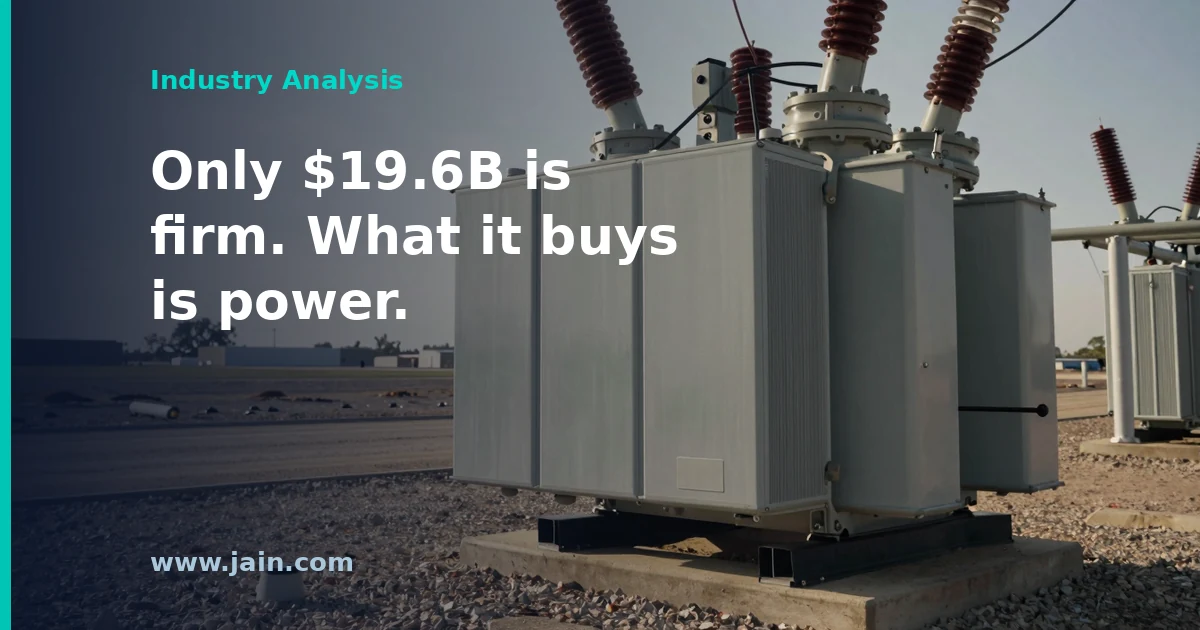
The deal is described as worth $50 billion, but only $19.6 billion is locked in for the first 15 years. The rest depends on renewals after that.
What is really being rented is electricity: a guaranteed grid connection roughly equal to what one large nuclear reactor produces. For artificial intelligence, that has become as important to secure as the chips themselves.
Data Center Frontier reported on August 3, 2026 that NVIDIA has emerged as the tenant behind Hut 8’s lease commitments at its one-gigawatt Beacon Point AI data center campus in Nueces County, Texas. Hut 8 has disclosed two 15-year leases covering 704 megawatts of IT capacity with a combined base-term value of $19.6 billion. That figure rises to as much as $50.2 billion if all renewal options are exercised. The Financial Times identified NVIDIA as the tenant. Reuters said it could not independently verify that, and NVIDIA neither confirmed nor denied its role, saying only that it works with ecosystem partners to deploy AI infrastructure through its DSX AI factory architecture.
In a separate announcement, Aalo Atomics and Crusoe said they will partner on a nuclear-powered AI data center. They plan to demonstrate it at Idaho National Laboratory in 2027 and then deploy 50-megawatt Aalo Pod reactors at Crusoe data centers by the end of 2029.
Executive Summary
Hut 8 has fully commercialized Beacon Point with two 352-megawatt phases, each carrying a base-term contract value of about $9.8 billion. The campus runs on a one-gigawatt interconnection agreement with AEP Texas and is being designed around NVIDIA’s DSX reference architecture. If the reported tenant is confirmed, NVIDIA would move beyond supplying GPUs and become an anchor tenant whose credit helps make a multibillion-dollar campus financeable.
The headline number overstates what is firm. Only $19.6 billion of the $50.2 billion is committed. The remaining $30.6 billion depends on renewals beyond the initial 15 years. What the firm commitment secures is 704 megawatts of capacity that is already power-connected, and in the current AI buildout that is the scarcest input.
The Aalo–Crusoe partnership takes the opposite approach to the same constraint. Instead of locking up a gigawatt of grid power, it aims to manufacture both a small reactor and a modular data center and to add them 50 megawatts at a time. Beacon Point itself is grid-connected, not nuclear-powered.
Most of the $50 Billion Sits in Renewal Options
The $50.2 billion figure is a ceiling, not a check. Hut 8 has disclosed two 15-year leases with a combined base-term contract value of $19.6 billion, about $9.8 billion for each 352-megawatt phase. The remaining $30.6 billion, roughly 61 percent of the headline, materializes only if every renewal option beyond the initial terms is exercised.
The firm commitment is still very large. Spread evenly, $19.6 billion over 15 years comes to about $1.3 billion a year, or roughly $1.9 million per megawatt of IT capacity annually. That is a simple average and not a rent schedule, because payment start dates and escalators have not been published.
Whether the renewals happen depends on something no one can promise today: that a campus designed in 2026 will still be competitive decades from now. Computing systems turn over rapidly, while the land, the shell and the grid connection last far longer. Power density and cooling will need repeated upgrades to keep the site useful. The base term prices the next 15 years of AI demand, and the option value prices how long the power connection itself stays valuable.
What the Lease Actually Buys Is Powered Capacity
Set aside the headline value, and the scarce asset at Beacon Point is electricity that has already been promised. The campus holds one gigawatt of utility capacity under an interconnection agreement with AEP Texas. An interconnection agreement is the utility contract that lets a large load plug into the grid, and obtaining one has become as important as obtaining GPUs. The two leases commit 704 megawatts of IT capacity, meaning the power delivered to servers, networking and storage. The gap between that figure and the 1 GW connection typically covers cooling and electrical overhead.
Hut 8’s own disclosure shows which variable is fixed. The company said it redesigned the first Beacon Point data hall around NVIDIA’s architecture and increased capacity by 57 percent within the same land and utility footprint. The grid connection did not grow. What changed was how much compute the design could extract from it. NVIDIA pitches DSX on the same logic, emphasizing token performance per megawatt (AI output per unit of power) rather than floor space.
The parties most affected are those who cannot secure this kind of power allocation on their own. Some reporting has speculated that NVIDIA could sublease capacity. If it does, smaller GPU cloud providers, often called neoclouds, would gain access to power and space they could not finance independently. For Hut 8, the leases bring its contracted AI portfolio to 949 megawatts on 1,330 megawatts of utility capacity, with $26.6 billion of aggregate base-term value. Beacon Point accounts for roughly three-quarters of that value.
A Chip Supplier’s Credit Becomes Construction Finance
If the Financial Times identification holds, the bigger shift is NVIDIA’s role in the market. Campuses at this scale are typically financed against the creditworthiness of the tenant, and Hut 8 has described its counterparty as investment-grade. An NVIDIA lease would make the company an anchor tenant whose balance sheet helps get a multibillion-dollar campus built. It would no longer be only the supplier of the GPUs, networking, systems and software inside.
The strategic logic is clear. A supplier that underwrites capacity can pull forward projects that might otherwise stall on financing. It can also standardize those projects around its own reference design and widen the pool of customers able to rent its hardware. The open question, which only NVIDIA can answer, is how much of the demand behind such a campus comes from end customers and how much is the supplier’s own commitment. A lease anchored by the chip vendor and sublet to the vendor’s customers concentrates risk around a single forecast of compute demand. That is the tradeoff the model accepts in exchange for speed.
The Other Model: Putting the Reactor Next to the Racks
The nuclear model in this news cycle comes from Aalo Atomics and Crusoe, not from Beacon Point. The two companies plan to run a Crusoe Spark modular data center on power from an Aalo reactor at Idaho National Laboratory in 2027. They then intend to deploy Aalo Pods, which are 50-megawatt-electric nuclear plants, at Crusoe data centers by the end of 2029. Crusoe puts its Spark factory lease, buildout and initial module fleet at more than $200 million. Aalo has secured more than $136 million in funding.
The milestone so far should be read precisely. On July 4, 2026, Aalo’s Critical Test Reactor reached criticality, meaning it sustained a nuclear chain reaction. It did so at zero power, before sodium coolant or any electricity-generating systems were added. The 10-megawatt-electric Aalo-X power reactor is being built next door. Commercial sites will still require regulatory approval, fuel, waste-management plans, insurance, financing and community support. For that reason, 2027 and 2029 are better read as ambitious targets than as delivery dates.
Side by side, the two projects answer the same constraint in opposite ways. Beacon Point locks up a gigawatt of grid power and fills it in 352-megawatt blocks. Aalo and Crusoe aim to manufacture both the power plant and the data center and to add capacity 50 megawatts at a time. In both cases, securing power comes first in the contract.
Background
Hut 8 built its business in bitcoin mining and has been repositioning toward AI data center development, leasing power-connected capacity to large tenants under long-term contracts. Its Beacon Point campus in Nueces County, Texas, is now fully contracted and sits within a 949-megawatt contracted AI portfolio supported by 1,330 megawatts of utility capacity. NVIDIA supplies the GPUs, networking, systems and software that many AI data centers run on. It promotes DSX as a reference architecture for designing entire facilities around its platforms.
Crusoe is an AI cloud and data center company that sells computing through Crusoe Cloud and builds prefabricated Spark data center modules. Aalo Atomics is developing small advanced reactors, including the 10-megawatt-electric Aalo-X, a sodium-cooled design, and the 50-megawatt-electric Aalo Pod. The company is expanding toward a one-million-square-foot manufacturing operation, and its planned demonstration with Crusoe is sited at Idaho National Laboratory.
Anthropic, the AI lab behind the Claude model family, has signed a data center lease valued at roughly $19 billion with TeraWulf (Nasdaq: WULF), a bitcoin miner that has been repositioning itself as an AI infrastructure host. The agreement was reported by SiliconANGLE on July 5, 2026.
The transaction makes Anthropic a long-duration anchor tenant on TeraWulf’s power-rich footprint, and it ranks among the largest single AI hosting commitments disclosed to date.
Executive Summary
The headline number — about $19 billion — is what an AI lab would normally spend building its own campus, not renting one. By pushing that spend into a lease with a listed bitcoin miner, Anthropic is trading capex for speed: TeraWulf already controls interconnected sites and substation capacity, which is the scarce input in the current AI build-out.
For TeraWulf, the contract is a category change. A company whose revenue has been tied to bitcoin’s price now has a multi-year, investment-grade-style cash flow tied to a frontier AI customer. That is why WULF sits on many investor watchlists as a proxy for the miner-to-AI-landlord thesis.
The deal also sharpens a broader trend: hyperscalers and AI-native labs are no longer waiting on traditional colocation supply. They are contracting directly with whoever holds the two things that matter most right now — energized land and a grid connection.
Why an AI Lab Rents from a Bitcoin Miner
Bitcoin miners spent the last cycle acquiring the exact ingredients AI now needs: cheap power contracts, substation rights, and shells that can dissipate very high rack densities. Retooling those shells for GPUs is non-trivial — liquid cooling, tenant-grade redundancy, and network fiber all have to be added — but it is far faster than greenfield permitting. For Anthropic, leasing from TeraWulf compresses time-to-first-megawatt in a market where a new build can take three to five years.
The economics also matter. A lease shifts risk: Anthropic pays for capacity as it is delivered rather than tying up cash in construction, while TeraWulf finances the fit-out against a signed contract. That is the same playbook enterprise tenants use with traditional colocation providers; what is new is the scale and the counterparty.
What $19 Billion Actually Buys
The release frames the commitment as a lease value rather than an upfront payment, which typically means it spans many years of rent, power pass-through, and services. Without disclosed megawatts, PUE assumptions, or a term length, the figure is best read as a ceiling on Anthropic’s obligation and a floor on TeraWulf’s backlog — not a check written on day one.
Even so, a nine- or ten-figure annualized run-rate at a single landlord is unusual. It implies gigawatt-class ambitions over the life of the contract, which in turn implies transmission upgrades and generation additions that neither party controls alone.
Winners, Losers, and the Miner-to-AI Trade
The clearest winner is any miner sitting on energized capacity in a utility territory friendly to large loads. TeraWulf’s deal will be used as a comparable by peers negotiating their own AI conversions, and it validates the equity story that has driven the miner-to-AI rerating. The clearest pressure point is on traditional wholesale data center developers, who now face a well-funded competitor class that already owns the power.
For Anthropic, the strategic read is independence. Locking in dedicated capacity outside the big three clouds gives the company optionality on where its next generation of models trains and serves, and reduces the risk that compute becomes a chokepoint controlled by a strategic investor or competitor.
The Grid Question Behind the Deal
Every large AI lease today is really a bet on the interconnection queue. Utilities in the regions where miners cluster — parts of Appalachia, Texas, and the upper Midwest — are already signaling multi-year waits for new large-load connections. A lease of this scale will draw scrutiny from regulators, ratepayer advocates, and neighboring loads who compete for the same megawatts.
None of that is a criticism of either party; it is the operating reality of the market. But it means execution risk on a deal of this size sits less with the tenant or the landlord than with transmission planners and permitting timelines that neither company can accelerate on its own.
Background
Anthropic, founded in 2021, has grown into one of a small group of frontier AI labs whose compute needs now rival those of the largest cloud tenants. Like its peers, it has relied on hyperscaler partners for training capacity while seeking to diversify its infrastructure footprint.
TeraWulf emerged from the last bitcoin cycle with a portfolio of power-anchored sites in the eastern United States. As mining economics compressed and AI compute demand surged, the company — along with several listed peers — began marketing its energized capacity to high-performance computing and AI tenants, a pivot investors have tracked closely under the miner-to-AI-landlord thesis.