
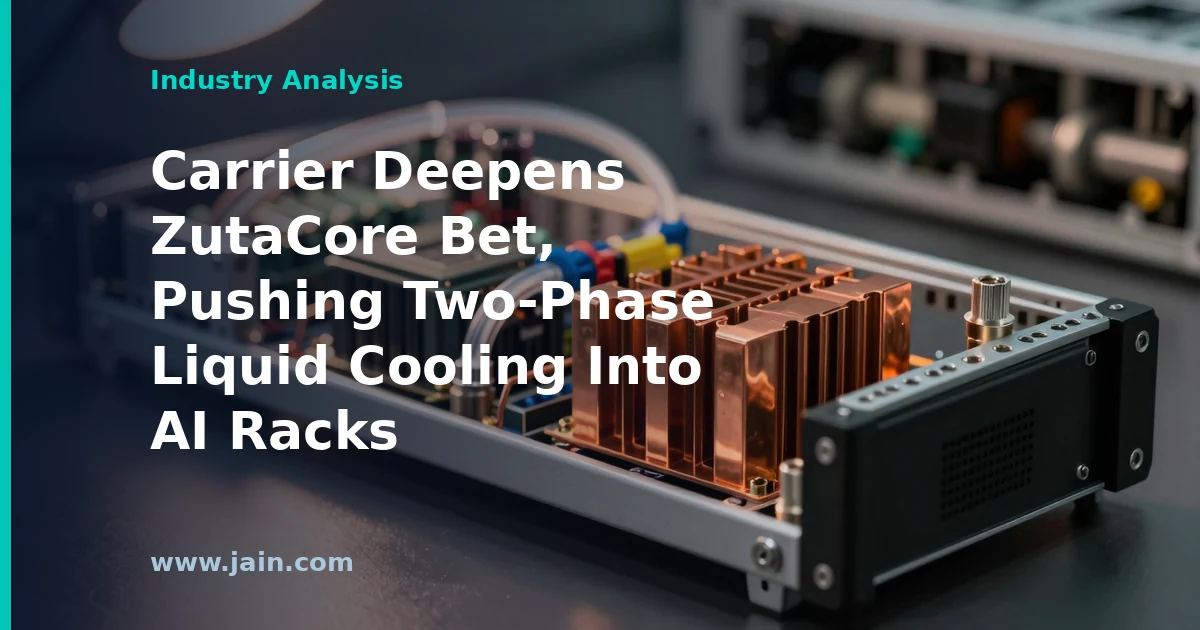
Carrier Ventures, the venture arm of HVAC and building-systems giant Carrier Global, announced on April 28, 2026 that it is expanding its investment in ZutaCore, a maker of two-phase, direct-to-chip liquid cooling technology. The stated purpose is to scale liquid cooling for AI data centers, where rapidly rising chip power densities are outrunning traditional air cooling. The announcement, distributed via PR Newswire, did not disclose the size or terms of the expanded investment.
Executive Summary
Carrier first backed ZutaCore with a strategic investment and partnership announced in late 2024. This follow-on commitment signals that Carrier sees direct-to-chip cooling — hardware that removes heat at the processor itself rather than from the room around it — as central to its data center strategy, not a side experiment. For a company whose traditional data center business is facility-level equipment such as chillers and air handlers, that is a meaningful shift in where it believes thermal value will be captured.
The ‘why now’ is straightforward: AI accelerators have pushed rack power draws from the tens of kilowatts into the hundreds, a range where moving heat with air alone becomes physically and economically impractical. Liquid cooling has moved from niche to necessity for AI deployments, and every major thermal-management vendor is racing to own a piece of the resulting stack. The open question is whether the announcement represents scaled commercial traction or primarily a strategic option on a still-contested technology — the release headline promises scale, but the syndicated text offers no deployment figures, customer names, or dollar amounts to measure it by.
Why an HVAC Giant Wants Inside the Rack
Carrier’s historical position in data centers is at the facility level: chillers, cooling towers, and air-handling systems that condition entire halls. Direct-to-chip cooling changes where the critical engineering happens. When heat is captured at the silicon by cold plates and carried away in fluid loops, the highest-value thermal decisions move from the building to the rack — territory contested by specialists like ZutaCore, CoolIT, and Motivair, and by IT-side players such as Vertiv and the server manufacturers themselves. An expanded investment in ZutaCore is a hedge against disintermediation: if Carrier does not have a credible chip-level offering, it risks being relegated to supplying the commodity heat-rejection equipment at the end of someone else’s thermal chain.
There is also a plausible offensive logic. A vendor that can pair chip-level heat capture with its own facility-scale heat rejection can sell an integrated thermal chain — from cold plate to cooling tower — which is attractive to operators who currently stitch that chain together from multiple vendors. Whether Carrier and ZutaCore intend to productize such an integrated offering is not stated in the announcement, but it is the strategic prize this kind of pairing points toward.
Two-Phase Cooling, Explained — and Why It Is Contested Ground
Most liquid cooling deployed for AI today is single-phase: water or a water-glycol mix flows through a cold plate on the chip, warms up, and carries the heat away. ZutaCore’s approach is two-phase — a dielectric (non-electrically-conductive) fluid boils directly on the cold plate, absorbing large amounts of heat as it vaporizes, then condenses elsewhere in the loop. The physics advantage is real: boiling absorbs far more heat per unit of fluid than simple warming, which matters as individual accelerator packages climb toward and beyond kilowatt-class heat output. Because the fluid is non-conductive, a leak is also less catastrophic than a water leak inside a server.
The counterweight is ecosystem maturity. Single-phase water cooling is the volume standard for current AI reference designs, with an established supply chain, well-understood operating practices, and trained technicians. Two-phase systems introduce different fluids, pressures, and service procedures, and specialty dielectric fluids carry their own cost and, depending on chemistry, environmental scrutiny. The bet embedded in Carrier’s investment is that next-generation chip heat densities will strain single-phase designs enough to open a mainstream window for two-phase — a defensible thesis, but one the market has not yet settled.
What the Announcement Does and Does Not Substantiate
Read carefully, this is a statement of investor conviction, not a disclosed commercial milestone. A follow-on investment from a strategic corporate backer is a genuine positive signal: corporate venture arms rarely double down on portfolio companies whose technology their own engineers have found wanting. It suggests the 2024 partnership produced enough validation to justify more capital.
What the syndicated release does not provide is the evidence a buyer or investor would need to gauge momentum: the investment amount, ZutaCore’s resulting valuation or Carrier’s stake, named customers, deployed megawatts, or manufacturing capacity commitments. ‘Scale liquid cooling for AI data centers’ is a direction, not a metric. That does not make the announcement empty — strategic capital and an incumbent’s distribution reach are real assets for a smaller technology vendor — but the gap between the headline’s ambition and the disclosed specifics is worth keeping in view. The same skepticism should be applied evenly: competing single-phase vendors’ claims of inevitability are also assertions, not settled fact, in a market where chip roadmaps can shift the thermal calculus every generation.
Background
Carrier Global, spun off from United Technologies in 2020, is one of the world’s largest providers of heating, ventilation, air conditioning, and refrigeration systems, with a long-standing data center business centered on facility-level cooling equipment. ZutaCore, founded in the mid-2010s with roots in Israel, developed a waterless two-phase direct-to-chip cooling platform aimed at high-density computing. The two companies first linked up in late 2024, when Carrier announced a strategic investment and partnership with ZutaCore as part of a broader industry pivot toward liquid cooling.
That pivot has been driven by the AI buildout: accelerator-dense racks have pushed power and heat densities beyond what air cooling can economically handle, turning liquid cooling from a specialty into a core requirement of new AI data center designs and drawing HVAC incumbents, power-infrastructure vendors, and startups into direct competition for the rack thermal stack.
Source: Carrier Ventures Expands Investment in ZutaCore to Scale Liquid Cooling for AI Data Centers — PR Newswire announcement, April 28, 2026, describing Carrier’s expanded strategic investment in two-phase liquid cooling company ZutaCore.