
TL;DR · 30-second read
The Short Version
atNorth, a company that builds and runs data centers across the Nordic countries, plans a roughly €2 billion computing campus in Salo, a Finnish town near Helsinki.
The first stage already has 75 megawatts of power lined up, enough electricity for tens of thousands of homes, with room to grow to about three times that. The computers customers install inside could cost up to five times more than the buildings.
The twist: atNorth says it will look at using the campus’s waste heat to warm local buildings, and wants to help keep the national power grid steady.
atNorth, a Reykjavik-headquartered operator of high-density data centers, announced on October 5, 2026, in a release distributed by PR Newswire, that it plans to develop FIN05, a new data center campus on a 28.6-hectare site in Salo, Finland. Power for the first phase, planned at 75 MW, is secured, with a path to up to 230 MW for the wider development through a substation on the national grid operated by Fingrid.
atNorth expects to invest approximately €2 billion in the site. Customer-owned servers and their installation, which are excluded from that figure, could add an estimated investment of up to €10 billion. The company also plans long-term power purchase agreements with local energy suppliers, grid flexibility arrangements, and heat reuse partnerships with local stakeholders.
Executive Summary
FIN05 is atNorth’s second large campus in Finland, after Kouvola, and its sixth major development currently under way across the Nordics. The core facts are concrete: 75 MW of secured power for phase one, a 230 MW ceiling for the full site, a transmission-level grid connection, and a combined facility and customer-hardware investment that could approach €12 billion at full build-out.
What makes the announcement worth reading closely is how it is assembled. atNorth places power purchase agreements, flexibility services for Finland’s transmission grid and waste-heat reuse alongside the capacity figures, not after them. The site itself came from a local developer, Regant Oy, which describes having prepared it with planning readiness and a power roadmap in place. Together, these suggest that in the Nordics, a campus of this size is now being presented as an energy-system partner to its host region, not only as a large electricity customer.
The commitments carry different weights, however. The 75 MW is secured; the power purchase agreements are planned; flexibility services could support the grid; heat reuse is to be explored. The capacity case is firm. The community dividend is, for now, a well-structured set of intentions.
At 230 MW, the Grid Becomes a Stakeholder
FIN05 will connect through a Fingrid substation. Fingrid is Finland’s transmission system operator, the company responsible for the high-voltage national grid and for keeping supply and demand balanced second by second. A campus that could eventually draw 230 MW is not a routine customer on a local distribution line; it is a load large enough that its behavior matters to how the national system is run. That is the context for atNorth’s plan to offer “flexibility solutions that could support the efficient operation of Fingrid’s transmission grid.” In industry practice, flexibility typically means a large consumer agreeing to shift or reduce its draw, or to make on-site equipment available, when the grid is under stress, so that the operator has another tool besides building more generation and lines.
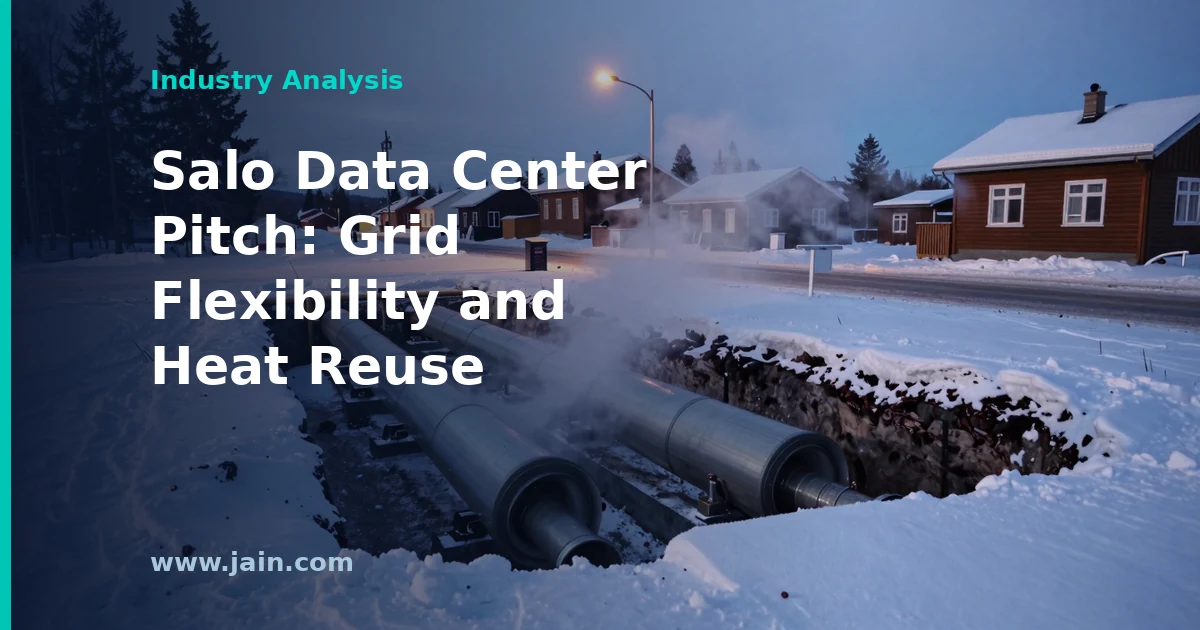
The two other elements of the plan point the same way. Long-term power purchase agreements, contracts in which a buyer commits to take electricity from a producer for years at agreed terms, are framed as support for energy production in the region, giving local suppliers a dependable customer. Heat reuse addresses a physical fact of computing: almost all the electricity a server consumes ends up as heat. In Nordic towns with district heating, networks of insulated pipes that carry hot water to homes and businesses, that heat can have a buyer instead of being vented. atNorth points to existing heat reuse collaborations with Kesko in Finland, Stockholm Exergi in Sweden, and Vestforbrænding and Selected Group in Denmark as evidence it has executed this model before.
The parties most affected are the Salo municipality, whose mayor emphasised construction and operating jobs; Fingrid, which gains a large load that may also offer flexibility; local power producers, who could gain a long-term buyer; and potential heat users. The measured conclusion is that, for a campus of this scale, atNorth is presenting grid support and heat value as part of the case for the site itself. Whether that case translates into delivered value depends on terms atNorth has not yet published: the power purchase agreements are planned, flexibility “could” support the grid, and heat reuse remains something to “explore.”
Secured Power Is the Hard Asset; the Rest Is Roadmap
The announcement uses carefully graded language, and the grades matter. Phase one power, 75 MW, is described as secured. The full 230 MW is a “path to power.” The €2 billion is an expected, approximate figure. For prospective customers, the secured first-phase power is the most bankable fact in the release: where grid connections take years to obtain, power already in hand is what turns land into a usable data center site.
Regant Oy’s role reinforces that point. Its partner said the firm worked with atNorth and the municipality to provide a development-ready site with “the scale, planning readiness and power roadmap needed for large data center projects.” That describes a model in which a local developer assembles land, planning groundwork and a grid pathway before an operator arrives. What the operator is effectively acquiring is time-to-power, which is often the scarcest input in large data center development.
€2 Billion of Buildings, Up to €10 Billion of Customer Hardware
The most revealing number may be the ratio between atNorth’s estimated investment and its customers’. atNorth expects to spend about €2 billion on the site, while customer-owned servers and their installation could add up to an estimated €10 billion, as much as five times the facility spend. A ratio like that is characteristic of dense, accelerator-based computing, the specialized chip servers used to train and run AI models, where the hardware inside costs far more than the building around it. atNorth describes itself as a high-density colocation and built-to-suit provider; the announcement frames demand as high-performance digital infrastructure and does not name specific workloads or customers.
Built-to-suit means a facility designed to one customer’s specification, and colocation means renting space, power and cooling to customers who install their own equipment. In both cases, when customers bring up to €10 billion of their own hardware, the length and credit quality of their contracts become central to the project’s economics. The €10 billion is also explicitly an upper-bound estimate, not a commitment. For Salo, the durable local value is more likely to sit in construction, operations, power sales and heat than in the hardware itself, which customers own and periodically replace.
Another Mega Site in a Busy Nordic Slate
FIN05 joins four mega sites atNorth already has under development, in Kouvola, Finland; Ølgod, Denmark; Sollefteå, Sweden; and Haugaland, Norway, plus a metro site in Stockholm, alongside seven operating data centers. Advancing that many large campuses at once requires capital, construction capacity and grid connections in parallel, and execution risk scales with the pipeline.
The Nordic region’s appeal for this kind of capacity is well established: a cool climate that reduces cooling energy, grids with a high share of renewable generation, and widespread district heating that can absorb data center waste heat. The last of these is what gives Nordic operators a community offer that is hard to replicate in many other regions, and FIN05 is built around using it.
Background
atNorth is a Nordic data center company headquartered in Reykjavik, Iceland. It offers high-density colocation, in which customers rent space, power and cooling for their own servers, and built-to-suit facilities designed to a single customer’s specifications. It operates seven data centers across the Nordics and is developing four mega sites, in Kouvola, Finland; Ølgod, Denmark; Sollefteå, Sweden; and Haugaland, Norway, plus a metro site in Stockholm. The company says its sites run on renewable energy and support circular economy principles, including heat reuse partnerships in Finland, Sweden and Denmark.
The Nordic countries have become a destination for large data centers because of their cool climate, which reduces the energy needed for cooling, grids with a high share of renewable generation, and extensive district heating networks that can absorb waste heat. As computing campuses grow to hundreds of megawatts, their relationship with national grid operators such as Finland’s Fingrid, and with the communities that host them, has become a central part of how projects are planned. Source: atNorth to develop new data center in Salo, Finland — atNorth’s announcement of its planned FIN05 campus in Salo, including power, investment, energy partnership and heat reuse plans.Sources