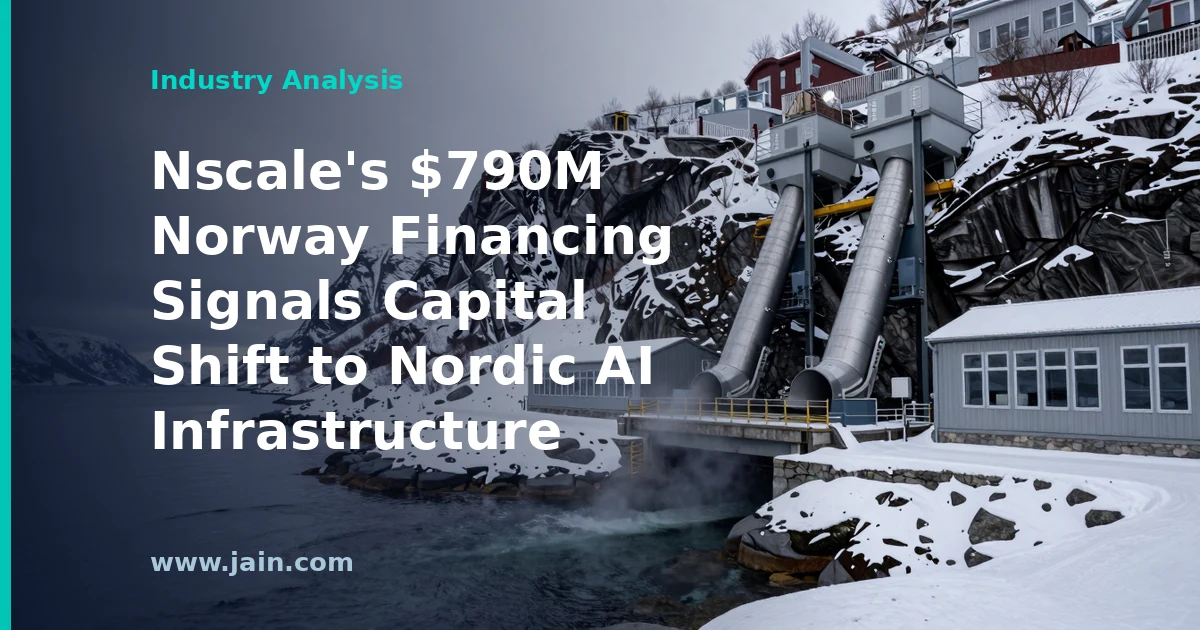
Nscale, the London-headquartered AI infrastructure company, announced on May 10, 2026 that it has secured $790 million in financing to support its AI infrastructure buildout in Norway. The announcement, distributed via PR Newswire, did not publicly detail the structure of the financing or the specific facilities it will fund.
The raise extends a rapid string of capital events for the two-year-old company, which operates hydropower-fed data center capacity in northern Norway and has positioned itself as a European alternative for large-scale AI compute.
Executive Summary
The headline fact is simple: $790 million in fresh financing, earmarked for AI infrastructure in Norway. What makes it worth analyzing is the pattern it confirms. Capital for AI data centers — both equity and, increasingly, project-style debt — is flowing toward locations selected for power and cooling economics rather than proximity to traditional internet hubs. Norway offers abundant hydroelectric power, some of Europe’s lowest industrial electricity costs, and a climate that allows servers to be cooled largely by outside air, a technique known as free cooling.
For Nscale, the money supports a buildout strategy the company has pursued since its 2024 founding: convert stranded or under-used Nordic renewable power into GPU capacity (the graphics processors that train and run AI models) and sell that capacity to hyperscalers and AI labs. For the broader market, a financing of this size directed at a Norwegian buildout is another data point that lenders and investors now treat AI compute facilities as a financeable infrastructure asset class — provided the power story is strong.
Why the Money Is Going North
Traditional European data center markets — Frankfurt, London, Amsterdam, Paris, Dublin — are power-constrained. Grid connection queues stretch for years, and several jurisdictions have imposed moratoria or tight limits on new capacity. AI training workloads, which need enormous amounts of electricity but are far less sensitive to network latency than a website or trading system, break the old rule that data centers must sit near users. That decoupling is the entire Nordic thesis: build where power is cheap, renewable, and available now, and ship the model weights rather than fighting for megawatts in a congested metro.
Norway sharpens that thesis further. Its grid is overwhelmingly hydroelectric, giving operators both low costs and a clean-energy claim that matters to hyperscale customers with public carbon commitments. Sub-Arctic ambient temperatures cut cooling energy dramatically — cooling can consume 30% or more of a conventional data center’s power budget, so free cooling flows straight to operating margin. A $790 million financing aimed specifically at Norway is capital underwriting exactly those advantages.
From Venture Rounds to Infrastructure-Scale Finance
Nscale’s earlier fundraising followed a venture pattern: a Series A in late 2024 and a Series B in late 2025 that ranked among Europe’s largest. The release does not specify whether the new $790 million is equity, debt, or a hybrid, but financings of this size in the sector have increasingly taken the form of asset-backed or project-level debt, where lenders advance capital against contracted future revenue and the hardware and facilities themselves. If that is the shape here, it would mark a maturation milestone — the point where a young company’s buildout is bankable on its contracts rather than purely on investor conviction in the AI boom.
The economics explain why that distinction matters. GPU clusters are extraordinarily capital-intensive, and the chips depreciate quickly as new generations arrive. Equity alone cannot efficiently fund gigawatt-scale ambitions; the industry needs debt markets to participate, and debt markets need predictable cash flows. Every large financing that closes on a power-advantaged site lowers the perceived risk for the next one, which is how a regional buildout becomes a self-reinforcing capital cycle.
Winners, Losers, and the Latency Trade
The obvious beneficiaries are Nordic host communities and utilities, which convert surplus renewable generation into industrial investment and jobs, and the AI labs and cloud providers that gain a European supply of compute at competitive cost — a point with real weight as European institutions push for “sovereign AI” capacity on EU-adjacent soil. Suppliers of high-density and liquid-cooling equipment, long-haul fiber, and grid interconnection services also ride the wave.
The trade-off is real but narrowing. Remote sites are poorly suited to latency-sensitive inference serving end users in central Europe, so Nordic capacity skews toward training and batch workloads. Competition is a second pressure: Sweden, Finland, and Iceland pitch similar advantages, and enormous buildouts in the United States and the Gulf compete for the same GPUs, transformers, and turbines. Cheap power is an advantage, not a moat — execution speed and customer contracts decide who wins.
The Risks Behind the Momentum
Three risks deserve sober attention. First, customer concentration: merchant AI compute providers typically depend on a small number of very large offtakers, so one renegotiated or lost contract can move the whole revenue model. Second, technology risk: financing hardware that may be economically obsolete in three to five years requires contract terms and depreciation assumptions that have not yet been tested through a full cycle. Third, local constraints: even in power-rich Norway, grid capacity in the far north is finite, and large industrial loads have drawn scrutiny over transmission upgrades and electricity-price effects for residents. None of these invalidate the buildout — but they are the variables that will determine whether today’s financings look prescient or aggressive in hindsight.
Background
Nscale was founded in 2024 as a spin-out of data center operator Arkon Energy, inheriting a hydropower-supplied site in Glomfjord in northern Norway. In roughly two years it moved from startup to one of Europe’s most heavily funded AI infrastructure players, raising a Series A in late 2024 and a Series B in late 2025 that ranked among the continent’s largest venture rounds, alongside major capacity agreements with hyperscale customers and a joint venture with Norwegian industrial group Aker to build AI capacity in Narvik with OpenAI as a customer.
The company’s rise tracks a broader industry shift: as AI training demand collided with power shortages in established data center hubs, operators and their financiers turned to energy-rich regions — the Nordics chief among them — where renewable generation, cool climates, and available grid capacity make gigawatt-scale computing economically and politically feasible.
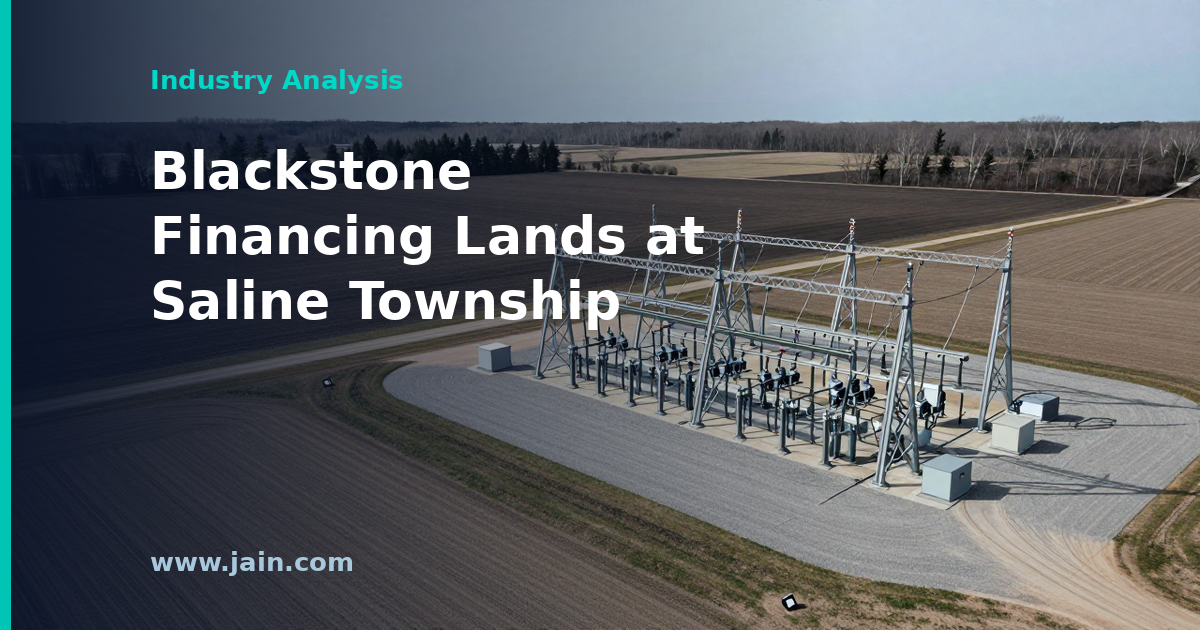
MLive reported on April 25, 2026 that the large data center campus planned for Saline Township, in Washtenaw County, Michigan, has secured financing through Blackstone, the world’s largest alternative-asset manager and a major private-credit lender. Saline Township is a rural farming community roughly south of Ann Arbor, and the site has been the subject of local debate since the project was first proposed.
The report is headline-level. The coverage available to us does not state the size of the facility, the amount or structure of the financing, the identity of the anchor tenant, or the construction schedule. What is established is the fact of a financing commitment from a private-capital provider rather than from a bank syndicate or a utility-led arrangement.
Executive Summary
A financing close is the moment a data center stops being a land-use argument and becomes a construction project. Site control, zoning approvals and power studies can all exist without a single dollar of committed capital; a lender writing a check is the first hard signal that a third party with money at risk believes the project will generate cash. That is why this particular disclosure matters more than its length suggests.
The identity of the lender matters as much as the event. Blackstone has become one of the largest financiers of digital infrastructure through its credit and real-assets platforms, and its involvement places Saline Township inside a broader shift: the capital funding America’s AI-era compute buildout is increasingly private credit — money lent directly by asset managers — rather than utility balance sheets, investment-grade bonds, or traditional construction lending. Private credit moves faster, tolerates more complexity, and prices that flexibility into the interest rate.
The consequence is a redistribution of risk. When a regulated utility builds generation and transmission for a large customer, cost overruns and demand shortfalls can end up in rate cases, where regulators decide how much lands on other ratepayers. When a private lender funds a merchant campus, the first loss sits with the sponsor’s equity and the lender’s loan. Which of those two models Saline Township follows is the single most consequential question the reporting does not yet answer.
Why a Private-Credit Lender, Not a Utility, Is the Story
For most of the last century, the entity that financed heavy electrical load in a place like Washtenaw County was the local utility. It raised capital, built the wires and the plants, and recovered the cost from customers over decades under a regulator’s supervision. The model was slow, but it was durable, and it socialized risk across a large base of ratepayers who had little say in the matter.
Data centers built for artificial-intelligence workloads do not fit that rhythm. The demand signal arrives in months, not decades, and it is concentrated in a handful of hyperscale buyers whose plans can change. Private credit — non-bank lending in which asset managers lend directly from their own funds — has filled the gap because it can underwrite an idiosyncratic asset quickly, structure around construction milestones, and accept collateral that a bank credit committee would struggle with. The borrower pays for that speed in spread.
The trade is real in both directions. A sponsor who takes private credit gets certainty of execution and avoids the political timeline of a rate case. It also accepts covenants, tighter reporting, and a lender that can enforce quickly if lease-up or delivery slips. Reading Blackstone’s involvement as validation of the Saline Township site is reasonable; reading it as a guarantee of completion is not, because financing commitments are typically conditioned on milestones that have not been disclosed here.
The Capital Structure Decides Who Eats the Power Risk
Whether a campus of this scale is financially safe depends less on the headline amount than on what sits behind it. Two structures dominate the sector. In the first, the developer signs long-term leases with a creditworthy tenant before drawing debt; the lender is effectively underwriting the tenant’s credit, and power costs are passed through under the lease. In the second — a merchant or speculative build — the developer takes capacity risk, betting that demand will appear at attractive rates. The interest cost of the two differs sharply, and so does the consequence of being wrong.
Power is where those structures are tested. A large campus needs a firm interconnection, a tariff that sets what it pays per megawatt-hour, and often a commitment to pay for a minimum volume whether or not the servers are drawing it. That last provision — a take-or-pay or minimum-demand charge — is the mechanism by which regulators try to ensure that a large customer, not the general ratepayer base, funds the network upgrades built on its behalf. Whether such terms exist here, and how strict they are, is not in the reporting.
The winners in the current arrangement are relatively easy to identify: landowners who sell into a rising market, contractors and electrical trades, lenders earning wide spreads on secured assets, and local governments that collect property tax on very expensive equipment. The exposed parties are harder to see in advance. They include equity holders if AI compute demand normalizes before the campus is leased, and residential ratepayers if grid investment is later judged to have been undersubscribed by its intended customer. Neither outcome is predictable from a financing headline, which is exactly why the terms matter.
Michigan’s Calculation: Tax Base Now, Load Growth Later
Michigan has actively courted data center investment as part of a broader effort to attract capital-intensive industry, and southeast Michigan offers a genuine set of advantages: cool climate for much of the year, abundant fresh water in the Great Lakes basin, existing transmission built for a manufacturing economy that has shrunk, and proximity to engineering talent around Ann Arbor and Detroit. Those are structural, not promotional.
The fiscal case for a rural township is also real but narrow. A hyperscale campus generates substantial property tax relative to farmland and comparatively few permanent jobs — typically technicians, security and facilities staff, against a much larger but temporary construction workforce. Communities that evaluate these projects as employment engines are usually disappointed; those that evaluate them as tax-base plays are usually not, provided the assessment holds and abatements are modest. The distinction is worth making plainly because it is where local expectations most often go wrong.
The longer-term question for Michigan is load. Adding gigawatt-scale demand to a grid changes generation planning, transmission queues and reserve margins for everyone connected to it. That can be managed well — with large-load tariffs, staged energization, and on-site or contracted generation — or managed poorly. The financing announcement tells us capital has arrived. It tells us nothing about which of those paths the electricity side is on.
A Contested Site, and How to Read Both Sides
The Saline Township project has drawn organized local opposition, as most large rural data center proposals now do. Residents raise farmland conversion, water use, noise from cooling equipment, traffic during construction, and the durability of tax promises. These are legitimate, checkable questions, and dismissing them as reflexive opposition would be lazy — several of them have been substantiated at other sites, particularly noise complaints near residential parcels.
The same standard applies to opposition claims. Water consumption varies by an order of magnitude depending on whether a facility uses evaporative cooling or a closed-loop design, so a figure quoted without the cooling architecture attached is not informative. Ratepayer-impact estimates depend entirely on the tariff, which is a public document once filed. And in a national debate where template campaigns circulate between communities, it is fair to ask of any local group — as of any developer — who is speaking, what the specific local evidence is, and whether the numbers cited come from this project’s filings or from someone else’s. Asking is not an accusation, and there is no basis here for speculating about anyone’s funding.
The most even-handed reading is that both sides are currently arguing about a project whose material terms are not public. The developer has not, in the reporting available, published capacity, water design, or power arrangements; opponents cannot fully assess impact without them. A financing close usually precedes more disclosure, not less, because lenders require documentation that eventually surfaces in permits and utility filings. That is where the argument should be settled.
Background
Blackstone is the world’s largest alternative-asset manager, with major platforms in real estate, infrastructure and private credit. It has become one of the most significant financiers of digital infrastructure globally, lending to and owning data center assets as demand from cloud and artificial-intelligence workloads has outpaced what traditional bank and utility financing could supply on the required timeline.
Saline Township sits in Washtenaw County, southeast Michigan, an agricultural community adjacent to a metropolitan corridor with legacy industrial transmission. Large data center proposals in such places have become a recurring national pattern over the past several years: developers seek land, power and water at rural prices near urban fiber, while residents weigh tax revenue against land use, noise and grid effects. The Saline Township project has been locally contested since it was proposed, and the April 2026 financing report is the point at which the debate moved from land-use approvals toward committed capital.
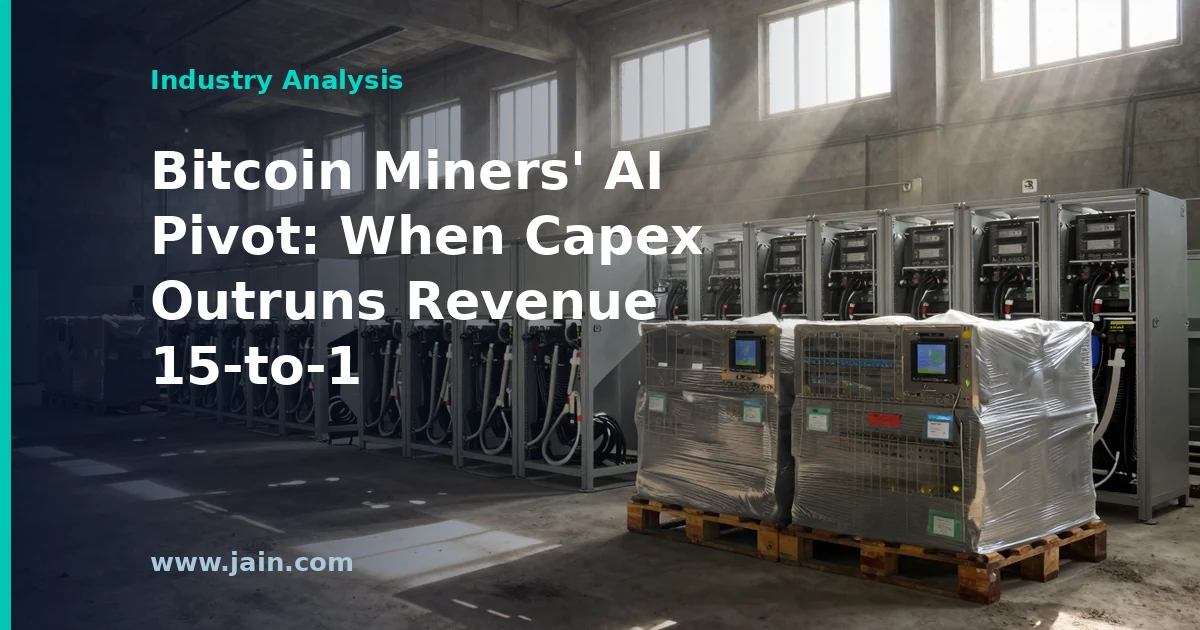
Bitcoin mining companies are collectively investing billions of dollars to convert and expand their facilities for artificial-intelligence and high-performance computing (HPC) workloads, according to an April 2026 report carried by TradingView. The striking figure in the headline: the sector’s AI-related capital expenditure is outpacing the revenue those AI operations currently generate by roughly 15-to-1.
The report frames the pivot as an industry-wide phenomenon spanning the class of publicly traded miners that includes names such as TeraWulf (WULF) and Riot Platforms (RIOT), which have been repositioning energized data-center sites originally built for cryptocurrency mining toward GPU-based compute.
Executive Summary
The announcement is less a single company’s news than a sector-level snapshot: bitcoin miners, squeezed by the economics of their core business, are betting their balance sheets on becoming AI infrastructure providers. Capital expenditure — the money spent building data halls, buying cooling and electrical equipment, and preparing sites for GPU tenants — is running at roughly fifteen times the revenue the AI segments are bringing in today.
That ratio matters because it quantifies the leap of faith underway. Data-center construction is a spend-first, earn-later business, so a wide gap between investment and current revenue is normal early in a buildout. But a 15-to-1 gap sustained across an entire sector of companies that historically financed themselves through volatile bitcoin proceeds raises a sharper question: can these firms carry the spending long enough for contracted AI revenue to arrive?
For the broader digital-infrastructure market, the answer will shape who supplies the next wave of AI capacity — and who ends up selling distressed sites to better-capitalized players.
Why Miners Are Racing Into AI
The pivot is rooted in assets, not sentiment. Bitcoin miners own something the AI boom desperately needs: large, already-energized sites with grid interconnections, substations, and industrial-scale power contracts in place. Securing new utility power for a data center can take years; miners already have it. Converting a mining site to HPC use lets them monetize that scarce head start.
At the same time, the core mining business has become structurally harder. Bitcoin’s periodic “halving” events cut the block rewards miners earn for the same work, and competition keeps pushing up the computing power required to win those rewards. AI hosting offers what mining never could: multi-year contracts with creditworthy tenants and revenue that does not swing with a cryptocurrency price. The strategic logic is sound. The question the 15-to-1 figure raises is whether the execution is affordable.
Reading the 15-to-1 Gap
A capex-to-revenue ratio of 15-to-1 is not automatically alarming — it is partly a timing artifact. AI data centers follow a J-curve: enormous upfront spending on construction, electrical gear, and cooling, followed by revenue that only begins once tenants move in and ramps over the life of a lease. Early in a buildout, the ratio is always lopsided. Traditional data-center developers run the same math, but usually with pre-leased capacity and cheap, secured financing behind it.
What makes the miners’ version riskier is who is doing the spending. These are companies whose historical cash flows came from an asset with extreme price volatility, whose cost of capital is higher than that of investment-grade data-center REITs (real estate investment trusts), and several of which are converting sites on the promise of future tenancy rather than fully contracted demand. A 15-to-1 gap backed by signed long-term leases is a construction schedule; the same gap backed by expected demand is a wager. The report, as summarized, does not break down how much of the sector’s spend falls in each category — and that distinction is the whole ballgame.
The Financing Strain Behind the Buildout
Billions in capex must be funded from somewhere, and miners have essentially four levers: cash from mining operations, selling bitcoin holdings, issuing new shares, or taking on debt — including convertible notes, which are loans that can turn into stock. Each carries a cost. Equity issuance dilutes existing shareholders; debt adds fixed obligations to businesses with historically variable income; selling bitcoin reduces the treasury cushion that has often reassured investors during downturns.
The sector precedent that makes this real rather than theoretical: miners have gone through bankruptcy restructurings before when leverage met a downturn, and the survivors’ pivot to AI hosting was in part a search for steadier ground. If AI revenue ramps on schedule, today’s spending converts into long-lived contracted cash flows and the ratio compresses rapidly. If tenant demand arrives slower than construction bills, the same companies face refinancing at whatever terms the market offers a capital-hungry, pre-revenue AI landlord. That asymmetry — not the pivot itself — is the strain worth watching.
Winners, Losers, and the Capacity Question
If the buildout succeeds, the clearest winners are AI tenants — hyperscalers and GPU-cloud operators — who gain powered capacity years faster than greenfield development could deliver it, plus the equipment vendors and contractors paid regardless of outcome. Miners that convert successfully effectively transform into data-center companies and may earn the valuation multiples that go with steadier revenue.
The losers in a stumble scenario are concentrated: shareholders absorbing dilution, and lenders to projects that miss their lease-up targets. But even failure has a second-order winner — established data-center operators and infrastructure funds, who would be natural buyers of energized sites at a discount. In that sense, the capacity being built is likely to serve the AI market either way; what the 15-to-1 gap really determines is who owns it when it does.
Background
Bitcoin miners are industrial-scale data-center operators that historically earned revenue by running specialized computers to secure the bitcoin network in exchange for newly issued coins. The business is capital-intensive and hostage to bitcoin’s price and to protocol-driven halvings that periodically cut rewards. After a bruising downturn cycle that pushed several operators into restructuring, the AI boom presented the sector with an unexpected second act: the power capacity and energized sites miners had assembled became strategically valuable to AI companies facing multi-year waits for new grid connections.
Beginning in the mid-2020s, a wave of publicly traded miners — including TeraWulf and Riot Platforms among the larger names — announced conversions of mining capacity to GPU-based high-performance computing, in some cases anchored by long-term hosting agreements with AI cloud providers. The April 2026 report examined here is a snapshot of how far that spending has run ahead of the revenue it is meant to create.