Bloomberg published a deep-dive feature, “The Race to Rethink Data Centers for AI’s Power Surge” (May 31, 2026), examining how the electricity demands of artificial intelligence are pushing the industry to redesign data centers from the ground up. The syndicated item carries the headline and framing rather than the full text, but the thesis is clear: AI has turned the data center from a real-estate product into a power-engineering problem, and the industry is racing to catch up.
Executive Summary
The framing matters because it comes from a general-audience financial outlet, not a trade publication. When Bloomberg tells its readership that data centers must be rethought — not incrementally upgraded — it signals that AI infrastructure has become a mainstream capital-markets story. The “race” in the headline is real: operators, chipmakers, cooling vendors, and utilities are all redesigning around a single constraint, the availability and delivery of electric power.
For a decade, data center design evolved slowly because the workload was predictable: web servers, storage, and enterprise applications drawing modest, steady power per rack. AI training and inference clusters broke that model. Racks packed with modern AI accelerators draw many times the power of traditional server racks, concentrate that power in small footprints, and generate heat that air cooling struggles to remove. Every downstream system — electrical distribution, cooling, floor loading, even site selection — inherits that change. That is the ground-up redesign Bloomberg describes.
From Real Estate to Power Engineering
The traditional data center business resembled specialized real estate: build a shell near fiber routes, sell space and a service-level agreement. AI inverts the priority order. The scarce input is no longer land or connectivity but grid capacity — the megawatts a utility can actually deliver to a site, and how soon. In many major markets, interconnection queues (the utility’s waiting list to hook up large new loads) now stretch years, which means the design question starts with “where can we get power?” before anyone draws a floor plan.
That shift changes who holds leverage. Utilities and transmission owners, long treated as background vendors, now effectively gate the industry’s growth rate. Operators that secured power commitments early, or that can bring generation and storage to the site themselves, hold an asset that cannot be quickly replicated. This is why data center announcements increasingly lead with gigawatts rather than square feet.
The Density Problem: Why Air Is No Longer Enough
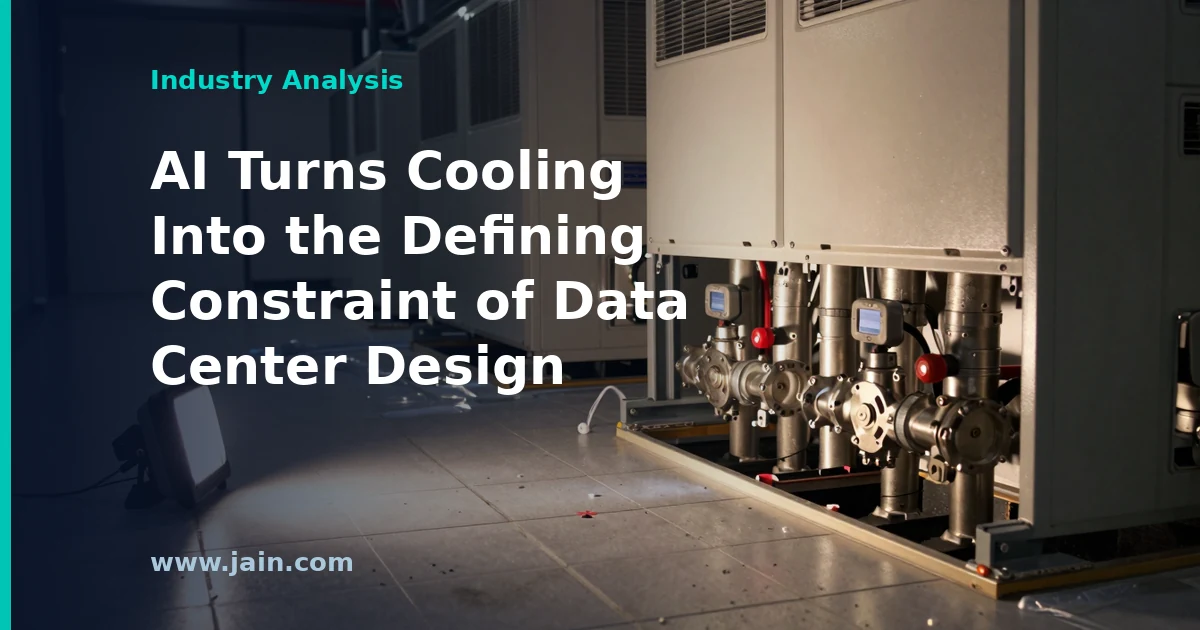
AI accelerators concentrate enormous computation — and therefore heat — into small spaces. Racks that once drew power in the single-digit kilowatts have given way to AI clusters drawing an order of magnitude more, and air cooling becomes physically impractical at those densities. The industry’s answer is liquid cooling: circulating coolant directly to chips or immersing hardware entirely, because liquids carry heat far more efficiently than air.
Retrofitting liquid cooling into a facility designed for air is expensive and disruptive — new piping, new heat-rejection equipment, reinforced floors, redesigned electrical distribution. That is what makes this a ground-up redesign rather than an upgrade cycle: much of the world’s existing data center stock was simply not built for what AI hardware now requires. New builds can be purpose-designed; legacy facilities face hard choices between costly conversion and serving the workloads they were built for.
Winners, Losers, and the Retrofit Divide
The redesign wave creates clear beneficiaries: liquid-cooling specialists, electrical-equipment manufacturers, builders of on-site generation and battery storage, and operators with new, high-density-capable campuses. Utilities in data-center-heavy regions gain large, creditworthy customers — along with political scrutiny over who pays for grid upgrades and how large loads affect residential rates.
The pressure falls on owners of older facilities and on markets where power is constrained. A bifurcation is plausible: purpose-built AI campuses commanding premium economics, while conventional facilities compete in the lower-growth market for traditional enterprise workloads. For the broader industry, the open question is pacing — whether power delivery, equipment supply chains, and skilled construction labor can scale as fast as AI demand projections assume, and what happens to capital deployed against those projections if demand growth moderates.
What It Means for Buyers of Capacity
Enterprises buying colocation or cloud capacity should read this as a warning about lead times and pricing. When power is the bottleneck, capacity in constrained markets gets scarcer and more expensive, and delivery dates slip to match utility timelines rather than construction schedules. Buyers planning AI deployments should ask providers pointed questions: how much power is actually contracted (not just applied for), what rack densities the facility supports today, and whether liquid cooling is installed or merely on a roadmap. The gap between a marketing deck and an energized megawatt is where AI projects stall.
Background
For most of the 2010s, data centers evolved gradually around predictable enterprise and cloud workloads, with racks drawing modest power and air cooling as the near-universal standard. The generative AI boom that began in late 2022 broke that pattern: training and serving large AI models requires dense clusters of accelerator chips whose power draw and heat output far exceed what conventional facilities were designed to handle. Since then, hyperscalers and data center developers have announced successive waves of AI-focused capacity, and the industry’s public conversation has shifted from square footage to megawatts — with power procurement, cooling technology, and grid constraints emerging as the defining issues of the buildout. Bloomberg’s May 2026 feature places that redesign race in front of a mainstream financial audience.
Data Center Dynamics has published a comparison of the two competing approaches to direct-to-chip liquid cooling — single-phase, where a liquid coolant absorbs heat and stays liquid, and two-phase, where the coolant boils at the chip and carries heat away as vapor — framed around a single question: which is right for AI data centers in 2026?
That the trade press is treating this as a live, unsettled debate is itself the news. As AI accelerators push per-chip power beyond what air can remove, direct-to-chip liquid cooling has moved from exotic to expected, and the industry has not yet converged on which of the two variants will define the next generation of facilities.
Executive Summary
Direct-to-chip liquid cooling puts a cold plate in contact with the processor and runs coolant through it, removing heat far more efficiently than blowing air across a heatsink. Within that category, two architectures are competing. Single-phase systems circulate a liquid — typically treated water or a water-glycol mix — that warms up as it passes over the chip and is cooled elsewhere. Two-phase systems use an engineered dielectric fluid that boils directly on the cold plate; the phase change from liquid to vapor absorbs a large amount of heat at a nearly constant temperature, and the vapor is condensed back to liquid to repeat the cycle.
The choice matters because it is not easily reversible. Coolant chemistry, pressure ratings, manifolds, coolant distribution units, and facility water loops are all designed around one approach or the other. An operator committing today to a multi-hundred-megawatt AI campus is effectively placing a bet on which architecture will best handle the chips of 2028 and beyond — and on which supply chain, service model, and regulatory environment will mature fastest.
The DCD piece lands at the moment this bet has become unavoidable. Air cooling handled decades of servers; single-phase liquid is handling today’s AI racks; the open question is whether tomorrow’s thermal densities force the industry through a second transition to two-phase — or whether single-phase engineering keeps stretching to meet the need.
Why the Question Exists at All
For most of computing history, this debate would have been academic. Air cooling was cheap, well understood, and sufficient. AI training hardware broke that equilibrium: modern accelerators concentrate so much power in so little silicon that the limiting factor is no longer the data center’s chillers but the last few millimeters between the chip surface and the coolant. Direct-to-chip designs attack exactly that bottleneck, which is why they have become the default assumption for new AI builds.
Single-phase direct-to-chip won the first round largely on familiarity. Water-based cooling loops are a known quantity — data center engineers, plumbers, and component suppliers have decades of experience with pumps, valves, and leak management for liquid water. Two-phase systems promise something physically compelling in exchange for novelty: boiling a fluid absorbs latent heat, meaning the coolant can soak up substantially more energy without a large temperature rise, and it does so uniformly across the hottest parts of the chip.
The Engineering Trade-Offs, Plainly Stated
Single-phase’s strengths are operational. The fluids are inexpensive and benign, the components are commodity, leaks are messy but manageable, and the industry’s existing skills transfer directly. Its weakness is headroom: as chips run hotter, single-phase designs must push more liquid, faster, through smaller channels, and must manage the temperature gradient across the cold plate — the chip’s inlet edge runs cooler than its outlet edge, which complicates thermal design as power climbs.
Two-phase inverts that profile. Boiling heat transfer offers high performance and near-isothermal operation — the whole cold plate sits close to the fluid’s boiling point — which is attractive precisely where single-phase strains. But the costs are real: engineered dielectric fluids are far more expensive than water, systems must manage vapor and pressure rather than simple liquid flow, servicing a sealed two-phase loop is a different discipline, and several candidate fluids belong to chemical families (such as PFAS-related compounds) facing regulatory scrutiny in major markets. A technically superior heat-transfer mechanism does not automatically win if its fluid supply or compliance picture is uncertain.
Who Wins and Loses on Each Path
If single-phase continues to stretch, the winners are incumbents: established cooling vendors, existing supply chains, and operators who have already deployed water-based loops and want continuity. Chip designers absorb more of the burden, engineering packages and cold plates to live within single-phase limits. If two-phase becomes necessary, the advantage shifts toward specialist fluid and systems companies, and toward operators willing to build new competencies early — with the corresponding risk of backing immature technology.
There is also a middle path worth naming: hybrid facilities, where single-phase handles the bulk of the load and two-phase (or other advanced techniques) is reserved for the hottest components or highest-density halls. Many operators will likely hedge this way rather than commit wholesale, which suggests the 2026 answer to “which is right?” may genuinely be “both, in different places” — an unsatisfying but rational outcome for an industry making thirty-year infrastructure bets on three-year chip roadmaps.
What This Means for the Broader Market
The cooling decision cascades outward. Coolant choice affects how much heat a facility can reject to the outside world and at what temperature, which shapes heat-reuse opportunities and water consumption. It affects colocation providers, who must decide which architecture to offer tenants whose hardware they do not control. And it affects the retrofit market: the vast installed base of air-cooled data centers faces different conversion economics depending on which liquid architecture prevails. Standardization efforts — common connectors, fluid specifications, and safety practices — will matter as much as raw thermal performance in determining which camp scales fastest.
Background
Data centers spent decades cooled almost entirely by air: chilled air pushed through raised floors and hot aisles, with per-rack power low enough that fans and heatsinks sufficed. The AI buildout broke that model. Training clusters pack accelerators drawing unprecedented power into dense racks, pushing the industry through its biggest thermal transition since the mainframe era — first to rear-door heat exchangers and now to liquid brought directly to the chip.
Data Center Dynamics, the publication behind this comparison, is a long-running trade outlet covering data center design and operations. That its editorial attention has moved from whether to liquid-cool to which liquid architecture to choose reflects how quickly direct-to-chip cooling has become the baseline assumption for AI infrastructure — and how much unresolved engineering debate still sits beneath that baseline.
An analysis published by Data Center Frontier on May 22, 2026 argues that the rise of AI workloads is reshaping how data center operators define and manage risk, moving the conversation beyond the long-standing focus on uptime toward a broader notion of resilience that spans power, cooling, network, and workload recovery.
Executive Summary
The piece reframes a debate that has quietly been building for several years. For decades, the data center industry benchmarked itself on uptime — the percentage of time facilities remained available, typically measured against Uptime Institute tier definitions. AI training and inference workloads, with their concentrated power draw, thermal density, and tightly coupled cluster behavior, expose the limits of that single metric.
Why it matters: buyers of colocation and cloud capacity have historically negotiated on service-level agreements built around availability. If the operative risk is now cluster-level disruption, cooling excursions, or grid interaction rather than isolated component failure, the contracts, insurance, and design standards that underpin the industry will need to evolve alongside the hardware.
Uptime Was Built for a Different Workload
The uptime-first mindset was calibrated for enterprise and early cloud workloads: many independent servers, stateless front ends, and applications that tolerated the loss of a node without disrupting the service. A five-nines facility (99.999 percent availability, roughly five minutes of downtime a year) was a defensible proxy for customer experience because software above it was designed to route around small failures.
AI training clusters behave differently. A single training job may span thousands of GPUs (graphics processing units, the specialized chips that do the heavy math for AI models) synchronized on every step. A brief power event, a cooling excursion, or a network partition can force a checkpoint restart that costs hours of compute and, at current GPU rental rates, meaningful money. Availability at the facility level says little about whether the job actually finishes.
Resilience Is a Wider Surface
Resilience, as the source frames it, is a superset of uptime. It includes how quickly a site can ride through a grid disturbance, whether liquid cooling loops degrade gracefully under partial failure, how the network fabric behaves when a spine switch drops, and how workloads are checkpointed so that a disruption does not erase a day of training. Each of those is a distinct engineering discipline, and each has its own vendors, standards, and blind spots.
That widening surface also expands who bears the risk. Uptime SLAs put the operator on the hook for a narrow, well-defined failure mode. Resilience, by contrast, is a shared problem: the utility, the operator, the cooling vendor, the network provider, and the customer’s own software all shape whether a workload survives a bad afternoon. Contract structures have not caught up.
What Changes for Buyers and Operators
For operators, the practical implication is that design margins that looked conservative in a CPU-era facility can look thin under AI density. Rack power draws that used to sit in the 5 to 15 kilowatt range are now routinely quoted in the tens to over a hundred kilowatts per rack for GPU deployments, which stresses power distribution, cooling headroom, and the assumptions baked into concurrent maintainability. Retrofitting a legacy hall is not always cheaper than greenfield.
For buyers, the negotiation should widen. Beyond the availability guarantee, questions worth asking include how the site responds to grid frequency events, how cooling redundancy is validated under load rather than at commissioning, what the network’s failure domains look like, and whether the operator can produce evidence — not just design documents — of resilience under stress. None of this makes uptime irrelevant; it just makes uptime insufficient.
Background
The data center industry has organized itself for decades around the Uptime Institute’s tier system, which rates facilities from Tier I to Tier IV based on redundancy and concurrent maintainability. That framework, alongside vendor SLAs measured in nines of availability, became the common vocabulary for negotiating colocation and cloud contracts.
The rapid buildout of AI training and inference capacity from roughly 2023 onward has introduced rack densities, power profiles, and workload behaviors that the tier framework was not designed around. Industry publications including Data Center Frontier have been tracking the resulting rethink of design standards, power procurement, and cooling architecture.
CoreWeave, the AI-focused cloud provider, published a piece titled “Liquid Cooling for AI Data Centers: Run Cold, Act Bold,” making the argument that liquid cooling — circulating fluid directly to or near the chips rather than relying on chilled air — should be treated as the default engineering choice for dense AI training and inference clusters, not a specialty option.
The post, surfaced in early May 2026, is a vendor thought-leadership piece rather than a product or facility announcement: no new sites, capacity figures, or customer commitments accompany it. Its significance lies in who is saying it — one of the largest dedicated AI cloud operators publicly framing liquid cooling as table stakes.
Executive Summary
The core claim is architectural: modern AI accelerators are being packed into racks at power densities that air cooling struggles to serve economically, so operators who standardize on liquid cooling now will deploy the newest hardware faster and run it more efficiently than those who retrofit later. That position aligns with the direction of the hardware itself — flagship AI rack systems from the leading accelerator vendors are increasingly designed around liquid cooling from the outset.
Why it matters: cooling has quietly become one of the binding constraints on AI buildout, alongside power availability and chip supply. A data center designed for traditional air-cooled racks often cannot accept the densest AI systems without significant rework of its mechanical plant, piping, and floor layout. When a major AI cloud provider says liquid cooling is the default, it is effectively telling the colocation and construction ecosystem what the demand side now expects.
For buyers and investors, the practical takeaway is less about CoreWeave specifically and more about the signal: the market for AI capacity is bifurcating between facilities that can support liquid-cooled density and those that cannot, and the gap affects deployment speed, efficiency, and ultimately the cost of delivered compute.
Why Cooling Became the Bottleneck
For most of the data center industry’s history, air cooling was sufficient: racks drew a few kilowatts, and moving enough cold air through the room was a solved problem. AI changed the arithmetic. Training clusters concentrate power-hungry accelerators as tightly as possible to shorten the distances data travels between chips, because interconnect latency and bandwidth directly affect training performance. That pushes rack densities far beyond what conventional air handling was designed for, and at some point the physics favors liquid — water and engineered fluids carry heat far more effectively than air.
CoreWeave’s framing of liquid cooling as a default rather than an exception reflects where the hardware roadmap already points. The densest current-generation AI rack systems are engineered for direct liquid cooling, meaning operators who want the newest silicon at full density have limited choice. In that sense the post is less a prediction than a description of a constraint the industry is already living with — but stating it as doctrine matters, because much of the world’s existing data center stock was not built for it.
The Economics: Efficiency Versus Retrofit Cost
The business case for liquid cooling rests on two ledgers. On the operating side, liquid systems can reduce the energy spent on cooling itself — a meaningful lever, since cooling is typically one of the largest non-IT loads in a facility, and every watt saved on cooling is a watt available for revenue-generating compute in power-constrained markets. On the capital side, however, liquid cooling requires piping, coolant distribution units, leak management, and often structural changes, which is straightforward in a new build and expensive in a retrofit.
That asymmetry is the strategic subtext of a piece like this. Operators that standardized early on liquid-ready designs can absorb each new accelerator generation with incremental changes; operators with large air-cooled footprints face a harder choice between costly conversion and ceding the densest workloads. CoreWeave, which built its business specifically around GPU infrastructure for AI, has an obvious interest in emphasizing a criterion where purpose-built AI clouds hold an advantage over general-purpose incumbents — which does not make the underlying engineering argument wrong, but readers should recognize the alignment between the message and the messenger.
Winners, Losers, and the Supply Chain Ripple
If liquid cooling is the default, the beneficiaries extend well beyond AI clouds. Suppliers of coolant distribution units, cold plates, piping, and heat-rejection equipment see their addressable market expand from a niche to a standard line item in every AI facility. Colocation providers with liquid-ready halls gain pricing power for AI tenants; those without face pressure to invest. Engineering and construction firms with liquid-cooling experience become scarcer resources in an already stretched buildout.
The risk side deserves equal attention. Liquid cooling adds mechanical complexity — leaks, coolant chemistry, maintenance procedures — into environments that prize uptime above almost everything. Standardization across vendors is still maturing, which raises the possibility of stranded investment if designs shift between hardware generations. And efficiency gains at the rack level do not eliminate the larger constraint: many AI projects today are gated by grid power availability, a problem no cooling technology solves on its own.
Background
CoreWeave began as a cryptocurrency mining operation before pivoting to GPU cloud computing, and rode the generative AI boom to become one of the largest providers of dedicated AI infrastructure, going public in 2025. Its business model — building or leasing data centers purpose-designed for dense GPU clusters and renting that capacity to AI developers — makes facility engineering choices like cooling central to its competitive position.
The broader industry context: for decades, air cooling dominated data centers because rack power draws were modest. The AI era reversed that, with accelerator racks reaching power densities that favor liquid-based heat removal, and the latest flagship AI rack systems are designed for liquid cooling from the factory. That has turned cooling from a back-of-house mechanical detail into a strategic differentiator in the race to deploy AI capacity.
Data Center Knowledge reported on April 23, 2026 that cooling has moved to the forefront of data center design challenges, driven by the power density of AI computing. The trade publication’s framing captures a shift the industry has been living through: thermal management, once a back-of-house engineering detail, now shapes where facilities are built, how they are architected, and how quickly they can serve AI demand.
Executive Summary
The report’s core argument is structural rather than incremental: artificial intelligence has changed the physics of the data hall. Traditional enterprise servers could be cooled with chilled air pushed through raised floors and contained aisles. AI training and inference clusters concentrate far more electrical power — and therefore far more heat — into each rack than air can economically remove, forcing designers to treat heat rejection as a first-order constraint alongside power availability and land.
Why it matters: when cooling becomes the binding constraint, it stops being a line item and starts being a strategy. Choices between air, direct-to-chip liquid cooling (circulating coolant through cold plates mounted on processors), rear-door heat exchangers, and immersion systems now determine a facility’s compatibility with next-generation chips, its water and energy footprint, and its retrofit economics. Operators, colocation providers, and their customers are all repricing those decisions in real time.
When Air Runs Out of Headroom
Air cooling served the industry for decades because server heat loads were modest and evenly distributed. AI accelerators break that model: they pack extraordinary computation — and heat — into small silicon footprints, and operators deploy them in dense clusters to keep chip-to-chip communication fast. Past a certain density, moving enough air through a rack becomes physically impractical and economically punishing, because fan energy and airflow engineering costs rise steeply while cooling effectiveness plateaus.
Liquid is the natural successor because water and engineered coolants carry heat far more efficiently than air. But switching thermal mediums is not a component swap. It changes piping, floor loading, leak detection, maintenance procedures, and the skills a facilities team needs. That is why the trade press now describes cooling as a design challenge rather than an operations task: the decision has to be made before concrete is poured, and it constrains everything after.
The Retrofit Divide: Winners and Losers
The shift creates a two-tier market. New builds designed liquid-ready from day one can court the highest-value AI tenants. Older facilities — the majority of the world’s installed base — face a harder calculus: retrofitting liquid cooling into a live building is disruptive and expensive, but declining to retrofit risks ceding AI workloads entirely and competing for a shrinking pool of conventional enterprise demand.
The beneficiaries are visible across the supply chain: cooling equipment manufacturers, mechanical engineering firms, and colocation providers with modern, high-density-capable inventory. The squeezed parties are operators of legacy stock and, potentially, customers who signed long leases in facilities that cannot follow the density curve. For buyers of data center capacity, a facility’s thermal architecture is becoming as important a diligence question as its power contract.
Cooling as a Sustainability and Siting Question
Cooling choices also carry environmental and community consequences. Evaporative systems trade energy efficiency for water consumption — a sensitive issue in drought-prone regions where many data center clusters sit. Closed-loop liquid systems can reduce water draw and, in some designs, make waste heat recoverable for district heating or industrial reuse. As municipalities scrutinize data center growth, thermal design is increasingly part of the permitting and public-acceptance conversation, not just the engineering one.
That elevates cooling from a cost center to a siting variable. A design that minimizes water use or enables heat reuse can be the difference between a fast permit and a contested one — a dynamic worth watching as AI capacity expansion collides with local resource politics.
Background
For most of the industry’s history, data center design was governed by power and space, with cooling treated as a solved problem: chilled air, raised floors, and hot-aisle containment handled the modest, evenly distributed heat of enterprise servers. The AI buildout that accelerated after 2022 broke that assumption. Training and serving large models requires dense clusters of power-hungry accelerator chips, and each hardware generation has pushed per-rack heat loads further beyond what air-based systems were designed to handle.
The result has been a rapid industry pivot toward liquid-based thermal architectures — direct-to-chip cold plates, rear-door heat exchangers, and immersion systems — and a re-sorting of the market between facilities that can host high-density AI workloads and those that cannot. Trade coverage like this Data Center Knowledge report reflects a consensus that has hardened across operators, chipmakers, and engineers: cooling is no longer downstream of design; it is design.
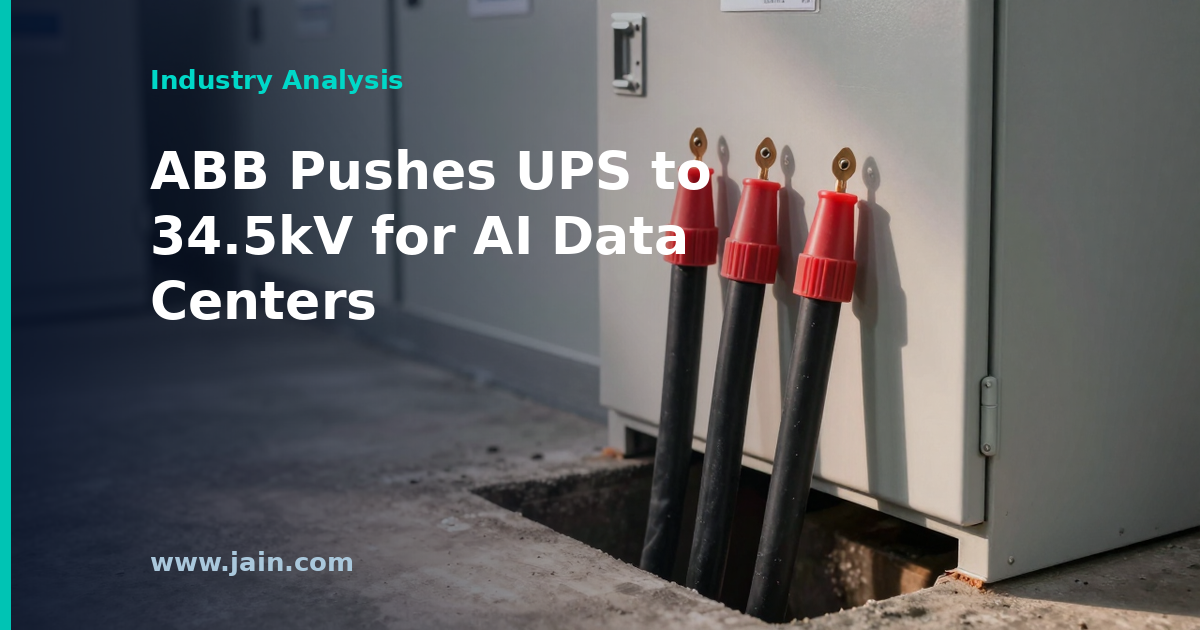
ABB has introduced a 34.5kV version of its HiPerGuard medium-voltage uninterruptible power supply, announced on 22 April 2026. The company positions the product as connecting directly to a medium-voltage grid feed, eliminating conversion steps between the utility connection and the data center’s power train, and says the result is lower power costs for AI data centers.
At 34.5kV, the unit sits at the top of the medium-voltage distribution class commonly used by North American utilities. The announcement is a product-capability disclosure rather than a customer deployment: the material published alongside the headline does not name sites, buyers, delivery dates or measured efficiency gains.
Executive Summary
An uninterruptible power supply is the equipment that keeps a data center’s servers running through a grid disturbance, bridging the seconds or minutes until generators take over. Conventionally, that equipment lives at low voltage — typically a few hundred volts — which means utility power arriving at medium voltage must first be stepped down through transformers, then protected, then distributed. Every one of those stages costs a percentage of the power passing through it, and each percentage becomes heat that must itself be cooled.
ABB’s claim with the 34.5kV HiPerGuard is that the UPS can sit further upstream, taking the medium-voltage feed directly and removing conversion stages from the chain. The commercial argument is straightforward: fewer stages mean fewer losses, less transformer and switchgear capacity to buy, and less floor space consumed by electrical rooms that could otherwise hold revenue-generating IT equipment.
The timing matters more than the voltage number. AI training and inference racks have moved from tens of kilowatts to the hundreds, with megawatt-scale racks on vendor roadmaps. At those densities the electrical distribution system, not the building shell, becomes the constraint. Medium-voltage UPS is one of several architectural responses to that constraint — and this announcement is a claim about a direction of travel that the released material does not yet quantify.
Voltage Is the New Density Lever
Power density in data centers has historically been solved by moving air and water more cleverly. That era is ending. When a single rack draws hundreds of kilowatts, the limiting factor shifts to how much current the distribution system can carry without unmanageable conductor sizes, losses and fault energy. Physics is unhelpful here: for a given amount of power, halving current requires doubling voltage, and copper cost and resistive loss scale with current, not with power.
Raising the voltage at which protected power is handled is therefore one of the few structural levers available. Doing it at the UPS means the medium-voltage feed can travel deeper into the facility before being stepped down close to the load, shortening the low-voltage runs that dominate conductor spend. It also compresses the equipment chain: each transformation stage carries its own footprint, maintenance regime, failure modes and efficiency penalty. Removing stages removes all four at once.
The counterpoint worth stating plainly is that this is a re-architecture, not a component swap. Medium-voltage equipment brings different clearance requirements, different arc-flash considerations, different qualification standards for the technicians who work on it, and a smaller pool of contractors able to commission it. Operators who adopt it are trading one set of engineering problems for another, and the trade only pays at scale.
Where the Savings Actually Come From
The headline frames the benefit as lower power costs. In a data center’s cost structure, electrical losses are compounded rather than linear: a watt lost in a transformer or rectifier is a watt bought from the utility and also a watt of heat that the cooling plant must remove, at further energy cost. Small efficiency percentages at the front of the power chain therefore multiply through the operating budget over a facility life measured in decades.
The capital side may matter as much. Eliminating conversion stages means fewer step-down transformers, less associated switchgear, and less electrical room area — space that, in a market where construction timelines and grid connections are the binding constraints, converts directly into deployable IT capacity per site. For operators who cannot get more megawatts from their utility, extracting more usable compute from the megawatts already contracted is the highest-value optimization available.
None of that is quantified in the material accompanying this announcement. There is no published efficiency figure, no comparison baseline, no total-cost-of-ownership model and no pricing. The mechanism ABB describes is sound engineering and widely understood in the industry; the specific magnitude of the benefit is, on the evidence released so far, an assertion rather than a demonstrated result. Buyers should treat it accordingly and ask for the numbers.
A Crowded Answer to a Real Problem
ABB is not alone in reading the AI power problem this way. Medium-voltage UPS lines, solid-state transformer research, and the broader industry push toward higher-voltage direct-current distribution inside the rack are all attacking the same bottleneck from different points in the chain. Chip and system vendors have been pushing rack-level power architectures upward in voltage for similar reasons. These approaches are complementary rather than mutually exclusive — a facility could plausibly take medium voltage deep into the hall and then distribute at high-voltage DC to the racks.
The likely winners are hyperscale and large colocation operators building new capacity, where greenfield design allows the electrical architecture to be chosen rather than retrofitted, and where volume justifies training staff on medium-voltage practice. The likely losers are smaller enterprise sites and retrofit projects, which carry the complexity without the scale to amortize it. For ABB, the strategic value is defending a position in the electrification supply chain against competitors selling into the same buildings.
The risk to watch is supply chain rather than technology. Medium-voltage switchgear, transformers and related equipment have been in constrained supply across the electrical industry, with lead times that already shape data center schedules. A product that reduces the count of such components could ease that pressure; one that simply relocates demand to a differently scarce component would not. The announcement does not address lead times or manufacturing capacity.
Background
ABB is a long-established electrification and automation supplier whose portfolio spans switchgear, transformers, drives and power protection. Its HiPerGuard line is a medium-voltage UPS family aimed at large industrial and data center loads, positioned against the conventional approach of stepping utility power down to low voltage before it reaches protection equipment.
The market context is the rapid escalation of data center power requirements driven by AI workloads. As rack densities climb, operators face constrained utility connections, long grid interconnection queues and shortages of electrical equipment. That has pushed power architecture — historically a settled part of data center design — back into active competition among vendors, with voltage levels, conversion topologies and distribution schemes all under reconsideration.