Johnson Controls announced on May 5, 2026 the release of its second data center reference design guide, aimed at advancing cooling for industrial-scale AI factories — the very large, GPU-dense data centers built to train and run artificial intelligence models. The guide follows the company’s earlier reference design publication and continues its effort to give data center developers pre-engineered, repeatable cooling blueprints rather than one-off custom designs.
Executive Summary
The announcement itself is straightforward: a major cooling and building-technology vendor has published a second installment in a series of reference design guides for AI data center thermal management. A reference design, in this context, is a validated engineering template — equipment selections, piping and airflow topologies, controls logic — that a developer can adopt largely as-is instead of engineering a cooling plant from scratch for every project.
Why it matters is the industry moment. AI computing has pushed rack power densities far beyond what traditional air cooling handles economically, forcing a rapid shift to liquid cooling. That shift has collided with a shortage of engineers who have actually designed liquid-cooled facilities at scale. Vendors who can package proven designs stand to compress project timelines and, not incidentally, lock their own equipment into the template. Johnson Controls publishing a second guide signals both that the first found an audience and that the company sees standardized, productized cooling design as a durable competitive front — not a one-off marketing exercise.
Reference Designs Are the Industry’s Answer to a Speed Problem
The binding constraints on AI data center construction are power, equipment lead times, and engineering hours — in roughly that order. Every hyperscaler and colocation developer is trying to shorten the time from land acquisition to energized racks, and bespoke mechanical design is one of the slowest, most error-prone stages. A reference design guide attacks that stage directly: if the cooling plant is pre-engineered and pre-validated, developers can order long-lead equipment earlier, permit faster, and reuse the same design across multiple sites.
This mirrors what happened in earlier infrastructure waves. Hyperscale data centers of the 2010s converged on repeatable electrical and mechanical templates, which is a large part of how build times fell even as facilities grew. AI factories reset that progress because liquid cooling — circulating fluid directly to chips or to rear-door heat exchangers instead of relying on chilled air — changed the entire mechanical architecture. Reference designs are how the industry rebuilds its muscle memory for the new architecture.
Standardization Is Also a Land Grab
A vendor-published reference design is not a neutral standard. It is a template built around the publisher’s own chillers, coolant distribution units, controls, and services. If a developer adopts the guide, Johnson Controls equipment becomes the default bill of materials, and switching components later means re-validating the design. That is the same playbook chip vendors use with their own data center reference architectures: publish the blueprint, become the default.
Seen that way, a second guide is a competitive statement aimed at the other large thermal players — the established chiller and precision-cooling manufacturers all racing to publish AI-ready architectures — and at engineering firms whose custom-design business a good-enough template partially displaces. For buyers, the trade-off is real but usually favorable: some vendor lock-in in exchange for schedule certainty and a design someone else has already de-risked. The buyers with the least to gain are those with strong in-house engineering; the biggest beneficiaries are the second wave of AI data center developers — enterprises, sovereign projects, smaller colocation firms — who lack liquid-cooling experience entirely.
What a Guide Can and Cannot Prove
It is worth being clear-eyed about what a design document demonstrates. Publishing a guide shows engineering investment and market intent; it does not by itself prove field performance, energy efficiency, or delivery capacity at the scale AI factories demand. The metrics that ultimately matter — cooling capacity per megawatt, water and energy consumption, equipment lead times, uptime in operation — are established by built projects, not publications. The announcement, as reported, is a step in productizing AI cooling; the evidence of success will be reference customers and operating facilities that used the designs. That is not a criticism of the release so much as the correct lens for reading any vendor reference architecture.
Background
Johnson Controls traces its history to the 19th-century invention of the room thermostat and has grown into one of the world’s largest building-technology companies, spanning HVAC equipment, industrial chillers, controls, and services. Over the past several years it has leaned hard into data centers as a growth market, positioning its chiller lines, coolant distribution equipment, and controls for the AI buildout.
The market context is a structural shift: the AI boom has driven rack power densities beyond air cooling’s practical limits, making liquid cooling a requirement rather than a niche option and setting off a race among thermal-management vendors to publish standardized, repeatable designs. Reference architectures — long a fixture in chip and server ecosystems — have become the mechanism through which cooling vendors compete to define how AI factories get built.
Trade publication Data Center Knowledge reported on May 1, 2026 that cooling capability is failing to keep pace with the power density of AI computing hardware in data centers. The report frames a problem now visible across the industry: racks packed with AI accelerators draw far more power — and therefore shed far more heat — than the air-cooled infrastructure most facilities were built around, turning thermal management into a gating factor for AI capacity.
Executive Summary
The core claim is simple but consequential: the heat produced by AI hardware is rising faster than the industry’s ability to remove it. Every watt a server consumes becomes heat that must be carried away, and conventional data centers were engineered for racks drawing modest single-digit to low-double-digit kilowatts. Dense AI training clusters concentrate an order of magnitude more power in the same floor space, pushing air-based cooling — fans, raised floors, and computer-room air handlers — toward its physical limits.
Why it matters: if cooling cannot keep up, it does not matter how many GPUs a company can buy or how much grid power a site can secure. Thermal capacity becomes the binding constraint on AI deployment schedules. That reality is forcing a generational transition toward liquid cooling — circulating coolant directly to chips or immersing hardware in fluid — and it is reshaping how facilities are designed, financed, and leased.
Heat Is the Hard Ceiling, Not Power or Chips
The AI buildout has been narrated mostly as a race for GPUs and grid connections, but this report points at the quieter bottleneck between them: getting heat out of the building. Air cooling works by moving enormous volumes of chilled air past hot components, and its effectiveness falls off sharply as power concentrates. Past a certain rack density, no arrangement of fans and airflow containment can remove heat as fast as modern accelerators generate it. Liquid, which carries heat far more efficiently than air, becomes a physical necessity rather than an optimization.
That distinction matters for planning. Power shortages can sometimes be solved with money and patience — new substations, on-site generation. Thermal limits are baked into a building’s design: pipe runs, floor loading, chilled-water plant capacity, and the space between racks. A facility designed for air cooling cannot simply be told to run hotter.
The Retrofit Problem: Old Buildings, New Physics
The industry’s installed base is the crux of the struggle the report describes. Most operating data centers were designed years before dense AI clusters existed. Retrofitting them for direct-to-chip liquid cooling means adding coolant distribution units, leak detection, new piping, and often structural work — all while existing tenants keep running. That is slow, expensive, and disruptive, which is why much of the highest-density AI capacity is going into purpose-built greenfield facilities instead.
The economic consequence is a widening split in the market. Modern, liquid-ready capacity commands premium pricing and pre-leases quickly, while older air-cooled facilities risk sliding toward commodity workloads. For operators, the question is no longer whether to invest in liquid cooling but how much of the existing portfolio is worth converting versus running out its useful life on conventional enterprise and cloud workloads.
Winners, Losers, and the Supply Chain in Between
A constraint this fundamental redistributes value. Suppliers of liquid-cooling hardware — cold plates, coolant distribution units, immersion systems, heat exchangers — and the engineering firms that integrate them stand to benefit from a multi-year upgrade cycle. Chipmakers are increasingly designing accelerators that assume liquid cooling, which pulls the whole ecosystem along. Operators with liquid-ready designs and available power gain leverage in lease negotiations with AI tenants who have few alternatives.
The losers are less obvious but real: enterprises and smaller cloud providers holding long leases in facilities that cannot economically support high-density deployments, and AI projects whose timelines quietly slip because the cooling plant — not the chips — is the long-lead item. For buyers of AI capacity, thermal specifications are becoming as important a diligence item as price per kilowatt.
Background
For most of the industry’s history, data centers were cooled by air: chilled air pushed through raised floors and aisles past servers drawing a few kilowatts per rack. That model scaled comfortably through the enterprise and cloud eras. The AI boom broke the pattern — training clusters built on power-hungry accelerators concentrate an order of magnitude more power per rack, and the industry has responded with a generational shift toward liquid cooling, a technique long used in supercomputing but new at commercial scale.
By early 2026, the constraint conversation around AI infrastructure had expanded from chip supply to grid power and, increasingly, to thermal capacity — the subject of this report. Cooling now sits alongside power procurement as a first-order determinant of where and how fast AI capacity gets built.
Veolia, one of the world’s largest water and environmental services companies, announced on April 27, 2026 that it is working with Amazon to develop a reclaimed-water cooling system for data centers. The collaboration targets Amazon Web Services (AWS) facilities, aiming to substitute treated, recycled water for the potable water that many data centers currently draw for cooling.
Executive Summary
The announcement pairs the operator of some of the world’s largest water-treatment networks with the world’s largest cloud provider on one of the industry’s most scrutinized problems: how much drinking-quality water data centers consume to stay cool. Reclaimed water — wastewater that has been treated to a standard fit for industrial reuse, though not for drinking — can displace that potable draw, easing pressure on municipal supplies in the communities where hyperscale campuses cluster.
For Amazon, the partnership supports its publicly stated goal of becoming “water positive” by 2030 — returning more water to communities than its operations consume — and, just as practically, it addresses a growing source of friction in siting and permitting new capacity. For Veolia, it signals a move to position water expertise as core infrastructure for the AI-era data center buildout. The release, however, is light on specifics: no named sites, volumes, timelines, or financial terms were disclosed.
Why Water Is the Data Center Industry’s Quiet Constraint
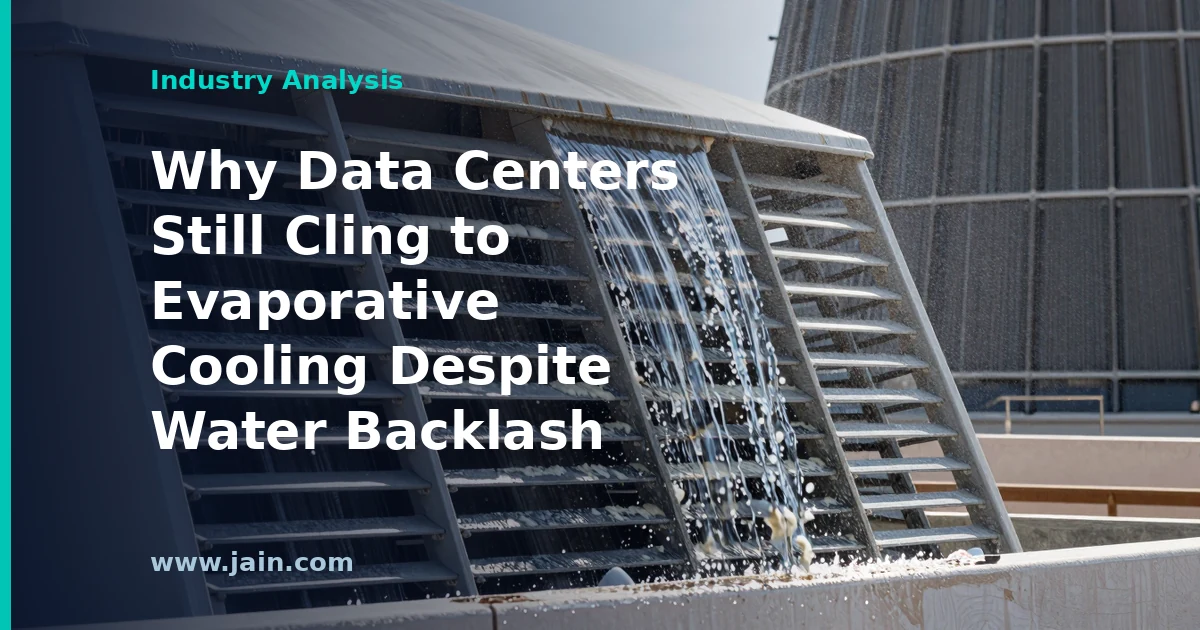
Power gets most of the headlines, but water is increasingly the constraint that shapes where data centers can be built. Many large facilities use evaporative cooling, which chills servers efficiently by evaporating water — often millions of gallons per year per site, much of it drawn from the same municipal systems that supply homes. In drought-prone regions, that draw has become a genuine permitting and community-relations issue, with local opposition to new campuses increasingly citing water alongside electricity and land.
The industry measures this through water usage effectiveness (WUE) — water consumed per unit of computing energy delivered — and operators face growing pressure from regulators, investors, and neighbors to disclose and reduce it. A credible, scalable alternative to potable water is therefore worth real money: it can be the difference between a project that clears local approval and one that stalls.
What Reclaimed Water Solves — and What It Doesn’t
Reclaimed water is municipal or industrial wastewater treated to a quality suitable for non-potable uses such as irrigation and industrial cooling. Using it for data center cooling substitutes a resource that would otherwise be discharged for one that communities drink. That is a genuine improvement, and it is proven ground: power plants and heavy industry have run on recycled water for decades. The engineering challenge is real but tractable — reclaimed water’s chemistry can promote scaling, corrosion, and biological growth in cooling loops, which is precisely the treatment problem a company like Veolia exists to solve, along with the pipeline infrastructure needed to move recycled water from treatment plants to campuses.
What reclaimed water does not do is reduce total water consumption. Evaporative cooling still evaporates the water, whatever its source. It changes which water is used, not how much — a meaningful distinction in water-stressed basins, where hydrologists note that treated wastewater returned to rivers also supports downstream flows. The release, as summarized, does not address consumption volumes or how the system compares with closed-loop and other low-water designs.
The Strategic Logic for Both Sides
For Veolia, hyperscale data centers represent a growth market adjacent to its core business: the company already operates treatment plants and industrial-water services worldwide, and packaging that capability for cloud providers moves it up the value chain from utility contractor to strategic infrastructure partner in the AI buildout. A named relationship with Amazon is also a powerful reference for selling similar systems to other operators.
For Amazon, the calculus spans sustainability accounting and siting pragmatism. Progress toward its water-positive pledge requires exactly this kind of substitution at scale, and demonstrating a reclaimed-water pathway gives AWS a stronger story in front of the councils and water authorities that approve new capacity. If the partnership produces a repeatable template rather than a single showcase, it could modestly widen the map of viable data center locations — and put competitive pressure on other hyperscalers, some of which have taken the different route of designs that eliminate evaporative water use entirely.
Background
Data center water use moved from an engineering footnote to a public issue over the past several years, as hyperscale construction accelerated to serve cloud and AI demand and communities in water-stressed regions began scrutinizing how much potable water evaporative cooling consumes. The major cloud providers have responded with public commitments — Amazon’s is a pledge to be water positive by 2030 — and with a mix of recycled-water sourcing, more efficient cooling designs, and replenishment projects.
Veolia, formed from more than a century of French municipal water operations and now one of the world’s largest environmental-services groups, has built its industrial business on exactly this kind of problem: treating and delivering non-potable water for cooling and process use. The April 2026 announcement extends that franchise into hyperscale computing, an infrastructure market whose growth currently outpaces most of the industrial sectors Veolia has traditionally served.
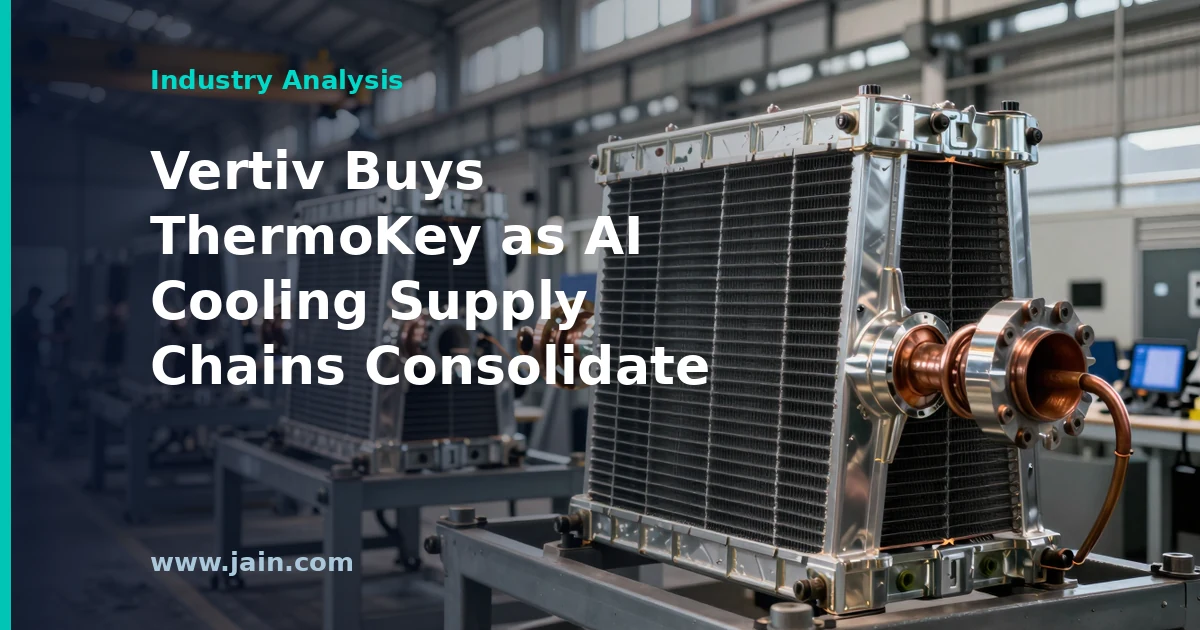
Vertiv, one of the largest suppliers of data center power and cooling infrastructure, has acquired Strategic Thermal Labs, a liquid cooling vendor, according to an April 26, 2026 report from Channel Dive. Financial terms and the scale of the target were not disclosed in the report.
The deal adds another liquid cooling specialist to Vertiv’s thermal management portfolio at a moment when AI computing is pushing rack power densities beyond what conventional air cooling can practically handle.
Executive Summary
The announcement itself is brief: Vertiv has bought a liquid cooling company. But the context is what matters. Liquid cooling — circulating fluid directly to hot components, or immersing hardware in it, rather than blowing chilled air across servers — has moved in just a few years from a niche technique to a central requirement for AI data centers. Racks built for AI accelerators draw many times the power of traditional enterprise racks, and the heat they produce increasingly exceeds what air can remove economically, or at all.
Vertiv has been assembling liquid cooling capability for years, and its largest competitors have been doing the same through their own acquisitions. Strategic Thermal Labs is the latest specialist to be absorbed into a major platform. For data center operators, the pattern points toward a market where liquid cooling is sold as part of an integrated infrastructure stack — power, racks, coolant distribution, and heat rejection from one vendor — rather than as a standalone specialty product.
What the report does not tell us is significant: no purchase price, no revenue or headcount figures for Strategic Thermal Labs, and no detail on which products or technologies motivated the deal. The strategic logic is clear; the economics are not yet visible.
Why Liquid Cooling Became a Must-Own Technology
For decades, data centers were cooled almost entirely by air: chillers and air handlers pushed cold air to server intakes and carried the exhaust heat away. That model works well when each rack draws modest power. AI changes the arithmetic. Racks packed with GPUs and other accelerators concentrate far more power — and therefore far more heat — into the same physical footprint, and at the densities modern AI hardware demands, air cooling becomes inefficient, then impractical.
Liquid is a far better heat conductor than air, which is why the industry has shifted toward direct-to-chip cold plates (metal plates with fluid channels mounted on processors) and, in some designs, full immersion cooling. Chip roadmaps from the major accelerator vendors increasingly assume liquid cooling as the default, meaning every serious data center infrastructure supplier needs credible liquid cooling products to stay relevant in AI buildouts. That makes specialist firms with proven technology natural acquisition targets.
Consolidation Follows the Thermal Money
This acquisition fits an established pattern rather than starting a new one. Vertiv previously bought coolant distribution specialist CoolTera to strengthen its liquid cooling line. Rival Schneider Electric acquired liquid cooling maker Motivair; electronics manufacturer Flex bought cold-plate specialist JetCool. The large infrastructure platforms are racing to own the full thermal chain — from the cold plate on the chip, through coolant distribution units, to the heat rejection equipment outside the building — because hyperscale and colocation customers increasingly want that chain engineered and warrantied as one system.
For the remaining independent liquid cooling vendors, consolidation cuts both ways. Acquisition interest validates their technology and offers a path to scale manufacturing quickly. But competing against integrated giants for large AI projects becomes harder, since those buyers value single-vendor accountability when a cooling failure can idle tens of millions of dollars of computing hardware. The likely trajectory is a market with a handful of full-stack thermal platforms and a shrinking field of independents serving specialized niches.
What Vertiv Gains — and What Remains Unproven
For Vertiv, the strategic appeal of bolt-on liquid cooling acquisitions is straightforward: they can add engineering talent, patents, and product lines faster than internal development, in a market where speed matters because AI capacity is being contracted years ahead. Thermal management is also attractive business territory — it is specified early in a data center’s design and generates ongoing service revenue over the facility’s life.
That said, the report substantiates very little beyond the fact of the deal. Without disclosed terms or information about Strategic Thermal Labs’ size, technology focus, or customer base, it is impossible to judge whether this is a significant capability acquisition or a small technology and talent tuck-in. Acquisitions in fast-moving hardware categories also carry integration risk: specialist engineering teams do not always thrive inside large product organizations, and overlapping product lines can create rationalization decisions that unsettle existing customers. Those are open questions, not criticisms — but they are the questions on which the deal’s value will ultimately turn.
Background
Vertiv traces its roots to Emerson Network Power, the data center infrastructure arm of Emerson Electric, which was spun off and renamed Vertiv in 2016. The company supplies the physical backbone of data centers — uninterruptible power supplies, power distribution, racks, and thermal management — and has ridden the AI infrastructure boom as one of its most direct beneficiaries, since every megawatt of new AI computing requires matching power and cooling equipment.
The liquid cooling market it is buying into has grown rapidly alongside AI deployment. A field once dominated by small specialists serving supercomputing labs is consolidating quickly as hyperscale AI buildouts turn liquid cooling into mainstream, high-volume business — a shift that has made those specialists prime acquisition targets for infrastructure giants like Vertiv, Schneider Electric, and large electronics manufacturers.
Keppel and Shell will launch an immersion cooling pilot at a data center in Singapore, according to an April 2026 report by Data Center Dynamics. Immersion cooling submerges servers in a non-conductive (dielectric) liquid instead of blowing chilled air across them, and the pilot pairs one of Asia’s most established data-center operators with an energy major that has been developing cooling fluids as a specialty product line.
Executive Summary
The announcement is short on specifics — no facility name, timeline, capacity, or fluid specification was reported — but the pairing itself is the story. Keppel is a longtime data-center developer and operator headquartered in Singapore, and Shell is one of several oil-and-gas majors that have built immersion cooling fluids into their lubricants and specialty-chemicals portfolios. A pilot puts that product in a live operator environment, which is the step fluid vendors need before operators will commit production workloads.
It matters because the industry’s cooling assumptions are shifting. AI accelerators have pushed per-rack power draws well beyond what conventional air cooling handles economically, and Singapore — a tropical, land- and power-constrained market that conditions new data-center capacity on efficiency — is one of the most demanding places to prove out an alternative. If immersion works commercially anywhere, a Singapore pilot is a credible proving ground.
Why Air Cooling Is Running Out of Headroom
For decades, data centers were cooled the same basic way: chill air, push it through server racks, and exhaust the heat. That model works well at the rack densities of the cloud era — roughly 5 to 15 kilowatts per rack — but AI training and inference hardware has driven densities several times higher, and air simply cannot carry heat away fast enough at those levels without extreme airflow and energy cost. Liquid conducts heat far more effectively than air, which is why the industry is moving toward direct-to-chip liquid cooling and, at the more radical end, full immersion.
Immersion cooling takes the concept to its logical conclusion: the entire server is submerged in a bath of dielectric fluid — a liquid engineered not to conduct electricity — so every component sheds heat directly into the liquid. Proponents cite lower cooling energy, reduced fan power, and quieter, denser halls. The trade-offs are real too: servicing a submerged server is messier, hardware warranties and supply chains are built around air, and the fluid itself is a new consumable with its own cost and lifecycle. A pilot is precisely how an operator quantifies those trade-offs on its own workloads rather than a vendor’s test bench.
An Oil Major’s Route Into the Data-Center Thermal Stack
Shell’s participation reflects a broader pattern: oil-and-gas companies repositioning parts of their refining and lubricants expertise toward digital infrastructure. Immersion fluids are, at bottom, specialty chemistry — the same competency that produces engine oils and transformer fluids — and Shell has marketed immersion cooling fluids for several years as part of its lubricants business. For an energy major, data-center cooling offers a growth market tied to AI demand at a time when traditional fuel demand faces long-term uncertainty.
For operators, the entry of large chemical producers addresses a practical adoption barrier: fluid supply at scale, with the quality control, safety documentation, and global logistics that hyperscale procurement requires. A niche fluid from a small vendor is a harder bet for a facility designed to run twenty years. That said, the release as reported does not disclose the commercial structure here — whether Shell is supplying fluid, co-developing the system, or simply lending its name to a joint trial — and those are very different depths of commitment.
Singapore Is a Deliberately Hard Test Bed
Singapore is one of the world’s most important data-center hubs and also one of its most constrained. The city-state paused new data-center approvals for several years over energy concerns, and when it resumed allocations it tied new capacity to stringent efficiency standards. Add a tropical climate — where conventional cooling works hardest and free-air economization is largely unavailable — and Singapore becomes a stress test: cooling technology that pencils out there has cleared a high bar.
That context cuts both ways for this pilot. It gives the results credibility if they are published, and it aligns with Keppel’s interest in squeezing more compute from a fixed power and land envelope. But it also means the pilot’s findings may flatter immersion relative to temperate markets, where cheap outside-air cooling narrows the efficiency gap. Operators elsewhere should read any results with their own climate and power costs in mind.
What a Pilot Proves — and What It Doesn’t
A pilot answers engineering questions: real-world efficiency, serviceability, fluid behavior over time, and how existing operational teams adapt. It does not answer the commercial questions that determine adoption — total cost of ownership at fleet scale, hardware-vendor warranty support, insurance treatment, and whether tenants will accept immersed infrastructure. The history of data-center cooling includes many well-run pilots that never converted to production deployments because the economics or the supply chain wasn’t ready.
The measured read is that this announcement signals direction, not destination. Keppel gains hands-on data for future builds in a market that rewards efficiency; Shell gains an operator reference in a marquee hub. Whether it becomes more than that depends on results neither company has yet reported.
Background
Keppel has been building and operating data centers for over two decades and is one of Asia’s most established players in the sector, with Singapore as its home market. Singapore itself paused new data-center approvals for several years over energy concerns before resuming allocations under strict efficiency conditions, making cooling performance a gating factor for growth there. Shell, like several energy majors, has extended its lubricants and specialty-chemicals expertise into immersion cooling fluids as demand for high-density computing rises — part of a broader repositioning of oil-and-gas capabilities toward digital infrastructure.
Data Center Dynamics has published an analysis of 800-volt direct current (800VDC) power distribution and its knock-on effects for data center cooling, examining the infrastructure evolution and operational impact of the architecture now being proposed for next-generation AI racks. The piece lands as the industry debates how facilities designed around alternating current (AC) and 54-volt in-rack distribution adapt to rack power densities approaching a megawatt.
Executive Summary
The subject is a plumbing-and-wiring story with strategic stakes: as AI accelerator racks climb toward megawatt-class power draws, the conventional approach — converting utility AC power through multiple stages down to low-voltage DC inside the rack — runs into hard physical limits on copper, conversion losses, and space. Moving distribution to 800VDC, an approach publicly championed by NVIDIA and partners across the power-electronics ecosystem for its next-generation rack designs, promises fewer conversion stages, dramatically thinner conductors, and higher end-to-end efficiency.
The DCD analysis focuses on the less-discussed second-order effect: what this does to cooling. Every watt saved in power conversion is a watt of heat that never has to be removed, but the racks 800VDC enables are so dense that liquid cooling becomes a prerequisite rather than an option. Power architecture and thermal architecture, historically designed by separate teams against separate budgets, are converging into a single engineering problem — and operators, colocation providers, and equipment vendors will all feel the shift.
Why a Power Story Is Really a Cooling Story
In a data center, electricity and heat are two views of the same quantity: essentially all power delivered to IT equipment leaves as heat that the cooling plant must reject. Every stage of power conversion — utility voltage to distribution voltage, AC to DC, high DC to the roughly one volt a chip core actually uses — wastes a slice of energy as heat, often inside the white space where cooling is most expensive. Collapsing conversion stages with 800VDC distribution reduces that parasitic load. But the same architecture exists to feed racks far denser than air can handle: at hundreds of kilowatts per rack and beyond, direct-to-chip liquid cooling with cold plates, coolant distribution units (CDUs), and facility water loops stops being an exotic option and becomes the baseline design.
That coupling changes how facilities get engineered. Busbar routing, cold-plate manifolds, leak detection, and serviceability now compete for the same rack volume. The DCD piece’s framing — implications, infrastructure evolution, operational impact — reflects a real shift in the industry conversation from “can we power it” to “can we power and cool it as one integrated system.”
What Actually Changes Between 54 Volts and 800
Today’s high-density AI racks typically distribute power internally at around 54 volts DC over copper busbars. Power scales with voltage times current, so at fixed voltage, a megawatt rack demands enormous current — and current is what sizes conductors, connectors, and their resistive losses. Raising distribution to 800VDC cuts the current for the same power by an order of magnitude, which is why the approach shrinks copper requirements and frees rack space for compute and cooling hardware. It also moves bulky AC-to-DC conversion equipment out of the rack into dedicated infrastructure, a further gift of space and a relocation of its heat.
For the thermal engineer, the ripple effects are concrete: less conversion loss inside the rack, but far more total heat per rack; new hot components (DC converters, solid-state protection devices) in new places; and coolant loops that must be designed around high-voltage conductors with appropriate creepage, isolation, and leak-response assumptions. None of this is unsolvable — electric vehicles and utility-scale solar have normalized high-voltage DC engineering — but it is genuinely new practice for most data center operations teams.
The Operational Bill: Skills, Safety, and Serviceability
The quiet cost of the transition is human. Data center technicians are trained on AC systems and low-voltage DC; 800VDC introduces different arc-flash behavior, different lockout and protection practices, and different failure modes, now interleaved with pressurized liquid-cooling loops in the same enclosure. Procedures for a coolant leak near an energized 800V busbar have to be written, trained, and drilled before the first rack lands. Vendors will point to sealed, engineered systems; operators will reasonably ask who is qualified to service them and on what schedule.
There is also a monitoring and commissioning dimension. When power and cooling are co-designed, so must be their telemetry: a CDU fault and a DC bus fault can each cascade into the other’s domain within seconds at megawatt densities. Operators evaluating 800VDC-era equipment should scrutinize integration of electrical and thermal controls as closely as the headline efficiency figures.
Winners, Losers, and the Retrofit Question
The clearest beneficiaries are power-electronics and liquid-cooling suppliers, which gain a generational replacement cycle, and hyperscale builders designing greenfield AI factories where the whole electrical-thermal stack can be specified at once. The harder position belongs to operators of existing facilities: buildings engineered around air cooling, AC distribution, and 10–30 kW racks cannot simply be re-declared 800VDC-ready. Some will retrofit power and cooling in tandem; others will find their most valuable asset is grid connection and land rather than the building itself.
For colocation providers and enterprise buyers, the pragmatic takeaway is sequencing. 800VDC is a roadmap item tied to next-generation rack platforms, not a description of most 2026 deployments — but cooling and electrical decisions made today have 15-to-20-year design lives. Facilities being planned now should at minimum preserve optionality: structural allowances for liquid loops, space for DC plant, and staff development that anticipates high-voltage practice.
Background
Data center power delivery has evolved in steps: from AC distribution to the server, to rack-level busbars at 12 and then 54 volts DC, each change driven by rising density. The AI buildout broke the curve — accelerator racks jumped from tens of kilowatts to hundreds, with roadmaps pointing toward a megawatt per cabinet, forcing the industry to revisit both how power reaches silicon and how heat leaves it. In 2025, NVIDIA and a wide ecosystem of power and cooling partners publicly outlined 800VDC distribution for next-generation rack platforms, borrowing high-voltage DC practice from electric vehicles and utility-scale solar.
Data Center Dynamics, the trade publication behind the source analysis, has tracked the parallel rise of liquid cooling from niche to necessity. The convergence of those two threads — high-voltage power and liquid thermal management as one co-designed system — is the backdrop for this piece and for facility design decisions now being made with multi-decade consequences.
Data Center Knowledge reported on April 23, 2026 that cooling has moved to the forefront of data center design challenges, driven by the power density of AI computing. The trade publication’s framing captures a shift the industry has been living through: thermal management, once a back-of-house engineering detail, now shapes where facilities are built, how they are architected, and how quickly they can serve AI demand.
Executive Summary
The report’s core argument is structural rather than incremental: artificial intelligence has changed the physics of the data hall. Traditional enterprise servers could be cooled with chilled air pushed through raised floors and contained aisles. AI training and inference clusters concentrate far more electrical power — and therefore far more heat — into each rack than air can economically remove, forcing designers to treat heat rejection as a first-order constraint alongside power availability and land.
Why it matters: when cooling becomes the binding constraint, it stops being a line item and starts being a strategy. Choices between air, direct-to-chip liquid cooling (circulating coolant through cold plates mounted on processors), rear-door heat exchangers, and immersion systems now determine a facility’s compatibility with next-generation chips, its water and energy footprint, and its retrofit economics. Operators, colocation providers, and their customers are all repricing those decisions in real time.
When Air Runs Out of Headroom
Air cooling served the industry for decades because server heat loads were modest and evenly distributed. AI accelerators break that model: they pack extraordinary computation — and heat — into small silicon footprints, and operators deploy them in dense clusters to keep chip-to-chip communication fast. Past a certain density, moving enough air through a rack becomes physically impractical and economically punishing, because fan energy and airflow engineering costs rise steeply while cooling effectiveness plateaus.
Liquid is the natural successor because water and engineered coolants carry heat far more efficiently than air. But switching thermal mediums is not a component swap. It changes piping, floor loading, leak detection, maintenance procedures, and the skills a facilities team needs. That is why the trade press now describes cooling as a design challenge rather than an operations task: the decision has to be made before concrete is poured, and it constrains everything after.
The Retrofit Divide: Winners and Losers
The shift creates a two-tier market. New builds designed liquid-ready from day one can court the highest-value AI tenants. Older facilities — the majority of the world’s installed base — face a harder calculus: retrofitting liquid cooling into a live building is disruptive and expensive, but declining to retrofit risks ceding AI workloads entirely and competing for a shrinking pool of conventional enterprise demand.
The beneficiaries are visible across the supply chain: cooling equipment manufacturers, mechanical engineering firms, and colocation providers with modern, high-density-capable inventory. The squeezed parties are operators of legacy stock and, potentially, customers who signed long leases in facilities that cannot follow the density curve. For buyers of data center capacity, a facility’s thermal architecture is becoming as important a diligence question as its power contract.
Cooling as a Sustainability and Siting Question
Cooling choices also carry environmental and community consequences. Evaporative systems trade energy efficiency for water consumption — a sensitive issue in drought-prone regions where many data center clusters sit. Closed-loop liquid systems can reduce water draw and, in some designs, make waste heat recoverable for district heating or industrial reuse. As municipalities scrutinize data center growth, thermal design is increasingly part of the permitting and public-acceptance conversation, not just the engineering one.
That elevates cooling from a cost center to a siting variable. A design that minimizes water use or enables heat reuse can be the difference between a fast permit and a contested one — a dynamic worth watching as AI capacity expansion collides with local resource politics.
Background
For most of the industry’s history, data center design was governed by power and space, with cooling treated as a solved problem: chilled air, raised floors, and hot-aisle containment handled the modest, evenly distributed heat of enterprise servers. The AI buildout that accelerated after 2022 broke that assumption. Training and serving large models requires dense clusters of power-hungry accelerator chips, and each hardware generation has pushed per-rack heat loads further beyond what air-based systems were designed to handle.
The result has been a rapid industry pivot toward liquid-based thermal architectures — direct-to-chip cold plates, rear-door heat exchangers, and immersion systems — and a re-sorting of the market between facilities that can host high-density AI workloads and those that cannot. Trade coverage like this Data Center Knowledge report reflects a consensus that has hardened across operators, chipmakers, and engineers: cooling is no longer downstream of design; it is design.