Tag: data center cooling

  • LONGWELL’s FanWall Claim: 38% Less CRAH Fan Energy

    LONGWELL’s FanWall Claim: 38% Less CRAH Fan Energy

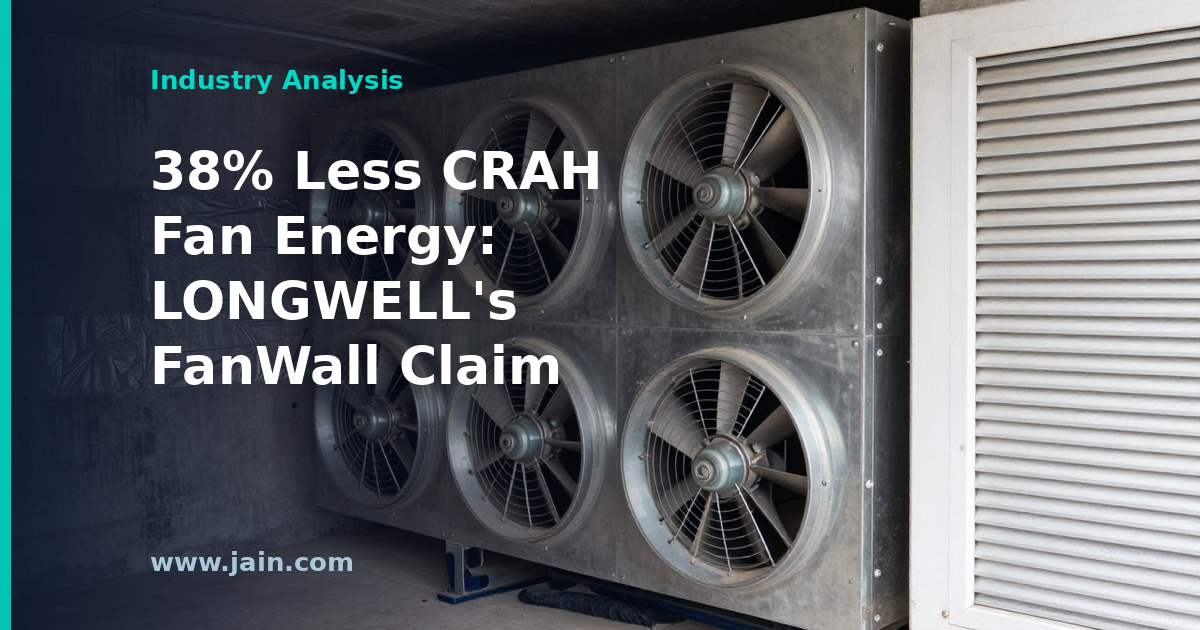
    Ningbo Longwell Electric Technology Co., Ltd. (LONGWELL), a Chinese fan and motor manufacturer founded in 1990, announced on 31 August 2026 an AI-era data center cooling line built around its LWBE3G EC plug-fan platform. Deployed as a FanWall array — a bank of smaller fans replacing one large fan — the company reports a 38% reduction in CRAH fan energy consumption, a 6.5 dB(A) noise reduction, and no field failures on the project cited.

    The work was done with what LONGWELL describes as one of the world’s top three precision-cooling OEMs, which it does not name. LONGWELL says it delivered 12 engineering samples in 35 days, passed DV/PV testing 100% on the first attempt, and went from specification validation to mass production in 90 days. The first customer order was 1,500 units; 2025 deliveries exceeded 80,000 units under a 2025–2027 framework agreement with a stated annual minimum of 60,000 units.

    Executive Summary

    The headline number is a 38% cut in the electricity drawn by the fans inside CRAH units — the computer-room air handlers that push cold air through a data hall. LONGWELL also reports that the CRAH system’s contribution to the facility energy-efficiency metric improved from a 1.42 baseline to 1.28 on the project in question. Fan power is one of the largest non-IT loads in an air-cooled hall, so a double-digit percentage cut there is economically meaningful even though it changes nothing about the servers themselves.

    The second, arguably more consequential claim is about speed. LONGWELL states that the incumbent European supplier on the same program had scheduled 14 months of development plus six months of production ramp, while LONGWELL completed spec-validation-to-mass-production in 90 days. If that comparison holds up, it says something about how quickly the precision-cooling supply chain can be re-sourced when AI buildouts compress every schedule — and about competitive pressure on established European fan vendors.

    The context is thermal density. LONGWELL cites rack loads moving from 15–20 kW to 60–100 kW in two years, with next-generation platforms exceeding 100 kW. That trajectory is usually cited as the argument for liquid cooling. This announcement makes the opposite-facing point: the air side of the plant still exists, still consumes power, and still has efficiency headroom that operators can capture without re-plumbing a building.

    Fan Power Is the Quiet Line Item in Data Center Energy

    In an air-cooled data hall, electricity splits between the IT equipment and everything that supports it: chillers, pumps, power conversion losses, and air movement. The air-movement share is easy to overlook because no single fan looks expensive, but CRAH fans run continuously, at every hour of every day, for the life of the facility. That duty cycle is what turns a percentage into money. A 38% reduction on a load that never switches off compounds differently from a 38% reduction on something that runs during business hours.

    The physics behind FanWall designs is not exotic and is worth stating plainly for non-specialists: fan power rises steeply with speed, so several smaller fans each running slower can move the same air volume for less power than one large fan running hard. EC — electronically commutated — motors, which use electronic control rather than mechanical brushes, make that easier by allowing precise, continuous speed modulation instead of on-off cycling. The array also degrades gracefully; LONGWELL cites automatic N+1 failover, meaning the array carries a spare fan’s worth of capacity so a single failure does not force a shutdown.

    None of that is unique to LONGWELL. FanWall architectures and EC motors are established practice across precision cooling, which is precisely why the interesting question in this release is not whether the approach works but what specifically LONGWELL’s platform was replacing, and at what operating point. The release’s own footnote says the comparative energy data refer to the equipment displaced on that project.

    Ninety Days Versus Twenty Months: The Real Competitive Story

    Component qualification is normally the slowest, least glamorous part of building cooling equipment. An OEM cannot simply swap a fan; it must re-run design verification and production validation testing, requalify acoustics and vibration, and re-certify the assembled unit. That is why the incumbent’s quoted 14-month development plus six-month ramp is not obviously unreasonable — it is roughly the industry’s normal cadence. LONGWELL’s claim is that it collapsed the same sequence to 90 days, with 12 engineering samples inside 35 days and a first-pass DV/PV result.

    For buyers, first-pass DV/PV is the detail worth noticing. Test cycles fail routinely, and each failure costs weeks. A supplier that passes on the first attempt is signalling that its engineering samples already matched the specification, which is a manufacturing-maturity claim as much as a design one. For the precision-cooling OEMs racing to fill AI-driven order books, a supplier who can compress twenty months into three is solving a scheduling problem, not just a component-cost problem.

    The competitive read is straightforward and should be stated without overreach: European fan suppliers have long held strong positions in HVAC and data center air movement on the strength of engineering depth and long qualification relationships. Speed of response is now being priced alongside that. The release does not claim the incumbent’s product was technically inferior — only that its timeline was longer on this program — and it explicitly disclaims any affiliation or endorsement.

    What the 38% Establishes, and What It Does Not

    LONGWELL is unusually candid in its own disclaimer: the performance data correspond to a specific project and a specific operating point, and final selection must be confirmed against operating point, voltage and control scheme, mounting arrangement, and project validation. That caveat is doing real work. Fan performance is highly sensitive to the pressure the fan works against, and a figure measured in one CRAH cabinet at one airflow does not transfer automatically to another.

    The 1.42-to-1.28 figure deserves particular care. Those numbers are in the numerical range of PUE — power usage effectiveness, the ratio of total facility power to IT power, where 1.0 is theoretically perfect — but the release describes this as the CRAH system’s contribution to the efficiency metric on this project, not a whole-facility PUE for a named site. Read as a subsystem-level improvement it is a coherent result; read as a facility PUE it would be a much larger claim than the release supports. The distinction matters for anyone modelling savings.

    The commercial figures are the most independently checkable part of the announcement, in the sense that they describe behaviour rather than test conditions. A first order of 1,500 units expanding to more than 80,000 units delivered in 2025, under a 2025–2027 framework with a 60,000-unit annual minimum, is a customer voting with volume. It is not third-party verification of 38%, but repeat purchasing at that scale is a stronger signal than a datasheet.

    Air Cooling Does Not Disappear Because Liquid Arrives

    The prevailing narrative says racks above roughly 60–100 kW must go to liquid cooling, and for the densest AI training clusters that is broadly where the industry is heading. But the transition is neither instant nor total. Direct-to-chip liquid cooling typically removes most, not all, of a rack’s heat; the remainder still leaves via air. Storage, networking, and general-purpose compute remain air-cooled. Retrofit halls with existing CRAH fleets will keep running for years on depreciation schedules that do not care about GPU roadmaps. Condensers and cooling towers — LONGWELL’s LWAE3G axial fan line targets these — are needed in liquid-cooled plants too.

    That is the strongest version of this announcement’s editorial premise: air-side efficiency has remaining headroom precisely because it is being treated as legacy. Capital and attention are flowing toward liquid, which leaves ordinary optimisation of the air path comparatively under-exploited. Operators who cannot re-plumb a building this year can still change fans.

    The counter-risk for a supplier in this position is that it is selling into a segment whose long-run share of new-build capacity may shrink even as its absolute installed base stays large. LONGWELL’s stated data center fan capacity of more than 120,000 units annually against a 60,000-unit contractual minimum suggests it has built for growth beyond this one customer; whether that growth comes from new AI halls, retrofits of existing ones, or the condenser and cooling-tower side of liquid-cooled plants is not something the release addresses.

    Background

    Precision cooling — the equipment class covering CRAC and CRAH units that hold data halls at controlled temperature and humidity — has historically been dominated by a small group of global OEMs, which in turn buy fans and motors from a specialist supply chain long anchored by European manufacturers. Fans are qualified rather than simply purchased: each one must pass verification testing inside the OEM’s cabinet, so incumbency has been durable and switching slow.

    The AI compute buildout has strained that arrangement. As per-rack heat loads climbed from the 15–20 kW typical of general-purpose servers toward 60–100 kW and beyond for accelerated computing, OEMs have needed higher-performance air movement on schedules far shorter than the industry’s traditional multi-year qualification cadence. LONGWELL, a Ningbo-area manufacturer founded in 1990 and long active in HVAC-R and industrial fans, is one of several Asian suppliers positioning against that compressed timeline — an announcement that is as much about procurement velocity as about thermodynamics.

    Source: La technologie FanWall de LONGWELL EC permet de réduire de 38 % la consommation énergétique des ventilateurs CRAH des centres de données IA de nouvelle génération — PR Newswire release, dated 31 August 2026 from Ningbo, China, detailing LONGWELL’s LWBE3G EC plug-fan platform, its reported CRAH fan energy and acoustic results, and the volumes shipped under a 2025–2027 framework agreement.

  • Modine’s $4B Backlog vs. Vertiv’s 12% Slide: Cooling Splits

    Modine’s $4B Backlog vs. Vertiv’s 12% Slide: Cooling Splits

    Two thermal-management suppliers moved in opposite directions in the same news cycle. Aggregated coverage carried by Google News reports that shares of Vertiv Holdings (NYSE: VRT), one of the largest vendors of data center power and cooling systems, fell 12%, under a headline asking whether the decline is a buying opportunity. A separate item reports that Modine Manufacturing (NYSE: MOD) gained on a $4 billion data center figure.

    The available source material is limited to those two aggregated headlines. The Modine headline is truncated in the feed as “$4B data center c…” and no underlying release text, dated filing, customer name, or delivery window accompanies either item.

    Executive Summary

    The news itself is small: one stock down 12%, another up on a large dollar figure. What makes it worth an article is the divergence. Vertiv and Modine sell into the same demand driver — the buildout of AI data centers, whose dense computing racks generate far more heat per square foot than conventional servers and increasingly require liquid cooling rather than air. If that demand were the only variable, the two share prices would tend to move together. They did not.

    The most defensible reading is that investors are no longer pricing thermal-management companies purely on demand. They are pricing the gap between demand and what is already embedded in each share price. A supplier can book record orders and still see its stock fall if the market had assumed even more; a smaller supplier can rerate sharply on a single large figure because far less was assumed to begin with.

    For infrastructure buyers, none of this changes physics or lead times. But supplier share prices influence capital costs, capacity expansion decisions and acquisition activity, so procurement teams have a legitimate reason to watch the tape — without mistaking it for operational news.

    Order Books and Share Prices Answer Different Questions

    A backlog or contract figure answers a backward-looking question: what has a customer already committed to buy? A share price answers a forward-looking one: is the expected future stream of profits better or worse than what buyers had already paid for? These can diverge for long stretches, and the reported moves are consistent with exactly that. A $4 billion data center figure at Modine is large relative to the company’s historical association with vehicular and building HVAC heat exchangers, so it plausibly resets expectations upward. Vertiv, by contrast, has been among the most visible listed proxies for AI infrastructure spending, which means a good deal of optimism can already sit inside the price before any new information arrives.

    This is the ordinary mechanics of expectations, not evidence that AI cooling demand is weakening. Nothing in the source material states why Vertiv shares fell. A 12% single-move decline in a high-expectation industrial name can follow guidance, margin commentary, a customer concentration disclosure, a sector-wide rotation, or an analyst action. Attributing it to any one cause without the underlying report would be speculation.

    Liquid Cooling Is Real Revenue, Not Just a Theme

    The substantive point beneath both headlines is that thermal management has moved from a line item to a gating factor. When a rack of AI accelerators draws many times the power of a traditional server rack, air alone stops working economically well before it stops working physically. That pushes operators toward direct-to-chip cold plates, rear-door heat exchangers and, at the extreme, immersion — all of which involve pumps, manifolds, coolant distribution units and heat rejection equipment that did not exist in volume in the previous generation of data centers.

    That shift widens the addressable market and, importantly, widens the supplier set. Cooling was historically dominated by a small group of specialists selling precision air-conditioning units. Liquid cooling draws in companies with heat-exchanger and fluid-handling engineering heritage from adjacent industries. Modine’s move is the clearest illustration in this news cycle of an adjacent-industry entrant being repriced as a data center supplier. The competitive implication for incumbents is not that demand disappears; it is that the premium for scarcity may compress as more credible suppliers qualify.

    What Procurement Teams Should Actually Do With This

    Buyers should separate two signals. The first is capacity: a supplier reporting a very large committed order book is telling you its factories and engineering teams are spoken for, which is a lead-time warning as much as a growth story. The second is durability: a supplier whose equity falls sharply is facing a higher cost of capital, which can constrain the very capacity expansion buyers are counting on. Neither headline here is severe enough to warrant requalifying vendors, but both argue for the standard disciplines — dual sourcing on long-lead thermal components, contractual delivery remedies, and design choices that do not lock a hall to a single vendor’s coolant distribution architecture.

    For investors, the fair conclusion from two aggregated headlines is narrow: the market is differentiating within a trade it previously bought as a block. Whether Vertiv’s decline is an entry point or a repricing of expectations cannot be determined from the material available, and the source headline poses that as a question rather than answering it.

    Background

    Data center cooling was for decades a specialist niche dominated by precision air-conditioning vendors serving halls of relatively uniform, air-cooled servers. The economics were stable and the engineering incremental. The arrival of high-density AI computing changed that: rack power densities rose to levels where air cooling becomes impractical, pushing operators toward liquid-based approaches and turning cooling from a supporting utility into a constraint on how much computing a site can host.

    That transition has made listed suppliers of power and thermal equipment, Vertiv among the most prominent, into widely traded proxies for AI capital spending, while opening the market to manufacturers such as Modine whose heat-exchanger engineering originated in other industries. Because both the demand and the expectations attached to it have risen quickly, share prices in this group have become sensitive to small revisions in outlook — the backdrop against which these two contrasting headlines should be read.

    Source: Vertiv Shares Slide 12%: Is the AI Data Center Play Worth Buying on the Dip? — aggregated market coverage of a 12% decline in Vertiv shares, read alongside a separate item reporting Modine Manufacturing gains on a $4 billion data center figure.

  • Systemair’s SEK 60M Finland Order and Air Cooling’s Hybrid Future

    Systemair’s SEK 60M Finland Order and Air Cooling’s Hybrid Future

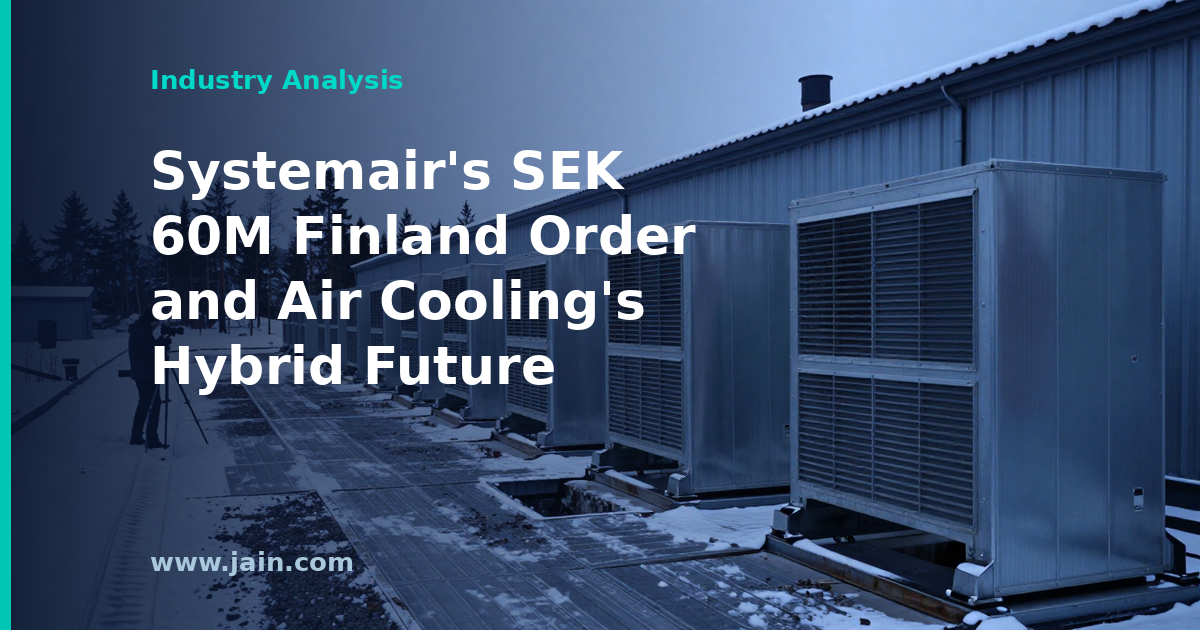
    Swedish ventilation manufacturer Systemair AB (NASDAQ Stockholm: SYSR) said on 27 August 2026 that it has received an order for air-based data centre cooling solutions worth approximately SEK 60 million (EUR 5.4 million). The order is for a new data centre in Finland, and deliveries are scheduled to begin at the start of 2027.

    The scope comprises Geniox Tera Fanwall units — modular air-handling assemblies with integrated controls and sensors — which will be produced at Systemair’s facility in Turkey. The Finnish site will recover waste heat from the cooling units and feed it into the local district heating network. Systemair announced the order the same day it published its Q1 2026/27 interim report.

    Executive Summary

    On its face this is a routine equipment win: a mid-cap European manufacturer books a single order equal to roughly half a percent of its SEK 12.5 billion in annual sales. What makes it worth reading closely is the technology choice and the geography. In a market narrative dominated by direct-to-chip liquid cooling for AI accelerators, a hyperscale-grade Finnish facility is still buying a substantial package of air handling capacity — and buying it a year or more before the building is expected to carry load.

    Systemair’s CEO, Robert Larsson, framed the demand explicitly in AI terms: “Mission-critical hyperscale data centres require cooling solutions that combine high energy efficiency with exceptional reliability – and we are seeing a growing demand for energy-efficient data centre cooling as AI-related investments continue to expand.” That is a vendor’s characterisation of its own order book rather than an independently verified market statistic, but it is consistent with what the order itself shows: air-side equipment is being specified into the same buildings that host dense compute.

    The second detail that matters is heat reuse. The Finnish site will export recovered heat into district heating. That turns a waste stream into a local utility input and, in Nordic markets, into part of the permitting and community-relations case for building at all. For buyers and investors, the practical takeaway is that thermal equipment orders — which are placed early, are hard to fake, and are denominated in real currency — are one of the cleaner leading indicators available for where AI-era capacity is genuinely being built.

    Air Cooling Is Not Being Retired — It Is Being Reassigned

    The dominant story of the past two years has been liquid: cold plates bolted directly to accelerators, rear-door heat exchangers, and immersion tanks, all pitched as the only way to handle rack densities that air physically cannot. That physics is real. What it does not mean is that air handling leaves the building. Liquid loops remove heat from the chips; they do not condition the room, they do not handle the substantial share of IT load that remains air-cooled, and they do not manage the electrical rooms, battery rooms, and support spaces that sit alongside the white space. A facility running direct-to-chip liquid on its densest halls still needs a competent air-side system — often a smaller one per megawatt of IT, but not a token one.

    That is the reading this order supports. Fanwall units — arrays of multiple smaller fans working in parallel behind a common wall, rather than one large fan — are a design choice about redundancy and part-load efficiency as much as raw capacity. If one fan fails, the array degrades rather than stops, and at low load the array can run fewer fans closer to their efficient operating point. Systemair describes the Geniox Tera Fanwall line as flexible, compact and modular with integrated controls and sensors. Those are the attributes an operator specifies when it expects the load profile to change over the life of the building — which is precisely the situation of anyone commissioning a hall in 2027 without knowing what silicon will occupy it in 2030.

    The honest framing, then, is hybrid rather than replacement. The competitive question for air-side vendors is not whether they get designed out, but what share of the thermal budget they retain per megawatt, and whether they can sell the controls and sensing layer alongside the boxes. Systemair’s release emphasises integrated controls; that is where differentiation and margin tend to migrate once the mechanical hardware itself becomes a commodity.

    Why Finland, and Why the Heat Goes Back Out the Door

    Finland has been an attractive Nordic data centre location for the same cluster of reasons that keep drawing operators north: a cold climate that extends the hours per year when outside air alone can do the cooling work, a grid with a substantial low-carbon component, political stability, and mature fibre routes into the rest of Europe. Cold ambient air is not a marketing point — it is an operating-cost line. Every hour a facility can cool with fans instead of compressors is an hour of materially lower energy draw.

    The waste-heat detail is the more strategically interesting one. District heating — networks of insulated pipes that distribute hot water to buildings across a town or city district — is widespread across the Nordics in a way it is not in most of the United States. That existing pipe network is what makes data centre heat reuse economically viable rather than merely aspirational: the offtake infrastructure already exists and already has customers. Recovering heat from cooling units and pushing it into that network converts a disposal problem into a saleable or at least socially creditable output.

    This matters commercially because heat reuse is increasingly part of how large facilities earn their social and regulatory licence. Data centres compete for grid connections, land, and public tolerance against other users of the same scarce power. An operator that can point to a heat offtake arrangement has a materially stronger position in that competition than one that vents everything to atmosphere. For equipment vendors, that creates a design requirement — cooling units specified with heat recovery in mind — that favours suppliers who already build for European efficiency standards.

    Thermal Orders as a Leading Indicator of Where AI Capacity Lands

    Announced AI capacity and delivered AI capacity are different quantities, and the gap between them is where a great deal of market confusion lives. Letters of intent, memoranda of understanding, and headline gigawatt figures are cheap to issue and frequently slip or quietly vanish. A signed equipment order with a delivery schedule is a harder object. Someone has committed capital, a manufacturing slot has been reserved, and a delivery date has been fixed — here, deliveries commencing at the beginning of 2027 for a facility that must therefore be structurally ready to receive them.

    Long-lead mechanical and electrical equipment is ordered early precisely because it is long-lead. That timing property is what makes it useful as a signal: cooling and power orders surface roughly a build cycle ahead of the racks going in. Read across enough vendors, this order flow is arguably a better map of real capacity formation than announcement volume. The caveat is that a single order tells you almost nothing about aggregate demand — it is one data point from one supplier, and vendors publish the wins rather than the losses.

    There is a related claim worth handling carefully. A separate forecast published the same day projects the generator cooling systems market reaching USD 5.03 billion by 2031, up from USD 3.76 billion in 2026, a 6.0% compound annual growth rate. That is a genuinely adjacent market but not the same one: generator cooling refers to the thermal management of electrical generating machinery, not the conditioning of data centre halls, and much of that market sits in power generation broadly rather than in data centres specifically. It is also a vendor-published research forecast, sold as a report, with methodology that is not open to inspection. It is reasonable to note the directional overlap — more compute means more backup and prime power, which means more machinery that needs cooling — and unreasonable to treat a 6.0% CAGR in that segment as validation of Systemair’s order or of AI-driven data centre cooling demand generally. The two releases share a date and a theme; they do not corroborate each other.

    What SEK 60 Million Does and Does Not Prove

    Scale discipline is worth applying. Systemair reported sales of SEK 12.5 billion in the 2025/26 financial year, with approximately 7,400 employees across 51 countries. A SEK 60 million order is therefore roughly half a percent of a single year’s revenue — around 1.8% of the SEK 3,281 million in net sales the company reported for Q1 2026/27 (May–July), which grew 6% organically. This is a meaningful, publishable win. It is not a company-transforming contract, and the release does not claim it to be.

    What the order does demonstrate is qualification: a manufacturer whose core identity is building ventilation for offices, schools, and industry has been specified into what its own CEO characterises as mission-critical hyperscale infrastructure. That is a credential with option value. Data centre buyers are conservative and repeat-purchase heavily from vendors that have already performed; the first order into a programme is frequently worth more than its face value. Systemair’s own framing — “a diversified customer base” — suggests it views data centres as one growth vertical rather than a pivot.

    What the release does not establish is equally worth stating plainly. It names no customer, no facility capacity, no contract margin, and no follow-on volume. It does not say whether the site also deploys liquid cooling, which would be the single most informative fact for the hybrid thesis. It does not disclose the terms of the district heating arrangement. And production in Turkey for delivery into Finland introduces a cross-border logistics and trade-policy exposure that the release does not address. None of that is unusual for an order announcement of this size — but it does mean this is a data point, not a proof.

    Background

    Systemair was founded in 1974 and has grown into one of Europe’s larger ventilation manufacturers, building air handling units, fans, air curtains and related climate equipment for buildings of every kind. Its historic market is ordinary commercial and industrial property — offices, schools, retail, factories — sold through the Systemair, Frico, Fantech and Menerga brands across 51 countries. The company is listed on Nasdaq Stockholm’s Large Cap list and reported SEK 12.5 billion of sales with roughly 7,400 employees in the 2025/26 financial year.

    Data centres represent an adjacent but distinct opportunity for such manufacturers. The engineering is related, but the reliability expectations, controls sophistication, and procurement cycles are different, and qualification with hyperscale-grade buyers is slow to win and sticky once won. The Nordics have meanwhile become a favoured region for large facilities: cold ambient air reduces the hours per year that mechanical refrigeration must run, grids carry a significant low-carbon share, and established district heating networks give operators somewhere useful to send waste heat — a combination that shows up directly in the specification of this Finnish project.

    Source: Systemair wins data centre cooling order worth SEK 60 million — the company’s 27 August 2026 announcement of an approximately SEK 60 million (EUR 5.4 million) order for air-based cooling at a new Finnish data centre, with deliveries starting in early 2027.

  • Coherent’s AI Thermal Story: Why Cooling, Not Chips, May Gate Rack Density

    Coherent’s AI Thermal Story: Why Cooling, Not Chips, May Gate Rack Density

    The Globe and Mail has published a watchlist commentary on Coherent Corp (NYSE: COHR), the photonics and engineered-materials maker, arguing that the stock is “cooling off just as its AI thermal opportunity heats up.” The piece frames a recent share-price pullback against what it presents as a growing opportunity for Coherent in thermal management for AI computing infrastructure.

    This is investor commentary rather than a company announcement: Coherent has not, in this item, disclosed new products, contracts, or financial targets. The interesting question the piece surfaces is a structural one — whether heat removal, rather than chip supply, is becoming the binding constraint on how densely operators can pack AI accelerators into a rack.

    Executive Summary

    The commentary positions Coherent as a beneficiary of a well-documented shift in data center engineering: as AI accelerators draw ever more power per chip and per rack, traditional air cooling runs out of headroom, pushing operators toward liquid and advanced thermal solutions. In that framing, companies that supply thermal components and materials sit on the critical path of AI buildout alongside — and in some respects ahead of — the chipmakers themselves.

    Why it matters: Coherent is best known in AI infrastructure for optical transceivers, the laser-based modules that carry data between GPU servers. A credible second exposure in thermal management would broaden its AI story beyond optics. But readers should be clear-eyed about what this item is: a stock-watch article pairing a price decline with a thematic opportunity. The theme — thermal as a gating constraint — is real and widely corroborated across the industry. The company-specific claim — that Coherent is positioned to capture it in size — is asserted here rather than evidenced with disclosed design wins, revenue figures, or customer names.

    Why Cooling Is Becoming the Binding Constraint

    For most of data center history, air cooling was sufficient: fans and chilled airflow could remove the heat a rack of servers produced. AI accelerators have broken that model. Each generation of GPU draws substantially more power than the last, and operators want them packed tightly together because AI training performance depends on short, fast connections between chips. More power in less space means more heat in less space — and air, a poor conductor, simply cannot carry it away fast enough at the densities modern AI racks demand.

    The industry’s answer is liquid cooling in its various forms — cold plates bolted directly to chips, rear-door heat exchangers, and immersion systems — along with the pumps, coolant distribution units, interface materials, and specialty components that make those systems work. The practical consequence is that a data center’s usable capacity is increasingly set by how much heat it can reject, not by how many chips it can procure. That is the structural insight behind the editorial framing here, and it is well supported by how hyperscalers and colocation providers are actually redesigning facilities.

    Where Coherent Fits — and Where the Evidence Thins Out

    Coherent’s clearest and best-documented AI exposure is optical: it is one of the major suppliers of the high-speed optical transceivers that link GPU clusters inside AI data centers, a business that scales directly with AI networking buildout. On thermal management specifically, Coherent’s heritage is in engineered materials and components — including thermoelectric cooling technology from its acquisition history and deep expertise in materials such as silicon carbide and diamond that are valued precisely for how they handle heat. That is a plausible foundation for a thermal-management business serving AI systems.

    Plausible, however, is not the same as demonstrated. This commentary does not cite disclosed thermal-management revenue, named customers, or design wins in AI cooling, and none are announced in the source item. Investors evaluating the thesis should look for those specifics in Coherent’s own filings and earnings materials. It is equally worth noting that the thermal opportunity has many claimants: established cooling and power-infrastructure vendors, cold-plate and coolant-distribution specialists, and component makers are all converging on the same market, and the eventual split of value among them is far from settled.

    Reading a Watchlist Piece for What It Is

    The article’s hook — a stock “cooling off” while its opportunity “heats up” — is a valuation argument, not a news event. Such framing can be useful: markets do sometimes mark down a company’s shares for near-term reasons even as a long-cycle demand driver strengthens. But the same framing can dress up an ordinary pullback as a buying opportunity without establishing that the underlying business has changed. The honest read is that the macro thesis (thermal constraints on AI density) stands on broad industry evidence, while the micro thesis (Coherent as a distinct winner in thermal) rests, in this piece, on positioning rather than disclosed numbers.

    For infrastructure operators and buyers, the takeaway is less about one stock and more about procurement reality: cooling capability is becoming a first-order selection criterion for sites, racks, and system vendors. Facilities designed only for air cooling face expensive retrofits, and supply of liquid-cooling components has become a schedule risk on AI deployments in its own right. Whoever the eventual share winners are, the direction of spend is not in serious dispute.

    Background

    Coherent Corp traces its lineage to II-VI Incorporated, a Pennsylvania-based engineered-materials and photonics company founded in 1971, which grew through decades of acquisitions — including thermoelectric-cooler maker Marlow Industries and optical-component businesses — before acquiring laser maker Coherent Inc. in 2022 and taking its name. Today the company supplies lasers, optical networking components, and specialty materials across telecom, industrial, and data center markets, with AI data center networking emerging as a headline growth driver.

    The market backdrop is the rapid escalation of power density in AI computing. Each accelerator generation draws more power, and clustering them tightly is essential to training performance, pushing rack heat loads beyond what air cooling handles economically. That has turned liquid cooling and advanced thermal components from a niche into one of the fastest-moving segments of data center infrastructure spending.

    Source: Coherent Stock Is Cooling Off Just as Its AI Thermal Opportunity Heats Up — The Globe and Mail watchlist commentary on Coherent Corp (COHR) and the AI thermal management market.

  • Modine Surges on Reported $23B Cooling Pipeline Tied to Google and Amazon

    Modine Surges on Reported $23B Cooling Pipeline Tied to Google and Amazon

    Shares of Modine Manufacturing (NYSE: MOD) jumped after Hunterbrook published a report, based on what it describes as leaked files, claiming the thermal-management company has a roughly $4 billion deal tied to Google and a data center cooling demand pipeline of about $23 billion that also links Amazon as a customer. Multiple financial outlets, including Benzinga, Proactive, and Pluang, relayed the report on August 22, 2026.

    Neither Modine, Google, nor Amazon has publicly confirmed the figures, which originate from the report rather than from any company disclosure.

    Executive Summary

    The claim at the center of the move is simple but large: a report by Hunterbrook, citing leaked documents, names Google and Amazon as customers behind a data center cooling pipeline it sizes at $23 billion, including a reported $4 billion arrangement connected to Google. For a company of Modine’s size — a century-old industrial thermal specialist rather than a hyperscale household name — numbers of that magnitude, if borne out, would represent a step-change in the scale of its data center business.

    The market’s reaction is as informative as the claim itself. Investors bid the stock up on an unverified, third-party report — a signal of how hungry the market is for pure-play exposure to data center cooling. As artificial intelligence workloads push server racks toward power densities that air cooling alone cannot handle, the companies that move heat — through chillers, coolant distribution units, and liquid cooling systems — are being repriced as strategic AI infrastructure suppliers rather than cyclical industrial vendors.

    What matters now is verification: whether the companies involved confirm, deny, or stay silent, and whether the reported pipeline reflects contracted backlog or aspirational opportunity. Those are very different things for a stock that just moved on the distinction being blurred.

    Cooling Is Becoming the Buildout’s Next Bottleneck

    For most of the data center industry’s history, cooling was a solved problem: blow enough cold air across the servers and manage the electric bill. AI has broken that model. Modern accelerator racks can draw many times the power of traditional server racks, concentrating heat beyond what air-based systems efficiently remove. The industry’s answer — liquid cooling, where coolant is piped directly to chips or to heat exchangers at the rack — requires specialized equipment, and the supplier base for that equipment is far smaller than the demand now chasing it.

    That is the structural story that makes a report like this land so hard. Investors have already repriced power equipment makers, transformer suppliers, and generator manufacturers as AI bottleneck trades. Thermal management is the logical next link in that chain: every megawatt of new AI compute is also a megawatt of heat that must go somewhere. A report naming the two largest cloud builders as anchor customers of a mid-cap cooling specialist fits a narrative the market was already primed to believe.

    What the Report Claims Versus What Is Confirmed

    It is worth being precise about the evidentiary chain here. The $4 billion and $23 billion figures come from a media report citing leaked files — not from a Modine securities filing, an earnings call, or a customer announcement. Hyperscalers rarely confirm their suppliers, and suppliers are often contractually barred from naming hyperscaler customers, so silence from Google and Amazon would be unremarkable either way. As of the coverage cited, none of the three companies had substantiated the numbers.

    The word “pipeline” also deserves scrutiny. In industrial sales, a pipeline is typically the total value of opportunities being pursued — not signed contracts, not backlog, and not revenue. If the $23 billion figure describes potential demand Modine is quoting against, the economic reality could differ substantially from what a headline reader might assume. The reports available do not make that distinction clear, and the distinction is worth billions.

    The Messenger Matters: Reading a Hunterbrook Report

    The source of the claim adds its own analytical wrinkle. Hunterbrook operates an unusual model in financial media: a newsroom paired with an affiliated investment fund that can trade on its reporting before publication. In this case the report is bullish — a departure from the short-seller-style exposés such outlets are better known for — but the incentive question cuts the same way in both directions. Readers and investors should ask of any market-moving report: who benefits from the move, and was the evidence strong enough to justify it?

    None of that makes the reporting wrong. Leaked documents can be accurate, and Hunterbrook’s work has moved markets before precisely because it is often substantive. But the fair standard is symmetrical: the same skepticism this publication would apply to an unverified vendor press release applies to an unverified media report, however sophisticated the outlet. Until Modine addresses the figures directly — in a filing, an earnings call, or a formal statement — the $23 billion number is a claim, not a fact.

    Concentration Risk Hides Inside the Opportunity

    Suppose the report is directionally right. Even then, the economics carry a caveat familiar to anyone who supplies hyperscalers: customer concentration. A supplier whose growth story rests on two buyers — however creditworthy — inherits their capital-expenditure cycles, their pricing leverage, and their willingness to dual-source or bring capabilities in-house. Hyperscalers have a long record of commoditizing their supply chains once a technology matures, from servers to networking gear.

    The competitive field is also crowding fast. Established HVAC and infrastructure giants, specialist liquid cooling firms, and well-funded startups are all racing into the same thermal market. A large pipeline today says little about margins three years from now if the bidding field triples. For buyers of cooling equipment, that competition is good news — more capacity and better pricing. For any single supplier’s shareholders, it is the risk that tempers the headline number.

    Background

    Modine Manufacturing, founded in 1916 and headquartered in Racine, Wisconsin, spent most of its history as a heat-transfer specialist serving automotive and industrial markets. In recent years it has pivoted deliberately toward higher-growth thermal businesses, with data center cooling — including chillers and precision cooling systems — becoming a centerpiece of its climate solutions segment. That repositioning has coincided with the AI-driven data center boom, which has turned formerly unglamorous supply categories like power distribution and heat rejection into some of the market’s most closely watched bottleneck trades.

    Hunterbrook, the report’s source, represents a newer breed of financial media: an investigative newsroom paired with an affiliated fund that can trade on its findings. Its reports have moved stocks in both directions before, which is why a bullish claim about Modine’s customer pipeline traveled so quickly through financial media despite lacking company confirmation.

    Source: Modine shares rise on report of $4B Google deal and $23B data center cooling demand — aggregated coverage (Pluang, Benzinga, Proactive, finance.biggo.com) of a Hunterbrook report citing leaked files naming Google and Amazon in Modine’s data center cooling pipeline.

  • GE Vernova’s AI Order Surge Signals Power and Cooling Are the New AI Bottleneck

    GE Vernova’s AI Order Surge Signals Power and Cooling Are the New AI Bottleneck

    Financial media reports in August 2026 highlight that GE Vernova’s orders for AI data-center equipment in the first half of the year have already doubled the total it booked in all of 2025, according to coverage from The Motley Fool syndicated across Yahoo Finance and The Globe and Mail. In parallel, Yahoo Finance analysis asks whether Eaton Corporation and Trane Technologies — suppliers of electrical distribution gear and cooling systems, respectively — can emerge as major winners from the same AI data-center boom.

    None of the items is a company press release; they are investor-focused analyses built around the order-growth headline. But taken together, they point at a consistent industry story: the equipment that powers and cools AI facilities, not the chips inside them, is where demand is now outrunning supply.

    Executive Summary

    The headline claim is striking: in one half-year, GE Vernova — the energy-equipment company spun out of General Electric — booked more AI data-center orders than in the entire previous year. The coverage frames this as evidence that hyperscalers and data-center developers are racing to lock in turbines, grid equipment, and electrical infrastructure years ahead of need. The companion piece extends the thesis to Eaton, which makes the switchgear, transformers, and power-distribution systems inside data centers, and Trane, whose chillers and thermal-management systems remove the enormous heat that AI server racks generate.

    Why it matters: for the past two years, the constraint on AI capacity was widely assumed to be GPU supply. These reports suggest the constraint is migrating downstream — to megawatts and cooling tons. A data center without secured power generation, electrical distribution, and heat rejection cannot deploy a single chip, no matter how many accelerators its owner has purchased. If order books at the equipment makers are filling this fast, delivery lead times become a strategic variable for everyone building AI infrastructure.

    A caveat up front: the source material is investment commentary, not audited disclosure. The doubling claim originates in stock-analysis coverage, and the articles supply no dollar figures, customer names, or delivery schedules that we can independently verify from the release text alone. The direction of the signal is consistent across outlets; the precision of it is not something this coverage establishes.

    The Bottleneck Has Moved Downstream from Chips to Electrons

    Every AI data center is, functionally, a machine for converting electricity into computation and heat. The industry spent 2023–2025 focused on the computation side — who could get GPUs, and how many. But GPUs are a fast-cycle product: fabs can expand output on a timescale of quarters. Heavy electrical equipment is not. Gas turbines, large power transformers, and high-capacity switchgear are engineered-to-order products with lead times measured in years, built in a small number of factories worldwide. When demand doubles, capacity cannot.

    That asymmetry is what makes the reported GE Vernova order surge significant beyond one company’s income statement. If AI data-center orders in six months exceeded all of last year’s, buyers are effectively queueing — paying now for delivery slots later. In infrastructure markets, a lengthening queue is the classic signature of a bottleneck: the constraint on how fast the AI buildout can proceed stops being capital or chips and becomes the physical delivery calendar of the equipment supply chain.

    Three Companies, Three Layers of the Same Stack

    The coverage bundles GE Vernova, Eaton, and Trane together for a reason: they occupy successive layers of the same value chain. GE Vernova sits upstream, supplying power generation and grid-scale equipment — the megawatts themselves. Eaton sits in the middle, making the electrical distribution gear — switchgear, uninterruptible power supplies, transformers — that moves power safely from the substation to the server rack. Trane sits at the end of the energy journey, providing the chillers and cooling systems that reject the heat those racks produce. In a conventional data center, cooling can consume a substantial share of total power; AI racks, which run far denser than traditional IT loads, intensify that thermal problem.

    The strategic implication is that AI demand does not create one winner but a chain of them — and a chain of potential choke points. An operator who secures generation but not switchgear, or switchgear but not chillers, still cannot open. That is why the market is asking the Trane-and-Eaton question at all: if the upstream layer (GE Vernova) is visibly capacity-constrained, the same dynamic plausibly applies to the layers behind it. Plausibly — the coverage poses the question about Eaton and Trane rather than documenting equivalent order data for them, and that distinction matters.

    Reading Order Books Honestly: Signal, Not Revenue

    Orders are a forward indicator, not money in the bank. An order becomes backlog, backlog becomes revenue only upon delivery, and the coverage here does not disclose the dollar value of the orders, their delivery timeline, cancellation terms, or margin profile. History counsels some humility: capital-equipment cycles have seen order books swell during booms and thin out when customers re-time projects. If AI capital spending decelerates — because model economics disappoint, power prices spike, or financing tightens — equipment orders placed years ahead of need are among the first things large buyers revisit.

    There is also a framing question worth noting even-handedly. All three source articles are investor commentary keyed to stock tickers, published across financial outlets asking “is the stock still a buy?” That genre rewards dramatic framing of growth statistics. The underlying fact pattern — surging demand for power and cooling equipment from AI builders — is consistent with what the broader industry has been experiencing, and nothing in the coverage appears contrived. But readers should distinguish between the well-supported directional claim (demand is heavily outrunning historical levels) and the precise multiples in headlines, which the articles as syndicated do not source to specific filings in the material available here.

    What This Means for Anyone Building or Buying Capacity

    For data-center operators and enterprise buyers, the practical takeaway is that procurement of electrical and thermal equipment has become a competitive discipline, not a back-office function. When lead times stretch, operators who ordered early hold an asset — a delivery slot — that late movers cannot buy at any price in the short run. Expect that advantage to show up in which projects actually energize on schedule, and in the pricing power of colocation providers who already hold contracted power and installed cooling.

    For the equipment makers, the boom is an opportunity wrapped in a capacity-planning dilemma: expand factories aggressively and risk overcapacity if AI spending normalizes, or expand cautiously and cede share. How GE Vernova, Eaton, and Trane each answer that question — none of which this coverage addresses — will shape the supply side of the AI buildout for the rest of the decade.

    Background

    GE Vernova became an independent company in 2024 when General Electric split into separate aviation, healthcare, and energy businesses, giving the energy unit a standalone identity spanning power generation, wind, and grid electrification. Eaton is a long-established power-management company whose electrical segment supplies the distribution and backup-power equipment inside commercial facilities and data centers. Trane Technologies, formed from the 2020 separation of Ingersoll-Rand’s climate businesses, is one of the world’s largest suppliers of commercial HVAC and chiller systems.

    The market context is the AI infrastructure buildout that accelerated from 2023 onward, as hyperscale cloud providers and specialized developers began constructing data centers of unprecedented power density to train and run large AI models. That expansion has pushed demand for generation capacity, grid interconnection, electrical gear, and industrial cooling well beyond historical data-center norms — turning previously unglamorous equipment categories into strategically contested supply.

    Source: Can Trane Technologies plc (TT) and Eaton Corporation, PLC (ETN) Become Major Winners from the AI Data Center Boom? — Yahoo Finance analysis, alongside syndicated Motley Fool coverage reporting that GE Vernova’s first-half AI data-center orders doubled its full-2025 total.

  • 3M and Microsoft Partner on AI Data Center Materials

    3M and Microsoft Partner on AI Data Center Materials

    On July 14, 2026, 3M and Microsoft announced a strategic partnership focused on advancing AI data center infrastructure and enterprise transformation. The announcement was carried on Microsoft’s own newsroom (Microsoft Source).

    The headline positions the collaboration around AI-era infrastructure — a domain where 3M has historically supplied materials, adhesives, films and thermal management products, and where Microsoft is one of the world’s largest hyperscale operators.

    Executive Summary

    The release frames a tie-up between an industrial materials incumbent and a hyperscale cloud operator at a moment when AI compute is straining the physical envelope of data centers. Power density per rack, heat rejection, and materials that can survive higher junction and coolant temperatures have all become gating factors for GPU deployments.

    What is substantiated in the headline is intent: a strategic partnership, AI data center infrastructure as the target, and enterprise transformation as a secondary theme. What is not yet substantiated — at least in the excerpt available to us — is scope: which 3M product lines, which Microsoft facilities, on what timeline, and under what commercial structure.

    For readers evaluating the announcement, the useful posture is neither dismissal nor hype. Materials science is a genuine bottleneck for AI infrastructure, and 3M has relevant portfolios. Whether this specific partnership delivers meaningful capacity or is primarily a marketing framing will depend on details the release, as published, does not spell out.

    Why Materials Suddenly Matter to Hyperscalers

    For most of the cloud era, hyperscale data centers were an integration problem: racks of commodity servers, air cooling, and steady incremental efficiency gains. AI training and inference clusters have changed the physics. Modern GPU accelerators dissipate hundreds to over a thousand watts each, and racks are moving from the 10–20 kW range typical of general-purpose cloud toward 50–100 kW and beyond. At those densities, the materials in contact with silicon — thermal interface materials, dielectric fluids for immersion cooling, cold-plate seals, and vapor-barrier films — become first-order engineering constraints rather than commodity inputs.

    3M’s historical relevance here is real: the company has long supplied fluorinated dielectric fluids used in two-phase immersion cooling, thermal interface products, and specialty films and tapes used inside servers and networking gear. Microsoft, for its part, has publicly experimented with immersion cooling in prior years. A partnership badged as targeting AI data center infrastructure sits squarely in this well-established technical overlap, even if the announcement itself does not enumerate specific product families.

    What a Strategic Partnership Actually Buys

    "Strategic partnership" is one of the more elastic phrases in corporate communications. In practice, such arrangements range from joint marketing and preferred-supplier status at the light end, to co-development agreements, capacity reservations, and equity or offtake commitments at the heavy end. The release headline as available does not disclose where on that spectrum this deal sits.

    For 3M, a formal alignment with a top-three hyperscaler is commercially valuable regardless of the exact contract structure: it validates its materials portfolio for AI workloads at a moment when the company has been repositioning after divesting parts of its business and navigating environmental litigation around per- and polyfluoroalkyl substances (PFAS). For Microsoft, tying a materials supplier more closely into its infrastructure roadmap is consistent with a broader hyperscaler trend of pushing further down the stack — into custom silicon, custom racks, and now, plausibly, custom materials specifications.

    Enterprise Transformation: The Ambiguous Second Leg

    The headline also references enterprise transformation, a phrase that in Microsoft’s usage typically implies Azure adoption, Microsoft 365, and Copilot-branded AI products. Read literally, it suggests 3M is also a customer — modernizing its own IT and manufacturing operations on Microsoft’s stack — not only a supplier.

    Two-way arrangements of this kind are common in hyperscaler deal-making: the supplier commits materials or capacity, and in return standardizes on the buyer’s cloud and AI platforms. Whether that reciprocity is present here, and on what scale, is not stated in the available excerpt. Buyers and investors should treat the enterprise-transformation framing as a signal to look for future disclosures around Azure commitments or Copilot deployments at 3M.

    Risks and Open Questions on Both Sides

    Any materials-heavy AI infrastructure story now runs into the PFAS question. Several of the dielectric and thermal fluids historically associated with immersion cooling belong to fluorochemical families that are under increasing regulatory scrutiny in the United States and European Union. 3M has publicly stated it intends to exit PFAS manufacturing by the end of 2025. A partnership announced in mid-2026 targeting AI infrastructure therefore raises a legitimate, non-inflammatory question: what chemistries are in scope, and how does the roadmap reconcile with that exit commitment? The release excerpt does not answer this.

    On Microsoft’s side, the risk is narrative. Hyperscalers have announced many AI-era infrastructure partnerships in the past two years — with utilities, nuclear developers, chipmakers, and cooling specialists. Each individually is plausible; collectively, they can create an impression of capacity certainty that specific contracts may not yet support. The measured read is that this announcement adds one more supplier relationship to that mosaic, and its weight will be visible only when product-level or facility-level detail follows.

    Background

    3M is a diversified U.S. industrial company whose materials science portfolio has long included products used inside data centers — thermal interface materials, films, adhesives, filtration and, historically, dielectric fluids associated with immersion cooling. The company has been repositioning in recent years, including a stated intent to exit PFAS manufacturing by the end of 2025 amid regulatory and litigation pressure.

    Microsoft is among the top three hyperscale cloud operators globally and has publicly committed to a large multi-year build-out to support AI training and inference workloads. That build-out has surfaced physical constraints — power, cooling, and materials — that were secondary concerns in the pre-AI cloud era, prompting a wave of supplier and infrastructure partnerships across the industry.

    Source: 3M and Microsoft announce strategic partnership to advance AI data center infrastructure and enterprise transformation — Microsoft Source, July 14, 2026.

  • MHI Reports Field-Verified Efficiency Gains From AI Cooling Optimization

    MHI Reports Field-Verified Efficiency Gains From AI Cooling Optimization

    Mitsubishi Heavy Industries (MHI) announced on July 9, 2026 that it has demonstrated energy-efficiency improvements through cooling optimization in an operational data center. Rather than a lab simulation or a controlled test bed, the demonstration ran in a live facility — the setting where cooling systems must respond to real, fluctuating IT loads.

    Executive Summary

    MHI, the Japanese heavy-industry group whose portfolio spans power generation, HVAC and thermal systems, says it has shown measurable energy-efficiency improvements by optimizing cooling in a data center that was actively serving production workloads. The approach centers on smarter control of cooling equipment — adjusting how chillers, air handlers and airflow respond to actual conditions rather than running at conservative fixed settings.

    The announcement matters for a simple reason: cooling is one of the largest non-IT consumers of electricity in a data center, and it is one of the few places where efficiency gains can be captured without touching the servers themselves. With AI workloads pushing rack power densities sharply higher, operators are looking hard at control-layer optimization as a way to cut operating costs and free up power capacity. A field demonstration in a live facility — as opposed to vendor modeling — is the kind of evidence buyers increasingly demand, though the syndicated version of this release does not carry the underlying figures, which readers should verify against MHI’s full publication.

    Why a Live-Facility Demonstration Matters

    Cooling-optimization claims are easy to make in simulation and hard to prove in production. A real data center has messy thermal behavior: IT load rises and falls with customer demand, outside temperatures swing by season and hour, and no operator will tolerate a control experiment that risks overheating servers. Demonstrating gains in an operational facility means the system had to deliver savings while respecting those constraints — which is why field verification is the credibility bar for this product category.

    That said, a single-site demonstration is evidence, not proof of general applicability. Results depend heavily on the baseline: a facility with poorly tuned cooling will show dramatic improvement from almost any optimization, while a well-run site will show far less. The commercial question is not whether MHI improved one building, but how transferable the method is across climates, cooling architectures and load profiles — something only multi-site data can answer.

    Cooling Is the Biggest Efficiency Lever Left

    In most data centers, cooling is the largest energy consumer after the IT equipment itself, which is why the industry’s standard efficiency metric — PUE, or power usage effectiveness, the ratio of total facility power to IT power — is largely a measure of cooling overhead. Servers get more efficient with every silicon generation, but the facility side improves only when operators invest in it. Control-layer optimization is attractive because it can often be applied to existing equipment: the chillers stay, the software running them gets smarter.

    The economics have sharpened as AI infrastructure scales. Grid connections are constrained in many markets, so every kilowatt not spent on cooling is a kilowatt available for revenue-generating compute. For operators facing multi-year waits for new power capacity, efficiency gains at the cooling layer function as found capacity — frequently at a fraction of the cost of new construction.

    MHI Enters a Crowding Field

    MHI is not alone here. AI-assisted cooling control has been pursued by hyperscalers internally and by facility-equipment and building-management vendors for several years, and the space now includes established cooling manufacturers, controls specialists and software startups. MHI’s differentiation, if it holds, comes from owning the equipment side: a company that builds chillers and thermal systems can integrate control optimization more deeply than a software-only vendor, and can stand behind the combined result.

    For MHI, the strategic logic is also defensive. As liquid cooling, heat reuse and AI-driven operations reshape data center thermal design, equipment makers that offer only hardware risk being commoditized while the value migrates to the control and services layer. A demonstrated optimization capability positions MHI to sell outcomes — efficiency, capacity headroom — rather than just machines. Whether that translates into a commercial product with published pricing and guarantees is the next thing to watch.

    Background

    Mitsubishi Heavy Industries is a diversified Japanese engineering group whose thermal-systems businesses build chillers, HVAC and industrial cooling equipment — the physical machinery that data center cooling optimization software ultimately controls. Like other established equipment makers, MHI has been extending from hardware into the control and services layer as data center operators demand measurable efficiency outcomes rather than standalone machines.

    The push comes amid a broader industry squeeze: AI-driven demand has data center construction booming while grid power in major markets is scarce, making energy efficiency both a cost issue and a capacity issue. Cooling, as the largest non-IT energy consumer in most facilities, has become the primary battleground, with hyperscalers, controls vendors and equipment manufacturers all pursuing AI-assisted optimization of the thermal plant.

    Source: MHI Demonstrates Energy Efficiency Improvements through Cooling Optimization in Operational Data Center — Mitsubishi Heavy Industries announcement, July 9, 2026, via Google News.

  • Wafr Technologies’ Reported $100M Raise Shows Investors Chasing the Cooling Bottleneck

    Wafr Technologies’ Reported $100M Raise Shows Investors Chasing the Cooling Bottleneck

    Cooling vendor Wafr Technologies has raised $100 million, according to a report carried by Data Center Dynamics on July 7, 2026. The publication characterized the raise as a report rather than a company announcement, and the item available to us does not name the investors, the round structure, or the intended use of proceeds.

    Executive Summary

    According to the Data Center Dynamics item, Wafr Technologies — identified simply as a cooling vendor — has reportedly secured $100 million in new funding. That is the extent of what the source substantiates: a company name, a sector, a dollar figure, and the qualifier “report,” which signals the news has not been confirmed in detail by the company itself.

    Even in that skeletal form, the story matters because of what it represents. Cooling — the unglamorous business of moving heat away from computer chips — has become one of the tightest constraints on data center construction in the AI era. A nine-figure round for a cooling specialist, if confirmed, would be another data point in a clear pattern: capital that once flowed almost exclusively to chips, land, and power is now chasing thermal management, because without it the rest of the AI buildout stalls.

    Why Heat Became the Industry’s Chokepoint

    For most of the data center industry’s history, cooling was a solved problem: blow chilled air across servers, exhaust the hot air, repeat. That model works up to roughly the power density of a traditional enterprise rack. AI training hardware broke the equation. Modern accelerated-computing racks draw many times what air can economically remove, which is why the industry is shifting to liquid cooling — circulating fluid directly to cold plates on the chips, or immersing hardware in dielectric fluid — to carry heat away far more efficiently than air ever could.

    That transition is not optional for AI-class facilities, and it is happening faster than the supply chain matured. Cold plates, coolant distribution units, rear-door heat exchangers, and the engineering talent to deploy them have all been in tight supply. When a component becomes the binding constraint on a trillion-dollar buildout, capital follows. A reported $100 million round for a cooling vendor fits that logic precisely.

    What a Nine-Figure Round Signals About the Market

    Cooling has historically been the domain of large industrial incumbents — the Vertivs and Schneider Electrics of the world — for whom thermal management is one product line among many. Venture-scale money flowing to independent cooling specialists suggests investors believe the liquid-cooling transition is big enough, and moving fast enough, to support new entrants rather than simply enlarging incumbents’ order books.

    It also says something about where returns are perceived to be. Building data centers is capital-intensive and increasingly commoditized; supplying the critical components that gate construction can carry better margins and faster growth. Investors who missed the GPU wave or the land-and-power wave may see thermal management as the remaining underpriced layer of the AI infrastructure stack. Whether that thesis pays off depends on execution questions this report cannot answer — but the direction of the money is itself informative.

    Winners, Losers, and the Scaling Test Ahead

    If the raise is confirmed, the most immediate beneficiaries are data center operators and their customers: more capitalized suppliers mean more manufacturing capacity, shorter lead times, and more competitive pricing in a segment where demand has outrun supply. Chipmakers benefit indirectly, since every rack that can be cooled is a rack that can be sold.

    The harder question is whether a funded challenger can convert capital into share. Cooling is a trust business — operators are conservative about anything that puts liquid near multi-million-dollar hardware — and incumbents hold deep service networks and long-standing customer relationships. History in this industry suggests that well-funded specialists either scale into meaningful suppliers, get acquired by incumbents seeking their technology, or burn capital competing on price. A $100 million war chest buys time to find out which path applies; it does not guarantee the answer.

    Reading a Report, Not a Press Release

    It is worth being precise about the evidentiary status here. The source is a trade-press item flagged as a report — not a company announcement, not a regulatory filing. The figure could ultimately prove different in size, structure (equity versus debt), or timing. Trade reporting on private raises is often directionally right and precisely wrong. Until Wafr Technologies or its investors confirm the details, the responsible reading is: a credible industry publication believes a cooling vendor has attracted roughly $100 million, and that belief is consistent with everything else happening in the thermal-management market.

    Background

    For decades, data center cooling meant air: chillers, raised floors, and hot-aisle containment, handled largely by big industrial suppliers as one product line among many. The AI era upended that. Racks built around modern accelerators draw several times the power of traditional enterprise racks, pushing the industry toward direct-to-chip liquid cooling and immersion systems that can remove heat air cannot. That transition turned a mature, sleepy segment into one of the most supply-constrained corners of the infrastructure market, and capital has followed — into incumbents’ expansion and, increasingly, into independent specialists.

    Wafr Technologies enters the public record here with little published history: the report available to us identifies it only as a cooling vendor. That thinness is itself common in this cycle, where private thermal-management companies often surface in trade press via funding reports before making detailed public disclosures.

    Source: Cooling vendor Wafr Technologies raises $100m – report, Data Center Dynamics, July 7, 2026 — a trade-press report of the funding round, unconfirmed by the company at publication.

  • China Switches On the First Commercial Underwater Data Center

    China Switches On the First Commercial Underwater Data Center

    China has brought online what is being described as the world’s first commercial underwater data center, according to a report published July 4, 2026 by the Spanish outlet OkDiario. The facility submerges sealed server modules in the ocean and uses the surrounding seawater as its cooling medium, an approach the report says sharply reduces the energy the facility consumes.

    The report frames the launch as a template other coastal regions could adopt, naming Cartagena, Spain as the kind of Mediterranean port city where the model might be replicated. It does not disclose the operator, the facility’s capacity, or its precise location.

    Executive Summary

    The announcement matters because it moves underwater data centers from experiment to product. Submerging servers has been tested before — most famously by Microsoft — but a commercial deployment means paying customers are expected to run real workloads on seabed infrastructure, and that changes the questions from “does it work?” to “does it pencil out?”

    The core appeal is cooling. Keeping servers from overheating is one of the largest energy costs in any data center, and the deep ocean offers a vast, stable heat sink at no mechanical-chilling cost. If seawater cooling delivers the efficiency the concept promises at commercial scale, it would arrive at a moment when AI-driven demand has made power and cooling the industry’s tightest constraints.

    That said, the source report is brief and light on specifics. It attributes no capacity figures, energy metrics, customer names, or operator details. The launch is a genuine milestone in cooling infrastructure if the commercial framing holds — but the evidence available in this report is a claim of a first, not a documented performance record.

    Why Put Servers on the Seabed?

    Data centers spend an enormous share of their electricity not on computing but on removing the heat that computing generates. The industry measures this with PUE — power usage effectiveness, the ratio of total facility power to the power that actually reaches IT equipment. Conventional air-cooled facilities need chillers, fans, and often large volumes of water to hold safe temperatures, and in hot climates that overhead climbs steeply.

    The ocean solves the problem passively. Below the surface, water temperature is low and remarkably stable year-round, and water conducts heat far better than air. A sealed capsule on the seabed can reject heat directly into an effectively unlimited sink, eliminating most mechanical cooling. Subsea deployment also removes evaporative water consumption — a growing point of friction between data centers and the communities that host them — and seabed real estate near dense coastal cities is not competing with housing or industry the way urban land is.

    From Microsoft’s Experiment to Chinese Commercialization

    The concept is not new; the commercial claim is. Microsoft’s Project Natick sank a sealed server vessel off Scotland’s Orkney Islands from 2018 to 2020 and reported that the submerged servers failed at a fraction of the rate of an equivalent land-based control group — likely because the nitrogen-filled, human-free capsule eliminated oxygen corrosion, humidity swings, and accidental knocks. Microsoft judged the experiment a technical success but never turned it into a product. China, meanwhile, has been running underwater data center pilots off its own coast for several years, so a progression from pilot to commercial service there is consistent with the trajectory — even though this report does not name the company involved.

    If the commercial characterization is accurate, China would be first to market with a technology a US hyperscaler proved and shelved. That is a familiar pattern in infrastructure: the economics that don’t fit one company’s portfolio can fit another market’s constraints, particularly where coastal land, grid capacity, and water for cooling are all scarce at once.

    The Hard Economics of Subsea Capacity

    The obstacles are as real as the appeal. A submerged module cannot be serviced by a technician; a failed component stays failed until the entire vessel is raised, which pushes operators toward redundant hardware and infrequent, expensive retrieval cycles. Marine engineering, corrosion-resistant housings, subsea power and fiber connections, and specialized deployment vessels all add capital cost that the cooling savings must repay. Insurance, uptime guarantees, and repair logistics for seabed assets are largely uncharted territory for enterprise customers used to walking their auditors through a facility.

    Environmental questions also need honest accounting. Rejecting heat into the ocean is thermodynamically unavoidable here, and while small-scale trials such as Natick reported minimal localized warming, the effect of dense clusters of commercial modules on marine ecosystems is site-specific and largely unstudied. Coastal permitting regimes — fisheries, shipping lanes, protected habitats — will shape where this model can actually go, and the report offers no detail on how the Chinese deployment cleared those hurdles.

    Could Cartagena Be Next?

    The report’s suggestion that coastal cities like Cartagena could follow is speculation, not an announced project, and it is worth being clear about that distinction. Still, the logic of the shortlist is sound: Mediterranean port cities combine dense populations that want low-latency services, constrained urban land and grids, warm climates that make conventional cooling expensive, and immediate deep water. Those are precisely the conditions under which subsea capacity is most competitive against land-based builds.

    For European adoption, the gating factors would be EU environmental review, marine-spatial-planning approvals, and — not least — the geopolitics of importing a Chinese-proven infrastructure model into European digital sovereignty debates. Any operator pursuing it would more likely license the concept or develop it independently than deploy Chinese-operated modules in EU waters.

    Background

    Underwater data centers trace to Microsoft’s Project Natick, which began with a proof-of-concept in 2015 and culminated in a sealed vessel of several hundred servers operating off Scotland from 2018 to 2020. The retrieved servers had failed at a small fraction of the rate of an identical land-based group, validating the reliability case — but Microsoft ended the program without a commercial product. China picked up the thread with coastal pilot deployments in the years that followed, pursuing subsea capacity as an answer to scarce coastal land, strained grids, and the water consumption of conventional cooling.

    The timing is not incidental. By 2026, explosive AI demand had made electricity and cooling the data center industry’s defining bottlenecks worldwide, pushing operators toward liquid cooling, novel sites, and any design that cuts overhead energy. A commercial subsea launch is China staking a claim to one of those frontiers first.

    Source: China just switched on the first underwater data center, cooling servers with the ocean to slash energy use, and coastal cities like Cartagena could be next — OkDiario report, July 4, 2026, on China’s launch of the first commercial seawater-cooled underwater data center.