Tag: data center construction

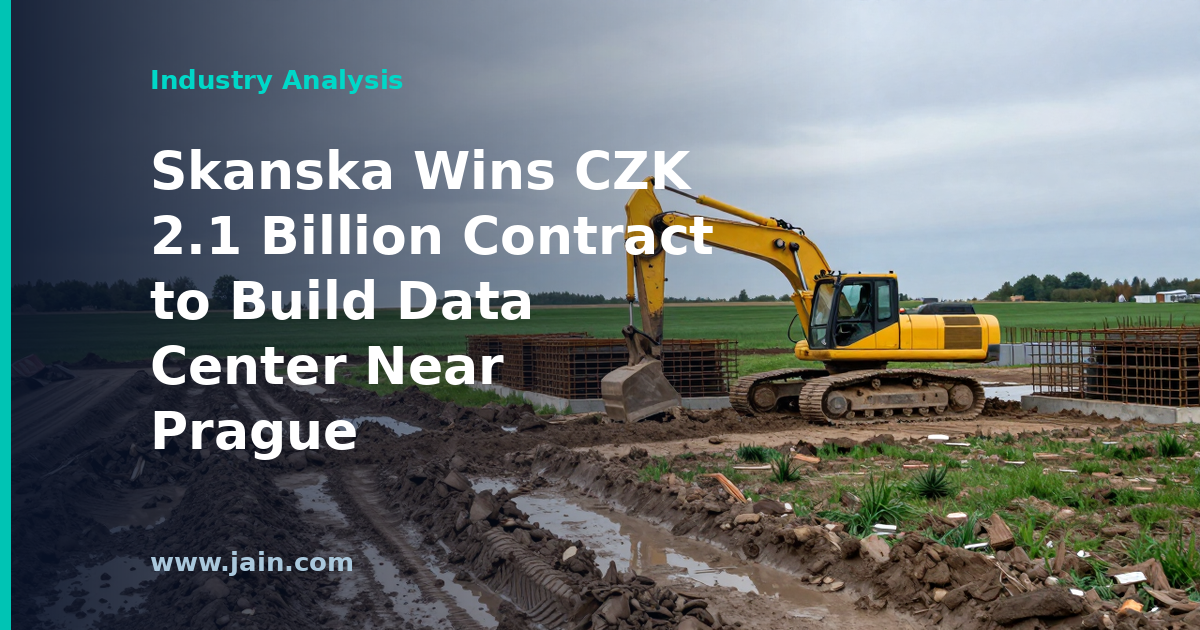
  • Skanska Wins CZK 2.1 Billion Contract to Build Data Center Near Prague

    Skanska Wins CZK 2.1 Billion Contract to Build Data Center Near Prague

    Skanska, the Swedish construction group, has signed a contract with CRA Prague Gateway DC to build a new data center on the outskirts of Prague, Czechia. The contract is worth CZK 2.1 billion (about SEK 930M) and will be recorded in Skanska’s European order bookings for the third quarter of 2026. Work begins in August 2026, with completion scheduled for 2028.

    Executive Summary

    The scope covers complete construction plus non-IT technologies — the mechanical, electrical, and building systems that make a data center run, as distinct from the servers and networking gear a future operator or tenants would install. The initial phase is foundational in the literal sense: site infrastructure, foundation structures, and the load-bearing precast concrete skeleton of the building.

    The announcement matters less for its absolute size than for what it signals. A nine-figure (in euro terms) data-center construction contract in Czechia — outside the traditional Frankfurt, London, Amsterdam, Paris, and Dublin (FLAP-D) hubs — is another data point that Europe’s data-center buildout is pushing into secondary markets, where power, land, and permitting are often easier to secure than in the saturated core hubs.

    The release is brief, however. It names no capacity figures, no anchor tenants, and offers no detail on the client beyond its name. Readers should treat this as a construction-order announcement, not a full project reveal.

    Secondary Markets Are Absorbing Europe’s Data-Center Overflow

    For two decades, European data-center demand concentrated in the FLAP-D metros, where connectivity density and customer proximity justified premium costs. That model is under strain: grid connection queues, land scarcity, and in some cities outright moratoria on new facilities have pushed developers toward secondary markets. Prague fits the profile — a central European capital with strong fiber connectivity to Frankfurt and Vienna, an established enterprise base, and comparatively more headroom for new construction.

    A CZK 2.1 billion construction contract will not by itself reorder the European map. But contractor order books are a useful leading indicator of where capacity is actually being built, because construction contracts get signed after land, financing intent, and at least preliminary planning are in place. This contract says a substantial facility near Prague has cleared those early hurdles.

    What the Contract Structure Reveals — and Conceals

    Skanska’s scope of “complete construction and non-IT technologies” describes a shell-plus-fit-out arrangement common in the sector: the contractor delivers the building and its supporting systems, while IT equipment comes later and separately. The phased structure — starting with site works, foundations, and the precast concrete skeleton — is also typical for projects where later phases may be released as demand or financing firms up.

    What the release does not disclose is arguably more interesting. There is no megawatt capacity, no floor area, no power-sourcing arrangement, and no indication of whether the facility is speculative or anchored by committed tenants. The CZK 2.1 billion figure covers Skanska’s construction contract, not the total project cost, which would also include land, IT fit-out, and grid connection. Without those figures, the project’s true scale can’t be benchmarked against other European builds.

    A Growing Data-Center Franchise for a Traditional Builder

    For Skanska, the contract extends a visible push into data-center construction. The same wire feed carries a separate Skanska announcement of four data centers in the southeastern United States worth USD 1.2 billion — an order roughly twelve times the Prague contract’s value. For diversified builders, data centers have become a prized segment: technically demanding, repeatable for hyperscale and colocation clients, and backed by capital expenditure cycles that have so far proven resilient.

    The competitive implication cuts both ways. Construction capacity — skilled mechanical and electrical trades in particular — is one of the buildout’s real bottlenecks, and contractors with proven data-center delivery records can command strong pipelines. But that same scarcity means schedule risk. A 2028 completion date leaves a multi-year window in which labor, materials, and grid-connection timelines all have to cooperate.

    Background

    Skanska, headquartered in Stockholm, is one of the world’s largest construction and development companies, with a long record in commercial and infrastructure projects across Europe and North America. Like several major contractors, it has built a growing franchise in data-center construction as cloud and AI demand drives one of the largest capital-expenditure waves in the industry’s history.

    Europe’s data-center market has historically centered on the FLAP-D hubs — Frankfurt, London, Amsterdam, Paris, and Dublin — but power availability and land constraints there have redirected new development toward secondary markets across central, southern, and northern Europe. Czechia, with Prague as its connectivity anchor, is among the markets positioned to absorb that overflow.

    Source: Skanska to build datacenter near Prague, Czechia, for CZK 2.1 billion, about SEK 930M — Skanska press release via PR Newswire, August 24, 2026, announcing a data-center construction contract with CRA Prague Gateway DC.

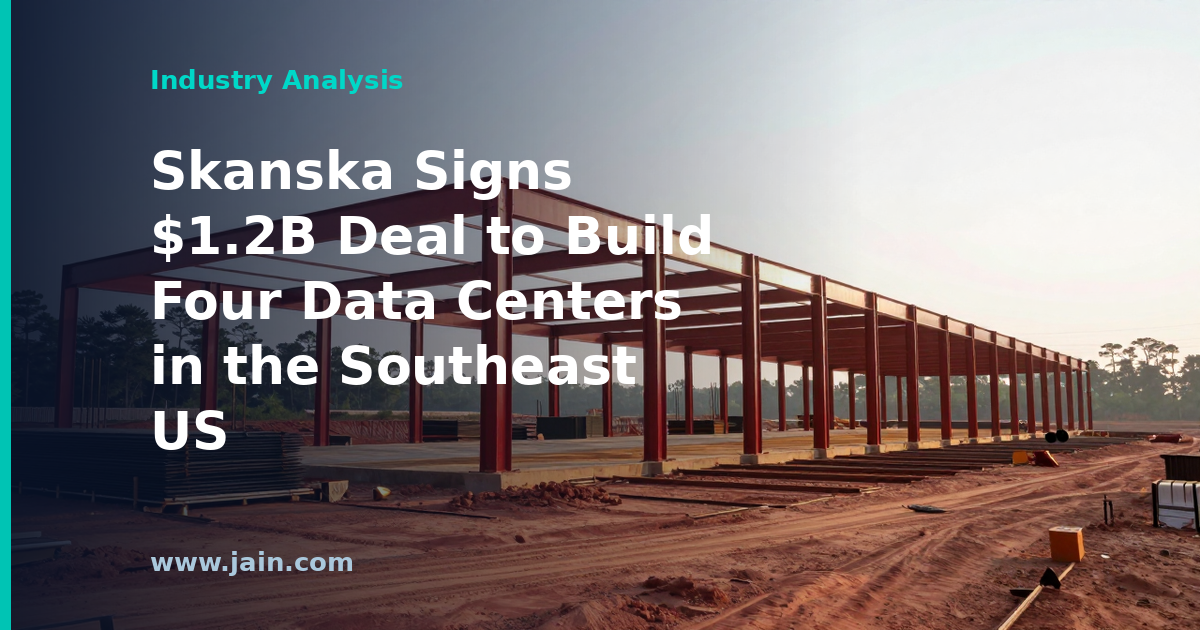
  • Skanska Signs $1.2B Deal to Build Four Data Centers in the Southeast US

    Skanska Signs $1.2B Deal to Build Four Data Centers in the Southeast US

    Swedish construction group Skanska announced on August 20, 2026 that it has signed a contract with an existing client to build four new data centers in the southeast United States. The contract is worth USD 1.2 billion (about SEK 11.2 billion) and will be booked in Skanska’s US order bookings for the third quarter of 2026.

    The four facilities total approximately 75,000 square meters (808,000 square feet). Skanska’s scope covers the building shell plus interior fit-out for technical spaces, support areas, and offices. Construction begins in the third quarter of 2026 and is expected to finish in the third quarter of 2028.

    Executive Summary

    Skanska’s announcement is short on specifics — the client, the exact locations, and the facilities’ power capacity are all undisclosed — but the headline numbers tell a clear story: a single customer is committing to four buildings at once, worth $1.2 billion in construction value alone, on a two-year delivery clock. That is a program, not a project, and it reflects how hyperscale and large-enterprise data center buyers now procure capacity in multi-site batches rather than one building at a time.

    The deal also reinforces the southeast US as a serious data center growth corridor. As land, power interconnection queues, and community pushback tighten conditions in established hubs like Northern Virginia, developers have increasingly looked south for available land, comparatively faster utility timelines, and business-friendly permitting. A four-facility award in the region — from a repeat client, no less — suggests that migration of demand is continuing.

    For the construction industry, the contract underscores that data centers have become a core revenue engine for major contractors. Skanska separately announced an additional $238 million data center contract in Virginia, indicating a pipeline of repeat data center work across multiple US regions.

    A Program Buy, Not a Building Buy

    The most telling detail in this release is not the dollar figure but the structure: one client, four facilities, one contract. Data center customers with large, predictable capacity needs — typically cloud platforms, AI companies, or the developers who serve them — increasingly bundle construction into multi-site programs. Bundling locks in contractor capacity, standardizes designs across sites, and compresses delivery schedules, all of which matter when the constraint on growth is how fast physical capacity can be stood up rather than how much capital is available.

    The ‘existing client’ framing matters too. Repeat awards are how construction firms build durable data center franchises: a contractor that has already delivered for a customer carries proven designs, familiar subcontractor networks, and established safety and quality track records into the next award. For Skanska, converting one relationship into a four-building, $1.2 billion follow-on is evidence that this flywheel is working — though it also concentrates revenue exposure in a single customer relationship, a tradeoff worth noting.

    Why the Southeast, and What It Strains

    The southeast US has become one of the fastest-growing data center regions because the traditional hubs are congested. Northern Virginia — the world’s largest data center market — faces multi-year waits for grid interconnection (the process of getting a utility to deliver large blocks of power to a new site), rising land costs, and local zoning battles. States across the southeast have courted the industry with available land, tax incentives, and utilities willing to plan for large new loads.

    But four facilities landing at once in one region illustrates the strain this growth creates. Data centers are extraordinarily power-dense buildings, and every new campus adds load that regional utilities must generate, transmit, and balance. Meanwhile, the specialized trades that data center construction depends on — electricians, mechanical fitters, controls technicians — are in short supply nationally, and the southeast’s simultaneous boom in chip plants, battery factories, and other industrial projects competes for the same workers. The release does not say how these projects will be powered or staffed, and those are precisely the variables that determine whether a Q3 2028 completion date holds.

    The Economics of Shell and Fit-Out

    Skanska’s scope — shell construction plus interior fit-out of technical, support, and office spaces — works out to roughly $300 million per building, or on the order of $1,500 per square foot across the 808,000-square-foot program based on the disclosed figures. That is far above typical commercial construction costs, which reflects what a data center actually is: the building is effectively a machine, dense with structural, electrical, and mechanical infrastructure long before any servers arrive. It is worth remembering that construction cost is only one layer of total project cost; the IT equipment the eventual owner installs typically represents a further large investment not captured in a construction contract.

    For Skanska, the award lands in Q3 2026 order bookings, giving investors a concrete signal about the health of its US commercial pipeline. For the broader market, it is one more data point that data center construction spending remains robust — a useful counterweight to periodic debate about whether AI-driven infrastructure investment is decelerating. One contract cannot settle that debate, but a repeat client committing to four buildings through 2028 is not the behavior of a customer pulling back.

    Background

    Skanska, founded in Sweden and headquartered in Stockholm, is one of the world’s largest construction and development companies, with the United States among its most important markets. Data centers have become a growing line of business for major contractors as cloud and AI operators race to add physical capacity; alongside this award, Skanska announced a further $238 million data center contract in Virginia and a $957 million light rail contract in California, illustrating the breadth of its US order book.

    The US data center market has historically concentrated in hubs like Northern Virginia, but constraints on power, land, and permitting there have pushed a growing share of new development into the southeast, where utilities and state governments have actively courted the industry. Multi-building, single-client construction programs like this one have become a hallmark of how hyperscale capacity is now procured.

    Source: Skanska builds data centers in southeast USA worth USD 1.2 billion, about SEK 11.2 billion — Skanska press release via PR Newswire, August 20, 2026, announcing a four-facility data center construction contract with an existing client.

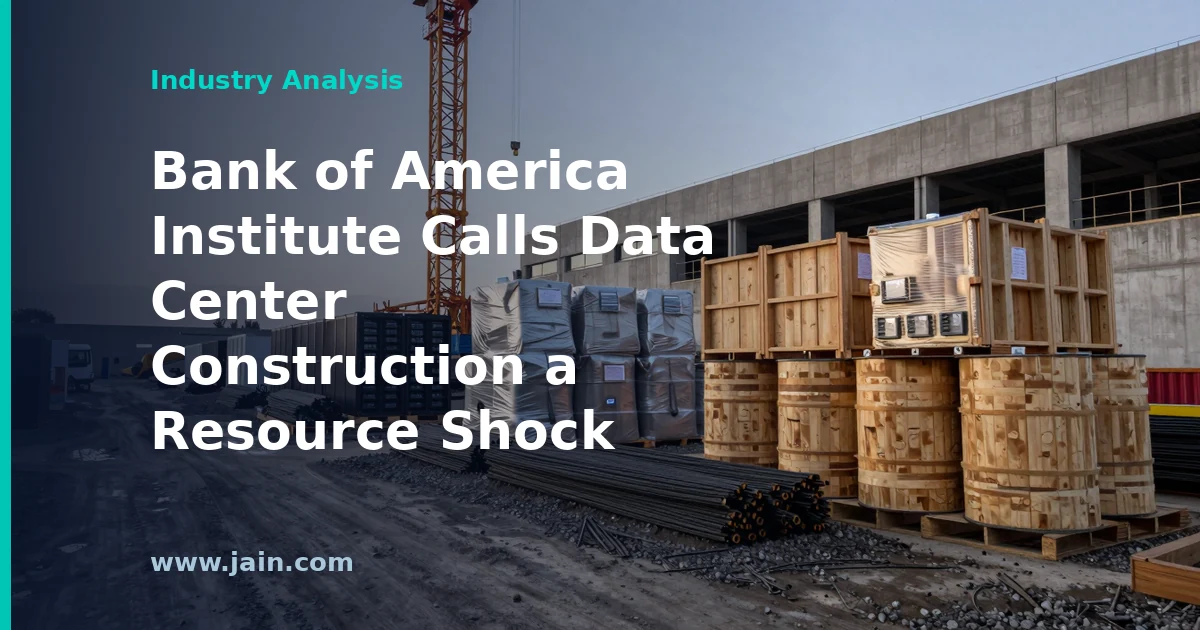
  • Bank of America Institute Calls Data Center Construction a Resource Shock

    Bank of America Institute Calls Data Center Construction a Resource Shock

    The Bank of America Institute, the research arm of Bank of America that publishes economic analysis drawn from the bank’s data and economists, released a report on June 2, 2026 characterizing the ongoing wave of data center construction as a “resource shock.” The framing points to strain across the three inputs every large-scale digital infrastructure project competes for: skilled construction labor, building materials and electrical equipment, and electric power supply.

    Executive Summary

    When a major bank’s in-house think tank labels an investment cycle a “resource shock,” it is making an economic claim, not just a descriptive one. A resource shock is a sudden shift in demand for inputs that outruns the supply side’s ability to respond, pushing up prices and lead times for everyone competing for the same resources. Applied to data centers, the term asserts that the AI-driven construction boom is no longer just a story about one industry’s capital spending — it is large enough to move markets for electricians, transformers, generators, concrete, steel, and grid capacity.

    That matters because the effects of a resource shock do not stay contained. Other construction sectors — housing, manufacturing plants, public infrastructure — draw on the same labor pools and equipment supply chains. Utilities planning grid investments must now weigh data center load requests against other customers. For an institution with Bank of America’s lending and card-spending visibility into the real economy, elevating this to a formal research theme signals that the strain is showing up in measurable economic data, not just industry anecdote.

    Why a Bank Is Sounding This Note

    The Bank of America Institute exists to translate the bank’s proprietary vantage point — payments flows, commercial lending, economic research — into public analysis. Its choice of subject is itself informative: research arms of large banks tend to formalize themes their client-facing businesses are already encountering, such as construction lenders seeing bid inflation or corporate clients reporting equipment delays. A “resource shock” framing suggests the institute sees data center demand as a macroeconomic force rather than a niche real-estate story.

    It also reflects where the money is going. Data centers have shifted from a specialized corner of commercial real estate to one of the most capital-intensive construction categories in the United States, propelled by hyperscale cloud providers and AI infrastructure buildouts. When a single project can require hundreds of megawatts of power and years of specialized electrical work, a national pipeline of such projects mechanically competes with everything else being built.

    The Three Bottlenecks: Labor, Materials, Power

    The report’s headline identifies the three constraints practitioners consistently cite. Labor is the most immediate: data centers need unusually high concentrations of electricians, pipefitters, and mechanical trades, and those skills take years to develop. Materials and equipment form the second constraint — long-lead electrical gear such as transformers, switchgear, and backup generators has been the industry’s chronic pain point, with order backlogs measured in years at various points in this cycle.

    Power is the deepest constraint because it is the slowest to fix. A data center is ultimately a machine for converting electricity into computation, and connecting large new loads requires generation and transmission investments that operate on utility timescales — often five to ten years for major grid upgrades. This is why power availability, more than land or capital, has become the primary siting criterion for new facilities.

    Winners, Losers, and the Cost Question

    A resource shock redistributes advantage. Operators with land already secured, grid interconnection agreements signed, and equipment orders placed hold assets that are increasingly difficult to replicate — which supports valuations for incumbent data center platforms. Electrical contractors, equipment manufacturers, and utilities with capacity to sell are on the receiving end of the demand surge. The squeezed parties are those competing for the same inputs without data-center-scale budgets: other construction sectors facing higher trade wages and equipment prices, and potentially ordinary ratepayers if grid upgrade costs are socialized across utility customers rather than assigned to the large loads that drive them.

    For enterprises buying colocation or cloud capacity, the practical translation is that scarcity flows through to pricing and lead times. When new supply is gated by labor, equipment, and power, existing capacity commands a premium — a dynamic already visible in historically low vacancy rates across major data center markets. Fair questions run in both directions, though: resource-shock framings can also overstate permanence if demand forecasts prove optimistic or if supply responds faster than expected, as it eventually did in previous infrastructure cycles.

    Background

    Data centers — the specialized buildings that house the servers behind cloud services, websites, and AI systems — have grown from a niche real-estate category into one of the largest construction stories in the United States. The acceleration began with cloud computing in the 2010s and intensified sharply after 2022, when the generative AI boom pushed hyperscale operators and AI companies into a race for computing capacity, with individual campuses now sized in the hundreds of megawatts. The Bank of America Institute, launched by the bank in 2022 as a public-facing research arm, has made the economic ripple effects of this buildout a recurring subject, and its June 2026 report places the construction surge in macroeconomic terms: as a demand shock hitting labor, materials, and power markets simultaneously.

    Source: Data center construction creates a resource shock — Bank of America Institute, a research report characterizing the data center construction boom as a strain on labor, materials, and power supply.

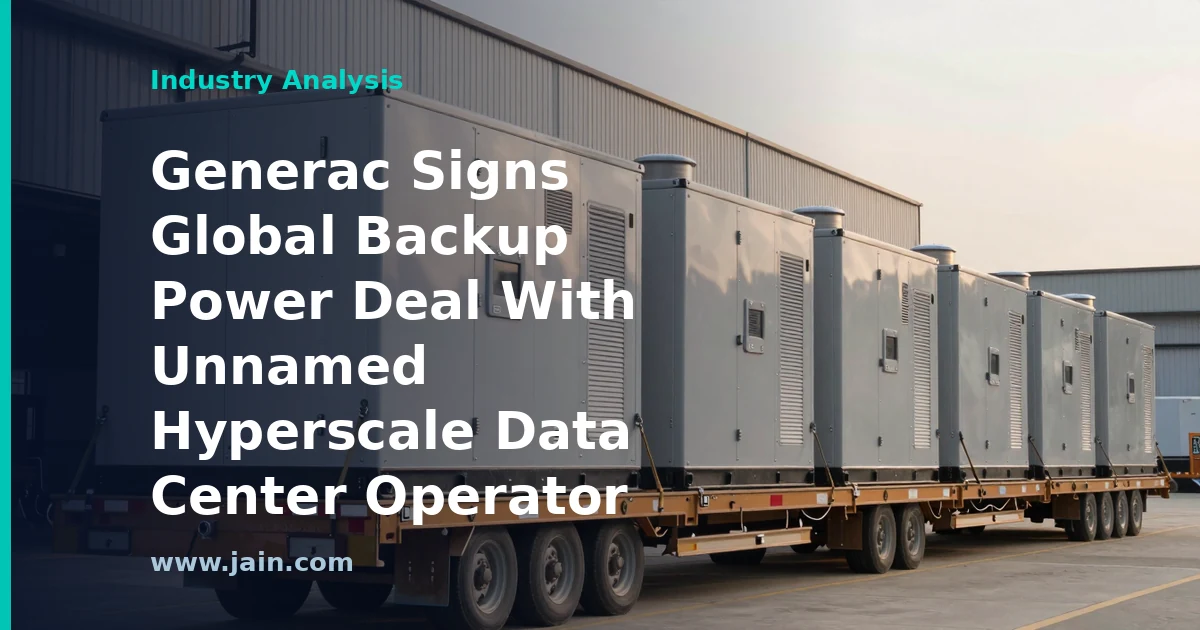
  • Generac Signs Global Backup Power Deal With Unnamed Hyperscale Data Center Operator

    Generac Signs Global Backup Power Deal With Unnamed Hyperscale Data Center Operator

    Generac Power Systems announced on June 1, 2026 that it has signed a global supply agreement to provide backup power equipment to a company it describes as a leading hyperscale data center operator. The customer was not named, and the announcement, distributed via PR Newswire, did not disclose financial terms, unit volumes, or a delivery timeline.

    Executive Summary

    The announcement matters less for its disclosed details — which are minimal — than for what it signals about both parties. For Generac, a company best known for residential standby generators, a global agreement with a hyperscaler is a credibility milestone in the large commercial and industrial power market, where data centers have become the most sought-after customer class. Hyperscalers — the handful of companies operating cloud and AI computing platforms at global scale — historically sourced backup generation from a small set of heavy-industrial incumbents.

    For the data center industry, the deal is another data point in a broader pattern: operators locking in multi-year, multi-region supply of critical electrical equipment rather than procuring project by project. When a hyperscaler signs a global agreement for backup power, it suggests that generator capacity, like transformers and switchgear before it, is now scarce enough to justify strategic sourcing. That framing should be tempered by what the release does not say — no customer name, no dollar value, no megawatt figure — which limits how much weight the announcement can bear.

    Backup Power Moves From Commodity to Constraint

    Every serious data center pairs its utility feed with on-site backup generation — typically large diesel or natural gas generator sets that carry the facility through grid outages. For most of the industry’s history this was routine procurement: generators were a mature, readily available product bought near the end of a project’s design cycle. The AI-driven construction boom changed that. As operators race to bring gigawatts of new capacity online, long-lead electrical equipment — transformers, switchgear, and increasingly generator sets — has become a pacing item that can delay a facility as surely as a missing utility interconnection.

    A global supply agreement is the procurement response to that scarcity. Instead of bidding each project separately, an operator reserves manufacturing capacity across regions and years, trading flexibility for certainty of delivery. The fact that a hyperscaler apparently judged this worthwhile for backup power is itself evidence of how tight the market has become, and it mirrors similar forward-buying behavior seen across the data center supply chain.

    What the Deal Means for Generac

    Generac built its business on home standby generators and mid-sized commercial units, while the largest data center generator orders have traditionally gone to heavy-industrial manufacturers such as Caterpillar, Cummins, and Rolls-Royce’s mtu brand. Generac has spent recent years pushing into larger industrial applications, and a hyperscale win — if it translates into sustained volume — would validate that strategy in the most demanding segment of the market. Hyperscale operators qualify suppliers rigorously, so passing that bar is meaningful even before any units ship.

    The caution is that the release discloses no volumes or revenue. Supply agreements can range from firm multi-year commitments to framework arrangements that simply make a vendor eligible for future orders. Without disclosed terms, investors and industry observers cannot yet distinguish between the two, and the announcement should be read as a positive signal rather than a quantified backlog addition.

    Why Hyperscalers Are Diversifying Their Supplier Base

    From the buyer’s side, adding a supplier makes straightforward sense. When incumbent generator manufacturers carry extended backlogs, a hyperscaler that depends on a narrow vendor list risks having construction schedules dictated by someone else’s factory queue. Qualifying an additional manufacturer at global scale adds resilience, creates pricing competition, and expands total available manufacturing capacity — the same playbook hyperscalers have applied to chips, power equipment, and construction contractors.

    The competitive implication for the wider market is worth watching: enterprise and colocation buyers, who lack hyperscale purchasing power, may find themselves further back in the queue as manufacturers allocate capacity to their largest strategic accounts. Backup power availability could quietly become another dimension on which the largest operators out-execute smaller ones.

    Background

    Generac Power Systems, founded in 1959 and headquartered in Waukesha, Wisconsin, became a household name in residential standby generators — the units that keep homes powered through grid outages. Over the past decade it has expanded into commercial and industrial generation, energy storage, and grid services, seeking growth beyond the housing-linked residential market. The largest tier of that industrial market is data center backup power, a segment long dominated by heavy-equipment incumbents.

    The announcement lands amid an unprecedented data center construction cycle driven by cloud growth and AI computing demand. That boom has strained the supply chains for electrical infrastructure of every kind, prompting the biggest operators to lock in equipment supply years ahead — the context in which a global backup power agreement with a hyperscaler is best understood.

    Source: Generac Signs Global Supply Agreement with Leading Hyperscale Data Center Operator to Supply Backup Power — PR Newswire release, June 1, 2026, announcing Generac’s backup power supply agreement with an unnamed hyperscale data center operator.

  • AI Data Centers Need 36x More Fiber as Glass Shortage Stretches Lead Times

    AI Data Centers Need 36x More Fiber as Glass Shortage Stretches Lead Times

    Industry reporting published May 15, 2026 by Tom’s Hardware says AI data centers require roughly 36 times more optical fiber than facilities designed around standard servers, and that severe shortages of the specialty glass used to make fiber have pushed cable lead times out to as much as a full year.

    Executive Summary

    The headline claim is stark: an AI-optimized data center consumes on the order of 36 times the fiber optic cabling of a conventional server hall, according to the report. That multiplier reflects how modern GPU clusters are built — thousands of accelerators wired to each other through dense optical network fabrics, rather than rows of independent servers that mostly talk to the outside world.

    The second half of the story is the supply chain’s response. Optical fiber begins as ultra-pure glass, and the report says shortages of that glass are now severe enough that cable orders can take a year to fill. If accurate, that puts fiber alongside GPUs, power equipment, and cooling gear on the list of long-lead items that determine when an AI facility can actually come online — a bottleneck that gets far less attention than chips or megawatts, but can stall a build just as effectively.

    Why AI Clusters Devour Fiber

    In a traditional data center, most traffic is “north-south”: requests come in from the internet, a server answers, and the response goes back out. AI training clusters invert that pattern. Training a large model requires thousands of GPUs to exchange intermediate results with each other constantly — so-called “east-west” traffic — over network fabrics where every accelerator may need a high-bandwidth path to many others.

    Those paths run over optical transceivers and fiber because copper cabling cannot carry the required bandwidth beyond a few meters. Multiply high port counts per GPU by tens of thousands of GPUs, add multiple network planes (compute fabric, storage, management), and the cabling bill grows geometrically rather than linearly. A 36x multiplier versus a standard-server design is a dramatic figure, but the architectural logic behind heavy fiber consumption in AI facilities is well established, even though the report does not detail how that specific number was derived.

    A Supply Chain Built for a Different Era

    Optical fiber is drawn from glass preforms — cylinders of extremely pure silica manufactured in specialized, capital-intensive plants. That production base was scaled for telecom demand: long-haul networks, broadband buildouts, and steady data center growth. It was not sized for a scenario in which single campuses consume fiber volumes previously associated with regional networks.

    Capacity of this kind does not flex quickly. New preform and draw capacity takes significant time and investment to bring online, and manufacturers burned by past boom-bust cycles in fiber tend to expand cautiously. That is how demand shocks turn into year-long lead times: the report’s claim of severe glass shortages is consistent with a supply base that responds in years while demand is compounding in quarters, though the report itself does not identify which producers are constrained or how long the shortfall may last.

    Another Hidden Gate on the AI Buildout

    The AI infrastructure race has repeatedly been slowed less by capital than by unglamorous physical inputs: grid interconnections, transformers, generators, chillers — and now, potentially, cabling. A data center with power, cooling, and GPUs on the floor still cannot train models if the fabric connecting those GPUs is stuck in an order backlog. For builders, that makes fiber a schedule-critical procurement item to be locked in early, not a finishing detail ordered late in construction.

    If lead times hold at a year, the likely effects are familiar from other constrained components: large buyers with forecasting muscle and framework agreements absorb available supply, smaller operators and enterprises face longer waits or higher prices, and fiber and cable manufacturers gain pricing power and a rationale for capacity expansion. The caveat is that this is a single report; buyers should verify current lead times with their own suppliers rather than treating the year figure as universal.

    Background

    Optical fiber has been the workhorse of global connectivity since the 1980s, and the industry has weathered demand cycles before — most notably the telecom boom and bust of the early 2000s, which left manufacturers wary of overbuilding capacity. Inside data centers, fiber’s role grew steadily as network speeds passed the limits of copper, but conventional facilities still used it relatively sparingly.

    The generative AI buildout that accelerated from 2023 onward changed the equation. Training clusters grew from hundreds to tens of thousands of GPUs, each demanding multiple high-bandwidth optical connections, while hyperscalers and specialist operators announced multi-gigawatt campuses worldwide. That put unprecedented demand on every physical input to a data center — power equipment, cooling, chips, and, as this report highlights, the glass and cable that tie the machines together.

    Source: AI data centers require 36 times more fiber than designs with standard servers — severe glass shortages push cable lead times out to a full year, Tom’s Hardware, May 15, 2026 — a report on AI-driven fiber demand and optical glass supply constraints.

  • Jacobs Takes On Hut 8’s Second Texas AI Data Center

    Jacobs Takes On Hut 8’s Second Texas AI Data Center

    Jacobs, the Dallas-headquartered engineering and professional services firm, said on 13 May 2026 that it has been awarded an engineering, procurement and construction management (EPCM) contract to deliver a second artificial-intelligence data center in Texas for Hut 8, the US-listed digital infrastructure and bitcoin mining company.

    The announcement identifies the parties, the delivery model and the state. It does not, in the material available, disclose the site, the power capacity, the contract value, the construction schedule or the end customer for the completed facility.

    Executive Summary

    The award is short on numbers but clear on direction. Hut 8 has spent the past two years repositioning from bitcoin mining toward data centers built for AI and high-performance computing workloads, and it is now hiring a tier-one engineering house to manage delivery rather than assembling that capability entirely in-house. That it is the second such Texas project for the same pairing suggests the first engagement produced a working relationship worth repeating.

    EPCM is the operative detail. Under this model, Jacobs designs the facility, runs procurement and manages the contractors who physically build it — but does not self-perform the construction or, typically, wrap the whole job in a fixed lump-sum price. The owner keeps more cost risk and more control; the engineer supplies the discipline, drawings and supply-chain leverage. Choosing EPCM tells you Hut 8 wants speed and flexibility on a design that is still evolving, and is willing to carry risk to get it.

    The broader read: in the current AI buildout, megawatts and land are necessary but no longer sufficient. Skilled engineering, procurement slots for electrical gear and construction management bandwidth have become the scarce inputs. Hut 8 is buying those, and that is the story.

    EPCM Is the Tell: Hut 8 Is Buying Delivery Capacity

    Companies choose a contracting model the way they choose a mortgage: it reveals what they are optimising for. A lump-sum turnkey EPC contract transfers schedule and cost risk to the contractor, which prices that risk in and, in return, resists design changes. EPCM does the opposite. The engineering firm acts as the owner’s agent — producing the design, letting trade packages, sequencing the site — while the owner signs the trade contracts and absorbs the variance. It is faster to start, easier to change mid-flight, and less forgiving if the owner’s own governance is weak.

    For an AI data center in 2026, that trade is defensible. Rack densities, liquid-cooling choices and even the identity of the eventual tenant frequently change between groundbreaking and energisation. Freezing a design early enough to price it as a lump sum can cost more than the risk it transfers. Hut 8 appears to be betting that a well-run EPCM structure, with Jacobs supplying the process rigour, beats paying a contractor’s contingency for certainty it may not want.

    The implicit admission is also worth naming: a company of Hut 8’s size does not have hundreds of data center engineers on payroll, and building that bench organically would take longer than the market window allows. Renting it from Jacobs is the rational move, but it makes the relationship a dependency rather than an asset on the balance sheet.

    The Miner-to-AI Pivot Meets a Different Class of Building

    Bitcoin mining halls and AI training halls look superficially alike — big sheds, big substations — and that resemblance has powered a wave of miner repositioning stories. The engineering reality is less flattering to the analogy. A mining facility tolerates interruption, runs air-cooled hardware that is cheap to replace, and can be built to modest redundancy because downtime costs only forgone revenue. A facility hosting accelerated computing for a creditworthy tenant must meet contractual uptime, support liquid cooling loops, and satisfy the tenant’s own commissioning regime before a single invoice is issued.

    That gap in standards is precisely why an EPCM award matters more than another megawatt announcement. Converting a mining land-and-power position into a leasable AI facility requires design documentation, factory witness testing, commissioning scripts and as-built records that enterprise and hyperscale customers will audit. Hiring an established engineering firm is how a former miner acquires that credibility quickly — and it is a signal counterparties can price.

    The caveat is that the announcement, as available, does not say what the finished building will be certified to, who will occupy it, or whether it is contracted. Engineering pedigree improves the odds of a bankable outcome; it does not by itself create one.

    Texas, Again — And Why Repetition Is the Point

    Texas remains the centre of gravity for large-load computing in the United States for reasons that have not changed: abundant land, an interconnection process on the ERCOT grid that has historically moved faster than neighbouring markets, a deep industrial construction labour pool, and a policy environment friendly to large electricity consumers. It also concentrates risk — grid stress in extreme weather, growing scrutiny of large flexible loads, and competition for the same substations and transformers from every other developer in the state.

    Doing a second project in the same state with the same engineer is where the economics improve. Repeat delivery lets both sides reuse a reference design, keep the same commissioning agents, negotiate the same equipment vendors and avoid re-learning a permitting jurisdiction. In an environment where long-lead electrical gear — switchgear, transformers, generators — is the schedule driver, a standing relationship that holds order slots is worth real months. If Hut 8 is building a repeatable template rather than a series of bespoke sites, unit costs and delivery times should both improve.

    Who Gains, and What Could Still Go Wrong

    Jacobs is the clearer near-term winner. Engineering firms have watched the AI buildout push demand toward advanced-facility work, and repeat EPCM mandates provide the kind of recurring, lower-capital-intensity revenue that public markets reward. For Hut 8, the benefit is optionality: an execution partner it can scale with, without the fixed cost of an in-house delivery organisation. The losers, if any, are the smaller regional design-build firms that served the mining era and are being displaced as the customer’s standards rise.

    The risks are ordinary and real. EPCM leaves cost and schedule exposure with the owner, so escalation in electrical equipment or labour lands on Hut 8’s accounts, not the engineer’s. Power interconnection timing sits outside both parties’ control. And the commercial question — whether this capacity is pre-leased or built speculatively into a market where a great deal of AI capacity is being announced at once — is the one that determines whether the engineering award is the start of a contracted revenue stream or an investment in inventory.

    Read plainly, the announcement substantiates one thing well: Hut 8 has secured serious engineering management for a second Texas project, and Jacobs judged the work worth taking. It substantiates nothing about size, cost, timing or demand. Both statements can be true at once, and readers should hold them together.

    Background

    Hut 8 emerged from the bitcoin mining industry, where operators built large, power-hungry computing halls next to cheap electricity. When demand for AI computing accelerated, several miners discovered their most valuable assets were not the machines but the land, substations and grid interconnection rights beneath them — and began repositioning as data center developers. The transition is harder than it looks, because AI tenants require reliability, cooling and documentation standards that mining facilities were never designed to meet.

    Jacobs sits on the other side of that gap. A long-established engineering and professional services firm, it delivers complex technical facilities for clients that expect formal design, procurement discipline and construction oversight. Engagements like this one are the connective tissue of the current buildout: capital and power positions on one side, engineering and delivery capability on the other, with EPCM contracts as the mechanism joining them.

    Source: Jacobs awarded EPCM contract to deliver second Hut 8 AI data center in Texas — Jacobs announcement, published 13 May 2026, confirming the parties and delivery model without disclosing capacity, value or schedule.

  • Hyperscaler Earnings Point One Way: AI Demand Is Outrunning Infrastructure

    Hyperscaler Earnings Point One Way: AI Demand Is Outrunning Infrastructure

    Data Center Knowledge published an analysis on May 1, 2026, arguing that the latest round of hyperscaler earnings reports tells a single consistent story: demand for AI computing is growing faster than the infrastructure — data centers, chips, power, and network capacity — available to serve it. According to the piece’s framing, capital expenditure (capex) guidance from the major cloud platforms continues to rise rather than plateau, signaling that the buildout is far from over.

    Executive Summary

    The analysis, as framed by its headline, synthesizes a quarter of hyperscaler earnings — the results reported by the largest cloud and AI platform operators, a group that conventionally includes Microsoft, Amazon, Alphabet, and Meta — into one thesis: AI demand is outrunning supply, and spending guidance shows no ceiling. “Capex guidance” here means the forward-looking spending plans these companies disclose to investors, most of which now flows into data centers, AI accelerator chips, and the power and land beneath them.

    Why it matters: when every major buyer of digital infrastructure reports demand ahead of capacity in the same quarter, the constraint moves downstream. Data center developers, utilities, chipmakers, and network operators become the pacing items for the entire AI economy. That is a materially different market than one where cloud growth is decelerating and operators are digesting capacity — and it shapes pricing, lead times, and investment decisions across the sector.

    When the Constraint Is Supply, Not Demand

    For most of cloud computing’s history, the operative question was whether demand would materialize to fill the capacity being built. The thesis in this analysis inverts that: hyperscalers are reportedly selling AI capacity faster than they can stand it up. In that regime, revenue growth is gated by how quickly new data centers can be energized — a function of construction schedules, chip deliveries, and above all electrical power — rather than by customer appetite.

    That inversion changes behavior across the supply chain. Buyers pre-commit years ahead, developers build speculatively with more confidence, and utilities face interconnection queues measured in years. It also concentrates risk: if capacity is the bottleneck, whoever controls powered land and grid access holds pricing leverage, from wholesale data center landlords down to regional colocation providers.

    What ‘No Ceiling’ on Capex Actually Signals

    Capex guidance is one of the few forward-looking, board-approved signals hyperscalers publish. Guidance that keeps rising — the piece’s “no ceiling” characterization — implies these companies believe the return on AI infrastructure still exceeds its enormous cost, and that under-building is the bigger risk than over-building. That is a bet on sustained AI monetization: model training, inference services, and AI features embedded across their product lines.

    The counterweight, which any even-handed reading should hold onto, is that capex guidance measures conviction, not proof. Spending plans confirm what executives believe about future demand; they do not confirm that end-customer revenue will ultimately justify the outlay. Prior infrastructure cycles — telecom fiber in the late 1990s being the canonical example — show that synchronized, conviction-driven buildouts can overshoot even when the underlying technology trend is real.

    Winners, Losers, and the Long Tail

    If the thesis holds, the near-term beneficiaries are the picks-and-shovels layer: data center developers and REITs, power equipment manufacturers, cooling vendors, fiber and interconnection providers, and utilities positioned to serve large loads. Enterprises buying AI capacity face the flip side — tighter availability, longer lead times, and less negotiating leverage, which pushes some toward multi-cloud strategies, regional providers, or on-premises deployments where economics allow.

    The long tail of the market matters too. When hyperscalers absorb the available supply of chips, transformers, generators, and skilled construction labor, smaller operators compete for what remains. A demand-outrunning-supply cycle at the top of the market tends to propagate scarcity, and therefore pricing power, through every tier beneath it.

    Background

    Hyperscaler capital spending has been the dominant force in digital infrastructure since generative AI reached mass adoption. Each earnings season, the spending plans of the largest cloud platforms — which fund data center construction, AI accelerator purchases, and power procurement — are scrutinized as a barometer for the whole sector, because these few companies represent an outsized share of global demand for data center capacity, advanced chips, and utility-scale power connections.

    Through 2024 and 2025, successive quarters brought upward revisions to those plans, alongside recurring commentary that available capacity, not customer demand, was the limiting factor on AI revenue. The May 2026 analysis discussed here sits in that context: it reads the latest earnings cycle as continued confirmation of a supply-constrained market rather than an inflection toward moderation.

    Source: Analysis: Hyperscaler Earnings Show AI Demand Outrunning Infrastructure — Data Center Knowledge analysis of hyperscaler earnings and capex guidance, published May 1, 2026.

  • Google Breaks Ground in Kronstorf: Austria Joins the Map

    Google Breaks Ground in Kronstorf: Austria Joins the Map

    Google has begun construction on a data center in Kronstorf, a municipality in the Linz-Land district of Upper Austria, according to a groundbreaking announcement posted to the Google Cloud Press Corner and distributed on 23 April 2026. The item marks the start of physical work on the site.

    The release as circulated is a headline announcement. It does not, in the version distributed through news syndication, state the campus size, planned power capacity, capital commitment, construction timeline, staffing, or whether the facility will underpin a new Google Cloud region for Austria.

    Executive Summary

    Groundbreaking is the point at which a data center stops being a land holding and becomes a construction project. For a hyperscaler — an operator running compute at global scale, such as Google, Amazon Web Services, Microsoft or Meta — it normally implies that land control, planning permission and, critically, a grid connection agreement are already settled. Those are the hard parts. Steel and concrete are comparatively easy.

    The significance of Kronstorf is geographic more than technical. Europe’s data center industry has historically concentrated in five markets known as FLAP-D: Frankfurt, London, Amsterdam, Paris and Dublin. Those markets are now constrained less by demand than by electricity — grid connection queues, local moratoria and planning resistance have pushed new capacity outward into secondary markets with available power. Upper Austria, sitting on a hydro-heavy generation mix and on fiber routes between Munich, Vienna and northern Italy, fits that pattern.

    What the announcement does not do is tell buyers anything actionable. Google has not, as far as the distributed release states, committed to a launch date or to an Austrian cloud region. Enterprises with Austrian data residency requirements should treat this as an encouraging signal about Google’s intentions, not as a procurement input.

    Why Austria, and Why Now

    The proximate driver of hyperscale expansion into new European markets is power availability, not proximity to customers. Latency between Kronstorf and Frankfurt is a rounding error for most workloads; the difference that matters is whether a transmission operator can deliver tens of megawatts on a schedule the builder can plan around. In several established hubs it cannot. Dublin’s grid operator has restricted new data center connections in the Greater Dublin area for years, and Amsterdam imposed a construction pause that reshaped Dutch development. Frankfurt and London face their own queue and land pressures.

    Austria offers a different profile. Its electricity generation is unusually hydro-weighted by European standards, which is attractive both for carbon accounting and for price stability relative to gas-linked markets. Upper Austria is an industrial region with existing heavy-load infrastructure — the kind of grid that was built for manufacturing and can, in principle, be repurposed for compute. Kronstorf sits between Linz and Steyr, close to that industrial corridor.

    None of this is stated in the release. It is the standard site-selection logic of the sector, and it is the most plausible reading of the decision. Readers should hold it as inference, not as a company claim.

    What a Groundbreaking Actually Signals

    Announcements of this kind are frequently over-read in both directions. A groundbreaking is a stronger signal than a land purchase or a memorandum of understanding: capital has been committed, contractors are mobilised, and the permitting and interconnection work that typically consumes years has largely concluded. Hyperscalers do not break ground on sites they intend to abandon, and the sunk cost from this point forward rises steeply.

    It is a weaker signal than a service commitment. Large data center builds commonly run two to four years from groundbreaking to first customer traffic, and campuses are usually delivered in phases, with later buildings contingent on demand and on the operator’s capital plan at the time. A groundbreaking therefore says a facility is being built; it does not say when it will serve traffic, at what capacity, or which Google products will run on it.

    The distinction matters most for the question of a Google Cloud region in Austria. A physical data center and a published cloud region are related but separate things — regions require multiple availability zones, a defined service catalogue and a launch commitment. The release, as distributed, does not make that commitment, and the absence should not be filled in by assumption.

    Winners, Losers, and the Local Ledger

    The clearest beneficiaries are Austrian enterprises and public-sector bodies with data residency obligations, who gain a credible prospect of in-country hyperscale capacity, and the regional construction and electrical trades, who capture the build phase — the largest and shortest-lived share of employment any data center generates. Local landowners and the municipal tax base typically benefit as well.

    The competitive read is that Google is buying optionality in the DACH region rather than responding to a single anchor customer. Microsoft and AWS both hold established positions in German-language markets, and Vienna already hosts commercial colocation from international operators. Entering Austria with owned capacity changes Google’s cost structure and its sovereignty story simultaneously — owned facilities are cheaper at scale than leased ones and easier to make claims about.

    The costs land locally and are worth stating plainly rather than defensively. Large sites consume grid capacity, land and, depending on the cooling design, water; operational employment is modest relative to capital deployed. Communities that raise these points are asking legitimate questions, and the honest answer is that this release provides no basis to evaluate them in either direction. When Google publishes capacity, cooling method and water sourcing, those figures should be tested — and so should any counter-claims made about them.

    Reading a Thin Announcement Fairly

    It would be unfair to characterise this release as evasive. Groundbreaking announcements are ceremonial by convention across the industry, and operators routinely withhold capacity figures for competitive and security reasons. Google’s more detailed European disclosures have historically followed at launch rather than at first excavation.

    It would be equally unfair to present the announcement as more than it is. What is substantiated: construction has started at Kronstorf, and Google is the party announcing it. What is not substantiated by the release text: megawatts, euros, jobs, dates, cooling design, power procurement, and any regional service commitment. Coverage that supplies those numbers should be checked against a primary source.

    For infrastructure buyers, the practical posture is patience. Treat Kronstorf as evidence of Google’s medium-term intent in Central Europe, factor it into three-to-five-year architecture planning, and revisit when the operator publishes a launch date or a region announcement.

    Background

    Google operates a global network of owned data centers supporting Search, YouTube, Workspace and Google Cloud, with a substantial European footprint including sites in Ireland, the Netherlands, Belgium, Finland and Denmark. Its cloud business competes with Amazon Web Services and Microsoft Azure, where physical proximity and in-country capacity increasingly matter for regulated customers subject to data residency rules.

    Austria has hosted commercial colocation and enterprise data centers for years, largely concentrated around Vienna, but has not been a primary hyperscale construction market. The wider shift of European capacity toward secondary markets has been driven principally by electricity: as grid connections in Dublin, Amsterdam and Frankfurt became constrained, operators moved toward regions with spare transmission capacity and favourable generation mixes. Upper Austria, with its hydro-heavy power supply and existing industrial grid, sits squarely in that category.

    Source: Google Breaks Ground on Data Center in Kronstorf, Austria – Google Cloud Press Corner — Google’s groundbreaking announcement for a data center site in Upper Austria, published 23 April 2026.

  • Riot Sells 4,300 BTC to Fund Its AI Data Center Pivot: Megawatts Over Coins

    Riot Sells 4,300 BTC to Fund Its AI Data Center Pivot: Megawatts Over Coins

    Bitcoin miner Riot has sold 4,300 BTC from its treasury to help fund the buildout of AI data center capacity, according to an April 20, 2026 report carried by TradingView. The sale converts a large slice of the company’s signature asset — its Bitcoin hoard — into construction capital for high-performance computing infrastructure.

    Executive Summary

    The reported transaction is notable less for its mechanics than for what it says about priorities. For years, large public Bitcoin miners treated their mined coins as a strategic reserve — a balance-sheet bet that holding Bitcoin would outperform selling it. Liquidating 4,300 BTC to pour concrete and energize halls for AI workloads inverts that logic: the scarce, appreciating asset Riot is now accumulating is powered data center capacity, not cryptocurrency.

    If the report is accurate, Riot joins a growing cohort of miners redeploying their most valuable holdings — power contracts, land, substations, and now treasury coins — toward AI and high-performance computing (HPC) hosting, where demand from AI developers has made grid-connected megawatts one of the most sought-after assets in technology infrastructure.

    From Strategic Reserve to Construction Budget

    Bitcoin miners’ treasuries were long marketed to investors as a leveraged way to own Bitcoin: the company mines coins, holds them, and shareholders benefit if the price rises. Selling 4,300 BTC to fund a buildout is a deliberate break from that playbook. It says management believes a dollar invested in AI-ready data center capacity will return more than a dollar left sitting in Bitcoin — a striking assessment from a company whose core business is producing Bitcoin.

    It is also a pragmatic financing choice. Data center construction is brutally capital-intensive, and the alternatives — issuing new shares, which dilutes existing holders, or borrowing, which adds interest costs and covenants — both carry real drawbacks. A treasury sale is the one funding source that requires no one else’s permission and creates no ongoing obligation. The trade-off is equally real: coins sold today cannot participate in any future Bitcoin rally, and shareholders who bought the stock as a Bitcoin proxy are now holding something different.

    Megawatts Are the Scarce Asset Now

    The deeper story is why miners are so well positioned for this pivot. AI training and inference clusters need enormous amounts of reliable electricity, and utility interconnections — the formal grid hookups that let a site draw hundreds of megawatts — can take years to secure. Bitcoin miners spent the last decade quietly assembling exactly those assets: large power contracts, energized substations, and industrial sites with cooling and fiber already in place.

    That inheritance means a miner can offer AI tenants something hyperscale cloud builders often cannot: capacity that is available soon rather than after a multi-year interconnection queue. In that market, a company’s Bitcoin stack is incidental; its megawatts are the franchise. Riot converting coins into capacity is the cleanest expression yet of that repricing.

    The Economics Behind the Pivot

    Mining economics have tightened structurally. Bitcoin’s periodic “halvings” cut the block reward — the number of new coins miners earn — in half, which squeezes revenue per unit of computing power unless the Bitcoin price doubles to compensate. AI and HPC hosting offers a very different profile: multi-year contracts with creditworthy tenants, revenue in dollars rather than a volatile asset, and returns tied to utilization instead of a global hash-rate arms race.

    But the pivot is not free money. AI hosting is a different business — different cooling densities, different reliability guarantees, different customers with demanding technical requirements — and miners must execute a conversion while incumbents like established colocation providers and hyperscalers expand aggressively. A miner that sells its Bitcoin, builds capacity, and then struggles to sign anchor tenants would have traded a volatile asset for an idle one. Execution, not vision, will decide who wins this transition.

    Background

    Riot Platforms grew into one of North America’s largest public Bitcoin miners by building power-hungry facilities in Texas, where it locked in substantial electricity capacity — an asset originally acquired to run mining rigs. Beginning around 2024, surging demand for AI computing collided with a shortage of grid-connected data center sites, and miners across the sector began converting or leasing their facilities to AI and high-performance computing tenants. Several of Riot’s peers struck high-profile hosting deals or announced conversions, establishing a template in which a miner’s power portfolio, rather than its coin production, drives its valuation. Riot’s reported treasury sale extends that industry-wide repositioning to the balance sheet itself.

    Source: AI Over Bitcoin: Mining Giant Riot Cashes Out 4,300 BTC for Data Center Buildout — TradingView report, April 20, 2026, on Riot’s treasury sale to fund AI data center construction.