TL;DR · 30-second read
The Short Version
The computer chips that run artificial intelligence get so hot that blowing cold air over them is no longer enough. The fix is to pipe liquid right up to the chip.
OData, a data center operator active across Latin America, is spending 630 million dollars to add that liquid plumbing to two buildings it already runs, one in Brazil and one in Mexico. The work has started.
Why it matters: the region can host the newest, hottest artificial intelligence machines by upgrading buildings that already exist, instead of waiting years for new ones to be built.
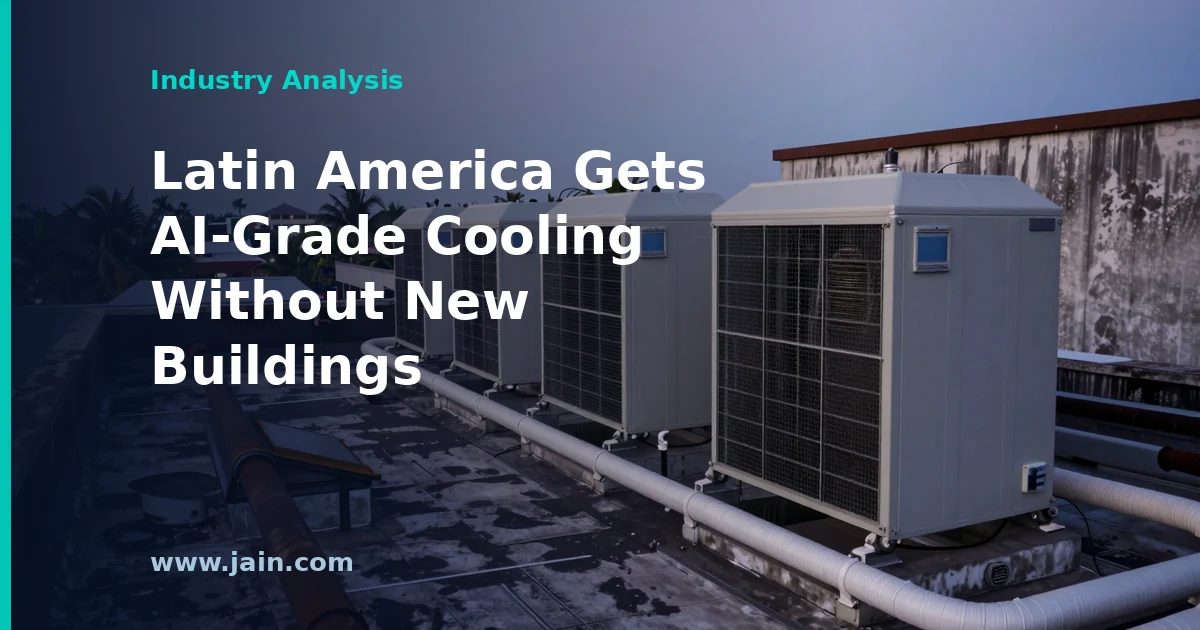
Data Center Dynamics reported that OData is installing DeltaFlow, a proprietary liquid cooling system developed by its parent company Aligned Data Centers with the power and cooling vendor Munters, at its SP04 data center in Brazil and its QR03 facility in Mexico. The project is priced at $630 million across the two sites, and phase one installation and testing is already underway at both.
Both facilities already run Aligned’s Delta Cubed air cooling system. DeltaFlow will let them operate as hybrid halls — air cooling for conventional servers, liquid cooling for the high-density racks that AI accelerators require. The DeltaFlow units are manufactured at Munters’ plant in Araucária, in the Brazilian state of Paraná.
Executive Summary
This is a retrofit, not a groundbreaking. OData is adding direct liquid cooling — coolant carried to a plate sitting on the processor itself, rather than chilled air pushed across a room — to two data centers that are already built, already powered and already in service. That distinction is the whole economic argument. Liquid cooling is what allows a rack to draw the tens of kilowatts that AI accelerators consume, and the fastest route to that capability is almost always a building that already exists.
The $630 million figure is unusually large for a project described in terms of cooling, which suggests scope well beyond swapping chillers: retrofits of this type typically pull in electrical distribution, floor loading, piping, heat rejection and controls. The release does not break the number down, and it does not state how much liquid-cooled capacity the spend produces.
The second thread is manufacturing. DeltaFlow is built at a Munters factory in Paraná, inside Brazil. Long-lead mechanical equipment has been one of the more stubborn schedule constraints in data center construction, and supplying a Brazilian deployment from a Brazilian plant removes ocean freight and customs from that path.
The Retrofit Is the Point
OData’s two target sites are not new. The release states that both already operate Aligned’s Delta Cubed air cooling, and that DeltaFlow will enable them to run as hybrid air-and-liquid facilities catering to high-density AI racks. In plain terms: the buildings were designed for servers that a stream of cold air could keep in range, and they are being upgraded for servers that it cannot. A modern AI accelerator rack concentrates heat in a volume where moving enough air becomes impractical and expensive long before it becomes impossible, which is why coolant is brought to the chip instead.
What that changes operationally is the pacing item. A new data center is gated by land, permits, construction and — most painfully in the current cycle — a grid connection, the queue to get utility power delivered to the site. A retrofit inherits all of those. The gate becomes mechanical installation and commissioning inside a shell that already has power, floor, network and security in place. That is measured in a fit-out schedule rather than a development schedule, and it is the reason a hybrid upgrade can put dense capacity into a market faster than any greenfield project competing for the same customer.
The people this reaches are buyers in Brazil and Mexico who want to train or serve AI models on machines physically located in the region — for latency, for data residency, or simply because capacity elsewhere is spoken for. The release confirms the capability is coming and that work has begun. It does not say how many megawatts of liquid-cooled capacity results, or what rack density in kilowatts the halls will support, so the size of that advantage cannot yet be measured from the outside.
$630 Million Is a Building Number, Not a Chiller Number
The figure is given for the project across both sites, without itemisation. It is worth being precise about what a cooling retrofit actually involves, because the headline number only makes sense at that scope. Introducing liquid cooling into a live air-cooled hall generally touches the electrical distribution feeding denser racks, the structural loading of the floor, the piping and manifolds that carry coolant, the heat rejection plant outside the building, the water or refrigerant management behind it, and the control systems that have to run two cooling regimes at once without either interfering with the other — all while the existing customers stay online.
What is substantiated here is a capital commitment of a stated size, a named technology, two named facilities and work that has begun. What is not substantiated is the unit economics. Without a capacity figure, there is no cost per megawatt, and cost per megawatt is precisely the number that would tell a buyer or an investor whether upgrading beats building. That is a disclosure question for OData and Aligned, not a flaw in the underlying project.
There is a strategic read in how the system is sourced. Aligned designed DeltaFlow itself, with Munters, rather than buying merchant coolant distribution units off a catalogue. For a group operating across several countries, a single in-house platform means common spares, common training and a repeatable commissioning process — real advantages when you are staffing facilities in four national markets. The trade-off is concentration: the platform’s roadmap, and the factory behind it, become a dependency.
The Factory in Paraná Is Part of the Infrastructure Story
DeltaFlow is manufactured at Munters’ plant in Araucária, Paraná, in southern Brazil. That detail does more work than it first appears to. Across the industry, the binding constraint on data center schedules has repeatedly been long-lead mechanical and electrical equipment rather than chips or capital. Supplying a Brazilian deployment from a Brazilian factory takes ocean freight, port handling and import clearance out of the critical path for at least one of the two sites.
Mexico is still a cross-border shipment, so the benefit is not symmetrical. But the same production line and the same platform serve both, and Munters’ Keith Dunnavant framed the company’s global manufacturing footprint as what allows it to support Aligned and OData as they expand across Latin America. A manufacturing presence in-region also tends to bring service technicians and spare parts inventory with it, which matters more for liquid systems than air ones: a leak or a pump failure in a liquid loop is a faster-moving problem than a failed fan.
Neither company has quantified the plant’s output or said whether any of it is reserved for this project, so the supply-chain advantage is directional rather than measured.
What It Signals About Latin American Colocation
OData was founded in 2015 by the Brazilian private equity firm Patria Investments and acquired by Aligned Data Centers in May 2023. It runs facilities in Chile, Colombia, Brazil and Mexico with more in development. This deployment is, in effect, technology transfer from a North American operator into a regional platform it now owns — the same pattern the company followed with Delta Cubed on the air side.
OData chief executive Ricardo Alário described the goal as establishing DeltaFlow as the market benchmark for liquid cooling in the region. That is an ambition rather than a disclosed market position, and it should be read as one. What the announcement does establish is concrete and checkable: a stated sum, two identified sites, a named manufacturing source and construction in progress. What it does not establish is demand. No anchor customer, pre-lease or contracted capacity has been disclosed, and a retrofit can be built ahead of committed tenants as easily as behind them.
For competing operators in the same two markets, the practical effect is that rack density moves onto the specification sheet. Once one regional provider can quote liquid-cooled halls, requests for proposals start asking every provider what they can support per rack — and the answer for an air-only site is a hard ceiling that no amount of floor space compensates for.
Background
OData was founded in 2015 by Patria Investments, a Brazilian private equity firm, and grew into one of the region’s larger colocation platforms — operators that lease space, power and cooling to companies that prefer not to run their own facilities. Aligned Data Centers, a US operator known for developing its own cooling technology rather than buying it, acquired OData in May 2023. OData now runs facilities in Chile, Colombia, Brazil and Mexico with further sites in development, and has been the route by which Aligned’s in-house systems reach Latin American markets: the same two data centers receiving DeltaFlow already run Aligned’s Delta Cubed air cooling.
The wider context is the shift in what a data center has to physically accommodate. For two decades, racks drew a few kilowatts each and chilled air sufficed. AI accelerators have pushed rack power an order of magnitude higher, past the point where air can economically carry the heat away. That has made cooling — historically an engineering afterthought to power and space — a gating factor on whether a given building can host AI workloads at all, and it has turned retrofits of existing, already-powered facilities into one of the faster routes to new AI-capable capacity. Source: OData to deploy Aligned’s DeltaFlow liquid cooling system at Brazil and Mexico data centers — reporting on the $630 million deployment of Aligned’s DeltaFlow liquid cooling at OData’s SP04 facility in Brazil and QR03 facility in Mexico, including comment from OData and Munters.Sources