Tag: dark fiber

  • WhiteFiber’s 83 km, 136 Tbps Link Bets Fiber Can Pool AI Power Across Sites

    WhiteFiber’s 83 km, 136 Tbps Link Bets Fiber Can Pool AI Power Across Sites

    TL;DR · 30-second read

    The Short Version

    WhiteFiber, a company that rents out computing power for artificial intelligence, is now selling a way to make two data centers about 50 miles apart work as one giant computer. The two buildings are joined by a bundle of fiber-optic cables.

    Why it matters: the computers that train artificial intelligence are often limited by how much electricity a single building can get. WhiteFiber’s idea is to combine spare electricity at several existing buildings instead of building one enormous new site.

    The top speed is still being tested, and no customers have been named yet.

    StorageReview reported on September 25 that WhiteFiber (WYFI) has made WhiteFiber Continuum commercially available. Continuum is the productized version of Project Redwood, a two-site GPU supercluster the company first detailed in July. It links two HITRUST-certified QTS data centers 83 kilometers apart over 12 Zayo dark fiber strands, with DriveNets supplying the Ethernet network fabric and WEKA’s NeuralMesh supplying shared storage and memory.

    WhiteFiber rates the architecture at 136 Tbps of aggregate bandwidth, which it describes as 170 wavelength channels of 800 gigabits per second each, with 0.9 milliseconds of guaranteed round-trip latency. The July research result measured 111.2 Tbps on part of the fiber spectrum. Full-spectrum testing to confirm the guaranteed commercial specifications is underway, and the company has submitted patent applications for the implementation.

    Executive Summary

    WhiteFiber is selling a way to make GPUs in two separate buildings behave like a single cluster. GPUs are the chips that train and run AI models, and large training jobs have normally been confined to one building because the chips have to exchange data constantly. Continuum stretches that boundary to 83 kilometers by carrying the traffic over leased, unlit fiber that WhiteFiber lights itself, which the industry calls dark fiber.

    The launch matters because of what WhiteFiber says the design is for. The company pitches Continuum as a way to get past the power and space ceiling of a single campus. Enterprises would pool GPUs across sites, and telecom and metro facilities with spare power could contribute capacity to one logical cluster. If that works at the stated performance, the useful unit of AI capacity is no longer one building with enough electricity. It is any set of buildings connected by enough fiber.

    The headline number still needs confirmation. The 136 Tbps figure is a design rating that depends on additional wavelengths coming online and on full-spectrum testing now in progress. The figure WhiteFiber has actually measured is 111.2 Tbps, taken in July on part of the spectrum.

    Fiber as a Way Around the Single-Site Power Ceiling

    AI capacity is increasingly set by power: how many megawatts a single building or campus can draw. A megawatt is a million watts, and a large GPU campus uses many of them. A company that has filled its power allocation at one site usually faces a choice between waiting for more grid capacity and building a new campus from scratch. WhiteFiber offers a third option. Continuum lets enterprises pool GPUs across sites and add overflow training and inference capacity without a separate greenfield deployment. It also lets telecom and metro facilities with spare power and fiber join the same logical cluster.

    The design choice that makes this plausible is what crosses the link. According to WhiteFiber’s product page, both sites carry live traffic at the same time and only model gradients cross the 83 km connection. Gradients are the incremental updates each group of GPUs computes during training. The bulk of the work and data stays local to each site, and the two halves synchronize their learning over the fiber. A single job can span both sites, or the cluster can be split into independent workloads that burst from one site to the other as demand shifts.

    Fiber does not create power. It lets power that already exists in two places be used by one workload. The groups most affected are operators whose sites have stranded capacity, such as telco central offices and metro facilities with power to spare but too little of it to host a full cluster. Fiber owners like Zayo, whose dark fiber becomes part of the compute fabric, stand to gain as well. Enterprises that have maxed out a campus are the third group. Whether this changes where AI capacity gets built will depend on how much of a real training job’s performance survives the split, and WhiteFiber has not yet published that comparison.

    What 136 Tbps Establishes, and What It Does Not Yet

    The internal arithmetic holds together. 170 wavelength channels at 800 gigabits per second each come to 136 terabits per second. Dense wavelength-division multiplexing sends many separate colors of light down the same fiber strands, each carrying its own data stream. Adding wavelengths is how the design scales from the 111.2 Tbps measured in July to the 136 Tbps now rated.

    The status of the number matters to buyers. WhiteFiber says the design reaches 136 Tbps after additional wavelengths come online, and that full-spectrum testing is underway to confirm the guaranteed commercial specifications. Enterprises evaluating Continuum should treat 111.2 Tbps as the demonstrated figure and 136 Tbps as the contracted target until test results are released.

    The latency figure tells a different story. WhiteFiber guarantees 0.9 milliseconds round trip, which it says is within 8% of the physical limit for light in fiber over 83 km. There is little left to optimize, so distance itself is the fixed cost of the architecture. Longer links between sites add latency in proportion to distance. The 83 km result shows the approach works at metro-to-regional range, and it says nothing yet about sites much farther apart.

    Resilience and Data Boundaries as the Enterprise Pitch

    Continuum is also sold as a resilience and compliance product. WhiteFiber says neither site is a single point of failure, so training runs are designed to continue if one location goes down. For regulated industries, it says sensitive workloads can stay within their originating jurisdiction while failover and pooled compute happen across locations. HITRUST is a security and privacy certification framework widely used in healthcare, and the certification of both QTS facilities is aimed at that audience.

    CEO Sam Tabar framed the product around both themes, saying it is for enterprises that need AI compute to “hold up under compliance requirements, and not break when a single site has a problem.” These are credible goals for a two-site design. They are also claims about behavior under failure, and no failure test results have been released.

    A Partner Stack With a Patent Claim on Top

    Continuum is assembled from named partners. QTS provides the facilities, Zayo the fiber, DriveNets the Ethernet-based network fabric, and WEKA the shared storage and memory layer. WEKA CEO Liran Zvibel said NeuralMesh lets GPUs that sit many kilometers apart “operate as if the data were local.” DriveNets said its fabric is built to maximize GPU utilization across scale-across superclusters. Using Ethernet rather than proprietary interconnects for the inter-site fabric keeps the design within a widely supported networking standard.

    WhiteFiber calls Continuum the first commercially available distributed GPU supercluster architecture and has submitted patent applications for the implementation. Submitted applications are not granted patents. Because most of the stack comes from third-party vendors, WhiteFiber’s lasting advantage will likely come from its integration and operating know-how, and from customer contracts once it signs them.

    Background

    WhiteFiber, which trades under the ticker WYFI, provides AI infrastructure. In July it detailed Project Redwood, a research effort that connected GPUs in two data centers 83 km apart and measured 111.2 Tbps across the link. Its partners are well-established infrastructure suppliers. QTS operates data centers, Zayo owns and leases fiber networks, DriveNets builds Ethernet networking for AI clusters, and WEKA makes high-performance data storage software.

    Large AI models have traditionally been trained inside a single building. The GPUs doing the work exchange data constantly, and longer distances add delay. As single campuses run up against limits on how much power and space they can secure, operators have looked for ways to spread one workload across several sites. Continuum is WhiteFiber’s commercial answer to that problem.

    Sources

    Source: WhiteFiber Continuum Goes Commercial, Scaling Its 83 km Two-Site GPU Supercluster Design to 136 Tbps (StorageReview.com): WhiteFiber makes its two-site, 83 km GPU supercluster architecture commercially available with a rated 136 Tbps of inter-site bandwidth.

  • 1,200-Mile Midwest Fiber Corridor Rides Old Rock Island Rail Lines

    1,200-Mile Midwest Fiber Corridor Rides Old Rock Island Rail Lines

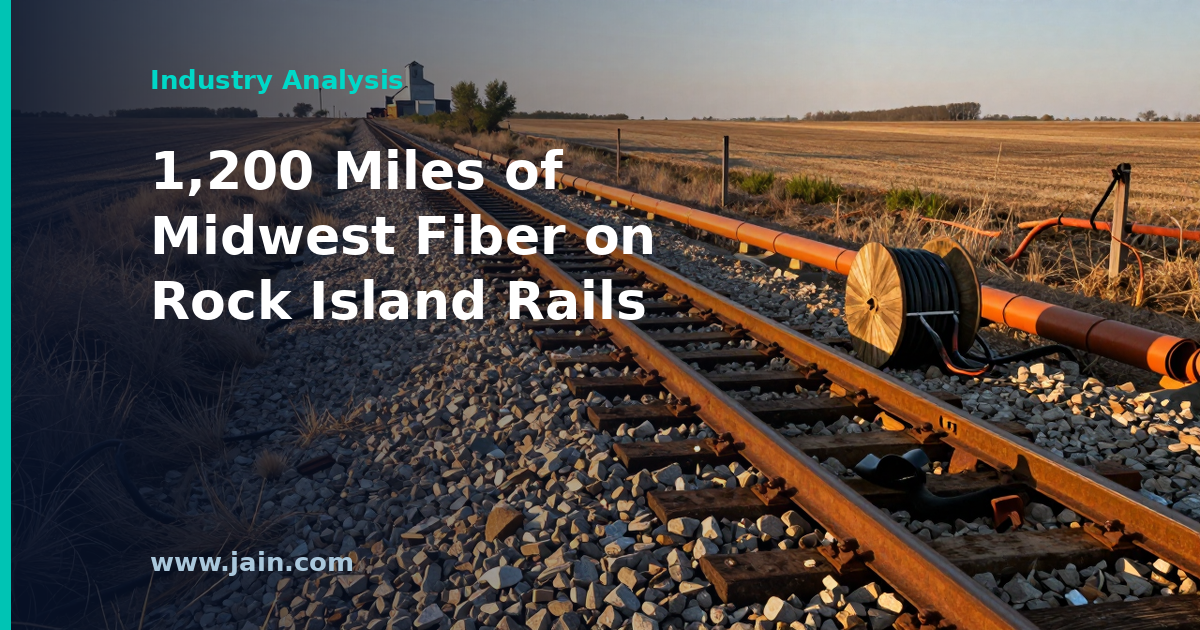
    Midwest Fiber Networks (MWFN) and Midwest Fiberpath, LLC, together with Fiberpath partner Hawkeye Land Co., announced on August 27, 2026 an agreement to develop and commercialize approximately 1,200 miles of fiber corridors connecting Chicago, Omaha, Minneapolis and Kansas City. The announcement was issued from Glendale, Wisconsin and Cedar Rapids, Iowa.

    Under the agreement, MWFN becomes the key provider supporting commercialization and delivery of connectivity services across Hawkeye’s right-of-way corridor, with planned offerings spanning conduit, dark fiber and scalable lit services for carriers, hyperscalers, data centers, enterprises, utilities, and public- and private-sector organizations. Construction is anticipated to begin in Spring 2027; the parties say the project is in advanced engineering and materials procurement, with shipments scheduled before the end of 2026.

    Executive Summary

    The headline number is 1,200 miles of long-haul fiber route across the middle of the country. The more interesting number may be 106 — the count of Midwest counties in four states where Hawkeye Land Co. says it holds the exclusive, perpetual right to grant easements along former Rock Island Railroad corridors. That includes rail corridors running from Council Bluffs to Joliet and from Minneapolis to Kansas City. In long-haul fiber, the hardest thing to buy is not glass or conduit; it is a continuous, legally clean path across hundreds of separate landowners and jurisdictions. This agreement is essentially an attempt to convert a 40-year-old land-rights portfolio into a telecom platform.

    Why it matters: the AI buildout is pushing compute into secondary and tertiary markets — places chosen for power availability and land, not for network density. Those sites are only as useful as the routes that connect them, and in the Midwest a large share of legacy long-haul capacity funnels through Chicago. A route system with north–south and east–west legs that meet somewhere in the middle of Iowa rather than in Cook County changes the shape of what buyers can procure, and gives network planners a genuinely distinct path to price against.

    What is not yet established: the release discloses no capital cost, no financing structure, no anchor customers, no conduit or fiber counts, and no in-service date. It describes an agreement and an intent, backed by a stated procurement position. Those are meaningful signals — materials orders are harder to fake than a press release — but they are not the same as a funded, contracted build. Buyers should treat this as a credible route under development, not as available inventory.

    Route Diversity Is the Quiet Half of the AI Buildout

    Most coverage of AI infrastructure focuses on the compute: the campuses, the megawatts, the cooling. The connectivity layer gets less attention because it is less photogenic, but it constrains the same outcomes. A training cluster needs to ingest and checkpoint enormous datasets; an inference site needs low, predictable latency to the users and applications it serves. Both need to reach the interconnection points where carriers and cloud providers exchange traffic. Put a facility in a secondary market with cheap land and available power, and you have solved the expensive problem while creating a new one — the site is stranded unless multiple physically separate fiber paths reach it.

    “Route diversity” is the industry term for that separation. Two circuits sold as redundant are only redundant if they ride different physical paths; if both traverse the same bridge, the same conduit bank, or the same metro chokepoint, one backhoe or one building fire takes out both. In the Midwest, a great deal of legacy long-haul was engineered to converge on Chicago, historically the region’s dominant interconnection hub. That concentration is efficient until it isn’t. The announced corridor is pitched squarely at this problem, and the endpoint pairs Hawkeye names — Council Bluffs to Joliet, Minneapolis to Kansas City — describe an east–west leg and a north–south leg that cross well outside the Chicago metro.

    It is worth being precise about the claim, though. Chicago is explicitly one of the four markets the corridor connects, and the Council Bluffs–Joliet leg terminates in the Chicago area. The value proposition is not “avoid Chicago”; it is “reach Chicago on a path other people are not using, and reach Minneapolis or Kansas City without going through Chicago at all.” That is a narrower but more defensible pitch, and it is the one that matters to a network planner filling out a diversity matrix.

    The Asset Is the Right-of-Way, Not the Glass

    Fiber cable is a commodity. Splicing crews are a commodity. Continuous, permitted, long-term access to a linear path across four states is not. Hawkeye Land Co. has been in the business of selling crossing and longitudinal easements along former Rock Island corridors since 1985, which means the entitlement work that usually dominates a greenfield long-haul schedule — negotiating with hundreds of landowners, counties and agencies, one parcel at a time — is substantially pre-solved. That is the economic core of this deal, and Hawkeye’s CEO Rick Stickle framed it in exactly those terms, calling the partnership “the highest and best” use of the company’s property rights.

    The structure also explains the division of labor. Hawkeye holds the land rights but is not a telecom operator. Fiberpath is positioned as the corridor platform developer — a managed right-of-way system built for blank conduit and dense fiber deployments. MWFN brings the operating side: regional carrier relationships, service delivery, and the customer-facing commercial motion. Each party contributes the thing it would otherwise have to spend years and considerable capital acquiring. That is a sensible structure, and it is a common one in digital infrastructure, where land-rights holders increasingly partner rather than build.

    The risk in this shape is coordination. Three parties, three balance sheets, and revenue that arrives over decades in the form of long-dated capacity contracts. The release does not describe how economics are shared, whether MWFN’s role is exclusive, or what happens if one party wants to sell. None of that is unusual to withhold, but all of it affects how much confidence a large customer can place in a 20-year commitment on this route.

    Three Products, Three Different Businesses

    The announced service set — conduit, dark fiber, and lit services — reads as one offering but is really three businesses with different capital profiles and different buyers. Empty conduit is the rawest form: a buried plastic pipe a customer can blow its own cable through, typically sold to hyperscalers and large carriers who want to control their own fiber and upgrade it on their own schedule. Dark fiber is unlit strand: the customer supplies the optical electronics and gets full control of capacity, latency and encryption, which is why it appeals to operators building at scale. Lit services are finished bandwidth — the provider runs the equipment and sells a circuit at a stated speed.

    The economics run in the opposite direction from the sophistication. Conduit and dark fiber sales, often structured as long-term indefeasible-right-of-use agreements with substantial payment up front, are how corridor projects fund construction; they convert future revenue into present cash at the moment it is most needed. Lit services carry higher margins over time but require ongoing equipment investment, network operations, and a sales motion into a fragmented enterprise market. A route system that can sell all three has more ways to monetize each mile — but the first and largest deals almost always come from the conduit and dark-fiber end, which is exactly where hyperscaler demand currently sits.

    What Is Substantiated, and What Is Framing

    Two things in this release carry real weight. First, the Hawkeye rights are specific and checkable: an exclusive, perpetual easement-granting position across named corridors, held and commercially exercised for more than 40 years. Second, the procurement statement — advanced engineering and materials shipments scheduled before the end of 2026, ahead of a Spring 2027 construction start — implies committed spending. Companies do not typically order long-lead fiber and conduit materials for routes they are not serious about.

    Other elements are framing rather than fact. This release does not mention AI at all; the AI positioning comes from a companion Fiberpath announcement describing the same 1,200 miles as a “center-noded, multi-direction AI backbone.” That is a legitimate market read — AI demand is genuinely reshaping long-haul procurement — but readers should note it is the same asset described twice for two audiences, not two separate developments. Similarly, phrases like “key provider supporting the commercialization” describe a commercial role without defining its scope or exclusivity.

    An even-handed summary: this is a well-structured deal built on an unusually strong underlying asset, announced at the agreement stage with normal commercial confidentiality. It is not thin marketing — there is a real land-rights position and a stated procurement commitment behind it. It is also not yet a proven route. The distance between “agreement to advance” and “lit and sellable” is measured in years, and the milestones that would close that gap have not been published.

    Background

    The Chicago, Rock Island and Pacific Railroad ceased operations in 1980, and its corridors were broken up and sold. Hawkeye Land Co. was formed in 1985 around a durable piece of that estate: the exclusive, perpetual right to grant easements along the former Rock Island corridors across 106 Midwest counties in four states. For four decades that position has generated revenue from utilities and municipalities buying crossing and longitudinal easements. Railroad rights-of-way have long been prime telecom real estate for the same reason they were good railroad routes — they are straight, continuous, gently graded, and already assembled.

    The current interest in Midwest long-haul reflects where compute is going. Power availability, land cost and cooler climates have pushed data center development into Iowa, Nebraska, Wisconsin and the Dakotas, away from the coastal and Northern Virginia clusters. Those sites need long-haul routes that did not exist when the region’s fiber map was drawn around Chicago in the late 1990s and early 2000s. Several developers are now trying to monetize legacy linear rights-of-way to serve that demand; this agreement is one of them.

    Source: Midwest Fiber Networks and Midwest Fiberpath Announce Agreement to Advance 1,200-Mile Midwest Fiber Corridor — PR Newswire release dated August 27, 2026, announcing an agreement to develop and commercialize approximately 1,200 miles of fiber corridors across the Midwest.

  • Verizon’s $1B+ Google Deal Shows Why Old Telecom Fiber Is Now AI Infrastructure

    Verizon’s $1B+ Google Deal Shows Why Old Telecom Fiber Is Now AI Infrastructure

    TL;DR · 30-second read

    The Short Version

    Verizon, best known for phone service, will supply Google with unused fiber-optic cable in a deal worth more than $1 billion. Fiber-optic cables are glass lines that carry internet traffic as pulses of light.

    Google needs the cable to link its data centers, the warehouse-sized buildings full of computers that run artificial intelligence. Those buildings must constantly swap huge amounts of data.

    The surprise is that much of this cable was laid for an older internet. Artificial intelligence has turned it into something worth a fortune, and Verizon says more deals worth billions are coming this year.

    Verizon Communications has signed a dark fiber agreement with Alphabet’s Google worth more than $1 billion, Quartz reported. CEO Dan Schulman disclosed the deal on Verizon’s second-quarter earnings call on Friday, July 24, 2026. Under the agreement, Verizon will provide dark fiber to connect Google’s data centers.

    Schulman said Verizon expects to announce additional AI infrastructure agreements by year-end that would generate multiple billions of dollars in revenue over the next several years. Verizon shares rose more than 3% in Friday’s opening trade, and Alphabet’s Class A shares gained about 1%.

    Executive Summary

    Verizon is selling Google access to dark fiber, meaning optical cable with no transmission equipment attached, which Google will light with its own gear to link its data centers. The disclosed value is more than $1 billion. Schulman called the announcement “consequential” and a preview of where Verizon’s revenue trajectory is headed.

    The deal matters beyond one contract. Schulman argued that Verizon’s long-haul and metro fiber, originally built for a different technological era, now fits precisely what is needed to connect AI data centers, compute clusters and geographic regions. If he is right, fiber routes already in the ground are becoming a strategic input to AI buildouts, alongside power and chips, and carriers holding those routes gain a new class of long-term customer.

    What remains unproven is scale. One deal is disclosed; the “multiple billions” are a forecast. The year-end pipeline is what will show whether this is a durable revenue line or a single large transaction.

    Why Fiber Built for Another Era Now Sells as AI Infrastructure

    Dark fiber is the rawest form of network capacity a carrier can sell: strands of glass with no lasers or routers attached. The buyer installs its own optical equipment at each end, decides how much data to push through, and upgrades on its own schedule. For a company like Google, that means the capacity between its sites is set by its own engineering choices rather than by a carrier’s service tiers, which is why large cloud operators favor it for their most important links.

    AI changes how much those links matter. Large AI workloads increasingly span multiple buildings and regions, so data centers must move enormous volumes of data between one another. Schulman’s claim is that Verizon’s network, though built for an earlier era, fits “precisely” what is needed to link AI data centers, compute clusters and geographic regions. The operational point is that the glass itself is rarely the scarce part. The scarce parts are the installed routes, rights-of-way and permits, which take years to assemble and which an incumbent carrier already holds. A more-than-$1 billion commitment from Google is a concrete price signal that those existing routes now carry AI-era value.

    That reprices assets across the industry. Other owners of long-haul fiber now have a public comparable for what a hyperscaler will commit. Data center developers have another reason to weigh proximity to established fiber corridors alongside power availability. And for hyperscalers, leasing proven routes is one way to connect new campuses without waiting on new construction.

    A Billion-Dollar Headline Without the Fine Print

    Markets took the news seriously. Verizon stock rose more than 3% at Friday’s open, a notable move for a large, mature telecom carrier, and Alphabet’s Class A shares gained about 1%. Investors appear to be reading the deal as evidence that Verizon can earn growth revenue from assets it already owns, rather than only from its consumer wireless business.

    The economics are harder to judge than the headline. “More than $1 billion” does not say over how many years that value is earned, how many route miles or strands are involved, or whether payment is largely upfront or spread across the term. Dark fiber deals can carry attractive margins when the cable is already in the ground, but Verizon has not said how much new construction, such as short connecting routes to Google’s sites, the agreement requires. Those details determine whether this is a high-margin monetization of sunk investment or a capital project with a customer attached.

    The Year-End Test for Verizon’s AI Pitch

    Schulman framed Google as the beginning, not the peak. He said additional agreements expected by year-end would generate multiple billions of dollars in revenue over the next several years, describing them as stable, extended-term arrangements with some of the most technically rigorous customers in infrastructure. That is a specific, checkable commitment, and it will define how the Google deal is judged.

    There are structural limits to watch. Dark fiber inventory is finite: a strand provided to one customer is not available to another, so sustained growth eventually depends on how much spare capacity Verizon holds on the routes AI customers want, or on building more. Hyperscalers also have alternatives, including other fiber owners and their own construction, which will shape pricing. None of this undercuts the Google deal; it frames the question of whether a network built for an earlier era can supply AI demand at the scale Schulman describes.

    Background

    Verizon Communications is one of the largest US telecom carriers, known mainly for wireless and broadband service. It also owns long-haul fiber connecting cities and regions and metro fiber within urban areas. Schulman, now CEO, argues that this network, originally built for a different technological era, suits the connectivity needs of AI data centers.

    Google, owned by Alphabet, is one of the hyperscalers building large-scale AI infrastructure. As AI computing spreads across multiple campuses and regions, the network links between data centers have become a strategic requirement. Large cloud operators commonly buy dark fiber on long-term agreements and light it with their own equipment, keeping control of capacity and upgrades.

    Sources

    Source: Verizon lands a $1 billion-plus dark fiber deal with Google for AI data centers (Quartz), covering Verizon’s second-quarter earnings call disclosure of its dark fiber agreement with Google.

  • Google-Telstra Pact on 3 Subsea Cables Shows Why AI Resilience Is Also Won Onshore

    Google-Telstra Pact on 3 Subsea Cables Shows Why AI Resilience Is Also Won Onshore

    TL;DR · 30-second read

    The Short Version

    Google and Telstra, Australia’s leading phone and internet company, have agreed to use each other’s cables.

    Google gets strands of fiber on Telstra’s new cross-country network, already more than 8,000 kilometers long, or roughly twice the drive from Sydney to Perth. Telstra gets space on three undersea cables that are part of Google’s Pacific programs, linking Australia to Japan, the Pacific Islands and the United States.

    Why it matters: if one cable is cut, internet and artificial intelligence services can reroute instead of going dark. Neither company said what the deal is worth.

    Google and Telstra announced a partnership on June 1, 2026, that connects the two companies’ networks on land and at sea. Google will secure inter-city dark fiber, which is unlit fiber that the buyer switches on with its own equipment, on Telstra’s new Aura Network backbone. In return, Telstra will use subsea fiber pairs on the Tabua, Proa and Bulikula cable systems through Google’s Pacific Connect and Australia Connect initiatives. Those cables link Australia with Japan, the Pacific Islands and the United States.

    The deal was announced jointly by Bikash Koley, Google’s Vice President of Global Infrastructure, and Steven Worrall, CEO of Telstra Digital Infrastructure. Worrall said Aura has more than 8,000 kilometers of fiber already laid, and that its Melbourne-Canberra-Sydney coastal routes launched late last year. The companies did not disclose financial terms, capacity volumes or in-service dates.

    Executive Summary

    This is a reciprocal infrastructure arrangement, and it is not a conventional supply contract. Each company takes access to the half of the network the other one is building. Google is a major builder of subsea cable, and it gains terrestrial backbone across Australia’s key inter-city corridors. Telstra owns the country’s most extensive domestic network, and it gains fiber on three international systems that reach Japan, the Pacific Islands and the United States.

    The stated goal is resilience. The companies say that joining their land and sea routes will let each of them ‘remove single points of network failure.’ The underlying argument is an operational one that often gets lost in AI-infrastructure coverage. Diverse ocean cables do not add much resilience if the traffic they carry funnels into the same stretch of fiber once it reaches shore.

    For Australian enterprises, government agencies and cloud customers, the practical promise is more redundant paths in and out of the country and between its major cities. The companies have not yet said how much capacity is involved or when it becomes usable.

    The Shoreline Is Where Diversity Is Won or Lost

    A subsea cable comes ashore at a landing station, and from there its traffic still has to travel overland, over terrestrial fiber, to data centers, exchanges and cities. Network engineers call the full path end-to-end diversity. If two separate ocean cables land in different places but their inland backhaul runs through the same conduit or corridor, a single construction accident can cut both. The ocean diversity bought at great cost is lost a few kilometers from the beach.

    The Google-Telstra deal is built around that problem. Google already has subsea reach into the region through Tabua, Proa and Bulikula. What it lacked was inter-city capacity on land that it controls. It chose dark fiber, which means it lights the strands with its own optical equipment and sets capacity and upgrade timing itself, and it chose it on a new backbone that is physically separate from older routes. Telstra had the domestic network but wanted more international exits. The release states that integrating the two lets ‘Telstra and Google each remove single points of network failure.’ That is the substance behind the AI framing. As AI services depend more on moving data between Australian cities and overseas compute, a cable cut costs more, and the fix involves the land side as much as the sea side.

    Several groups are affected. Google’s Australian users and cloud customers get more alternative routes if a path fails. Telstra’s enterprise and government customers get more options for international traffic. Other carriers and cloud providers face a competitor pair that now controls diversity at both ends of the path. This is one deal, so it is not proof of an industry trend. It is a clear example of how a hyperscaler, meaning one of the largest cloud operators, and a national carrier can split the build instead of each duplicating the other’s half.

    A Two-Way Exchange of Scarce Assets

    The structure is notable because each company offers something that is slow and expensive to replicate. Laying new inter-city fiber across Australia takes years of trenching, permits and landholder negotiations. Building a trans-Pacific cable takes consortium financing, marine surveys and cable-ship time. By exchanging access, each company avoids building the other’s specialty. Long-haul fiber and subsea capacity commonly change hands through long-term rights of use. The companies have not said whether cash, capacity or both are involved in this deal.

    For Telstra’s Aura build, a hyperscaler taking dark fiber serves as an anchor tenant, a large customer whose commitment helps justify the network. Worrall tied the deal to Aura’s momentum and to ‘sustainable, disciplined growth.’ That suggests the company sees Google as validation for the backbone’s economics. How much of Aura’s capacity Google has taken, and on which routes, has not been said.

    What Is Substantiated and What Is Aspiration

    Some claims are concrete. These include the named cable systems and their destinations, the dark-fiber arrangement on Aura, Aura’s more than 8,000 kilometers laid, and the launch of the Melbourne-Canberra-Sydney coastal routes. The resilience mechanism is also sound network engineering.

    Other claims are broader and harder to test. These include the partnership being ‘a significant step forward in securing Australia’s digital and AI future,’ Australia’s role as a ‘regional connectivity hub,’ and the link to ‘the next industrial revolution.’ The release does not quantify AI traffic growth, capacity added, or any change in latency or availability. These are reasonable ambitions for a well-connected market. Readers should weigh them as direction rather than as measured outcomes.

    Background

    Australia’s geography makes it heavily dependent on subsea cables for international traffic. Its population is concentrated in a few coastal cities linked by long terrestrial fiber routes. That combination makes route diversity, both at sea and on land, a recurring concern for carriers, cloud providers and government. Telstra is Australia’s largest telecommunications company. Its Telstra Digital Infrastructure unit is building Aura, a new inter-city fiber backbone.

    Google, a subsidiary of Alphabet, has become one of the most active investors in subsea cables worldwide. It uses them to connect its data centers and to serve cloud and consumer products. Through its Pacific Connect and Australia Connect initiatives, it has backed new systems linking Australia with Japan, the Pacific Islands and the United States, including Tabua, Proa and Bulikula.

    Sources

    Source: Google and Telstra Partner to Connect Australia and Bolster its Digital Future: Google Cloud Press Corner announcement of the Aura dark-fiber and Tabua, Proa and Bulikula subsea partnership.

  • Zayo Closes $4.25B Crown Castle Fiber Deal, Redrawing the US Long-Haul Map

    Zayo Closes $4.25B Crown Castle Fiber Deal, Redrawing the US Long-Haul Map

    Zayo Group has completed its $4.25 billion acquisition of Crown Castle’s fiber business, according to a May 2, 2026 report from Fierce Network. The close finalizes a transaction first announced in March 2025, when Crown Castle agreed to exit fiber entirely by splitting the segment between Zayo, which took the fiber solutions business, and EQT, which took the small-cell operations, in a combined deal valued at roughly $8.5 billion.

    The completion makes Zayo — already one of North America’s largest independent bandwidth-infrastructure providers — a substantially bigger force in both long-haul and metro fiber, while returning Crown Castle to its roots as a pure-play wireless tower company.

    Executive Summary

    The announcement itself is short: the deal has closed. But the closing matters more than most, because it formally redraws the ownership map of US fiber at a moment when fiber has shifted from a commodity business to a strategic one. Long-haul fiber — the high-capacity routes that carry traffic between cities — and metro fiber — the dense local networks that connect buildings, data centers, and cell sites within a city — are both being repriced by the AI build-out, as hyperscalers and data center developers scramble to connect new campuses.

    For Zayo, the acquisition is a bet that scale wins in that environment: more routes, more conduit, more on-net buildings, and more ability to sell end-to-end connectivity to the customers spending most aggressively. For Crown Castle, it is the final step in unwinding a decade-long fiber strategy that the market never rewarded, refocusing the company on towers. Two companies looked at the same asset class and reached opposite conclusions — which is precisely what makes this deal worth watching.

    Fiber Is Having Its Moment — and Zayo Is Consolidating Into It

    For most of the 2010s, long-haul fiber was treated as a mature, low-growth business: capacity was abundant, prices declined steadily, and the assets traded hands repeatedly among private-equity owners. The AI infrastructure cycle has changed that calculus. New data center campuses are being sited in secondary and rural markets where power is available but fiber often is not, and connecting those sites — to each other and to major interconnection hubs — requires exactly the kind of route diversity and dark fiber (unused fiber strands leased whole, rather than as managed bandwidth) that Zayo sells.

    Absorbing Crown Castle’s fiber business gives Zayo a much denser metro footprint to pair with its national backbone. In connectivity, density compounds: the more buildings and data centers a provider can reach on its own network, the more of each customer’s traffic it can carry without paying another carrier, and the better its margins and win rates. That logic, not nostalgia for telecom assets, is what a $4.25 billion price tag implies.

    Two Readings of the Same Asset

    The striking feature of this transaction is the strategic divergence it crystallizes. Crown Castle spent heavily to build its fiber segment in the mid-2010s — including the reported $7.1 billion purchase of Lightower in 2017 — on the thesis that fiber and small cells would complement its tower business. Investors, including prominent activist shareholders, ultimately disagreed, arguing the fiber business consumed capital while earning returns below the tower segment’s. The March 2025 agreement to sell the entire segment, and now its completion, is the definitive verdict of that internal debate: Crown Castle is a tower company again.

    Zayo’s owners are making the opposite wager — that fiber’s return profile has structurally improved with AI-era demand, and that assets underperforming inside a tower REIT can perform well inside a focused fiber operator with a different cost base and sales motion. Both positions are defensible. Crown Castle’s shareholders wanted capital discipline and simplicity; Zayo’s private owners can hold a capital-intensive asset through a demand cycle without quarterly scrutiny. The deal is less a judgment on fiber than on who is best structured to own it.

    Integration Is Where $4.25 Billion Deals Are Won or Lost

    Zayo was itself assembled through dozens of acquisitions, so network integration is a core competency — but this is among the largest single integrations it has attempted. Merging two national fiber operations means reconciling network inventories, OSS/BSS systems (the operational and billing software that tracks what fiber exists and who is paying for it), overlapping routes, and two sales organizations, all without disrupting enterprise and carrier customers who treat connectivity outages as existential. Historically, fiber roll-ups have stumbled less on the assets than on the systems and service quality during the merge.

    There is also a balance-sheet dimension. Fiber consolidation of this scale is typically debt-financed, and the sector’s private owners have been navigating a higher-rate environment than the one in which many of these assets were last underwritten. Strong AI-driven demand improves the revenue side of that equation, but execution risk during integration is the variable Zayo most controls.

    What Changes for the Market

    For enterprise and wholesale buyers, one fewer independent fiber provider means the competitive set in some metros narrows, which bears watching on pricing and on route diversity — customers who deliberately bought from both companies for redundancy may now find both circuits on one network. For data center developers, a larger Zayo is arguably good news: a single counterparty that can deliver metro entrances and long-haul routes together simplifies procurement for new campuses. And for the remaining independent fiber operators, the deal resets the benchmark for what scaled fiber platforms are worth, which tends to invite further consolidation rather than end it.

    Background

    Zayo was founded in 2007 and grew into one of North America’s largest independent fiber operators through a long series of acquisitions, going public in 2014 before being taken private in 2020 by a consortium led by DigitalBridge and EQT. Crown Castle, one of the largest US tower REITs, moved aggressively into fiber in the mid-2010s — including the reported $7.1 billion acquisition of Lightower in 2017 — betting that fiber and small cells would complement its tower franchise.

    That bet faced years of investor pushback over returns on the fiber capital, culminating in a strategic review and the March 2025 agreement to sell the entire fiber segment for roughly $8.5 billion, split between Zayo and EQT. The May 2026 closing of Zayo’s $4.25 billion portion completes Crown Castle’s retreat to towers and lands just as AI data center construction has made fiber routes one of the most sought-after asset classes in digital infrastructure.

    Source: Zayo closes $4.25B Crown Castle fiber deal — Fierce Network’s May 2, 2026 report on the completion of Zayo’s acquisition of Crown Castle’s fiber business.