TL;DR · 30-second read
The Short Version
- Corning makes the hair-thin glass strands that carry internet traffic around the world. Verizon has agreed to buy billions of dollars of them.
- Corning’s share price rose about 7 percent on the news.
- Lumentum, which makes the lasers that push light down those strands, rose about 11 percent, even though it is not part of the deal.
- Why it matters: the artificial intelligence building boom is soaking up the world’s supply of optical glass, so phone and internet companies now have to line up years ahead to get theirs.
Seeking Alpha reported that Corning shares rose roughly 7% on a multibillion-dollar optical fiber supply agreement with Verizon, and a report from finance.biggo.com put the same-day gain in Lumentum Holdings at about 11% as the news pulled up the wider optical complex. Corning supplies optical fiber, cable and connectivity hardware; Verizon is one of the largest buyers of that equipment in the United States.
Corning’s own most recent current report with the Securities and Exchange Commission, an 8-K filed September 4, does not describe the agreement. It discloses instead that Chief Financial Officer Edward A. Schlesinger will speak at the Citi 2026 Global TMT Conference on September 9 at 8:10 a.m. Eastern, and that he expects to discuss recent business performance, progress on the company’s Springboard plan, and market trends and demand drivers across its businesses. That appearance is management’s first scheduled opportunity to put numbers and duration around the Verizon relationship in front of investors.
Executive Summary
A long-dated fiber purchase agreement between a glass maker and a carrier would once have been a routine procurement story. It is not being read that way now. Optical fiber has become a contested input, and the reason is the enormous volume of cable being consumed inside artificial intelligence data centers, where thousands of accelerators are stitched together with optical links rather than copper. Every meter of preform, draw tower time and cabling capacity committed to that market is capacity not available to a telephone company building fiber to homes.
Against that backdrop, a multiyear commitment from Verizon does two things for Corning. It locks in volume against a fixed manufacturing base, which is what makes capacity expansion financeable. And it signals to the market that carriers no longer assume fiber will be there when they want it at the price they expect, which is a change in bargaining posture from the last decade.
The more revealing market reaction was Lumentum’s. Lumentum does not sell the glass Verizon is buying. Its move reflects investors treating optical capacity of any kind as a single AI infrastructure exposure, which is a thesis about the sector rather than a fact about the contract.
Glass Became a Bottleneck Before Anyone Called It One
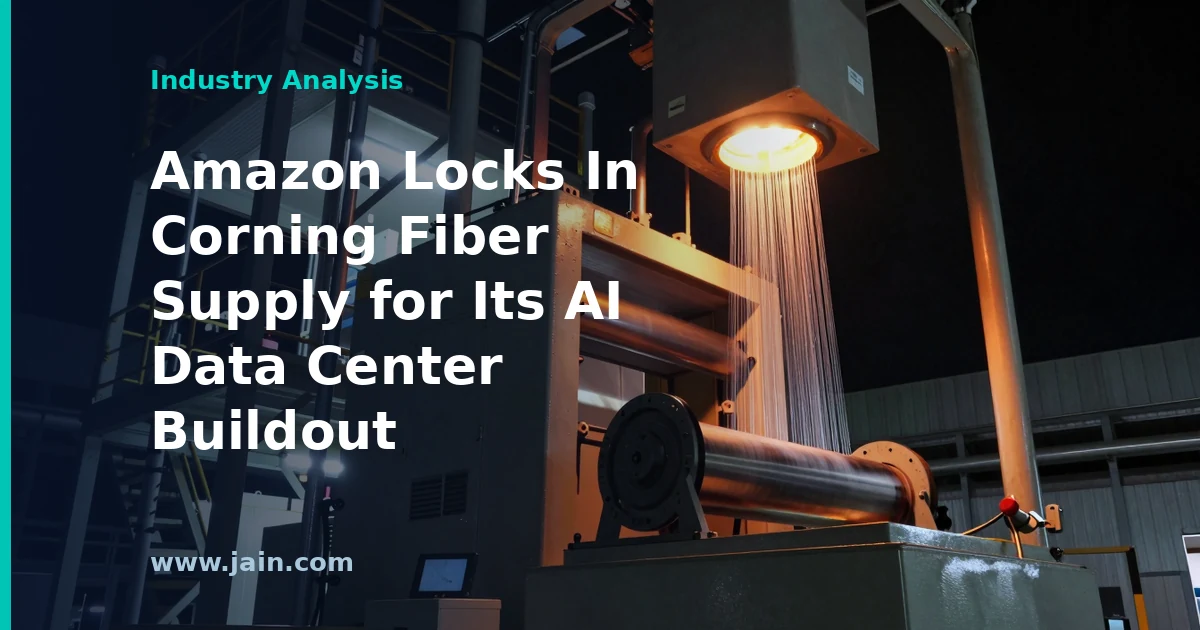
Optical fiber starts as a glass preform, a cylinder of ultra-pure silica that is heated and drawn into a strand thinner than a human hair, then coated, stranded and jacketed into cable. The process is capital-intensive and slow to scale: draw towers are purpose-built, the plants are large, and adding capacity is a multiyear commitment rather than a quarterly adjustment. Supply is therefore inelastic in exactly the situations where demand spikes.
Artificial intelligence training clusters are one of those situations. Interconnecting large numbers of accelerators requires far more optical links per rack than a traditional cloud deployment, and the cabling runs inside and between buildings on a campus consume fiber in quantities that used to belong to metropolitan network projects. That demand lands on the same industrial base that serves carriers. A hyperscale operator willing to sign for volume years out competes directly with a telephone company doing the same, and both are bidding for the output of a small number of qualified suppliers.
A large carrier agreement is the visible consequence. When supply is comfortable, buyers keep purchasing flexible and short. When it is not, they trade flexibility for certainty and sign long. That trade is the actual news here, more than any single dollar figure.
Why Verizon Signs Long, and What Corning Gets
Verizon has spent years pushing fiber deeper into its network, both to reach homes directly and to feed the wireless sites that carry mobile and fixed-wireless traffic. Its move to combine with Frontier Communications extends that footprint substantially, and a larger footprint means a larger, more predictable annual appetite for cable. Carriers with build targets and regulatory or competitive deadlines cannot afford a supply gap in year three of a five-year program.
For Corning, the value of a committed multiyear volume is not only revenue. It is the planning input that justifies keeping capacity hot and, if needed, adding to it. Optical Communications is Corning’s largest business, and the company has framed its growth ambitions publicly under the Springboard plan that its chief financial officer is scheduled to discuss at the Citi conference. A named anchor customer with a long horizon is the kind of evidence that plan needs.
The relationship is not new. Corning and Verizon announced a multiyear purchase agreement in 2017 valued at up to roughly a billion dollars, under which Verizon committed to buy substantial annual fiber volumes. What has changed is the competitive context around the renewal. In 2017 a carrier was securing favorable terms from a supplier with capacity to fill. In 2026 the supplier has an alternative buyer with deeper pockets and less price sensitivity, and both sides know it.
The Lumentum Move Is a Thesis, Not a Contract
Lumentum rose more than Corning did on a deal it is not a party to. That deserves scrutiny rather than celebration. Lumentum’s business is in lasers, optical components and the transceiver modules that convert electrical signals into light at each end of a link. Corning’s is in the glass in between, plus the cable and connectivity hardware around it. A carrier buying outside-plant fiber for a residential build does not, by that act, buy Lumentum’s datacom modules.
There is a defensible version of the read-across. If the deal is taken as confirmation that optical demand is broad rather than concentrated in a few AI campuses, then the whole photonics supply chain should carry a higher expected utilization, and component makers with exposure to data center interconnect benefit from the same underlying traffic growth. That argument is reasonable. It is also unverified by anything in this announcement, and it is worth separating from the parts of the story that rest on a signed agreement.
For readers who buy rather than trade, the practical signal is the same either way: the pricing and lead-time environment for optical capacity is tightening, and procurement teams should assume the seller’s leverage has improved.
Where the Upcycle Could Break
Fiber has burned optimistic investors before. In 2023 and 2024, carriers across North America and Europe worked down inventory they had bought during the previous supply scare and cut capital spending at the same time, and optical revenue at the major suppliers fell sharply despite unchanged long-run traffic growth. Purchase agreements did not prevent that, because most such agreements are volume frameworks rather than unconditional obligations to take delivery on a schedule.
The specific risks to watch are familiar. Carrier capital budgets are set annually and can be cut. Higher-count cable designs and denser packing let a buyer deliver the same route miles with less glass over time. Competing suppliers in Asia have capacity and price incentives to take share when Western capacity is committed elsewhere. And an artificial intelligence build cycle that slows would release capacity back into the merchant market quickly.
None of this argues the demand is illusory. It argues that a headline value spread over an undisclosed number of years, with undisclosed minimums, is not the same thing as booked revenue, and that the market’s willingness to reprice adjacent companies on the announcement is a measure of sentiment as much as of fundamentals.
Background
Corning has been a materials company since 1851 and produced the first low-loss optical fiber in 1970, the invention that made long-distance optical communication practical. Optical Communications is now its largest segment, selling fiber, cable, connectors and data center connectivity hardware to telecom carriers, cable operators, and increasingly to hyperscale and colocation operators building artificial intelligence capacity. Its results have historically tracked carrier capital spending cycles closely, which has made the business both large and volatile.
Verizon is one of the largest telecommunications operators in the United States and one of the largest single purchasers of optical equipment in the market. Its fiber strategy serves two purposes at once: delivering broadband directly to homes and businesses, and carrying traffic back from the wireless sites that support mobile and fixed-wireless service. Lumentum sits in a different part of the same supply chain, supplying the lasers and optical modules used at each end of a link, with substantial exposure to data center interconnect demand. Source: Corning rises 7% on Verizon fiber supply deal (GLW:NYSE) — report of Corning’s share move on a multibillion-dollar optical fiber supply agreement with Verizon. See also Lumentum Surges 11% as Corning’s Multi-Billion-Dollar Verizon Deal Lifts Fiber Stocks, on the read-across to optical component makers. Primary sources: Corning Incorporated, Form 8-K filed September 4, 2026 (Item 7.01, Regulation FD Disclosure), disclosing that Chief Financial Officer Edward A. Schlesinger will speak at the Citi 2026 Global TMT Conference on September 9, 2026 and expects to discuss recent business performance, progress on the Springboard plan, and market trends and demand drivers.Sources