Synergy Research Group reported on August 17, 2026 that “neoclouds” — the emerging tier of specialized GPU cloud providers built for AI workloads — are currently growing revenues at more than 200% per year. On that trajectory, Synergy forecasts the segment will reach $180 billion in annual revenues by 2030.
Executive Summary
Synergy Research Group, a market intelligence firm that has tracked cloud and data center markets for decades, put a striking pair of numbers on one of the fastest-moving corners of the infrastructure industry: neocloud providers are more than tripling their revenues each year, and the category is projected to become a $180 billion market by 2030.
The forecast matters because it treats neoclouds not as a temporary arbitrage on scarce GPUs, but as a durable market tier alongside the hyperscale clouds. If Synergy is right, a business model that barely existed three years ago will, within four years, rival the size of the entire global colocation industry — with all the capital, power, and data center demand that implies. It is worth noting the syndicated item we reviewed carries the headline figures but not Synergy’s full methodology, so the underlying assumptions deserve scrutiny alongside the projection itself.
What a Neocloud Is — and Why the Category Exists
“Neocloud” is the industry’s shorthand for cloud providers built specifically around GPU compute for artificial intelligence — renting out clusters of accelerators for model training and inference rather than offering the sprawling general-purpose service catalogs of AWS, Microsoft Azure, or Google Cloud. Commonly cited players in the category include CoreWeave, Lambda, Nebius, and Crusoe, though Synergy’s specific inclusion list is not visible in the syndicated item.
The category exists because AI demand outran what the traditional clouds could supply. Training frontier models requires dense, tightly networked GPU clusters, exotic power and cooling footprints, and pricing models closer to industrial capacity contracts than to on-demand virtual machines. Specialists that could secure GPUs, power, and data center space quickly found a seller’s market waiting for them.
The Economics Behind 200% Growth
Growth above 200% per year is extraordinary, but the arithmetic behind it is straightforward: the segment started from a small base, and demand for AI compute currently exceeds supply. When capacity sells out before it is built, revenue growth tracks how fast a provider can energize new data center capacity — which is why the neocloud story is inseparable from the power and data center construction booms.
The harder question is margin durability. Neocloud economics rest on expensive, fast-depreciating hardware, heavy debt financing in many cases, and — for several prominent players — revenue concentrated in a small number of very large AI customers. A $180 billion revenue projection says the market will be big; it does not by itself say the businesses in it will be uniformly profitable. Investors should distinguish between the size of the pie and the quality of any individual slice.
Winners, Losers, and the Hyperscaler Question
For data center operators, utilities, and connectivity providers, the forecast is almost unambiguously bullish: neoclouds are among the largest lessees of wholesale data center capacity and the most aggressive buyers of power. A tier growing toward $180 billion in revenue implies sustained demand for the physical layer beneath it — sites, substations, fiber, and cooling.
For the hyperscalers, the picture is more nuanced. Neoclouds are simultaneously competitors for AI workloads and, in some well-publicized arrangements across the industry, suppliers of capacity to the hyperscalers themselves. Whether the big clouds ultimately reabsorb this demand as their own GPU fleets scale, or the neocloud tier keeps a permanent structural advantage in speed and specialization, is the central competitive question the next few years will answer.
Can the Curve Hold to 2030?
Extending any 200% growth rate for years produces implausible numbers, and Synergy’s own forecast implies significant deceleration: a market compounding at 200% would blow far past $180 billion by 2030 from almost any plausible base. Read properly, the projection assumes today’s hypergrowth cools into merely strong growth — a reasonable but assumption-laden path.
The risks to the curve are the familiar ones for AI infrastructure: whether enterprise AI spending keeps converting into paid compute at current rates, whether power availability constrains buildouts, how quickly GPU generations depreciate, and whether customer concentration turns any single buyer’s pullback into a segment-wide shock. None of these invalidate the forecast; all of them are the difference between the projection and the outcome.
Background
The neocloud category rose to prominence after 2023, when generative AI demand created acute scarcity in GPU compute and a wave of specialists — several of them former cryptocurrency miners repurposing power-rich sites — pivoted to renting AI capacity. The segment has since attracted tens of billions of dollars in capital and become one of the largest sources of demand in the data center leasing market. Synergy Research Group, which has long published the benchmark market-share data for cloud infrastructure services, tracking the rise of AWS, Microsoft, and Google, now treats this GPU-specialist tier as a distinct market worth forecasting in its own right — itself a signal of how the AI buildout is restructuring cloud economics.
CoreWeave announced on July 6, 2026 that it has been named a Visionary in Gartner’s 2026 Magic Quadrant for Cloud AI Developer Services. The recognition places the GPU-focused cloud provider on one of the industry’s most closely watched analyst grids alongside larger hyperscalers.
Executive Summary
CoreWeave, best known for renting out large fleets of Nvidia GPUs to AI labs and enterprises, has picked up a Visionary designation in Gartner’s 2026 Magic Quadrant for Cloud AI Developer Services. Gartner’s Magic Quadrant is a widely referenced analyst report that plots vendors on two axes — completeness of vision and ability to execute — and Visionaries score high on vision but are typically still building out execution scale.
The placement matters because Cloud AI Developer Services is a category traditionally dominated by the three hyperscalers, whose managed AI platforms bundle models, training frameworks, and deployment tools. CoreWeave earning a named spot signals that its pitch — purpose-built GPU infrastructure with a developer-facing stack — is being taken seriously by procurement teams that historically default to AWS, Azure, or Google Cloud.
Why a Visionary Tag, Not a Leader Tag, Is the Story
Being named a Visionary is a genuine analyst endorsement, but the label carries a specific meaning. In Gartner’s framework, Visionaries understand where a market is heading and often shape it with differentiated technology, but they have not yet demonstrated the operational breadth of the Leaders quadrant. For a company like CoreWeave, that reading fits the public narrative: a GPU specialist that grew explosively during the generative AI wave, but whose managed developer services are newer than the hyperscalers’ decade-old platforms.
For buyers, the practical translation is that CoreWeave is worth a serious bake-off for AI workloads, particularly training and large-scale inference, without assuming it yet matches AWS or Azure on the breadth of adjacent services like identity, data warehousing, or global compliance tooling.
The Competitive Frame: Specialist Clouds Versus Hyperscalers
The Magic Quadrant category itself is worth unpacking. Cloud AI Developer Services covers the tools developers use to build, tune, and deploy AI applications — model APIs, training platforms, MLOps, and increasingly agent frameworks. The hyperscalers compete here with fully integrated stacks. Specialist clouds compete on price-performance for GPU-intensive workloads and, more recently, on time-to-capacity for scarce accelerators.
Getting graded in the same report as the hyperscalers is a validation of the specialist thesis: that a meaningful share of AI spend will flow to providers optimized specifically for the workload, rather than to general-purpose clouds that also happen to sell GPUs. Whether that share remains large as hyperscaler capacity catches up is the open strategic question.
What This Does — and Does Not — Prove
Analyst recognition is a procurement lubricant. Enterprise buyers frequently cite Magic Quadrant placement to justify shortlists, and inclusion can shorten sales cycles materially. In that narrow sense, the designation has real commercial value for CoreWeave beyond the marketing headline.
What it does not prove is durable margin, customer diversification, or that CoreWeave’s developer-services layer is at feature parity with incumbents. Gartner scores vision and execution against a defined market frame; it does not opine on unit economics, GPU supply contracts, or concentration risk with a small number of very large customers. Readers should treat the placement as one useful signal among several, not as a verdict on the business.
Background
CoreWeave began as a niche compute provider and repositioned during the generative AI boom into a specialist cloud focused on large-scale Nvidia GPU deployments, becoming a prominent supplier of training and inference capacity to AI labs and enterprises. It has since expanded into developer-facing services that sit above the raw infrastructure layer.
Gartner’s Magic Quadrant for Cloud AI Developer Services is one of the industry’s most cited analyst reports for AI platform procurement, historically dominated by the largest hyperscale cloud providers. Inclusion for a specialist cloud reflects the broader shift of AI workloads toward providers optimized specifically for accelerated computing.
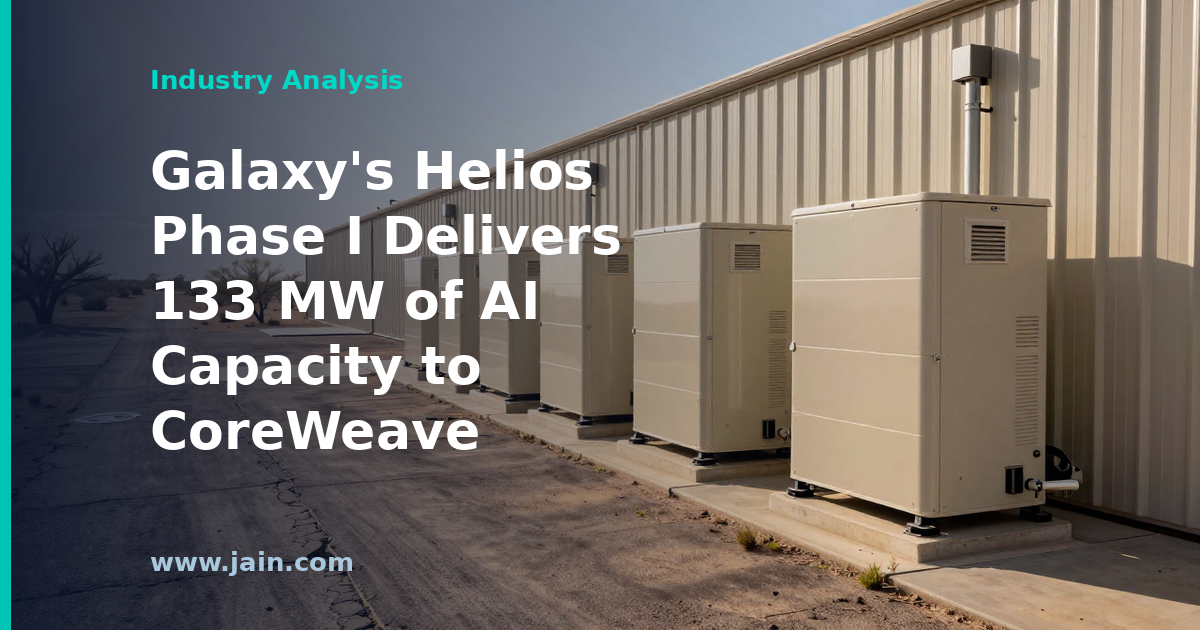
Galaxy announced on July 5, 2026 that it has completed Phase I of its Helios data center campus in West Texas, delivering 133 megawatts (MW) of critical IT load to CoreWeave, the AI-focused cloud provider. Critical IT load refers to the power available to the computing equipment itself — servers and GPUs — as distinct from the total power a facility draws for cooling and other overhead.
The completion converts a site that began life as a Bitcoin mining campus into dedicated AI infrastructure under Galaxy’s long-term lease arrangement with CoreWeave, one of the most prominent examples of the crypto-to-AI conversion trend reshaping the data center market.
Executive Summary
Galaxy, the digital assets and data center infrastructure firm, has finished the first phase of its Helios campus buildout and handed over 133 MW of critical IT load to its anchor tenant CoreWeave. Phase I completion moves the project from promise to delivery: Helios is now an operating revenue-generating AI data center rather than a conversion story on a slide deck.
The milestone matters beyond Galaxy. Helios is the flagship test case for whether former cryptocurrency mining sites — which come with grid interconnections and power contracts already in place — can be economically retrofitted to the far more demanding standards of AI training and inference infrastructure. Delivering a first phase at this scale suggests the model can work, at least for sites with strong power positions.
For CoreWeave, the delivery adds substantial contracted capacity at a time when access to powered land and energized shells — not GPUs — is widely seen as the binding constraint on AI cloud growth.
Why Crypto Sites Became AI Real Estate
The most valuable asset in data center development today is not land or buildings but secured power: a grid interconnection agreement and the megawatts behind it. Bitcoin mining operators spent the late 2010s and early 2020s locking up exactly that, often in low-cost power markets like West Texas. When AI demand exploded, those interconnections became worth far more serving GPUs than mining rigs, because AI tenants sign long-term leases at data center economics rather than riding volatile crypto margins.
Galaxy’s Helios campus, acquired from a Bitcoin mining operator, is the highest-profile execution of that arbitrage. The conversion is not trivial — AI facilities require far denser power delivery, liquid or advanced air cooling, and enterprise-grade redundancy that mining sites never needed — but the timeline still beats greenfield development, where new grid interconnection requests can queue for years.
What 133 MW Actually Buys
133 MW of critical IT load is a substantial block of capacity by any historical standard — a few years ago it would have ranked among the larger single-tenant deployments in the world. In the AI era it is best understood as a first tranche: large frontier training clusters are increasingly specified in the hundreds of megawatts, and operators including Galaxy have discussed multi-phase expansion at Helios well beyond Phase I.
Because the load is contracted to a single tenant, the economics resemble a triple-net real estate deal more than a retail colocation business: predictable lease revenue over a long term, with Galaxy carrying development and delivery risk and CoreWeave carrying utilization risk. That structure has become the dominant template for AI data center finance because lenders can underwrite the lease.
Winners, Losers, and the Competitive Field
The clearest winners are holders of energized or near-energized power positions — converted mining sites, utilities with spare interconnection capacity, and developers who queued early. CoreWeave benefits by adding capacity faster than greenfield timelines would allow, supporting its competition with hyperscale clouds for AI workloads. The pressure lands on developers still waiting in interconnection queues, and on regions whose grids cannot absorb gigawatt-class requests.
The open competitive question is durability. Conversion sites tend to sit in remote, power-rich locations, which suits training workloads that tolerate latency. If the market shifts toward inference — which favors proximity to users — the value of remote megawatts could be repriced. Phase I’s completion answers the execution question; it does not settle the location question.
Background
Helios began as one of the larger Bitcoin mining campuses in the United States before Galaxy acquired the site and redirected it toward AI and high-performance computing. Galaxy subsequently signed long-term lease agreements making CoreWeave the campus’s anchor tenant, with capacity to be delivered in phases — Phase I, now complete, being the first.
The conversion sits inside a broader industry shift: as demand for AI compute outran the pace of new grid connections, sites with existing power infrastructure — many of them crypto mining facilities in Texas and the Mountain West — became prime targets for repurposing. Helios is widely watched as the leading proof point for whether that playbook delivers at scale.
CoreWeave, the GPU cloud provider, announced on June 17, 2026 that Kimi K2.7 Code — a coding-focused model in Moonshot AI’s open-weight Kimi family — is now available on its serverless inference service. The company says the offering delivers leading benchmark price-performance, positioning it as a low-cost way to run one of the more capable open coding models without managing GPU infrastructure.
Executive Summary
The announcement itself is narrow: a new model added to an existing managed service. Its significance lies in what it represents. CoreWeave built its business renting raw GPU capacity to AI labs and enterprises; serverless inference — where customers pay per token processed rather than per GPU-hour — is a move up the stack into a managed service business with different economics and a much broader addressable market.
The choice of model is equally telling. Coding models are among the most token-hungry workloads in AI today, because autonomous coding agents read and write large volumes of text in long loops. By pairing a well-regarded open-weight coding model with a price-performance pitch, CoreWeave is targeting exactly the segment — developer tools and agentic coding platforms — where inference bills are growing fastest and buyers are most price-sensitive.
What the release headline does not settle is the substance behind the claim: the syndicated summary does not include the actual per-token pricing, the benchmarks cited, or the rivals compared against. The claim is plausible given CoreWeave’s infrastructure scale, but as published it is a marketing assertion awaiting verification.
GPU Clouds Are Climbing the Stack
CoreWeave’s core product has historically been infrastructure: large clusters of Nvidia GPUs leased to customers who bring their own software. Serverless inference inverts that model. The provider runs the model, handles scaling and reliability, and bills per token — the unit of text an AI model reads or writes. For customers, this removes the hardest parts of AI operations: capacity planning, GPU utilization, and model serving expertise.
For CoreWeave, the strategic logic is margin and market breadth. Raw GPU rental is increasingly commoditized and dominated by a small number of very large contracts. A token-metered service can serve thousands of smaller customers, smooth utilization across its fleet, and capture software-layer value on top of hardware it already operates. Every major GPU cloud is attempting the same climb, which is precisely why price-performance has become the battleground.
Open-Weight Models Fuel an Inference Price War
Kimi K2.7 Code is part of Moonshot AI’s Kimi line of open-weight models — models whose trained parameters are published for anyone to download and run, unlike closed models such as those from OpenAI or Anthropic, which are available only through their makers’ APIs. Open weights turn model serving into a competitive market: many providers can host the identical model, so they compete on price, speed, and reliability rather than exclusive access.
That dynamic is good for buyers and brutal for margins. When the model is a commodity, the winner is whoever runs it most efficiently — better hardware utilization, better serving software, cheaper power. CoreWeave’s implicit argument is that owning and operating its own large-scale GPU fleet lets it undercut resellers and match or beat specialist inference providers. The claim is credible in principle; whether it holds depends on numbers the announcement headline does not supply.
Coding Is the Beachhead Workload
The decision to lead with a coding model is not incidental. AI coding assistants and autonomous coding agents consume tokens at rates far beyond chat applications, because they iterate: reading codebases, generating changes, running checks, and revising, often for many cycles per task. For the companies building those tools, inference cost is a first-order line item, and many of them already prefer open-weight models specifically so they can shop across hosts.
Winning this segment matters beyond the immediate revenue. Developer-tool companies are sophisticated, benchmark-driven buyers; a provider that earns their workloads gains both a proof point and a durable base of high-volume usage. Conversely, they are also the quickest to leave when a competitor posts a better price-per-benchmark-point, which keeps pressure on every provider’s pricing.
Reading Price-Performance Claims Carefully
“Leading benchmark price-performance” is a compound claim, and each half deserves scrutiny — as it would from any vendor. On the performance side, coding benchmarks are useful but imperfect proxies; results can vary with how a model is configured and served, so a hosted version’s scores should ideally be verified against the model publisher’s own reported figures. On the price side, headline per-token rates can obscure differences in speed, rate limits, context-length pricing, and reliability guarantees that materially change real-world cost.
None of this means the claim is wrong. It means the appropriate response, for any buyer, is a straightforward evaluation: run your own workload, measure quality and latency, and compute cost per completed task rather than cost per token. That standard applies equally to CoreWeave and to every competitor making similar claims in what has become a loudly contested market.
Background
CoreWeave rose from cryptocurrency-mining origins to become one of the most prominent specialized GPU clouds of the AI boom, operating large fleets of Nvidia accelerators for AI labs and enterprises, and completed its Nasdaq IPO in March 2025. Like other GPU clouds, it has been expanding from raw infrastructure into managed services — of which serverless inference is the most direct bid for the application-developer market.
Moonshot AI’s Kimi K2 family established itself as one of the leading open-weight model lines, drawing attention especially for coding and agentic tasks. Because the weights are published, the models are served by many competing providers worldwide — a dynamic that has made hosted open-weight inference one of the most price-competitive corners of the AI market, and the arena in which CoreWeave’s announcement stakes its claim.
A data center company tied to AI cloud provider CoreWeave is seeking to raise $850 million through a junk bond sale, Bloomberg reported on May 31, 2026. The issuer was not identified in the report summary available at publication time, and terms of the offering — coupon, rating, and collateral — were not disclosed in the material we reviewed.
The deal adds to a growing pattern: companies whose business rests on leases or contracts with CoreWeave are turning to the high-yield bond market, rather than equity or traditional bank lending, to fund AI data center capacity.
Executive Summary
According to Bloomberg, a data center firm connected to CoreWeave — the GPU cloud provider that has become one of the largest buyers of AI computing capacity — is marketing an $850 million bond offering in the high-yield, or “junk,” market. Junk bonds are debt rated below investment grade, meaning rating agencies judge the borrower’s risk of default to be elevated and investors demand higher interest in return.
The announcement matters less for its size than for what it represents. The first phase of the AI infrastructure buildout was financed largely by venture capital, hyperscaler balance sheets, and private credit. An $850 million public high-yield deal from a CoreWeave-linked issuer shows the buildout has grown past the point where equity and private lenders can carry it alone: the broad, liquid corporate debt markets are now being asked to underwrite AI data centers directly.
That shift brings scale — and scrutiny. High-yield investors will price, in public view, exactly how much risk they see in a business model that often depends on a single fast-growing, heavily leveraged tenant.
Debt Markets Take the Baton in the AI Buildout
Building AI-grade data centers is extraordinarily capital-intensive: land, shells, power infrastructure, and liquid cooling can run into the billions per campus before a single GPU arrives. No single funding channel can absorb that alone. Venture equity funded the early movers, private credit funds stepped in next, and now — as this reported $850 million deal illustrates — the public high-yield bond market is opening to issuers whose story is essentially “we build capacity, and CoreWeave (or its customers) fills it.”
For the industry, that is a maturation signal. Public bond markets bring deeper pools of capital and lower cost than most private alternatives, but they also demand disclosure, ratings, and ongoing market pricing of risk. Once AI data center paper trades publicly, the sector gets a visible, daily referendum on whether investors believe the demand forecasts underpinning the buildout.
One Tenant, One Credit: The Concentration Question
The phrase “CoreWeave-tied” is doing significant work in this headline. A landlord or developer whose revenue depends substantially on one tenant effectively inherits that tenant’s credit profile. Bondholders in such a deal are not just underwriting concrete and cooling — they are underwriting CoreWeave’s ability to keep paying its leases for a decade or more. CoreWeave has grown at remarkable speed, but it has also financed that growth with substantial debt of its own and has disclosed meaningful customer concentration in its public filings. Risk, in other words, can stack: the bond investor is exposed to the issuer, the issuer to CoreWeave, and CoreWeave to a small set of very large AI customers.
This is not a novel structure — single-tenant credit lease financing is decades old in real estate — but the tenor mismatch is worth noting. Data center leases and bonds run for many years; AI demand forecasts are being revised quarter to quarter. Whether the release addresses lease length, renewal terms, or credit support is not visible in the source material, and those details will determine how risky this paper actually is.
What High-Yield Pricing Will Tell Us
A below-investment-grade rating is not a verdict of failure — much of the world’s infrastructure has been built on high-yield and leveraged debt. What matters is the price. If this deal and others like it clear at modest spreads, it signals that mainstream credit investors accept AI data center cash flows as durable. If issuers must pay up substantially, it signals skepticism that today’s AI compute contracts will hold their value over the life of the bonds.
Either outcome resets the cost of capital for the whole sector. Developers with signed hyperscaler or AI-cloud leases will watch this pricing closely, as will incumbents with investment-grade balance sheets, who may find their cheaper capital becoming a sharper competitive weapon if high-yield windows narrow. Banks and bond underwriters, meanwhile, gain a lucrative new issuance category either way.
Background
CoreWeave emerged as one of the defining companies of the AI infrastructure boom. Founded in 2017 as a cryptocurrency-mining operation, it repositioned itself as a specialized GPU cloud provider and rode surging demand for AI training capacity to a Nasdaq IPO in March 2025. Rather than building all of its own facilities, CoreWeave leases substantial capacity from third-party data center developers — creating a class of landlords and partners whose fortunes, and creditworthiness, are closely tied to its own.
Those partners have increasingly tapped debt markets to fund construction, part of a broader wave in which hundreds of billions of dollars in projected AI data center spending has outgrown venture equity and private credit alone. By mid-2026, high-yield bonds backed directly or indirectly by AI compute contracts had become a recognizable — and closely watched — corner of the corporate debt market.
On May 28, 2026, CoreWeave — the Nasdaq-listed GPU cloud provider often described as the leading “neocloud” — announced a unified agentic AI platform aimed at what the company calls continuous agent improvement. The announcement positions CoreWeave as a provider not just of raw GPU compute but of the software layer used to build, evaluate, and iteratively refine AI agents.
The release, distributed by CoreWeave itself, was headline-level in the version available to us: it did not detail pricing, availability, named customers, or the specific components bundled into the platform.
Executive Summary
CoreWeave built its business renting large fleets of NVIDIA GPUs to AI labs and enterprises — a capital-intensive model in which the product is fundamentally access to scarce hardware. This announcement signals a deliberate move up the stack: a “unified” platform for agentic AI, meaning software systems in which AI models autonomously plan and execute multi-step tasks, and for the tooling loop — evaluation, monitoring, and retraining — that makes such agents improve over time rather than remain static after deployment.
Why it matters: raw GPU capacity is becoming easier to procure as supply catches up, which pressures rental pricing across the neocloud sector. Platform software is how an infrastructure provider differentiates, deepens customer lock-in, and defends margins. CoreWeave has been assembling the ingredients for this for over a year — it acquired the machine-learning tooling company Weights & Biases in 2025 and reinforcement-learning startup OpenPipe later that year — and a unified agentic platform is the logical product of those deals.
What the announcement does not yet establish is substance: the release headline promises unification and continuous improvement, but the available text offers no technical detail, benchmarks, or customer evidence against which those claims can be tested.
From GPU Landlord to Platform Company
CoreWeave’s core business — leasing GPU clusters by the hour or under multi-year contracts — is lucrative when accelerators are scarce, but it is structurally exposed to commoditization. Competitors ranging from hyperscalers (AWS, Microsoft Azure, Google Cloud) to fellow neoclouds can offer the same NVIDIA silicon, so price becomes the battleground as supply normalizes. Software platforms change that equation: a customer who builds its agent development, evaluation, and retraining workflow on a provider’s tooling is far harder to dislodge than one renting interchangeable compute.
This is a well-worn playbook. The hyperscalers long ago wrapped raw infrastructure in managed AI services — Amazon Bedrock, Azure AI Foundry, Google Vertex AI — precisely because services carry better margins and stickiness than instances. CoreWeave following the same path is a sign of the neocloud category maturing: the first wave of competition was about who could deploy GPUs fastest; the next is about who owns the developer workflow that runs on them.
The Continuous-Improvement Loop Is the Real Product
The phrase “continuous agent improvement” is worth unpacking. AI agents — systems that use large language models to autonomously carry out tasks like coding, research, or customer support — are notoriously hard to keep reliable in production. They fail in long-tail ways that only surface in real usage. The emerging answer is a feedback loop: capture production behavior, evaluate it systematically, and feed the results back into the agent through techniques such as reinforcement learning, in which a model is trained on reward signals rather than static examples.
CoreWeave’s prior acquisitions map directly onto that loop. Weights & Biases is one of the most widely used platforms for experiment tracking and model evaluation; OpenPipe specialized in reinforcement-learning fine-tuning for agents. If the new platform genuinely unifies those capabilities with CoreWeave’s training and inference infrastructure, it would offer something the raw-compute competitors do not: a closed loop from deployment telemetry back to GPU-powered retraining, all in one vendor. Whether the integration is that deep, or the platform is initially a bundling of existing products under one name, is not answerable from the release.
Winners, Losers, and the Lock-In Question
If the platform gains traction, the clearest beneficiary is CoreWeave itself — agent training and continuous retraining are compute-hungry workloads that would drive utilization of its fleet, and platform revenue could diversify a business that has historically depended on a small number of very large customers. Enterprises adopting agents could also benefit from an integrated stack that reduces the engineering burden of assembling evaluation and retraining pipelines from separate vendors.
The trade-off for buyers is concentration risk. A unified platform that works best on one provider’s cloud is, by design, a lock-in mechanism. Organizations weighing it should ask whether the tooling layer remains portable — Weights & Biases historically ran across all major clouds — or whether the “unified” version ties workflows to CoreWeave capacity. For the broader market, the launch raises the bar for other neoclouds, which must now decide whether to build competing software layers, partner for them, or compete purely on price and availability — a difficult position if agent workloads become the dominant demand driver.
Background
CoreWeave began in 2017 as Atlantic Crypto, an Ethereum-mining venture, and repurposed its GPU expertise into a specialized AI cloud after crypto economics soured. Backed by NVIDIA and fueled by the post-2022 generative-AI boom, it grew into the most prominent of the “neoclouds,” signing multibillion-dollar capacity deals with major AI labs and completing a closely watched Nasdaq IPO in March 2025. Through 2025 it expanded aggressively beyond hardware, acquiring Weights & Biases for ML tooling and OpenPipe for reinforcement-learning-based agent training.
The broader market context is a shift in AI workloads from one-off model training toward deployed agents that must be monitored and improved continuously — a shift that rewards providers who control the software loop as well as the silicon it runs on.
CoreWeave, the GPU-focused AI cloud provider, announced support for Red Hat AI Inference Server on CoreWeave Kubernetes Service (CKS), its managed Kubernetes offering. The announcement, dated May 13, 2026, positions the pairing as an enabler of hybrid inference — running AI model-serving workloads consistently across CoreWeave’s cloud and other environments, such as enterprise data centers.
Executive Summary
The announcement joins two complementary layers of the AI stack. CoreWeave supplies large-scale GPU capacity delivered through CKS, its Kubernetes-based orchestration service; Red Hat supplies the inference-serving software layer — Red Hat AI Inference Server, an enterprise-supported model-serving platform built on the open-source vLLM project, a widely used engine for running large language models efficiently on GPUs. Together they aim at enterprises that want one consistent way to deploy and operate AI models wherever the workload runs.
It matters because the AI cloud market is shifting its center of gravity from training — the one-time, compute-intensive process of building models — to inference, the ongoing work of serving those models to users. Inference is where recurring revenue lives, and where enterprises face real portability questions: models trained in one place often need to run in another for latency, data-residency, or cost reasons. A hybrid inference story, if delivered, addresses exactly that friction — though the source release offers few specifics on how, when, or at what price.
Inference Is Where AI Clouds Will Be Judged Next
Training frontier models is a market with a handful of very large buyers. Inference is the opposite: every enterprise that deploys an AI application becomes an inference customer, and the spending recurs for as long as the application runs. For a specialized GPU cloud like CoreWeave — whose growth to date has leaned heavily on large training and capacity contracts with a concentrated set of customers — building a credible inference franchise is a route to broader, stickier, more diversified demand. Supporting an enterprise-standard serving layer on CKS is a logical step in that direction.
The competitive backdrop is that raw GPU access is commoditizing. Hyperscalers, neoclouds, and sovereign providers all sell similar silicon. Differentiation is migrating up the stack to orchestration, serving efficiency, and operational tooling — precisely the layer this announcement targets. An inference server matters economically because serving efficiency (how many tokens a GPU produces per dollar) directly sets gross margin for both the provider and the customer; vLLM, the engine underneath Red Hat’s product, exists specifically to raise that efficiency.
What Each Side Gets From the Pairing
For CoreWeave, Red Hat brings enterprise legitimacy. Red Hat — the open-source software company IBM acquired in 2019 — is already inside most large enterprises via Red Hat Enterprise Linux and OpenShift, and its support model is familiar to conservative IT buyers. Certifying Red Hat’s inference stack on CKS lowers the perceived risk of moving regulated or mission-critical inference workloads onto a young cloud provider, and lets CoreWeave sell to platform-engineering teams in language they already speak: Kubernetes, operators, supported software lifecycles.
For Red Hat, CoreWeave is distribution into the fastest-growing tier of GPU capacity. Red Hat’s AI strategy depends on its serving layer running everywhere customers have accelerators — on-premises, on hyperscalers, and on specialized AI clouds. Each certified venue strengthens its pitch that the inference layer, not the underlying cloud, is the portable standard. Notably, that pitch cuts both ways for CoreWeave: a genuinely portable serving layer makes it easier for customers to arrive, but also easier to leave.
Hybrid Inference: Real Need, Unproven Delivery
The hybrid framing responds to a genuine enterprise constraint. Latency-sensitive applications, data-residency rules, and existing data-center investments mean many organizations will run inference in several places at once. A consistent Kubernetes-plus-inference-server substrate across those venues would reduce duplicated engineering and make capacity fungible — burst to the cloud when demand spikes, serve locally when regulation requires it.
What the announcement does not yet substantiate is the hard part. Hybrid operation lives or dies on details the source leaves out: unified model registries and observability across sites, network paths between customer premises and CoreWeave regions, consistent GPU support matrices, and commercial terms that don’t penalize moving workloads. Until reference customers describe production hybrid deployments, this is a credible roadmap claim rather than a demonstrated capability — a caution that applies equally to every vendor currently marketing ‘hybrid AI.’
Background
CoreWeave began as a cryptocurrency-mining operation before pivoting into GPU cloud computing, and rose to prominence during the generative-AI boom as one of the largest independent providers of NVIDIA-based capacity, completing its Nasdaq IPO in March 2025. Its early revenue skewed toward very large training and capacity deals, making expansion into broader enterprise inference a recurring strategic theme. Red Hat, IBM’s open-source software arm since a $34 billion acquisition in 2019, has built its AI portfolio around portable, supported open-source layers — including inference serving based on the vLLM project — that run across on-premises and cloud infrastructure. The two companies’ stacks meet naturally at Kubernetes, the open-source container-orchestration standard both build upon.
CoreWeave, the specialized AI cloud provider, announced on May 10, 2026 that it ranked first on Artificial Analysis’s public benchmark for serving the Kimi K2.6 large language model. The claim was published on the company’s own editorial blog, citing the independent third-party leaderboard as the source of the ranking.
Executive Summary
Artificial Analysis is a widely cited independent site that measures how AI cloud providers serve popular open-weight models, tracking metrics such as tokens produced per second, time-to-first-token latency, and price per million tokens. Topping one of its per-model leaderboards is a marketing and sales asset in the increasingly crowded market for GPU-backed inference, where dozens of providers now compete to host the same underlying model.
For CoreWeave, the ranking on Kimi K2.6 — a large model released by Chinese lab Moonshot AI — reinforces the company’s positioning as an inference-performance leader, not just a supplier of raw GPU capacity. The result matters because inference workloads, which run trained models in production, are becoming a larger share of AI cloud spending than the one-time training runs that first defined the market.
Why a Single Benchmark Win Actually Matters
Inference performance is not an abstract engineering metric. Every additional token per second a provider can squeeze out of the same GPU translates directly into lower cost per query and better user experience for downstream applications like chatbots, coding assistants, and agentic systems. A leaderboard-topping result on a widely followed public benchmark gives buyers a shorthand to compare providers without running their own tests, which shortens sales cycles for the winner.
That said, a benchmark victory is a snapshot on one model at one moment. Providers tune their deployments aggressively for popular tested configurations, and rankings shift as software stacks, batching strategies, and hardware allocations change. The commercial value of the win depends on whether CoreWeave can sustain the position across the models customers actually run in production.
The Inference Cloud Land Grab
The market for serving open-weight models has become a genuine competitive arena. CoreWeave sits alongside a growing roster that includes Together AI, Fireworks, Groq, SambaNova, Lambda, and the hyperscalers’ own inference endpoints. Each is chasing the same buyer: developers and enterprises who want to run models like Llama, DeepSeek, Qwen, and now Kimi without operating their own GPU fleet.
Differentiation in this market is thin. Everyone has access to broadly similar hardware, and the underlying model weights are identical across providers. That leaves the software layer — kernel optimizations, speculative decoding, KV-cache management, request routing — as the primary lever. Independent benchmarks like Artificial Analysis are one of the few places where those software investments become visible to buyers.
Kimi K2.6 and the Broadening Model Landscape
Kimi K2 is a family of large models from Moonshot AI, a Beijing-based lab. Its inclusion on Western inference benchmarks reflects the fact that competitive open-weight models increasingly originate from Chinese labs, alongside DeepSeek and Qwen. Providers that move quickly to host new releases can capture early demand from developers evaluating alternatives to closed models from OpenAI and Anthropic.
For infrastructure buyers, the practical read is that model provenance is decoupling from serving provider. A US-based enterprise can now run a Chinese-origin open-weight model on a US inference cloud, avoiding data-residency concerns tied to using the model developer’s own API. CoreWeave’s Kimi K2.6 result is one data point in that broader unbundling.
Background
CoreWeave started as a cryptocurrency mining operation before pivoting to become a GPU-focused cloud provider serving AI, visual effects, and other accelerated-compute workloads. Its rapid scale-up during the generative AI wave made it one of the most-discussed alternatives to the traditional hyperscalers for AI compute, with a customer roster that has included major model labs.
The inference segment where this benchmark result sits has emerged as a distinct competitive market, separate from long-running model training contracts. Independent benchmarking sites such as Artificial Analysis have grown in influence as buyers seek neutral comparisons across a growing roster of providers hosting the same open-weight models.
CoreWeave, the AI-focused cloud provider, published a piece titled “Liquid Cooling for AI Data Centers: Run Cold, Act Bold,” making the argument that liquid cooling — circulating fluid directly to or near the chips rather than relying on chilled air — should be treated as the default engineering choice for dense AI training and inference clusters, not a specialty option.
The post, surfaced in early May 2026, is a vendor thought-leadership piece rather than a product or facility announcement: no new sites, capacity figures, or customer commitments accompany it. Its significance lies in who is saying it — one of the largest dedicated AI cloud operators publicly framing liquid cooling as table stakes.
Executive Summary
The core claim is architectural: modern AI accelerators are being packed into racks at power densities that air cooling struggles to serve economically, so operators who standardize on liquid cooling now will deploy the newest hardware faster and run it more efficiently than those who retrofit later. That position aligns with the direction of the hardware itself — flagship AI rack systems from the leading accelerator vendors are increasingly designed around liquid cooling from the outset.
Why it matters: cooling has quietly become one of the binding constraints on AI buildout, alongside power availability and chip supply. A data center designed for traditional air-cooled racks often cannot accept the densest AI systems without significant rework of its mechanical plant, piping, and floor layout. When a major AI cloud provider says liquid cooling is the default, it is effectively telling the colocation and construction ecosystem what the demand side now expects.
For buyers and investors, the practical takeaway is less about CoreWeave specifically and more about the signal: the market for AI capacity is bifurcating between facilities that can support liquid-cooled density and those that cannot, and the gap affects deployment speed, efficiency, and ultimately the cost of delivered compute.
Why Cooling Became the Bottleneck
For most of the data center industry’s history, air cooling was sufficient: racks drew a few kilowatts, and moving enough cold air through the room was a solved problem. AI changed the arithmetic. Training clusters concentrate power-hungry accelerators as tightly as possible to shorten the distances data travels between chips, because interconnect latency and bandwidth directly affect training performance. That pushes rack densities far beyond what conventional air handling was designed for, and at some point the physics favors liquid — water and engineered fluids carry heat far more effectively than air.
CoreWeave’s framing of liquid cooling as a default rather than an exception reflects where the hardware roadmap already points. The densest current-generation AI rack systems are engineered for direct liquid cooling, meaning operators who want the newest silicon at full density have limited choice. In that sense the post is less a prediction than a description of a constraint the industry is already living with — but stating it as doctrine matters, because much of the world’s existing data center stock was not built for it.
The Economics: Efficiency Versus Retrofit Cost
The business case for liquid cooling rests on two ledgers. On the operating side, liquid systems can reduce the energy spent on cooling itself — a meaningful lever, since cooling is typically one of the largest non-IT loads in a facility, and every watt saved on cooling is a watt available for revenue-generating compute in power-constrained markets. On the capital side, however, liquid cooling requires piping, coolant distribution units, leak management, and often structural changes, which is straightforward in a new build and expensive in a retrofit.
That asymmetry is the strategic subtext of a piece like this. Operators that standardized early on liquid-ready designs can absorb each new accelerator generation with incremental changes; operators with large air-cooled footprints face a harder choice between costly conversion and ceding the densest workloads. CoreWeave, which built its business specifically around GPU infrastructure for AI, has an obvious interest in emphasizing a criterion where purpose-built AI clouds hold an advantage over general-purpose incumbents — which does not make the underlying engineering argument wrong, but readers should recognize the alignment between the message and the messenger.
Winners, Losers, and the Supply Chain Ripple
If liquid cooling is the default, the beneficiaries extend well beyond AI clouds. Suppliers of coolant distribution units, cold plates, piping, and heat-rejection equipment see their addressable market expand from a niche to a standard line item in every AI facility. Colocation providers with liquid-ready halls gain pricing power for AI tenants; those without face pressure to invest. Engineering and construction firms with liquid-cooling experience become scarcer resources in an already stretched buildout.
The risk side deserves equal attention. Liquid cooling adds mechanical complexity — leaks, coolant chemistry, maintenance procedures — into environments that prize uptime above almost everything. Standardization across vendors is still maturing, which raises the possibility of stranded investment if designs shift between hardware generations. And efficiency gains at the rack level do not eliminate the larger constraint: many AI projects today are gated by grid power availability, a problem no cooling technology solves on its own.
Background
CoreWeave began as a cryptocurrency mining operation before pivoting to GPU cloud computing, and rode the generative AI boom to become one of the largest providers of dedicated AI infrastructure, going public in 2025. Its business model — building or leasing data centers purpose-designed for dense GPU clusters and renting that capacity to AI developers — makes facility engineering choices like cooling central to its competitive position.
The broader industry context: for decades, air cooling dominated data centers because rack power draws were modest. The AI era reversed that, with accelerator racks reaching power densities that favor liquid-based heat removal, and the latest flagship AI rack systems are designed for liquid cooling from the factory. That has turned cooling from a back-of-house mechanical detail into a strategic differentiator in the race to deploy AI capacity.
CoreWeave, the GPU-focused cloud provider, and Google Cloud have announced a partnership covering AI training and inference workloads, according to an April 21, 2026 report by CIO Dive. The tie-up pairs one of the world’s three largest hyperscale cloud platforms with the most prominent of the so-called “neoclouds” — specialist providers that rent out large fleets of Nvidia GPUs for artificial-intelligence computing.
Executive Summary
The reported arrangement positions CoreWeave as a capacity partner to Google Cloud for AI training (the compute-intensive process of building machine-learning models) and inference (running those models to answer user requests). For a hyperscaler with its own global data-center footprint and custom TPU silicon to lean on an outside GPU specialist is a notable signal: demand for AI compute is outrunning even the largest builders’ ability to bring capacity online.
It matters for a second reason. CoreWeave has been a watchlist name since its March 2025 IPO — admired for its growth, questioned for its debt-financed expansion and customer concentration. Landing Google Cloud as a partner is the kind of validation that speaks directly to those questions, because it adds a marquee counterparty and suggests the GPU-rental model works at hyperscale, not just for AI labs. That said, the report available at publication is brief: no dollar value, duration, or capacity figures were disclosed, so the deal’s true weight cannot yet be assessed.
When Hyperscalers Rent Instead of Build
Google operates one of the largest data-center estates on earth and designs its own AI accelerators, the TPU line. That it would still contract with an outside GPU landlord says less about Google’s engineering and more about the physics of the moment: data centers take years to permit, power, and build, while AI demand compounds quarterly. Renting ready capacity from CoreWeave converts a construction problem into a procurement problem — faster, more flexible, and off Google’s capital-expenditure line.
There is precedent. Microsoft has been CoreWeave’s largest customer, effectively subcontracting part of its AI buildout, and OpenAI signed a multibillion-dollar capacity contract with CoreWeave in 2025. If Google is now sourcing capacity the same way, the pattern hardens into an industry structure: hyperscalers as demand aggregators, neoclouds as overflow capacity, and the grid and supply chain as the real constraint. The headline’s pairing of “training” and “inference” is worth noting too — inference is the recurring, revenue-linked workload, and contracts that include it tend to be stickier than one-off training rentals.
Validation for a Watchlist Stock
CoreWeave’s story invites scrutiny. The company began life in 2017 as a cryptocurrency-mining operation, pivoted to GPU cloud services, and grew at extraordinary speed on the strength of Nvidia hardware access and heavy borrowing secured against its chips and contracts. Skeptics have focused on two risks: customer concentration — a large share of revenue from a handful of counterparties — and the treadmill of financing new GPU generations before the old ones are paid off.
A Google Cloud relationship addresses the first risk directly by diversifying the customer base with a counterparty of unimpeachable credit quality. It also functions as technical due diligence by proxy: hyperscalers audit partners’ facilities, networking, and operations before routing customer workloads to them. What it does not do — absent disclosed terms — is tell investors how much revenue is involved, for how long, or on what margin. A validation signal is not the same as a valuation input, and the two should not be conflated until numbers appear.
What It Means for the Rest of the Market
For enterprise buyers, hyperscaler–neocloud deals cut both ways. In the near term they can ease GPU waiting lists, since capacity reaches customers through whichever storefront has it. Over time, though, consolidation of neocloud capacity under hyperscaler contracts could reduce the independent spot supply that gave smaller AI companies negotiating leverage. Competing neoclouds — Lambda, Crusoe, Nebius, and others — now face a clearer bar: land an anchor hyperscaler or lab contract, or compete on price in the remaining open market.
For the infrastructure sector jain.com covers, the through-line is unchanged: every one of these agreements ultimately resolves into megawatts, cooling, fiber, and land. Whoever the logo on the contract, the binding constraints are power interconnection queues and data-center construction timelines — which is why capacity already built, like CoreWeave’s, commands a premium at all.
Background
CoreWeave was founded in 2017 and originally mined cryptocurrency before repurposing its GPU expertise into a cloud business aimed at AI workloads. Backed in part by Nvidia and fueled by debt raised against its hardware and contracts, it grew into the flagship of the neocloud category and completed a closely watched Nasdaq IPO in March 2025. Its rise tracked the broader AI infrastructure boom, in which demand for GPU compute from model developers and hyperscalers persistently exceeded the industry’s ability to build powered data-center capacity.
Google Cloud is the third-largest hyperscale cloud platform, behind Amazon Web Services and Microsoft Azure, and is distinctive for fielding its own custom AI accelerators (TPUs) alongside Nvidia GPUs. Hyperscaler–neocloud capacity deals emerged as a defining feature of the AI buildout, with Microsoft’s use of CoreWeave the template this reported Google partnership now appears to follow.