Companies that mine Bitcoin have spent years building huge, power-hungry computer warehouses. Many now want to rent that electricity and space to artificial intelligence companies instead.
The catch is that Bitcoin mining machines can only mine Bitcoin. In the first half of 2026, publicly listed miners lost mining machines worth about $1.5 billion, as Bitcoin prices fell and some sites switched to AI-style computing.
The takeaway: in these businesses, the valuable part is the power hookup and the land. The machines are what gets thrown away.
Tokenpost reported, in an item carried by Pluang on October 4, 2026, that publicly traded Bitcoin miners lost about 75 exahashes per second (EH/s) of mining capacity in the first half of 2026, equipment valued at roughly $1.5 billion. Exahashes per second measure how many guesses a mining fleet makes at the Bitcoin network’s puzzle each second; 75 EH/s is a large slice of the public miners’ combined fleets.
The report ties the decline partly to miners such as Cipher Digital moving away from mining and toward high-performance computing (HPC), the dense, GPU-based computing used for AI training and inference, which has produced significant impairment charges. Separately, Core Scientific reported $266.5 million in equipment write-downs, which it attributed to lower Bitcoin prices and reduced mining revenue.
Executive Summary
The headline figure is a price tag on retirement. About 75 EH/s of mining capacity, worth roughly $1.5 billion in equipment, left public miners’ fleets in six months. Some of it was retired because Bitcoin’s economics weakened, and some because operators decided their power and sites would earn more hosting AI hardware than running mining rigs.
That matters to anyone building or financing AI infrastructure. Bitcoin miners control a meaningful pool of already-energized industrial sites, the scarcest input in today’s AI data center buildout. The write-downs show what those sites cost to free up. The specialized mining hardware on them has little use outside Bitcoin, so it is written down, sold or scrapped, while the grid connection, land and electrical infrastructure carry forward into the new business.
The numbers also carry a caution. Not all of the $1.5 billion is an AI cost. Core Scientific’s $266.5 million charge, the largest named figure, was attributed to falling Bitcoin prices, not to conversion. Readers should treat the total as a mix of cyclical mining losses and deliberate strategic exits.
Why the Rigs Go and the Power Stays
A Bitcoin mining rig is built around an ASIC, an application-specific integrated circuit. It is a chip designed to do one calculation, Bitcoin’s SHA-256 hash, extremely efficiently, and it can do nothing else. It cannot train a language model or serve AI queries. When a miner decides a site is worth more as an AI facility, the rigs have no role in the new business. Their book value has to be written down to what they will realistically fetch, which is the impairment charge the report describes at Cipher Digital.
What carries over is everything around the machines: the utility interconnection, the substation, the land, the permits and the high-voltage electrical gear. For AI tenants those are the hard parts. New large grid connections in many US markets can take years to secure. A miner that already holds hundreds of megawatts of energized capacity has something an AI cloud provider cannot quickly build. The conversion trade is therefore asymmetric: the asset with a long lead time is kept, and the asset with a short life and a single purpose is discarded.
The arithmetic makes the trade concrete. Roughly $1.5 billion across 75 EH/s implies about $20 million per exahash, or around $20 per terahash, of equipment value leaving the sector. For a converting miner, that is part of the entry cost of the AI business. It sits alongside the far larger spending needed to rebuild halls for liquid cooling and the much higher rack power densities that GPU clusters demand.
Two Write-Downs, Two Different Causes
The report groups two different phenomena under one number, and they should be separated. Cipher Digital’s charges are described as linked to the move toward HPC, a strategic decision to redeploy a site. Core Scientific’s $266.5 million in equipment write-downs is attributed to lower Bitcoin prices and reduced mining revenue, a cyclical decline in what its mining fleet can earn, regardless of any AI plans.
That distinction matters for interpretation. If most of the $1.5 billion reflects Bitcoin’s weaker economics, the figure says more about mining profitability than about the cost of the AI pivot. The two forces also reinforce each other: when mining margins thin, the case for converting a site strengthens, and when a site is earmarked for conversion, the rigs on it lose their future cash flows. The aggregate figure does not show how the losses split between those causes.
Impairments are also non-cash. They reduce reported earnings and the value of assets on the balance sheet, but they do not drain the bank account in the quarter they are booked. The cash was spent when the rigs were bought. The charge acknowledges that the spending will not be recovered at the original rate. The decisions that matter for cash come next: the capital spent to convert sites, and the lease revenue that conversion brings in.
What It Means for AI Builders, Miners and Investors
For AI developers and cloud providers hunting for power, retiring mining capacity is a supply signal. Every exahash taken offline for conversion frees electrical load that could, after rebuilding, host GPU clusters. Miners with large, well-located interconnections become potential landlords, and their negotiating position rests on the scarcity of that power rather than on their mining history.
For miners that keep mining, retirements by rivals can help at the margin. Bitcoin’s protocol adjusts the difficulty of its puzzle roughly every two weeks to keep block times steady. When aggregate capacity falls, each remaining machine earns a larger share of rewards. That cushion depends on what happens network-wide, not only among public companies, and it does not offset a falling Bitcoin price.
For investors, the report’s own framing is apt: the financial outcomes of conversion are uncertain. A write-down records the cost of leaving mining. It says nothing about whether a site will land a creditworthy tenant, on what terms, or when revenue starts. The pivot’s value is realized only when signed, energized leases replace the mining revenue the impaired rigs once produced.
Background
Bitcoin mining is the process of running specialized computers to secure the Bitcoin network in exchange for newly issued bitcoin and transaction fees. Large US public miners built fleets of hundreds of thousands of ASIC rigs at industrial sites chosen for cheap, abundant electricity. Their revenue rises and falls with Bitcoin’s price and with the network’s total computing power. The network also cuts the new-bitcoin reward in half roughly every four years, most recently in April 2024.
Since the AI boom created a scramble for powered data center capacity, several miners have repositioned as infrastructure landlords. Core Scientific, one of the largest US public miners, has signed hosting agreements with AI cloud provider CoreWeave. Cipher Digital, which reports to the SEC as a public company and filed a Form 8-K current report on September 25, 2026, is among the miners shifting toward high-performance computing.
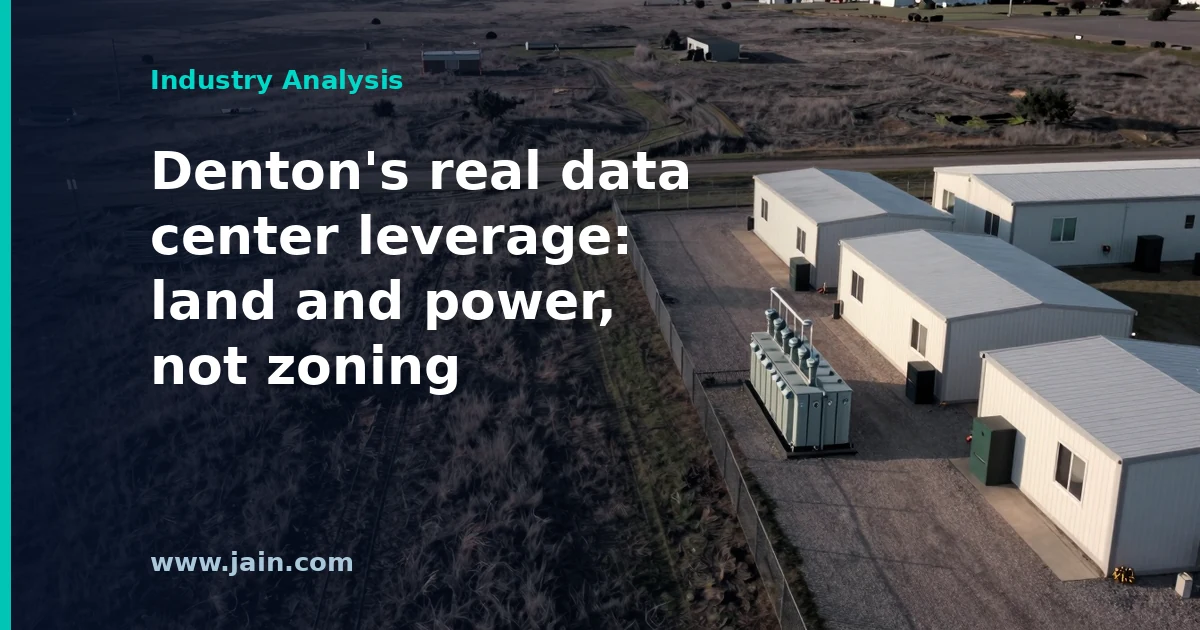
Denton, a Texas city north of Dallas, is weighing a 90-day pause on new data centers. These are giant buildings full of computers that run online services and artificial intelligence.
The surprise: the pause may not reach the biggest one already there. Core Scientific’s site is built to handle 391 megawatts, about as much electricity as a sizable city uses. Its growth depends more on the city-owned power company, which sells it electricity and owns the land it wants to rent.
Residents are split between worries about the power grid and a $3 billion rise in the value of local taxable property.
Denton City Council held the first of two required public hearings on a proposed moratorium on new data center development during its Sept. 22 meeting, Community Impact reported. The moratorium would halt all new data center development and permitting in city limits for 90 days, with an option to extend for another 90. A second hearing is set for Oct. 27, and the council could vote as early as Dec. 2.
At the same meeting, city officials said Core Scientific, which operates a 391-megawatt (MW) data center in Denton, had asked Denton Municipal Electric (DME), the city-owned utility, to lease additional public land south of its facility. A second project, Qumulus AI’s 20 MW data center, is planned to start operating in 2028 but has not begun construction.
Executive Summary
Denton is moving through the legal steps to pause new data center development, a process the council started with a unanimous vote on Aug. 18. The city attorney, Mack Reinwand, told the council that “a moratorium being passed does not necessarily stop an existing project from being built out.” Whether the pause would apply to an operator expanding or needing more land to meet its agreement with the city will depend on what that project’s original submission included.
That distinction matters because Denton is not only a zoning authority. Through DME, it sells electricity to its largest data center under a power purchase agreement (PPA, a long-term contract for electricity) and owns the land that operator wants to lease. The hearing also landed days after Texas Gov. Greg Abbott ordered state environmental regulators to stop issuing new data center permits while ERCOT, the state grid operator, audits proposed projects.
For data center operators, including bitcoin miners repositioning as hosts for AI and high-performance computing, Denton shows how local, state and grid-level controls now stack on the same site. For an existing operator, the most precise controls sit with the utility, not the moratorium.
What a Moratorium Can and Cannot Reach
A moratorium is a temporary pause on accepting or processing new development applications. Denton’s version would stop new data center development and permitting in city limits as soon as it passed. That is a blunt tool aimed at what has not been built yet. The city attorney’s caution that it “does not necessarily stop an existing project from being built out” means the pause bites hardest on projects that have not yet secured approvals.
That puts the two projects in different positions. Core Scientific’s 391 MW facility is operating. Qumulus AI’s 20 MW data center has a 2028 target, according to Charlie Rosendahl, Denton’s director of development services, but has not started construction. Whether Qumulus falls under the pause depends on the same question Mayor Chris Watts raised: what was submitted, and what the city already approved. Until the council answers that, the moratorium’s practical reach is unclear at both ends.
The Utility Is Also the Landlord
The headline point rests on what DME officials said about Core Scientific. DME Assistant General Manager Chris Lutrick said Core Scientific’s PPA limits how many megawatts it can consume. Those limits are controlled by ERCOT. He also said the company “ha[s] not got there” and has not asked for more power than the contract allows. So the operator’s electrical ceiling is already set by a contract with the city’s utility and by the state grid operator, whatever the council decides on the moratorium.
Land is the second lever. Lutrick said Core Scientific asked three to four months earlier to lease public land just south of its facility. He said the company did not say how it would use that land, and that it had been renting space at a private residence to park contractor vehicles. He added that the company “never mentioned another data center.” Rosendahl said the city is not discussing future data center development while the moratorium process continues. Interim City Manager Cassey Ogden said Core Scientific had not contacted the city about leasing more land, which does not match the utility’s account.
Taken together, the city’s decisions on whether to lease that parcel and how to administer the PPA will shape the 391 MW site more precisely than a pause on new applications. For operators on municipal utilities, the city can be regulator, power supplier and landlord at once. Each role gives it a separate point of leverage.
State and Grid Controls Stack on Top
Denton’s process does not run alone. According to the same reporting, Gov. Abbott said on Sept. 21 that state environmental regulators must stop issuing new data center permits. His order expands an existing state pause while ERCOT audits proposed data center projects. Rosendahl told the council that any interconnection, meaning the physical and contractual hookup to the grid, requires a study. Loads over 75 MW also need ERCOT approval, and that category is now under closer review at the governor’s direction.
The grid itself is the backdrop. Rosendahl said recent studies show Denton’s transmission system was already running near its limits before the large data center developments came online. That gives the moratorium’s supporters a concrete argument. It also suggests that any large new load would face capacity questions even without a local pause. For developers, the practical result is three layers of review: city permitting, state permits and ERCOT interconnection approval. Any one of them can set the schedule.
A $3 Billion Tax Base Against Unanswered Questions
The trade-off residents described is real on both sides. Denton saw a $3 billion increase in property tax value from data center development, according to earlier reporting. That is a direct fiscal benefit to the city and other local taxing bodies. Opponents cited long-term community effects and grid strain. Council Member George Ferrie said the city lacks long-term data on questions such as air quality because data centers “haven’t been this dense, this present for two decades.”
Neither side’s case is settled by what was presented at the hearing. The tax figure is a documented gain, but the grid concerns are backed by the city’s own transmission findings. A 90-day pause, extendable once, is a way to buy time for those studies rather than a final verdict. For AI infrastructure investors, the signal is that Texas sites near constrained municipal grids now carry local political review as a scheduling risk alongside power and equipment lead times.
Background
Denton, a fast-growing city in the Dallas-Fort Worth area, runs its own public power utility, Denton Municipal Electric. It currently has two data center operators: Core Scientific, with a 391 MW facility already operating, and Qumulus AI, with a 20 MW project planned for 2028. The moratorium effort began with a two-minute pitch from Mayor Pro Tem Nick Stevens on May 14. The council approved the pitch June 2 and voted unanimously on Aug. 18 to start the legal process.
Core Scientific built its business on bitcoin mining and has been repositioning toward hosting AI and high-performance computing workloads, part of a wider shift among miners with large power allocations. Most of Texas is served by the ERCOT grid, which has become a central gatekeeper for large new electricity loads such as data centers.
Texas cannot connect every giant computer warehouse that wants to plug into its power grid. So the agency running the grid has started rationing, deciding who gets electricity first by paperwork and start dates rather than by who asks loudest.
One company, Cipher, cleared an early hurdle for enough power to run a large city. Its shares jumped about nine percent.
A filing from rival Core Scientific shows the catch. Sites switched on before March 2022 skip the line. Everything newer waits, even after the concrete is poured.
Yahoo Finance reported that shares of Cipher Digital rose roughly 9% after the company received conditional status from the Electric Reliability Council of Texas (ERCOT), the operator of the Texas power grid, for 3.2 gigawatts of capacity in the state, with Core Scientific up about 4% and IREN slightly higher on the same read-across.
The move landed days after Core Scientific furnished an 8-K to the Securities and Exchange Commission on September 10, 2026, disclosing the ERCOT power status of each of its existing and proposed Texas data centers site by site: 371 megawatts at Denton, 600 megawatts at Pecos and 431 megawatts planned at Hunt. That filing is the clearest public description yet of how ERCOT is now sorting large data center loads — and of how much of a miner’s announced capacity is conditional rather than secured.
Executive Summary
The news event is a share price move, but the substance underneath it is regulatory. ERCOT is running an allocation exercise it calls Batch Zero, which assigns large new electrical loads to defined pathways and only releases a final allocation and load ramp when the process concludes. Conditional status inside that process is now the gating item between a developer’s announced gigawatts and energized, billable capacity.
Core Scientific’s 8-K sets out how the sorting works in practice. Denton’s existing 297 megawatts was conditionally approved as “Base Load, Pathway (a)” — longstanding existing load — purely because it energized before March 25, 2022, and is exempt from Batch Zero altogether. A further 74 megawatts at Denton is also exempt, because ERCOT had already incorporated it into the 2025 Regional Transmission Plan study cases. Pecos, by contrast, sits inside Batch Zero: 300 megawatts as “Base Load, Pathway (b)” for load energized after March 25, 2022, and another 300 megawatts as “Studied Load.” Hunt’s planned 431 megawatts qualified under Pathway (e) for demonstrated maturity, which the company earned by completing interconnection studies, clearing a 431-megawatt stability study, posting collateral, ordering long-lead equipment and starting construction.
For anyone buying, financing or underwriting Texas compute capacity, that hierarchy is the story. Two identical 300-megawatt blocks at the same site carry different regulatory certainty because of when they switched on. Cipher’s 3.2 gigawatts of conditional status is a real milestone; it is not the same thing as a final allocation, and the market repriced three companies on the distinction in a single session.
The Scarce Asset in Texas Isn’t a Megawatt. It’s a Date.
Core Scientific’s filing is unusually legible about a mechanism the industry usually discusses in the abstract. At Denton, 297 megawatts of existing power was conditionally approved as “Base Load, Pathway (a)” on one qualification: it was energized prior to March 25, 2022. That single fact takes it outside the Batch Zero allocation process entirely. At Pecos, 300 megawatts of existing power — physically comparable capacity, already operating — was conditionally approved as “Base Load, Pathway (b)” because it energized after that cutoff and before July 10, 2026. It sits inside Batch Zero, and the company states plainly that it will not receive its final allocation and load ramp until the process concludes.
The same asymmetry shows up in a quieter form on Denton’s additional 74 megawatts, which is exempt not because of an energization date but because ERCOT had already validated it inside the 2025 Regional Transmission Plan study cases. Presence in the grid operator’s own planning model functions as an entitlement. This is what makes interconnection paperwork the scarce input: it cannot be bought with capital on a short timeline, it cannot be manufactured, and it is not fungible with megawatts sourced elsewhere.
Run the arithmetic across the three Texas sites and the exposure becomes concrete. Of 1,402 megawatts described in the filing, 371 megawatts — just over a quarter — is outside Batch Zero and effectively settled in status terms. The remaining 1,031 megawatts is conditional and awaiting final allocation. Anyone underwriting Texas capacity, whether a lender sizing a facility, a GPU cloud tenant signing a multi-year lease or an investor modelling ramp, now has to ask which bucket a given block sits in, because the headline gigawatt figure no longer distinguishes them.
Pathway (e) Turns the Queue Into a Capital Test
Hunt is the instructive case, because it shows the alternative route for capacity that has no date advantage. Its planned 431 megawatts was conditionally approved as “Base Load, Advancing Large Load, Pathway (e)” — demonstrated maturity and advancement through the interconnection process. Core Scientific earned that by doing five specific things: completing interconnection studies with its utility partner, obtaining ERCOT approval of a 431-megawatt stability study, posting financial collateral, ordering long-lead equipment, and commencing construction.
That is a queue that rewards irreversible spend. Long-lead equipment orders — transformers, switchgear, generation and cooling plant — are placed years ahead and are difficult to cancel cleanly. Posting collateral ties up cash. Starting construction commits site capital before final allocation is known. The effect is to sort applicants by balance sheet and by willingness to accept sequencing risk, which advantages incumbent operators with existing land, utility relationships and financing access, and disadvantages speculative filings that exist mainly to hold a position.
The policy logic is defensible: a queue clogged with phantom load helps nobody, and requiring proof of advancement filters it. The commercial consequence is that developers must now fund a substantial portion of a project before they know what load ramp they will be granted. That is a materially different risk profile from the pattern of the past several years, and it is a cost that eventually shows up in the price of Texas capacity.
Why Three Companies Repriced on One Company’s Filing
Cipher’s 9% move, Core Scientific’s 4% and IREN’s smaller gain describe a market re-rating regulatory position rather than operating performance. Nothing about hash rate, bitcoin price or a new customer contract changed that day. What changed was information about who is likely to be allowed to energize large load in ERCOT, and the read-across was applied to peers with Texas portfolios.
The spread between those moves is worth reading carefully rather than dramatically. A one-day share price reaction is not a valuation, and conditional approval is several steps short of revenue. The chain runs: conditional status, then final allocation and load ramp, then energization, then a signed tenant, then billable capacity. Core Scientific’s own history illustrates the far end of that chain — its February 2025 expansion with CoreWeave added 70 megawatts of contracted power at Denton, took the site to 260 megawatts of critical IT load, brought CoreWeave’s contracted total across six locations to 590 megawatts, and carried an expected $10.2 billion of revenue over 12-year contract terms against $104 million of company capital expenditure. Note that critical IT load and electrical power are different measures, the former excluding cooling and electrical overhead, so the 260-megawatt figure and the filing’s 297 megawatts are not directly comparable.
There is a neat coincidence in that pairing: Denton, the site carrying the deepest contractual commitment, is also the site with the cleanest queue position. That is the combination the market is now hunting for, and it is rarer than announced gigawatt totals suggest. Capacity that is both contracted and exempt from allocation risk is the genuinely scarce product; capacity that is conditional and uncontracted is an option on a process whose conclusion has not been dated publicly.
Background
Bitcoin miners built large, power-hungry sites in Texas over the past decade because the state combines abundant generation, an independent grid and a market that rewards flexible load. After the 2024 halving cut mining rewards, several of those operators pivoted their footprints toward hosting artificial intelligence and high-performance computing, where tenants pay long-term contracted rates rather than exposing the operator to commodity price swings. Core Scientific’s February 2025 Denton expansion with CoreWeave was an early template: $1.2 billion of investment, 70 additional megawatts of contracted power, and a stated intent to run 900 megawatts of its contracted capacity as HPC hosting against 400 megawatts of mining.
The constraint on that pivot has shifted from capital to connection. As requests for hundreds of megawatts per site multiplied, ERCOT moved to formalise how large loads are approved and sequenced, creating the pathway definitions and the Batch Zero allocation process that Core Scientific’s September 10 filing describes. The practical effect is that a developer’s position in that process — its energization dates, its completed studies, its posted collateral, its presence in the grid operator’s transmission planning model — now determines how much of its announced capacity it can actually energize, and when.
On July 27, 2026, Core Scientific (NASDAQ: CORZ) executed lease agreements covering 377 MW of critical IT capacity with AMD at its Pecos, Texas; Muskogee, Oklahoma; and Hunt County, Texas sites, plus 152 MW with an unnamed “Neocloud” at Auburn, Alabama and Dalton Phase 3, Georgia. Each lease runs fifteen years with three five-year renewal options. The AMD leases also grant AMD the right to reserve an additional 1,925 MW through December 28, 2028 — the arithmetic behind the “up to 2.5 gigawatts” headline in the two companies’ joint announcement of July 28. Core Scientific issued AMD a warrant for up to 30 million shares at $23.47, of which roughly 6.5 million vested on signing.
Credit where it is due: Stocktwits surfaced the market reaction to the partnership, and that pointer led us to the underlying filings, where the actual terms sit. What follows is built on those documents — the July 28 8-K, the same-day Q2 2026 results, the August 14 and August 27 8-Ks, and AMD’s own second-quarter report.
Executive Summary
The announcement matters because of what is contracted versus what is merely available. Approximately 530 MW across five sites is under signed fifteen-year leases, which Core Scientific told investors represents more than $14 billion of potential base contracted revenue. The remaining 1,925 MW is a reservation right — an option AMD may exercise “at certain times and under certain circumstances” before the end of 2028. Both numbers are real; they are not the same kind of real, and the gap between them is the single most important thing to understand about the deal.
The transaction lands on a company in the middle of a fast pivot. Core Scientific’s Q2 2026 colocation revenue was $136.7 million, up from $10.6 million a year earlier, on total revenue of $164.2 million and adjusted EBITDA of $41.1 million. Total leased customer power now stands at roughly 1.1 GW, which the company frames as more than $24 billion of potential contracted revenue. It also reported a net loss of $1,155.3 million, attributed primarily to the change in fair value of warrants as its share price appreciated — an accounting outcome, not a cash one, but one the AMD warrant will keep producing.
For AMD, this is ecosystem construction. Data Center revenue was $6.7 billion in Q2 2026, up 107% year over year and 58% of a company that grew total revenue 50% to $11.5 billion. Securing megawatts where Instinct GPUs and EPYC CPUs can land is a way of removing the physical bottleneck between a chip roadmap and a customer deployment. It also commits a semiconductor company to fifteen-year real-estate obligations, which is not a normal item on a fabless balance sheet.
Five Sites Signed, Four Times That Reserved
The joint press release says AMD “secures more than 500 megawatts of U.S. capacity.” The 8-K filed the same week is more precise: AMD itself is the tenant on 377 MW. The balance that gets the figure over 500 — 152 MW at Auburn and Dalton Phase 3 — is leased by an unnamed Neocloud, industry shorthand for a specialist cloud provider that rents out GPU compute rather than a general-purpose cloud. AMD’s involvement there is indirect: a tri-party Credit Support Agreement among Core Scientific, the Neocloud and AMD that protects AMD equipment on the premises and gives AMD the right, but not the obligation, to cure certain Neocloud defaults.
That structure is sensible and common — a chip vendor backstopping a smaller customer’s lease so the landlord will sign it — but it should be read for what it is. The Credit Support Agreements terminate automatically on the earliest of lease expiration, fifteen years, or “specified circumstances relating to the insolvency or default” of the Neocloud, and AMD may terminate on a material misrepresentation by Core Scientific after a cure period. The filing does not spell out which insolvency circumstances end the support. The protection is therefore strongest in the ordinary case and least defined in the scenario where it would matter most.
The 1,925 MW reservation right deserves equally plain language. It is not a lease, not a commitment to lease, and carries no disclosed reservation fee, exercise price or trigger. What it does is hold Core Scientific’s future development pipeline for AMD’s ecosystem through December 28, 2028. For a landlord in a market where power is the scarce input, exclusivity of that duration has a cost, and the filings do not say what AMD paid for it.
The Warrant Is the Deal’s Second Currency
AMD received a warrant for up to 30 million Core Scientific shares at $23.47 — the five-day volume-weighted average price before execution, so struck at market rather than at a discount. It vests at 12,222 shares per megawatt of critical IT load contemplated by the leases, which is why roughly 6.5 million shares vested immediately against the ~530 MW signed. Run the arithmetic in the other direction and the full 30 million shares correspond to about 2,455 MW: the 530 MW leased plus the 1,925 MW reserved, almost exactly. The warrant is calibrated to the whole 2.5 GW ambition, and it expires July 27, 2031.
This is a well-designed alignment mechanism. AMD only earns equity as it fills halls, and Core Scientific only dilutes as contracted revenue arrives. It is also genuine dilution, and it creates an unusual reporting artifact. Core Scientific carries warrants as liabilities — $1.81 billion in current warrant liabilities at June 30, against $1.77 billion of cash — and marks them to fair value each quarter. When the shares rise, the liability rises and the income statement records a loss. The company’s $1,155.3 million Q2 net loss was, on its own account, primarily that mechanism at work.
The practical consequence for anyone reading future quarters: good news about the stock will keep manufacturing headline losses. Adjusted EBITDA of $41.1 million and gross profit of $70.0 million are the figures that describe the operating business. Neither, however, makes the dilution imaginary. The two facts coexist: the loss is not cash, and the shares are.
The Cash Question: $797.5 Million a Quarter Against a $100 Million Revolver
Core Scientific spent $797.5 million on capital expenditure in Q2 2026, including land and development rights, and closed the acquisition of Polaris DS on August 13 for approximately $444.3 million in cash, with a further $40 million payable if an additional 40 MW of firm electric capacity reaches the target before December 31, 2026. Liquidity at quarter-end was $1,819.4 million. At the second quarter’s spending rate, that is a runway measured in quarters, not years, and the ~530 MW now under lease has to be built before it bills.
Against that, the August 25 credit agreement with JPMorgan Chase as administrative and collateral agent provides a $100.0 million revolving facility and a $500.0 million letter-of-credit facility, secured by a first-priority lien on substantially all assets, maturing in three years or four at the company’s election. The letter-of-credit line is the operationally important half: utilities require credit support for interconnection and project obligations, and $500 million of L/C capacity buys the ability to hold power positions. But only $100 million of it is borrowable cash. This is a liquidity and collateral facility, not a construction financing, and the company has not described how the remaining build is funded.
Two covenant details are worth flagging. Liquidity — unrestricted cash plus undrawn revolver commitments — must be at least $150.0 million at each quarter end. And each revolver borrowing is conditioned on a market capitalisation of at least $3.0 billion at the prior close. That second condition ties access to credit to the equity market’s continuing enthusiasm, at a company whose share price is also the input to its warrant accounting and the strike on AMD’s warrant. It is a reasonable lender protection. It is also a link between financing capacity and sentiment that did not exist before.
Why a Chip Company Signs a Fifteen-Year Lease
AMD’s own quarter explains the motive. Revenue of $11.5 billion was up 50% year over year with 54% GAAP gross margin and $2.3 billion of net income, and Data Center more than doubled to $6.7 billion. Alongside that, AMD reported partnerships to deploy Helios racks with Anthropic at up to 2 gigawatts and with Microsoft on Azure. The constraint on converting that demand into revenue is not wafer supply alone; it is energised, high-density space. Leasing it directly, rather than waiting for customers to find it, shortens the path from an MI400-series launch to an installed rack.
The cost is that a fabless semiconductor company now holds fifteen-year lease obligations with three five-year extensions, in a business whose product cycles run eighteen to twenty-four months. Nvidia’s competitive position, the pace of accelerator obsolescence, and the possibility that end customers prefer someone else’s real estate are all risks that a chip company does not usually take onto its balance sheet. AMD has structured around some of it — the Neocloud takes 152 MW directly, and the 1,925 MW is optional rather than committed — which is exactly the point of the option.
For the wider infrastructure market, the read-through is that GPU vendors are becoming counterparties to data center operators, not just suppliers to them. That is good for operators with power in hand: Core Scientific’s implied economics on the anchor leases, at more than $14 billion over fifteen years across roughly 530 MW, work out to roughly $1.76 million per megawatt-year, against roughly $1.45 million per megawatt-year implied by the $635 million average annualised colocation revenue on 437 MW of billing capacity as of mid-July. It also means the tenant roster in AI colocation increasingly includes firms whose primary business is selling the chips inside — a concentration of interest that buyers negotiating for capacity in the same markets should factor into their own timelines.
Background
Core Scientific designs, builds and operates large-scale, purpose-built data centers for high-density colocation, with facilities in Alabama, Georgia (2), Kentucky, North Carolina, North Dakota, Oklahoma and Texas (4). The majority of its revenue now comes from colocation services for AI workloads; the remainder comes from earning digital assets for its own account and from digital asset mining hosting, and the company says it is repurposing its remaining mining facilities to support colocation as circumstances allow. The scale of that transition shows in one comparison: colocation revenue of $10.6 million in Q2 2025 against $136.7 million in Q2 2026, with billing capacity rising from 225 MW at the end of Q1 2026 to 395 MW at the end of Q2 and 437 MW as of mid-July. On July 29, 2026 the company appointed Mark W. Adams — formerly chief executive of Penguin Solutions and president of Micron Technology — to its board as an independent director.
AMD is the second-largest supplier of data center CPUs and the principal challenger to Nvidia in AI accelerators, selling Instinct GPUs, EPYC server processors and the open-source ROCm software stack. Its recent product cadence includes the Helios rackscale system and the Instinct MI400 series. The competitive problem AMD faces is not only silicon performance but deployment surface: customers need somewhere powered to put the racks. Arrangements in which a chip vendor contracts for megawatts on behalf of its ecosystem — rather than waiting for customers to source capacity themselves — are a recent development in a market where interconnection queues and utility timelines, not manufacturing, increasingly set the pace.
Blue Owl Capital and PIMCO have structured a $2.4 billion debt facility for IREN Ltd, the Nasdaq-listed operator that is converting bitcoin-mining sites into AI compute campuses. Reporting on the deal indicates the proceeds are earmarked for purchasing Nvidia accelerators — the specialised processors that run AI training and inference workloads. Separately, Core Scientific announced $600 million in new credit facilities.
The two financings land alongside IREN’s statement that its 2026 capacity is sold out and that it is now negotiating contracts for 2027 and 2028. Together they mark the maturing of a financing structure in which the chips themselves, and the contracted revenue they generate, carry the debt.
Executive Summary
The headline number is $2.4 billion, but the more consequential detail is the structure. Blue Owl and PIMCO are both large private-credit managers — firms that lend directly to companies rather than arranging syndicated bank loans — and they have built a facility specifically tailored to GPU procurement. That framing implies a financing secured against a hardware fleet and the contracts that fleet serves, rather than against a diversified corporate balance sheet.
This matters because it decouples AI infrastructure buildout from equity issuance. A neocloud — an operator that rents out GPU capacity without the broader service portfolio of a hyperscaler like AWS or Azure — has historically had two ways to buy chips: sell shares, or fund from cash flow. Neither scales to multi-billion-dollar fleets. Asset-backed debt is the third path, and it is now open at institutional size.
The trade-off is symmetrical. Pre-selling capacity years forward gives lenders visible cash flows to underwrite against; IREN’s claim that 2026 is fully contracted is precisely the kind of evidence that makes such a facility underwritable. But it also fixes revenue in advance while leaving the borrower exposed to the residual value of assets that depreciate on a schedule nobody has yet observed across a full technology cycle.
What It Means to Pledge a Chip
Collateralised lending is old; the question is always what the lender can recover if the borrower stops paying. Real estate works as collateral because buildings are immobile, long-lived, and trade in a deep secondary market. Aircraft and shipping containers work because they are standardised, tracked, and re-leasable. GPUs are a genuinely new asset class in this respect: they are standardised and in acute demand, which argues for strong recovery values, but they are also installed inside purpose-built facilities with specific power and cooling requirements, which complicates repossession in any literal sense.
In practice, facilities of this type tend to rely less on physically seizing hardware and more on capturing the contracted revenue that hardware produces — the customer agreements, and the entity that holds them. That is why the sequencing in IREN’s case is notable: the company’s statement that 2026 capacity is sold out precedes and supports the financing logic. Lenders are underwriting a contracted book, with the chips as backstop rather than as primary recovery.
None of the public material specifies the security package, the advance rate against hardware cost, the tenor, or the pricing. Those terms are where the actual risk allocation lives, and their absence is the single largest gap in what has been disclosed.
The Residual Value Problem Nobody Has Solved
Every asset-backed structure embeds an assumption about what the asset is worth at the end. For GPUs, that assumption is unusually hard to defend. Nvidia has been shipping new accelerator generations at a cadence far faster than the multi-year amortisation periods typically applied to data centre equipment, and each generation has delivered large performance-per-watt improvements. A chip that is two generations old is not worthless — inference workloads, smaller models, and price-sensitive customers all provide a floor — but its rental rate is not the rate it commanded at launch.
This creates a specific mismatch. If a facility amortises over, say, a longer horizon than the period during which a chip commands premium pricing, the borrower must either re-contract older hardware at lower rates or refinance into a fleet upgrade. Both are manageable in a market with excess demand. Neither is comfortable if demand normalises while the debt schedule does not. The honest position is that no one has yet observed a full GPU depreciation cycle under sustained competitive supply, so residual-value assumptions in these deals are estimates, not history.
It is worth being even-handed here. The counterargument — that compute demand has repeatedly outrun supply forecasts, and that older accelerators have found ready secondary uses — is not unreasonable. The point is not that these facilities are unsound; it is that their soundness rests on a forward-looking judgment that has not been stress-tested, and that lenders are being compensated for taking it.
Winners, Losers, and the Private-Credit Angle
The clearest beneficiaries are the neoclouds themselves. IREN and Core Scientific both originated as bitcoin miners, meaning they already controlled the scarcest input in AI infrastructure — energised sites with interconnection agreements and power contracts. What they lacked was the capital to fill those sites with accelerators. Debt of this kind converts a land-and-power position into a compute business without diluting shareholders at every step.
Nvidia benefits indirectly and substantially: financing capacity is now a gating factor on GPU sales, and structures that unlock institutional debt expand the buyer pool beyond hyperscalers with investment-grade balance sheets. Private credit managers benefit from a new, large, yield-generating asset class at a moment when they hold substantial dry powder. Traditional banks are, for now, less visible in these transactions — which is itself informative about where regulatory capital treatment and risk appetite currently sit.
For buyers of AI capacity, the second-order effect is availability. More financed hardware means more contractable capacity, and IREN’s stated pivot to 2027 and 2028 negotiations suggests operators are trying to lock in demand well ahead of delivery. Enterprises signing multi-year GPU contracts should nonetheless treat counterparty durability as a real diligence item: a highly levered provider whose debt is secured against the very fleet serving your workload is a different credit risk than a hyperscaler, and contract terms should reflect that.
Background
Both IREN and Core Scientific began as bitcoin miners, businesses defined by the pursuit of cheap electricity at scale. That pursuit left them holding something the AI buildout badly needs: sites with signed grid interconnection agreements and multi-year power contracts, in a market where new interconnection queues can run for years. When AI compute demand accelerated, converting those sites to GPU hosting became a more attractive use of the same infrastructure. Core Scientific emerged from Chapter 11 bankruptcy protection in 2024 and continued that pivot; a proposed all-stock acquisition by CoreWeave was rejected by its shareholders in 2025, leaving the company independent.
The financing question followed directly. Site and power are capital-intensive but financeable through familiar channels; filling those sites with accelerators requires very large equipment purchases that neither company could fund from operating cash flow. Equity issuance dilutes shareholders. That gap is what facilities like the Blue Owl and PIMCO structure are designed to fill, and it explains why the terms of these deals — not just their headline sizes — are the thing worth watching.
In a cluster of announcements tracked across financial wires, four publicly traded bitcoin miners advanced their conversion into AI data center companies: MARA Holdings saw its stock jump on a reported $1.5 billion Long Ridge power deal, Core Scientific secured a $1 billion financing facility from Morgan Stanley for its AI push, and Riot Platforms landed $573 million in new debt as its data center focus sharpens. Separately, Kentucky’s utility regulator approved an electricity contract for TeraWulf’s Hancock County data center project, and Cipher Mining drew fresh investor commentary on its own AI pivot.
Taken together, the headlines represent more than $3 billion in fresh capital and power commitments flowing into former bitcoin mining platforms in a single news cycle.
Executive Summary
The bitcoin-miner-to-AI-data-center pivot has moved from strategy slides to balance sheets. The announcements span the three ingredients an AI facility actually needs: money (Core Scientific’s $1 billion Morgan Stanley facility, Riot’s $573 million debt raise), power (MARA’s reported $1.5 billion Long Ridge deal), and regulatory clearance to consume that power (TeraWulf’s approved Kentucky electricity contract).
Why it matters: the scarcest input in AI infrastructure today is not GPUs but grid-connected electricity, and bitcoin miners are among the few companies that already hold large, energized interconnections. These deals suggest institutional lenders and power counterparties are now willing to finance that position at scale — a meaningful shift for companies that historically funded themselves through equity issuance and the price of bitcoin.
The caveat: these are headline-level reports, and the underlying deal terms — tenants, rates, tenors, covenants — are largely undisclosed in the source material. The direction is clear; the economics are not yet.
From Hashrate to Megawatts: Power Is the Product
A bitcoin mine and an AI data center share one essential asset: a large, approved connection to the electrical grid. Utility interconnection queues in the United States now stretch years, which means a miner holding hundreds of megawatts of energized capacity owns something a new data center developer cannot quickly buy at any price. The pivot reframes these companies from sellers of computed bitcoin into landlords of contracted electricity.
That is the common thread across the announcements. MARA’s reported $1.5 billion Long Ridge deal is, per the coverage, a power arrangement — its latest step beyond mining. TeraWulf’s milestone is not a chip order but a regulator-approved electricity contract for its Hancock County, Kentucky project. In this market, the press release that matters is increasingly the one signed with a utility, not a hardware vendor.
The Financing Shift: Institutional Debt Replaces Dilution
Bitcoin miners have historically financed growth through share issuance and, in some cases, loans collateralized by mined bitcoin — funding sources that rise and fall with crypto sentiment. A $1 billion facility arranged by Morgan Stanley for Core Scientific and a $573 million debt raise by Riot signal a different kind of capital: institutional credit that must be underwritten against durable cash flows and hard assets rather than token prices.
That is the capital-intensive phase in practice. Debt of this size generally implies lenders see financeable collateral — sites, interconnections, and prospective hosting contracts — where they once saw commodity exposure. It also raises the stakes: interest must be serviced regardless of whether AI tenants materialize on schedule, which makes execution risk a balance-sheet question, not just an operational one.
Regulators Are the New Gatekeepers
TeraWulf’s Kentucky approval is the least flashy headline and arguably the most instructive. Data center power contracts increasingly require sign-off from state utility commissions, which must weigh large new industrial loads against reliability and ratepayer impacts. An approval is a genuine de-risking event; a denial or protracted proceeding can strand an otherwise finished site.
For the sector, this means the competitive map is being drawn by regulatory and utility processes as much as by capital markets. Companies that can navigate commissions, secure tariff arrangements, and demonstrate community benefit will convert their pivots faster than those that cannot — a discipline closer to utility development than to cryptocurrency operations.
Execution Risk: A Mine Is Not Yet a Data Center
Converting mining infrastructure into AI-grade capacity is a real engineering lift. Mining tolerates interruptions and runs on air-cooled, low-redundancy designs; AI training and cloud tenants typically demand high-density racks, liquid or advanced cooling, backup power, and strong uptime guarantees. The capital being raised is precisely for closing that gap, but none of the source reports detail conversion timelines or committed tenants for the newly financed capacity.
The Cipher Mining coverage — investor opinion rather than a deal announcement — is a reminder that markets are still debating how to value these pivots. The winners will be judged on signed leases and energized halls, not announcements.
Background
MARA Holdings, Core Scientific, Riot Platforms, TeraWulf, and Cipher Mining are publicly traded companies that built their businesses operating large-scale bitcoin mining facilities — warehouses of specialized computers whose defining requirement is cheap, abundant electricity. That footprint left them holding sizable grid interconnections and power-ready land just as the AI boom made those assets scarce and valuable.
Over the past two years the sector has increasingly repositioned toward hosting high-performance computing and AI workloads, where revenue comes from long-term capacity contracts rather than mining rewards. The announcements covered here mark that repositioning entering a heavier phase: billion-dollar institutional financings, major power transactions, and formal utility regulatory approvals.
Source: Cipher Mining Stock (CIFR) Opinions on AI Data Center Pivot (Quiver Quantitative), analyzed alongside contemporaneous reports on Core Scientific’s Morgan Stanley facility (CoinMarketCap), MARA’s Long Ridge deal (Stocktwits), TeraWulf’s Kentucky approval (WEKU), and Riot’s debt raise (Yahoo Finance).