TL;DR · 30-second read
The Short Version
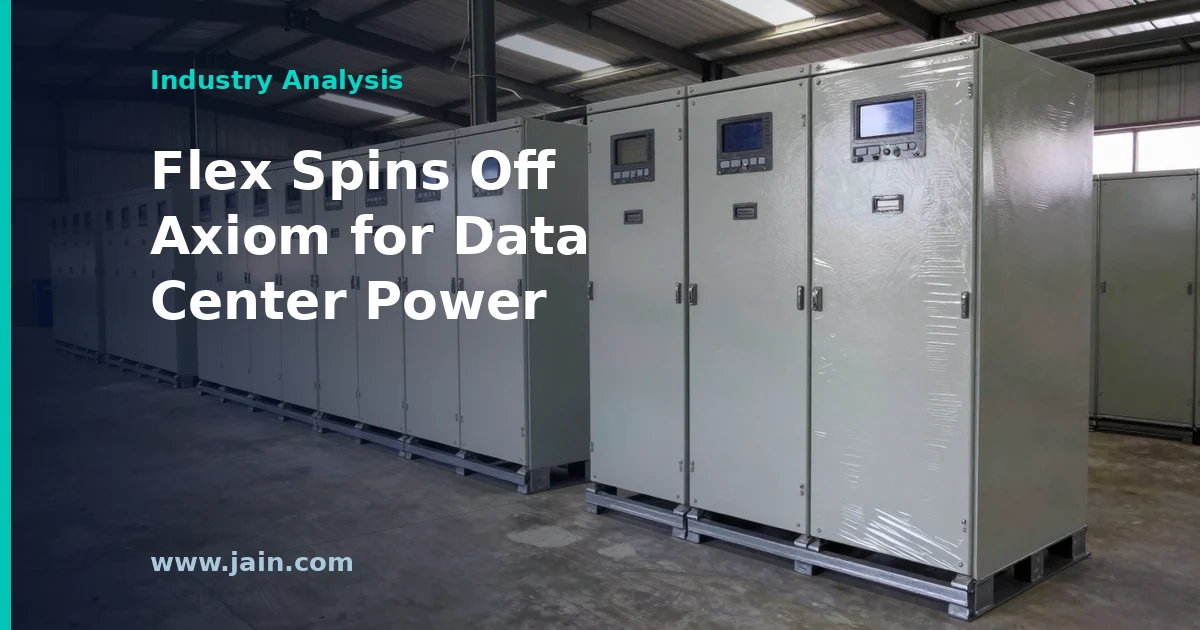
Flex, a large manufacturer that builds products for other brands, is splitting in two. Its business making power and cooling equipment for data centers, the giant buildings full of computers that run artificial intelligence tools, will become a separate company called Axiom.
On September 15, Flex named the leaders and board members for both companies. Flex’s current boss will run Axiom, and several of Axiom’s directors come from big electrical-equipment makers.
The split still needs approval from shareholders, market regulators and a court in Singapore. Flex expects to finish it in early 2027.
Flex (Nasdaq: FLEX) on September 15, 2026 unveiled Axiom Solutions International, Inc. as the name of its planned independent Cloud and Power Infrastructure company and filed a preliminary Form 10 registration statement with the U.S. Securities and Exchange Commission. A Form 10 is the document a new company files to register its shares for public trading, and it is typical of a spin-off. In a spin-off, a parent hands shares of a business unit directly to its own shareholders. In a companion announcement, also filed as Exhibit 99.1 to an 8-K dated September 15, Flex set out the expected post-separation boards of both companies, named four new directors, and said Amy B. Schwetz, most recently CFO of Flowserve, will join on October 5, 2026 and is expected to become Flex CFO after the split.
Flex expects to complete the separation in the first quarter of calendar 2027. Completion is subject to final Flex board approval, the Form 10 becoming effective, a Flex shareholder vote and approval from the Singapore High Court.
Executive Summary
The September 15 announcements move Flex’s separation plan from concept toward execution. The spin-off business now has a legal name and a registration filing, and both companies have named their leaders. Revathi Advaithi, Flex’s CEO, is expected to lead Axiom. Michael Hartung, Flex’s chief commercial officer, is expected to become CEO of the remaining Flex, which keeps the Regulated Manufacturing Services (RMS) and Integrated Technology Services (ITS) segments.
The appointments show what each company wants to be. Axiom’s board draws heavily on the electrical-equipment industry, including two Eaton veterans and a former head of electrification at ABB. That points toward competing as a power infrastructure supplier for data centers, which Flex describes as the problem of solving ‘power, heat, and scale challenges’ in the AI era. The remaining Flex board is weighted toward industrial operating and finance experience.
For investors and data center buyers, the practical result would be a dedicated power and cooling supplier that can be valued and judged separately. Flex has not yet presented many of the details that would allow that judgment, including a final capital structure and an Axiom finance chief.
The Pure-Play Bet on Data Center Power
Flex has long operated as a diversified contract manufacturer across 30 countries. Its stated reason for separating the Cloud and Power Infrastructure segment is to create focus. The forward-looking statements attached to the 8-K list the anticipated benefits as ‘enhanced strategic focus, financial flexibility, and value creation for shareholders.’ The logic is familiar. Investors who want exposure to the build-out of AI data centers, which need large amounts of electricity delivered and heat removed, may pay more for a business that does only that than for the same business inside a broader manufacturer.
That thesis is plausible, but Flex has not quantified it. Neither announcement puts a number on value creation, and Flex’s risk factors state that the benefits ‘may not be achieved or may take longer to achieve than expected.’ The strength of the pure-play case will depend on Axiom’s disclosed growth, margins and customer mix once they are tested against the market.
A Board Built From Electrical Incumbents
Axiom’s expected board shows clearly where the company intends to compete. Mark Eubanks, CEO of Brink’s, previously ran Eaton’s Electrical Products business, which Flex says had about $6 billion in annual revenue. David Johnson, CFO of Corteva, spent 29 years at Eaton, finishing in finance and operations for its Electrical Sector, and was later CFO of Atkore. Maryrose Sylvester was U.S. head of electrification at ABB. William D. Watkins, former CEO of Seagate Technology, will chair the board. Michael E. Hurlston, CEO of Lumentum, and Charles K. Stevens III, former CFO of General Motors, round it out.
Directors who helped run established electrical-products businesses bring knowledge of pricing, channels and manufacturing scale in that market. A strong board does not by itself win business, though. Whether Axiom can take share from long-established electrical suppliers is still an open question. The remaining Flex board is more of a general industrial group: George R. Oliver (former chair and CEO of Johnson Controls), Patrick J. Ward (former CFO of Cummins), Brian Yoor (former CFO of Abbott Laboratories), plus existing directors from Raytheon International, UnitedHealth Group and STATS ChipPAC. Schwetz’s background as CFO of Flowserve and Peabody Energy fits that profile.
The Governance Link Between the Two Companies
One feature deserves attention from shareholders of both companies. Advaithi is expected to be CEO of Axiom, a director on Axiom’s board and chair of the Flex board at the same time. It is common for a parent’s chief executive to move to a spun-off company. Chairing the former parent while running the new company is less routine, and it raises reasonable questions about how the two boards will handle any commercial dealings or competing interests between the companies after separation.
Flex has signaled that it is aware of the issue. It plans to appoint a Lead Independent Director of the Flex board, effective at separation. Flex has not named that person or defined the role’s authority, so investors cannot yet judge how strong a counterweight it will be.
What Still Has to Happen
The separation has several conditions. Flex is incorporated in Singapore, and the 8-K references the Singapore Companies Act. That is why the Singapore High Court must approve the transaction in addition to Flex shareholders. Flex says it will file a proxy statement on Schedule 14A to seek the shareholder vote. The Form 10 must also be declared effective, and the Flex board must give final approval. Flex expects the spin-off to be tax-free for U.S. federal income tax purposes and lists the possibility that it will not qualify as a risk.
The 8-K also discloses the pay for incoming directors Oliver and Eubanks: $90,000 in annual cash, a pro-rated share of the current restricted stock unit award, and an annual stock award worth $235,000. Oliver and Eubanks join the Flex board on September 24, 2026. Eubanks moves to Axiom’s board at separation.
Background
Flex is an Austin, Texas-based manufacturer, listed on Nasdaq and registered in Singapore, that designs, builds and manages products for other brands across 30 countries. It reports through segments that include Regulated Manufacturing Services, Integrated Technology Services and Cloud and Power Infrastructure. The last of these supplies power, cooling and IT infrastructure products that Flex says help customers speed up data center deployment.
Demand for AI computing has made electricity delivery and heat removal major constraints for data center operators. That has drawn investor attention to companies that sell power and cooling equipment. Flex’s plan to spin off Cloud and Power Infrastructure as Axiom would create a stand-alone public company focused on that market. The remaining Flex would continue as a diversified manufacturing and technology services company. Source: Flex Announces Expected Flex CFO and Board Composition for Flex and Axiom Following Separation, Flex’s announcement of post-separation leadership and boards, and the companion release Flex Announces New Company Name for the Planned Cloud and Power Infrastructure Spin-Off and Files Form 10 Registration Statement. Primary sources: Flex Ltd. Form 8-K filed September 15, 2026 (SEC EDGAR); Exhibit 99.1 to Flex’s 8-K, press release on expected CFO and board composition (SEC EDGAR).Sources