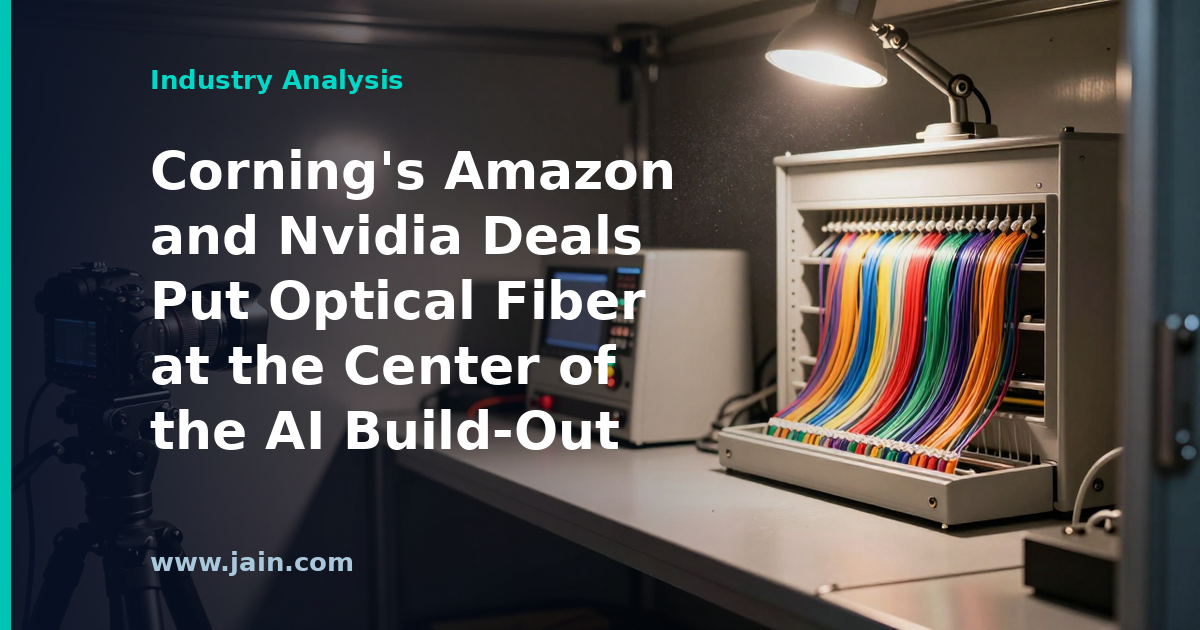
Corning Incorporated (NYSE: GLW), the U.S. glass and optical-fiber maker, has landed a supply deal with Amazon and a tie-up with Nvidia to support AI-driven fiber expansion, according to a Yahoo Finance report dated July 11, 2026. The report identifies the two partners and the AI-infrastructure context but discloses no financial terms, volumes, or timelines.
Executive Summary
According to the report, Corning has secured two of the most consequential names in AI infrastructure as partners: Amazon, the largest cloud provider through AWS, and Nvidia, whose GPUs power the bulk of AI training clusters. The pairing matters because it spans both ends of the optical market — a hyperscale buyer locking in fiber supply for data-center construction, and a chipmaker whose networking roadmap increasingly depends on optics engineered into the systems themselves.
The deeper signal is about scarcity. For three years the AI build-out narrative has centered on GPUs, then power, then land and cooling. Deals like these suggest the industry is now moving down the stack to connectivity: the millions of fiber strands that stitch tens of thousands of accelerators into a single usable computer. When buyers of Amazon’s and Nvidia’s scale contract directly with a fiber manufacturer, it typically means they no longer trust the spot market to deliver.
Fiber Is the Layer the AI Boom Forgot to Price In
An AI data center is, in networking terms, unlike anything the cloud era built. Traditional cloud facilities connect servers that mostly work independently; AI training clusters must make thousands of GPUs behave like one machine, which requires every accelerator to talk to every other at extreme speed. That drives fiber consumption per megawatt to multiples of what conventional data centers use — dense mesh fabrics of optical links inside the building, plus long-haul routes connecting campuses into distributed training networks.
Corning has been positioning for this shift for some time. In 2024 it struck a widely reported agreement with Lumen Technologies that reserved roughly 10% of its global fiber capacity to interconnect AI data centers — an early sign that fiber, a product long treated as a commodity, was becoming something buyers reserve years ahead. A reported Amazon deal would extend that pattern from carriers to the hyperscalers themselves.
What Amazon and Nvidia Each Want — and Why It’s Not the Same Thing
Amazon’s interest is straightforward supply security. AWS has committed to one of the largest capital programs in corporate history, building AI campuses that each require enormous quantities of fiber-optic cable, connectors, and pre-terminated assemblies. Contracting directly with the manufacturer hedges against the lead-time blowouts that hit transformers and switchgear, and can lock in pricing before competitors absorb capacity.
Nvidia’s angle is architectural. As GPU clusters scale, the copper links traditionally used for short connections run out of reach and power budget, pushing the industry toward optics integrated ever closer to the chip — including co-packaged optics, where the optical components sit in the same package as the switch silicon. Nvidia has publicly built a silicon-photonics ecosystem around its networking platforms, and Corning has previously been named among its optics partners. A deepened tie-up would suggest fiber makers are moving up the value chain, from selling cable to co-engineering the optical guts of AI systems.
Winners, Losers, and What the Report Actually Establishes
If the deals are as described, Corning gains something rare for a components maker: demand visibility anchored to the two most creditworthy names in AI. Other fiber and connectivity suppliers — Prysmian, CommScope, Fujikura, Sumitomo — face a market where marquee demand is being locked up bilaterally, which can lift the whole sector’s pricing but also concentrates the best volumes with the leader. Buyers without such agreements, including telecom carriers and enterprises mid-way through their own fiber projects, may face longer lead times if AI demand absorbs available capacity.
That said, the source material here is thin: a headline confirming that deals exist, not what they contain. No dollar values, durations, capacity commitments, or product scope are disclosed. Supply agreements in this industry range from binding take-or-pay contracts to loose framework arrangements that generate headlines but little guaranteed revenue. Until terms emerge — in an SEC filing, an earnings call, or a detailed release — the prudent reading is directional: fiber is now strategic enough that Amazon and Nvidia negotiate for it directly, and that fact alone is meaningful.
Background
Corning invented the first commercially viable low-loss optical fiber in 1970 and has remained one of the world’s largest fiber producers through every connectivity cycle since — the dot-com fiber glut, fiber-to-the-home, and the cloud data-center era. Its optical communications segment sells fiber, cable, and pre-connectorized hardware to carriers and, increasingly, to hyperscale data-center operators.
The AI era reframed that business. Beginning around 2024, Corning began striking capacity-reservation agreements tied explicitly to AI data-center interconnection, including its Lumen Technologies deal, and was named among the partners in Nvidia’s silicon-photonics ecosystem. The reported Amazon and Nvidia deals of July 2026 continue that trajectory: fiber shifting from commodity purchase to strategically contracted supply.
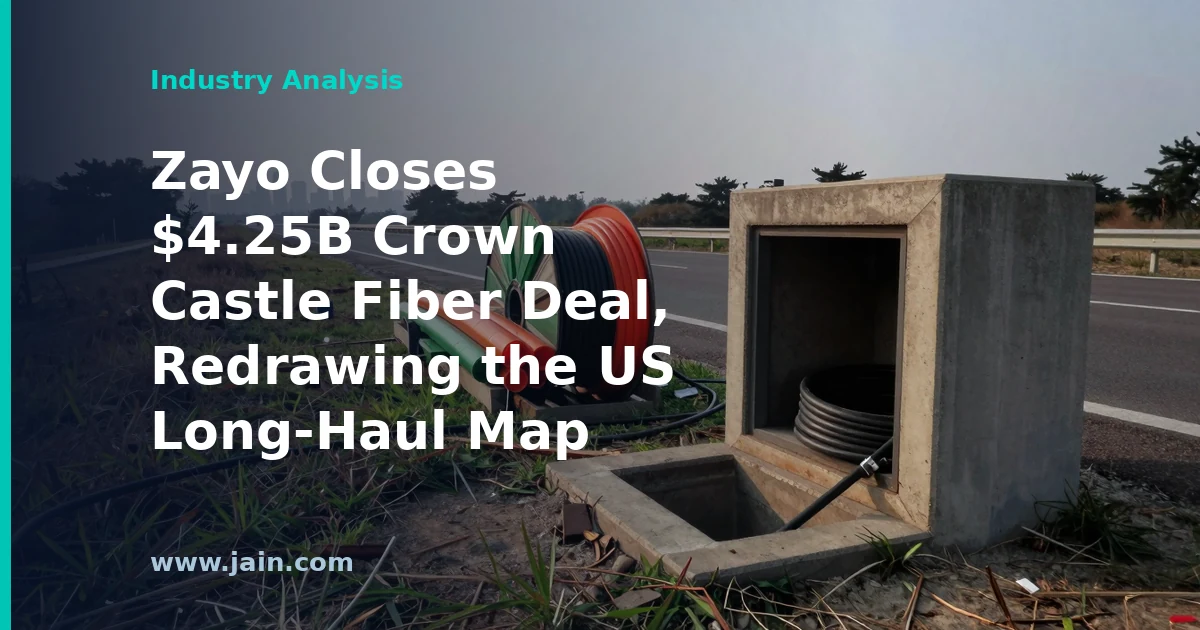
Zayo Group has completed its $4.25 billion acquisition of Crown Castle’s fiber business, according to a May 2, 2026 report from Fierce Network. The close finalizes a transaction first announced in March 2025, when Crown Castle agreed to exit fiber entirely by splitting the segment between Zayo, which took the fiber solutions business, and EQT, which took the small-cell operations, in a combined deal valued at roughly $8.5 billion.
The completion makes Zayo — already one of North America’s largest independent bandwidth-infrastructure providers — a substantially bigger force in both long-haul and metro fiber, while returning Crown Castle to its roots as a pure-play wireless tower company.
Executive Summary
The announcement itself is short: the deal has closed. But the closing matters more than most, because it formally redraws the ownership map of US fiber at a moment when fiber has shifted from a commodity business to a strategic one. Long-haul fiber — the high-capacity routes that carry traffic between cities — and metro fiber — the dense local networks that connect buildings, data centers, and cell sites within a city — are both being repriced by the AI build-out, as hyperscalers and data center developers scramble to connect new campuses.
For Zayo, the acquisition is a bet that scale wins in that environment: more routes, more conduit, more on-net buildings, and more ability to sell end-to-end connectivity to the customers spending most aggressively. For Crown Castle, it is the final step in unwinding a decade-long fiber strategy that the market never rewarded, refocusing the company on towers. Two companies looked at the same asset class and reached opposite conclusions — which is precisely what makes this deal worth watching.
Fiber Is Having Its Moment — and Zayo Is Consolidating Into It
For most of the 2010s, long-haul fiber was treated as a mature, low-growth business: capacity was abundant, prices declined steadily, and the assets traded hands repeatedly among private-equity owners. The AI infrastructure cycle has changed that calculus. New data center campuses are being sited in secondary and rural markets where power is available but fiber often is not, and connecting those sites — to each other and to major interconnection hubs — requires exactly the kind of route diversity and dark fiber (unused fiber strands leased whole, rather than as managed bandwidth) that Zayo sells.
Absorbing Crown Castle’s fiber business gives Zayo a much denser metro footprint to pair with its national backbone. In connectivity, density compounds: the more buildings and data centers a provider can reach on its own network, the more of each customer’s traffic it can carry without paying another carrier, and the better its margins and win rates. That logic, not nostalgia for telecom assets, is what a $4.25 billion price tag implies.
Two Readings of the Same Asset
The striking feature of this transaction is the strategic divergence it crystallizes. Crown Castle spent heavily to build its fiber segment in the mid-2010s — including the reported $7.1 billion purchase of Lightower in 2017 — on the thesis that fiber and small cells would complement its tower business. Investors, including prominent activist shareholders, ultimately disagreed, arguing the fiber business consumed capital while earning returns below the tower segment’s. The March 2025 agreement to sell the entire segment, and now its completion, is the definitive verdict of that internal debate: Crown Castle is a tower company again.
Zayo’s owners are making the opposite wager — that fiber’s return profile has structurally improved with AI-era demand, and that assets underperforming inside a tower REIT can perform well inside a focused fiber operator with a different cost base and sales motion. Both positions are defensible. Crown Castle’s shareholders wanted capital discipline and simplicity; Zayo’s private owners can hold a capital-intensive asset through a demand cycle without quarterly scrutiny. The deal is less a judgment on fiber than on who is best structured to own it.
Integration Is Where $4.25 Billion Deals Are Won or Lost
Zayo was itself assembled through dozens of acquisitions, so network integration is a core competency — but this is among the largest single integrations it has attempted. Merging two national fiber operations means reconciling network inventories, OSS/BSS systems (the operational and billing software that tracks what fiber exists and who is paying for it), overlapping routes, and two sales organizations, all without disrupting enterprise and carrier customers who treat connectivity outages as existential. Historically, fiber roll-ups have stumbled less on the assets than on the systems and service quality during the merge.
There is also a balance-sheet dimension. Fiber consolidation of this scale is typically debt-financed, and the sector’s private owners have been navigating a higher-rate environment than the one in which many of these assets were last underwritten. Strong AI-driven demand improves the revenue side of that equation, but execution risk during integration is the variable Zayo most controls.
What Changes for the Market
For enterprise and wholesale buyers, one fewer independent fiber provider means the competitive set in some metros narrows, which bears watching on pricing and on route diversity — customers who deliberately bought from both companies for redundancy may now find both circuits on one network. For data center developers, a larger Zayo is arguably good news: a single counterparty that can deliver metro entrances and long-haul routes together simplifies procurement for new campuses. And for the remaining independent fiber operators, the deal resets the benchmark for what scaled fiber platforms are worth, which tends to invite further consolidation rather than end it.
Background
Zayo was founded in 2007 and grew into one of North America’s largest independent fiber operators through a long series of acquisitions, going public in 2014 before being taken private in 2020 by a consortium led by DigitalBridge and EQT. Crown Castle, one of the largest US tower REITs, moved aggressively into fiber in the mid-2010s — including the reported $7.1 billion acquisition of Lightower in 2017 — betting that fiber and small cells would complement its tower franchise.
That bet faced years of investor pushback over returns on the fiber capital, culminating in a strategic review and the March 2025 agreement to sell the entire fiber segment for roughly $8.5 billion, split between Zayo and EQT. The May 2026 closing of Zayo’s $4.25 billion portion completes Crown Castle’s retreat to towers and lands just as AI data center construction has made fiber routes one of the most sought-after asset classes in digital infrastructure.