Data Center Knowledge reported on May 23, 2026, that AI inference — the day-to-day serving of trained AI models to end users — is pulling infrastructure investment back toward metro data centers, reversing years of momentum toward remote hyperscale campuses. The driver, per the report’s framing, is latency: inference workloads live and die by response time, and response time is a function of physical distance to users.
Executive Summary
The trade publication’s thesis is straightforward: the AI buildout’s first act was dominated by training — the compute-intensive process of creating models — which rewarded remote sites with cheap land and abundant power, because training does not care where it runs. The second act is inference, the phase where those models actually answer queries for businesses and consumers, and inference is latency-sensitive in a way training never was.
If the thesis holds, it matters for nearly everyone in the infrastructure value chain. Metro colocation operators, carrier hotels, and interconnection-rich urban facilities — assets many analysts treated as yesterday’s story during the gigawatt-campus land rush — would regain strategic relevance. Site-selection criteria, capital allocation, and power procurement strategies would all tilt back toward proximity to population centers, precisely where power and real estate are scarcest.
Training Built the Campuses; Inference Pays the Bills
Training and inference are economically different animals. Training is a batch job: it runs for weeks or months, consumes enormous power, and produces a model. Because no end user is waiting on it in real time, operators could chase the cheapest available megawatt — which pushed campuses into rural and exurban regions with land, transmission access, and accommodating utilities. Inference is the opposite: it is the recurring, revenue-generating workload, triggered every time a user prompts a chatbot, a copilot drafts an email, or an application calls a model behind the scenes.
As AI products mature from demos into production services, the share of total AI compute devoted to inference grows structurally. That shifts the industry’s center of gravity from “where is power cheapest?” to “where are the users?” — a question metro data centers were built to answer. The report’s framing suggests the market is beginning to price this in.
Why Latency Is Redrawing the Map
Latency — the delay between a request and its response — is bounded by physics. Data cannot travel faster than light through fiber, and every additional kilometer between user and server adds round-trip time. For a monthly batch job, that is irrelevant. For an interactive AI assistant, a fraud-check API, or a voice agent, tens of milliseconds are perceptible and, at scale, commercially meaningful.
Newer AI application patterns compound the effect. Agentic and multi-step systems chain many model calls together to complete a single task, so per-call latency multiplies. Retrieval-augmented applications shuttle data between models and enterprise systems that already live in metro colocation facilities. Placing inference capacity near users and near enterprise data reduces both delay and data-transit cost — a pull toward the very urban markets the hyperscale era had de-emphasized.
Winners, Losers, and the Assets in Between
The clearest beneficiaries of a metro revival would be operators holding interconnection-dense urban facilities: carrier hotels, established colocation campuses in major metros, and providers with existing utility relationships in constrained markets. Those assets are hard to replicate — urban land, fiber density, and grid connections accumulate over decades. Enterprises also stand to gain optionality, since inference capacity near their existing colocation footprints simplifies hybrid architectures.
This is not, however, a zero-sum reversal. Remote hyperscale campuses remain essential for training and for latency-tolerant inference, and the report’s headline says infrastructure is being pulled “back into” metros, not out of the hinterlands. The more defensible reading is bifurcation: a two-tier geography where massive remote campuses handle training and batch work while a distributed metro layer serves real-time inference. The open question is how capital gets split between the tiers — and whether metro grids can absorb their share.
The Constraint That Follows the Workload: Power
The uncomfortable irony is that inference demand is heading toward the places least prepared to power it. Major metros already contend with constrained grids, long interconnection queues, and community resistance to new data center construction. AI inference hardware, while less power-dense per site than a training cluster, still pushes rack densities well beyond what many legacy urban facilities were engineered for, often requiring liquid cooling retrofits and electrical upgrades.
That constraint cuts both ways. It limits how fast the metro shift can happen, but it also makes existing permitted, powered metro capacity more valuable — scarcity is a landlord’s friend. Expect the competition for metro megawatts, substation capacity, and retrofittable urban shells to intensify if the trend the report describes continues.
Background
Data center geography has swung on a pendulum for two decades. The early internet clustered compute in urban carrier hotels where networks met; the cloud era then pushed capacity outward to remote regions where land and power were cheap, and the AI training boom of the mid-2020s accelerated that outward push into multi-hundred-megawatt and gigawatt-scale campuses.
Data Center Knowledge, the source of this report, is a long-running trade publication covering the data center industry. Its May 2026 piece captures a question the industry has been circling as AI products move from development into production: once models are built, the economics of serving them — inference — may favor a very different map than the one training drew.
Trade publication Data Center Knowledge reported on May 1, 2026 that cooling capability is failing to keep pace with the power density of AI computing hardware in data centers. The report frames a problem now visible across the industry: racks packed with AI accelerators draw far more power — and therefore shed far more heat — than the air-cooled infrastructure most facilities were built around, turning thermal management into a gating factor for AI capacity.
Executive Summary
The core claim is simple but consequential: the heat produced by AI hardware is rising faster than the industry’s ability to remove it. Every watt a server consumes becomes heat that must be carried away, and conventional data centers were engineered for racks drawing modest single-digit to low-double-digit kilowatts. Dense AI training clusters concentrate an order of magnitude more power in the same floor space, pushing air-based cooling — fans, raised floors, and computer-room air handlers — toward its physical limits.
Why it matters: if cooling cannot keep up, it does not matter how many GPUs a company can buy or how much grid power a site can secure. Thermal capacity becomes the binding constraint on AI deployment schedules. That reality is forcing a generational transition toward liquid cooling — circulating coolant directly to chips or immersing hardware in fluid — and it is reshaping how facilities are designed, financed, and leased.
Heat Is the Hard Ceiling, Not Power or Chips
The AI buildout has been narrated mostly as a race for GPUs and grid connections, but this report points at the quieter bottleneck between them: getting heat out of the building. Air cooling works by moving enormous volumes of chilled air past hot components, and its effectiveness falls off sharply as power concentrates. Past a certain rack density, no arrangement of fans and airflow containment can remove heat as fast as modern accelerators generate it. Liquid, which carries heat far more efficiently than air, becomes a physical necessity rather than an optimization.
That distinction matters for planning. Power shortages can sometimes be solved with money and patience — new substations, on-site generation. Thermal limits are baked into a building’s design: pipe runs, floor loading, chilled-water plant capacity, and the space between racks. A facility designed for air cooling cannot simply be told to run hotter.
The Retrofit Problem: Old Buildings, New Physics
The industry’s installed base is the crux of the struggle the report describes. Most operating data centers were designed years before dense AI clusters existed. Retrofitting them for direct-to-chip liquid cooling means adding coolant distribution units, leak detection, new piping, and often structural work — all while existing tenants keep running. That is slow, expensive, and disruptive, which is why much of the highest-density AI capacity is going into purpose-built greenfield facilities instead.
The economic consequence is a widening split in the market. Modern, liquid-ready capacity commands premium pricing and pre-leases quickly, while older air-cooled facilities risk sliding toward commodity workloads. For operators, the question is no longer whether to invest in liquid cooling but how much of the existing portfolio is worth converting versus running out its useful life on conventional enterprise and cloud workloads.
Winners, Losers, and the Supply Chain in Between
A constraint this fundamental redistributes value. Suppliers of liquid-cooling hardware — cold plates, coolant distribution units, immersion systems, heat exchangers — and the engineering firms that integrate them stand to benefit from a multi-year upgrade cycle. Chipmakers are increasingly designing accelerators that assume liquid cooling, which pulls the whole ecosystem along. Operators with liquid-ready designs and available power gain leverage in lease negotiations with AI tenants who have few alternatives.
The losers are less obvious but real: enterprises and smaller cloud providers holding long leases in facilities that cannot economically support high-density deployments, and AI projects whose timelines quietly slip because the cooling plant — not the chips — is the long-lead item. For buyers of AI capacity, thermal specifications are becoming as important a diligence item as price per kilowatt.
Background
For most of the industry’s history, data centers were cooled by air: chilled air pushed through raised floors and aisles past servers drawing a few kilowatts per rack. That model scaled comfortably through the enterprise and cloud eras. The AI boom broke the pattern — training clusters built on power-hungry accelerators concentrate an order of magnitude more power per rack, and the industry has responded with a generational shift toward liquid cooling, a technique long used in supercomputing but new at commercial scale.
By early 2026, the constraint conversation around AI infrastructure had expanded from chip supply to grid power and, increasingly, to thermal capacity — the subject of this report. Cooling now sits alongside power procurement as a first-order determinant of where and how fast AI capacity gets built.
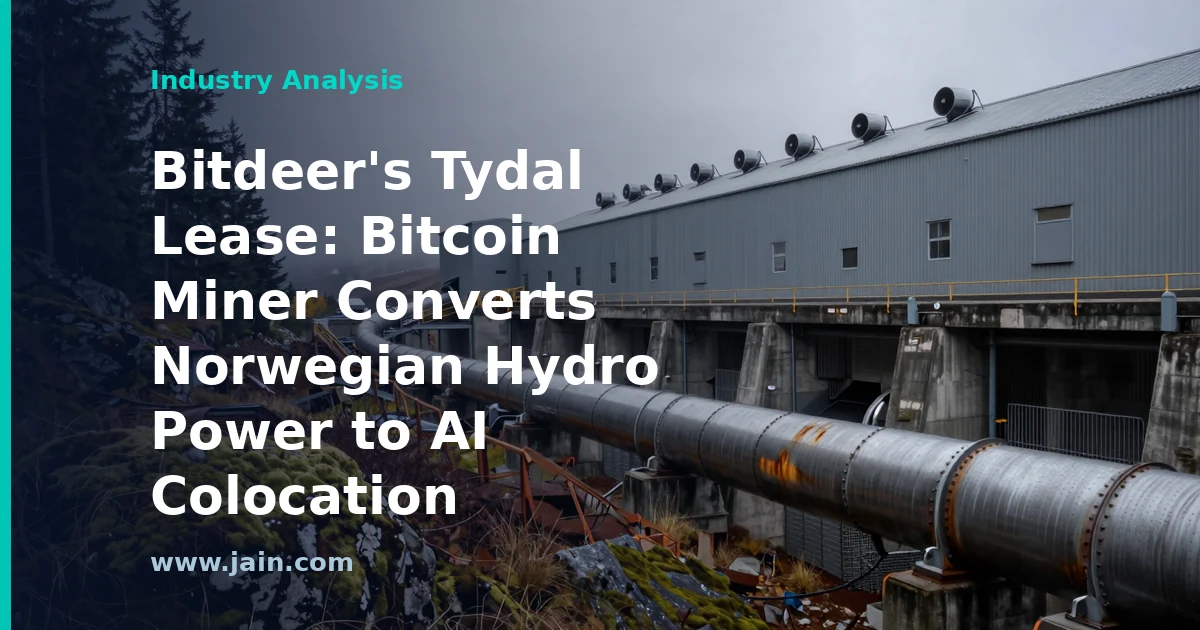
Bitdeer Technologies Group, the Nasdaq-listed bitcoin mining and data center company, has signed a colocation lease covering an AI data center at its site in Tydal, Norway, according to an April 24, 2026 report from Blockspace Media. Colocation means Bitdeer will act as landlord and facility operator, leasing powered, cooled data center space to a tenant that installs its own computing equipment.
The deal marks a concrete step in Bitdeer’s effort to convert part of its hydro-powered Norwegian footprint — originally built to mine bitcoin — into longer-duration AI infrastructure revenue.
Executive Summary
The announcement is notable less for its size — key commercial terms were not disclosed in the source report — than for what it represents: a signed lease, not a strategy slide. Over the past two years, most large bitcoin miners have announced intentions to pivot toward AI and high-performance computing (HPC), but the market has learned to distinguish between aspirational capacity announcements and executed contracts with tenants. A colocation lease at Tydal puts Bitdeer in the smaller group with a binding commercial agreement.
Tydal sits in central Norway, a region with abundant hydroelectric generation, a cool climate that reduces cooling costs, and historically low industrial power prices. Those attributes made it attractive for bitcoin mining; they are arguably more valuable for AI workloads, where customers pay a substantial premium per megawatt over what mining economics can support. For Bitdeer, swapping volatile, bitcoin-price-linked mining revenue for contracted lease income changes the character of the business — closer to a data center REIT than a commodity producer.
For the broader industry, the deal is another data point that the miner-to-AI conversion trend is producing real transactions, particularly at sites with cheap, clean, already-secured power.
Why Miners Are Becoming Landlords
The economic logic of the miner-to-AI pivot is straightforward: the scarcest input in AI infrastructure today is not chips but energized data center capacity — sites with grid connections, substations, and permits already in hand. Bitcoin miners spent a decade accumulating exactly that. Securing a new large-scale grid connection in most Western markets can take years; a miner with an operating site can, in principle, offer a tenant powered space far sooner.
The revenue math strengthens the case. Bitcoin mining revenue per megawatt is capped by network economics and falls with every halving of mining rewards, while AI tenants — cloud providers, GPU-cloud startups, and enterprises — have shown willingness to sign multi-year leases at rates mining cannot match. Converting a site from mining to AI colocation typically requires significant re-engineering, since AI servers demand far higher rack densities, more sophisticated cooling, and stricter reliability standards than mining rigs. But where the power and land are already in place, the conversion cost is generally lower than greenfield construction.
Norway’s Quiet Advantage in the AI Buildout
Norway rarely features in headlines dominated by Virginia, Texas, and the Gulf states, but it holds a strong hand: electricity that is overwhelmingly hydroelectric, among the lowest industrial power prices in Europe, a cold climate that allows free-air cooling for much of the year, and political stability. For AI customers facing sustainability reporting requirements — particularly European enterprises subject to EU disclosure rules — hydro-powered capacity carries genuine commercial value, not just marketing value.
The counterweights are real, too. Norway is far from the major European population centers, which adds network latency — a concern for user-facing AI inference, though far less so for model training, which tolerates distance well. Norwegian grid operators have also grown more selective about allocating power to data centers, and transmission constraints between Norway’s regions mean cheap power is not uniformly available. A site like Tydal, with an existing connection, is therefore more valuable than a map of Norwegian hydro resources might suggest.
Colocation Versus the GPU-Cloud Gamble
Bitdeer’s choice of a colocation lease — rather than buying GPUs and selling computing capacity itself — is a meaningful strategic signal. Miners pursuing the pivot face a fork: the asset-light path (lease space to a tenant who owns the chips) or the asset-heavy path (borrow to buy GPUs and operate a cloud). The colocation route earns lower headline revenue per megawatt but avoids the two biggest risks of the GPU-cloud model: rapid hardware depreciation as new chip generations arrive, and customer concentration in a market where a handful of AI labs dominate demand.
A lease also gives investors something mining never could: contracted, forecastable cash flow. How much credit Bitdeer earns for that depends on terms the report does not disclose — tenant identity and creditworthiness, lease duration, and who funds the conversion capital expenditure. Those details, more than the existence of the lease itself, will determine how the deal is ultimately judged.
What It Means for the Competitive Landscape
Each executed miner-to-AI deal tightens the market for the remaining players. Sites with cheap, clean power and existing interconnection are a finite inventory, and tenants signing leases today are effectively optioning that inventory ahead of rivals. For traditional data center operators, miners converting capacity represent new competition from an unexpected direction — though one that must still prove it can meet enterprise reliability expectations, which are far stricter than mining’s tolerance for downtime.
For other miners, the signal is double-edged. Successful conversions validate the strategy, but they also raise the bar: as more signed leases accumulate across the sector, companies still marketing unconverted ‘AI-ready’ capacity without tenants will face sharper investor questions about why their sites have not attracted commitments.
Background
Bitdeer Technologies Group went public on Nasdaq in 2023 and grew into one of the larger publicly traded bitcoin mining operators, building power-intensive computing facilities in markets with inexpensive electricity — including hydro-rich Norway. Bitcoin mining ties revenue directly to the cryptocurrency’s price and to network ‘halvings’ that cut mining rewards roughly every four years, pushing miners to seek steadier income from their energy assets.
Since the generative-AI boom began straining global data center supply, miners collectively controlling gigawatts of secured grid capacity have emerged as unexpected suppliers of AI infrastructure. Several have signed high-profile AI hosting and colocation agreements, and investors now reward executed contracts far more than announced ambitions — the context in which Bitdeer’s Tydal lease lands.