TL;DR · 30-second read
The Short Version
Texas regulators approved a giant artificial intelligence computing center, essentially a warehouse full of computers, built right beside a wind farm. The catch: whenever the state’s power grid is in trouble, the center must shut off completely within 30 minutes, even if that means flipping its main breakers.
The center uses roughly as much electricity as the wind farm produces, about what a small city draws. Its builders called the rule excessive. Regulators disagreed, because in an emergency the grid needs that wind power. The message to everyone else: building next to a power plant does not free you from the grid’s rules.
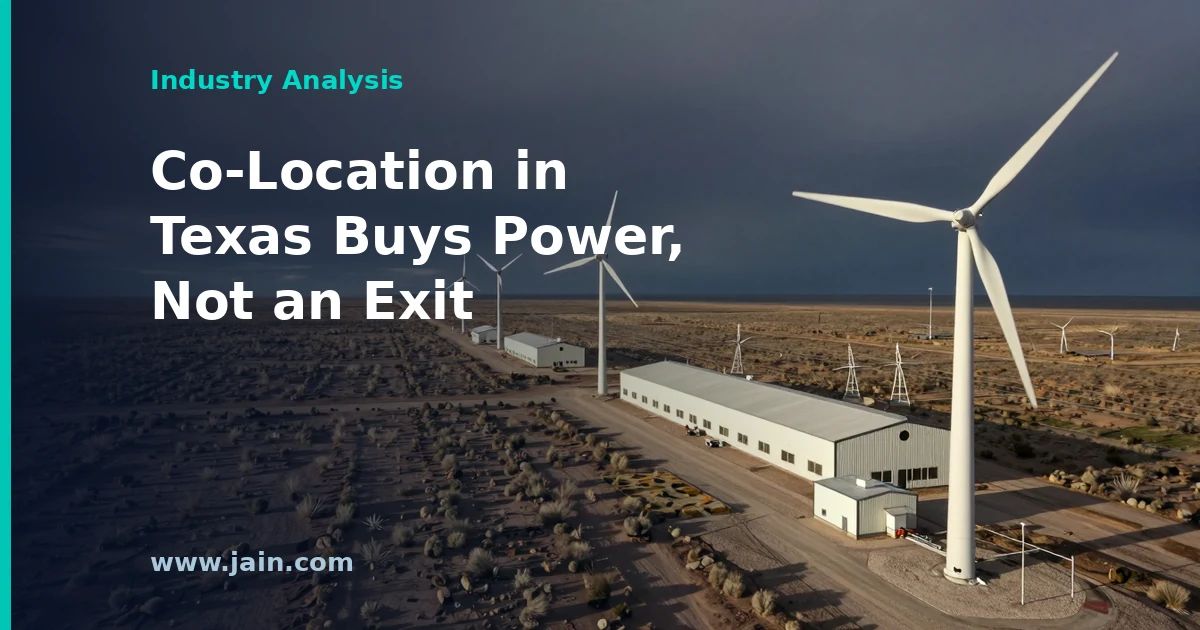
The Public Utility Commission of Texas has approved a net metering arrangement for a 260 MW AI data center co-located with a wind farm of 265.5 MW, Utility Dive reported. Net metering here means the data center draws power directly from the adjacent generator, with only the difference between the two settled against the grid. The project is developed by Crusoe and will be operated by Ensign, the large-load customer. It is the second data center planned at the site, bringing combined load to about 525 MW.
In an order dated July 23, 2026, the commission required the new facility to be able to curtail its full load within 30 minutes during grid emergencies, by physical breaker disconnection if necessary. It also barred the project from paid demand response programs tied to the arrangement. The commission rejected the developer’s argument that the second facility should be exempt from the curtailment conditions applied to the first.
Executive Summary
Texas has approved one of the first behind-the-meter AI data centers under SB 6, the 2025 state law that set new rules for large electricity users on the ERCOT grid and gave the grid operator authority to disconnect data centers during emergencies. Behind-the-meter means the load sits on the generator’s side of the grid connection and consumes its output directly. The approval lets the project proceed, but on terms that commissioners largely adopted from ERCOT’s proposed reliability conditions rather than writing a project-specific exception.
Those terms matter well beyond one site. Because the commission chose a general framework over a bespoke deal, the order is likely to serve as a reference point for other co-located loads in Texas. They include a pending application from Amazon and Vistra for a data center campus beside the Comanche Peak nuclear plant southwest of Fort Worth.
The practical takeaway for developers is that sitting next to a generator secures a power supply in normal conditions. It does not remove the load from the grid’s emergency claims. In a grid emergency, the wind farm’s output is treated as a grid resource, and the data center must be able to step aside quickly and without payment.
Why the Commission Counted Both Buildings
The heart of the dispute is simple arithmetic. The wind farm is rated at 265.5 MW. The first data center at the site accounts for roughly 265 MW, and the new one adds 260 MW, for a combined load of about 525 MW. Crusoe and Ensign argued that the first facility was already subject to curtailment and that the earlier reliability condition on the co-located wind project made further curtailment unnecessary. In their view, forcing the entire site offline was disproportionate.
The commission saw the mechanism differently. If the first facility were curtailed during an emergency while the second stayed online, the second facility’s 260 MW could absorb nearly all of the wind farm’s 265.5 MW nameplate output on-site. Almost nothing would reach the grid at the moment the grid most needed it. Commissioners, adopting the administrative law judge’s recommendation with revisions from Chairman Thomas Gleeson, concluded that this would undermine the goal of keeping generation available to the grid during emergencies. That reasoning is what turns co-location from a private supply arrangement into a conditional deal with the grid: the load gets the generator’s output in ordinary hours, and the grid gets it back when reliability is at stake.
This is the substance behind the headline. The order does not treat an adjacent wind farm as a private power plant that exits the data center from ERCOT’s reliability regime. The generator remains, in the commission’s framing, capacity the grid can call on. Any co-located load large enough to consume that capacity must be able to get out of the way.
The 30-Minute Clock and the Backup-Power Question
The operating requirements are specific. The data center must be able to shed its full load within 30 minutes, including by physically opening breakers. ERCOT should give 60 minutes’ advance notice when practicable, and the operator may voluntarily commit to a faster 10-minute response. This is more flexibility than traditional industrial loads have been asked to provide, and it reframes the ability to shut down rapidly as a condition of operating behind generation rather than an optional grid service.
For an AI operator, disconnection means lost compute time unless something else carries the load. Chris Talley, co-founder of GridTracker, wrote after the decision that the order is not a “death blow” to co-location in ERCOT but that “this architecture now essentially requires full backup capacity.” He later clarified that he meant resources able to carry the load off-grid for a meaningful period, not just ride through a brief interruption, and he called this an “untested assumption.” That caveat is worth keeping. The order sets a curtailment obligation; it does not mandate backup generation. Whether operators respond by building on-site capacity, by accepting downtime, or by designing workloads that tolerate interruption is a commercial choice the ruling leaves open.
What the ruling does settle is that the cost of staying online through an emergency now sits with the developer. For any co-location pitch built on the idea that an adjacent generator guarantees uninterrupted power, that is a material change in the assumptions.
Emergency Duty Is Not a Paid Service
The ban on paid demand response programs tied to the arrangement is the order’s quieter economic lever. Demand response programs typically pay large users to reduce consumption when the grid is stressed, and flexible loads can earn meaningful revenue from them. By prohibiting compensation here, the commission drew a line between mandatory emergency curtailment, which is a condition of the co-location arrangement, and voluntary grid services, which can be sold.
The effect is to remove an offsetting revenue stream from the project’s economics. A developer cannot count the same flexibility twice: once as the price of permission to co-locate and again as a product sold back to the grid. For project finance models that assumed curtailment could be partly monetised, that assumption no longer holds under this framework.
A Template Under SB 6, With Comanche Peak as the Next Test
Because commissioners largely adopted ERCOT’s proposed conditions rather than negotiating a one-off exception, the order reads as a template for future behind-the-meter projects in Texas. Utility Dive has reported that Texas faces a large-load interconnection queue of 438 GW, so the rules governing how big loads connect, and how they behave in emergencies, affect a very large pipeline of proposed projects.
Not every stakeholder agrees the template is sound. The Texas Competitive Power Advocates and natural gas producer BKV filed arguments that the framework could discourage future co-location. PUCT staff contended those parties lacked standing under the governing statute, and the final order did not address their arguments on the merits. Their concern therefore remains an open policy question rather than a resolved one. The next data point will likely be the Amazon and Vistra application at Comanche Peak, a co-location next to nuclear generation rather than wind. Talley said that how ERCOT and the commission treat that arrangement “will be very telling.”
Background
Texas runs most of its electricity through ERCOT, a grid largely separate from the rest of the US, and it has become a leading destination for large AI data centers because of available land and generation. That demand has pushed lawmakers and regulators to write rules specifically for very large loads. SB 6, enacted in 2025, set requirements for such loads and gave ERCOT authority to disconnect data centers during grid emergencies.
Co-location, placing a data center directly beside a power plant, has attracted developers as a way to secure supply faster than a conventional grid connection allows. Regulators, however, have had to decide whether generation consumed on-site should still count toward the grid’s reliability during emergencies. The Crusoe and Ensign case is among the first to answer that question under SB 6. Source: Texas approves AI data center co-location next to wind farm, with curtailment caveats. Utility Dive on the Public Utility Commission of Texas order approving a 260 MW co-located AI data center with emergency curtailment conditions.Sources