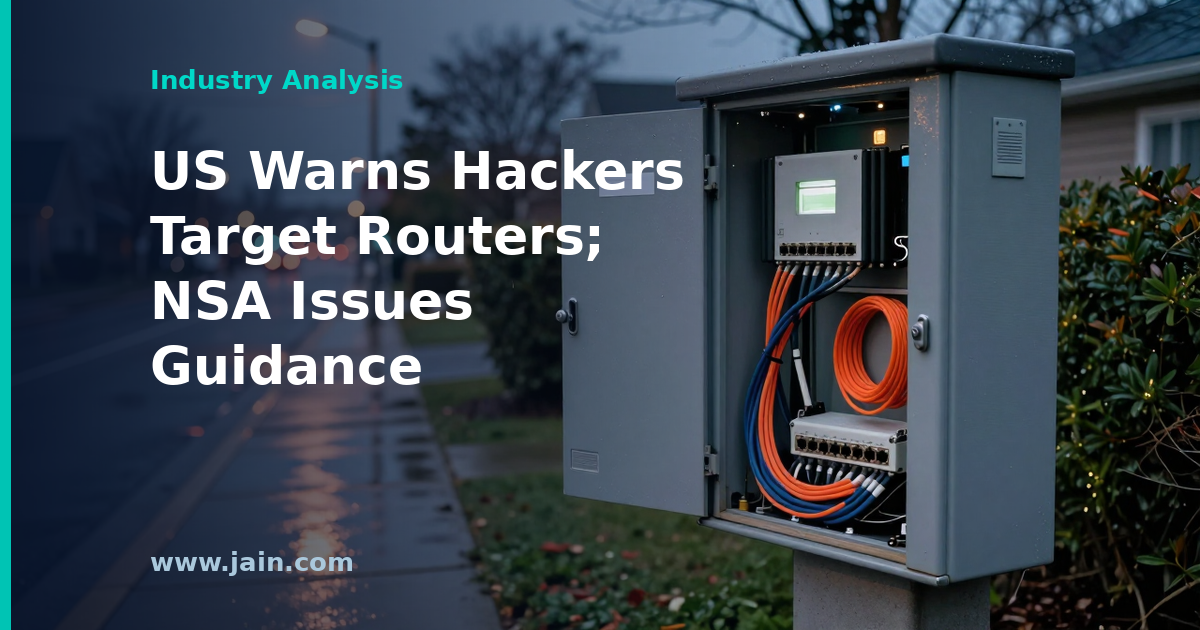
US government authorities issued a public warning that state-linked threat actors are actively targeting vulnerable networking devices — including routers, switches and other edge gear — and the National Security Agency published accompanying router hygiene guidance, according to a July 13, 2026 Cybersecurity Dive report.
The advisory is directed at operators of enterprise, small-business and home networks whose exposed devices can be recruited into espionage and pre-positioning campaigns.
Executive Summary
The joint messaging elevates a long-running concern into a formal public alert: perimeter networking devices, not just servers and endpoints, are a preferred entry point for state-linked intrusion sets. NSA’s router hygiene guidance is the practical companion — a checklist of configuration and maintenance steps operators are expected to follow.
For infrastructure buyers, the significance is less about a single new vulnerability and more about the framing. Routers and firewalls that historically sat outside patch cycles and asset inventories are being reclassified, at least rhetorically, as first-class security assets. That has procurement, staffing and lifecycle implications for anyone running network gear at scale.
The Edge Is the New Front Door
For years, defenders concentrated on endpoints, identity and cloud workloads while edge devices — the routers, VPN concentrators and firewalls that sit between the internet and the internal network — were treated as appliances. State-linked operators noticed. Compromising an edge device gives an intruder a stable foothold with elevated network visibility, often below the level where endpoint detection tools can see. The current US warning is an acknowledgement that this asymmetry has become material at national scale.
The economic pull for attackers is straightforward: one exploitable router can grant persistent access to every device behind it, and these devices are rarely rebooted, rarely re-imaged and often run firmware that has not been updated in years. That is a high-yield target for espionage groups that value durability over noise.
What Router Hygiene Actually Means
NSA’s guidance in this space typically covers a familiar but under-executed set of controls: keep firmware current, disable unused management services, restrict administrative access to trusted networks, replace default credentials, enable logging, and retire devices that no longer receive vendor patches. None of it is exotic. The gap the advisory is trying to close is operational, not conceptual — most organizations know the checklist and still do not run it end-to-end on their perimeter fleet.
For smaller operators and home users, the practical implication is blunter: a consumer router that stopped getting firmware updates two years ago is a liability regardless of the brand on the box. The advisory implicitly pushes the market toward vendors that commit to defined support lifecycles, and away from cheap gear with unclear patch pipelines.
Winners, Losers and Second-Order Effects
Network vendors with mature secure-boot, signed-firmware and managed-update stories stand to benefit from any tightening of buyer expectations. Managed network and security service providers benefit too, because most organizations lack the staff to run a disciplined router hygiene program across dozens or hundreds of sites. The losers are end-of-life devices still in production and the budgets that have deferred their replacement.
There are second-order effects worth flagging. Regulators and insurers tend to translate advisories like this into questions on audits and renewal forms; expect edge device patch status and end-of-support inventory to become recurring line items. Enforcement, however, is not automatic — a warning is not a rule, and the source coverage does not indicate any new binding requirement.
Reading the Advisory Fairly
It is worth being precise about what the source does and does not establish. The Cybersecurity Dive report describes a US government warning and NSA guidance; it is not, on its own, a technical disclosure of a specific new vulnerability chain, victim list or attribution to a named group. Readers should treat the advisory as a policy signal backed by prior public incidents rather than as a fresh indicator-of-compromise release.
That framing cuts both ways. Skeptics who dismiss such warnings as vendor-friendly demand generation should note that the underlying pattern — state-linked targeting of network edge devices — has been documented repeatedly in prior US and allied advisories. Equally, industry claims that a given product line is inherently safer than another deserve the same scrutiny the advisory implicitly applies to unpatched fleets.
Background
US government agencies including the NSA and CISA have issued a running series of advisories over recent years warning that state-linked threat actors — attributed in prior public reporting to Russian, Chinese and other groups — target edge networking devices for espionage and pre-positioning. These campaigns exploit the fact that routers and firewalls are frequently unpatched, poorly monitored and long-lived compared with servers and endpoints.
Router hygiene guidance from the NSA sits alongside broader ‘secure by design’ pressure on network vendors to ship devices with safer defaults, transparent patch pipelines and defined support lifecycles. The July 13, 2026 messaging reported by Cybersecurity Dive continues that trajectory rather than opening a new front.
Nextgov/FCW reported on July 12, 2026 that a network intrusion at the U.S. Department of Homeland Security (DHS) was ruled a false positive on two separate occasions before analysts ultimately confirmed a genuine breach. The report frames the sequence as a cybersecurity governance failure inside one of the federal government’s most security-conscious departments.
Executive Summary
The disclosure is narrow but significant: the same signal (or set of related signals) reached DHS defenders more than once and was dismissed each time before the intrusion was finally validated. In security operations, that pattern is the textbook definition of a triage failure — the detection layer worked, but the human or procedural layer that decides what a detection means did not.
For a department whose Cybersecurity and Infrastructure Security Agency (CISA) advises the rest of the federal government and the private sector on exactly this class of problem, the reputational and operational stakes are elevated. The reporting does not, at least in the material available, quantify data loss, dwell time, or the identity of the intruder, so the immediate policy question is procedural: how does a mature SOC (security operations center) convert a repeat ‘false positive’ into a re-investigation trigger?
When ‘False Positive’ Becomes a Systemic Blind Spot
Modern intrusion detection generates a firehose of alerts, and analysts are trained — correctly — to close most of them as benign. The failure mode the DHS incident illustrates is not that analysts made a bad call once; it is that the same underlying activity was cleared twice. Well-run detection programs treat repeat or recurring signatures as a distinct category, because attackers who are present in an environment tend to generate correlated telemetry over time. If a suppression or closure rule does not force a fresh look when a signal recurs, the organization is effectively teaching itself to ignore its intruder.
The reporting, as summarized, does not tell us whether the two dismissals were made by the same analyst, the same tooling rule, or across different shifts and teams. Each of those root causes points to a different fix: analyst training, detection engineering, or cross-team hand-off procedure. Without that detail, outside observers should be careful not to overfit a narrative to a single failure mode.
Governance Questions the Incident Sharpens
Federal cybersecurity guidance — much of it authored by components within DHS itself — emphasizes continuous monitoring, threat hunting, and ‘assume breach’ postures. A twice-missed intrusion is a useful stress test of whether those doctrines are being executed as designed inside the department that promotes them. Fair questions apply in both directions: critics should ask whether the guidance is realistic given federal staffing and budget realities, and defenders of the current model should explain why the specific controls that were supposed to catch recurrence did not.
It is also worth noting what the reporting does not establish. There is no public evidence in the summary of foreign-actor attribution, of a specific data set exfiltrated, or of a policy directive being violated. Treating the story as a procedural lesson rather than a scandal is the more defensible reading until additional facts emerge.
Implications for Operators Outside Government
The lesson generalizes cleanly to enterprise and infrastructure operators. Any organization running a SIEM (security information and event management platform) or an XDR (extended detection and response) stack should audit how repeat closures on the same asset, user, or indicator are handled. A closure that silently suppresses future related alerts is a very different risk profile from a closure that flags recurrence for mandatory re-review.
For data center, cloud, and connectivity providers in particular — whose customers increasingly demand SOC 2, ISO 27001, and FedRAMP-style assurances — the DHS episode is a useful prompt to document not just detection coverage but escalation logic. Buyers evaluating vendors would be reasonable to ask, during due diligence, how a provider distinguishes a truly benign recurring alert from an intruder generating similar telemetry over days or weeks.
Background
The U.S. Department of Homeland Security was created in 2002 and consolidates a broad set of federal missions including border security, emergency management, and cybersecurity. Within DHS, the Cybersecurity and Infrastructure Security Agency (CISA), established in 2018, is the primary federal body responsible for coordinating civilian cyber defense and issuing binding operational directives to other federal agencies.
Federal cyber operations rely on a layered stack of endpoint detection, network monitoring, and centralized log analysis, staffed by security operations center analysts who close the great majority of alerts as benign. Repeat-closure failures — where a genuine intrusion is misclassified more than once — are a recognized risk category in the security literature and a common subject of after-action reviews.
The US Cybersecurity and Infrastructure Security Agency (CISA) had to build its incident-response playbook while an incident was already underway, the agency revealed, according to a TechCrunch report published July 11, 2026. The report indicates that the government’s lead civilian cyber-defense agency entered at least one real-world event without a finished, ready-to-run plan for handling it.
The available source material does not identify the incident in question, when it occurred, or what the playbook now contains — details that matter considerably for judging how serious the admission is.
Executive Summary
An incident-response playbook is the documented, step-by-step procedure an organization follows when it is under attack: who is in charge, who gets called, what gets isolated, what gets communicated, and in what order. The entire value of a playbook is that it exists before the crisis, so responders execute rather than improvise. According to the TechCrunch report, CISA has acknowledged that in at least one incident, that document was being written while the response was in motion.
The admission matters because CISA is not an ordinary organization. It is the agency charged with coordinating the defense of US federal civilian networks and supporting the private operators of critical infrastructure — power, water, telecommunications, and the data centers that underpin the digital economy. When the coordinating agency is improvising its own procedures mid-crisis, every organization that plans to lean on federal support during a major incident has reason to re-examine that assumption.
At the same time, the disclosure should be read with proportion. Candid admissions of this kind usually surface through after-action reviews — a sign the retrospection process is working — and improvised response is a failure mode that afflicts well-resourced private companies too. With only a single, thin source available, the honest position is that the admission is notable, the surrounding detail is missing, and the questions it raises are more valuable than any verdict.
When the Plan Is Written During the Fire
Incident response rests on a simple premise: decisions made under pressure are worse than decisions made in advance. A playbook front-loads the hard choices — escalation thresholds, containment authority, communication trees, legal notification duties — so that during an actual intrusion, responders follow a tested script instead of negotiating roles at 3 a.m. Building that script mid-incident inverts the model. It means the response absorbed effort that should have gone to containment, and it means early decisions were made without the benefit of pre-agreed procedure.
For CISA specifically, the irony is sharp. The agency is the federal government’s principal author of incident-response guidance for others: it published formal incident and vulnerability response playbooks for federal civilian agencies in 2021, following Executive Order 14028, and it routinely urges private organizations to maintain and exercise their own plans. The available reporting does not say how the newly admitted gap relates to those published playbooks — whether the incident fell outside their scope, whether internal procedures lagged the public guidance, or something else. That distinction is central to how much weight the admission should carry, and it is currently unanswered.
Paper Readiness vs. Operational Readiness
The episode illustrates a distinction every security leader knows: having a document is not the same as being ready. Plans that are written for auditors and never exercised routinely collapse on first contact with a real adversary — contact lists go stale, assumed tooling is unavailable, and the people named in the escalation chain have changed jobs. The security industry’s standard corrective is the tabletop exercise: a rehearsal that stress-tests the plan before an attacker does. If CISA’s playbook had to be authored during an incident, the implication is that for that class of event, neither the document nor the rehearsal existed in usable form.
It is worth being even-handed here. Organizations that conduct genuine after-action reviews are precisely the ones that surface uncomfortable findings like this, while organizations that never look find nothing. An agency admitting the gap — if that is what occurred — is behaving more transparently than one quietly papering over it. The fair question is not whether CISA once lacked a playbook, but whether the gap has since been closed, exercised, and independently validated. The source material does not say.
What It Means for Critical Infrastructure and Enterprise Operators
Data-center operators, network providers, and other critical-infrastructure firms sit in a shared-responsibility arrangement with CISA: the agency provides threat advisories, coordination, and in some cases direct assistance during major incidents. This disclosure is a reminder that federal support is a supplement to, not a substitute for, an operator’s own readiness. Enterprises that have penciled ‘call CISA’ into their crisis plans should treat that line as one resource among several — and should verify that their own playbooks are current, exercised, and executable without outside help.
There is also a resourcing dimension that the admission invites, without settling. Sustained readiness — maintained playbooks, regular exercises, retained senior responders — is a function of budget and staffing continuity. The reporting available here does not address CISA’s resourcing, and it would be speculation to attribute the gap to any particular cause. But it is a legitimate line of oversight inquiry: preparedness is perishable, and it decays quietly until an incident makes the decay visible.
Background
CISA was established by Congress in November 2018 as the Department of Homeland Security’s operational lead for civilian cybersecurity. Its remit spans defending federal civilian (‘.gov’) networks, publishing threat advisories and its Known Exploited Vulnerabilities catalog, and partnering with the private operators who run most US critical infrastructure. After the 2020 SolarWinds supply-chain compromise exposed coordination weaknesses, Executive Order 14028 directed a series of federal cyber reforms, including standardized incident-response playbooks that CISA published in 2021.
That history frames the current disclosure: the agency positioned as the government’s playbook author has acknowledged, per the reporting, entering at least one real incident without a finished playbook of its own — a reminder that in cybersecurity, documented preparedness and operational readiness are not the same thing.
The US Department of Homeland Security said it is investigating a cyber breach at an information-sharing network, Reuters reported on July 1, 2026. The networks DHS operates in this category exist to move cyber threat intelligence — indicators of compromise, vulnerability alerts, incident details — between the federal government and thousands of private-sector and state and local participants.
Beyond confirming an active probe, DHS has released few details: the agency has not publicly named the specific network, described what data may have been accessed, or attributed the intrusion to any actor.
Executive Summary
According to Reuters, DHS confirmed it is probing a cyber breach at an information-sharing network — one of the systems through which the US government and private industry exchange threat intelligence. Information-sharing networks are, in plain terms, the group chat of American cyber defense: when one participant sees an attack, the details are pushed to everyone else so they can block it before it reaches them.
That is what makes this incident notable regardless of its ultimate scope. A breach of a threat-sharing platform is not just another federal IT compromise; it strikes the mechanism that the entire public-private defense model depends on. Such systems can hold sensitive submissions from companies, contact rosters of security personnel, and a running picture of what defenders know — and don’t know — about active threats.
The disclosure itself is thin. As of the July 1 report, there is a confirmed investigation and little else on the public record. The honest summary is: something happened to a system that exists to help everyone else respond when something happens, and the details that would establish severity — which network, what data, which actor, how long — remain unanswered.
The Watchtower Becomes the Target
Threat information-sharing networks are unusually attractive targets precisely because of what they aggregate. A typical platform of this kind carries indicators of compromise (the technical fingerprints of attacks), early vulnerability warnings, and in some cases incident reports that identify which organizations were hit and how. An adversary with access to that stream gains something rare: visibility into what defenders collectively know. They can see which of their tools have been burned, which intrusions have been detected, and which have not.
There is also a quieter asset inside these systems — the participant directory. Sharing networks connect security officers across critical infrastructure sectors, and a roster of those people, their organizations, and their communication channels is valuable raw material for targeted phishing and social engineering. Even if no threat data was taken, a compromised membership list would have real downstream consequences.
None of this is yet established in the DHS case; the report confirms an investigation, not a scope. But it explains why a breach at this particular kind of system draws more attention than its size alone might warrant.
Trust Is the Product
The US model of cyber defense is voluntary at its core. Companies are encouraged — through liability protections established in the Cybersecurity Information Sharing Act of 2015 and through programs run by DHS’s Cybersecurity and Infrastructure Security Agency (CISA) — to hand the government sensitive details about attacks they experience. The implicit bargain is that the government protects what it is given. Participation rates in federal sharing programs have historically been a persistent challenge, with companies citing exactly this concern: what happens to our data once it leaves our hands?
A confirmed breach, even a limited one, tests that bargain. The practical risk is a chilling effect — companies quietly sharing less, later, or through informal channels instead — which degrades the common operating picture for everyone. How DHS handles the next phase matters as much as the intrusion itself: prompt notification of affected participants and a transparent accounting of what was exposed is how sharing regimes retain members after incidents. It is worth noting the system worked in one respect: the breach was detected and publicly acknowledged, which is the behavior these programs ask of their own members.
Confirmation Without Detail: Reading a Thin Disclosure Fairly
It is worth being explicit about how little is substantiated here. The public record, per Reuters, consists of DHS confirming a probe. There is no named network, no attribution, no timeline, no data inventory. Early-stage breach disclosures are often thin for legitimate reasons — investigators avoid tipping off an intruder who may still have access, and premature scoping statements frequently have to be retracted. Thin disclosure at day one is normal practice, not evidence of concealment.
The counterweight is precedent. Federal security agencies have been breached before — CISA itself confirmed in 2024 that it took systems offline after attackers exploited Ivanti VPN flaws — and in past incidents the eventual scope sometimes exceeded initial characterizations. The fair posture for now is neither alarm nor dismissal: treat the confirmation as significant because of what the target is, and treat the severity as genuinely unknown until DHS says more. For enterprises that participate in federal sharing programs, the prudent interim assumption is that anything submitted to a government platform could someday be part of a breach scope, and to calibrate submissions and internal exposure accordingly.
Background
The Department of Homeland Security has anchored the US government’s cyber partnership with industry since the mid-2000s, a role concentrated since 2018 in its Cybersecurity and Infrastructure Security Agency (CISA). The model is deliberately collaborative rather than mandatory: the Cybersecurity Information Sharing Act of 2015 gave companies liability protections for handing threat data to the government, and DHS built the plumbing to move it — including the Homeland Security Information Network (HSIN) for sensitive-but-unclassified collaboration and CISA’s Automated Indicator Sharing service for machine-speed exchange of attack indicators.
Those systems serve thousands of participants across critical infrastructure sectors, from utilities and banks to state and local governments. Federal networks have been high-value targets throughout: the 2015 Office of Personnel Management breach, the 2020 SolarWinds campaign, and 2024 intrusions affecting CISA’s own systems all demonstrated that the agencies coordinating US cyber defense are themselves squarely in adversaries’ sights.
Hackers breached a Department of Homeland Security information-sharing network, according to a Nextgov/FCW report published June 29, 2026 citing people familiar with the matter. The network is used to coordinate cyber threat intelligence across federal agencies and with private-sector partners.
Public details are limited. The report does not identify the attackers, the duration of access, or the specific data affected, and DHS has not publicly detailed remediation steps as of publication.
Executive Summary
An intrusion into a DHS information-sharing platform is, by definition, a compromise of the plumbing the federal government uses to warn industry about other compromises. Even absent confirmed data loss, a breach of a threat-sharing channel raises questions about the integrity of indicators, advisories, and coordination that downstream defenders rely on.
For operators of critical infrastructure — data centers, carriers, cloud providers, utilities — the practical concern is trust in the feed. If adversaries had visibility into what defenders were sharing, they could learn which of their tools and techniques had been detected, and by whom. That informational asymmetry, if it occurred, would be more consequential than any single stolen document.
As of the June 29 report, the scope, attribution, and dwell time are not public. The story is significant less for what it confirms than for the category of system involved.
Why A Threat-Sharing Breach Is Different
Information-sharing networks exist so that a compromise at one organization becomes a warning at every other. They aggregate indicators of compromise (IOCs) — file hashes, IP addresses, domains, tactics — from federal agencies, sector-specific ISACs (Information Sharing and Analysis Centers), and private companies. A breach of that pipe is not the same as a breach of a single agency’s email: it potentially exposes what the defender community collectively knows and does not know.
The strategic value to an attacker is visibility into detection. Knowing which of your malware samples have been catalogued, which infrastructure has been burned, and which techniques have been attributed lets an adversary rotate tooling before defenders notice. That is a durable operational advantage even if no classified material was taken.
The Trust Question For Industry Consumers
Critical infrastructure operators subscribe to DHS and CISA feeds precisely because government has visibility private companies do not. If a sharing platform is compromised, downstream consumers face a temporary integrity problem: were indicators altered, suppressed, or seeded with noise? The answer usually turns out to be no, but the question has to be asked and answered before the feed can be trusted at the same weight.
Practically, this is where mature security programs lean on defense in depth: multiple feeds, internal telemetry, and vendor threat intelligence that does not depend on a single government source. The incident, whatever its scope, is a reminder that no single feed should be a single point of failure in a detection program.
Attribution And Restraint
Early reporting on federal breaches often outpaces confirmed facts. Attribution to a nation-state actor, in particular, tends to leak before formal assessments, and initial scoping estimates frequently move by an order of magnitude in either direction as forensic work proceeds. Readers and buyers should treat the current picture as preliminary.
What is fair to say now: a breach of a coordination system is inherently more concerning per byte than a breach of a general-purpose network, and the government’s disclosure cadence on this incident will itself be a data point about how the current administration handles federal cyber incidents.
Background
The Department of Homeland Security has operated cyber information-sharing programs for well over a decade, with CISA — established in 2018 — now serving as the primary hub for coordination with industry. These programs range from unclassified indicator exchanges with private companies to more restricted channels among federal agencies and cleared partners.
The premise of threat sharing is collective defense: adversaries reuse tooling and infrastructure, so a detection at one organization can protect many. That premise depends on the integrity of the sharing platforms themselves, which is what makes an intrusion into such a system a distinctive category of incident.
The cybersecurity agencies of the Five Eyes intelligence alliance — the United States, United Kingdom, Canada, Australia, and New Zealand — issued a joint statement on AI-related shifts in cybersecurity risk, telling organizational leaders to act now rather than wait for guidance to mature.
The statement, surfaced through the Inside Privacy legal publication on 25 June 2026, is directed at boards and executives across critical infrastructure and enterprise sectors rather than at technical staff alone.
Executive Summary
Joint Five Eyes statements are relatively rare and typically signal that member agencies see a risk landscape shifting faster than existing guidance and procurement cycles can absorb. In this case, the subject is artificial intelligence — both as a capability defenders can deploy and as a set of systems attackers can target or abuse.
The act now framing is the notable editorial choice. Rather than a technical bulletin aimed at security operations centers, the statement targets organizational leaders, implying that governance, procurement, and risk-tolerance decisions — not just tooling — are what member agencies believe are lagging.
For infrastructure operators, cloud tenants, and the vendors supplying them, the message is that AI-related cybersecurity risk is now a board-level topic in five major English-speaking economies simultaneously, which tends to precede regulatory attention and customer contract changes.
Why A Joint Statement, And Why Now
The Five Eyes is a signals-intelligence sharing arrangement dating to the postwar UKUSA Agreement. Its civilian cybersecurity arms — CISA in the United States, the NCSC in the United Kingdom, the CCCS in Canada, the ASD’s ACSC in Australia, and New Zealand’s NCSC — have increasingly co-signed technical advisories over the past several years. A joint statement addressed to leadership, rather than a technical advisory addressed to defenders, suggests the agencies see the gap as one of executive urgency and organizational readiness rather than missing detection signatures.
The phrasing shifts in cybersecurity risks is deliberately broad. It can cover attacker use of large language models for phishing and social engineering, model and data-pipeline security within enterprises adopting AI, exposure of sensitive data through third-party AI services, and the emerging attack surface of AI-enabled software supply chains. Without the underlying document text, it is not possible to say which of these the agencies weight most heavily.
What Changes For Infrastructure Buyers
For operators of data centers, networks, and cloud platforms, a coordinated Five Eyes push tends to translate into three practical pressures within twelve to eighteen months: customer questionnaires expand to include AI governance and model-security controls; regulated customers in finance, health, and government begin requiring contractual assurances about how AI features process their data; and insurance underwriters recalibrate cyber policies to reflect AI-related exposure. Vendors that can point to concrete controls — data segregation, model access logging, red-team results — will have an easier renewal cycle than those still describing intent.
The economics are not neutral. Meeting a rising bar on AI security controls favors larger providers with dedicated security engineering capacity and disadvantages smaller vendors that ship AI features by wrapping third-party APIs. That concentration effect is a recurring pattern whenever cybersecurity expectations step up, and it deserves scrutiny on its own terms rather than being treated as an unambiguous good.
Reading The Statement Carefully
A leadership-level act now statement is useful precisely because it is short and non-technical, but that brevity is also its limitation. Boards asked to act now reasonably want to know: act on what, measured how, and against what threshold. Without accompanying technical annexes or a maturity model, well-intentioned organizations can respond with procurement activity — buying tools labeled AI-secure — that does not change their actual risk posture.
It is also fair to ask whether coordinated agency messaging is the most effective channel. The Five Eyes agencies bring credibility and reach, but their remit is advisory in most member countries; the operative levers on organizational behavior remain domestic regulators, sector supervisors, and, increasingly, insurers. A statement of this kind is best read as a signal that those levers are likely to move, not as a substitute for them.
Background
The Five Eyes alliance traces to the 1946 UKUSA Agreement on signals-intelligence sharing among the United States, United Kingdom, Canada, Australia, and New Zealand. Its civilian cybersecurity agencies have progressively taken on a public advisory role, co-publishing technical advisories on ransomware, state-linked intrusion sets, and secure-by-design software practices.
Coordinated statements on artificial intelligence sit at the intersection of two trends: the rapid enterprise adoption of generative AI since 2023, and a broader policy shift toward holding software and service providers — not only end users — accountable for the security properties of what they ship.
The Multi-State Information Sharing and Analysis Center (MS-ISAC) — the primary cyber threat-sharing hub for US state, local, tribal, and territorial governments — has entered what Cybersecurity Dive describes as an uncertain new era after losing its federal funding and thousands of member organizations, according to a June 14, 2026 report.
The organization, operated by the nonprofit Center for Internet Security (CIS), spent roughly two decades as a free, federally supported service before its cooperative-agreement funding through the Cybersecurity and Infrastructure Security Agency (CISA) was cut in 2025, forcing a pivot to a fee-based membership model that many members have evidently declined to join.
Executive Summary
For most of its existence, MS-ISAC functioned as something close to a public utility for government cybersecurity: any state agency, county, city, school district, or tribal government could join at no cost and receive threat intelligence, incident-response support, and network monitoring, with the bill largely picked up by the federal government. That arrangement ended when federal support was withdrawn in 2025, and CIS moved the service to paid membership.
The reported result — thousands of member organizations gone — matters because an information-sharing organization’s value is a function of its network. Every member that drops out is both a blind spot in the collective picture and, potentially, a softer target. State and local governments run elections, water systems, 911 dispatch, courts, and schools; they are also among the most frequent victims of ransomware, precisely because so many of them lack the budget and staff for standalone security programs.
The open question as of mid-June 2026 is whether a smaller, self-funded MS-ISAC can sustain the same defensive footprint — and what happens to the organizations that used to depend on it and now, apparently, go without.
From Public Good to Paid Service — and Why That Math Is Hard
Shared threat intelligence has the economics of a public good: it is expensive to produce, nearly free to distribute, and most valuable when everyone participates. Federal funding solved the free-rider problem by simply paying for universal access. A fee-based model reintroduces it, and with a cruel twist known as adverse selection: the organizations most likely to drop out are the small, resource-poor ones — rural counties, small school districts, modest municipal utilities — which are exactly the entities least able to replace the service on their own and among the most attractive targets for ransomware crews.
None of this means CIS made the wrong call; a nonprofit cannot indefinitely underwrite a national service out of its own reserves once its primary funder exits. But the reported loss of thousands of members suggests the transition is playing out the way the economics would predict. The membership that remains will skew toward larger, better-funded governments, which changes what the shared data represents.
The Collective-Defense Network Effect Runs in Reverse
An ISAC — an Information Sharing and Analysis Center — works because one member’s incident becomes every member’s early warning. A phishing campaign spotted against one county clerk’s office can be blocked at ten thousand others within hours. That flywheel spins both ways: as membership shrinks, the sensor network shrinks, detection gets slower, and the value proposition for remaining members weakens, which can encourage further departures. Managed defensively, a smaller ISAC can still deliver real value to a committed core; managed poorly, shrinkage becomes self-reinforcing.
There is also a national-visibility cost that lands on the federal government itself. MS-ISAC historically served as the aggregation point through which federal agencies understood what was happening across tens of thousands of state and local networks. Fewer members means a dimmer picture — for everyone, including the agencies that cut the funding.
Who Fills the Gap
Three candidates stand out. First, states themselves: the “whole-of-state” model, in which a state CISO extends security services, monitoring, and grant money downward to counties, cities, and schools, has been gaining momentum for years and now has a stronger forcing function. Second, commercial vendors: managed detection and response (MDR) providers, threat-intelligence platforms, and security-focused hosting and connectivity providers will compete for budget that once didn’t need to exist, though public-sector procurement cycles and thin budgets make this a slow, uneven substitution. Third, CISA’s own free services — vulnerability scanning, advisories, regional advisors — which remain available but were never designed to replicate an ISAC’s peer-to-peer sharing fabric.
For infrastructure and security providers, this is a genuine market signal: the public-sector demand for outsourced security operations just grew, involuntarily. The risk is that the gap gets filled unevenly — well-funded jurisdictions buy their way to coverage while the long tail of small governments simply absorbs more risk.
Background
MS-ISAC was established in the early 2000s and grew, under the nonprofit Center for Internet Security, into the designated cyber threat-sharing and defense hub for US state, local, tribal, and territorial (SLTT) governments — a sector spanning tens of thousands of organizations, most of them too small to staff full security teams. Membership was free, underwritten by federal cooperative-agreement funding channeled through the Department of Homeland Security and later CISA, and the center became a fixture of national cyber defense, particularly as ransomware attacks on cities, counties, and school districts escalated through the 2020s.
That model unraveled in 2025 when federal funding was withdrawn amid broader cuts to CISA programs, pushing CIS to a fee-based membership structure. The June 2026 reporting marks a milestone in that transition: the organization survives, but with thousands fewer members and an open question about who now watches over the jurisdictions that left.
Sen. Mark Warner (D-Va.) has introduced legislation that would compel the Cybersecurity and Infrastructure Security Agency (CISA) — the Department of Homeland Security unit responsible for defending U.S. critical infrastructure — to update its critical infrastructure cybersecurity plans to account for threats driven by artificial intelligence, according to a June 12, 2026 report by Industrial Cyber.
Executive Summary
The core of the proposal, as reported, is procedural rather than technical: it would use statute to force a planning refresh. CISA maintains national-level plans and guidance that federal agencies and the operators of the 16 designated critical infrastructure sectors — power, water, communications, financial services, and the data centers and networks that underpin them — use to organize their cyber defenses. Warner’s bill would require those plans to be updated with AI-driven threats explicitly in scope.
That matters because planning documents in this space have historically aged badly. The foundational National Infrastructure Protection Plan dated to 2013 and stood for over a decade before the federal government began modernizing the underlying policy framework in 2024. Meanwhile, the threat landscape has shifted quickly: AI tooling can accelerate phishing, vulnerability discovery, and social engineering at a pace that decade-old planning assumptions never contemplated. A statutory mandate converts “we should update this” into “the agency must update this” — with the congressional oversight hook that implies.
Why a Planning Mandate Is Bigger Than It Sounds
National cyber plans can read as bureaucratic paperwork, but they do real work: they set the shared assumptions that sector risk management agencies, regulators, and private operators build their own security programs around. When the top-level plan is stale, everything keyed to it inherits the staleness. By forcing an update through legislation rather than leaving timing to agency discretion, the bill — if enacted — would create an enforceable deadline and a paper trail Congress can audit. The trade-off is familiar from other compliance regimes: mandates guarantee that a document gets refreshed, not that the refresh is good. The substance will depend on CISA’s execution and resourcing, neither of which is described in the source report.
What “AI-Driven Threats” Could Mean for Operators
The report does not detail how the bill defines AI-driven threats, so operators should watch the bill text closely. In practice the term usually spans two categories. The first is AI as an attacker’s tool: machine-generated phishing and deepfake-enabled fraud, faster reconnaissance and vulnerability discovery, and malware that adapts to defenses. The second is AI as an attack surface: as utilities, hospitals, and industrial operators embed AI into operations, the models, data pipelines, and inference infrastructure themselves become targets. A credible planning update would need to address both — and clarify which agency guidance applies to each.
There is also a third dimension of particular interest to infrastructure providers: the facilities running AI are increasingly critical infrastructure in their own right. Data centers, high-capacity fiber routes, and the power systems feeding them now sit underneath much of the AI economy. Whether an updated national plan treats AI infrastructure as a protected asset class, and not just a threat vector, is one of the more consequential open questions.
The Business Signal for Infrastructure Providers
For operators of data centers, networks, and cloud platforms, legislation like this is a leading indicator even before it passes. Updated federal plans tend to cascade: sector-specific guidance follows, procurement language follows that, and customers in regulated sectors begin asking vendors to demonstrate alignment. Providers who can already document AI-aware threat modeling, incident response, and supply chain controls will be positioned ahead of any cascade. The cost side is real too — planning refreshes often precede new reporting or assessment expectations — but the source report identifies no specific obligations on private operators, so any compliance impact remains speculative until bill text and subsequent rulemaking are public.
The Path From Bill to Law Is the Real Test
A proposal is not a statute. The report available to us covers the introduction of the bill, not co-sponsorship, committee prospects, or companion legislation in the House — and the majority of introduced bills never reach a floor vote. Warner’s long tenure on cybersecurity issues and his seat on the Senate Intelligence Committee give the proposal a credible sponsor, but timing, amendments, and whether the measure moves standalone or gets folded into a larger vehicle such as an annual defense authorization bill will determine whether this becomes binding policy or a marker of congressional intent. Both outcomes carry signal; only one carries force of law.
Background
CISA was created by Congress in 2018 to serve as the federal government’s lead civilian agency for cybersecurity and critical infrastructure protection, working with the private owners and operators who control most U.S. infrastructure. The planning framework it inherited was showing its age: the National Infrastructure Protection Plan dated to 2013, and the underlying presidential policy directive from that same year was only replaced by a new national security memorandum in April 2024. Congress has been layering statute onto this space in recent years — most notably the 2022 law requiring critical infrastructure operators to report significant cyber incidents — and Warner, a former telecommunications executive and senior member of the Senate Intelligence Committee, has been a consistent voice in those debates. The rapid mainstreaming of generative AI since 2023 has given both attackers and defenders new tooling, which is the gap this bill reportedly aims to close at the planning level.
On June 9, 2026, the Cybersecurity and Infrastructure Security Agency (CISA) published Binding Operational Directive (BOD) 26-04, titled “Prioritizing Security Updates Based on Risk.” A Binding Operational Directive is a compulsory order to U.S. federal civilian executive branch agencies, and this one — as its title states — directs agencies to prioritize security updates according to risk rather than treating all patches alike.
The directive continues an evolution in federal vulnerability management that began with fixed remediation deadlines and moved, over successive directives, toward focusing scarce patching capacity on the vulnerabilities most likely to be exploited.
Executive Summary
BOD 26-04 formalizes a shift that vulnerability-management practitioners have argued for over a decade: with tens of thousands of new vulnerabilities disclosed every year, no organization — not even a federal agency under mandate — can patch everything on a uniform clock. The rational alternative is to rank vulnerabilities by actual risk: whether they are being exploited in the wild, whether they sit on internet-facing or mission-critical systems, and what an attacker could reach through them.
Why it matters beyond Washington: CISA’s directives bind only federal civilian agencies, but they have repeatedly become de facto standards for the private sector. The Known Exploited Vulnerabilities (KEV) catalog, created by BOD 22-01 in 2021, is now baked into commercial security tools, cyber-insurance questionnaires, and contract language far outside government. If BOD 26-04 follows the same path, risk-based patching mandates — with the documentation and telemetry they require — are a preview of what critical-infrastructure operators, federal contractors, and regulated industries should expect to be asked for next.
A caveat on sourcing: this article is based on CISA’s publication of the directive and its stated title and purpose. The operational specifics — exact timelines, scoring methodology, and reporting requirements — live in the directive text itself, and we flag below what a one-line announcement leaves unanswered.
From Compliance Clocks to Risk Math
Federal patching policy has historically run on fixed deadlines. BOD 19-02 (2019) gave agencies 15 days to remediate critical vulnerabilities on internet-facing systems and 30 days for high-severity ones. BOD 22-01 (2021) refined the idea by creating the KEV catalog — a curated list of vulnerabilities with confirmed real-world exploitation, each carrying its own due date. Both approaches share a weakness: they treat severity scores or catalog membership as a proxy for risk, when the risk of any given vulnerability depends heavily on where it sits in a specific network and what it exposes.
A directive built around risk-based prioritization acknowledges that reality. In plain terms, it means an agency should patch a moderately scored flaw on a crown-jewel system before a critically scored flaw on an isolated test box. That is how mature security teams already operate; the significance here is making it a matter of federal mandate rather than practitioner discretion. Mandating judgment is harder than mandating deadlines — which is precisely why the directive’s implementation details will determine whether it works.
The Hidden Prerequisite: Knowing What You Own
Risk-based prioritization has an unglamorous dependency: a complete, current inventory of assets and their exposure. You cannot rank vulnerabilities by risk if you do not know which systems are internet-facing, which hold sensitive data, and which are reachable from which. CISA has been building toward this for years — BOD 23-01 required asset visibility and vulnerability enumeration across federal networks — and BOD 26-04 is the logical next layer on that foundation.
For infrastructure operators, this is the practical takeaway. Data-center, network, and cloud environments are dense with long-lived systems — hypervisors, building-management controllers, out-of-band management interfaces — where blanket patch deadlines were never realistic because patching means downtime windows and change-control risk. A risk-based regime is genuinely better suited to that world, but only for operators who have done the inventory and exposure-mapping homework first.
The Template Effect on Critical Infrastructure
CISA’s binding authority stops at federal civilian agencies; it cannot order a private colocation provider or utility to patch anything. Its influence, however, travels through softer channels: procurement requirements flow from agencies to their contractors and hosting providers, insurers and auditors adopt federal benchmarks because they are free and defensible, and sector regulators borrow CISA’s frameworks rather than inventing their own. KEV remediation status is already a common question in vendor security reviews.
The likely trajectory is that risk-based patching expectations — documented prioritization decisions, exploitability-aware triage, evidence that high-exposure assets get fixed first — migrate into contracts and compliance frameworks over the next several years. Vulnerability-management and exposure-management vendors are natural beneficiaries, since operationalizing “risk-based” at scale is difficult without tooling that correlates threat intelligence, asset criticality, and network exposure. Organizations still running spreadsheet-driven patch cycles keyed to severity scores alone will find the gap widening.
Background
CISA has used Binding Operational Directives to steadily raise the floor of federal cybersecurity since the agency’s creation in 2018. BOD 19-02 imposed fixed remediation deadlines — 15 days for critical vulnerabilities on internet-facing systems — while BOD 22-01 created the Known Exploited Vulnerabilities catalog, shifting attention to flaws with confirmed real-world exploitation, and BOD 23-01 required agencies to build continuous asset and vulnerability visibility. Each directive has tended to ripple outward, shaping commercial security tooling and private-sector practice well beyond its legal reach.
The broader industry context is a vulnerability-disclosure volume that has grown relentlessly for years, far outpacing any organization’s capacity to patch everything quickly. That arithmetic pushed the security field toward exploitability- and exposure-aware prioritization, and BOD 26-04 represents the federal mandate catching up with that practice.
Sen. Mark Warner, a senior voice on U.S. intelligence and technology policy, is proposing an overhaul of the federal government’s cybersecurity plans for critical infrastructure, arguing that existing frameworks were not designed for threats amplified by artificial intelligence. The proposal, reported by Nextgov/FCW on June 9, 2026, targets the policy scaffolding that governs how sectors such as energy, communications, water, and information technology defend against and report cyber incidents.
Executive Summary
The announcement lands at a moment when defenders and attackers are both integrating AI into their toolchains. Warner’s framing — that the current critical-infrastructure cyber posture is a product of a pre-AI era — implies a rethink of risk assessments, sector-specific plans, and coordination between the federal government and private operators who own most of the assets in scope.
For infrastructure operators, the practical stakes are concrete even if the legislative text is not yet public: any overhaul is likely to touch incident-reporting timelines, minimum security baselines, supply-chain scrutiny, and the interface between operators and agencies such as CISA. Data-center, cloud, telecom, and power companies should expect the conversation about their obligations to intensify.
Why an AI-Era Rewrite Is Being Argued For
The core claim behind Warner’s proposal is that AI changes both sides of the cyber ledger. On offense, generative models lower the cost of writing convincing phishing lures, scaling reconnaissance, and probing for vulnerabilities in operational technology. On defense, AI can accelerate detection but also introduces new attack surfaces: model supply chains, training-data poisoning, and automated agents with credentials. Existing sector plans, many rooted in a 2013 presidential directive and refreshed only incrementally, were not written with those dynamics in mind. That is a defensible premise; whether Warner’s specific fix matches the diagnosis is a separate question the public materials do not yet answer.
Who Feels This First: Grid, Telecom, and Data Centers
Critical-infrastructure policy is not abstract for infrastructure companies. Electric utilities already live under NERC-CIP standards; pipeline operators absorbed emergency TSA directives after Colonial Pipeline; telecoms answer to the FCC and, increasingly, CISA. Data centers sit at the intersection of the communications and IT sectors and are becoming load-defining customers for the grid — which makes their security posture a shared concern with utilities. An overhaul that raises the floor for any of these sectors will ripple into procurement, insurance, and colocation contracts, particularly around incident notification and third-party risk.
What the Release Substantiates — and What It Does Not
Based on the reporting available, Warner is proposing an overhaul; the specifics of scope, statutory vehicle, funding, and enforcement are not yet visible in the excerpt. That distinction matters. A resolution urging the administration to update Presidential Policy Directive 21 is a very different intervention from a bill that expands CISA authorities or mandates AI-specific controls. Readers, and operators building budget cases, should treat the proposal as a policy signal rather than a settled compliance requirement until legislative text or an accompanying framework is published.
The Political and Industry Cross-Currents
Cyber policy for critical infrastructure has historically drawn bipartisan support in principle and friction in detail, particularly around reporting timelines, liability protections, and the balance between voluntary and mandatory measures. Industry groups tend to favor harmonization across regulators; civil-liberties groups scrutinize information-sharing provisions; and agencies compete for lead-sector authority. Warner’s proposal will be tested against all three currents. The fair questions to ask are the same on every side: what evidence supports the specific controls being proposed, what is the cost-benefit for smaller operators, and does the mechanism actually reduce risk rather than paperwork?
Background
The U.S. approach to critical-infrastructure cybersecurity has evolved through a patchwork of presidential directives, sector-specific regulations, and voluntary frameworks anchored by NIST and CISA. Presidential Policy Directive 21, issued in 2013, established the current sector model; subsequent measures such as the 2015 Cybersecurity Information Sharing Act, the 2018 creation of CISA, and the 2022 CIRCIA reporting law layered on new authorities without a comprehensive rewrite.
The rapid mainstreaming of generative AI since 2023 has intensified debate over whether that scaffolding is still fit for purpose. Congressional interest, agency guidance, and executive orders have addressed AI safety broadly, but the specific intersection of AI and critical-infrastructure defense has remained a gap that proposals like Warner’s are now attempting to close.