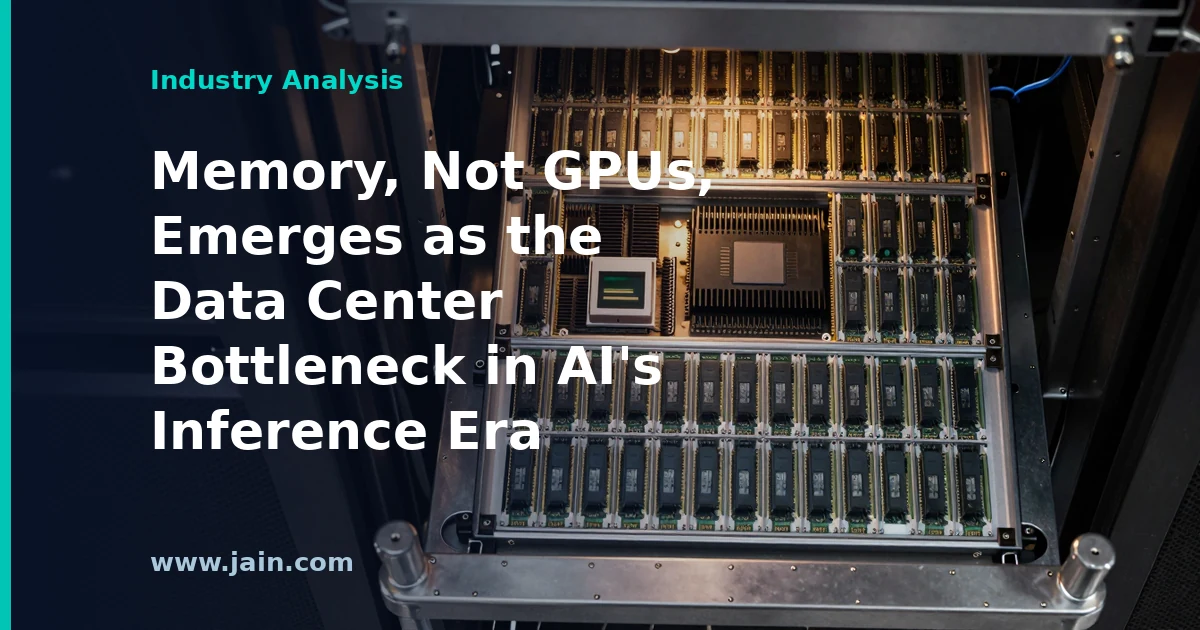
Data Center Knowledge reports that the AI industry’s next major data center challenge is scaling memory for the inference era. As of June 13, 2026, the trade publication frames memory — its capacity, bandwidth, and cost — rather than GPU supply alone as the constraint that will shape how AI infrastructure is built and operated as workloads shift from training models to serving them at scale.
Executive Summary
For the past several years, the AI infrastructure conversation has been dominated by one question: can you get enough GPUs? Data Center Knowledge’s report signals a maturing of that conversation. As deployed AI systems move from the training phase — where a model is built once on a massive cluster — to the inference phase — where that model answers millions of user requests every day — the binding constraint increasingly shifts toward memory: how much data an accelerator can hold close to its processors, and how fast it can move that data in and out.
This matters because inference is where AI meets its users and its revenue. Training is an episodic capital project; inference is a continuous operating workload whose economics are set by how efficiently each request can be served. If memory is the gating factor on that efficiency, then memory — not just compute — becomes a first-order design variable for chipmakers, server vendors, and the data center operators who house them. That has implications for procurement, facility design, and where the industry’s next supply-chain pressure points appear.
Why Inference Stresses Memory Differently Than Training
Training and inference are both AI workloads, but they stress hardware in different ways. Training is a throughput problem: enormous batches of data are pushed through a model in parallel, and the industry has optimized clusters, networks, and cooling around it. Inference is a latency and concurrency problem: a served model must hold its parameters — and, for modern conversational systems, the working context of many simultaneous user sessions — in fast memory, ready to respond in fractions of a second.
That is why the framing in this report resonates. A GPU with idle compute cycles but exhausted memory is, for inference purposes, a smaller GPU. The practical ceiling on how large a model you can serve, how long a context you can support, and how many users you can handle per accelerator is often set by memory capacity and bandwidth — the rate at which data moves between memory and processor — rather than by raw arithmetic performance. In industry shorthand, many inference workloads are ‘memory-bound’ rather than ‘compute-bound.’
From a GPU Supply Story to a Memory Supply Story
If the industry’s constraint migrates from processors to memory, the competitive map shifts with it. High-performance accelerators depend on specialized memory stacked directly alongside the processor — high-bandwidth memory, or HBM — which is produced by a small number of manufacturers and is among the most complex components in the server supply chain. A world in which inference demand keeps compounding is a world in which memory suppliers, packaging capacity, and memory-rich system designs command growing strategic attention.
It also opens the door to architectural alternatives. When fast on-package memory is scarce or expensive, system designers look for ways to tier it: pooling memory across servers, offloading less-frequently-accessed data to slower but larger stores, and caching repeated work so it need not be recomputed. Which of these approaches wins at scale is one of the genuinely open questions of the inference era, and the answer will influence everything from server bills of materials to network design inside the rack.
What It Means for Data Center Operators
For facility operators, the shift is subtler but real. Inference fleets are provisioned for sustained, user-facing demand, which favors availability, geographic distribution, and predictable power draw — a different profile from the concentrated, campus-scale training builds that have dominated recent headlines. Memory-heavy server configurations also change the calculus per rack: the balance of power, cooling, and floor space allocated to a given amount of useful serving capacity depends on how much memory ships alongside each accelerator.
The measured takeaway for buyers and operators is to treat memory as a first-class capacity-planning metric. Contracts, density assumptions, and refresh cycles built purely around GPU counts may misestimate what an inference-era fleet actually needs. That is not a crisis; it is the normal maturing of a young industry learning which of its inputs is truly scarce.
A Claim Worth Testing, Not Taking on Faith
It is worth being clear about the nature of this story: it is an analytical trend piece from a trade publication, not an announcement with commitments attached. The thesis — that memory becomes the bottleneck as inference scales — is directionally consistent with how served AI workloads behave, but its strength depends on variables the headline alone cannot settle: how fast inference demand actually grows, how quickly memory supply and packaging capacity expand, and whether software techniques blunt the constraint faster than hardware demand compounds. Readers should treat ‘memory is the next bottleneck’ as a well-founded hypothesis to plan against, not a settled fact.
Background
The AI infrastructure boom that accelerated from 2023 onward was defined first by a scramble for GPUs — the specialized processors used to train large AI models — and then by a scramble for the power and data center capacity to house them. As trained models moved into production across consumer and enterprise applications, the industry’s center of gravity began shifting from building models to serving them, a phase widely called the inference era.
That shift changes which hardware inputs are scarce. Modern accelerators pair their processors with high-bandwidth memory, a stacked, tightly integrated memory type made by only a few manufacturers worldwide. Because a served model’s size, context length, and concurrent user count are all bounded by available memory, industry attention has increasingly turned to memory supply, advanced packaging capacity, and architectures that stretch scarce fast memory further — the backdrop against which Data Center Knowledge’s June 2026 report was published.
In remarks reported on 24 April 2026 by the Taiwan-based research firm TrendForce, Intel said the shift in AI data center workloads from training to inference is driving the ratio of general-purpose processors (CPUs) to accelerators (GPUs) up from roughly 1:8 toward 1:1. In the same set of comments, Intel said it has pulled forward the target date for reaching its yield goal on 18A — its most advanced manufacturing process — to the middle of the year.
The two statements are directional guidance from a supplier rather than an audited disclosure. The item circulated as an aggregated news headline and short summary; the underlying figures behind the ratio claim, and the definition of the 18A yield target, were not published with it.
Executive Summary
Two claims are bundled into one short item, and they pull on different parts of the AI infrastructure market. The first is a demand-mix claim: that inference — running trained AI models to answer queries — leans far more heavily on CPUs than training did, moving server designs from roughly one CPU per eight accelerators toward something closer to parity. The second is a manufacturing claim: that Intel’s 18A process is hitting its internal yield milestone earlier than previously signalled.
If the ratio claim holds at scale, it changes what an AI data center buys. CPUs, and the memory and I/O that travel with them, become a larger slice of the bill of materials rather than a rounding error next to the accelerator spend. That reshapes procurement negotiations, rack-level power budgeting, and the relative bargaining position of every vendor that sells server silicon — not only Intel.
The caveat matters as much as the claim. Intel sells CPUs and sells foundry capacity, so it has a commercial interest in both statements being believed. Neither is inherently implausible, and the CPU-heavy character of inference serving is a widely discussed engineering reality. But as presented, both are assertions without published supporting data, and buyers should treat them as a hypothesis to test against their own workloads rather than a planning input.
Why Inference Puts the CPU Back on the Critical Path
Training a large AI model is close to the ideal case for an accelerator: a long, predictable, mathematically dense job that keeps GPUs saturated for days or weeks. The CPU’s role is largely to feed and supervise. That is how the industry arrived at server designs with one or two CPUs shepherding eight accelerators — the accelerators do the work, and the host processor is overhead you minimise.
Inference — the production phase, where a trained model actually serves users — has a different shape. Requests arrive unpredictably and must be batched, scheduled and routed. Inputs get tokenised, retrieved documents get fetched and ranked, outputs get filtered and post-processed. Increasingly, a single user request triggers a chain of model calls with orchestration logic between them. Most of that work is branchy, latency-sensitive general-purpose computing, which is what CPUs are for. Serving systems also spend real effort managing the memory that holds a conversation’s intermediate state, and moving data in and out of it. As the accelerator gets faster, the surrounding coordination becomes a bigger share of end-to-end latency — a familiar pattern in which speeding up one component simply relocates the bottleneck.
So the direction of Intel’s claim is consistent with how inference serving is built. What is not established by a headline is the magnitude. A ratio of 1:1 across the industry is a strong statement, and real deployments vary enormously: a retrieval-heavy enterprise assistant and a batch image-generation farm sit at opposite ends of the same spectrum. Without knowing which workloads, which deployment sizes and which time horizon Intel is describing, “1:8 toward 1:1” is best read as a trend claim, not a design specification.
What Parity Would Change on the Purchase Order
Move from one CPU per eight accelerators to something near parity and the effect is not limited to the processor line item. Each additional CPU socket brings its own memory channels, DRAM, network interfaces, power delivery and cooling load. Server CPUs and their memory are meaningful contributors to rack power, and in facilities already constrained by the electricity available at the meter, a denser CPU complement competes for the same watts as the accelerators. Operators planning at fixed megawatts per hall would see fewer accelerators per rack, or higher power per rack, or both.
The commercial consequence is a rebalancing of leverage. In a market where accelerators are scarce and everything else is commodity, the accelerator vendor sets the terms. If CPU and memory content becomes a materially larger share of system cost, buyers gain a second axis to negotiate on, and the suppliers of that content gain relevance. Memory makers are plausible beneficiaries; so are the vendors of high-speed networking and the platform integrators who design around new socket counts.
It does not follow that Intel captures the upside. A structurally higher CPU attach rate is a market-wide tailwind that Intel’s competitors also ride — AMD in x86, and Arm-based host processors sold as part of integrated accelerator platforms, which are specifically designed to keep the host tightly coupled to the accelerator. Intel is describing a market it must still win share in. That is a fair thing for a vendor to point out, and an equally fair thing for a buyer to discount.
18A: A Yield Date Is a Supply Statement
18A is Intel’s most advanced manufacturing process, the one carrying its return to competitive leading-edge production after years of delay, and the one it intends to sell to outside chip designers through Intel Foundry. Yield — the fraction of chips on each silicon wafer that come out working — is the number that converts a process from a technical achievement into an economic one. Wafers cost roughly the same whether most of the chips on them work or few of them do, so yield sets cost per usable chip and, just as importantly, sets how much output a fab can actually ship.
Pulling a yield target forward to mid-year is therefore a supply signal, not a marketing one. Earlier confidence in yield supports earlier volume ramps, firmer commitments to customers, and a better cost position on every product built on the node. For a company that has spent heavily on capacity, the gap between a fab that is running and a fab that is running profitably is almost entirely a yield question.
The claim as reported is unfalsifiable in its current form, because the target itself is not disclosed. “The yield target” could mean defect density against an internal roadmap, functional yield on a specific test vehicle, or yield on a particular shipping product — and these are very different statements. Reaching an internal milestone early is genuine progress; it is not the same as demonstrating competitive yield on a complex, large-die product at volume, which is the bar that determines whether external customers commit. Intel has been explicit in the past that 18A is central to its foundry strategy, and the market will price the milestone accordingly only when it is corroborated by shipping products and named customers.
Reading a Vendor Claim Fairly
Both statements come from a supplier with a direct interest in the conclusion, delivered through an aggregated news item rather than a technical disclosure. That is not a reason to dismiss them. Suppliers frequently see demand-mix shifts before the rest of the market does, precisely because they sit at the order book, and process engineers know their yield curves better than anyone outside the fab. Intel’s ratio claim is also the kind of thing that would be quickly contradicted by customers if it were far off, which imposes some discipline.
The appropriate posture is symmetrical scrutiny. Ask of Intel: what workloads, what customers, what time frame, what definition of the target? Ask the same of the counter-narrative — the assumption that inference remains accelerator-dominated and that host CPU content stays marginal is also an assertion, one that suits vendors whose value is concentrated in the accelerator. Neither position has been demonstrated here with published data.
For anyone making procurement or capital decisions, the practical resolution is empirical and cheap: instrument your own inference serving stack and measure where time is actually spent. A single week of profiling on representative traffic will tell an operator more about its own correct CPU-to-accelerator ratio than any vendor’s industry-wide average, and that measurement is the only version of this claim that can safely be put into a budget.
Background
Intel spent much of the past decade losing manufacturing leadership to Asian foundries and share in server processors to AMD, while missing the accelerator wave that drove the AI buildout. Its response has been to rebuild leading-edge manufacturing and to open its fabs to outside chip designers as Intel Foundry — a capital-intensive strategy in which 18A, the company’s most advanced process, is the pivotal node. Progress on 18A is therefore read by the market as a proxy for whether the broader turnaround is working.
Separately, AI data center demand is passing through a mix shift. The first phase of the buildout was dominated by training runs that reward raw accelerator throughput. As models move into production and serve real users, spending shifts toward inference, where cost per query, latency and system-level efficiency matter more than peak compute. That transition reopens questions about server architecture — including how much general-purpose processing each accelerator needs beside it — that the training era had largely settled.