TL;DR · 30-second read
The Short Version
New Jersey fined the builder of an artificial intelligence data center in the town of Vineland a record $1.07 million for running 62 portable power generators without pollution permits.
Split across the generators, that is about $17,000 each. Neighbors called it pocket change. The real threat is a deadline: get the permits within 45 days or switch the generators off.
The site supplies computing power for a $33 billion deal involving Microsoft, so losing its power source would be a far bigger problem than the fine.
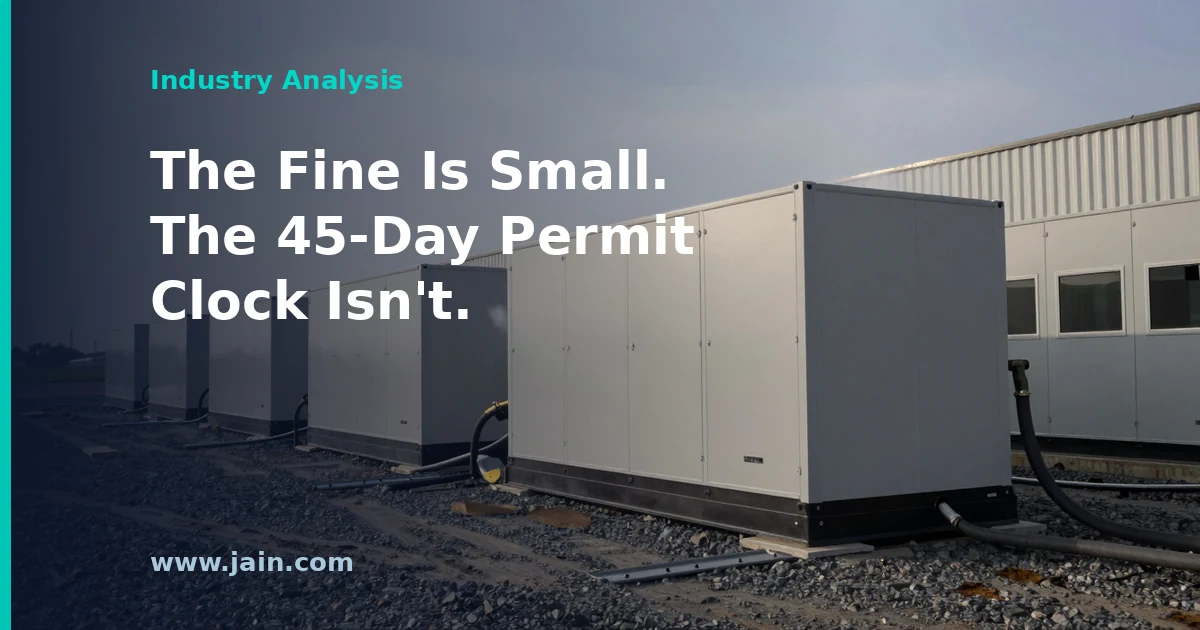
New Jersey has fined DataOne a record $1.07 million for running 62 unpermitted portable generators at its AI data center construction site in Vineland. The state also ordered the company to obtain air permits within 45 days or stop using the units. Tom’s Hardware reported the action on September 25, 2026, citing The New York Times. State inspectors found the generators powering the facility in late July. DataOne supplies computing capacity to Nebius, which Microsoft signed to a $33 billion deal.
Residents have raised several other complaints:
- the construction, without a permit, of a 1.5-million-gallon liquefied natural gas (LNG) tank;
- night-time noise reaching homes within half a mile;
- little public consultation before the project began.
DataOne disputed the fine. It said it will apply for air permits for the temporary generators and is moving from portable turbines to fuel cells.
Executive Summary
The penalty is modest against the scale of the project. Spread across 62 generators, it comes to roughly $17,300 per unit, a point residents made bluntly. The 45-day order is what carries operational weight. Generators that were powering the site must be permitted by state regulators in that window or switched off. That puts a regulatory decision, not a construction milestone, on the critical path for a facility tied to one of the larger AI capacity contracts in the market.
The case matters beyond Vineland. On-site generation, often called bridge power, lets developers bring their own electricity instead of waiting for a utility connection, and it is an increasingly common way to get AI capacity online quickly. New Jersey’s action and the earlier dispute over unpermitted turbines at SpaceXAI’s Colossus 2 site in Memphis point to the same limit: the workaround only moves as fast as the air-permit process allows.
Why the 45-Day Clock Outweighs the $1.07 Million
Divide $1.07 million by 62 generators and the penalty works out to about $17,300 per unit. Next to a $33 billion capacity contract, that is a rounding error. Residents said so directly. Longtime Vineland resident Steve Brown called it “a drop in the bucket,” and Tiffany Leone-Vespa argued the fine should have applied to each generator. As a financial deterrent, a penalty of this size does little to change the calculation behind what Brown described as a “don’t ask for permission, just ask for forgiveness later” approach.
The shutdown order is a different kind of lever. New Jersey told DataOne to meet its permitting requirements and to stop running the generators if permits are not granted within 45 days. Inspectors found those units powering the facility. If the permits do not come through, DataOne has to replace that power on a schedule set by regulators rather than by its own construction plan. The replacement could be utility supply, the fuel cells it says it is adopting, or other permitted equipment. For a company whose product is computing capacity, a power gap is a delivery problem, not an accounting line.
That exposure runs down a contract chain. DataOne supplies Nebius, and Nebius supplies Microsoft. The company has said it will apply for the permits. Whether regulators can review and grant them inside the window is the operative question, and it matters far more to the project’s timeline than the size of the fine.
Bring-Your-Own Power Comes With a Permit Attached
AI developers are bringing their own power because utility connections for very large new loads can take years, while trailer-mounted turbines and generators can be delivered and running in weeks. When a data center is built to rent out expensive AI processors, every month without power is lost revenue.
The trade-off is that fuel-burning equipment emits pollutants such as nitrogen oxides, along with noise. That is why states require air permits, which are licenses that set emission limits, operating hours and monitoring for combustion equipment. At 62 units, a temporary generator fleet starts to resemble a small power plant, and it draws the scrutiny that comes with one. Noise complaints from homes within half a mile show the effects are felt locally, not just on paper.
Memphis offers the closest comparison. SpaceXAI’s unpermitted turbines at Colossus 2 led to a lawsuit, and the Department of Justice asked the court to dismiss it on the grounds that the site “supports mission-critical operations.” The company ultimately agreed to remove the unpermitted turbines. It said the process would take more than a year as replacement plants totaling 1.2 gigawatts come online. Both cases end with temporary generation giving way to permanent, permitted supply. What differs is who sets the pace: more than a year in Memphis, 45 days in Vineland.
Fuel Cells, an LNG Tank and the Replacement Question
DataOne’s stated fix is to move from portable turbines to fuel cells. Fuel cells generate electricity through a chemical reaction rather than combustion. They are generally quieter and emit fewer local pollutants, so they address both of the neighbors’ main complaints. They still need fuel, most commonly natural gas, and they would have to match the output the 62 units were providing. DataOne has not said how much capacity it plans to install, who will supply it, or when it will be running.
The 1.5-million-gallon LNG tank is a separate exposure. Liquefied natural gas is gas cooled until it becomes a liquid so it can be stored in bulk, and on-site storage at that scale is one way to fuel generation where pipeline supply is limited. DataOne has not explained what the tank is for. Residents say it was built without a permit, which could make its status a second regulatory question alongside the generators.
Community Consent Is Now Part of the Power Plan
According to residents, they learned a data center was going up in their neighborhood only after Microsoft announced its deal with Nebius. They raised concerns at a February town hall, citing satellite imagery that showed “some type of unit” on site. Inspectors had found no generators during a December visit, then found 62 in late July. When the units first arrived remains unclear, and so does how long they ran before enforcement.
Both sides deserve a fair reading. DataOne’s commitment to seek permits and move to cleaner equipment points in the direction regulators want. Residents’ argument that a flat fine is too small for a well-capitalized operator is a legitimate question about how penalties are designed, including whether they should scale per unit. For developers, the lesson is practical. Permitting and early community engagement cost time up front, but enforcement mid-construction imposes a deadline the developer does not control.
Background
Nebius is an AI cloud company, sometimes called a neocloud, that rents out computing capacity built on graphics processors, the chips used to train and run AI models. It is headquartered in Amsterdam, listed on Nasdaq, and emerged in 2024 from the restructuring of Yandex’s international business. Its $33 billion deal with Microsoft makes it a major capacity supplier to one of the largest buyers of AI computing. DataOne is the developer contracted to provide computing capacity for that arrangement at Vineland, in southern New Jersey.
AI data centers draw far more electricity than traditional facilities, and utility connections for large new loads can take years. Many developers now use on-site generation such as gas turbines, engines or fuel cells as bridge power until grid supply is ready. Under the federal Clean Air Act framework, states require air permits for fuel-burning equipment above certain size thresholds. Operating without one exposes a site to fines and orders to shut the equipment down. Source: New Jersey hits Microsoft-linked AI data center with record fine for 62 unpermitted power generators, issues 45-day shutdown deadline — site tied to $33 billion deal also built illegal 1.5M-gallon fuel tank: Tom’s Hardware on New Jersey’s $1.07 million fine and 45-day permit deadline for DataOne’s Vineland AI data center.Sources