
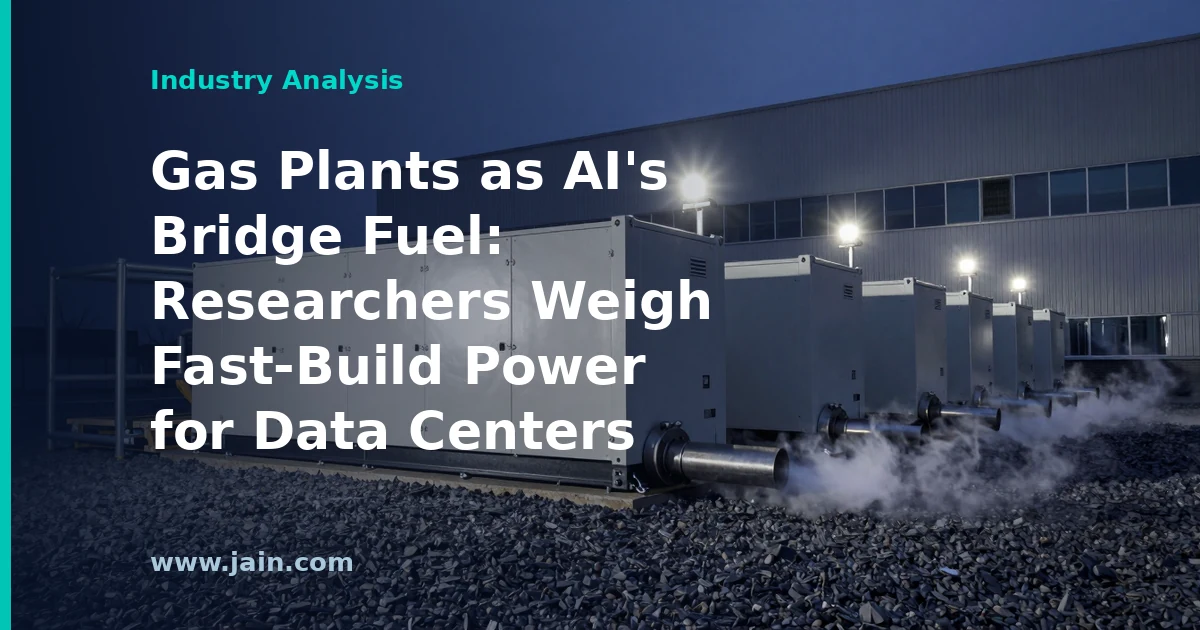
RTO Insider reported on May 24, 2026 that grid researchers are examining the long-term future of natural gas plants built quickly to serve data centers — the generation category that has become the default answer to AI-driven electricity demand across U.S. power markets. The piece frames a question now central to utility and grid-operator planning: what happens to a fleet of fast-build gas plants over the decades after the immediate data-center crunch they were built to solve?
Executive Summary
The report, published by RTO Insider — a trade outlet covering regional transmission organizations (RTOs), the entities that run wholesale electricity markets and the high-voltage grid across much of the United States — captures a debate that has moved from the margins to the center of power-sector planning. Data-center developers facing multi-year waits for grid interconnection have increasingly turned to natural gas generation, often sited at or near the data center itself, because gas turbines can be permitted and installed faster than almost any other firm, dispatchable power source at comparable scale.
That researchers are now asking what becomes of these plants matters because the answer shapes who bears the cost. A gas plant is a decades-long asset being built to serve a demand surge whose duration nobody can guarantee. Whether these units become permanent baseload, transition into backup and peaking roles as cleaner firm power arrives, or end up underused, will determine outcomes for utilities, ratepayers, data-center operators, and the emissions trajectory of the AI build-out. The syndicated version of the article available to us carries only the headline, so the specific researchers, markets, and findings involved are not detailed here — but the question itself is well documented across the industry, and it deserves examination on its own terms.
Speed to Power Is the Whole Ballgame
The reason gas keeps winning data-center deals is not ideology or even, primarily, fuel economics — it is time. In several major U.S. markets, connecting a large new load or generator to the grid can take years of interconnection study and transmission upgrades. A hyperscale AI campus that needs hundreds of megawatts cannot wait that long when the competitive race in AI is measured in quarters. Gas turbines, including smaller aeroderivative and reciprocating-engine units, can often be deployed in a fraction of the time, sometimes ‘behind the meter’ — meaning on the customer’s side of the utility connection, serving the facility directly rather than flowing through the shared grid.
Nuclear cannot be built quickly; new large hydro is essentially unavailable; wind and solar are fast but intermittent, and pairing them with enough storage to run a 24/7 AI facility remains expensive at gigawatt scale. That leaves gas as the pragmatic default — which is precisely why researchers are scrutinizing what the industry is committing itself to by default rather than by design.
A Bridge Needs a Far Shore
Calling gas a ‘bridge fuel’ — a transitional energy source used until cleaner firm power scales up — embeds an assumption: that something is on the other side of the bridge. Candidates include advanced nuclear (including small modular reactors), enhanced geothermal, long-duration storage, and gas units retrofitted for carbon capture or hydrogen blending. All are promising; none is deployable today at the pace and price the AI build-out demands. If those technologies mature on schedule, fast-build gas plants can gracefully shift from running constantly to running occasionally, as peakers and reliability backstops. If they do not, the ‘bridge’ quietly becomes the destination, with the associated locked-in emissions and fuel-price exposure.
The honest answer — and likely part of why researchers are ‘pondering’ rather than concluding — is that both outcomes are live possibilities, and the difference is worth billions of dollars and a meaningful slice of U.S. emissions.
Who Holds the Asset Risk?
The economics hinge on who owns the plant and who pays if demand disappoints. When a data-center developer builds its own on-site generation, the stranded-asset risk — the danger of an expensive asset losing its economic purpose before it is paid off — sits largely with a private company that chose it. When a regulated utility builds gas capacity into its rate base to serve forecast data-center load, ordinary ratepayers can end up carrying the cost if AI demand forecasts prove inflated or if a customer leaves. Grid operators and state regulators are actively developing large-load tariffs, minimum-take contracts, and exit fees to allocate that risk more explicitly, and the research attention RTO Insider describes feeds directly into those proceedings.
Supply chains add another wrinkle: demand for heavy-duty gas turbines has surged worldwide, and lead times for new orders have stretched to several years. That erodes some of gas’s core speed advantage and pushes developers toward smaller, modular units — machines that are, conveniently, also easier to redeploy or run flexibly if the long-term role of these plants shrinks.
What It Means for the Data-Center Industry
For data-center operators and their customers, the takeaway is that power strategy is now inseparable from business strategy. Facilities powered by fast-build gas gain schedule certainty today but inherit questions about fuel-cost volatility, future emissions regulation, and the sustainability commitments of the tenants they serve — many large technology companies maintain public carbon-free-energy targets that on-site gas complicates. Operators that pair near-term gas with credible contracts for cleaner firm power, or that site where grid capacity genuinely exists, will have an easier story to tell enterprise customers, regulators, and communities. The infrastructure sector should welcome the scrutiny: a clear-eyed answer to ‘what happens to these plants in 2040?’ is better arrived at before the concrete is poured than after.
Background
After roughly two decades of flat U.S. electricity demand, the AI data-center build-out has triggered the fastest load-growth forecasts utilities have issued in a generation, with individual campuses now requesting hundreds of megawatts — and some multi-gigawatt projects proposed. Grid interconnection queues, transmission construction timelines, and generator retirements have collided with that surge, making ‘speed to power’ the defining constraint of the data-center industry. Natural gas, which already supplies the largest share of U.S. electricity generation, has emerged as the default fast answer, spawning a wave of proposed on-site and utility-scale gas projects. RTO Insider, the outlet behind this report, covers the regional transmission organizations and regulatory proceedings where the resulting cost, reliability, and emissions questions are being fought out.
Source: Researchers Ponder Future of Gas Plants that Quickly Power Data Centers — RTO Insider report, May 24, 2026, on grid researchers’ analysis of fast-build gas generation serving data-center load.