Blue Owl, a large investment firm, plans to bundle about $6.5 billion worth of its data centers into a company whose shares trade on the stock market. Data centers are the warehouse-sized buildings full of computers that run apps and artificial intelligence.
Today, most new data centers are paid for by big private funds that ordinary savers cannot easily buy into. If this listing happens, anyone with a brokerage account could own a slice. The share price would then show how much everyday investors think the artificial intelligence building boom is really worth.
Blue Owl Capital is planning a publicly traded real estate investment trust (REIT) that would hold about $6.5 billion of data center assets, Bloomberg reported on September 4, 2026. The vehicle would roll up data center holdings that Blue Owl currently manages into a single listed company. Public investors could then own the buildings directly through shares, rather than only through the firm’s private funds.
The plan would add a second sponsor-built listed data center vehicle to the market. Blackstone is preparing a data center REIT of its own. Timing, listing venue, and the precise portfolio were not disclosed.
Executive Summary
A REIT is a company that owns income-producing property and passes most of its taxable income to shareholders as dividends. In the US, the requirement is at least 90%. By putting roughly $6.5 billion of data center assets into a listed REIT, Blue Owl would move part of its AI-era infrastructure out of closed private funds and into a vehicle priced every trading day.
That matters beyond Blue Owl. Most of the capital behind recent data center construction has come from private funds, infrastructure investors, and the balance sheets of the largest cloud companies. A listed vehicle gives stock-market investors a way to own that buildout directly. It also produces something the private market does not: a continuous public price for these assets. That price will show whether public investors value AI-driven data center portfolios as richly as private buyers have.
With Blackstone also preparing a listed vehicle, the two plans together suggest large private sponsors now see public equity as a funding channel for data centers, and no longer only as a place to sell out.
A Daily Price for Assets That Have Rarely Had One
The core consequence of the plan is price discovery. Private data center funds value their holdings periodically, often through appraisals and transaction comparables. A listed REIT gets repriced every trading day by investors who can sell at any time. If Blue Owl’s roughly $6.5 billion portfolio trades at a premium to the value of its underlying assets, it would signal that public investors will pay up for AI-linked infrastructure. That would lower the cost of equity for the next round of construction. If it trades at a discount, private sponsors learn that public markets want a higher return than private buyers have been accepting.
Several groups are directly affected by that signal. Developers borrow and raise equity against expected asset values. Large cloud and AI tenants depend on landlords being able to finance new capacity. Private fund investors want to know what their marks are worth in an open market. A single listing will not settle those questions for the whole sector, but it creates a public reference point where few existed for sponsor-owned AI-era portfolios.
Why Sponsors Want a Public Door
A REIT listing is also a capital-recycling tool. When assets move from a private fund into a listed vehicle, the sponsor can return cash to earlier investors, free up capacity for new projects, and keep earning fees for managing the listed company. For a firm growing a data center platform, that turns finished buildings into a source of funding for unfinished ones.
The REIT structure has a built-in tension, though. Because REITs pay out most of their taxable income, they retain little cash. Growth usually means issuing new shares or taking on debt. Data center development is extremely capital-hungry: power equipment, cooling systems, and the buildings themselves all have to be paid for before any tenant pays rent. A listed data center REIT that wants to keep expanding will likely need to come back to public markets repeatedly. Its share price therefore feeds directly into how fast it can build.
A Crowding Public Shelf
Public investors already have options. Equinix and Digital Realty are established listed data center REITs, and Blackstone’s planned vehicle would add another. Blue Owl’s REIT would be judged against all of them on tenant quality, lease length, power availability, and development pipeline. The size and makeup of the portfolio will matter more than the headline asset figure.
The listing also exposes AI infrastructure to risks that private funds can hold more quietly. Those include interest-rate swings, which weigh on all yield-oriented stocks, and concentration risk if a small number of very large tenants account for most of the rent. Equipment obsolescence is another question. Facilities built for one generation of AI chips may need costly power and cooling upgrades for the next. Public shareholders will price those risks explicitly, and that scrutiny is part of what the market will learn from this deal.
Background
Blue Owl Capital was formed in 2021 through the combination of Owl Rock Capital and Dyal Capital Partners and trades on the New York Stock Exchange. Alongside its lending and private equity stake businesses, it has expanded into real assets and digital infrastructure. That includes data center investment and financing for large-scale campuses built to serve cloud and AI customers.
Listed data center ownership has long been dominated by a few specialist REITs, notably Equinix and Digital Realty. Much of the capital behind the recent wave of AI-driven construction has come instead from private equity, infrastructure funds and hyperscale cloud companies building for themselves. Plans by Blue Owl and Blackstone to create listed vehicles would open more of that privately funded buildout to public-market investors.
Two companies want to build up to 11 giant computer warehouses near the small town of Turkey, Texas. These are data centers, the buildings that run websites, apps and artificial intelligence. The price tag is more than $10 billion.
The twist is electricity. The companies say they will pay the full cost of the power setup, and one of them plans to supply electricity from solar panels and large batteries. They also say they will not draw from the town’s water system.
Texas’s governor has been asking big developers to do exactly that.
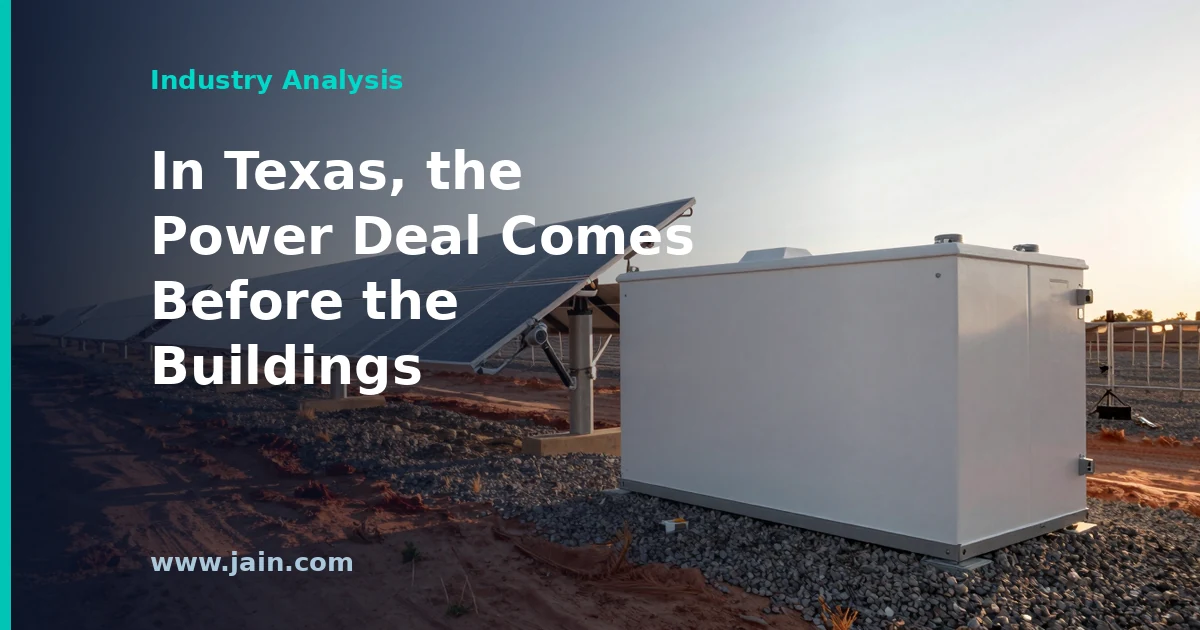
ETDatacenters reported on July 20, 2026 that QTS Data Centers, the Blackstone-owned US data center operator, and Lancium, an energy technology and infrastructure company, plan a hyperscale data center campus on Lancium’s Clean Campus in Hall County, near Turkey, Texas. The site covers roughly 465 acres and could hold up to 11 data center buildings. The project is expected to draw more than $10 billion in capital investment.
The two companies will jointly fund 100 percent of the energy infrastructure improvements. Lancium, which owns the campus, will provide the electrical and civil infrastructure and plans to supply power through solar resources and battery storage. QTS will design, build and operate the buildings. The companies expect up to 7,000 jobs at peak construction and about 350 permanent positions.
Executive Summary
The headline figure is $10 billion, but the more telling detail is how the work is divided. Lancium owns the land and supplies the electrical backbone. QTS builds and runs the data halls. Both companies pay for the energy infrastructure in full. The site’s value to QTS comes from the power arrangements attached to it, not from the acreage.
The structure also fits a policy moment. The companies’ commitments to self-fund infrastructure, supply their own power and avoid the municipal water supply align with Texas Governor Greg Abbott’s calls for data center developers to cover their own funding and energy needs. That makes the project a template other developers in the state may be measured against.
Much remains unstated. The companies have not disclosed the campus’s electrical capacity, a tenant, a construction timeline or how solar and batteries alone would serve a facility that runs around the clock.
The Power Comes First, the Buildings Second
In a conventional data center deal, the operator buys land, applies to the local utility for a grid connection, and waits. For large campuses, that wait for electricity has become the longest item on the schedule. Pouring concrete and installing servers take less time than securing hundreds of megawatts of reliable supply. The QTS–Lancium structure turns the usual sequence around. Lancium, as campus owner, provides the electrical and civil infrastructure: power delivery, site preparation, roads and utilities. QTS, one of the largest US operators, arrives to design, build and operate the buildings on ground whose energy plan is already Lancium’s responsibility.
That division of labor explains the headline. Powered land here means a site where the question of where the electricity comes from has an owner and a plan. It is the input QTS has chosen to partner for rather than build on its own. The more than $10 billion in expected capital will mostly flow into buildings and equipment. Whether any of it can be deployed still depends on the energy side, and that is why the energy company holds the land.
Several groups are affected. For landowners and energy developers, the deal shows that a site with a credible power plan can attract a top-tier operator. For operators, it suggests the competitive edge may lie in securing such sites early. This is one project, not proof of an industry-wide shift, but it shows clearly where the leverage sits.
Self-Funded Energy as a Policy Answer
Large data centers have raised a recurring worry: that the grid upgrades needed to serve them will be paid for, at least partly, by households and small businesses through their utility bills. By committing to fund 100 percent of the energy infrastructure improvements, QTS and Lancium are presenting a direct answer to that concern. The release explicitly links the approach to Governor Abbott’s calls for developers to take responsibility for their projects’ funding and energy needs.
That alignment is likely to matter for permitting, local acceptance and future negotiations with Texas regulators. A developer that can say it is not asking ratepayers to underwrite its load has a stronger public case than one that cannot. The commitment is only as meaningful as its scope, however, and the companies have not said which improvements it covers. Transmission lines, substations and on-site generation carry very different price tags.
Can Solar and Batteries Carry a Hyperscale Load?
The claim that deserves the closest reading is that Lancium will supply the site’s power through solar and battery storage, which the release says will enhance energy independence and grid stability. Solar generates only in daylight. Batteries at utility scale typically discharge over a period of hours, not days. A hyperscale data center, whether it serves cloud or AI workloads, draws power continuously. Covering nights, cloudy stretches and winter lows from solar and storage alone would require very large overbuilding. More commonly, a site also connects to the grid or to firm generation such as gas.
The release does not say whether the campus will connect to the grid, how much of its demand solar and batteries will meet, or what backs them up. None of this makes the plan unworkable. It means the energy-independence claim is a stated intention, not a demonstrated design. The answer will determine both the project’s cost and how much it actually eases pressure on the Texas grid.
Water and Jobs: What the Numbers Do and Do Not Say
Closed-loop cooling recirculates the same water instead of evaporating large volumes of it, and QTS says it will significantly reduce the campus’s impact on local water. The commitment to avoid Turkey’s municipal supply is concrete. Sourcing from on-site wells still draws on groundwater, however, and trucking water in has its own costs and logistics. Volumes have not been disclosed.
The job figures follow the typical data center profile: heavy construction employment, then a lean permanent staff. Up to 7,000 workers at peak construction against about 350 permanent roles works out to roughly $29 million of expected capital per permanent job. That is not a criticism. It is simply what capital-intensive infrastructure looks like, and it is worth keeping in mind when local economic benefits are weighed against resource use.
Background
QTS Data Centers is a US data center operator owned by the investment firm Blackstone. It builds and runs large facilities for cloud and technology customers. Lancium is an energy technology and infrastructure company. It owns the Clean Campus site in Hall County, near Turkey, Texas, where the new project is planned.
Hyperscale campuses of this size need large amounts of reliable electricity, and connecting new large loads to the grid has become a central constraint on data center development. In Texas, the scale of proposed projects has drawn attention from state leaders, including Governor Greg Abbott, who has called for developers to take responsibility for their projects’ funding and energy needs.
Sources
Source: QTS, Lancium Plan Texas Hyperscale Campus with $10 Billion Investment (ETDatacenters): QTS and Lancium plan an up-to-11-building, 465-acre data center campus in Hall County, Texas, with self-funded energy infrastructure, solar and battery power, and closed-loop cooling.
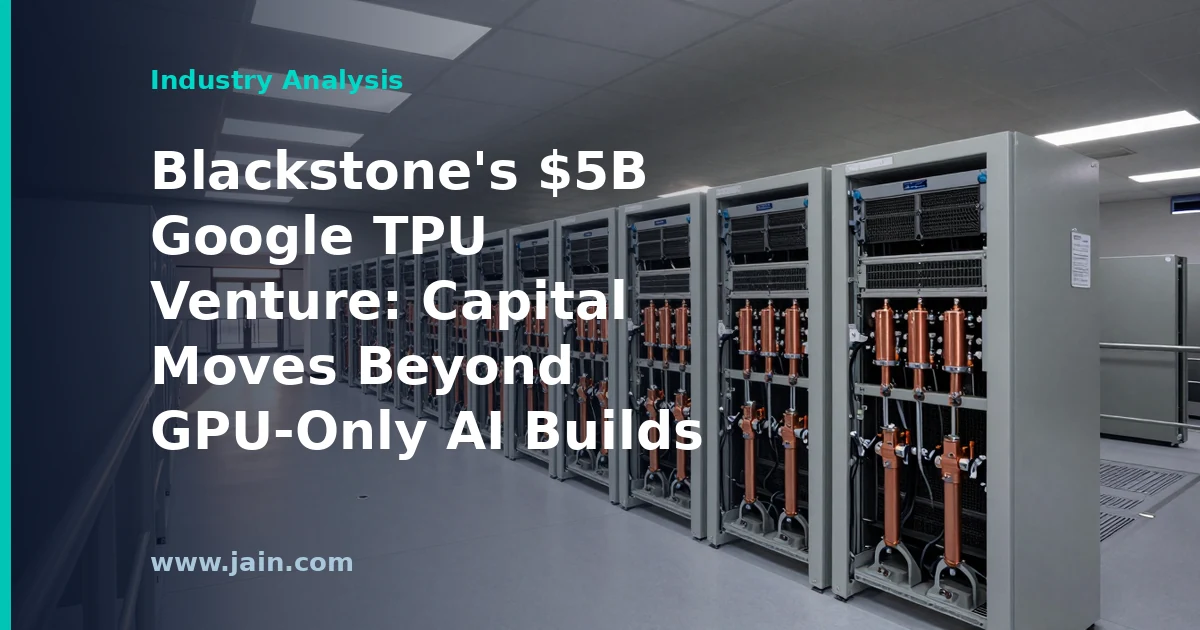
Blackstone, the world’s largest alternative asset manager, will invest $5 billion in an AI infrastructure venture with Google, with the resulting capacity powered by Google’s Tensor Processing Units (TPUs) rather than the Nvidia graphics processing units (GPUs) that have dominated AI build-outs to date, according to a CNBC report published May 18, 2026.
Executive Summary
The announcement pairs one of the deepest pools of private capital with the only hyperscaler that designs and deploys its own AI accelerator at scale. Blackstone’s $5 billion commitment funds infrastructure — the data center capacity, power, and systems needed to run AI workloads — while Google contributes its TPU silicon, custom chips it has refined over roughly a decade to train and serve machine-learning models.
Why it matters: nearly every headline AI infrastructure deal of the past three years has been, implicitly or explicitly, an Nvidia GPU deal. A marquee private-equity firm underwriting billions against TPU-based capacity is a meaningful vote of confidence that alternative accelerators can anchor institutional-grade infrastructure investment — and a signal that the financing market for AI compute is beginning to diversify beyond a single chip vendor.
The First Big Check Written Against Non-Nvidia Silicon
AI infrastructure finance has grown enormously, but it has grown narrowly: lenders and equity investors have overwhelmingly underwritten deals where the collateral and the revenue engine are Nvidia GPUs. That concentration has been rational — Nvidia’s CUDA software ecosystem and resale liquidity made its chips the safest asset to finance — but it has also made the entire capital stack a leveraged bet on one supplier. Blackstone committing $5 billion against TPU-powered capacity is the clearest sign yet that sophisticated capital now sees a second underwritable accelerator. TPUs are application-specific chips Google designed for the mathematics of neural networks; they lack the open resale market of GPUs, which is precisely why a partnership with Google — the designer, operator, and most likely demand backstop — is the structure that makes the risk financeable.
For the broader market, the precedent may matter more than the dollars. If TPU capacity can attract institutional capital on infrastructure terms, similar structures become imaginable around other custom silicon. That would gradually loosen the financing chokepoint that has funneled most AI investment through a single vendor’s order book.
Blackstone’s Compounding Digital Infrastructure Thesis
This deal extends a strategy Blackstone has pursued aggressively since taking data center operator QTS private in 2021 in a transaction valued around $10 billion — then one of the largest data center acquisitions ever. Under Blackstone’s ownership, QTS became a vehicle for hyperscale expansion, and the firm has repeatedly identified AI infrastructure — data centers and the power to run them — as one of its highest-conviction themes. A venture with Google fits the pattern: Blackstone supplies capital at a scale few can match, and captures returns from the physical layer of AI regardless of which models or applications ultimately win.
The economics of such ventures typically hinge on tenancy: infrastructure returns are attractive when long-term, creditworthy commitments stand behind the capacity. Google’s involvement suggests — though the report does not confirm — that Google itself or its cloud customers would utilize the TPU capacity, which would make this closer to a pre-leased infrastructure play than a speculative build. The announcement does not disclose the venture’s structure, so that remains an inference rather than a fact.
Winners, Losers, and the Accelerator Question
Google is an obvious beneficiary: external capital lets it scale TPU deployment faster than its own capital-expenditure budget alone would allow, and every TPU-anchored venture strengthens the case that its silicon is a genuine alternative for AI workloads, not just an internal cost-saver. For Nvidia, one $5 billion venture is immaterial to near-term demand — its chips remain heavily supply-constrained — but the directional message is unwelcome: the largest infrastructure investors are actively building expertise in financing non-Nvidia compute. Data center developers, power providers, and cooling vendors win either way; TPUs, like GPUs, are power-dense accelerators that need substantial electricity and advanced thermal management.
The risks are real, too. TPU capacity is only as valuable as demand for TPU workloads, and that demand is concentrated in Google’s own ecosystem and a handful of large AI developers. If the software world remains standardized on Nvidia’s tooling, TPU infrastructure could face a narrower tenant pool than comparable GPU builds — a concentration risk any underwriter of this deal will have had to price.
Background
Google introduced TPUs in the mid-2010s to run its own machine-learning workloads more efficiently than off-the-shelf chips allowed, and has since iterated through multiple generations while making them available to outside customers through Google Cloud. TPUs are the most mature in-house AI accelerator program among the hyperscalers, all of whom have pursued custom silicon to reduce dependence on Nvidia. Blackstone, for its part, has spent the past half-decade positioning itself as a dominant financier of digital infrastructure — anchored by its roughly $10 billion take-private of QTS in 2021 — on the thesis that AI’s appetite for compute and power represents a generational infrastructure build-out.
Blackstone Digital Infrastructure Trust (BXDC), a newly formed data center real estate investment trust sponsored by Blackstone, priced its initial public offering at $1.75 billion on May 15, 2026, selling shares at $20 apiece, according to IPO research firm Renaissance Capital. At that price, the deal implies roughly 87.5 million shares sold in the offering.
The listing creates one of the few new pure-play public vehicles for data center real estate in years, arriving amid an unprecedented wave of capital spending on AI computing infrastructure.
Executive Summary
The announcement itself is straightforward: a new REIT — a real estate investment trust, a structure that lets investors own income-producing property through shares and requires most taxable income to be paid out as dividends — has been formed under the Blackstone umbrella and has raised $1.75 billion from public markets at $20 per share.
Why it matters is larger than the dollar figure. Since 2021, the universe of publicly traded data center REITs has contracted sharply as private equity — Blackstone prominently among them — took operators like QTS Realty private. BXDC reverses the direction of travel: after years of private capital absorbing data center assets, one of the largest private owners is now offering public investors a way back in. That is a meaningful signal about where data center financing goes next, because the capital requirements of the AI buildout are widely understood to exceed what private funds and credit markets can comfortably carry alone.
For a first-day read, the pricing is the headline and nearly the only hard fact. The source is a single pricing notice; portfolio details, leverage, and dividend policy are not described in it, and we flag those gaps below.
The Public Data Center REIT Club Gets a New Member
For most of the last two decades, retail and institutional investors could buy data centers on the stock exchange through a half-dozen REITs. That changed abruptly in 2021, when a privatization wave — Blackstone’s roughly $10 billion take-private of QTS Realty, KKR and GIP’s acquisition of CyrusOne, and American Tower’s purchase of CoreSite — left Equinix and Digital Realty as the only major U.S. pure plays. Private owners argued, credibly, that public markets undervalued the sector and that development-heavy strategies were easier to execute away from quarterly earnings scrutiny.
BXDC’s arrival suggests the calculus has shifted. Public market appetite for anything attached to AI infrastructure is strong, and a $1.75 billion raise at pricing is a real vote of confidence. For investors, a new pure-play vehicle broadens choice in a sector where demand has been concentrated in two large incumbents plus indirect exposure through hyperscaler equities.
Why Blackstone Is Going This Direction Now
Blackstone, the world’s largest alternative asset manager, has spent years calling digital infrastructure one of its highest-conviction themes, assembling QTS in the Americas and AirTrunk in Asia-Pacific, alongside major commitments to the power and land that data centers require. The traditional private equity playbook is to buy, build, and eventually exit — and public listing is one of the classic exits.
A sponsored REIT IPO can serve several purposes at once: it recycles capital back to earlier funds, establishes a public currency that can be used for future acquisitions, and creates a permanent-capital vehicle that can keep funding development long after a private fund’s life would end. Which of these motivations dominates here is not disclosed in the pricing notice, and the answer matters — a vehicle designed primarily to fund new construction has a different risk profile than one designed primarily to monetize existing assets at favorable valuations. Prospective investors should read the prospectus with that distinction in mind.
The AI Buildout Needs More Wallets
The broader context is arithmetic. Hyperscale cloud and AI operators have signaled capital spending measured in the hundreds of billions of dollars annually, and every gigawatt of new data center capacity requires land, shells, power infrastructure, and cooling that someone must finance. Private equity, infrastructure funds, and private credit have carried much of that load, but the sums involved increasingly point toward the deepest pool available: public equity and debt markets.
In that light, BXDC looks less like a one-off transaction and more like the opening of a channel. If the offering trades well, expect other large private owners of digital infrastructure to consider similar listings. If it trades poorly, it will reinforce the argument that these assets are better held privately. Either way, the deal makes BXDC an early public-market referendum on AI infrastructure economics — dividend-paying real estate wrapped around a growth story.
What Could Complicate the Story
Data center REITs sit at the intersection of several risks that a $20 share price does not by itself resolve. Power availability has become the binding constraint on new capacity in many markets, with multi-year utility interconnection queues. Tenant concentration is structural: a handful of hyperscalers dominate leasing, which makes credit quality strong but negotiating leverage lopsided. Interest rates matter twice over — they set the discount rate on REIT dividends and the cost of the heavy debt that data center development requires.
And there is the demand question that hangs over the entire sector: current buildout plans assume sustained, rapidly growing AI workloads. That assumption may well prove correct, but a REIT built to fund the buildout is levered to it. None of this is a criticism of the offering — these are the standard risks of the asset class — but they are the framework through which the eventual prospectus disclosures should be read.
Background
Blackstone is the world’s largest alternative asset manager, with businesses spanning private equity, real estate, credit, and infrastructure. Over the past half-decade it has become one of the biggest private owners of digital infrastructure: it led the take-private of U.S. data center operator QTS Realty in 2021 in a deal valued around $10 billion, acquired Asia-Pacific hyperscale developer AirTrunk in 2024, and has invested across the power generation and transmission assets that data centers depend on.
Those privatizations were part of a broader 2021–2022 wave in which private capital removed most pure-play data center REITs from public markets, leaving Equinix and Digital Realty as the principal listed options. BXDC’s May 2026 IPO marks the first major reversal of that trend, arriving as AI-driven demand pushes the industry’s capital needs to levels that make public markets an increasingly necessary funding source.
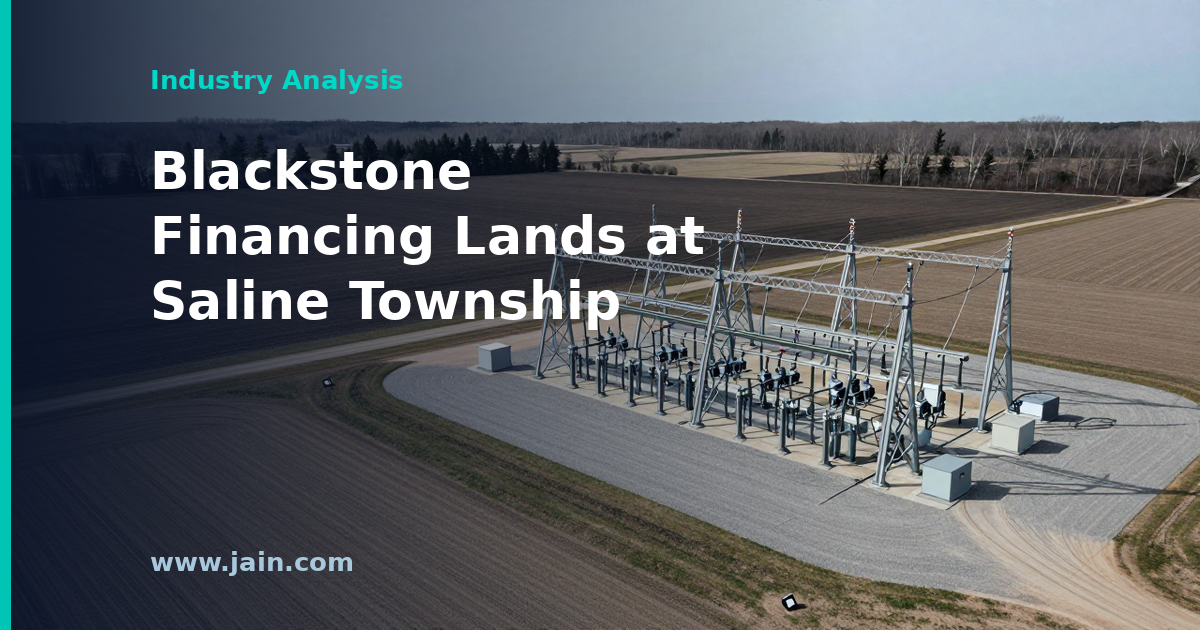
MLive reported on April 25, 2026 that the large data center campus planned for Saline Township, in Washtenaw County, Michigan, has secured financing through Blackstone, the world’s largest alternative-asset manager and a major private-credit lender. Saline Township is a rural farming community roughly south of Ann Arbor, and the site has been the subject of local debate since the project was first proposed.
The report is headline-level. The coverage available to us does not state the size of the facility, the amount or structure of the financing, the identity of the anchor tenant, or the construction schedule. What is established is the fact of a financing commitment from a private-capital provider rather than from a bank syndicate or a utility-led arrangement.
Executive Summary
A financing close is the moment a data center stops being a land-use argument and becomes a construction project. Site control, zoning approvals and power studies can all exist without a single dollar of committed capital; a lender writing a check is the first hard signal that a third party with money at risk believes the project will generate cash. That is why this particular disclosure matters more than its length suggests.
The identity of the lender matters as much as the event. Blackstone has become one of the largest financiers of digital infrastructure through its credit and real-assets platforms, and its involvement places Saline Township inside a broader shift: the capital funding America’s AI-era compute buildout is increasingly private credit — money lent directly by asset managers — rather than utility balance sheets, investment-grade bonds, or traditional construction lending. Private credit moves faster, tolerates more complexity, and prices that flexibility into the interest rate.
The consequence is a redistribution of risk. When a regulated utility builds generation and transmission for a large customer, cost overruns and demand shortfalls can end up in rate cases, where regulators decide how much lands on other ratepayers. When a private lender funds a merchant campus, the first loss sits with the sponsor’s equity and the lender’s loan. Which of those two models Saline Township follows is the single most consequential question the reporting does not yet answer.
Why a Private-Credit Lender, Not a Utility, Is the Story
For most of the last century, the entity that financed heavy electrical load in a place like Washtenaw County was the local utility. It raised capital, built the wires and the plants, and recovered the cost from customers over decades under a regulator’s supervision. The model was slow, but it was durable, and it socialized risk across a large base of ratepayers who had little say in the matter.
Data centers built for artificial-intelligence workloads do not fit that rhythm. The demand signal arrives in months, not decades, and it is concentrated in a handful of hyperscale buyers whose plans can change. Private credit — non-bank lending in which asset managers lend directly from their own funds — has filled the gap because it can underwrite an idiosyncratic asset quickly, structure around construction milestones, and accept collateral that a bank credit committee would struggle with. The borrower pays for that speed in spread.
The trade is real in both directions. A sponsor who takes private credit gets certainty of execution and avoids the political timeline of a rate case. It also accepts covenants, tighter reporting, and a lender that can enforce quickly if lease-up or delivery slips. Reading Blackstone’s involvement as validation of the Saline Township site is reasonable; reading it as a guarantee of completion is not, because financing commitments are typically conditioned on milestones that have not been disclosed here.
The Capital Structure Decides Who Eats the Power Risk
Whether a campus of this scale is financially safe depends less on the headline amount than on what sits behind it. Two structures dominate the sector. In the first, the developer signs long-term leases with a creditworthy tenant before drawing debt; the lender is effectively underwriting the tenant’s credit, and power costs are passed through under the lease. In the second — a merchant or speculative build — the developer takes capacity risk, betting that demand will appear at attractive rates. The interest cost of the two differs sharply, and so does the consequence of being wrong.
Power is where those structures are tested. A large campus needs a firm interconnection, a tariff that sets what it pays per megawatt-hour, and often a commitment to pay for a minimum volume whether or not the servers are drawing it. That last provision — a take-or-pay or minimum-demand charge — is the mechanism by which regulators try to ensure that a large customer, not the general ratepayer base, funds the network upgrades built on its behalf. Whether such terms exist here, and how strict they are, is not in the reporting.
The winners in the current arrangement are relatively easy to identify: landowners who sell into a rising market, contractors and electrical trades, lenders earning wide spreads on secured assets, and local governments that collect property tax on very expensive equipment. The exposed parties are harder to see in advance. They include equity holders if AI compute demand normalizes before the campus is leased, and residential ratepayers if grid investment is later judged to have been undersubscribed by its intended customer. Neither outcome is predictable from a financing headline, which is exactly why the terms matter.
Michigan’s Calculation: Tax Base Now, Load Growth Later
Michigan has actively courted data center investment as part of a broader effort to attract capital-intensive industry, and southeast Michigan offers a genuine set of advantages: cool climate for much of the year, abundant fresh water in the Great Lakes basin, existing transmission built for a manufacturing economy that has shrunk, and proximity to engineering talent around Ann Arbor and Detroit. Those are structural, not promotional.
The fiscal case for a rural township is also real but narrow. A hyperscale campus generates substantial property tax relative to farmland and comparatively few permanent jobs — typically technicians, security and facilities staff, against a much larger but temporary construction workforce. Communities that evaluate these projects as employment engines are usually disappointed; those that evaluate them as tax-base plays are usually not, provided the assessment holds and abatements are modest. The distinction is worth making plainly because it is where local expectations most often go wrong.
The longer-term question for Michigan is load. Adding gigawatt-scale demand to a grid changes generation planning, transmission queues and reserve margins for everyone connected to it. That can be managed well — with large-load tariffs, staged energization, and on-site or contracted generation — or managed poorly. The financing announcement tells us capital has arrived. It tells us nothing about which of those paths the electricity side is on.
A Contested Site, and How to Read Both Sides
The Saline Township project has drawn organized local opposition, as most large rural data center proposals now do. Residents raise farmland conversion, water use, noise from cooling equipment, traffic during construction, and the durability of tax promises. These are legitimate, checkable questions, and dismissing them as reflexive opposition would be lazy — several of them have been substantiated at other sites, particularly noise complaints near residential parcels.
The same standard applies to opposition claims. Water consumption varies by an order of magnitude depending on whether a facility uses evaporative cooling or a closed-loop design, so a figure quoted without the cooling architecture attached is not informative. Ratepayer-impact estimates depend entirely on the tariff, which is a public document once filed. And in a national debate where template campaigns circulate between communities, it is fair to ask of any local group — as of any developer — who is speaking, what the specific local evidence is, and whether the numbers cited come from this project’s filings or from someone else’s. Asking is not an accusation, and there is no basis here for speculating about anyone’s funding.
The most even-handed reading is that both sides are currently arguing about a project whose material terms are not public. The developer has not, in the reporting available, published capacity, water design, or power arrangements; opponents cannot fully assess impact without them. A financing close usually precedes more disclosure, not less, because lenders require documentation that eventually surfaces in permits and utility filings. That is where the argument should be settled.
Background
Blackstone is the world’s largest alternative-asset manager, with major platforms in real estate, infrastructure and private credit. It has become one of the most significant financiers of digital infrastructure globally, lending to and owning data center assets as demand from cloud and artificial-intelligence workloads has outpaced what traditional bank and utility financing could supply on the required timeline.
Saline Township sits in Washtenaw County, southeast Michigan, an agricultural community adjacent to a metropolitan corridor with legacy industrial transmission. Large data center proposals in such places have become a recurring national pattern over the past several years: developers seek land, power and water at rural prices near urban fiber, while residents weigh tax revenue against land use, noise and grid effects. The Saline Township project has been locally contested since it was proposed, and the April 2026 financing report is the point at which the debate moved from land-use approvals toward committed capital.