Anthropic, the AI lab behind the Claude model family, has signed a data center lease valued at roughly $19 billion with TeraWulf (Nasdaq: WULF), a bitcoin miner that has been repositioning itself as an AI infrastructure host. The agreement was reported by SiliconANGLE on July 5, 2026.
The transaction makes Anthropic a long-duration anchor tenant on TeraWulf’s power-rich footprint, and it ranks among the largest single AI hosting commitments disclosed to date.
Executive Summary
The headline number — about $19 billion — is what an AI lab would normally spend building its own campus, not renting one. By pushing that spend into a lease with a listed bitcoin miner, Anthropic is trading capex for speed: TeraWulf already controls interconnected sites and substation capacity, which is the scarce input in the current AI build-out.
For TeraWulf, the contract is a category change. A company whose revenue has been tied to bitcoin’s price now has a multi-year, investment-grade-style cash flow tied to a frontier AI customer. That is why WULF sits on many investor watchlists as a proxy for the miner-to-AI-landlord thesis.
The deal also sharpens a broader trend: hyperscalers and AI-native labs are no longer waiting on traditional colocation supply. They are contracting directly with whoever holds the two things that matter most right now — energized land and a grid connection.
Why an AI Lab Rents from a Bitcoin Miner
Bitcoin miners spent the last cycle acquiring the exact ingredients AI now needs: cheap power contracts, substation rights, and shells that can dissipate very high rack densities. Retooling those shells for GPUs is non-trivial — liquid cooling, tenant-grade redundancy, and network fiber all have to be added — but it is far faster than greenfield permitting. For Anthropic, leasing from TeraWulf compresses time-to-first-megawatt in a market where a new build can take three to five years.
The economics also matter. A lease shifts risk: Anthropic pays for capacity as it is delivered rather than tying up cash in construction, while TeraWulf finances the fit-out against a signed contract. That is the same playbook enterprise tenants use with traditional colocation providers; what is new is the scale and the counterparty.
What $19 Billion Actually Buys
The release frames the commitment as a lease value rather than an upfront payment, which typically means it spans many years of rent, power pass-through, and services. Without disclosed megawatts, PUE assumptions, or a term length, the figure is best read as a ceiling on Anthropic’s obligation and a floor on TeraWulf’s backlog — not a check written on day one.
Even so, a nine- or ten-figure annualized run-rate at a single landlord is unusual. It implies gigawatt-class ambitions over the life of the contract, which in turn implies transmission upgrades and generation additions that neither party controls alone.
Winners, Losers, and the Miner-to-AI Trade
The clearest winner is any miner sitting on energized capacity in a utility territory friendly to large loads. TeraWulf’s deal will be used as a comparable by peers negotiating their own AI conversions, and it validates the equity story that has driven the miner-to-AI rerating. The clearest pressure point is on traditional wholesale data center developers, who now face a well-funded competitor class that already owns the power.
For Anthropic, the strategic read is independence. Locking in dedicated capacity outside the big three clouds gives the company optionality on where its next generation of models trains and serves, and reduces the risk that compute becomes a chokepoint controlled by a strategic investor or competitor.
The Grid Question Behind the Deal
Every large AI lease today is really a bet on the interconnection queue. Utilities in the regions where miners cluster — parts of Appalachia, Texas, and the upper Midwest — are already signaling multi-year waits for new large-load connections. A lease of this scale will draw scrutiny from regulators, ratepayer advocates, and neighboring loads who compete for the same megawatts.
None of that is a criticism of either party; it is the operating reality of the market. But it means execution risk on a deal of this size sits less with the tenant or the landlord than with transmission planners and permitting timelines that neither company can accelerate on its own.
Background
Anthropic, founded in 2021, has grown into one of a small group of frontier AI labs whose compute needs now rival those of the largest cloud tenants. Like its peers, it has relied on hyperscaler partners for training capacity while seeking to diversify its infrastructure footprint.
TeraWulf emerged from the last bitcoin cycle with a portfolio of power-anchored sites in the eastern United States. As mining economics compressed and AI compute demand surged, the company — along with several listed peers — began marketing its energized capacity to high-performance computing and AI tenants, a pivot investors have tracked closely under the miner-to-AI-landlord thesis.
Investor Stanley Druckenmiller has disclosed new equity positions in three publicly traded bitcoin miners — Hut 8, Riot Platforms and Bitdeer — according to a Yahoo Finance report dated June 27, 2026. All three companies have been actively repositioning parts of their energized data center footprints toward artificial intelligence and high-performance computing workloads.
Executive Summary
The disclosure matters less for its dollar size, which the source does not quantify, than for the pattern: a well-known macro investor concentrating on three miners that share a common pivot story. Hut 8, Riot Platforms and Bitdeer each control large blocks of contracted power and operational data center sites — assets that have become scarce in a market where AI training and inference demand is running ahead of grid interconnection queues.
For readers outside finance, a stake disclosure of this kind does not commit the manager to a long-term view, nor does it validate any specific company’s execution. It does, however, mark that a discretionary investor with a long macro track record sees enough upside in the miner-to-AI trade to take exposure to all three names rather than pick a single winner.
Why Miners Are Suddenly AI Real Estate Plays
Bitcoin miners spent the last decade acquiring something the AI industry now urgently needs: interconnected sites with signed power contracts, substations, cooling, and the permits to operate at hundreds of megawatts. Building that stack from scratch in the United States or Canada today typically takes three to seven years, dominated by utility interconnection studies rather than construction. Miners already have the electrons, even if their existing buildings were designed for air-cooled ASIC racks rather than liquid-cooled GPU clusters.
That gap — energized land versus AI-ready halls — is the core of the investment thesis. Retrofitting a mining shed for high-density GPU compute is expensive and technically demanding, but it is faster and cheaper than winning a new interconnection. Investors buying the miner-to-AI story are effectively paying for optionality on power, with bitcoin revenue as a floor while sites are converted or leased.
Three Companies, Three Different Bets
Grouping Hut 8, Riot and Bitdeer together is convenient but glosses over meaningful differences. Hut 8 has publicly pursued a diversified compute strategy that includes managed services and AI-oriented capacity. Riot Platforms has historically emphasized scale in Texas mining, with more recent signals toward HPC hosting. Bitdeer combines self-mining, hosting and its own ASIC design, with sites across multiple jurisdictions.
A basket approach — taking positions in all three rather than one — is consistent with an investor who believes the theme will work but is uncertain which operator will convert power into AI revenue most efficiently. It also spreads exposure across different regulatory regimes, customer mixes, and balance sheets, each of which will matter more than the bitcoin price if AI hosting becomes the primary revenue line.
What A 13F-Style Signal Does and Does Not Mean
Position disclosures by well-known investors routinely move share prices, and coverage of this kind tends to be read as endorsement. It is worth being precise about what such a filing conveys: it is a snapshot of holdings as of a past date, without cost basis, without hedges, and without the manager’s forward intent. A stake can be trimmed or exited before the market ever sees the next disclosure.
For infrastructure buyers evaluating these operators as potential AI capacity providers, the more relevant questions are contractual: what tenants have signed, at what power price, on what term, and with what service-level commitments around uptime and density. Those data points, not fund flows, determine whether a converted mining site is a credible enterprise-grade colocation offering.
Background
Publicly traded bitcoin miners emerged as a distinct equity category after 2017, scaling rapidly through the 2020-2021 crypto cycle by locking in long-term power contracts, often in Texas, the U.S. Midwest, Canada and Scandinavia. The 2024 bitcoin halving compressed mining margins and coincided with an unprecedented surge in AI compute demand, prompting several miners to publicly reposition energized sites toward AI and high-performance computing hosting.
Hut 8, Riot Platforms and Bitdeer are three of the most-watched names in that transition. Institutional investor attention to the group has grown as hyperscalers and AI-native tenants search for sites where power is already contracted, since new utility interconnections in North America can take years to secure.
Bitcoin mining operator Bitdeer will deploy 28 megawatts (MW) of mining capacity at a Soluna Holdings wind-powered site in Texas, according to a June 4, 2026 report by ForkLog. The arrangement pairs Bitdeer’s application-specific mining hardware with electricity generated at Soluna’s co-located Texas wind facility.
Executive Summary
The announcement is modest in scale — 28 MW is a fraction of a typical hyperscale data-center campus — but it is a clean illustration of a business model that has become a fixture of the U.S. power market: bitcoin miners acting as flexible offtakers for renewable generation that the grid cannot always absorb.
For Soluna, whose stated strategy is to co-locate compute loads with wind and solar assets in transmission-constrained regions, the deployment adds a paying tenant to existing infrastructure. For Bitdeer, it is incremental hashrate at a site whose marginal power cost should be low precisely because the underlying wind energy is often curtailed. Neither company disclosed contract length, pricing, or revenue-share terms in the source material.
Stranded Wind, Willing Buyer
West and South Texas produce more wind power than local transmission lines can always evacuate to demand centers. When the grid operator, ERCOT, cannot move the electrons, wind farms either curtail output or accept negative prices to keep turbines spinning. Bitcoin miners — which can start, stop, and modulate consumption in seconds — are among the few loads willing to sit next to that generation and buy the surplus. The Bitdeer–Soluna deployment is a textbook example of that pairing at 28 MW, roughly the draw of a mid-sized industrial park.
The economic logic is straightforward: mining revenue is set by the global bitcoin price and network difficulty, but the cost side is dominated by electricity. A site that can source curtailed wind at a deep discount to grid retail rates has a structural margin advantage, provided the operator can tolerate the intermittency.
What This Says About the Post-Halving Miner Playbook
Following bitcoin’s April 2024 halving, block rewards dropped to 3.125 BTC, compressing miner gross margins and forcing operators to hunt for the cheapest available power. Publicly traded miners have responded by signing behind-the-meter deals with independent power producers, buying distressed sites, and — as here — plugging into renewables developers that need a compute anchor tenant. Bitdeer, which is Nasdaq-listed and was spun out of Bitmain, has been methodically expanding its self-mining fleet alongside its hosting and cloud-hashrate businesses.
Soluna, for its part, is a small-cap public company whose thesis is that co-located data compute makes marginal renewable projects financeable. Every incremental megawatt under contract validates that thesis to its own investors, even if the absolute numbers remain small relative to utility-scale peers.
Winners, Losers, and the AI Overhang
The immediate winners are the two counterparties and, arguably, the wind farm’s original developer, which gains a more predictable revenue floor. Ratepayers in ERCOT are largely indifferent at this scale, though critics of behind-the-meter mining argue that adding flexible load anywhere on the grid changes wholesale price formation in ways that deserve scrutiny.
The looming variable is AI. Hyperscalers and neocloud operators are now competing with miners for the same combination of cheap power, fast interconnect, and permissive siting. AI training clusters generally pay more per megawatt-hour than mining and demand higher uptime, which could crowd miners off the best sites over time. A 28 MW mining build today is defensible; whether the same footprint gets renewed at 2029 pricing, when a GPU tenant might be willing to pay a premium for the same substation capacity, is an open question.
Background
Texas has become the center of gravity for U.S. bitcoin mining, driven by abundant wind and solar generation, a deregulated ERCOT market, and permissive local siting. Curtailment of West Texas wind — power that the grid physically cannot deliver to load centers — created an opening for flexible industrial consumers, and bitcoin miners, whose loads can ramp in seconds, filled it.
Soluna Holdings has built its strategy around this dynamic, developing modular compute sites next to renewable projects. Bitdeer, spun out of mining-hardware giant Bitmain and listed on Nasdaq in 2023, has grown by combining its own mining fleet with hosting and cloud-hashrate products, and by seeking low-cost power in the U.S., Norway, Bhutan, and elsewhere.
Bitdeer, a publicly traded bitcoin mining company, has sold off its entire corporate bitcoin treasury, according to a CCN.com report dated 30 May 2026. The disclosure lands in a year when mining economics have tightened following the last halving and rising network difficulty.
The report frames the sale as a possible bellwether for peers, including TeraWulf (WULF) and Riot Platforms (RIOT), that have been evaluating pivots toward artificial intelligence and high-performance computing (HPC) hosting.
Executive Summary
A public miner draining its own bitcoin balance sheet is more than a treasury adjustment. It signals that at least one operator judges cash — or reinvestment into infrastructure — as more valuable than continuing to hold the asset the business exists to produce.
The move matters because the same physical footprint that mines bitcoin (megawatts of power, cooling, land, and grid interconnects) is precisely what AI training and inference workloads need. If Bitdeer’s liquidation is being redeployed toward that pivot, it validates a thesis that several rivals have been publicly courting. If it is simply to shore up operating cash, it says something quieter but no less important about margin pressure in mining today.
Either way, investors, hyperscaler procurement teams, and utilities watching miner load are likely to read this as a data point on where the sector’s capital is heading in 2026.
Why A Miner Would Sell Its Own Product
Bitcoin miners have historically treated retained coin as both a strategic reserve and a leveraged bet on the price of the asset they produce. Holding coin lets a miner participate in upside without additional hashrate; selling it converts that optionality into cash. A full liquidation is therefore a directional statement: the company either needs the cash now, sees better uses for it than holding bitcoin, or both. Without disclosed proceeds or use-of-funds, outside observers cannot yet tell which mix applies to Bitdeer.
The backdrop is well understood in the industry. The 2024 halving cut block subsidies in half, network difficulty has continued to climb, and energy costs in several key jurisdictions have not fallen in step. That combination compresses gross margin per terahash and rewards operators with cheaper power, newer machines, or additional revenue lines beyond block rewards.
The AI And HPC Pivot Thesis
Several public miners have spent the last two years marketing a pivot toward AI and HPC hosting. The logic is straightforward: a bitcoin mining site is, at its core, a large power contract wrapped in a building with cooling. Convert the racks from ASICs to GPUs, upgrade the cooling to handle higher rack densities, add low-latency networking and tier-appropriate redundancy, and the same megawatts can earn hosting revenue from AI customers rather than block rewards.
The catch is that the conversion is not free. AI-grade halls typically need redundant power paths, liquid cooling, denser fiber, and service-level commitments that a mining shed does not. Not every mining site will make that transition economically, and the customers writing those hosting checks — hyperscalers, GPU cloud specialists, and large model developers — are selective about power quality, location, and counterparty. A miner freeing capital by selling coin can, in principle, fund that upgrade; whether Bitdeer has actually earmarked proceeds for it remains unstated in the source material.
What This Means For WULF, RIOT, And The Field
TeraWulf and Riot Platforms have been named in the framing question, but the broader field of listed miners — including Core Scientific, Marathon Digital, CleanSpark, and Iris Energy — faces the same choice architecture. Each has to decide, quarter by quarter, whether to hold coin, sell coin to fund growth, add hashrate, or reallocate capacity to AI and HPC hosting. Bitdeer’s disclosure adds one more data point suggesting the balance is tipping toward monetization and redeployment rather than accumulation.
For infrastructure buyers, the read-through is that additional AI-capable capacity may come online from operators pivoting out of mining, potentially at unconventional grid locations that hyperscalers had not previously mapped. For utilities and grid operators, a shift from interruptible mining load to firmer AI hosting demand changes the interconnection conversation and, in some cases, the ratepayer politics around large loads.
Background
Public bitcoin miners emerged as a distinct category in the last cycle, listing shares to fund large power contracts and ASIC purchases. Their economics hinge on three variables: the bitcoin price, network difficulty, and the delivered cost of electricity. When any one moves against them, the pressure on margins is immediate and visible in quarterly filings.
Since 2023, several of these companies have marketed a strategic option to convert some or all of their footprint to AI and HPC hosting, arguing that the true asset is the power interconnect rather than the mining rig on top of it. That thesis is being tested in 2026 as post-halving economics collide with unprecedented demand for AI compute capacity.
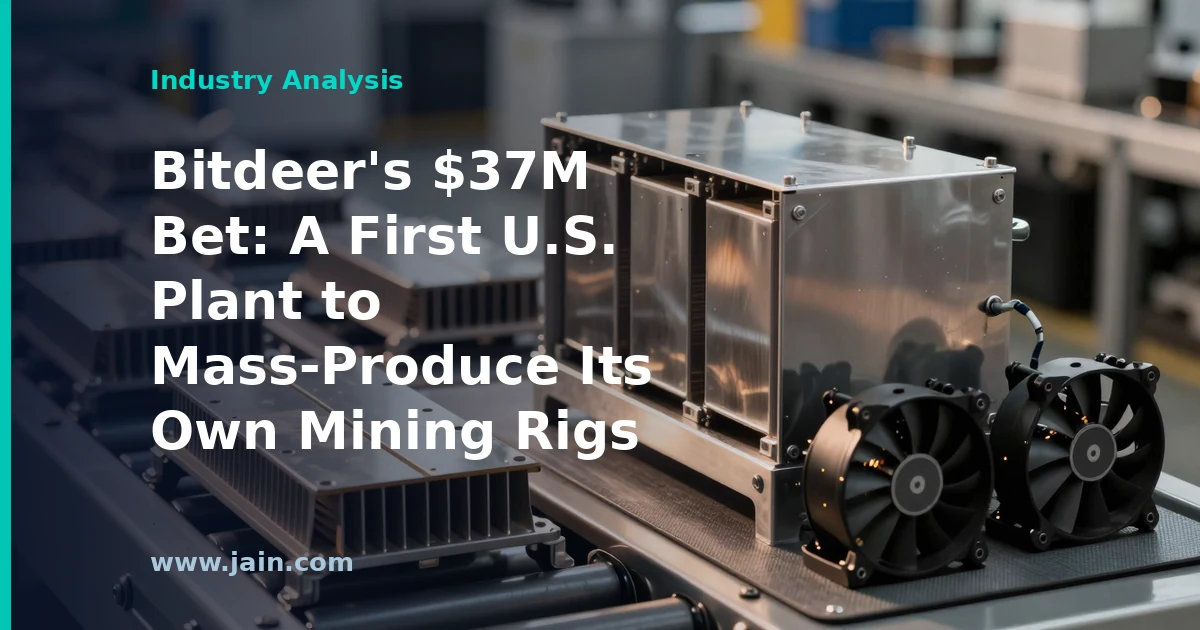
Bitdeer Technologies Group, the Nasdaq-listed bitcoin miner and mining-hardware developer, announced on May 26, 2026 that it will invest approximately $37 million to establish its first manufacturing facility in the United States, dedicated to mass-producing its own proprietary mining machines. The company’s shares rose about 14% on the news.
Executive Summary
The announcement marks a notable step in a trend the mining industry has discussed for years but rarely executed: moving hardware production onto U.S. soil. Bitcoin mining machines — specialized computers built around custom ASIC chips (application-specific integrated circuits designed to do one task, in this case bitcoin’s hashing algorithm, extremely efficiently) — have historically been designed and assembled in China and Southeast Asia. A U.S. plant puts final production of Bitdeer’s rigs inside the same borders as the large American mining fleets that deploy them.
For Bitdeer, which both operates its own mining data centers and develops its SEALMINER line of rigs, the move deepens a vertical-integration strategy: controlling the machine, not just the megawatts. The 14% share-price jump suggests investors read it as strategically meaningful, though at roughly $37 million the commitment is modest by manufacturing standards — a scale worth keeping in perspective when weighing the announcement.
Onshoring the Rig Supply Chain
The economics of bitcoin mining are dominated by two inputs: electricity and machines. U.S. miners have long controlled the first — cheap domestic power — while depending almost entirely on overseas suppliers for the second. That dependence became expensive and unpredictable as U.S. tariff policy toward Chinese-linked electronics hardened, and as shipping, customs, and export-control friction added cost and lead time to every container of rigs. A domestic production line is a direct hedge: machines assembled in the U.S. can reach U.S. deployment sites without crossing the tariff and logistics gauntlet.
It also carries an industrial-policy resonance. Reshoring advanced electronics assembly aligns with the broader U.S. push to localize technology supply chains, which can translate into goodwill with regulators and utilities — intangible but real assets for a company whose core business depends on grid access and permitting.
What $37 Million Buys — and What It Doesn’t
It is worth being precise about scale. Roughly $37 million funds a serious assembly, integration, and testing operation; it does not fund semiconductor fabrication, which requires capital measured in billions. The ASIC chips at the heart of any mining rig will still come from offshore foundries, as they do for the entire industry. What moves onshore is the downstream work: board assembly, enclosures, hashboard integration, quality testing, and logistics. That is genuinely valuable — it shortens delivery times, reduces tariff exposure on finished goods, and improves repair turnaround — but the deepest layer of the supply chain remains abroad.
The headline framing of “mass-producing proprietary machines” is therefore best read as a supply-chain restructuring, not full technological self-sufficiency. Investors and buyers should watch for disclosed production capacity figures to judge how much of Bitdeer’s fleet demand the plant can actually serve.
Vertical Integration as Competitive Strategy
Most large mining operators buy rigs from third-party giants — a market long led by China-linked manufacturers Bitmain and MicroBT. Bitdeer, whose founder previously co-founded Bitmain, is one of the few operators attempting the harder path: designing its own chips and machines while also running the data centers that consume them. If it works, the payoff is structural — capturing the manufacturer’s margin, tuning hardware to its own facilities, and insulating itself from the allocation queues and pricing power of dominant suppliers.
The risk is equally structural. Hardware development is capital-hungry and unforgiving; a rig generation that lags competitors on efficiency (measured in joules per terahash — how much energy it takes to produce a unit of computing work) can strand the investment. A U.S. factory raises the fixed-cost base, which cuts both ways: leverage if demand holds, drag if the bitcoin cycle turns.
Why the Market Cheered
A 14% single-day move on a $37 million investment says the market is pricing the signal, not the sum. The plausible reading: investors see the plant as evidence that Bitdeer’s hardware business is graduating from R&D project to commercial product line, and that the company is positioning for a world where U.S.-made mining and compute hardware commands a premium. It may also reflect optimism that manufacturing capability is transferable — companies with rig-assembly lines and power-rich data centers have optionality toward adjacent high-performance-computing and AI-infrastructure work. That optionality, however, is inference, not commitment; the announcement itself concerns mining machines.
Background
Bitdeer was spun off from Bitmain — the world’s dominant maker of bitcoin mining hardware — and listed on Nasdaq in 2023. Unlike most mining operators, which are pure consumers of third-party machines, Bitdeer runs mining data centers across multiple countries while also developing its own SEALMINER line of rigs, a vertical-integration strategy few in the industry have attempted.
The move lands amid a broader realignment of technology supply chains: U.S. tariff policy and export-control friction have made imported electronics costlier and less predictable, pushing companies across the compute-hardware spectrum to localize final assembly. Mining hardware, long an almost entirely Asia-manufactured category, has been among the most exposed.
IREN, the publicly traded bitcoin miner repositioning itself as an AI infrastructure company, has closed a $3 billion convertible notes offering, according to a report from The Block dated May 16, 2026. The raise ranks among the largest capital events yet for a company making the miner-to-AI transition.
Convertible notes are debt instruments that can later be exchanged for shares, letting companies borrow at lower interest rates in exchange for potential future dilution. For IREN, the proceeds arrive as the company accelerates its push into AI compute and data center capacity.
Executive Summary
The headline fact is simple: $3 billion in fresh capital, closed, for a company that began life mining bitcoin and now markets itself as an AI infrastructure provider. Capital at that scale is not raised to sustain a mining operation — it is raised to build data centers, buy GPUs, and sign the power and construction commitments that AI compute demands. The offering’s closure, rather than mere announcement, means the money is in hand.
Why it matters: the miner-to-AI pivot has been the dominant strategic story in the bitcoin mining sector for over two years, but most pivots have been announced in press releases rather than financed in capital markets. A closed $3 billion convertible offering is a market verdict of sorts — institutional buyers were willing to lend against IREN’s AI story at convertible terms. It suggests the pivot narrative, at least for the largest and most credible miners, has graduated from concept to bankable strategy.
That said, the report is brief, and the substantive details that determine whether this is cheap or expensive capital — coupon, conversion premium, hedging arrangements, and specific use of proceeds — are not spelled out in the source. Readers should treat the raise as a strong signal of momentum while withholding judgment on its economics.
From Mining Rigs to GPU Halls: Why the Pivot Attracts Capital
Bitcoin miners and AI data center operators need the same scarce ingredients: large blocks of grid power, industrial land, cooling, and the operational muscle to run energy-dense facilities. Miners spent a decade securing exactly those assets, often in power-rich regions where capacity was cheap. When AI demand exploded and grid interconnection queues stretched to five years or more in many markets, energized megawatts became the bottleneck — and miners suddenly held an asset the AI industry desperately wants.
The pivot is not automatic, however. A mining facility is engineered for cheap, interruptible, low-redundancy compute; an AI data center serving enterprise or hyperscale customers typically requires far higher reliability, denser networking, and liquid cooling. Converting one into the other is a genuine construction project, not a rebranding exercise. That is precisely why a raise of this magnitude is the tell: $3 billion is conversion-and-buildout money.
The Economics of Convertible Debt in an AI Land Rush
Convertible notes have become the financing instrument of choice for capital-hungry compute companies. The logic is straightforward: a company with a volatile, high-momentum stock can borrow at a much lower cash interest cost than straight debt would demand, because lenders are partly paid in the option to convert into equity if the stock rises. For shareholders, the trade-off is potential dilution down the road.
For a company straddling bitcoin mining and AI — two of the most volatility-prone narratives in public markets — convertibles are arguably the only large-scale debt market reliably open. Traditional project finance lenders want long-term contracted revenue; a miner mid-pivot often cannot yet show it. The willingness of convertible buyers to absorb $3 billion of IREN paper says the market is pricing meaningful upside into the equity, but it also means the company is, in effect, pre-selling a slice of that upside to fund the buildout.
Winners, Losers, and the Sorting of the Mining Sector
The miner-to-AI transition is sorting the sector into tiers. Companies with large, well-located power portfolios and access to capital markets can finance real conversions; smaller miners without either are left competing in a bitcoin mining business whose economics tighten with every halving — the programmed event that cuts mining rewards roughly every four years. A raise like this one widens that gap: capital compounds, because funded buildouts attract customers, and customer contracts attract cheaper follow-on capital.
For the broader data center industry, well-capitalized former miners are becoming genuine competitors for AI workloads, particularly in the cost-sensitive middle of the market. Incumbent operators retain advantages in reliability track record and enterprise relationships, but the energized-power advantage is real, and $3 billion buys a lot of construction.
What a Closed Raise Does and Does Not Prove
It is worth being precise about what this announcement substantiates. It proves investor appetite: sophisticated buyers committed $3 billion. It does not, by itself, prove customer demand for IREN’s AI capacity, the economics of its contracts, or the timeline on which the capital becomes revenue-generating infrastructure. The AI infrastructure boom has featured both genuinely contracted buildouts and speculative capacity built ahead of demand, and a financing headline cannot distinguish between them. The next meaningful data points will be customer agreements, deployment milestones, and disclosed note terms — not the raise itself.
Background
IREN began as Iris Energy, an Australian-founded bitcoin miner that listed publicly and built a portfolio of power-intensive data center sites, emphasizing access to low-cost and renewable energy. Like much of the mining sector, it faced the structural squeeze of bitcoin’s halving cycle, which periodically cuts mining revenue, just as the generative AI boom created enormous demand for exactly the kind of powered data center capacity miners control.
Over the past two years, the miner-to-AI pivot has become the defining strategic story of the sector, with a handful of large operators securing AI and high-performance computing deals while smaller players remained pure miners. Capital markets have increasingly rewarded the pivot, and large convertible note offerings have become the sector’s signature financing tool for funding GPU purchases and data center conversion at scale.
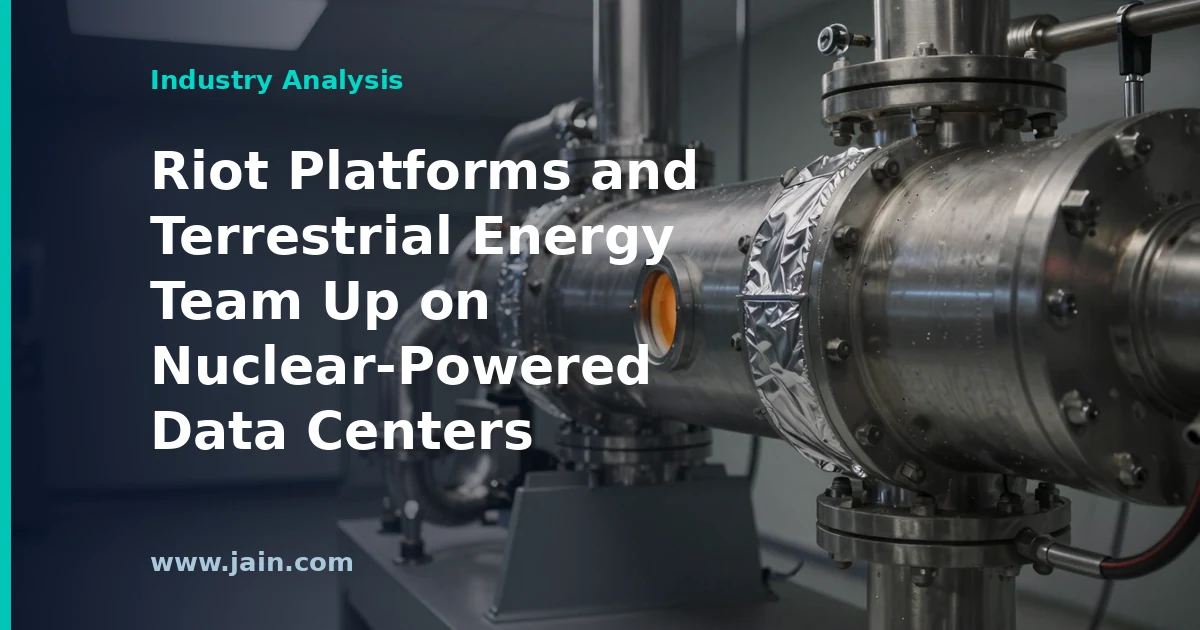
Riot Platforms, one of the largest publicly traded Bitcoin miners in North America, announced on May 5, 2026 a collaboration with advanced-reactor developer Terrestrial Energy to develop nuclear-powered large-scale data center projects. The companies intend to pair Terrestrial Energy’s Integral Molten Salt Reactor (IMSR) technology — a Generation IV design that produces high-temperature heat and electricity — with the kind of gigawatt-class digital infrastructure that AI computing increasingly demands.
The announcement frames the partnership as a development collaboration rather than a completed transaction: no specific sites, capacity figures, financial commitments, or delivery dates were disclosed in the release.
Executive Summary
The announcement matters less for what it commits and more for what it signals. Riot Platforms built its business on Bitcoin mining — an industry whose core competency is acquiring cheap power at enormous scale — and has been publicly repositioning its Texas footprint toward AI and high-performance computing (HPC) tenants, who pay far more per megawatt than mining does. Partnering with a nuclear developer extends that pivot to the supply side of the equation: rather than only competing for scarce grid interconnections, Riot is positioning to help create new firm generation dedicated to its campuses.
Terrestrial Energy, for its part, gains what every advanced-reactor developer needs most: a credible prospective customer with land, transmission access, and an urgent load. Its IMSR is a molten salt reactor — a design that uses liquid fuel dissolved in molten salt rather than solid fuel rods, operating at high temperature and low pressure. Like every small modular reactor (SMR) aimed at the data center market, it has yet to be built commercially, which is the central caveat hanging over this and similar announcements.
For the data center industry, this is another data point in a now-unmistakable trend: the binding constraint on AI infrastructure is no longer chips or capital but firm, around-the-clock power — and operators are reaching further up the energy value chain to secure it.
From Bitcoin Mines to AI Campuses
Bitcoin miners spent a decade solving a problem the AI industry now faces: how to energize hundreds of megawatts of computing quickly and cheaply. Riot’s large Texas operations — including its Rockdale facility and its Corsicana campus, which the company has been evaluating for AI/HPC use — represent exactly the assets hyperscalers and AI cloud providers covet: secured land, existing high-voltage interconnections, and teams experienced in power procurement. That is why miners across the sector have been converting capacity or striking hosting deals with AI tenants, whose revenue per megawatt-hour comfortably exceeds mining economics in most market conditions.
The catch is that AI workloads are far less forgiving than mining. A Bitcoin mine can shut off when power prices spike — Riot has historically earned meaningful revenue from demand-response programs in Texas that pay it to curtail. AI training and inference customers expect the opposite: continuous, high-availability operation. That flips the miner’s ideal power profile from interruptible-and-cheap to firm-and-reliable, which is precisely the niche nuclear generation occupies. Seen through that lens, a nuclear collaboration is the logical endpoint of the AI pivot, not a diversion from it.
Why Molten Salt, and Why Nuclear at All
Data center operators have signed a wave of nuclear arrangements over the past two years — restarts of shuttered plants, power purchase agreements with existing reactors, and development deals with SMR startups — because nuclear is the only carbon-free source that delivers firm baseload power without dependence on weather or long-duration storage. Terrestrial Energy’s IMSR belongs to the Generation IV category: its liquid-fuel, molten-salt design operates at low pressure (reducing certain accident risks associated with conventional pressurized reactors) and at high output temperatures, which improves thermal efficiency and could serve industrial heat applications alongside electricity.
The commercial reality is more sobering. No Generation IV molten salt reactor is in commercial operation today, and the SMR sector as a whole has yet to deliver a grid-connected unit in North America. Licensing pathways through the U.S. Nuclear Regulatory Commission are multi-year undertakings, first-of-a-kind construction costs are notoriously difficult to forecast, and the sector’s most prominent earlier project — NuScale’s Utah plant — was cancelled in 2023 after cost escalation. Any realistic timeline for IMSR-powered data centers extends into the 2030s, while the AI demand driving these deals is being provisioned now.
Reading a Collaboration Agreement Honestly
It is worth being precise about what this announcement is: a collaboration to develop projects, not an order for reactors, a joint venture with committed capital, or a power purchase agreement. In the current market, announcements linking AI data centers to advanced nuclear reliably generate investor enthusiasm for both parties — Riot gets association with the AI-infrastructure narrative beyond mining, and Terrestrial Energy, which came to public markets amid strong investor appetite for nuclear exposure, gets customer validation. None of that makes the collaboration insubstantial, but the distance between a memorandum-style partnership and an energized facility is measured in years, permits, and billions of dollars.
The strategic logic still holds even on a long timeline. If Riot secures AI tenants at Corsicana or elsewhere on grid power in the near term, an eventual on-site or nearby nuclear supply becomes an expansion and hedging story rather than a prerequisite. The risk case is equally clear: if the collaboration produces no siting decisions, filings, or funding milestones over the next several quarters, it will belong to the growing category of AI-era power announcements that signaled intent rather than delivery. Observers should judge it by milestones, not by the press release.
Background
Riot Platforms grew into one of the largest North American Bitcoin miners on the strength of low-cost Texas power, including revenue from grid demand-response programs that pay large loads to curtail during price spikes. As AI demand transformed data center economics, Riot — like peers across the mining sector — began evaluating conversion of its capacity to AI and high-performance computing hosting, where tenants pay substantially more per megawatt than mining yields.
Terrestrial Energy has spent more than a decade developing the IMSR, one of several Generation IV designs competing to commercialize advanced nuclear power. The broader backdrop is a two-year surge of nuclear-data center dealmaking — plant restarts, hyperscaler power purchase agreements, and SMR partnerships — driven by the recognition that firm, carbon-free power has become the scarcest input in AI infrastructure.
Yahoo Finance reported on May 3, 2026 that Riot Platforms (NASDAQ: RIOT), one of the largest publicly traded bitcoin miners in the United States, is deepening its strategic pivot toward artificial-intelligence data centers, anchored by a widened deal with chipmaker AMD. The coverage frames the expanded relationship as a potential reshaping event for RIOT investors.
The report reached us as an aggregated headline without the underlying deal terms, so the scale, structure, and timeline of the expanded AMD arrangement were not specified in the material we reviewed.
Executive Summary
According to the May 2026 Yahoo Finance report, Riot Platforms is widening an existing relationship with AMD as part of a broader repositioning from cryptocurrency mining toward AI and high-performance computing (HPC) infrastructure. For a company whose core asset has long been access to large amounts of cheap electricity in Texas, the move follows a well-worn path: bitcoin miners across the sector have been converting power capacity into AI-grade data center space, where long-term customer contracts can offer steadier revenue than mining’s boom-bust cycles.
Why it matters: the AI build-out is increasingly constrained not by chips but by powered, grid-connected sites — exactly what large miners already control. A deepened tie to AMD, the primary challenger to Nvidia in AI accelerators, would also signal that the second wave of AI capacity is diversifying its silicon. That said, the source material we reviewed is a headline-level report; the substance of the wider deal — its dollar value, capacity commitments, and delivery schedule — is not disclosed in it, and readers should weigh the strategic logic separately from the still-unverified specifics.
Why Bitcoin Miners Keep Becoming AI Landlords
Riot’s reported pivot is the latest instance of the defining infrastructure trade of this cycle: converting bitcoin-mining capacity into AI data centers. The two businesses share one scarce input — large, grid-connected power allocations — but little else. Mining revenue is tied to a volatile bitcoin price and a protocol that halves mining rewards roughly every four years, squeezing margins on a fixed schedule. AI compute, by contrast, is typically sold under multi-year contracts to creditworthy customers, which capital markets value far more richly per megawatt.
Riot is unusually well positioned for this trade on paper. Its Texas footprint, including the very large Corsicana development site, gives it the kind of secured power capacity that AI developers now wait years to obtain through utility interconnection queues. Precedents are instructive: other miners that repositioned toward AI and HPC hosting saw substantial re-ratings of their stock. But precedent also shows the conversion is neither fast nor cheap — AI halls demand denser power delivery, liquid or advanced cooling, and far higher reliability standards than mining sheds.
What a Wider AMD Deal Would Signal
The AMD element is the distinctive part of the headline. Most AI data center announcements orbit Nvidia, whose GPUs dominate AI training. AMD’s Instinct accelerator line is the leading alternative, and hyperscalers have been actively cultivating it to diversify supply and pressure pricing. A miner-turned-data-center operator aligning with AMD suggests the challenger ecosystem is reaching down from hyperscalers into the emerging tier of independent AI infrastructure providers.
For Riot, an AMD alignment could cut both ways. It may offer better chip availability and economics than fighting for Nvidia allocation, and a strategic partner with an incentive to see AMD-based capacity succeed. The risk is that customer demand today still skews heavily toward Nvidia’s software ecosystem, so AMD-based capacity must find tenants willing to run on that stack. Because the reporting we reviewed does not describe the deal’s structure — chip purchases, a hosting arrangement, or something more strategic — the strength of this signal remains an open question rather than an established fact.
The Investor Lens: Re-Rating Potential Versus Execution Risk
The Yahoo Finance framing — how the pivot “may reshape” RIOT investors — reflects the market’s central question for every converting miner: does the company get valued like a data center operator or like a bitcoin proxy? Data center REITs and AI-cloud providers trade on contracted, recurring revenue; miners trade largely on bitcoin sentiment. Successful conversions can shift a company from one valuation regime to the other.
Execution is the gap between those regimes. Converting sites requires billions in capital expenditure, and miners must fund it from mining cash flows, equity issuance, or debt — each with costs to existing shareholders. Landing anchor tenants is the true validation milestone; announced chip partnerships, however wide, are inputs rather than revenue. Until Riot discloses signed AI customers, contracted capacity, and financing, the pivot remains a credible strategy with material execution risk, not a completed transformation.
Background
Riot Platforms grew out of the 2017 crypto boom, when Riot Blockchain rebranded from a biotech company to pursue bitcoin mining, and it scaled into one of North America’s largest miners with major Texas operations. Bitcoin mining economics are structurally punishing: the network’s reward halves roughly every four years, most recently in April 2024, forcing miners to find new revenue per megawatt or consolidate. That pressure, colliding with the post-2022 explosion in AI compute demand, created the miner-to-AI-data-center conversion trend now reshaping the sector.
By the mid-2020s, powered land — sites with secured grid interconnection — had become the binding constraint on AI infrastructure, with new utility connections taking years. Miners holding hundreds of megawatts of capacity became natural acquisition targets and conversion candidates, and several signed landmark AI hosting deals. Riot’s reported widening of an AMD relationship in May 2026 places it squarely in that migration, on the less-traveled AMD side of a GPU market still dominated by Nvidia.
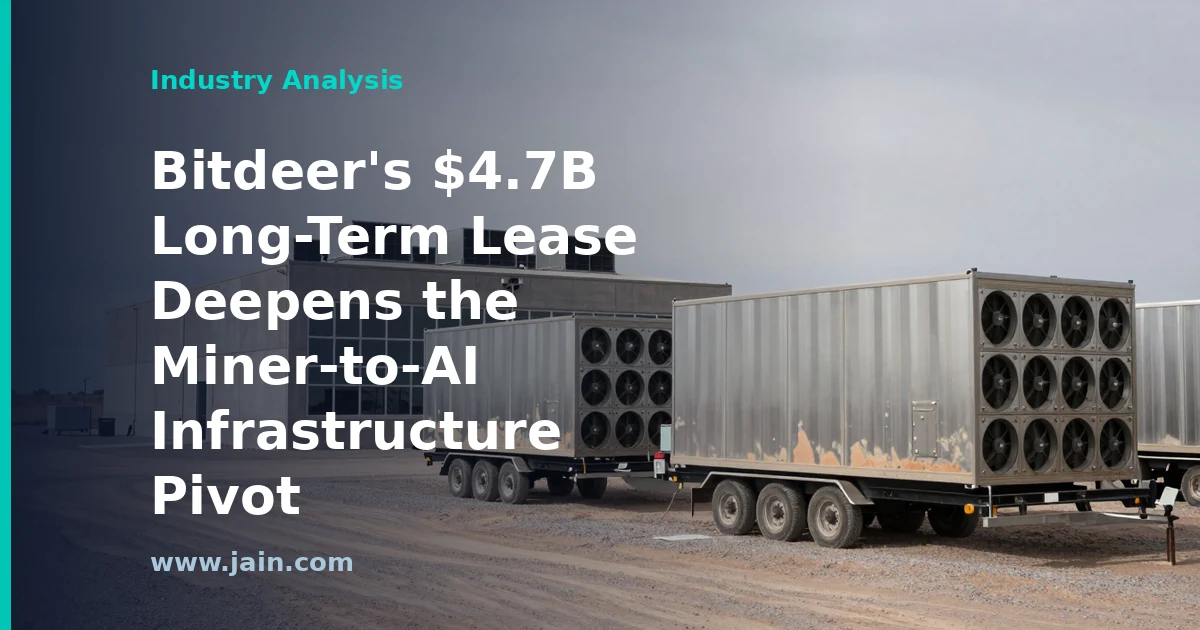
Bitdeer Technologies, the Nasdaq-listed bitcoin mining and digital infrastructure company, has entered a long-term data center lease valued at $4.7 billion, according to a report published April 30, 2026. The company frames the agreement as an expansion of its artificial intelligence infrastructure business — one of the largest single capacity commitments yet disclosed in the ongoing migration of crypto-mining operators into the AI data center market.
Executive Summary
The announcement, carried via TradingView, is short on operational detail but large in headline value: $4.7 billion committed under a long-term lease structure tied to AI infrastructure. Long-term leases — multi-year contracts in which one party commits to pay for data center capacity over the life of the agreement — are the currency of the AI buildout, because they convert speculative capacity into bankable, contracted cash flows that lenders and investors can underwrite.
For Bitdeer, a company built on bitcoin mining, a commitment of this scale matters because it shifts the company’s center of gravity. Mining revenue is volatile, tied to bitcoin’s price and network difficulty. AI infrastructure leases, by contrast, resemble traditional data center economics: contracted terms, identifiable counterparties, and revenue visibility measured in years rather than block rewards. A $4.7 billion figure, if executed as described, would place Bitdeer among the more consequential converts in the miner-to-AI transition.
From Bitcoin Mines to AI Campuses
Bitdeer’s move follows a pattern that has reshaped the crypto-mining sector: companies that spent years assembling large-scale power access and industrial sites for bitcoin mining are repurposing those assets for AI computing. The logic is straightforward. The scarcest input in AI infrastructure today is not chips but energized, grid-connected capacity — sites where hundreds of megawatts of power are already secured and permitted. Bitcoin miners happen to own exactly that.
Several large miners have already signed multi-billion-dollar, multi-year agreements to host AI and high-performance computing workloads, and the market has generally rewarded those pivots with valuations closer to data center operators than to commodity miners. A $4.7 billion long-term lease would signal that Bitdeer intends to compete in that same lane, not merely experiment at the edges of it.
Why Long-Term Leases Are the Deal Structure of the AI Buildout
A long-term lease does two things at once. For the capacity provider, it converts an industrial asset into a stream of contracted revenue that can support debt financing — critical, because retrofitting mining sites into AI-grade facilities is capital intensive, requiring denser power delivery, liquid or advanced air cooling, and far more resilient electrical infrastructure than mining rigs need. For the capacity buyer, it locks up scarce power and space ahead of competitors in a market where lead times for new grid connections can run to years.
The headline number deserves careful reading, however. In deals of this type, the quoted value typically represents total contract value across the full lease term, not annual revenue or an upfront payment. Without the term length disclosed, $4.7 billion could imply very different annual economics — a distinction that matters enormously for assessing the deal’s true weight.
The Real Asset Is Power
Whichever side of the lease Bitdeer occupies, the transaction underscores that access to electricity has become the defining constraint of the AI era. Utilities across major markets face multi-year interconnection queues, and hyperscalers and AI cloud providers have shown they will pay premium, long-duration commitments to secure energized capacity now rather than wait for new construction. Companies holding large existing power allocations — a category that prominently includes bitcoin miners — have found themselves holding strategic real estate.
That dynamic cuts both ways. The premium on power access exists precisely because supply is constrained; as utilities and developers bring new capacity online over the coming years, the scarcity value embedded in today’s deals could compress. Long-term contracts signed at the peak of scarcity may look either prescient or expensive in hindsight, depending on which side of the lease one sits.
Execution and Concentration Risks
The risks in miner-to-AI conversions are well documented across the sector. Retrofitting facilities to AI specifications routinely runs over budget and behind schedule, because AI workloads demand redundancy, cooling density, and network architecture that mining sites were never designed for. Counterparty concentration is the second concern: many of these long-term leases depend on a single tenant or customer, so the credit quality and durability of that counterparty effectively determines the value of the contract.
For a company in transition, there is also a strategic tension. Capital and management attention committed to AI infrastructure is capital not deployed in mining — and if the AI buildout slows or the counterparty falters, the company has repositioned itself around a contract rather than an operating business. None of this makes the deal unwise; it makes the undisclosed details decisive.
Background
Bitdeer Technologies emerged from the bitcoin mining industry’s consolidation around large-scale, professionally operated data centers. Spun off from mining-hardware giant Bitmain in 2021 and founded by Bitmain co-founder Jihan Wu, the company listed on Nasdaq in 2023 and built its business on three legs: mining bitcoin for its own account, hosting other miners’ machines, and selling cloud-based hash power. It operates industrial-scale facilities across multiple continents and has invested in developing its own mining chips.
The broader market context is the collision of two trends: bitcoin mining’s thinning margins after successive halvings, and explosive demand for AI computing capacity that has outrun the electric grid’s ability to serve it. That collision has turned miners’ power portfolios into strategic assets and produced a wave of multi-billion-dollar agreements converting mining sites into AI infrastructure — the wave this lease places Bitdeer squarely within.
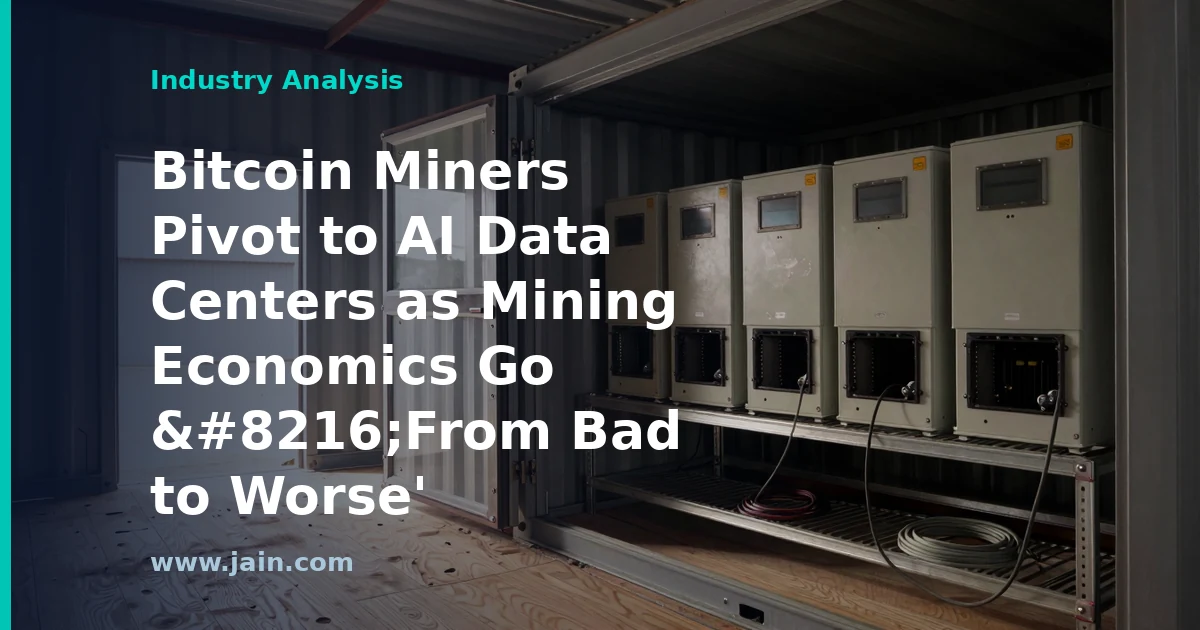
Sherwood News reports that bitcoin mining economics “have gone from bad to worse,” and that mining companies are responding by pivoting their businesses — or selling assets outright — to survive. According to the report, publicly traded miners on investor watchlists, including names such as Riot Platforms and Hut 8, are redirecting attention from pure hashrate growth toward converting their power-rich sites into AI data-center capacity.
The story, published April 29, 2026, frames the shift not as opportunistic diversification but as a survival response: when the core business of minting bitcoin no longer covers its costs for many operators, the land, power contracts, and electrical infrastructure miners control become more valuable serving artificial-intelligence workloads than mining rigs.
Executive Summary
The announcement here is really a diagnosis: the economics of industrial-scale bitcoin mining have deteriorated to the point that pivoting and selling are now mainstream strategies, not edge cases. Bitcoin mining profitability is a squeeze between three variables — the price of bitcoin, the total computing power competing on the network (which rises relentlessly), and the cost of electricity. When the spread between what a miner earns per unit of computing power and what it pays for energy compresses, weaker operators run out of room. Sherwood’s reporting says that spread has kept compressing.
Why it matters to the infrastructure industry: bitcoin miners collectively control one of the scarcest assets in technology today — large blocks of grid-connected power with substations, transformers, and cooling already in place. AI data-center developers routinely wait years for utility interconnections. A distressed miner with hundreds of megawatts energized is, from an AI developer’s perspective, a shortcut through the single longest item on the construction schedule. That is why the pivot is happening, and why acquirers are circling the sellers.
The unresolved question is execution. A mining shed and an AI data center share a power feed and little else. Whether watchlist miners can finance and deliver true high-density AI facilities — or whether they simply become land-and-power sellers to better-capitalized buyers — will separate the survivors from the exits.
Why Mining Economics Keep Getting Worse
Bitcoin’s protocol is deliberately unforgiving. Roughly every four years, a “halving” cuts the new-coin reward miners receive in half, mechanically slashing industry revenue per unit of work unless the bitcoin price doubles to compensate. Meanwhile, network hashrate — the total computing power competing for those rewards — tends to grow as new, more efficient machines come online, which dilutes every incumbent’s share. The result is a treadmill that speeds up on a schedule: costs are largely fixed in electricity and debt service, while revenue per terahash structurally declines.
Sherwood’s “bad to worse” framing captures the position of miners caught between those forces without a low-cost energy advantage. In commodity industries — and bitcoin mining is one, producing an identical product where the only durable edge is cost — deteriorating unit economics do not punish everyone equally. They sort the industry into low-cost survivors, distressed sellers, and pivots. The report indicates all three categories are now visible.
The Real Asset Was Always the Power
The pivot toward AI data centers rests on a simple arbitrage. AI training and inference facilities need enormous amounts of electricity delivered through utility-scale interconnections — agreements with grid operators that can take years to secure. Bitcoin miners spent the last cycle acquiring exactly those assets, often in power-rich regions, because cheap electricity was their business model. A miner’s site with an energized substation can be worth more as an AI campus shell than it ever earned mining.
But the conversion is not cosmetic. Mining facilities are typically air-cooled warehouses running hardware that tolerates heat and interruption; AI data centers demand dense power distribution, liquid or precision cooling, redundant systems, and uptime guarantees written into contracts. The capital cost per megawatt of a genuine AI facility is a large multiple of a mining build-out. That gap is precisely why some miners pivot while others sell: the pivot requires capital and data-center operating credibility that a distressed balance sheet may not support.
Winners, Losers, and the Middle
The likely winners are miners holding large, well-located power positions and enough financial flexibility to either fund conversions or strike partnerships with hyperscalers and AI cloud providers on favorable terms. Buyers of distressed sites also win: acquiring energized capacity is faster than greenfield development. Utilities and communities hosting these sites may see steadier, longer-term tenants, since AI facilities sign multi-year commitments in a way price-sensitive mining loads generally do not.
The losers are miners with small sites, expensive power, or leveraged balance sheets — operators whose assets are not distinctive enough to attract AI tenants and whose mining margins no longer cover obligations. For them, “pivot or sell” can shade into “sell at whatever the market offers.” Investors should also note a subtler risk in the middle: a miner that announces an AI strategy has not yet built one. The industry has an incentive to rebrand faster than it can execute, and the market has at times rewarded the announcement before the revenue.
What This Means for the Broader Data-Center Market
Every mining megawatt that converts to AI use adds supply to a data-center market defined by power scarcity — but not always where AI customers most want it. Mining sites were chosen for cheap power, not proximity to network hubs or enterprise demand, so converted capacity will suit some workloads (large-scale training, which tolerates remote locations) better than others (latency-sensitive inference near population centers). The pivot wave is therefore additive to AI infrastructure supply, but selectively so.
It also serves as a market signal. When an entire adjacent industry concludes its power portfolio earns more serving AI than its original purpose, it confirms how deep the demand for energized capacity runs. The countervailing question — one worth asking of the AI build-out with the same rigor applied to mining — is what happens to converted sites if AI infrastructure demand ever cools. Assets that have been repurposed once can be repurposed again, but the capital sunk into the conversion cannot.
Background
Industrial bitcoin mining grew through the early 2020s into a public-company sector, with operators such as Riot Platforms and Hut 8 raising capital to build warehouse-scale facilities wherever electricity was cheap — Texas, the U.S. Midwest, Canada, and beyond. The business model was a leveraged bet on bitcoin’s price against relentlessly rising network competition and scheduled halvings that cut mining rewards in half roughly every four years, most recently in April 2024.
As generative AI ignited unprecedented demand for grid-connected data-center capacity, the industry discovered that miners’ real strategic asset was their power portfolios rather than their mining machines. Core Scientific’s high-profile agreements to host AI computing marked an early template, and by 2026 the question facing much of the sector had become not whether to engage with AI infrastructure, but whether each miner would be a converter, a landlord, or a seller.