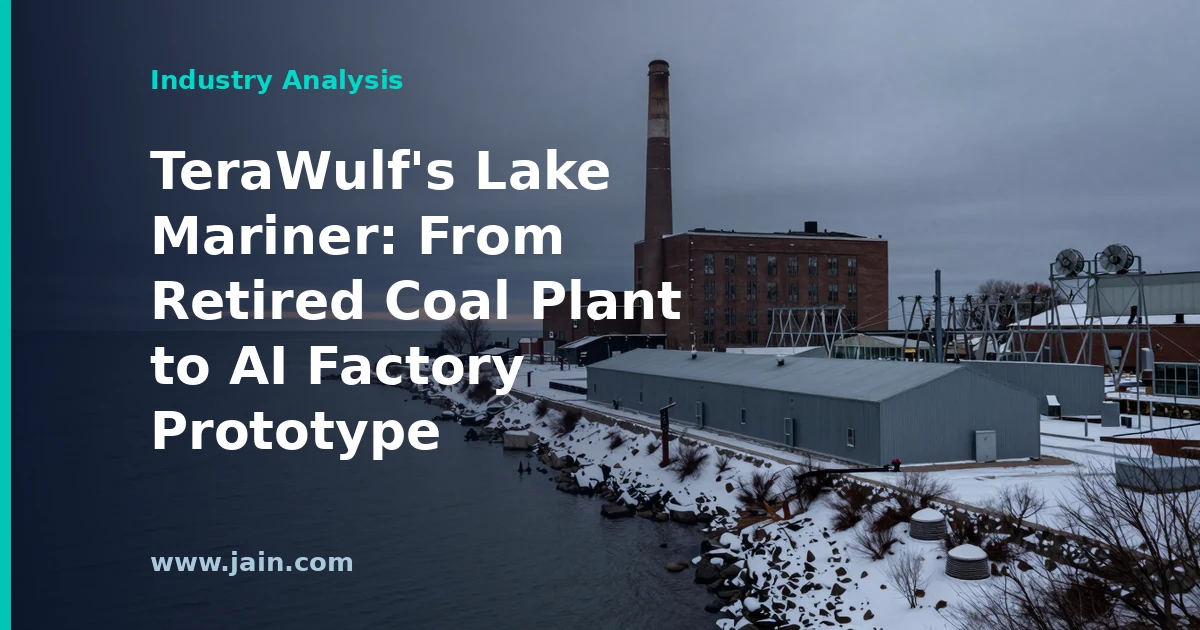
Data Center Frontier profiled TeraWulf’s Lake Mariner campus in Barker, New York, in a May 25, 2026 feature framing the site as a prototype for the “AI factory” — a large-scale data center purpose-built for artificial-intelligence computing. The campus occupies the site of the retired Somerset coal-fired power plant on the shore of Lake Ontario, and the piece traces how TeraWulf, a company that began as a bitcoin miner, has been converting that inherited industrial infrastructure into high-performance computing capacity.
Executive Summary
The core story is one of conversion twice over: a coal plant site converted to digital infrastructure, and a cryptocurrency-mining operator converting itself into an AI-infrastructure landlord. Lake Mariner’s appeal rests on assets that are nearly impossible to recreate quickly — an existing high-capacity grid interconnection built for a power station, access to abundant water for cooling, zoned industrial land, and a regional grid in upstate New York that draws heavily on zero-carbon hydroelectric generation.
Why it matters: the binding constraint on AI data center construction has shifted from chips to power. Utilities in major markets are quoting multi-year waits for large new grid connections, so sites that already have them — like retired thermal power plants — jump the queue. If Lake Mariner works as a template, the industry gains a playbook for turning stranded fossil-fuel assets into AI campuses, with meaningful implications for former coal communities, grid planners, and the competitive map of the data center industry.
The Interconnection Is the Asset
A modern AI campus can require as much electricity as a small city, and the slowest step in delivering it is usually not construction but the grid interconnection — the physical and contractual link that lets a facility draw power from the transmission system. New requests in constrained markets can sit in utility study queues for years. A retired power plant inverts that problem: the wires, switchyard, and transmission rights were built to push hundreds of megawatts out, and much of that capacity can be repurposed to pull power in.
That is the essence of the Lake Mariner thesis. TeraWulf did not have to win a greenfield site fight; it inherited the Somerset plant’s industrial footprint and grid position. The same logic explains a broader industry pattern — operators across the market have been scouting retired or retiring thermal plants precisely because the interconnection, land, and water rights are already in place. In that sense the “prototype” label is apt: the question the site tests is whether coal-to-compute conversion can be repeated at scale, not whether it can be done once.
From Bitcoin Mine to AI Landlord
TeraWulf built Lake Mariner as a bitcoin mining facility, and that history matters more than it might appear. Bitcoin mining taught the company to energize large amounts of power-dense compute quickly and cheaply — but mining revenue is volatile, tied to cryptocurrency prices and periodic “halving” events that cut miner rewards. High-performance computing (HPC) hosting for AI customers offers something mining never could: multi-year contracted revenue from creditworthy counterparties, which is the kind of cash flow lenders and infrastructure investors will finance.
The catch is that the two businesses are less similar than the shared electrical infrastructure suggests. AI training clusters demand far higher reliability, denser cooling — increasingly liquid cooling delivered directly to the chips — and enterprise-grade operations that mining sheds never needed. The conversion is therefore a genuine re-engineering exercise, not a tenant swap, and execution on that transition is the fair test by which TeraWulf and its bitcoin-miner peers should be judged.
The Zero-Carbon Power Angle
Upstate New York’s grid is unusually clean by U.S. standards, anchored by large-scale hydroelectric generation. For AI customers under pressure to report the carbon footprint of their computing, siting workloads on a predominantly zero-carbon grid is a marketable advantage — and there is a certain narrative symmetry in AI compute replacing coal combustion on the same acreage.
The claim deserves precision, though. A clean regional grid is not the same as dedicated clean power, and every large new load consumes headroom that grid planners had earmarked for other purposes. The substantive questions for any site making a sustainability case are how the incremental demand is matched with generation, and what the facility’s water and community impacts look like — questions that apply to Lake Mariner exactly as they apply to every competing campus.
Winners, Losers, and the Watchlist Question
If the coal-to-AI conversion model scales, the winners include former plant communities that regain a tax base and jobs, utilities that get to reuse stranded transmission assets, and early movers holding converted sites when capacity is scarce. The pressure lands on operators pursuing greenfield builds in queue-constrained markets, who must wait for infrastructure that conversion players already own.
For investors treating TeraWulf as a watchlist company, the prototype framing cuts both ways. It signals genuine strategic differentiation — but prototypes, by definition, have not yet proven repeatability. The durable questions are contract quality (who the tenants are and for how long), financing cost for the heavy capital expenditure AI-grade buildings require, and whether the company can operate to the uptime standards hyperscale customers demand. A compelling site thesis is necessary but not sufficient.
Background
TeraWulf was founded to mine bitcoin using predominantly zero-carbon energy and developed Lake Mariner on the grounds of the retired Somerset coal plant in Barker, New York, drawing on the region’s hydro-heavy grid. As demand for AI computing surged and power became the industry’s binding constraint, TeraWulf — like several other large miners — began redeveloping its energized sites for high-performance computing tenants, betting that its grid position would be worth more serving AI than mining cryptocurrency.
The broader market context is a structural shortage of grid-connected capacity: AI’s growth has pushed utilities in major data center markets to years-long interconnection queues, elevating any site with existing power infrastructure — especially former power plants — into strategic real estate.
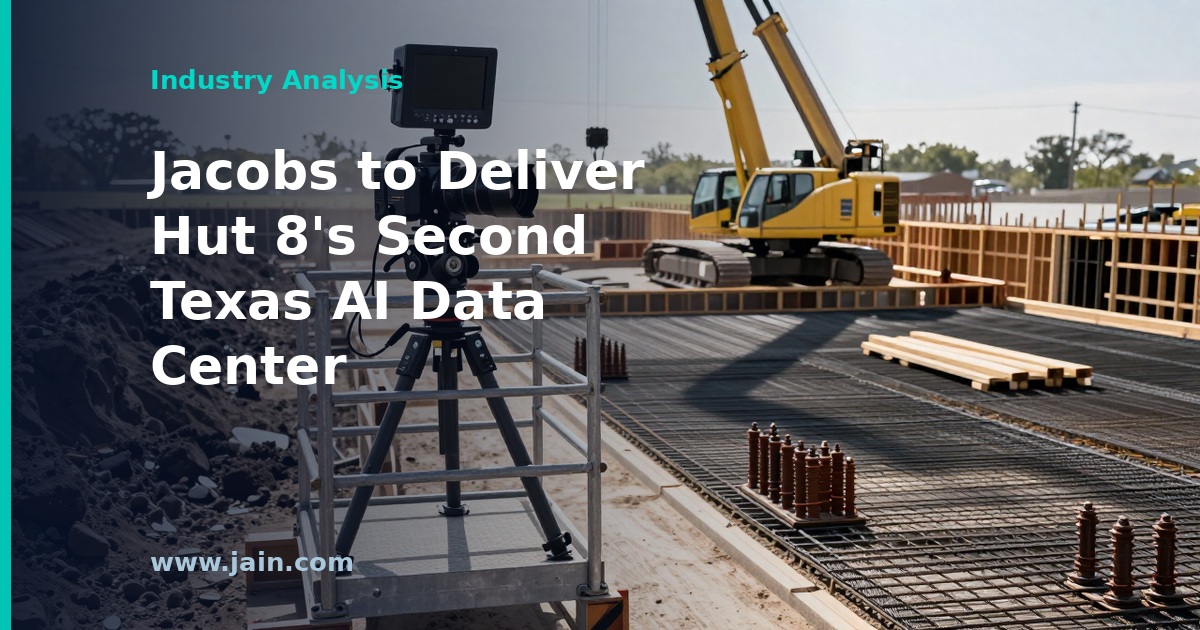
Jacobs, the Dallas-headquartered engineering and professional services firm, said on 13 May 2026 that it has been awarded an engineering, procurement and construction management (EPCM) contract to deliver a second artificial-intelligence data center in Texas for Hut 8, the US-listed digital infrastructure and bitcoin mining company.
The announcement identifies the parties, the delivery model and the state. It does not, in the material available, disclose the site, the power capacity, the contract value, the construction schedule or the end customer for the completed facility.
Executive Summary
The award is short on numbers but clear on direction. Hut 8 has spent the past two years repositioning from bitcoin mining toward data centers built for AI and high-performance computing workloads, and it is now hiring a tier-one engineering house to manage delivery rather than assembling that capability entirely in-house. That it is the second such Texas project for the same pairing suggests the first engagement produced a working relationship worth repeating.
EPCM is the operative detail. Under this model, Jacobs designs the facility, runs procurement and manages the contractors who physically build it — but does not self-perform the construction or, typically, wrap the whole job in a fixed lump-sum price. The owner keeps more cost risk and more control; the engineer supplies the discipline, drawings and supply-chain leverage. Choosing EPCM tells you Hut 8 wants speed and flexibility on a design that is still evolving, and is willing to carry risk to get it.
The broader read: in the current AI buildout, megawatts and land are necessary but no longer sufficient. Skilled engineering, procurement slots for electrical gear and construction management bandwidth have become the scarce inputs. Hut 8 is buying those, and that is the story.
EPCM Is the Tell: Hut 8 Is Buying Delivery Capacity
Companies choose a contracting model the way they choose a mortgage: it reveals what they are optimising for. A lump-sum turnkey EPC contract transfers schedule and cost risk to the contractor, which prices that risk in and, in return, resists design changes. EPCM does the opposite. The engineering firm acts as the owner’s agent — producing the design, letting trade packages, sequencing the site — while the owner signs the trade contracts and absorbs the variance. It is faster to start, easier to change mid-flight, and less forgiving if the owner’s own governance is weak.
For an AI data center in 2026, that trade is defensible. Rack densities, liquid-cooling choices and even the identity of the eventual tenant frequently change between groundbreaking and energisation. Freezing a design early enough to price it as a lump sum can cost more than the risk it transfers. Hut 8 appears to be betting that a well-run EPCM structure, with Jacobs supplying the process rigour, beats paying a contractor’s contingency for certainty it may not want.
The implicit admission is also worth naming: a company of Hut 8’s size does not have hundreds of data center engineers on payroll, and building that bench organically would take longer than the market window allows. Renting it from Jacobs is the rational move, but it makes the relationship a dependency rather than an asset on the balance sheet.
The Miner-to-AI Pivot Meets a Different Class of Building
Bitcoin mining halls and AI training halls look superficially alike — big sheds, big substations — and that resemblance has powered a wave of miner repositioning stories. The engineering reality is less flattering to the analogy. A mining facility tolerates interruption, runs air-cooled hardware that is cheap to replace, and can be built to modest redundancy because downtime costs only forgone revenue. A facility hosting accelerated computing for a creditworthy tenant must meet contractual uptime, support liquid cooling loops, and satisfy the tenant’s own commissioning regime before a single invoice is issued.
That gap in standards is precisely why an EPCM award matters more than another megawatt announcement. Converting a mining land-and-power position into a leasable AI facility requires design documentation, factory witness testing, commissioning scripts and as-built records that enterprise and hyperscale customers will audit. Hiring an established engineering firm is how a former miner acquires that credibility quickly — and it is a signal counterparties can price.
The caveat is that the announcement, as available, does not say what the finished building will be certified to, who will occupy it, or whether it is contracted. Engineering pedigree improves the odds of a bankable outcome; it does not by itself create one.
Texas, Again — And Why Repetition Is the Point
Texas remains the centre of gravity for large-load computing in the United States for reasons that have not changed: abundant land, an interconnection process on the ERCOT grid that has historically moved faster than neighbouring markets, a deep industrial construction labour pool, and a policy environment friendly to large electricity consumers. It also concentrates risk — grid stress in extreme weather, growing scrutiny of large flexible loads, and competition for the same substations and transformers from every other developer in the state.
Doing a second project in the same state with the same engineer is where the economics improve. Repeat delivery lets both sides reuse a reference design, keep the same commissioning agents, negotiate the same equipment vendors and avoid re-learning a permitting jurisdiction. In an environment where long-lead electrical gear — switchgear, transformers, generators — is the schedule driver, a standing relationship that holds order slots is worth real months. If Hut 8 is building a repeatable template rather than a series of bespoke sites, unit costs and delivery times should both improve.
Who Gains, and What Could Still Go Wrong
Jacobs is the clearer near-term winner. Engineering firms have watched the AI buildout push demand toward advanced-facility work, and repeat EPCM mandates provide the kind of recurring, lower-capital-intensity revenue that public markets reward. For Hut 8, the benefit is optionality: an execution partner it can scale with, without the fixed cost of an in-house delivery organisation. The losers, if any, are the smaller regional design-build firms that served the mining era and are being displaced as the customer’s standards rise.
The risks are ordinary and real. EPCM leaves cost and schedule exposure with the owner, so escalation in electrical equipment or labour lands on Hut 8’s accounts, not the engineer’s. Power interconnection timing sits outside both parties’ control. And the commercial question — whether this capacity is pre-leased or built speculatively into a market where a great deal of AI capacity is being announced at once — is the one that determines whether the engineering award is the start of a contracted revenue stream or an investment in inventory.
Read plainly, the announcement substantiates one thing well: Hut 8 has secured serious engineering management for a second Texas project, and Jacobs judged the work worth taking. It substantiates nothing about size, cost, timing or demand. Both statements can be true at once, and readers should hold them together.
Background
Hut 8 emerged from the bitcoin mining industry, where operators built large, power-hungry computing halls next to cheap electricity. When demand for AI computing accelerated, several miners discovered their most valuable assets were not the machines but the land, substations and grid interconnection rights beneath them — and began repositioning as data center developers. The transition is harder than it looks, because AI tenants require reliability, cooling and documentation standards that mining facilities were never designed to meet.
Jacobs sits on the other side of that gap. A long-established engineering and professional services firm, it delivers complex technical facilities for clients that expect formal design, procurement discipline and construction oversight. Engagements like this one are the connective tissue of the current buildout: capital and power positions on one side, engineering and delivery capability on the other, with EPCM contracts as the mechanism joining them.
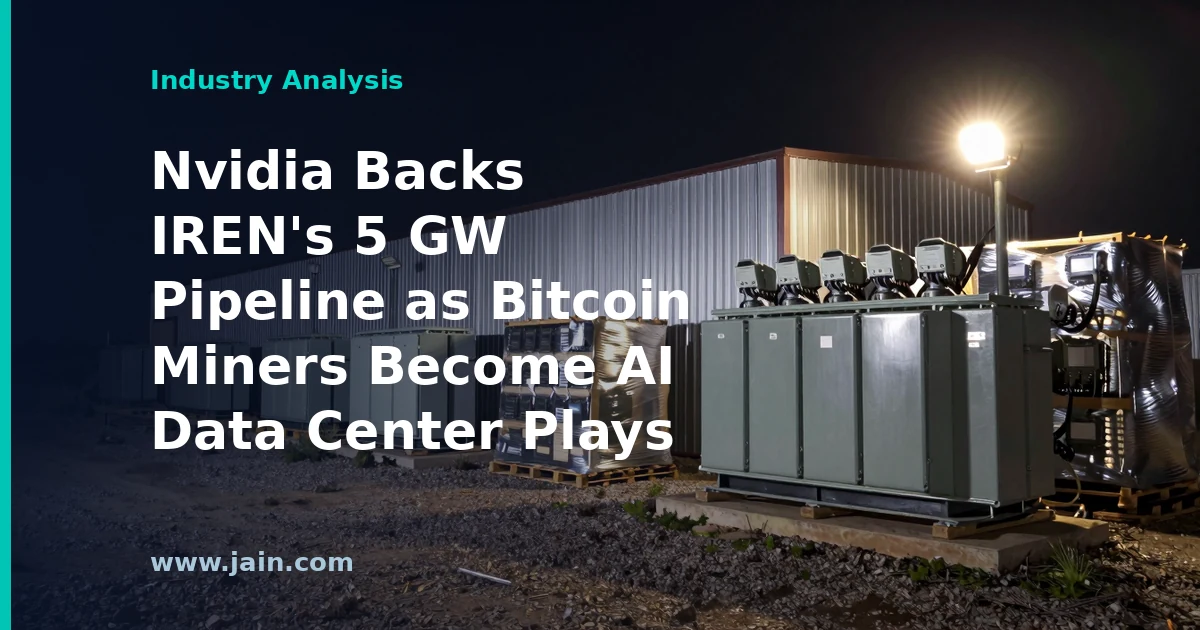
Nvidia is placing what Data Center Knowledge describes as a massive AI infrastructure bet on IREN, the Nasdaq-listed data center operator formerly known as Iris Energy, and its roughly 5 gigawatt (GW) power pipeline. IREN began life as a renewable-powered bitcoin miner and has been repositioning its sites for AI computing.
The report, published May 8, 2026, frames the move as part of a broader pattern: the world’s dominant AI chip maker is increasingly underwriting former cryptocurrency miners as vehicles for deploying its GPUs at scale.
Executive Summary
The significance here is less about any single transaction and more about what Nvidia’s endorsement confers. In today’s AI buildout, the binding constraint is no longer chips — it is energized land: sites with grid interconnection agreements, substations, and megawatts ready to draw. Bitcoin miners spent years accumulating exactly that, and IREN’s claimed 5 GW pipeline is among the largest such positions held by any former miner.
Nvidia backing a partner is a well-established playbook — the company took an equity stake in GPU cloud provider CoreWeave, itself a former Ethereum miner, before CoreWeave’s rise to prominence. Support from Nvidia typically signals preferential access to scarce GPU allocations, which in turn helps a company raise capital and sign customers. For IREN, that halo could be worth as much as any cash involved.
A caveat readers should hold onto: the available source material is a headline-level report, and it does not spell out the structure of Nvidia’s commitment — whether equity, chip supply priority, purchase commitments, or some combination. We flag what is and is not substantiated throughout.
Why Nvidia Underwrites Its Own Customers
Nvidia sells the picks and shovels of the AI gold rush, but picks are useless without mines — physical data centers with power, cooling, and fiber. By backing infrastructure operators, Nvidia expands the universe of buyers who can actually deploy its chips, diversifies demand beyond a handful of hyperscale cloud providers (Microsoft, Amazon, Google), and gains negotiating leverage against those same hyperscalers, who are all designing in-house AI silicon.
The strategy has precedent and critics alike. Supporting CoreWeave paid off handsomely. But analysts have raised fair questions about circularity when a chip vendor’s investment flows back to it as chip purchases: revenue is real, yet the demand signal is partly self-generated. Without the deal terms disclosed, one cannot say how much of that concern applies here — which is precisely why the terms matter.
Power Is the Moat: The Logic of the Bitcoin-to-AI Pivot
A gigawatt is roughly the output of a large nuclear reactor; 5 GW is enough electricity for several million homes. Grid interconnection queues in the United States now routinely run five years or more, so a company holding approved connections and built substations owns something money cannot quickly buy. That is the asset bitcoin miners stumbled into: they built low-cost, high-density power infrastructure when nobody else wanted it.
The pivot is not trivial, however. Bitcoin mining tolerates cheap, interruptible power and minimal redundancy; AI training and inference customers demand high uptime, liquid cooling for dense GPU racks, and enterprise-grade networking. Converting a mining site into an AI-grade facility means substantial re-engineering and capital — typically an order of magnitude more per megawatt than the original mining buildout. IREN, which runs sites on renewable-heavy grids in Texas and British Columbia, has been investing in exactly this conversion, but the pace and cost of that transition are where execution risk lives.
Reading the 5 GW Number Carefully
“Pipeline” is a term of art in data center development, and it deserves scrutiny wherever it appears — from IREN or any competitor. A pipeline typically blends operating capacity, sites under construction, and land with power applications in varying stages of approval. The operating fraction is usually a small share of the headline figure. The report does not break down how much of IREN’s 5 GW is energized today versus contracted, queued, or aspirational.
That distinction determines the economics. Energized megawatts can generate AI revenue within quarters; queued megawatts may be years and billions of dollars away. Nvidia’s backing suggests the company has seen enough to be confident, but investors should want the same breakdown Nvidia presumably received: megawatts by status, by site, and by expected energization date.
Winners, Losers, and the Competitive Ripple
If Nvidia’s model of anointing power-rich partners continues, the winners are miners with large, well-located, transferable power portfolios — and the electricity-rich regions that host them. Traditional data center developers, who must start interconnection processes from scratch, face a compressed timeline disadvantage. Hyperscalers gain another supply option but also another Nvidia-aligned competitor for the same GPUs.
The losers may be smaller miners without convertible assets, and potentially the bitcoin-mining business lines themselves, as boards conclude AI hosting offers steadier, contract-backed returns than volatile block rewards. For enterprise buyers of AI compute, more supply entering the market from converted mining sites should, over time, ease pricing and availability — assuming these conversions deliver true data-center-grade reliability.
Background
IREN was founded in 2018 as Iris Energy and listed on Nasdaq in 2021 as a renewable-powered bitcoin miner, later rebranding as IREN to reflect a broader data center ambition. Like several large miners, it responded to the post-2022 AI boom by redirecting its power-rich sites toward GPU computing, buying Nvidia hardware and marketing AI cloud services alongside its mining business.
The backdrop is an industry-wide land rush: AI demand has outstripped the electric grid’s ability to connect new data centers, turning companies with secured megawatts into acquisition and partnership targets. Nvidia, whose GPUs power most AI training, has repeatedly used investments and partnerships — most famously with CoreWeave — to cultivate infrastructure partners beyond the major cloud providers.