Tag: Bitcoin Mining Conversion

  • HIVE’s $350M AI Cloud Deal Is Twice Its GPU Run-Rate — Delivery Is the New Risk

    HIVE’s $350M AI Cloud Deal Is Twice Its GPU Run-Rate — Delivery Is the New Risk

    TL;DR · 30-second read

    The Short Version

    A company best known for mining Bitcoin has signed a deal worth 350 million US dollars over five years to rent out computing power for artificial intelligence.

    The company, HIVE Digital Technologies, runs warehouses full of computers, largely on renewable electricity. It is steadily pointing those machines at artificial intelligence work instead of Bitcoin.

    Why it matters: the deal promises roughly 70 million dollars a year, about double what HIVE’s artificial intelligence business brings in today. The hard part now is getting the machines installed and running on schedule.

    scanx.trade reported that BUZZ High Performance Computing Inc. (“BUZZ HPC”), the wholly owned subsidiary of HIVE Digital Technologies Ltd. (TSX: HIVE; Nasdaq: HIVE), has signed a $350 million, five-year AI cloud services agreement — a contract that would supply GPU compute capacity, the specialised processors used to train and run artificial-intelligence models, on a multi-year committed basis rather than by the hour.

    The deal arrives in an unusually dense month of disclosure for HIVE. In an 8-K filed September 16, the company told investors that on August 21, 2026 it exceeded $1 million in combined average daily revenue from Bitcoin hashrate and GPU cloud services, with the GPU cloud business contributing roughly $100,000 of that per day. A second 8-K, filed September 17, disclosed a partnership between BUZZ HPC and Vancouver-based applied-AI firm ProCogia announced on September 16.

    Executive Summary

    A $350 million contract with a five-year term is a different financial object from a GPU rental business. Spot and short-term GPU capacity is priced like a commodity and repriced constantly; a dated multi-year agreement converts that capacity into something closer to a lease — a revenue line with a start date, an end date and a counterparty obligation behind it. For HIVE, which spent years as a Bitcoin miner monetising renewable power through a volatile, unhedged commodity, that distinction is the whole point of the BUZZ HPC strategy.

    The scale is worth measuring carefully in both directions. Against HIVE’s disclosed GPU cloud run-rate of about $100,000 per day — roughly $36.5 million annualised, per the company’s September 16 filing — the contract’s straight-line average of $70 million a year is roughly double the entire AI segment as it stands. Against the whole company, which HIVE says has been running above $1 million in combined daily revenue, the same contract is smaller than a single year of current total revenue. It is transformative for one engine and incremental for the business overall.

    What changes with a signed multi-year contract is the location of the risk. Demand risk falls; delivery risk rises. HIVE’s own forward-looking language in the September 17 filing names the exposure precisely: the ability to convert “signed total contract value into recognized revenue on the timing anticipated,” alongside “delays in equipment delivery or commissioning” and “capital availability.” Those are procurement, construction and financing problems, not sales problems.

    The Arithmetic: What $350 Million Means in a $100,000-a-Day Business

    Start with the two numbers side by side. HIVE disclosed in an 8-K filed September 16 that since August 21, 2026 its GPU cloud operations generated approximately $100,000 in average daily revenue. Annualised on a straight line, that is roughly $36.5 million. A $350 million agreement spread evenly across five years implies about $70 million a year. The contract, on its face, is worth close to twice the current annual run-rate of the business it is meant to feed.

    That ratio is the operationally interesting part, because a contract that large relative to an existing book cannot be served out of spare capacity. It has to be built. Real contracts also rarely run straight-line: multi-year compute agreements typically ramp as racks energise, which means the revenue curve is back-weighted and the capital spend is front-weighted. Between signature and recognition sit accelerator delivery slots, power energisation, cooling and network commissioning, and the working capital to pay for hardware before the customer pays for capacity. HIVE says as much in its own risk disclosure, listing equipment delivery delays, commissioning delays and capital availability as the factors that could break the timing.

    Who is affected downstream is concrete. Accelerator suppliers and system integrators gain a scheduled order rather than a speculative one. Electrical contractors, cooling vendors and interconnection counterparties — the utilities and operators who connect a site to the grid — get a date to work against. And lenders get what they have been asking for from this asset class: a named term and an amount, which is what makes GPU fleets financeable at something other than venture pricing. The flip side is that a dated contract removes the operator’s option to slip. A miner can idle machines when economics turn; a contracted AI host that misses a commissioning window is in breach, not merely idle.

    Dual Engines, Different Risk: 12 Bitcoin a Day Versus Contracted Compute

    HIVE’s September 10 release, furnished to the SEC on September 16, laid out the current mix plainly: approximately 12 Bitcoin per day, which the company put at roughly 2% of global Bitcoin network production, plus about $100,000 a day from GPU cloud, together exceeding $1 million in combined average daily revenue. On those figures the AI business is still well under a tenth of the top line. The $350 million contract does not reverse that overnight — but it changes the character of the revenue it adds.

    Mining revenue is spot revenue. It moves with Bitcoin’s price, with network difficulty, and with the scheduled supply reductions built into the protocol, and no amount of operational skill hedges those. Contracted compute revenue is dated and, depending on structure, may be substantially insensitive to what the spot GPU market does over the same five years. That is the trade the entire miner-to-AI cohort is attempting: exchange high-velocity, high-variance cash generation for lower-variance, longer-duration cash flows that a lender will underwrite. HIVE’s own framing in the September 10 release — Bitcoin as a “high-velocity cash-generating foundation” funding a “recurring, contracted AI infrastructure business” — is an accurate description of the mechanism, and it is also an admission that the second engine is not yet self-financing.

    The portfolio reallocation is already visible. HIVE said its Swedish Bitcoin mining operations represented less than 5% of global daily revenue during August and that it intends to wind down mining there while evaluating repurposing that infrastructure for HPC and AI. The candour of that number matters: it tells you the wind-down is a low-cost decision, not a painful one. It also warrants a caution the release does not dwell on. Repurposing a mining hall for AI is not a software change. Mining sites are built for cheap power, high temperature tolerance and thin redundancy; accelerated compute for enterprise customers needs denser power per rack, liquid or high-capacity cooling, carrier-grade networking and the uptime engineering implied by the Tier-III designation HIVE cites for BUZZ HPC. Some megawatts convert cheaply. Others are effectively a new build on an old plot.

    Sovereign Compute Is the Sales Motion, Not Just the Slogan

    The ProCogia partnership disclosed on September 17 shows how BUZZ HPC intends to fill capacity beyond a single anchor contract. ProCogia will procure dedicated GPU capacity in BUZZ HPC’s Canadian data centres to run its ZeroBoxx AI framework and vertical products — CallYeah, a voice-AI tool for healthcare providers, and PolyKode, a code-migration model for regulated environments — and will in turn act as a preferred applied-AI services partner to BUZZ HPC’s own customers, with the two intending to co-sell into the United States and Europe.

    Read commercially, that is a channel strategy aimed at a specific buyer problem. “Sovereign” compute means infrastructure where the data and the processing stay inside a defined legal jurisdiction, which matters to healthcare, financial services and public-sector buyers governed by data-residency rules. Those buyers are also the ones least able to assemble an AI stack themselves, so bundling infrastructure with an applied-AI delivery partner addresses the real obstacle — nobody to build the thing — rather than just the rack. The hire of Mark Volk as BUZZ HPC’s Senior Vice President, Revenue, announced in the same September 10 release, fits the same thesis: an enterprise and government sales motion is a different discipline from selling hashrate.

    The honest caveat is that the partnership discloses no dollar value, no committed capacity and no term, which places it in a different category from the $350 million agreement. Executive Chairman Frank Holmes referenced “a 400 MW coast-to-coast Canadian pipeline” — 400 megawatts being, very roughly, the electricity draw of a mid-sized city — but a pipeline is not energised capacity, and the release does not break it into secured power, sites under construction and sites under evaluation. Competition is real, too: the major cloud providers have been standing up in-country regions with sovereignty commitments of their own. BUZZ HPC’s argument is price and availability for Canadian companies that cannot get either, which is a defensible niche — and one that a five-year contract, if it converts on schedule, would do more to prove than any amount of positioning.

    Background

    HIVE Digital Technologies Ltd. (TSX: HIVE; Nasdaq: HIVE; BVC: HIVECO), headquartered in San Antonio, Texas, began as a Bitcoin miner built around low-cost renewable power and data centre operations. Its stated model is to convert electricity into compute and then sell that compute — historically as hashrate for the Bitcoin network, and increasingly as GPU capacity for artificial-intelligence workloads through its wholly owned subsidiary BUZZ High Performance Computing Inc.

    That pivot is an industry-wide pattern. Miners already control three scarce inputs for AI infrastructure — secured power, energised sites and operational experience running large fleets of hot, dense hardware — while facing a commodity revenue stream that is volatile and periodically halved by protocol design. Converting megawatts to AI hosting trades that volatility for contracted, longer-duration cash flows, but requires heavier capital per megawatt and a customer base that demands uptime guarantees, data-residency assurances and enterprise service levels that mining never did.

    Sources

    Source: HIVE BUZZ HPC signs $350 million five-year AI cloud services agreement — report that HIVE Digital Technologies’ BUZZ HPC subsidiary entered a $350 million, five-year AI cloud services agreement.

    Primary sources: HIVE Digital Technologies Ltd., Form 8-K filed September 17, 2026; Exhibit 99.1 — “HIVE’s BUZZ HPC Partners with ProCogia to Deliver End-to-End Sovereign AI to Enterprise and SMB Clients Across Canada, the U.S., and Europe”; HIVE Digital Technologies Ltd., Form 8-K filed September 16, 2026; Exhibit 99.1 — “HIVE’s BUZZ HPC Appoints AI and HPC Veteran Mark Volk as Senior Vice President, Revenue; HIVE Surpasses $1 Million in Average Daily Revenue”.

  • Fire at TeraWulf’s Lake Mariner Exposes AI Site Safety Gaps

    Fire at TeraWulf’s Lake Mariner Exposes AI Site Safety Gaps

    TL;DR · 30-second read

    The Short Version

    In early June, a building caught fire at a large computer facility in upstate New York, built on the site of a retired coal plant. Firefighters arrived to find no working fire alarm, no built-in system to put out flames, and three fire hydrants that did not work.

    The paperwork listing which chemicals were burning had, the owner said, burned in the fire itself. The fire chief said his crew went in blind.

    The site is being converted from mining digital currency to running artificial intelligence — the same conversion happening at dozens of sites nationwide.

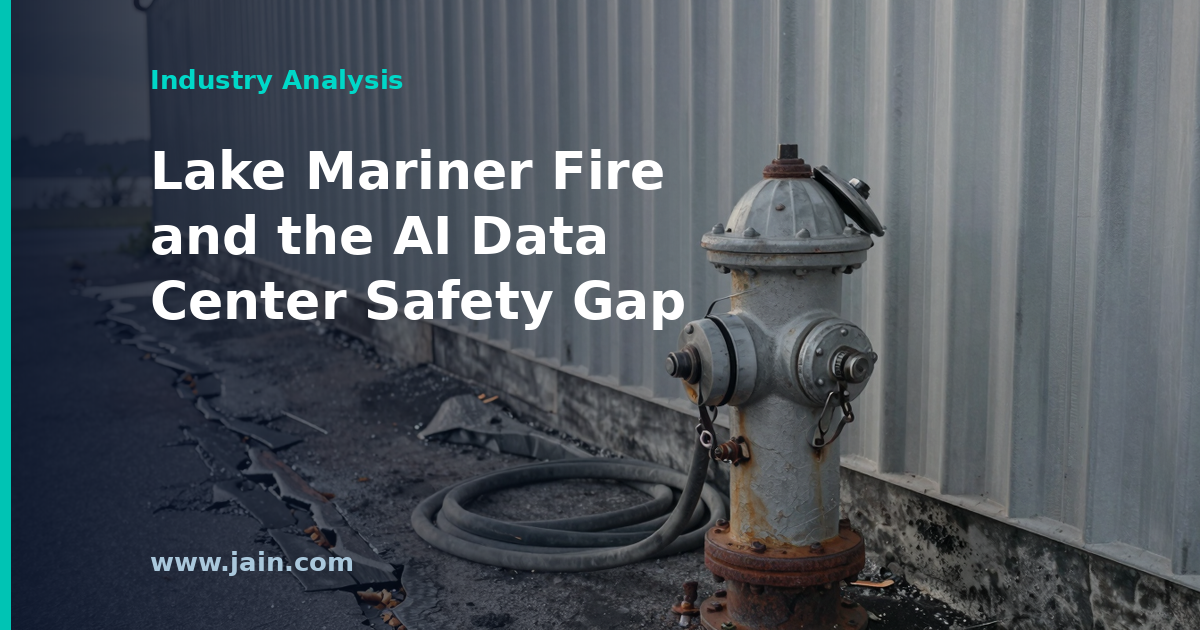
    Crypto Briefing reported that firefighters from the Barker Fire Department responded in early June to a fire in an unfinished building at TeraWulf’s Lake Mariner campus in Somerset, New York, and found no functioning fire alarm, no suppression system and three hydrants that did not work. According to TeraWulf, the safety data sheets that would have identified the chemicals producing the heavy black smoke had burned up in the fire. Fire Chief Steve Matisz said his crew went into the building “kind of blind,” and that he was unsure what to make of the claim that the safety sheets had been destroyed. “It’s been a difficult situation,” Matisz said.

    Lake Mariner sits on the site of a retired coal plant that TeraWulf (Nasdaq: WULF) began operating in 2022 for Bitcoin mining and is now converting to artificial intelligence and high-performance computing workloads, targeting a combined 500 to 750 megawatts across several buildings by the end of 2026. Tenants include Core42 and Fluidstack. Post-incident discussions reportedly included plans for additional hydrants and improved storage of safety data sheets. No regulatory follow-up or investigative action has been publicly reported.

    Executive Summary

    The facts as reported are narrow — one fire, one building still under construction, one rural fire department — but they touch three things that matter across the AI build-out: whether life-safety systems are in service before a building is finished, whether a site’s water supply can actually deliver, and whether anyone outside the company checks. A megawatt is a unit of electrical demand; a campus rated at several hundred megawatts draws power on the scale of a small city, and it concentrates that energy inside a handful of buildings packed with electrical gear, batteries and, increasingly, liquid cooling.

    What makes Lake Mariner a useful case is not that TeraWulf is unusual. It is that TeraWulf is typical. A retired coal plant with an existing grid connection is among the most sought-after assets in the industry right now, because the interconnection queue — the waiting line to attach new load to the electrical grid — runs years long almost everywhere else. Buying speed by inheriting a brownfield site also means inheriting its fire mains, its hydrants and its water pressure.

    For tenants such as Core42 and Fluidstack, and for the customers behind them, the operational question raised here is not about one fire. It is about what construction-phase safety looks like at a campus racing toward 500 to 750 megawatts by the end of next year, and what an insurer, a lender or a lease counterparty is told when something goes wrong.

    Construction Is the Most Dangerous Phase of a Data Center’s Life

    A finished data center is one of the better-protected buildings in commercial real estate: detection on every ceiling, suppression plumbed and pressurised, and a fire alarm panel that is tested, certified and monitored before the first server is energised. A data center under construction is a different building entirely. Suppression piping is often installed but not charged. Detection is often wired but not commissioned. Combustible packaging, temporary power, insulation and hot work — welding, cutting, grinding — all sit in the same shell at once. That is why the industry treats the construction window as a distinct risk class with its own controls, rather than assuming a partly built facility is a slightly less protected finished one.

    The reported conditions at Lake Mariner map onto exactly that window: an unfinished building, no functioning alarm, no suppression. None of that is inherently a code violation — requirements phase in as construction progresses, and there is a legitimate period in any project when systems exist but are not yet live. What the account does not establish, and what would determine whether this was routine or a lapse, is which protections were required at that stage and which were merely absent. That is a question about the project’s fire-protection plan, and it is answerable only by the company and the authority having jurisdiction.

    Brownfield Speed Comes With Borrowed Plumbing

    The three dead hydrants are the detail with the longest reach. Converted industrial sites — retired coal, steel, paper, aluminium — are attractive because the heavy electrical infrastructure is already there and the grid connection already exists. But the fire-water infrastructure is inherited too, and it was engineered for the plant that used to be there, under a maintenance regime that ended when that plant did. Private hydrants on a large campus are the owner’s responsibility to flow-test and maintain, not the municipality’s. When three of them do not work, the failure is usually not the fire itself but everything that did not happen in the years before it.

    The response profile compounds this. Repurposed heavy-industrial land tends to be rural, which means the responding department may be small, volunteer or both, with tanker shuttles rather than an urban grid of reliable pressurised mains. The specific failure the chief described — going in without knowing what was burning, because the safety data sheets were reportedly inside the building that was on fire — is the one that pre-incident planning exists to prevent. Chemical inventories are meant to be duplicated off-site and shared with the responding department in advance, precisely so that a fire cannot destroy the document that explains itself. That the post-incident discussion reportedly turned to additional hydrants and better storage of those sheets suggests the gap was recognised.

    The Risk Is Priced Somewhere, Even If It Is Not Disclosed

    Fires during construction are covered by builder’s risk policies, and completed data centers are among the most heavily underwritten assets in the market — insurers inspect them, set conditions and price on the strength of protection systems. A loss during construction is not merely an expense; it becomes part of the underwriting file for the campus, and it can shape terms on renewal and on the buildings not yet built. Where a company is financing a rapid build-out, insurance terms and lender conditions are a real cost line, not a footnote.

    There is also a schedule dimension. TeraWulf is targeting 500 to 750 megawatts across several buildings at Lake Mariner by the end of 2026, with tenants already signed. Lease agreements in this market typically carry delivery dates, and a delivery date missed by construction damage is a commercial event as well as a safety one. Nothing in the reported account establishes that this fire affected the schedule, the tenants or the target — but those are the specific channels through which a construction-phase fire reaches investors, and they are the ones worth watching.

    Who Checks, and When

    The reported absence of publicly known regulatory follow-up is the part that generalises furthest beyond this one campus. Data center fire safety is enforced locally — by building departments, fire marshals and code officials — and the enforcement capacity of a small jurisdiction is not always matched to a multi-hundred-megawatt industrial conversion arriving inside a few years. That is a structural feature of how the AI build-out has distributed itself: toward places with cheap land, existing grid capacity and, often, modest municipal staffing.

    It is worth being precise about what can and cannot be concluded. That no follow-up has been publicly reported is not evidence that none occurred; investigations are frequently non-public until they conclude, and some are never announced at all. The fair reading is narrower and still useful: three months after an incident at a campus of this scale, the public record contains a fire chief’s account and little else. For a sector asking communities to host enormous new industrial loads, that asymmetry between the size of the facility and the visibility of its oversight is itself a thing to watch.

    Background

    TeraWulf (Nasdaq: WULF) started as a Bitcoin miner, a business whose economics turn almost entirely on the price of electricity. That pushed the industry toward the same places utilities and heavy industry once favoured: sites with large, already-permitted grid connections. Lake Mariner, on the grounds of a retired coal plant in Somerset, New York, is a textbook example, and TeraWulf has operated it since 2022.

    The rise of artificial intelligence turned those assets into something more valuable. Training and running large models requires dense clusters of specialised chips, and the binding constraint on building them is power — specifically, how quickly a site can attach hundreds of megawatts to the grid. Former mining campuses already have that, which is why so many miners are converting into landlords, leasing capacity to compute providers rather than mining coins themselves. TeraWulf’s Core42 and Fluidstack tenancies at Lake Mariner, alongside a target of 500 to 750 megawatts by the end of 2026, place it squarely in that transition. The conversion also changes the building: denser electrical gear, more batteries and increasingly liquid cooling, all of which raise the stakes on fire protection.

    Sources

    Source: TeraWulf’s Lake Mariner data center fire raises safety concerns — an account of the early-June fire at TeraWulf’s Somerset, New York campus, including Barker Fire Chief Steve Matisz’s description of the conditions his crew found on arrival.

  • Blue Owl’s $2.4B GPU Loan to IREN Prices AI Risk at 9%

    Blue Owl’s $2.4B GPU Loan to IREN Prices AI Risk at 9%

    TL;DR · 30-second read

    The Short Version

    The investment firm Blue Owl, alongside Pacific Investment Management Company, is lending $2.4 billion to a company called IREN. The loan is secured against the chips themselves — the specialised processors that train artificial intelligence systems.

    IREN once mined Bitcoin. It now rents computing power to artificial intelligence firms, Microsoft among them. It disclosed the loan on 27 August alongside annual results showing a $703 million loss, mostly from scrapping old mining machines.

    Why it matters: the money funding the artificial intelligence boom increasingly comes from private lenders, secured on hardware that loses value fast.

    IREN Limited (NASDAQ: IREN) disclosed on August 27, 2026, in a press release filed as an exhibit to a Form 8-K, that it has secured $2.8 billion of new GPU financings for non-investment-grade customer deployments. The largest tranche is a $2.4 billion facility led by Blue Owl and Pacific Investment Management Company LLC, as adviser to certain investors, at a 9.0% fixed rate. IREN says the facility funds 90% of the GPU capital expenditure associated with its air-cooled expansion at Mackenzie, and that combined with customer prepayments it provides funding in excess of GPU capex, freeing cash for other data center spending.

    The disclosure came inside IREN’s full-year results for the fiscal year ended June 30, 2026, filed the same day alongside its annual report on Form 10-K. Yahoo Finance and 24/7 Wall St. reported that IREN shares climbed about 4% on the news, with fellow bitcoin-miner-turned-AI-host Cipher Mining up about 2%.

    Executive Summary

    The headline number is $2.4 billion, but the more revealing number is 9.0%. In the same results release, IREN disclosed a separate $3.6 billion “investment grade” GPU financing tied to its Microsoft contract priced at 6.0%. The two facilities buy substantially the same physical asset — racks of NVIDIA accelerators in IREN-owned data centers — yet they clear 300 basis points apart. The difference is not the hardware. It is who signed the offtake contract.

    That spread is the story for anyone trying to understand how the AI buildout is actually being paid for. Lenders are underwriting GPU deployments as discrete, contract-matched financings rather than lending against a corporate balance sheet, and they are pricing each one off the credit quality of the customer at the other end. Private credit managers, not banks and not equity markets, are supplying the capital at the riskier end of that curve.

    For IREN, the mechanics are aggressive by any standard. The company says recent three-year contracts are being struck at more than $20 million of revenue per megawatt of IT capacity, implying roughly a two-year payback, with customer prepayments covering 45–55% of GPU capex. Layer 90% debt financing on top of prepayments of that size and the equity cheque approaches zero — which is precisely the point, and precisely the risk.

    Three Hundred Basis Points Is the Price of a Name

    Read IREN’s two GPU financings side by side and you get an unusually clean market reading. The $3.6 billion facility supporting the Microsoft deployment is described as investment grade and priced at 6.0%; together with prepayments it funds 96% of the associated GPU capex. The $2.4 billion Blue Owl and PIMCO-led facility supports non-investment-grade customer deployments at 9.0% and funds 90% of GPU capex on its own. Same operator, same asset class, same vintage of silicon, roughly the same moment in the market.

    What separates them is counterparty credit. When a hyperscaler with a top-tier rating signs the contract, the lender is effectively buying that hyperscaler’s payment stream with a data center wrapped around it. When the offtaker is a fast-growing but unrated AI developer, the lender is exposed to a company that may not exist in its current form when the loan matures — and charges accordingly. IREN’s recently disclosed customer list, which includes Cohere, Prometheus, Perplexity, Figure AI, Fal AI and Higgsfield AI alongside an unnamed frontier lab, is a plausible map of what sits behind that 9.0%.

    This is a healthier signal than it might first appear. Credit markets differentiating between AI counterparties is what functioning risk pricing looks like; a world in which every GPU deployment funded at the same rate regardless of who was buying the compute would be far more worrying. The open question is whether 300 basis points is enough compensation for the gap between a hyperscaler and a Series C startup.

    Collateral That Depreciates on a Two-Year Clock

    GPU-backed lending inverts the usual logic of infrastructure credit. A data center shell, a substation and a power interconnection are long-lived assets that hold value across decades and multiple tenants. Accelerators are not. They are consumables on a rapid product cadence — IREN’s own Horizon 1 build for Microsoft runs GB300 NVL72 systems that did not exist a couple of generations ago — and their residual value depends on a secondary market that has never been tested at scale through a downturn.

    The economics only work if cash comes back faster than the collateral ages. IREN’s disclosed contract terms are built for exactly that: more than $20 million of revenue per IT megawatt on three-year deals, active discussions at around $25 million, and a stated payback of roughly two years. If those contracts perform, the loan is largely repaid from revenue before hardware obsolescence becomes the binding question, and the collateral is a backstop rather than a repayment source. If a non-investment-grade customer stops paying in year one, the lender is left holding used accelerators and looking for a replacement tenant — the scenario the 9.0% is meant to cover.

    Scale sharpens the point. A fully drawn $2.4 billion at a 9.0% fixed rate implies on the order of $216 million in annual interest before any amortization — close to IREN’s entire FY26 adjusted EBITDA of $245.7 million. That comparison is not a solvency warning; the facility is matched to new capacity that does not yet generate revenue. But it makes explicit that this debt is underwritten against contracted future cash flows, not against the business as it exists today.

    The Cost of Leaving Bitcoin Behind

    IREN’s FY26 accounts show a company mid-pivot and paying for it. Total revenue rose to $707.0 million from $501.0 million, with AI Cloud Services revenue up roughly eightfold to $128.8 million while bitcoin mining still contributed $578.2 million. The company reported a net loss of $702.6 million for the year, including $638.8 million of non-cash impairments that IREN attributes primarily to decommissioning bitcoin mining hardware as sites convert to AI workloads. Adjusted EBITDA slipped to $245.7 million from $269.7 million, and fell sharply in the June quarter to $19.2 million on higher headcount and platform investment ahead of the AI revenue ramp.

    Those impairments are best read as the accounting cost of a strategic decision rather than a deterioration in trading. Converting a mining site to liquid-cooled AI capacity means writing off machines that still work but no longer fit the plan. The relevant test is whether the replacement revenue arrives: IREN says its 2026 capacity is largely sold out, that contracted annualized run-rate revenue for 2026 capacity stands at $4 billion against $1 billion operating today, and that it holds $14 billion in cash plus committed GPU financing and prepayments.

    The gap between $4 billion contracted and $1 billion operating is where the entire thesis sits. It is a delivery problem — Horizon 2 is commissioning, Horizon 3 and 4 are in late-stage construction targeting Q4 2026 delivery, and cumulative targets of 0.3GW of IT capacity in 2026 rising to 0.8GW in 2027 depend on power, supply chain and construction all landing on schedule across sites in Texas, Oklahoma, British Columbia, Australia and Spain.

    Private Credit Becomes the Buildout’s Balance Sheet

    Step back from IREN and the structural shift is the real news. Blue Owl and PIMCO are not project-finance banks; they are alternative asset managers deploying institutional capital into an asset class that barely existed three years ago. A $2.4 billion single-asset-class facility at a fixed rate, sized to a specific deployment at a specific site, is closer to how aircraft and shipping fleets are financed than to how enterprise IT has traditionally been bought.

    The appeal to operators is obvious. Ninety percent debt funding plus prepayments covering roughly half of GPU capex means expansion without commensurate equity dilution — a meaningful advantage for a company whose share count has grown through equity offerings, at-the-market facilities and convertible notes maturing in 2029 and 2030. The appeal to lenders is spread: 9.0% fixed on collateralised paper is attractive in a market where comparable yield is scarce, provided the underwriting holds.

    The systemic question is concentration. If a large share of the world’s AI compute capacity ends up financed by a relatively small group of private credit managers, against collateral whose value is correlated to a single technology cycle and whose repayment depends on the durability of AI customer demand, then a broad slowdown would hit lenders, operators and chip demand simultaneously rather than sequentially. Nothing in IREN’s disclosures suggests distress. But the structure is new enough that no one has yet observed how it behaves when contracted revenue fails to convert.

    Background

    IREN Limited is one of a cohort of bitcoin mining companies attempting to convert accumulated power capacity, land and data center shells into AI compute hosting. The logic is that the scarce input for AI infrastructure is not chips but energized real estate — grid interconnections, substations and cooling — and miners spent years acquiring exactly that. The conversion is not simple: AI training racks draw far more power per rack than mining rigs, frequently require liquid cooling, and demand redundancy and network performance that mining sites were never built to provide.

    IREN reports two segments, Bitcoin Mining and AI Cloud Services, with the latter growing from $16.4 million in FY25 to $128.8 million in FY26. In FY26 the company completed acquisitions of Mirantis and Nostrum, adding software and managed services capability and a European footprint, nearly tripled headcount, and made five C-suite appointments. It has a stated pipeline of more than 5GW across sites including Childress and Sweetwater in Texas, Kiowa in Oklahoma, Mackenzie, Canal Flats and Prince George in British Columbia, Bundey in Australia and Badajoz in Spain. Its capital structure includes dual-class shares, convertible senior notes due 2029 and 2030, an at-the-market equity facility and now several billion dollars of asset-backed GPU debt.

    Sources

    Source: IREN Climbs 4% on $2.4B Blue Owl-Led GPU Financing; Cipher Digital Gains 2% — market coverage of the trading reaction to IREN’s GPU financing disclosure.

    Primary sources: IREN Reports FY26 Results (Exhibit 99.1 to Form 8-K, filed August 27, 2026), which discloses the $2.4 billion Blue Owl and PIMCO-led financing at 9.0%, the $3.6 billion investment-grade facility at 6.0%, contract pricing per megawatt and full-year financials; IREN Limited, Form 8-K filed August 27, 2026; and IREN Limited, Form 10-K for the fiscal year ended June 30, 2026, filed August 27, 2026, covering segment reporting, convertible notes and capital structure.

  • Bitdeer’s $100M Texas Land Buy Is a Bet on Grid Access

    Bitdeer’s $100M Texas Land Buy Is a Bet on Grid Access

    TL;DR · 30-second read

    The Short Version

    Bitdeer paid about $100 million for 200 acres of empty land in rural Texas — roughly half a million dollars an acre. The land itself is not really what it bought.

    What it bought is a spot on the electricity grid. The site sits next to a plant the company already runs near Rockdale, about 70 miles from Austin, where the utility has already agreed to deliver enough power to run a small city.

    Getting that kind of power hookup can take years of waiting. Land next to one that already exists is worth paying up for.

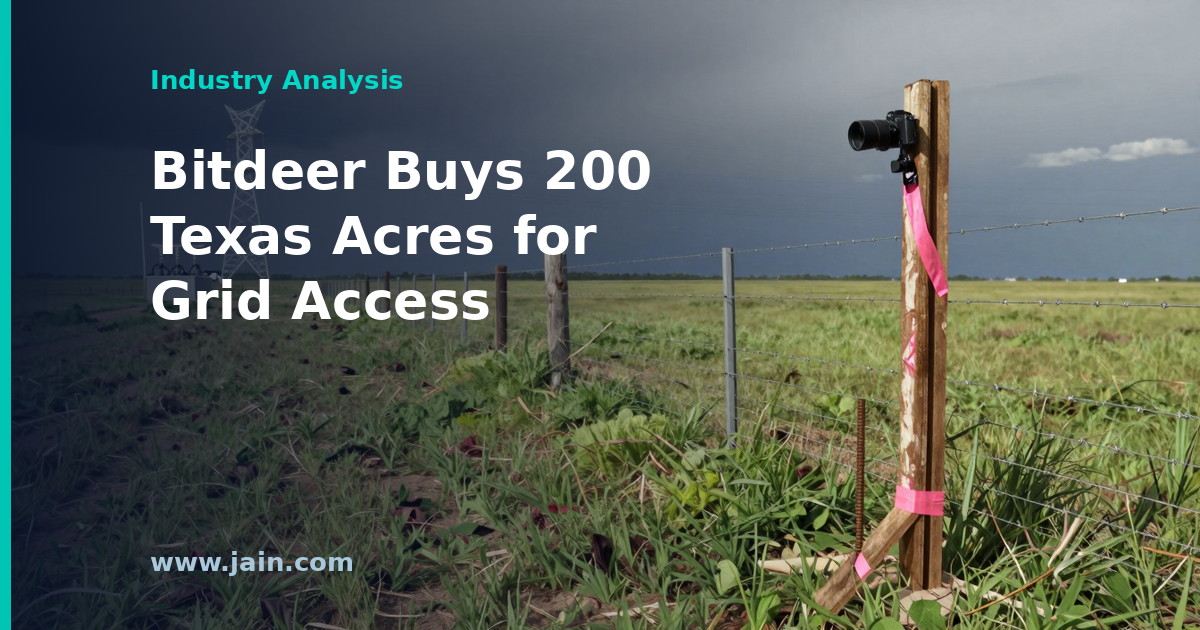
    Bitdeer Technologies Group (NASDAQ: BTDR) said on September 1 that it has completed the fee simple purchase of approximately 200 acres of greenfield land in Milam County, Texas, for total consideration of approximately $100 million, paid in cash. The parcel sits near the company’s existing Rockdale facility, roughly 70 miles from Austin, and is intended to support development of AI and high-performance computing (HPC) infrastructure. The announcement was furnished to the U.S. Securities and Exchange Commission as an exhibit to a Form 6-K filed September 2.

    In the release, Bitdeer says the Milam County sites, including the new parcel, currently feature approximately 563 megawatts (MW) of interconnected grid capacity with existing plans expected to scale to 742 MW, plus a dedicated water supply. After the deal, the company says it owns and/or operates roughly 255 acres and 742 MW of existing and pipeline power capacity in the county, against approximately 3.0 gigawatts of total power capacity across a global portfolio spanning the United States, Norway, Bhutan, Canada, Malaysia and Ethiopia.

    Executive Summary

    The headline number is land, but the substance is electricity. Bitdeer disclosed a cash purchase of about 200 acres next to a campus that already holds a large-load grid connection — the utility-approved right to draw power at scale, which in Texas and most other markets is now the slowest and scarcest input in data center development. Land can be bought in weeks. An interconnection typically cannot.

    Chief Financial Officer Michael G. Potter framed the deal as a control decision rather than a capacity decision, saying outright ownership “eliminates the renewal risk associated with a lease” and gives the company flexibility to keep running Bitcoin mining while it develops the new property. That matters commercially: hyperscale and AI tenants signing decade-plus leases underwrite the landlord’s title as well as its power, and a developer building on leased dirt carries a financing discount its owned-land peers do not.

    The wider context is a Bitcoin miner converting itself into a data center landlord. In its July operations update, filed August 26, Bitdeer pointed to a $4.7 billion, 16-year AI/HPC lease announced in early August as “a key milestone in converting our power portfolio into contracted, long-term revenue,” alongside approximately 76.7 exahashes per second of self-mining hash rate and a 9.5 MW facility in Malaysia fully committed under long-term offtake agreements. The Texas purchase extends that conversion strategy to the company’s best-connected North American site — without, so far, a disclosed customer, budget or construction timeline attached to the new parcel.

    Half a Million Dollars an Acre Is a Price for the Queue, Not the Dirt

    Divide the disclosed consideration by the disclosed acreage and the arithmetic is stark: roughly $500,000 per acre for greenfield land in a rural Texas county. No one pays that for soil. They pay it for adjacency — proximity to an energized campus with established transmission and substation infrastructure, which is what Bitdeer says the Rockdale location already has.

    The mechanism worth understanding is the interconnection queue. Before a large facility can draw meaningful power, the grid operator must study the request and the utility must build or upgrade the lines and substations to serve it. For loads measured in hundreds of megawatts, that process is measured in years, and in the current AI buildout the queue — not capital, not chips, not construction labour — is the binding constraint on delivery dates. Buying land beside a site that has already cleared much of that path is a way of buying time, and time is the input in shortest supply.

    A rough yardstick: measured against the 742 MW of existing and pipeline capacity Bitdeer attributes to its Milam County sites, $100 million works out to about $135,000 per megawatt. Treat that number carefully — the company assigns the capacity to the sites collectively, not to the new parcel alone, and it has not said how much of it the new land would serve. But even on the most conservative reading, land is a small line item next to the cost of building AI-ready halls on it.

    The Conversion Trade: From Hash Rate to Lease Rate

    Bitcoin miners and AI data centers want the same thing — cheap, abundant, interruptible power — and differ sharply in everything else. Mining tolerates modest reliability and rough-and-ready buildings because the revenue is a commodity output. AI and HPC tenants want redundancy, dense power per rack, sophisticated cooling and contractual guarantees, and they pay for it in long-dated leases. That gap is why so many mining campuses are being re-underwritten as data center real estate.

    Bitdeer is explicit that this is the direction of travel. The August 26 filing quotes Potter describing the $4.7 billion, 16-year lease as converting the power portfolio “into contracted, long-term revenue,” and the Malaysia facility as fully committed under offtake agreements representing expected contracted revenue exceeding $800 million. The September release goes further in a place readers often skip: its forward-looking-statements paragraph flags expectations about “the potential reallocation of existing interconnected capacity.” In plain terms, some of the 563 MW now serving mining machines could be redirected to AI tenants. That is the cheapest megawatt in the industry — one already connected — and it is also the one whose reallocation the company has not yet quantified.

    The company’s claim that the purchase “removes one of the principal constraints on AI/HPC data center development at the location” is defensible as far as it goes. Land tenure was a real constraint, and it is now resolved. It is worth being precise about what remains: the power allocation beyond 563 MW is described as planned, not granted; the water supply is described as dedicated but not quantified; and no tenant, capital budget or energization date has been attached to the new parcel.

    Why a Landlord Buys Instead of Leases

    Fee simple ownership — outright title, as opposed to a lease — sounds like a legal footnote and is in fact a financing question. A developer signing a 16-year lease with a creditworthy compute tenant will typically want to borrow against that lease. Lenders and rating agencies look at whether the ground beneath the building could revert to someone else, at what price, and on whose terms. Ground-lease renewal risk sits directly in that analysis, and Potter’s language about eliminating it reads as written for that audience.

    Ownership also buys sequencing freedom. Bitdeer says the purchase lets it “maintain our existing Bitcoin mining operations while we develop the newly acquired property” — that is, build the AI campus next door rather than demolishing a revenue-producing mining site to make room. For a company whose mining business was still scaling to roughly 76.7 EH/s (exahashes per second, a measure of total mining computation) in July, keeping both revenue streams live during a multi-year construction programme has real value.

    One quiet detail deserves attention. Bitdeer says it owns and/or operates approximately 255 acres in Milam County after the transaction — implying the pre-deal footprint was on the order of 55 acres. For a site holding a 563 MW interconnection, that is a very small land base, and it explains the price: the company was power-rich and land-poor at exactly the location where it most wants to build.

    Concentration, and What It Costs to Get It Wrong

    After this deal, Milam County accounts for 742 MW of Bitdeer’s roughly 3.0 GW global capacity — close to a quarter of the portfolio, in one county, on one grid. Concentration of that kind cuts both ways. It delivers scale, shared substation infrastructure and a single operating team, which is how campuses get built cheaply. It also stacks regulatory, weather and grid-policy exposure in one place, and Texas has been actively revisiting how very large flexible loads are treated on its system.

    The diversification argument runs the other way for Bitdeer’s international sites in Norway, Bhutan, Canada, Malaysia and Ethiopia, which spread jurisdictional risk but sit further from the North American enterprise and hyperscaler demand that AI leases are written against. Proximity to Austin — the company cites 70 miles — matters less for latency than for labour, construction supply chains and the simple willingness of a customer’s engineering team to visit the site.

    For buyers of capacity, the practical read is that powered land next to energized campuses is now being priced as a scarce financial asset rather than as real estate, and that miners with existing large-load interconnections are among the few holders of it. For investors, the disclosure is a genuine, cash-settled commitment rather than a memorandum of understanding — but a $100 million land purchase is a call option on development, not development itself. The value depends entirely on the power allocations and tenant contracts that follow.

    Background

    Bitdeer Technologies Group is a Singapore-headquartered company listed on Nasdaq under BTDR that describes itself as a technology company for AI and Bitcoin mining infrastructure. It handles equipment procurement, logistics, data center design and construction, and daily operations, and also sells cloud capacity to AI customers. Its data centers span the United States, Norway, Bhutan, Canada, Malaysia and Ethiopia, and it reported approximately 76.7 EH/s of self-mining hash rate in its July 2026 operations update.

    Milam County, in central Texas, has been a magnet for very large electricity consumers because of established transmission and substation infrastructure and a grid that has historically welcomed flexible industrial load. That drew Bitcoin miners first; the same attributes — abundant interconnected power and available land — now make such campuses candidates for AI and HPC conversion. Bitdeer has been moving in that direction through 2026, announcing a $4.7 billion, 16-year AI/HPC lease in early August and a fully committed 9.5 MW facility in Malaysia representing expected contracted revenue above $800 million. The company also said in August that it would shift infrastructure updates from monthly to quarterly disclosures issued with earnings.

    Source: Bitdeer Buys 200 Acres in Texas to Expand AI and HPC Infrastructure — report on Bitdeer’s $100 million land acquisition in Milam County, Texas.

    Primary sources: Bitdeer Technologies Group, Form 6-K filed September 2, 2026 (SEC EDGAR); Exhibit 99.1 — “Bitdeer Announces Acquisition of 200 Acres Near Rockdale Facility in Milam County, Texas to Support AI/HPC Infrastructure Development,” September 1, 2026; Bitdeer Technologies Group, Form 6-K filed August 26, 2026 (SEC EDGAR); Exhibit 99.1 — “Bitdeer Announces July 2026 Production and Operations Update,” August 26, 2026.