TL;DR · 30-second read
The Short Version
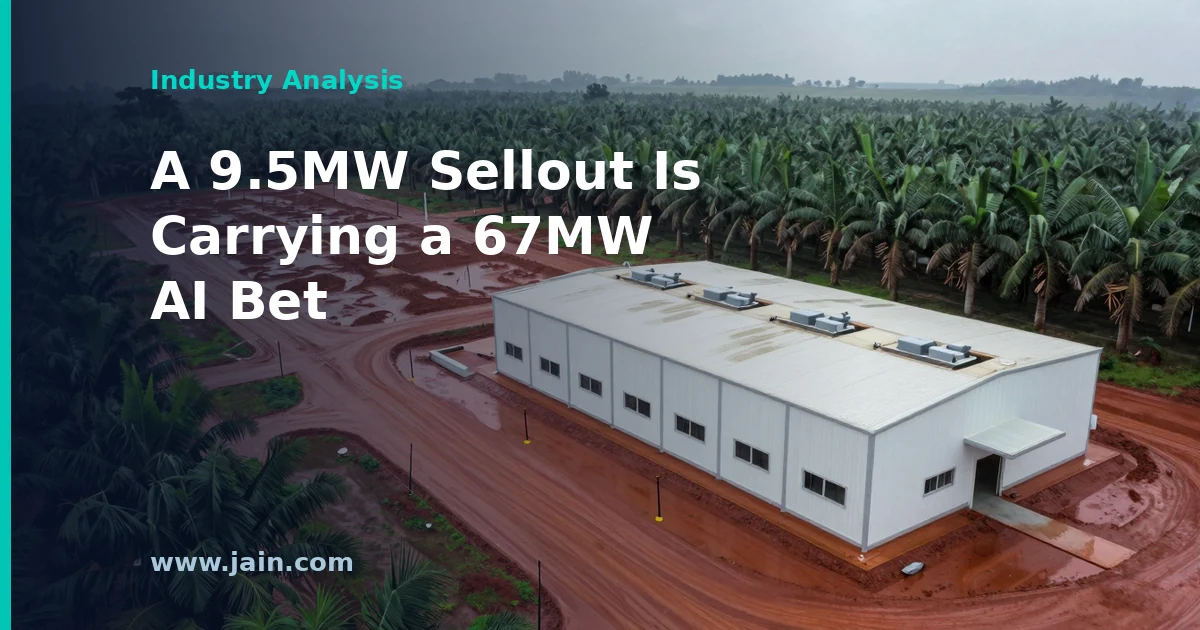
Bitdeer, a company best known for bitcoin mining, is adding a large computer center in Malaysia built for artificial intelligence work. It will draw about as much electricity as a sizable town and is due to be ready by mid-2027.
The catch: no customer has signed up to rent it yet. Its main proof that people want this is a Malaysian site one-seventh the size, which sold out this summer.
So it is a bet that customers will come, made while the company pays as much as 13% a year on some of its loans.
Bitdeer Technologies (Nasdaq: BTDR), through its Bitdeer AI unit, has secured a 67MW AI data center campus in Malaysia, with delivery targeted for the second quarter of 2027, according to MarketScreener, StreetInsider and Crypto Briefing. TheEnergyMag reported that the addition brings Bitdeer’s total to 273.5MW. FourWeekMBA reported that no offtake has been signed. An offtake is a customer’s commitment to take the capacity. Investing.com put the facility at 60MW rather than 67MW. StreetInsider and Stocktwits reported that Bitdeer’s AI infrastructure pipeline tops $10 billion.
Separately, Stock Titan reported that Bitdeer told readers to disregard a release that had cited a facility target of up to 350MW. MarketScreener reported that alerts on Bitdeer AI’s data center services agreement were withdrawn. The announcement follows a 6-K filed September 29, in which Bitdeer disclosed that its roughly 9.5MW A102 data center in Malaysia had sold out on five-year offtake commitments.
Executive Summary
Bitdeer is adding 67MW of AI data center capacity in Malaysia, a country where it already operates. Delivery is targeted for Q2 2027, only a few quarters away, and no customer has committed to the space. The only Malaysian AI contract the company has put on the record is the 9.5MW A102 sellout disclosed in its September 29 filing. The new campus is therefore about seven times larger than the demand Bitdeer has demonstrated in that market.
The contrast with Bitdeer’s Norwegian project is sharp. At Tydal, the company signed a named tenant at a disclosed price before building, with roughly $1.3 billion of bank-arranged credit support behind the tenant. The Malaysian campus so far has a size and a date, but no tenant, price or financing disclosed. This is a speculative build, meaning one put up ahead of signed demand. It comes as Bitdeer carries collateralized loans at a 13.0% effective interest rate, with $373.5 million of principal falling due within a year of June 30, 2026.
Two figure discrepancies need clearing up. One is the withdrawn reference to an up-to-350MW target. The other is the 60MW versus 67MW sizing. Until Bitdeer clarifies them, it is hard to say exactly what is being built.
A 9.5MW Sellout Is the Demand Case for 67MW
Bitdeer has put only one piece of Malaysian AI demand on the record, and it is small. In its September 29 6-K, the company said Bitdeer AI sold out approximately 9.5MW at its A102 data center in August, with five-year offtake commitments for its AI Cloud business, which sells computing capacity for AI workloads. The new campus, at 67MW, is about seven times that size. It is being added before any customer has committed to it.
That ratio is the core of the bet. The A102 sellout shows that buyers in Malaysia will sign multi-year commitments for Bitdeer’s capacity. It does not show that buyers exist for seven times as much, on Bitdeer’s timeline and at the price it needs. The calendar is also short. Q2 2027 is two to three quarters away, so Bitdeer has quarters, not years, to sign tenants. If the campus is delivered before it is contracted, Bitdeer carries the cost of a finished facility with no revenue against it until the space fills.
Different groups are affected in different ways. For AI companies looking for capacity in Southeast Asia, an uncommitted campus with a near-term delivery date gives them room to negotiate. For Bitdeer shareholders, the value of the project depends on when the first tenant signs and on what terms. A further question is how the space will be used. Bitdeer could fill the campus with its own AI Cloud service, as at A102, which means buying its own processors on top of the facility. Or it could lease the space as colocation, where the tenant brings its own hardware. Those two paths carry very different capital requirements.
Tydal Is the Template Malaysia Has Not Yet Matched
Bitdeer’s own filings show what a fully contracted AI campus looks like. Under the Tydal, Norway agreement with Volta Tydal AS, described in the September 29 6-K, Bitdeer’s subsidiary will deliver 121 IT MW of contracted critical load, supported by an estimated 133 gross MW. IT MW is the power available to the computers themselves. Gross MW also covers cooling and other building systems. The contract is worth approximately $4.7 billion over a 16-year base term, at an average rate of about $202 per kilowatt per month. Electricity is fully reimbursed by the tenant, and payments rise 3% a year. Bitdeer expects about $2.4 million of annual revenue per IT MW. It also expects a net operating income margin of roughly 90%, meaning the share of revenue left after operating the property.
The tenant’s obligations are expected to be backed by letters of credit totaling about $1.3 billion, arranged by affiliates of J.P. Morgan and another major financial institution. These are bank guarantees that pay out if the tenant cannot. That backing is subject to customary conditions, and the tenant can terminate without a fee at year 10. So even Bitdeer’s strongest contract has conditions attached. Still, it has a named counterparty, a price, a term and credit support, all disclosed before construction completes. The design-and-construction contract for Tydal is phased to begin in December 2026.
The Malaysian campus has none of those elements on the record yet. That is not unusual for a project announced early. But it means the 67MW should be read as capacity Bitdeer intends to sell, not capacity it has sold.
13% Debt Puts a Clock on the Lease-Up
Bitdeer’s balance sheet makes the timing of tenant signings more important. According to the financial statements filed September 29, the company’s collateralized loans from BIT Group carried a 13.0% effective interest rate in the first half of 2026. Interest expense on those loans was $32.7 million, up from $3.0 million a year earlier. As of June 30, $373.5 million of that principal was due within twelve months, and $142.1 million was due after that. The loans are secured by mining rigs, inventories and data center assets.
Bitdeer has other obligations as well. It has a $26.0 million bank facility at 10.31% that matures in December 2026. It has $375.0 million of 5.00% convertible notes due 2032, issued in February. It also had roughly 3,669 Bitcoin outstanding under a separate BIT Group Bitcoin loan as of September 29. In August, the company paid about $100 million in cash for roughly 200 acres in Milam County, Texas. On October 8, its board authorized a new $100 million share buyback after fully using a previous $40 million program.
None of that is unusual for a company expanding quickly. It does mean the Malaysian campus competes for capital with debt repayments, land acquisition and buybacks. Every quarter the campus sits unleased, capital stays committed with nothing coming back. Bitdeer has not said how the campus is being financed.
One Figure Withdrawn, Another Disputed
The withdrawn up-to-350MW reference is worth noting in a measured way. Companies correct releases for many reasons, and the figure that stands is the 67MW campus. But Bitdeer has not explained what the 350MW target referred to or whether a larger expansion is still under consideration. For a company that investors increasingly value on its pipeline of planned capacity, that clarification matters.
The 60MW versus 67MW gap may have a simple explanation. The ratio is close to the IT-versus-gross distinction Bitdeer itself draws at Tydal, where 121 IT MW sits within 133 gross MW. But Bitdeer has not confirmed that this is the reason. It is a question the company can answer quickly. Buyers pricing capacity and investors modeling revenue need to know which number is the sellable one.
Background
Bitdeer Technologies Group is incorporated in the Cayman Islands, headquartered in Singapore and listed on the Nasdaq under the ticker BTDR. It built its business on bitcoin mining. Its revenue lines include self-mining, cloud hash rate (selling mining capacity to others), hosting and mining rig sales, plus a growing AI Cloud business. Its financial statements break out figures for Ethiopia, Canada, Malaysia, Norway, Bhutan, the United States and Singapore. The company cites about 3.0 GW of total power capacity across its global site portfolio.
Like several miners, Bitdeer is repositioning its power-connected sites toward AI computing. In Norway, it is converting its Tydal data center into an AI facility, under a cost-plus construction contract phased to begin in December 2026. In Texas, it bought about 200 acres near its Rockdale facility in August for roughly $100 million in cash, giving it 742MW of existing and pipeline power capacity in Milam County. In Malaysia, its 9.5MW A102 site sold out to AI Cloud customers in August 2026. Source: Bitdeer Technologies Expands Malaysian AI Data Center Capacity With 67MW Campus (MarketScreener): Bitdeer AI adds a 67MW Malaysian AI data center campus. Primary sources: Bitdeer 6-K filed October 8, 2026 (US$100 million share repurchase program); Bitdeer 6-K filed October 2, 2026 (resignation of director); Bitdeer 6-K filed September 29, 2026 (interim report); Exhibit 99.1 to 6-K filed September 29, 2026 (unaudited consolidated financial statements); Exhibit 99.2 to 6-K filed September 29, 2026 (recent developments). Further reporting: FourWeekMBA; StreetInsider; Stocktwits; TheEnergyMag; Crypto Briefing; MarketScreener (withdrawn alerts); Stock Titan; Investing.com.Sources