Tag: Birmingham Alabama

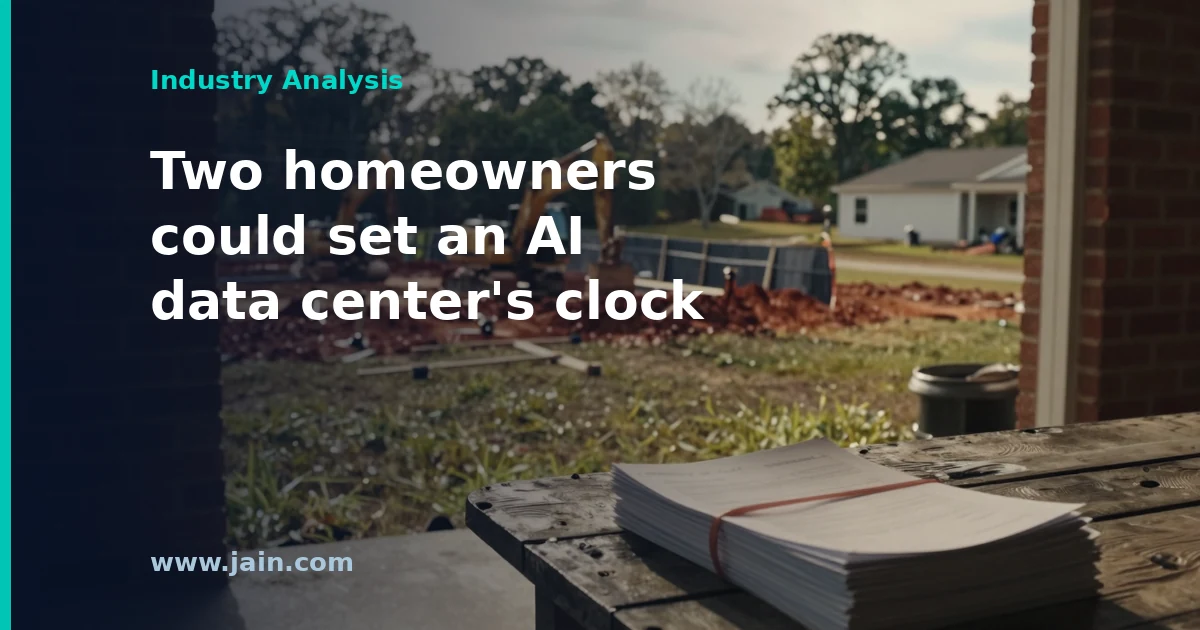
  • Two Homeowners’ Suit Shows How Nebius’s AI Build Schedule Can Hinge on a Local Court

    Two Homeowners’ Suit Shows How Nebius’s AI Build Schedule Can Hinge on a Local Court

    TL;DR · 30-second read

    The Short Version

    Two homeowners in Birmingham, Alabama, have sued to stop construction of a large computer center being built by Nebius, a company that rents out the computing power behind artificial intelligence tools.

    They say the city never properly approved it, and that the building work has already brought noise, shaking, dust, heavy trucks and damage to one home. They want the work stopped, the permits cancelled and money for the harm.

    Why it matters: two neighbors and one local court could now affect when the project is finished. The first judge stepped aside, so another will be picked at random.

    Two homeowners living near the Nebius AI data center under construction in Birmingham, Alabama, have filed a lawsuit asking a court to halt the work, ABC 33/40 (WBMA) reported on July 2, 2026. The suit claims the project was never properly approved under the city’s zoning rules. It also challenges Birmingham’s new data center ordinance and alleges that construction has already caused noise, vibrations, dust, heavy truck traffic and damage to one home.

    The homeowners are asking the court to stop construction, void the project’s permits and award damages. The judge originally assigned to the case has recused herself, and the case will be randomly reassigned to another Jefferson County judge.

    Executive Summary

    On its face this is a local zoning dispute. The relief it seeks, however, reaches the core of the project: a halt to construction and the voiding of the permits the site is being built under. A data center is a building packed with servers, power and cooling equipment, and it cannot be finished without valid permits. A successful challenge would therefore send the project back through approvals rather than simply attach conditions to it.

    The suit also targets Birmingham’s new data center ordinance, the rulebook the city wrote for exactly this kind of facility. That widens the stakes beyond one site. If the ordinance itself is found wanting, other projects that rely on it inherit the uncertainty. For Nebius, a provider of GPU cloud capacity (rented access to the graphics processors that train and run AI models), the practical question is schedule: when the building can start delivering capacity. That question now partly sits with a Jefferson County court.

    The homeowners’ allegations are claims in a complaint, not findings. The court has not yet ruled on any of them.

    How Two Plaintiffs Can Reach an Entire Build Schedule

    Only two people have sued, but the leverage in a zoning case does not come from headcount. It comes from what is asked for. The homeowners want three things: damages, the voiding of the project’s permits, and a halt to construction. Damages are money and do not by themselves change the schedule. The other two can. An order stopping work idles crews and equipment on a site where power, cooling and hardware installation are sequenced in advance. Voided permits would mean re-establishing approvals before work could resume.

    The legal theory matters as much as the relief. The suit claims the project was never properly approved under the city’s zoning rules. If that argument succeeds, the problem lies in the approval itself rather than in how the site is being run. A developer cannot fix an approval problem by changing site practices. It has to be cured through the municipal process, which runs on the city’s calendar rather than the developer’s.

    The recusal adds a procedural step at the outset. The case now goes to another Jefferson County judge chosen at random. Until that judge takes the case and addresses the request to stop construction, whether work continues is an open question. The exposure runs to Nebius, its contractors, any customers expecting capacity from the site, and the City of Birmingham, whose approval is being challenged.

    An Ordinance Challenge Is a Risk for More Than One Site

    A data-center-specific ordinance normally gives developers certainty. It tells them what the city requires and what an approved project looks like. By challenging Birmingham’s new ordinance directly, the homeowners are contesting that certainty, not just this one application of it.

    That puts the city in the position of defending both its approval of this project and the framework behind it. The outcome will signal to any developer weighing Birmingham whether the ordinance is a stable path to a permit or a contested one. A ruling that upholds the ordinance would strengthen it. A ruling against it would leave projects approved under it asking whether they need to revisit their approvals.

    The same scrutiny applies to both sides. The homeowners’ zoning claim will stand or fall on the text of the ordinance and the approval record, which a court has not yet examined. The city’s and developer’s position that the project was properly approved faces the same test.

    Construction Impacts Are the Part a Developer Controls

    The nuisance allegations are noise, vibrations, dust, heavy truck traffic and damage to one home. They are a different kind of claim from the zoning challenge, because they concern how the site is being built, not whether it should be. That also makes them the category a developer can most directly address. Typical tools include truck routing and working-hours limits, dust suppression, vibration monitoring, and surveys of neighboring structures before and during construction.

    The claim of damage to a home is specific, and whether construction caused it is a factual question that evidence can settle either way. Assurances that a site is being built responsibly are testable in the same way, through measurements and records.

    For a neocloud, schedule is effectively part of the product. Nebius and its peers compete on how quickly they can bring GPU capacity online for AI developers, so a site that delivers late is a commercial problem, not only a construction one. That is why a two-plaintiff local suit deserves attention from people who track Nebius’s buildout: the case controls no chips or power, but it can affect the date the building is ready to use them.

    Background

    Nebius Group is an AI infrastructure company headquartered in Amsterdam and listed on Nasdaq. It emerged in 2024 from the restructuring of Yandex N.V., which sold its Russian businesses and kept its international operations. Nebius builds and operates data centers and sells GPU cloud capacity to AI developers. That makes it one of the so-called neoclouds, specialist providers that compete with the largest cloud platforms for AI computing work.

    Its data center project in Birmingham, Alabama, has been locally controversial. Birmingham has adopted a new ordinance specifically governing data centers. That ordinance is now under legal challenge in Jefferson County alongside the Nebius project’s approvals.

    Sources

    Source: Homeowners file lawsuit against Nebius AI data center, judge recuses herself. ABC 33/40 (WBMA) reports on two homeowners’ suit to halt construction of the Nebius data center in Birmingham and the original judge’s recusal.

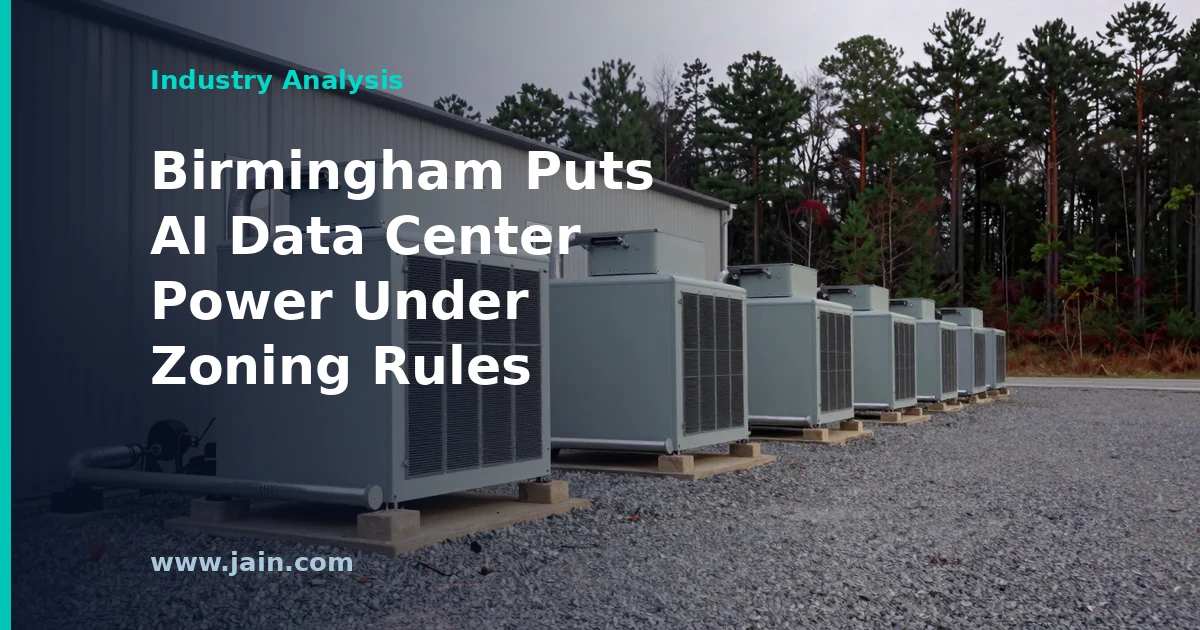
  • Birmingham’s 20-Point Code Turns AI Data Center Power Plans Into Zoning Terms

    Birmingham’s 20-Point Code Turns AI Data Center Power Plans Into Zoning Terms

    TL;DR · 30-second read

    The Short Version

    Birmingham, Alabama, has passed strict new rules for giant data centers, the warehouse-sized buildings full of computers that run cloud services and artificial intelligence.

    • They must sit at least 500 feet from homes, more than a football field and a half.
    • They cannot run their own gas-fired power plants on site.
    • Their cooling must use no more water than an ordinary office building.
    • Nearby neighbors must be told by certified letter before one is built.

    The city, not the state, now decides these terms.

    The City of Birmingham announced on June 9, 2026, that its City Council had approved a zoning ordinance setting 20 protective conditions for hyperscale data centers, the very large facilities built by cloud and AI operators. The city describes it as the toughest such ordinance in Alabama.

    The rules include a 500-foot setback from residential districts, a 1,000-foot separation from high-capacity transit facilities, a 5-acre minimum lot size, mandatory closed-loop cooling, a ban on onsite gas turbines and round-the-clock diesel generation, noise studies before and after construction, disclosure of projected peak electricity demand, and certified-mail notice to property owners within 500 feet.

    Executive Summary

    Birmingham has written the most contested parts of AI data center development, power, water and noise, directly into its zoning code. A developer seeking a site in the city now has to show where its water comes from, how much electricity it expects to draw at peak and in what phases, which utility will supply it, and how it will keep noise at the property line in check, all before the project can proceed.

    The most consequential provision is the prohibition on onsite gas turbines and diesel generators running 24/7. Onsite gas generation has become one of the ways large AI campuses bring capacity online faster than a utility connection allows. Birmingham has closed that route within city limits while leaving room for solar, fuel cells and battery storage under review.

    The city pairs these limits with a pitch: it cites its strong electrical grid, industrial infrastructure and affordable land as reasons developers want to build there. The ordinance is an attempt to keep that demand while setting the conditions locally.

    Power Moves From the Utility Contract to the Zoning File

    Traditionally, how a data center gets its electricity is negotiated between the developer and the utility, and the city’s role is limited to land use. Birmingham’s ordinance changes that in two ways. First, it restricts the generation a site may build for itself: gas turbines and diesel generators running around the clock are prohibited, solar and fuel cells are allowed, and battery storage is permitted subject to emergency-response review. Second, it requires developers to disclose projected peak demand, planned development phases and the identity of the utility provider as part of the application.

    For AI-focused developers, that matters because speed to power is often the binding constraint. When a utility cannot deliver a large new connection quickly, one workaround has been to install gas turbines on site and run them as primary or bridging power. Within Birmingham, that option is off the table. A hyperscale project there will depend on grid supply, supplemented only by solar, fuel cells or batteries, which puts the utility’s delivery timeline back at the center of the project schedule.

    The disclosure requirement has a quieter effect. Peak demand projections and phasing plans give the city a public record of how much load each project intends to add and when. That turns electricity from a private commercial term into something neighbors and officials can see and question during permitting.

    The Water Rule Is a Performance Standard With an Energy Cost

    The ordinance does not just require closed-loop cooling; it sets a benchmark that water use be no greater than that of a similarly sized office building. That is a performance test, not simply a technology checkbox. Closed-loop systems recirculate the same coolant rather than evaporating water to shed heat, which sharply reduces consumption.

    The trade-off is well understood in the industry: cooling without evaporation generally takes more electricity, particularly in hot, humid summers like Alabama’s. Birmingham has therefore chosen to protect local water supplies at the price of somewhat higher power draw per facility, which loops back to the peak demand figures developers must now disclose. Dense AI hardware, which runs hotter than conventional servers, makes that trade-off more pronounced.

    Setbacks, Not Lot Size, Will Decide Where Campuses Fit

    A 5-acre minimum lot is modest by hyperscale standards, so it is unlikely to be the constraint that matters. The 500-foot setback from residential and urban neighborhood districts is more demanding: a 5-acre parcel is only about 470 feet on a side if square, so a small site bordering a neighborhood could struggle to fit a building at all. In practice, the rules steer large projects toward bigger industrial tracts, which Birmingham, with its long manufacturing history, has in supply.

    The 1,000-foot separation from high-capacity transit facilities is less common. It keeps land near major transit, which cities typically reserve for housing and employment-dense development, from being absorbed by facilities that employ relatively few people once built. Combined with pre- and post-construction noise studies, acoustical walls and certified-mail notice within 500 feet, the ordinance front-loads community disclosure rather than leaving disputes to surface after construction.

    Weighing the City’s ‘Toughest’ Claim

    The city’s description of the ordinance as Alabama’s toughest and as a mark of national leadership is its own characterization, and it has not published a side-by-side comparison with other jurisdictions to support it. What can be said is that combining an onsite gas ban, a water-use benchmark, noise studies and power disclosure in a single zoning instrument is more comprehensive than codes that address only setbacks or noise.

    For developers, stricter rules are not purely a cost. Clear conditions published in advance reduce the risk of a project being stalled by opposition late in the process, and a site that meets them arrives with a documented answer to the questions neighbors most often raise. The larger point is structural: state-level tax incentives can make Alabama attractive, but in Birmingham it is the city code that now determines whether and how a specific site gets built.

    Background

    Birmingham grew as an iron and steel center, leaving it with industrial land, heavy electrical infrastructure and rail and utility corridors that suit large facilities. Alabama has courted data centers with state tax incentives and has already drawn large projects from companies such as Google and Meta elsewhere in the state.

    Nationally, the surge in AI computing has driven demand for ever-larger data centers that consume significant electricity and, depending on cooling design, water. Many local zoning codes were written before facilities of this scale existed, and cities have begun adding specific rules on siting, noise, water and power as proposals arrive.

    Sources

    Source: The City of Birmingham approves Alabama’s toughest zoning ordinance, establishing 20-point community protections for data center development, the City of Birmingham’s June 9, 2026 announcement of its hyperscale data center zoning rules.