Tag: behind-the-meter power

  • NANO Nuclear’s Tillman Deal Tests the Behind-the-Meter Promise

    NANO Nuclear’s Tillman Deal Tests the Behind-the-Meter Promise

    NANO Nuclear Energy (Nasdaq: NNE) and Tillman Digital Gateway have signed a framework agreement under which NANO Nuclear would supply advanced nuclear power — specifically microreactors, factory-built reactors far smaller than conventional nuclear plants — to U.S. AI industrial zones being developed by Tillman Digital Gateway.

    The announcement, carried by Energies Media and picked up by market commentary including Simply Wall St, describes the intended scope of the relationship. The material available does not state contracted capacity, named sites, pricing, financing, or a first-power date.

    Executive Summary

    The agreement pairs two halves of a problem the AI buildout keeps running into. Tillman Digital Gateway is assembling industrial-scale campuses for AI compute; NANO Nuclear is one of a cohort of U.S. developers designing microreactors intended to sit alongside large loads rather than feed a regional grid. On paper, that is a clean match: the data center needs firm, always-on power in one place, and a microreactor is designed to deliver exactly that.

    What makes the news notable is less the technology than the sequencing. For two years, “behind-the-meter nuclear” — generation sited at the customer’s facility, bypassing the public grid — has functioned mostly as a directional statement in data center strategy decks. A named developer signing a framework with a named campus developer moves the conversation from category to counterparty.

    It does not, however, move it to schedule. A framework agreement sets the terms on which later contracts might be written; it is not a power purchase agreement, an equipment order, or a construction commitment. The commercially decisive facts — how many megawatts, on which sites, by when, financed how, and licensed under what pathway — are the ones the announcement leaves open.

    What a Framework Agreement Actually Buys

    Energy procurement runs along a ladder of commitment. At the bottom sits the memorandum of understanding, which signals mutual interest and binds almost nothing. A framework agreement sits a rung up: it typically defines scope, roles, and the shape of future contracts, and it may include exclusivity or development obligations. Above it sit the documents that actually move money — definitive supply agreements, power purchase agreements with price and volume, and engineering, procurement and construction contracts.

    The distinction matters because early-stage announcements in advanced nuclear are frequently read as orders. They are more accurately read as pipeline. For a pre-commercial reactor developer, a framework with a credible industrial counterparty is genuine progress: it demonstrates a customer willing to be named, and it gives the developer something concrete to show regulators, fuel suppliers, and capital markets. That is a real asset. It is simply a different asset from revenue.

    The even-handed reading, then, is that this announcement substantiates commercial interest and a working relationship. It does not yet substantiate deployment. Both statements can be true at once, and coverage that collapses them into one another — in either direction — misreads the document.

    Why AI Campuses Are Shopping for Their Own Reactors

    The demand side of this story is not speculative. Large AI training and inference campuses want hundreds of megawatts in a single location, running near-continuously, with power quality that tolerates very little interruption. Grid interconnection — the process of getting a new large load or generator formally connected to the public network — has become the binding constraint in many U.S. markets, with queues and transmission upgrades measured in years rather than months.

    That is what makes “behind-the-meter” attractive. If generation sits inside the fence, the campus avoids some of the interconnection wait, reduces exposure to congested transmission, and can present a cleaner load profile to the local utility. Microreactors extend the idea further: rather than a single large plant requiring a decade of site-specific construction, the design intent across the sector is factory fabrication, transport to site, and modular addition of units as a campus scales.

    The economics are correspondingly attractive on paper and unproven in practice. Nobody yet has a fleet-scale cost curve for factory-built microreactors, because no U.S. commercial microreactor fleet exists to generate one. Buyers evaluating this option are, in effect, underwriting the assumption that serial manufacturing will do for small reactors what it has not yet done for large ones.

    The Timeline Problem

    Every advanced nuclear deal for AI infrastructure runs into the same arithmetic. Hyperscale capacity decisions operate on cycles of roughly two to four years from land to live racks. Nuclear operates on licensing, fuel, and fabrication cycles that are considerably longer. The U.S. Nuclear Regulatory Commission must license both the reactor design and each specific site; fuel — particularly the higher-assay low-enriched uranium many advanced designs require — depends on a domestic supply chain still being built; and first-of-a-kind manufacturing has a way of consuming schedule.

    This is not a criticism unique to NANO Nuclear or to this agreement. It is the structural condition of the entire advanced nuclear sector, and it is precisely why frameworks without dates deserve to be read carefully rather than dismissed. The honest question for any such deal is not “is nuclear real?” — it plainly is — but “which power source is actually carrying the load in year one, year three, and year seven of this campus?”

    In most credible plans, the answer for the near term is something else: grid supply where it can be obtained, gas turbines, fuel cells, or storage-firmed renewables, with nuclear entering later as an addition rather than a substitute. A framework signed today is best understood as an option on the back half of a campus’s power stack, not the front half.

    Who Gains, and What Would Confirm It

    The clearest near-term beneficiary of announcements like this is narrative positioning. For a listed pre-revenue developer, a named industrial counterparty changes the investment story from “design in development” to “design with identified demand,” which is a materially different pitch to capital markets — and, as the accompanying market commentary notes, the question is whether it should shift the narrative that far on the evidence disclosed. For Tillman Digital Gateway, the agreement signals to prospective AI tenants that long-horizon firm power is being addressed, which is increasingly a leasing differentiator.

    The parties with the most to prove are the same ones. Confirmation would look concrete: a definitive supply or power purchase agreement with stated capacity, a named site entering the NRC licensing process, a secured fuel pathway, and disclosed financing for units that cost far more than a typical data center power plant. Each of those is observable and checkable; none of them is present in this announcement.

    Incumbent power options are not displaced by this news. Gas turbine manufacturers with multi-year order books, grid utilities negotiating large-load tariffs, and developers of storage-backed renewables all continue to serve demand that exists now. The competitive question microreactors must eventually answer is not whether they are cleaner or firmer, but whether they arrive in time and at a delivered cost per megawatt-hour that a hyperscale tenant will actually sign for.

    Background

    Microreactors and small modular reactors emerged as a response to the cost and schedule problems of gigawatt-scale nuclear construction. Instead of building a large custom plant on site over a decade, the premise is to manufacture standardized units in a factory, ship them, and add capacity in increments. A cohort of U.S. developers, NANO Nuclear Energy among them, has pursued this route with designs at varying stages of regulatory review; none has yet reached commercial fleet operation in the United States.

    Demand arrived faster than the technology. From 2023 onward, AI compute buildouts pushed data center power requirements into a range that strained grid interconnection processes across major U.S. markets, prompting technology and infrastructure firms to look at generating their own firm power on site. That convergence — mature demand meeting pre-commercial supply — is the context for framework agreements like this one, and it is also why the gap between announcement and delivery deserves close attention.

    Source: Will AI Data Center Deal With Tillman Shift NANO Nuclear Energy’s (NNE) Narrative on Microreactors? — market commentary on the NANO Nuclear Energy and Tillman Digital Gateway framework agreement to supply advanced nuclear power to U.S. AI industrial zones, also reported by Energies Media.

  • Chevron to Power Microsoft’s West Texas AI Data Center With Natural Gas

    Chevron to Power Microsoft’s West Texas AI Data Center With Natural Gas

    Chevron has struck a deal to supply electricity generated from natural gas to a Microsoft artificial-intelligence data center in West Texas, according to a Wall Street Journal report dated June 21, 2026. Deal terms — including capacity, pricing, and start date — were not disclosed in the source material available to us.

    The agreement pairs one of America’s largest oil and gas producers with one of its largest data-center builders, and it lands in the Permian Basin region, where Chevron produces enormous volumes of natural gas close to where Microsoft needs power.

    Executive Summary

    The reported arrangement makes Chevron a power supplier — not just a fuel supplier — to a hyperscaler, the industry term for the handful of companies (Microsoft, Google, Amazon, Meta) that operate cloud computing at global scale. That distinction matters: selling gas molecules is Chevron’s traditional business, while selling electrons under long-term contract to a single anchor customer is a new one, and it captures more of the value chain.

    For Microsoft, the deal addresses the single biggest constraint on AI expansion: getting large amounts of reliable power quickly. Utility interconnection queues — the waiting lists to plug big new loads or generators into the transmission grid — now stretch years in much of the country. Dedicated generation built by an energy company with its own fuel supply is one way to shortcut that wait.

    Chevron had previously signaled this ambition: in early 2025 the company announced plans to develop gas-fired power plants co-located with data centers, in partnership with investment firm Engine No. 1 and turbine maker GE Vernova, with West Texas among the first targeted regions. The Microsoft deal, as reported, would be visible evidence that the strategy has landed a marquee customer.

    Oil Majors Are Becoming Power Companies

    For decades, the boundary was clean: oil and gas companies produced fuel, utilities and independent power producers turned it into electricity. AI is dissolving that boundary. Data-center operators need gigawatt-scale power on timelines utilities struggle to meet, and they are willing to sign long-dated contracts to get it. That contract structure — a creditworthy counterparty committing to buy power for many years — is exactly what makes a power plant financeable, and it is an asset profile oil majors understand from their LNG businesses.

    Chevron’s advantage is vertical integration. In the Permian Basin, gas is so abundant relative to pipeline takeaway capacity that regional prices at the Waha hub have repeatedly traded near zero or even negative in recent years. Burning that gas on-site to serve a data center converts a stranded, low-value commodity into contracted electricity revenue. Few competitors can match that feedstock economics story.

    Why Gas, and Why West Texas

    Natural-gas turbines remain the fastest way to deliver large blocks of firm, around-the-clock power — the kind AI training clusters demand. Solar and wind are cheaper per unit of energy but intermittent; nuclear is firm but slow to build; batteries shift power in hours, not weeks. Texas adds a structural advantage: ERCOT, the state’s independent grid, has lighter interconnection processes than other U.S. regions, and state law accommodates large co-located or behind-the-meter loads — facilities that take power directly from a dedicated plant rather than through the public grid.

    The tradeoff is emissions. Microsoft has a publicly stated goal of being carbon negative by 2030, and a new gas-fired power arrangement runs against that grain unless it is paired with carbon capture, offsets, or a credible transition plan. The source material does not say whether any such mitigation is part of this deal — a material omission, since how hyperscalers reconcile gas-fired AI power with climate commitments is one of the industry’s live controversies. The fair reading cuts both ways: gas power for data centers is neither the betrayal critics sometimes claim nor the bridge its promoters assert until the specifics — capture rates, contract duration, retirement plans — are on the table.

    Winners, Losers, and the Competitive Map

    If deals like this proliferate, the winners are gas producers with stranded Permian volumes, turbine manufacturers whose order books are already stretched to the end of the decade, and Texas jurisdictions collecting tax base. Traditional utilities lose a growth story if the largest new loads in a generation bypass them; conversely, they shed the risk of building for a demand boom that may not fully materialize.

    The strategic question is whether hyperscaler-oil-major partnerships become a template. ExxonMobil has announced similar ambitions in gas-plus-carbon-capture power for data centers, and other producers are circling. If the model works, the AI buildout will have quietly created a new class of independent power producer — one with its own wells.

    Background

    Chevron is one of the world’s largest integrated energy companies and a top producer in the Permian Basin, the West Texas oil field whose wells also produce vast quantities of natural gas. Historically Chevron sold that gas into pipelines and export markets; in 2025 it announced a venture to build gas-fired power plants serving data centers directly, reserving turbine capacity with GE Vernova alongside investment firm Engine No. 1.

    Microsoft, through its Azure cloud division and its partnership with OpenAI, has been spending tens of billions of dollars a year building AI data centers, and has pursued a wide portfolio of power deals — from renewables to the planned restart of a reactor at Three Mile Island — as electricity has replaced land and chips as the scarcest input in the AI buildout.

    Source: Chevron Strikes Power Deal With Microsoft for West Texas AI Data Center — WSJ, reporting a natural-gas power supply agreement for a Microsoft AI data center, published June 21, 2026.

  • Texas Data Center Goes Behind the Meter Amid Grid Delays

    Texas Data Center Goes Behind the Meter Amid Grid Delays

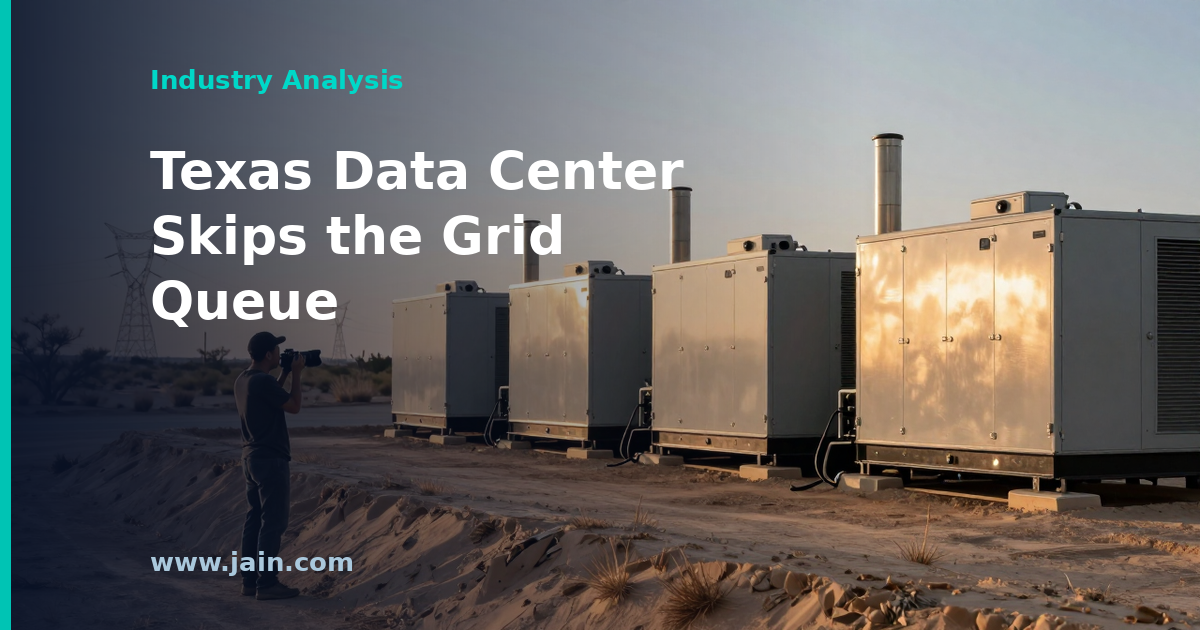
    Data Center Knowledge reported on 9 May 2026 that a Texas data center has stopped waiting for a grid connection and will instead be served by generation sited behind the meter — industry shorthand for power that reaches the load without passing through the utility’s revenue meter, typically from plant on or adjacent to the customer’s own property. The stated trigger is delay in the interconnection queue: the study-and-approval process through which a large new load or generator is modelled, cleared and physically tied into the transmission network.

    The report as circulated to us is headline-level. It does not name the operator, the site, the megawatt capacity, the generating technology, the counterparties or the energisation date, so the size of the commitment cannot be established from this source alone.

    Executive Summary

    The substantiated claim is narrow but consequential: at least one Texas data center project has concluded that private generation is a faster route to electrons than the queue for public grid capacity. That is a decision about time, not ideology. A shell with tenants and no power earns nothing, and self-supply converts a regulatory wait into a construction schedule the operator controls.

    It matters because it inverts a fifty-year assumption in this industry. Data centers were historically sited where large, reliable, cheap grid power already existed; the operator’s job was to buy it well. When queue times stretch past the useful life of an AI hardware generation, the operator’s job becomes building a power plant as a precondition of building a data center — a different balance sheet, a different risk register and a different set of counterparties.

    Read with appropriate caution. A single trade report of a single project establishes a direction of travel, not its magnitude. What follows treats the behind-the-meter decision as reported and examines the economics and risks that any such decision entails, while marking clearly where the source is silent.

    What Behind the Meter Actually Buys — and What It Costs

    Grid power is, in ordinary conditions, the cheapest and least troublesome electricity a data center can buy. Someone else finances the plant, maintains it, holds the fuel contracts, carries the outage risk and spreads the cost across many customers. Going behind the meter means taking all of that onto your own books: capital for generating equipment, firm fuel supply, air permits, spare parts, operators on shift, and redundancy engineered to the availability level your tenants’ contracts require.

    What the operator gets in exchange is a schedule. Interconnection is an administrative queue in which the customer’s position is set by process, not by willingness to pay; on-site generation is a procurement and construction problem, and construction problems respond to money. The arithmetic that makes the swap rational is straightforward: if a leased or pre-let facility is earning nothing while it waits, the carrying cost of idle capital plus foregone revenue can exceed the premium on self-generated power for a long time. That premium is real, and it recurs every year the plant runs.

    The corollary is that this decision is much easier with contracted demand behind it. Speculative capacity rarely justifies a private power plant. Where an operator has firm hyperscale or AI tenancy, the revenue is certain enough to underwrite generation assets; where it does not, behind-the-meter economics look considerably thinner. The report does not tell us which situation applies here, and that distinction changes how much the case should be generalised.

    The Queue Became the Scarce Asset

    For most of the past decade the constraints on data center siting were land, fibre routes, water, tax treatment and labour. Power was a line item. The last few years have promoted grid access to the binding constraint almost everywhere large campuses are proposed, and the practical effect is that a credible, near-dated path to megawatts is now the asset being competed for — more than the acreage it sits on.

    That reordering creates identifiable winners. Suppliers of on-site generating equipment and the engineering firms that install it gain pricing power, because their delivery slots are what a stranded project is actually buying. Landowners with gas pipeline adjacency, existing industrial permits or brownfield interconnects become disproportionately valuable. Developers who can present a financed, permitted power solution can charge for certainty in a market where certainty is scarce.

    The losers are less visible. Developers whose principal advantage was an early queue position lose that advantage when rivals stop queuing. Utilities forgo the load growth that would have supported their own investment cases, and lose the revenue base across which fixed network costs are spread. System planners face a harder forecasting problem when significant demand exists but does not appear as grid load. None of these effects is catastrophic at the scale of one project; all of them compound if the pattern holds.

    Texas Rules, Texas Risks

    Texas is a plausible place for this to surface first. ERCOT, the grid operator covering most of the state, runs an energy-only market and sits largely apart from the two big interconnections that cover the rest of the country, which has historically made it quick to build in and attractive to load. Rapid demand growth has strained that reputation, and Texas has abundant gas infrastructure and a permitting culture that makes private generation a more available answer than it would be in many jurisdictions.

    It also lands in an unresolved policy argument that deserves scrutiny in both directions. Consumer advocates argue that very large loads which self-supply but retain grid ties for backup or standby service should still contribute to the network costs they rely on; operators argue that adding generation alongside new demand relieves rather than burdens the system. Both positions are testable and neither should be accepted on assertion: the fair questions are what the load’s actual grid interaction looks like under stress, whether the on-site plant is dispatchable to the system or purely captive, and what the standby tariff genuinely recovers. Nothing in this report answers those questions for this project.

    The risk ledger is equally concrete. Generating equipment has its own multi-year lead times, so the swap is not automatically fast. Firm fuel transport must be contracted, and fuel price exposure moves onto the operator. Air permitting can consume the schedule the queue exit was meant to save. And behind-the-meter is often a bridge rather than a destination — many operators intend to connect eventually and run private generation as an interim or hybrid arrangement. Whether that is the plan here is precisely the sort of thing the available reporting does not say.

    Background

    Data centers were traditionally sited where large, reliable grid power already existed, alongside fibre routes, water and favourable tax treatment. The rise of AI training and inference workloads has pushed campus power requirements to a scale that many transmission systems cannot absorb quickly, and the interconnection queue — the sequential study process that clears new loads and generators for connection — has become the binding constraint on when a facility can open rather than a routine administrative step.

    Texas is a focal point for that pressure. Most of the state is served by ERCOT, an energy-only market operating largely independently of the wider US interconnections, which long gave it a reputation for speed and low cost and attracted heavy data center investment. As demand growth has outpaced network build-out, operators there have increasingly explored on-site generation, co-location with power plants and other private-supply arrangements. Data Center Knowledge, which reported this case, is a long-established trade publication covering the sector.

    Source: Interconnection Delays Push Texas Data Center Behind the Meter — Data Center Knowledge, 9 May 2026, reporting that grid connection delays have led a Texas data center to adopt behind-the-meter power.

  • Kevin O’Leary’s 9GW Utah Data Center Campus Wins Approval

    Kevin O’Leary’s 9GW Utah Data Center Campus Wins Approval

    A 9-gigawatt AI data center campus backed by investor Kevin O’Leary has been approved in Utah, according to an April 26, 2026 report from Tom’s Hardware. The project is described as generating and consuming more than twice the amount of power the entire state of Utah currently uses — placing it among the largest data center developments ever announced anywhere in the world.

    Executive Summary

    The headline fact is the scale: 9 gigawatts is not a data center in any conventional sense — it is a power project with computing attached. For perspective, 9GW is roughly the output of nine large nuclear reactors, and the report frames it as more than double Utah’s entire statewide electricity draw. Notably, the report says the campus will generate as well as consume that power, which signals a behind-the-meter model: building dedicated generation on site rather than asking the regional grid to supply it.

    The second fact is the word “approved.” Some jurisdictional body has said yes to something — but at headline level, the report does not specify which approval this is: land-use zoning, an air-quality permit, a generation license, or a state economic-development agreement. In mega-project development, each of those is a different gate, and clearing the first one is a long way from moving dirt. What is substantiated here is an approval milestone for an extraordinarily ambitious plan; what is not yet substantiated is financing, customers, a construction timeline, or the generation technology behind the 9GW figure.

    A Power Plant First, a Data Center Second

    The most telling detail in the report is that the campus will “generate and consume” its power. AI campuses at gigawatt scale have collided with a hard constraint across the United States: utility interconnection queues — the waiting lines to connect large new loads to the grid — now stretch years in many regions. Developers who cannot wait are going behind the meter, building their own gas turbines, and in some proposals nuclear or geothermal capacity, dedicated to the site. A 9GW self-generation plan sidesteps the queue but inherits a different set of problems: gas turbine order books are backed up years, fuel supply must be contracted at enormous volume, and on-site generation still typically requires air-quality permits and some grid tie for backup and startup power.

    For lay readers, the practical meaning is this: the binding constraint on AI infrastructure has shifted from chips and buildings to electricity. Projects are now sized and sited around where power can be created, not where fiber or customers happen to be. Utah — with land, gas access, and a development-friendly posture — fits that new map.

    What “Approved” Does and Does Not Mean

    Approval is a genuine milestone; it is also the cheapest one. The industry has spent the past two years in an announcement race, with proposed multi-gigawatt campuses in the U.S., Canada, and the Gulf states collectively promising far more capacity than the supply chain — turbines, transformers, switchgear, chips, and skilled labor — can deliver on the advertised timelines. Analysts increasingly distinguish between announced gigawatts and energized gigawatts, and the gap between the two is wide. Kevin O’Leary himself previously announced a separate multi-gigawatt AI data center park in Alberta, Canada, which illustrates the pattern: high-profile backers can secure land and early approvals quickly, while the capital-intensive middle of the project — measured in tens of billions of dollars for a campus this size — takes years and committed tenants to close.

    None of that makes the Utah project unserious. It makes it unproven, which is the honest status of nearly every gigawatt-class announcement at the approval stage. The credible test will be what follows: named anchor tenants, equipment orders, and financing commitments, not renderings.

    Winners, Losers, and the Utah Question

    If the campus advances, the near-term winners are clear: turbine and electrical-equipment manufacturers with the scarcest order slots, construction and trades labor in Utah, and the state’s tax base. Hyperscalers and AI labs hungry for capacity gain another potential supply option in a market where powered land is the scarcest commodity. The open question is who bears the risks. Behind-the-meter gas generation at this scale raises air-quality and emissions questions; data centers in the arid West raise water and cooling questions; and residents near any 9GW generation complex will have views on all of it. A project sized at more than twice the state’s current consumption will, fairly or not, become a referendum on how Utah wants to participate in the AI buildout — and community sentiment has already slowed or stopped large data center proposals in other states. Developers who engage those concerns early, with specific commitments on emissions, water, and grid impact, have fared better than those who lead with the gigawatt number.

    Background

    The AI boom has turned electricity into the data center industry’s scarcest input. Training and running large AI models requires dense clusters of power-hungry chips, and since 2023 developers have raced to secure “powered land” — sites where gigawatt-scale electricity can be delivered or built. With utility interconnection queues stretching years, a new class of power-first campuses has emerged that builds its own generation on site, and announced capacity across North America and the Gulf now far outstrips what has actually been energized.

    Kevin O’Leary, the investor and Shark Tank personality behind O’Leary Ventures, entered this race with a previously announced multi-gigawatt AI data center park in Alberta, Canada. The Utah campus extends that playbook to the U.S. at even larger scale: at 9GW, the approved plan would exceed the entire current power draw of the state that will host it — a first even by the standards of this buildout.

    Source: New AI data center in Utah will generate and consume more than twice the amount of power the entire state uses — Kevin O’Leary’s 9 Gigawatt Utah data center campus approved — Tom’s Hardware report, April 26, 2026, on the approval of O’Leary’s 9GW self-generating AI campus in Utah.