
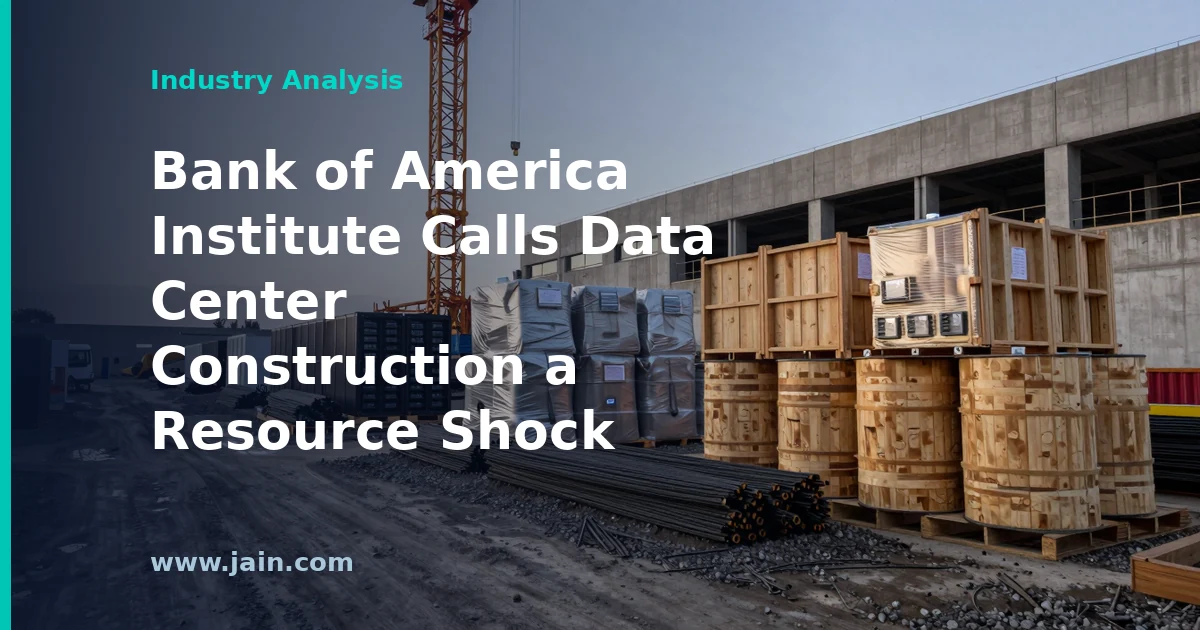
The Bank of America Institute, the research arm of Bank of America that publishes economic analysis drawn from the bank’s data and economists, released a report on June 2, 2026 characterizing the ongoing wave of data center construction as a “resource shock.” The framing points to strain across the three inputs every large-scale digital infrastructure project competes for: skilled construction labor, building materials and electrical equipment, and electric power supply.
Executive Summary
When a major bank’s in-house think tank labels an investment cycle a “resource shock,” it is making an economic claim, not just a descriptive one. A resource shock is a sudden shift in demand for inputs that outruns the supply side’s ability to respond, pushing up prices and lead times for everyone competing for the same resources. Applied to data centers, the term asserts that the AI-driven construction boom is no longer just a story about one industry’s capital spending — it is large enough to move markets for electricians, transformers, generators, concrete, steel, and grid capacity.
That matters because the effects of a resource shock do not stay contained. Other construction sectors — housing, manufacturing plants, public infrastructure — draw on the same labor pools and equipment supply chains. Utilities planning grid investments must now weigh data center load requests against other customers. For an institution with Bank of America’s lending and card-spending visibility into the real economy, elevating this to a formal research theme signals that the strain is showing up in measurable economic data, not just industry anecdote.
Why a Bank Is Sounding This Note
The Bank of America Institute exists to translate the bank’s proprietary vantage point — payments flows, commercial lending, economic research — into public analysis. Its choice of subject is itself informative: research arms of large banks tend to formalize themes their client-facing businesses are already encountering, such as construction lenders seeing bid inflation or corporate clients reporting equipment delays. A “resource shock” framing suggests the institute sees data center demand as a macroeconomic force rather than a niche real-estate story.
It also reflects where the money is going. Data centers have shifted from a specialized corner of commercial real estate to one of the most capital-intensive construction categories in the United States, propelled by hyperscale cloud providers and AI infrastructure buildouts. When a single project can require hundreds of megawatts of power and years of specialized electrical work, a national pipeline of such projects mechanically competes with everything else being built.
The Three Bottlenecks: Labor, Materials, Power
The report’s headline identifies the three constraints practitioners consistently cite. Labor is the most immediate: data centers need unusually high concentrations of electricians, pipefitters, and mechanical trades, and those skills take years to develop. Materials and equipment form the second constraint — long-lead electrical gear such as transformers, switchgear, and backup generators has been the industry’s chronic pain point, with order backlogs measured in years at various points in this cycle.
Power is the deepest constraint because it is the slowest to fix. A data center is ultimately a machine for converting electricity into computation, and connecting large new loads requires generation and transmission investments that operate on utility timescales — often five to ten years for major grid upgrades. This is why power availability, more than land or capital, has become the primary siting criterion for new facilities.
Winners, Losers, and the Cost Question
A resource shock redistributes advantage. Operators with land already secured, grid interconnection agreements signed, and equipment orders placed hold assets that are increasingly difficult to replicate — which supports valuations for incumbent data center platforms. Electrical contractors, equipment manufacturers, and utilities with capacity to sell are on the receiving end of the demand surge. The squeezed parties are those competing for the same inputs without data-center-scale budgets: other construction sectors facing higher trade wages and equipment prices, and potentially ordinary ratepayers if grid upgrade costs are socialized across utility customers rather than assigned to the large loads that drive them.
For enterprises buying colocation or cloud capacity, the practical translation is that scarcity flows through to pricing and lead times. When new supply is gated by labor, equipment, and power, existing capacity commands a premium — a dynamic already visible in historically low vacancy rates across major data center markets. Fair questions run in both directions, though: resource-shock framings can also overstate permanence if demand forecasts prove optimistic or if supply responds faster than expected, as it eventually did in previous infrastructure cycles.
Background
Data centers — the specialized buildings that house the servers behind cloud services, websites, and AI systems — have grown from a niche real-estate category into one of the largest construction stories in the United States. The acceleration began with cloud computing in the 2010s and intensified sharply after 2022, when the generative AI boom pushed hyperscale operators and AI companies into a race for computing capacity, with individual campuses now sized in the hundreds of megawatts. The Bank of America Institute, launched by the bank in 2022 as a public-facing research arm, has made the economic ripple effects of this buildout a recurring subject, and its June 2026 report places the construction surge in macroeconomic terms: as a demand shock hitting labor, materials, and power markets simultaneously.
Source: Data center construction creates a resource shock — Bank of America Institute, a research report characterizing the data center construction boom as a strain on labor, materials, and power supply.