Tag: backup power

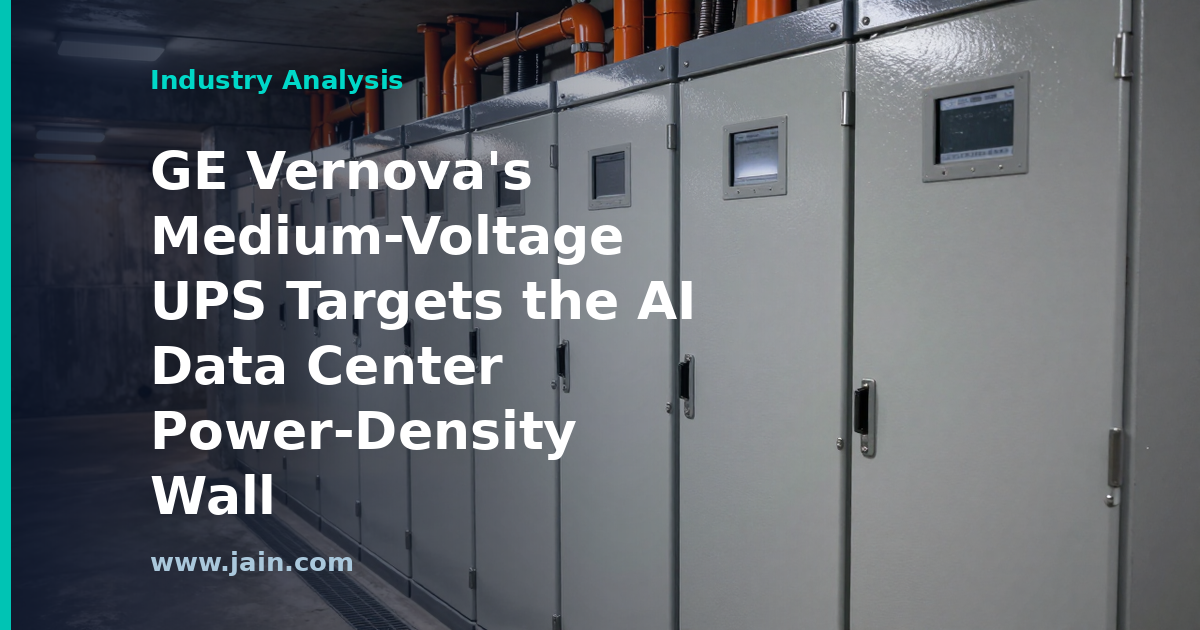
  • GE Vernova’s Medium-Voltage UPS Targets the AI Data Center Power-Density Wall

    GE Vernova’s Medium-Voltage UPS Targets the AI Data Center Power-Density Wall

    GE Vernova, the energy-equipment company spun off from General Electric in 2024, has introduced a medium-voltage uninterruptible power supply (UPS) aimed at AI data centers and other energy-intensive industries, according to coverage by ARC Advisory Group in August 2026. A UPS is the equipment that keeps critical loads powered during the seconds-to-minutes gap between a grid failure and backup generators taking over.

    The significance is architectural: UPS systems for data centers have traditionally operated at low voltage (below 1,000 volts), and moving that protection layer up to medium voltage — typically the 1kV–35kV range — signals that vendors now see AI campuses as too large for the conventional approach to scale gracefully.

    Executive Summary

    The announcement positions GE Vernova’s Electrification business in one of the fastest-growing corners of the power-equipment market: backup power for AI data centers. Training clusters have pushed individual racks toward and past 100kW, and hyperscale and neocloud operators are now planning campuses measured in the hundreds of megawatts. At that scale, the traditional pattern — dozens or hundreds of paralleled low-voltage UPS modules, each protecting a slice of the load — multiplies floor space, copper, conversion losses, and points of failure.

    A medium-voltage UPS protects the load higher up the electrical distribution chain, where the same power flows at higher voltage and therefore lower current. Fewer, larger protection blocks can replace fleets of smaller ones. GE Vernova is not alone in reading the market this way, but a product launch from one of the largest grid-equipment manufacturers is a meaningful signal that medium-voltage protection is moving from niche to mainstream consideration.

    Readers should note the limits of what has been disclosed: the source material available to us is headline-level, and we could not verify power ratings, topology, efficiency figures, availability dates, or customer commitments. Our analysis below addresses the strategy; the specification questions remain open.

    Why Backup Power Is Hitting a Voltage Ceiling

    Power equals voltage times current, so delivering more power at a fixed low voltage means proportionally more current — and current is what sizes conductors, breakers, and busway. A conventional data center UPS operates around 400–480 volts, and at that voltage a single system is practically limited to a few megawatts. Protecting a 100MW campus this way requires very large fleets of paralleled units, each with its own batteries, switchgear, cabling, and maintenance schedule.

    AI has broken the assumptions this architecture was built on. When racks drew 5–15kW, carving a facility into small low-voltage protection zones was sensible. With accelerated-computing racks drawing many times that, and single buildings approaching the load of a small city, the low-voltage approach consumes an increasing share of the floor area, capital budget, and construction timeline. Copper procurement alone has become a visible constraint on data center schedules.

    Moving the UPS to medium voltage — the tier utilities and campuses use for distribution, roughly 1kV to 35kV — cuts current by an order of magnitude for the same power. That means fewer conversion stages between the utility feed and the protected bus, less conductor mass, and protection blocks sized in tens of megawatts rather than single digits.

    The Trade-offs: Fewer, Bigger Blocks Cut Both Ways

    The efficiency and footprint logic is genuine, but consolidation concentrates risk. A campus protected by a handful of large medium-voltage blocks has fewer failure points, yet each failure affects more load — so redundancy design, fault isolation, and maintainability become the make-or-break engineering questions. The release headline does not tell us how GE Vernova’s design addresses concurrent maintainability or fault ride-through, and those answers will matter more to buyers than the voltage class itself.

    Operations change too. Medium-voltage equipment demands different technician qualifications, arc-flash procedures, and service ecosystems than the low-voltage gear most data center facilities teams know. Medium-voltage rotary UPS systems — machines that store energy in a spinning mass rather than batteries — have existed for years from specialist vendors, and they earned a reputation as robust but operationally distinct. Whether GE Vernova’s offering is static (power-electronics-based) or rotary is not stated in the material we reviewed, and it materially changes the competitive comparison.

    There is also a granularity cost. Small modular UPS units let operators grow capacity with demand; large blocks force bigger capital steps. For hyperscalers building entire campuses at once that is a fair trade. For enterprises and smaller colocation operators, it may not be — which suggests this product aims squarely at the top of the market.

    GE Vernova’s Position in a Crowding Field

    Since its April 2024 spin-off from General Electric, GE Vernova has ridden two demand waves: grid modernization and data center electrification. Its Electrification segment sells the transformers, switchgear, and power-conversion equipment that AI campuses consume in bulk, and the company already has relationships with the utilities and hyperscalers making these purchasing decisions. A medium-voltage UPS extends that portfolio one layer closer to the IT load — territory historically held by Schneider Electric, Vertiv, Eaton, and ABB in low-voltage UPS, and by specialist rotary vendors at medium voltage.

    The strategic logic favors integrated suppliers: an operator buying medium-voltage switchgear, transformers, and backup protection from one vendor simplifies interface engineering and accountability. But incumbency in grid equipment does not automatically translate to credibility in mission-critical backup power, where buyers weight field-proven reliability data heavily. The burden of proof — reference deployments, third-party certification, demonstrated availability numbers — sits with any new entrant to this layer, regardless of parent-company scale.

    Background

    GE Vernova was created in April 2024 when General Electric completed its three-way split, separating its energy businesses from aerospace and healthcare. The company spans gas and wind power generation, nuclear technology, and an Electrification segment covering grid solutions and power conversion — the segment most directly leveraged to data center construction. Demand for transformers, switchgear, and backup power has surged with AI buildouts, producing extended lead times across the industry.

    The data center UPS market, meanwhile, has been dominated for decades by low-voltage static systems that convert utility power through batteries via power electronics. As individual AI campuses have grown from tens to hundreds of megawatts, the industry has begun rethinking the entire power chain — higher distribution voltages, direct-current architectures, and now medium-voltage protection — to reduce losses, copper use, and construction time. ARC Advisory Group, which covered this announcement, is an industry-analyst firm focused on industrial and infrastructure technology.

    Source: GE Vernova Introduces Medium-Voltage UPS for AI Data Centers and Energy-Intensive Industries — ARC Advisory Group coverage of GE Vernova’s product introduction, August 2026.

  • PJM Cleared to Shift Data Centers to Backup Power in Heat Wave

    PJM Cleared to Shift Data Centers to Backup Power in Heat Wave

    PJM Interconnection, the grid operator serving 65 million people across 13 states and DC, has received regulatory clearance to instruct data centers within its footprint to shift onto on-site backup generation during a heat-wave-driven grid emergency, according to reporting from Maryland Matters on June 29, 2026.

    The mechanism turns large data-center campuses — normally treated as firm, always-on load — into a de facto peak-shaving resource for the duration of the event.

    Executive Summary

    The clearance matters because PJM is the single largest wholesale power market in North America and the epicenter of the data-center boom driven by AI training and inference workloads. Northern Virginia’s "Data Center Alley" alone accounts for a double-digit share of PJM’s peak demand, and interconnection queues across the footprint are dominated by hyperscale requests.

    Instructing those loads to island onto diesel or gas gensets during a heat wave is a pragmatic short-term relief valve — but it also establishes a precedent that data-center power draw is negotiable in an emergency, something operators have long resisted in contract negotiations with utilities.

    For hyperscalers, colocation providers, and their enterprise tenants, the near-term question is whether this becomes a one-off emergency tool or a template that regulators, utilities, and lawmakers extend into standing tariffs and interconnection conditions.

    A Grid Under AI-Era Stress Finds a New Lever

    PJM has spent the past two seasons warning that reserve margins are tightening faster than new generation and transmission can be built. Data-center load growth — driven overwhelmingly by AI compute — is the most-cited demand-side driver in the operator’s own capacity-market filings. Shifting even a subset of that load onto behind-the-meter generation during peak hours effectively hands PJM a demand-response resource it did not previously have access to at scale. In a market where the last few gigawatts of firm capacity now clear at record prices, that flexibility has real economic value.

    The trade-off is honest but uncomfortable: the backup fleet inside large data-center campuses is typically diesel, sometimes natural gas, and it runs cleaner than an emergency peaker only in the narrowest sense. Air-quality regulators in the Mid-Atlantic have historically capped generator runtime hours precisely because concentrated diesel exhaust during heat events coincides with the worst ground-level ozone conditions. Any recurring use of this mechanism will collide with those permits.

    Winners, Losers, and the New Contract Question

    The immediate winner is grid reliability: keeping the lights on for residential and small-commercial customers during a heat emergency is a policy priority that overrides most other considerations. PJM itself gains optionality and political cover. Utilities in the footprint gain a talking point when regulators ask why more transmission has not been built.

    Data-center operators are in a more complicated position. Publicly, most will support emergency cooperation — refusing looks bad and invites harsher intervention. Privately, the concern is that "emergency" becomes elastic. Enterprise and AI-lab tenants sign colocation and cloud contracts on the premise of firm power; if the underlying facility must periodically island, service-level agreements, insurance, and fuel-logistics assumptions all need re-examination. Expect language on grid-emergency curtailment to become a live negotiation item in 2026 renewals.

    Precedent Risk Cuts Both Ways

    The clearance is best understood as a precedent event rather than a single operational decision. Once a regulator has said yes to load-shifting a hyperscale campus onto backup generation during a heat wave, the harder question is what other conditions qualify: winter peaks, generation outages, transmission constraints, wildfire smoke events on the western edge of the footprint. Each expansion is defensible in isolation and cumulatively significant.

    For policymakers weighing whether to court or constrain new data-center construction, the mechanism cuts both ways. Advocates can point to it as evidence that hyperscale load can be a good grid citizen. Critics can point to it as confirmation that the current build-out is already outrunning firm supply. Both readings are supported by the announcement itself; which one dominates depends on how frequently PJM has to actually use the authority.

    Background

    PJM Interconnection was formed in its modern regional-transmission-organization form in the late 1990s and today coordinates the movement of wholesale electricity across a footprint stretching from Illinois to New Jersey and south to North Carolina. Its capacity market, which pays generators to be available years in advance, is the primary mechanism by which the region secures firm supply.

    The data-center boom of the past decade — first driven by cloud, now accelerated by AI training and inference — has concentrated unprecedented demand in Northern Virginia and secondary hubs in Ohio, Pennsylvania, and Maryland. PJM’s own load forecasts have been repeatedly revised upward, and recent capacity auctions have cleared at record prices, framing the policy backdrop for the current heat-wave clearance.

    Source: PJM gets green light to push data centers onto back-up power during heat wave – Maryland Matters — a Maryland Matters report describing regulatory clearance for PJM to direct data-center load onto on-site backup generation during heat-wave grid emergencies.

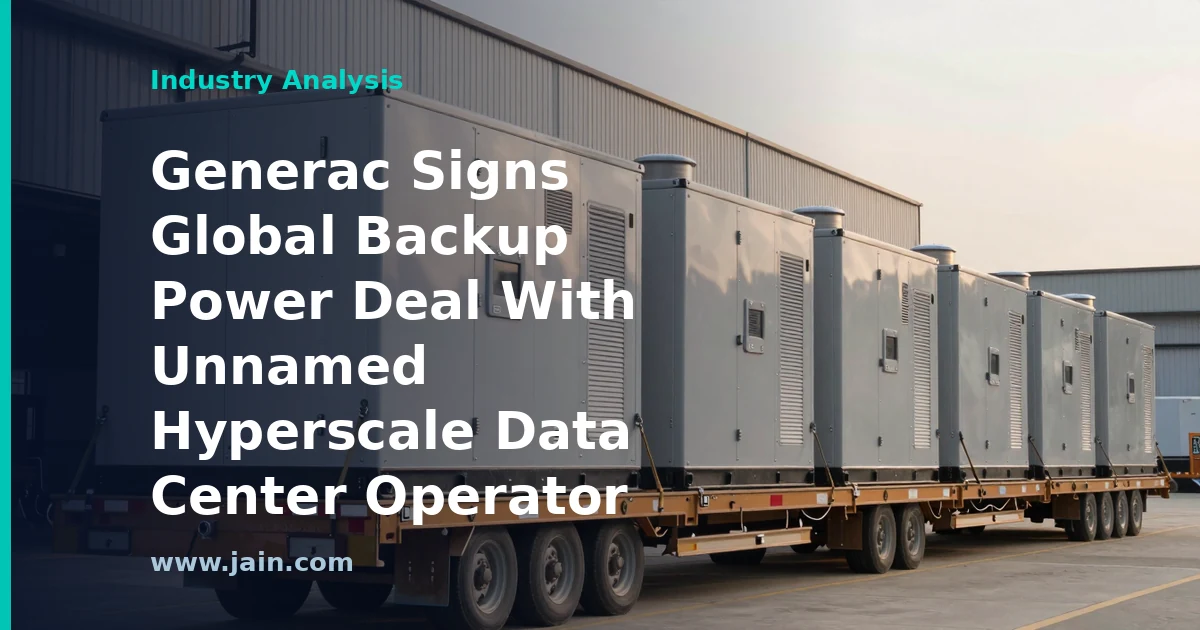
  • Generac Signs Global Backup Power Deal With Unnamed Hyperscale Data Center Operator

    Generac Signs Global Backup Power Deal With Unnamed Hyperscale Data Center Operator

    Generac Power Systems announced on June 1, 2026 that it has signed a global supply agreement to provide backup power equipment to a company it describes as a leading hyperscale data center operator. The customer was not named, and the announcement, distributed via PR Newswire, did not disclose financial terms, unit volumes, or a delivery timeline.

    Executive Summary

    The announcement matters less for its disclosed details — which are minimal — than for what it signals about both parties. For Generac, a company best known for residential standby generators, a global agreement with a hyperscaler is a credibility milestone in the large commercial and industrial power market, where data centers have become the most sought-after customer class. Hyperscalers — the handful of companies operating cloud and AI computing platforms at global scale — historically sourced backup generation from a small set of heavy-industrial incumbents.

    For the data center industry, the deal is another data point in a broader pattern: operators locking in multi-year, multi-region supply of critical electrical equipment rather than procuring project by project. When a hyperscaler signs a global agreement for backup power, it suggests that generator capacity, like transformers and switchgear before it, is now scarce enough to justify strategic sourcing. That framing should be tempered by what the release does not say — no customer name, no dollar value, no megawatt figure — which limits how much weight the announcement can bear.

    Backup Power Moves From Commodity to Constraint

    Every serious data center pairs its utility feed with on-site backup generation — typically large diesel or natural gas generator sets that carry the facility through grid outages. For most of the industry’s history this was routine procurement: generators were a mature, readily available product bought near the end of a project’s design cycle. The AI-driven construction boom changed that. As operators race to bring gigawatts of new capacity online, long-lead electrical equipment — transformers, switchgear, and increasingly generator sets — has become a pacing item that can delay a facility as surely as a missing utility interconnection.

    A global supply agreement is the procurement response to that scarcity. Instead of bidding each project separately, an operator reserves manufacturing capacity across regions and years, trading flexibility for certainty of delivery. The fact that a hyperscaler apparently judged this worthwhile for backup power is itself evidence of how tight the market has become, and it mirrors similar forward-buying behavior seen across the data center supply chain.

    What the Deal Means for Generac

    Generac built its business on home standby generators and mid-sized commercial units, while the largest data center generator orders have traditionally gone to heavy-industrial manufacturers such as Caterpillar, Cummins, and Rolls-Royce’s mtu brand. Generac has spent recent years pushing into larger industrial applications, and a hyperscale win — if it translates into sustained volume — would validate that strategy in the most demanding segment of the market. Hyperscale operators qualify suppliers rigorously, so passing that bar is meaningful even before any units ship.

    The caution is that the release discloses no volumes or revenue. Supply agreements can range from firm multi-year commitments to framework arrangements that simply make a vendor eligible for future orders. Without disclosed terms, investors and industry observers cannot yet distinguish between the two, and the announcement should be read as a positive signal rather than a quantified backlog addition.

    Why Hyperscalers Are Diversifying Their Supplier Base

    From the buyer’s side, adding a supplier makes straightforward sense. When incumbent generator manufacturers carry extended backlogs, a hyperscaler that depends on a narrow vendor list risks having construction schedules dictated by someone else’s factory queue. Qualifying an additional manufacturer at global scale adds resilience, creates pricing competition, and expands total available manufacturing capacity — the same playbook hyperscalers have applied to chips, power equipment, and construction contractors.

    The competitive implication for the wider market is worth watching: enterprise and colocation buyers, who lack hyperscale purchasing power, may find themselves further back in the queue as manufacturers allocate capacity to their largest strategic accounts. Backup power availability could quietly become another dimension on which the largest operators out-execute smaller ones.

    Background

    Generac Power Systems, founded in 1959 and headquartered in Waukesha, Wisconsin, became a household name in residential standby generators — the units that keep homes powered through grid outages. Over the past decade it has expanded into commercial and industrial generation, energy storage, and grid services, seeking growth beyond the housing-linked residential market. The largest tier of that industrial market is data center backup power, a segment long dominated by heavy-equipment incumbents.

    The announcement lands amid an unprecedented data center construction cycle driven by cloud growth and AI computing demand. That boom has strained the supply chains for electrical infrastructure of every kind, prompting the biggest operators to lock in equipment supply years ahead — the context in which a global backup power agreement with a hyperscaler is best understood.

    Source: Generac Signs Global Supply Agreement with Leading Hyperscale Data Center Operator to Supply Backup Power — PR Newswire release, June 1, 2026, announcing Generac’s backup power supply agreement with an unnamed hyperscale data center operator.