TL;DR · 30-second read
The Short Version
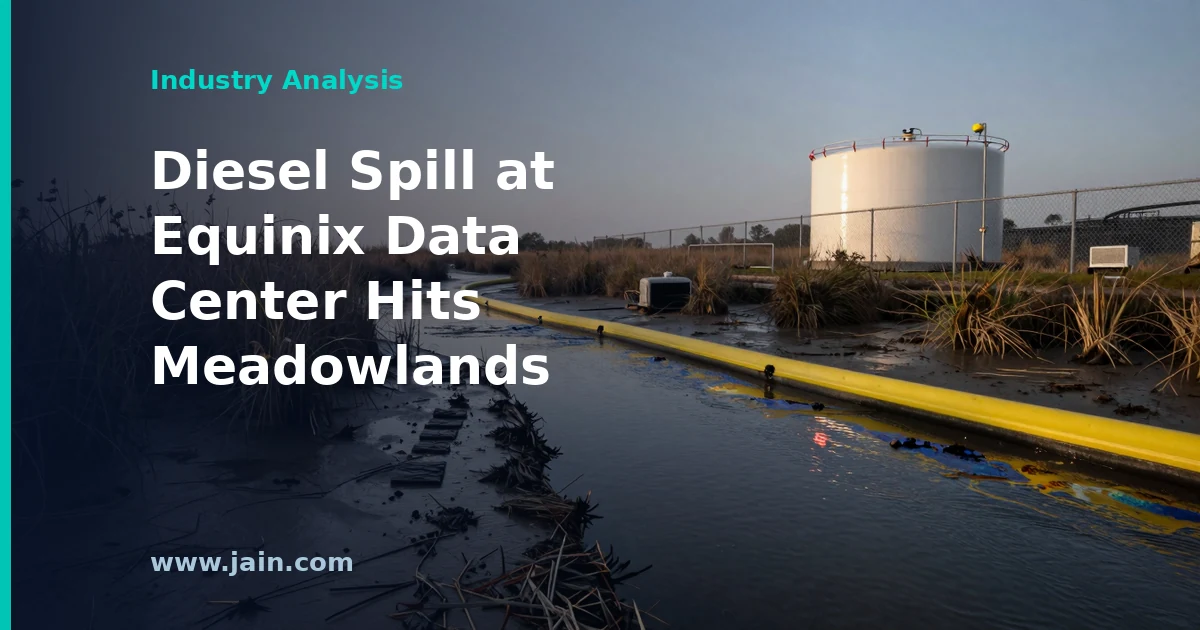
About 5,000 gallons of diesel fuel leaked from a storage tank at a large computer facility in Secaucus, New Jersey. That is roughly half of what a fuel tanker truck carries. It ran into a small creek that feeds the Hackensack River.
The facility belongs to Equinix, which rents space to companies that run websites and online services. Cleanup crews are vacuuming fuel out of the water. State officials say the fuel did not reach the river.
It matters because buildings like this often store large amounts of fuel for emergency generators, and nearly 100 New Jersey towns have already banned new ones.
About 5,000 gallons of diesel fuel spilled from a storage tank at the Equinix data center in Secaucus, New Jersey, and flowed into Anderson Creek, a tributary of the Hackensack River, Gothamist reported on September 14, 2026. That figure comes from the New Jersey Department of Environmental Protection (DEP). Equinix said the leak was detected on Friday evening, September 11. It has hired the environmental services contractor Clean Harbors to handle remediation.
DEP spokesperson Larry Hajna said the creek is small and narrow where the spill occurred and that the fuel was contained before it reached the river. Crews are expected to work at the site for several days. Hackensack Riverkeeper Bill Sheehan and Secaucus Mayor Michael Gonnelli have both called for the state to pursue a natural resource damages claim against the company.
Executive Summary
A fuel-tank leak at one of the New York metro area’s long-established data center sites has become an environmental cleanup and a political flashpoint. Contractors placed a boom (a floating barrier) across Anderson Creek to hold the diesel in place, and vacuum trucks have been pulling a fuel-and-water mixture out for treatment and disposal offsite. Equinix said it will conduct a full investigation and is committed to resolving the situation quickly.
The incident matters beyond Secaucus for two reasons. First, it shows a physical risk that rarely comes up in discussions of data center growth. Many facilities keep large volumes of diesel on site so that emergency generators can run during grid outages. As power availability tightens and operators lean harder on on-site backup, that fuel is a real environmental liability. Second, the spill lands in a state where close to 100 municipalities have enacted local bans on new data centers and activists are pressing the governor for a statewide moratorium.
Local officials were measured about the facility’s history. Gonnelli said the Secaucus site had operated for 25 years without issues, and Sheehan acknowledged that data centers have been in the Meadowlands for decades without causing problems. The open questions are what caused this failure, how much fuel is recovered, and whether the state seeks penalties or restoration funding.
The Diesel Behind the Cloud
Data centers are usually described in terms of servers, fiber and electricity. Their resilience also depends on something far older: fuel. To stay online through a utility outage, most large facilities keep diesel generators, along with on-site storage tanks sized to run them for hours or days. Equinix has not said what the leaking tank supplied, but backup generation is the most common reason a data center stores diesel in quantity.
That fuel is normally managed under spill-prevention rules. Typical safeguards include double-walled tanks, secondary containment berms, leak detection and regular inspections. Because roughly 5,000 gallons reached a creek, at least one of those layers did not hold. Whether the cause was a tank failure, a fueling or transfer error, damaged piping or a containment gap will determine whether this was an isolated equipment problem or a warning about practices across a fleet of aging sites.
Grid Stress Raises the Stakes on Backup Power
The industry’s appetite for power has grown quickly with AI workloads, and utilities in several regions have warned about constrained capacity. Generators exist to cover emergencies. But when grids run tight, operators may test them more often, keep larger fuel reserves, or run them during demand-response events, when utilities ask big users to cut grid consumption. Each of these puts more diesel on site and increases handling.
Nothing reported so far ties this spill to increased generator use or to AI demand, and it would be unfair to draw that link without evidence. The broader point still holds for buyers and investors. The environmental risk in data center portfolios is not just carbon emissions or water use. It also includes the ordinary, local hazard of storing and moving large volumes of fuel near waterways, and that exposure grows as backup power becomes more central to operations.
What a Damages Claim Could Mean
Sheehan wants New Jersey to pursue a natural resource damages claim. That is a legal mechanism under which a polluter pays to restore harmed ecosystems, separate from cleanup costs or fines. He pointed to a 1994 barge spill that put 310,000 gallons of caustic soda into the Hackensack River, which he said led to dedicated funding for the restoration of Lincoln Park in Jersey City. Mayor Gonnelli said he supports that push. The DEP said it did not yet have information on potential fines or enforcement.
Timing makes this more sensitive than a typical industrial spill. The Hackensack River was placed on the federal Superfund list, the program for the country’s most contaminated sites, in 2022, and a major cleanup is approaching. For Equinix, the direct financial exposure from remediating a contained spill is likely modest for a company of its size. The reputational and regulatory cost in a state actively debating limits on data centers could be harder to quantify.
A Flashpoint in New Jersey’s Data Center Debate
Opponents of data center expansion quickly cited the spill. Ben Dziobek of Climate Revolution Action Network argued that data center problems, including pollution, grid strain and higher electric bills, do not stop at municipal borders and warrant state action. Governor Mikie Sherrill’s office declined to comment and referred questions to the DEP.
Every side’s claims deserve a fair test. This single incident, at a site local officials say ran cleanly for a quarter century, does not by itself show that data centers are environmentally unsafe. Nor does it settle the argument over electricity prices, which the spill does not bear on. At the same time, the industry’s assurances that its facilities are low-impact neighbors depend on safeguards like fuel containment actually working. Equinix’s investigation findings, and whether it shares them, will matter for more than one creek.
Background
Equinix is one of the world’s largest colocation data center operators. It rents secure space, power, cooling and network interconnection to enterprises, cloud providers and network carriers, and it trades on Nasdaq under the ticker EQIX. Its Secaucus facility sits in the New Jersey Meadowlands, a longtime hub for data centers serving the New York financial and media markets. Local officials say the site has operated there for about 25 years.
The Meadowlands are a network of wetlands, creeks and tidal waterways feeding the Hackensack River, which was designated a federal Superfund site in 2022 after decades of industrial pollution. New Jersey has become a battleground over data center growth. Close to 100 municipalities have enacted local bans on new facilities, and advocacy groups are pressing for a statewide moratorium, citing pollution, grid strain and electricity costs. Source: Data center spills 5K gallons of diesel into New Jersey Meadowlands (Gothamist), reporting on a diesel leak at Equinix’s Secaucus data center and the cleanup and political response.Sources