Amazon plans to spend $1 billion on the towns and counties where it builds data centers. Data centers are the giant warehouses of computers that run websites, apps and artificial intelligence tools.
The pledge comes as more neighbors push back against new data centers being built near them.
Why it matters: winning local approval has become something tech companies pay for. If the money gets projects approved faster, other companies will likely copy it. If it doesn’t, the delays stay.
AP News reported that Amazon plans to invest $1 billion in communities that host its data centers, amid growing backlash against data center rollouts. The commitment is aimed at the localities where Amazon builds and operates the facilities behind its cloud and AI computing services.
Executive Summary
Amazon is putting a single, company-level figure on something data center developers have usually handled project by project: the cost of keeping host communities on side. A $1 billion pledge directed at those communities, made explicitly against a backdrop of local opposition, moves community relations from a public-relations task to a budgeted cost of building capacity.
The pledge matters because local decisions, such as zoning, special-use permits and public hearings, increasingly set how fast new data center capacity comes online. That capacity is the physical foundation for AI. Every month a site spends in approvals is a month the computing it would house is not available.
The open question is whether money buys speed. A pledge counts as infrastructure strategy only if it shortens approval timelines or reduces the share of projects stalled by opposition. Otherwise it is goodwill spending.
Local Consent Becomes a Line Item
Building a data center depends on a chain of local approvals: rezoning land, securing special-use or building permits, negotiating tax arrangements and, often, getting through public hearings where residents can object. Each step is a point where opposition can add months or stop a project. For a company building capacity to meet AI demand, that delay has a direct cost: the land, equipment orders and power arrangements sit idle while the approval clock runs.
Developers have long offered site-specific concessions, such as road improvements, local hiring or school funding, negotiated one project at a time. A $1 billion pledge aimed at host communities, announced as a single corporate commitment in response to backlash, changes that. It treats community acceptance as a recurring cost of doing business, budgeted like land, power or construction. That is the core of the shift: Amazon is acknowledging that local consent is now an input to capacity, not an afterthought.
The people affected are the ones on both sides of the approval table. Local officials gain bargaining weight. Utilities and regional planners may see projects move faster or slower depending on how hearings go. Competing developers now negotiate against a visible benchmark.
The Test Is Speed, Not Goodwill
Whether the pledge works depends less on its size than on its design. Money that is written into binding, site-specific agreements, often called community benefit agreements, gives local boards something enforceable to point to when they vote. Discretionary grants announced at the corporate level are easier to dismiss as public relations, especially by residents whose objections concern the facility itself rather than a lack of local funding.
The concerns raised against data centers in many markets include strain on the electric grid and possible effects on household power bills, water use for cooling, noise from equipment, loss of farmland or open space, and tax breaks that reduce local revenue. Funding a park does not answer a question about the grid. The pledge is most likely to speed approvals where the money is matched to the specific objection at each site, for example by offsetting infrastructure costs residents fear they will bear.
The measurable outcomes are concrete: shorter time from site announcement to approval, fewer projects withdrawn or denied, and fewer conditions attached late in the process. Those are the numbers that would show whether this is infrastructure strategy.
A New Baseline for Everyone Else
Every large cloud provider and data center developer goes through the same local processes. If Amazon’s approach visibly shortens approval timelines, competitors have a strong reason to match it. That would raise the starting point in every future negotiation. Large hyperscalers, the biggest cloud companies, can absorb that cost. Smaller developers and colocation operators, which rent data center space to multiple tenants, may find it harder to compete for contested sites.
There are risks on both sides of the argument. For the industry, a large pledge can draw more scrutiny rather than less if residents see it as an attempt to buy approvals rather than resolve concerns. For critics, the pledge is a direct test of their case: if the objections are about real local costs, well-designed community investment should address some of them. If opposition continues regardless, it suggests the concerns lie with the facilities themselves, which no payment fixes. Both readings deserve to be tested against what happens at actual sites.
Background
Amazon, through its Amazon Web Services cloud unit, is one of the world’s largest builders and operators of data centers, the facilities that store data and run software for millions of customers. Demand for computing, particularly for training and running AI models, has driven a wave of large data center construction by the biggest cloud providers, often called hyperscalers.
As these facilities have grown larger and more numerous, they have drawn more attention from the communities around them. Local zoning boards, county commissions and public hearings, once routine steps, have become points where residents can raise objections about power, water, noise and land use. That has made community relations a factor in how quickly new capacity can be delivered.
Amazon is reportedly trying to sell about $8 billion worth of Nvidia computer chips (the specialized processors that power artificial intelligence services) to outside investors.
That is unusual. Big tech companies normally buy these chips and keep them. Selling them would let Amazon free up cash while someone else owns the hardware.
The catch is that these chips can lose value quickly as newer models arrive. Investors who buy in are betting the chips stay useful long enough to pay off. That bet could shape how the artificial intelligence boom gets paid for.
Amazon is seeking to sell roughly $8 billion worth of Nvidia chips to investors, Reuters reported, citing the Financial Times. The chips are graphics processing units (GPUs), the processors that train and run most large AI models. Amazon has not publicly disclosed the structure, the buyers, the pricing or the timing of the transaction, and the effort is described as being sought rather than completed.
Executive Summary
The world’s largest cloud provider is reportedly looking to move a large block of AI hardware it already owns into the hands of outside investors. At $8 billion, this would be one of the largest single transfers of GPU ownership from a hyperscaler (the industry term for the handful of giant cloud operators such as Amazon Web Services, Microsoft Azure and Google Cloud) to financial buyers.
The transaction matters less for what it does to Amazon’s AI capacity, which has not been disclosed, than for what it asks of the buyers. Anyone paying $8 billion for GPUs has to put a price on things the industry has argued about for two years: how fast these chips become obsolete, how reliably they will be rented out, and who is on the hook if they are not. The answer will show whether AI compute can be financed like aircraft or real estate, as an asset owned by one party and used by another, or whether it stays an asset that only the largest technology companies can hold.
Why a Cloud Giant Would Sell Chips It Already Owns
Hyperscalers have historically funded data center buildouts themselves, out of operating cash flow and corporate bonds, and owned the servers inside outright. Selling installed or purchased hardware breaks with that pattern. Amazon has not explained its reasons. Transactions of this kind usually serve one of two purposes. The first is capital recycling: convert hardware into cash that can be redeployed into new data centers, power contracts or newer chips. The second is balance-sheet management: shift ownership, and with it the depreciation (the accounting charge that spreads a purchase’s cost over its useful life), to another party.
Which purpose applies depends on a detail Amazon has not disclosed: whether it keeps using the chips. In a sale-leaseback, a familiar structure in real estate and aviation, the seller hands over ownership and pays rent to keep operating the asset. In an outright sale, the chips leave Amazon’s fleet entirely. The two lead to very different conclusions about Amazon’s own capacity plans, which is why the reported $8 billion figure alone does not show whether Amazon is adding flexibility or reducing exposure.
What an $8 Billion GPU Buyer Actually Has to Underwrite
This is where the transaction becomes a test of GPUs as an investable asset. A building or a jet has decades of useful life and a deep resale market. An AI accelerator has neither. Nvidia releases new chip generations on a short cycle, and each one resets the performance customers expect per dollar and per watt. An investor holding older GPUs is exposed to that curve. The hardware may still work perfectly, but the rent it can command falls as newer chips arrive.
That leaves a buyer two ways to earn a return, and each has a different risk. If Amazon leases the chips back, the investor is mostly underwriting Amazon’s promise to pay. That is a strong credit, and the deal starts to look like corporate lending with GPUs as collateral. If Amazon does not lease them back, the investor is underwriting the chips themselves: their resale value, the cost of hosting and powering them elsewhere, and the strength of demand from other cloud tenants. Pricing that second scenario at $8 billion would be a much bolder bet on GPU residual value, meaning what the hardware is worth after its first few years of use.
Either way, the price investors will pay is information the market has lacked. Little public data exists on what large blocks of used AI accelerators are worth to financial buyers. A completed transaction at this size would give lenders, insurers and equipment financiers a reference point for valuing GPU collateral elsewhere in the industry.
Who Gains if GPUs Become a Financed Asset
If investor appetite proves deep, the most immediate beneficiaries are capital-hungry builders outside Big Tech: specialist GPU cloud providers, often called neoclouds, and data center developers whose growth depends on borrowing against hardware. A market in which a hyperscaler can sell GPUs to investors is also one in which a smaller operator can borrow against them more easily. For hyperscalers, it adds a funding channel at a time when AI capital spending is large enough to draw scrutiny from shareholders.
The risks fall on the other side of the ledger. Moving hardware ownership to investors does not remove the obsolescence risk. It relocates it, possibly into funds and credit vehicles that are less able to absorb a fast drop in chip values than a cloud operator that can redeploy older chips to cheaper workloads. For Nvidia, the transaction involves chips already sold and does not by itself change its revenue. A deeper financing market could still widen the pool of buyers able to afford its next generation. That makes the terms of any completed deal more informative than the headline number.
Background
Amazon Web Services is Amazon’s cloud computing division and one of the largest buyers of AI hardware in the world. It purchases Nvidia GPUs and also designs its own AI chips, including Trainium. Nvidia is the leading supplier of the accelerators used to train and run large AI models, and it releases new chip generations on a short cycle.
Hyperscalers have traditionally financed data centers and servers themselves and owned that hardware outright. As AI spending has grown, outside capital has moved into the sector. Specialist GPU cloud providers routinely borrow against their chips, and investors have debated how quickly AI accelerators lose value. The reported Amazon transaction brings that financing model to the scale of the largest cloud operator.
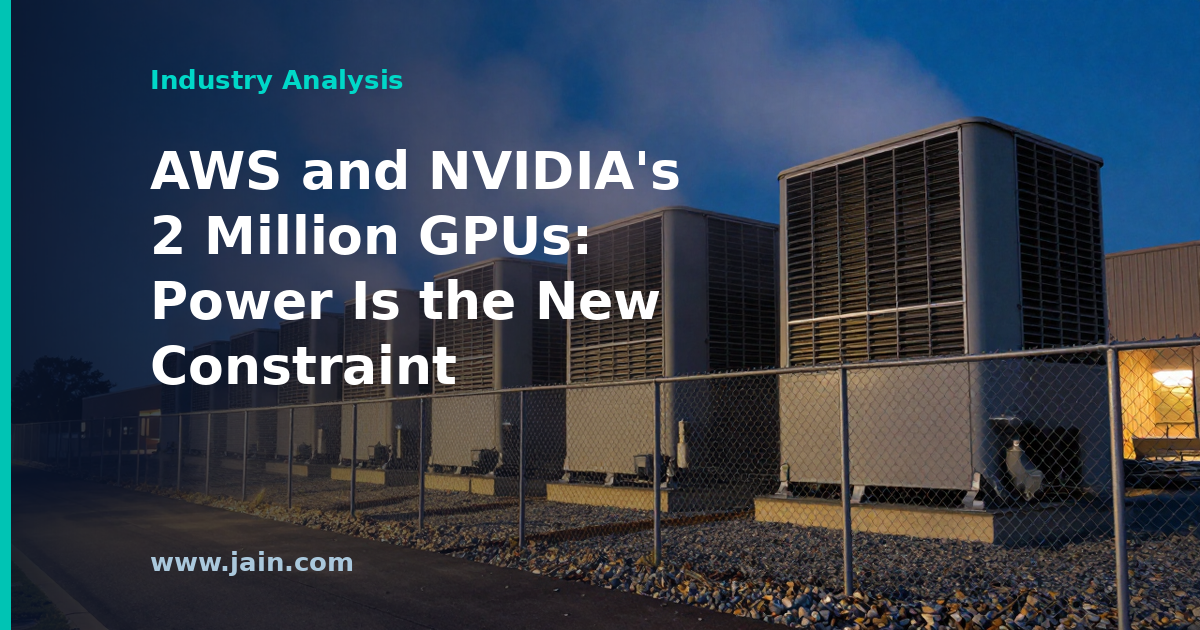
NVIDIA and Amazon Web Services have announced an expanded partnership to deliver 2 million additional GPUs and next-generation infrastructure aimed at agentic AI (software that plans and executes multi-step tasks rather than just answering prompts) and physical AI (robotics, autonomous machines and industrial systems). Both companies published the news through their own newsrooms.
The announcement lands alongside two related data points: TechCrunch reports that Amazon has tripled its order of Nvidia chips, citing “surging demand,” and the Associated Press reports that Nvidia’s second-quarter results came in well beyond Wall Street’s expectations on the strength of AI chip demand. Together they describe one buyer, one supplier, and a step-change in contracted volume.
Executive Summary
The headline number — 2 million GPUs — matters less for what it says about Nvidia’s order book than for what it implies about the physical plant required to land it. A GPU is a graphics processing unit: a chip built for massively parallel math, and the workhorse of AI training and inference. Two million of them is not a purchase order; it is a multi-year industrial programme that has to be matched by buildings, substations, transformers, switchgear, water or refrigerant loops, and fibre.
Read together with Amazon’s tripled chip order and Nvidia’s Q2 beat, the pattern is a shift in how hyperscalers buy. Opportunistic, quarter-by-quarter allocation chasing has given way to committed, long-horizon supply agreements — the procurement posture of an airline ordering airframes, not a retailer restocking shelves. That change is rational when lead times on the surrounding infrastructure run longer than the lead time on the chips themselves.
For anyone who builds, powers or cools digital infrastructure, the strategic reading is straightforward: the scarce input is migrating downstream. When silicon supply is contracted years ahead, the question that determines whether capacity actually arrives on schedule is no longer “can you get the accelerators?” but “where will you land them, what feeds them, and what carries the heat away?”
Procurement Has Gone Industrial
A commitment expressed in millions of units, spanning generations of hardware, behaves differently from a spot purchase. It requires the supplier to reserve foundry capacity, advanced packaging and high-bandwidth memory allocation well in advance, and it requires the buyer to commit capital before the demand it serves is fully booked. Both sides are trading flexibility for certainty — the classic structure of industrial supply contracts in aerospace, energy and heavy manufacturing.
That framing explains why Amazon tripling its order and Nvidia beating expectations are the same story told from two ends of the same contract. The supplier’s revenue recognition and the buyer’s capital plan are now coupled over a multi-year horizon. The upside is predictability: fabs can plan, and data centre teams can sequence construction against known delivery windows. The downside is that a demand forecast, once converted into contracted volume, is expensive to be wrong about.
It also raises the entry price for everyone else. When a large share of leading-edge accelerator output is spoken for by a handful of buyers with balance sheets to match, smaller clouds, enterprises and national programmes are not competing on price so much as on queue position — and increasingly on whether they can offer the supplier something the hyperscalers cannot.
The Binding Constraint Moves From Silicon to the Envelope
AI accelerators concentrate far more power into a rack than the general-purpose servers most existing data centre halls were designed around. That concentration is what forces the shift from air cooling to liquid — direct-to-chip cold plates or immersion — and what turns electrical distribution, from the utility interconnect down through transformers, switchgear and busway, into the pacing item of a build. None of that is fast. Utility interconnection studies, transformer manufacturing and high-voltage equipment orders routinely take longer than a chip generation.
This is the practical significance of a 2-million-GPU commitment for infrastructure operators. The chips have a delivery schedule; the power envelope has a permitting, procurement and construction schedule; and the two only intersect if someone sequenced them together years earlier. Capacity that cannot be energised and cooled on time is not capacity — it is inventory.
The physical-AI element of the announcement adds a second dimension. Robotics and autonomous systems generate inference demand at the edge and in regional facilities, not only in a handful of mega-campuses. If that materialises at scale, it argues for distributed, latency-sensitive capacity in metros — a different real-estate and connectivity problem from the remote gigawatt campus, and one where existing colocation footprints and dense fibre routes have a genuine structural advantage.
Who Benefits, and Where the Risk Sits
The clearest beneficiaries beyond the two named parties are the suppliers of the envelope: power developers and independent producers, electrical equipment manufacturers, liquid-cooling vendors, mechanical and electrical contractors, and colocation operators with energised, high-density-ready shells. Scarcity in those categories is not a temporary shortage caused by one deal; it is a structural mismatch between how quickly chips can be fabricated and how slowly grid infrastructure can be built.
The risk is concentration and timing. A programme sized in millions of units assumes sustained demand for agentic and physical AI workloads that are, today, earlier in commercial adoption than large language model inference. If adoption arrives more slowly than the delivery schedule, the exposure is not primarily in the chips — which can be redeployed to other workloads — but in the long-lived, single-purpose assets built to host them, and in the power contracts signed to feed them.
For enterprise buyers, the near-term implication is capacity planning, not panic. More contracted supply should, over time, ease the availability constraints that have shaped GPU cloud pricing. But it will not ease them uniformly: availability will follow where power and cooling land first, which makes region selection, interconnection and committed-use terms more consequential in procurement than headline instance pricing.
What These Announcements Do and Do Not Substantiate
It is worth being precise about the evidentiary base. What is on the record is a stated intent to deliver 2 million additional GPUs and next-generation infrastructure, a reported tripling of Amazon’s chip order attributed to surging demand, and a quarterly result that exceeded analyst expectations. Those are meaningful, and the financial result in particular is an audited, externally verifiable data point rather than a marketing claim.
What is not established by these announcements is the delivery schedule, the capital commitment, the split between training and inference capacity, the regions involved, or the power procurement behind them. “Additional” is doing real work in the headline and is not defined against a stated baseline. A vendor-and-customer joint announcement is, by construction, the parties’ own account of their arrangement; it is a statement of direction, not a disclosure document.
None of this makes the announcement thin — the direction it signals is consistent with the independently reported financial results. But the useful posture for infrastructure planners is to treat the 2-million figure as a demand signal for power, cooling and land, and to wait for filings, permit applications, interconnection queue entries and utility disclosures for the details that determine when and where the capacity actually appears.
Background
NVIDIA designs the GPUs and accompanying networking and software that underpin most large-scale AI training and a growing share of inference. Amazon Web Services is the largest public cloud provider and has long combined third-party accelerators with silicon of its own design. The two have partnered on AI infrastructure for years; this announcement extends that relationship rather than establishing it.
The context is a multi-year build-out in which cloud providers have committed unprecedented capital to AI capacity. Early in that cycle, the scarce resource was the accelerators themselves, and access to allocation was a competitive differentiator. As supply agreements have lengthened and volumes have grown, attention across the infrastructure industry has moved to the constraints that cannot be solved by a purchase order: grid capacity, interconnection queues, long-lead electrical equipment, and the retrofit or replacement of facilities designed for a lower power density than AI hardware demands.
Amazon has launched a $25 billion bond sale to help fund its artificial-intelligence infrastructure buildout, according to a report published by SiliconANGLE on July 6, 2026. The offering ranks among the largest corporate debt raises of the year and is aimed squarely at the data centers, chips, and power capacity behind Amazon’s AI ambitions.
Executive Summary
The announcement itself is simple: Amazon is borrowing $25 billion in the investment-grade bond market, and the stated purpose is AI infrastructure. What makes it significant is what it says about scale. Bond sales of this size were once reserved for blockbuster acquisitions; here, the “acquisition” is compute — data center campuses, accelerator chips, networking, and the electricity to run them.
It also confirms a structural shift in how the AI buildout is financed. The largest cloud providers, long famous for funding expansion out of their own operating cash flow, are increasingly turning to debt markets because annual capital spending has grown beyond what even their formidable cash generation comfortably covers. When the world’s biggest companies must borrow tens of billions to keep pace, AI infrastructure stops being just a technology story and becomes a fixed-income story — one that credit investors, utilities, and data center operators all have a stake in.
From Cash Machine to Serial Borrower
For most of the cloud era, hyperscalers — the handful of companies operating cloud platforms at global scale, such as Amazon, Microsoft, and Google — were net generators of cash. Capital expenditure was enormous but sat inside operating cash flow, so bond issuance was occasional and opportunistic. The AI cycle broke that pattern. Late 2025 saw a wave of jumbo hyperscaler bond deals, including a roughly $15 billion Amazon offering — its first major issuance in years — and even larger raises by peers. A $25 billion follow-on just months later suggests this is not a one-off top-up but a financing model: recurring, large-scale debt issuance to fund a multi-year infrastructure program.
That model is rational. Debt is well suited to long-lived physical assets — buildings, substations, cooling plants — and investment-grade borrowers of Amazon’s standing can raise it cheaply relative to the returns they project on AI services. The open question is duration matching: much of AI capex is not thirty-year buildings but accelerator chips (specialized AI processors) that may be economically competitive for only a handful of years. Borrowing long against assets that depreciate fast is a bet that AI revenue arrives on schedule.
Big Enough to Move the Bond Market
A $25 billion deal is not just large for Amazon; it is large for the market it lands in. Offerings at this scale absorb a meaningful share of investment-grade demand in the weeks they price, influence credit spreads (the extra yield investors demand over government bonds) for other issuers, and increase the weight of technology names in bond indexes that pension funds and insurers track. In effect, AI infrastructure is becoming an asset class within corporate credit — a bundle of quasi-utility bonds backed by the cash flows of cloud computing.
That has two second-order effects. First, it gives fixed-income investors — a far larger pool of capital than equity or venture markets — direct exposure to the AI buildout, which deepens the funding available for it. Second, it concentrates risk: if AI demand disappoints, the losses would no longer be confined to stock prices but would show up in credit portfolios that are meant to be the conservative part of institutional balance sheets. Nothing in this offering suggests distress — Amazon remains among the strongest credits in the market — but scale itself changes the risk picture.
Where the $25 Billion Actually Goes
“AI infrastructure” is shorthand for a long supply chain. Bond proceeds at this scale ultimately flow to chipmakers, to construction firms building data center shells, to electrical and cooling equipment vendors, to fiber and networking suppliers, and to utilities contracting new generation and transmission. For the data center industry, sustained debt-funded hyperscaler capex is demand visibility: it signals that orders for land, power, and capacity should continue well beyond the current fiscal year.
It also sharpens the competitive divide. Operators and regions that can deliver powered land — sites with grid connections, water or alternative cooling, and permits already in hand — are positioned to capture this spending. Those that cannot will watch it flow elsewhere. And because the hyperscalers can borrow at scale that colocation providers and smaller developers cannot match, cheap debt access itself becomes a competitive moat in the infrastructure race.
The Sustainability Question
The measured way to read this deal is as a confidence signal with a caveat. Amazon borrowing $25 billion says its leadership expects AI demand to justify the capacity — companies do not typically lever up to build assets they expect to idle. The caveat is that the entire industry is making a correlated version of the same bet, financed increasingly with borrowed money. If AI monetization compounds as projected, these bonds will look like textbook infrastructure finance. If it stalls, the sector will be servicing debt on capacity that arrived ahead of revenue.
History offers both comfort and warning. The fiber overbuild of the late 1990s was also debt-financed infrastructure ahead of demand; the capacity was eventually used, but not before wiping out many of its financiers. The difference this time is balance-sheet quality: the borrowers are among the most profitable companies ever to exist, with diversified revenue outside AI. That is a genuine buffer — but it is a buffer, not a guarantee.
Background
Amazon operates Amazon Web Services (AWS), the world’s largest cloud computing platform and the profit engine that has historically funded the company’s expansion. For most of the cloud era, Amazon and its hyperscale peers paid for data center growth out of operating cash flow, issuing bonds only occasionally. The generative-AI boom that accelerated from 2023 onward changed the math: annual capital budgets across the largest cloud providers climbed into the tens and then hundreds of billions of dollars, driven by AI chips, new data center campuses, and power procurement.
By late 2025 that spending had spilled into the bond market, with several of the largest technology companies — Amazon among them — launching some of the biggest corporate debt offerings on record to fund AI infrastructure. The $25 billion sale reported in July 2026 continues that shift, cementing debt markets as a core funding channel for the AI buildout rather than an occasional supplement.
Amazon says the buildings that run its websites, apps and artificial intelligence services use about one-seventh the water of a typical facility of their kind.
The main trick is letting the computers run warmer. Outside air cools the buildings about 90% of the time. Water is used only when it is hotter than about 85 degrees Fahrenheit outside.
This matters because these buildings are multiplying, and their neighbors want to know how much local water they take. The open question is whether the newest artificial intelligence chips, which Amazon says needed a new kind of liquid cooling, will let that approach last.
Amazon said in a June 11, 2026 post on its About Amazon site that its global data center operations used 0.12 liters of water per kilowatt-hour (L/kWh) in 2025. The company puts that at more than seven times better than an industry average of 0.84 L/kWh and says it is a 52% improvement since 2021. It withdrew about 2.5 billion gallons of water across its global data center footprint in 2025.
Amazon credits two things for the result. The first is free-air cooling, which it uses about 90% of the time. The second is higher server temperature limits, so that evaporative cooling runs only when outside air is above roughly 85°F. The company also said it is 75% of the way to its 2030 water-positive goal and that it runs 26 facilities on 100% reclaimed water, with 130 more contracted.
Executive Summary
Amazon has published a headline water-efficiency figure for its data centers: 0.12 liters of water for every kilowatt-hour of energy in 2025. It set that against an industry average of 0.84. The company explains how it got there. It relies on outside air for most cooling, uses evaporative cooling only in the hottest hours, and has spent several years raising the temperatures its servers are allowed to run at. It says this cut water use without raising hardware failure rates.
The figure matters because water has become one of the main local questions asked of new data center campuses. Amazon’s explanation also shows that water efficiency is a set of engineering trade-offs, not a fixed property of a building. The company chose to use some water on hot days rather than run chillers, which it says need 25% to 35% more electricity at the moments the grid is most stressed.
Two things are harder to assess. One is the comparison itself: Amazon did not publish how the 0.84 average was built or on what basis each peer’s figure is measured. The other is the future. Amazon says denser AI chips already required a custom liquid cooling system, so the air-first approach behind the 7x figure now has to hold up as AI capacity grows.
The Water Number Is Really a Temperature Number
Amazon’s 0.12 liters per kilowatt-hour did not come from a new water technology. It came from deciding how rarely to use water at all. About 90% of the time, Amazon says, its data centers use free-air cooling. Outside air is drawn past the servers and pushed back out, with no water involved. Water comes into play only through evaporative cooling. In that process, hot air passes through a water-soaked medium and cools by five to 10 degrees as the water evaporates. Amazon now switches that on only when outside air exceeds roughly 85°F.
That threshold is the lever. Every degree of heat the servers can tolerate removes hours from the evaporative season, so raising operating temperatures cuts water use directly. Amazon’s own evidence is specific:
Two identical data centers on the same campus, one running hotter, differed by about 50% in water use.
Northern Virginia, its largest region by IT load (the power drawn by the computing equipment itself), cut water use 42% year over year while demand grew.
Thousands of hours of campus data showed no increase in failure rates at the higher temperatures.
Those results fit the 52% efficiency improvement Amazon reports since 2021.
The same logic is why this is a test for AI-era cooling. The approach depends on air being able to carry heat away from the servers. Amazon itself says denser, more powerful AI chips required a completely custom liquid cooling system. It has not said how much of its fleet now runs that way, whether those systems rely on evaporative water on hot days, or how a growing share of AI capacity will move the 0.12 figure. The air-first playbook behind the 7x gap was proven on the fleet Amazon has run since 2021. Whether it carries over to high-density AI halls is the next data point to watch.
Water or Watts: The Trade Behind the Ratio
Amazon is explicit that a low water number is partly a choice about electricity. The alternative it names is chillers, which work like giant air conditioners and, by Amazon’s figures, typically need 25% to 35% more electricity. The timing of that extra load is the problem. It arrives in the hottest hours, when household air conditioning is already straining the grid. Amazon concluded it is better to spend some water on those days than to add power demand at the peak.
That is a defensible engineering position, and it cuts against a simple reading of water metrics. An operator could report a lower water ratio by running chillers, which shifts the burden onto the grid and, depending on how that electricity is generated, onto water used off site. Conversely, a site that uses more water may be sparing a stressed grid. For utilities and local planners, the useful question is how much water and how much power a campus uses together at the peak hour, not either one in isolation.
Amazon did not quantify the grid side of its trade. It has not said how much peak demand evaporative cooling avoids across its fleet, or how many hours a year its sites in hot regions exceed 85°F. Without those figures, the argument rests on the chiller penalty range alone.
Why 0.12 and 0.84 Are Hard to Line Up
Liters per kilowatt-hour is the industry’s standard water-efficiency ratio, often called water usage effectiveness. It divides the water used for cooling by the energy consumed by the IT equipment. Amazon describes it as water per unit of compute, but the denominator is energy, not work done. A fleet running more efficient chips gets more computing out of each kilowatt-hour, and the metric does not capture that in either direction.
The 7x claim depends entirely on the 0.84 industry average. Amazon’s chart cites sustainability reports and blogs from Microsoft, Google and Meta alongside its own report. The company did not publish how 0.84 was derived: which operators it covers, how they were weighted, or whether each figure measures water withdrawn (taken from a source) or water consumed (evaporated and not returned). Large operators do not all report water the same way, so a like-for-like reading requires knowing which basis each number uses.
Scope matters too. Amazon’s absolute figure, about 2.5 billion gallons in 2025, is a withdrawal number for its global data center footprint. The 2% year-over-year decline it cites applies only to sites it owns and operates directly. The company did not say whether the 0.12 ratio is based on withdrawal or consumption, or whether leased facilities are included. None of that makes the claim wrong. It does mean the 7x multiple is Amazon’s own calculation rather than a figure a reader can reproduce from peers’ reports.
Replenishment and Reclaimed Water Carry the Local Story
Efficiency is only half of Amazon’s water case. The company has committed to being water positive by 2030, meaning it returns more water to communities than its data center operations use. It says it is 75% of the way there, returning 3 gallons for every 4 used in 2025. It has announced more than 50 projects that are expected to return over 5.8 billion gallons a year once fully implemented, which is more than twice its 2025 withdrawals. Examples include:
storing Columbia River winter flows in an aquifer in Hermiston, Oregon;
a runoff pipeline in Pina del Ebro, Spain;
watershed restoration near Guadalajara, Mexico.
Replenishment is an accounting balance. Its value to a given town depends on whether the returned water lands in the same basin the data center draws from. Reclaimed water addresses the local question more directly, because it replaces drinking water with treated wastewater at the site itself. Amazon says 26 facilities already run on 100% reclaimed water, more than any other cloud provider, and 130 more are contracted. It has also funded infrastructure and helped with permitting for programs in Mississippi, Hong Kong and Indonesia. If those 130 facilities come online, reclaimed supply may matter as much to neighbors as the headline efficiency ratio.
Background
Amazon operates one of the world’s largest data center fleets, mostly to run Amazon Web Services (AWS), its cloud computing business. Data centers convert nearly all the electricity they use into heat, and removing that heat is where most of their water goes. The industry commonly measures water efficiency as liters of water per kilowatt-hour of IT energy, a ratio known as water usage effectiveness, or WUE.
Amazon has committed to being water positive by 2030 and has expanded its use of reclaimed water from wastewater treatment plants. Amazon says data centers account for less than 0.5% of global industrial water use. Still, where a campus draws its water matters to the surrounding community, and Amazon says its water team is particularly focused on water-scarce areas.
Amazon Web Services suffered a data center outage that the company attributed to a “thermal event,” according to a May 9, 2026 report from CRN. At the time of the report, some AWS services were still impacted, indicating recovery was ongoing rather than complete when the cause was disclosed.
The disclosure was notably spare: the phrase “thermal event” confirms a cooling- or heat-related failure inside an AWS facility, but the public reporting available at publication did not detail which region was hit, how many customers were affected, or how long full restoration would take.
Executive Summary
The world’s largest cloud provider experienced a facility-level outage traced not to software, networking, or a cyberattack, but to heat. A “thermal event” is industry shorthand for a situation in which a data center’s cooling systems can no longer remove heat as fast as the IT equipment produces it, forcing servers to throttle or shut down to protect themselves. That this occurred at AWS — an operator with deep engineering resources and decades of operational experience — is the story.
It matters because the physics of cloud computing are changing. Modern servers, especially those built for artificial intelligence workloads, draw far more power per rack than the equipment data centers were designed around a decade ago, and every watt consumed becomes heat that must be removed. Cooling has quietly moved from a background utility to one of the most consequential single points of failure in cloud infrastructure.
For enterprises, the incident is a prompt to treat facility-level physical risk — cooling and power, not just software bugs — as a first-class input to cloud architecture and continuity planning. For the industry, it is a data point in a pattern: as densities rise, thermal margins shrink, and the cost of a cooling failure grows with every server packed into the room.
What a ‘Thermal Event’ Actually Means
Data centers are, at their core, heat-management machines. Every server converts electricity into computation and, unavoidably, into heat; chillers, cooling towers, air handlers, and increasingly liquid-cooling loops carry that heat away. When any link in that chain fails — a chiller trips, a pump loses power, a control system misbehaves, or outside conditions exceed design assumptions — temperatures inside the data hall can climb within minutes. Servers respond by throttling performance and then shutting down to avoid permanent damage.
The phrase “thermal event” confirms the failure mode without revealing the failure cause. It could reflect mechanical breakdown, a power interruption to cooling equipment, a controls fault, or environmental stress. Each has different implications for how preventable the incident was, and the public reporting at the time did not say which applied. What the phrase does establish is that physical infrastructure, not code, took cloud services down — a category of failure that no amount of software redundancy inside a single facility can fully paper over.
Why Cooling Is Now a Top-Tier Reliability Risk
For most of the cloud era, the outages that made headlines were logical: configuration errors, DNS problems, cascading software failures. Cooling rarely featured because thermal margins were generous — racks drawing a few kilowatts left plenty of headroom. That headroom is disappearing. AI accelerators and dense compute have pushed rack power demands up sharply across the industry, and higher density means a cooling interruption becomes critical faster, with less time for operators to respond before equipment protection kicks in.
The economics cut both ways. Operators pack facilities densely because space, power, and capital are expensive, but density concentrates risk: one cooling plant now underpins far more revenue-generating compute than it once did. The industry’s shift toward liquid cooling addresses heat removal at the chip level yet introduces new mechanical dependencies — pumps, loops, coolant distribution units — each a component that can fail. The engineering trend line points one direction: thermal management is becoming more complex precisely as the tolerance for its failure shrinks.
The Customer’s Dilemma: Redundancy Is a Design Choice, Not a Default
Cloud providers, AWS included, architect their platforms around Availability Zones — physically separate facilities within a region — precisely so that a single-building failure like a thermal event need not become a customer outage. But that protection only applies to workloads customers have deliberately architected to span zones, and the fact that “some services” remained impacted when CRN reported suggests the blast radius extended beyond any one customer’s choices.
The practical lesson for buyers is uncomfortable but familiar: the shared-responsibility model extends to physical risk. Enterprises that treat a single cloud region — or a single zone — as infinitely reliable are making an implicit bet on someone else’s chillers. Incidents like this one argue for testing failover paths rather than assuming them, and for asking providers harder questions about facility-level dependencies that sit beneath the abstractions. It also strengthens the case, for the most critical workloads, of multi-region or hybrid designs whose costs were once hard to justify.
Transparency as a Competitive Variable
Two words — “thermal event” — carried the entire public explanation at the time of the report. That is consistent with how hyperscalers typically communicate mid-incident, and there are defensible reasons for early caution: root causes genuinely take time to establish. But the information asymmetry is real. Customers making architecture and procurement decisions cannot weigh a risk they cannot see, and cooling-plant design, maintenance posture, and thermal headroom are precisely the details cloud providers disclose least.
How AWS follows up matters more than the initial phrasing. The company has historically published detailed post-event summaries for major incidents, and a substantive account of what failed and what will change would convert this outage into usable information for the market. Absent that, enterprises are left to price the risk blind — and the industry loses a chance to learn from a failure at one of its most sophisticated operators.
Background
Amazon Web Services, launched in 2006, is the largest cloud infrastructure provider in the world, operating dozens of regions composed of multiple Availability Zones — physically separate data center facilities engineered so that a failure in one need not take down the others. Enterprises, governments, and a large share of the consumer internet run on its platform, which is why even partial AWS disruptions ripple widely and draw immediate scrutiny.
Data center cooling, meanwhile, has shifted from a background utility to a strategic constraint across the industry. Rising rack power densities — accelerated by the AI buildout — have pushed operators toward higher-capacity cooling designs, including liquid cooling, while simultaneously narrowing the time margin between a cooling interruption and equipment shutdown. Facility-level physical failures now sit alongside software faults among the principal threats to cloud availability.
Amazon Web Services experienced power issues at its us-east-1 cloud region in Northern Virginia, causing what was described as a limited outage, according to a report published by Data Center Dynamics on 9 May 2026. us-east-1 is AWS’s oldest and largest region and sits inside the world’s most concentrated cluster of data centers.
The report characterises the disruption as contained rather than region-wide. Beyond the fact of a power-related fault and a limited service impact, the available source material does not establish the root cause, the number of facilities or availability zones affected, the duration, or the list of services and customers involved.
Executive Summary
The headline event is small. A power problem at one of the many buildings that make up AWS’s us-east-1 region in Northern Virginia produced an outage that was reported as limited in scope — the kind of incident that, on most days, resolves before it reaches a board-level conversation.
The significance is structural rather than dramatic. Cloud regions are engineered so that a single building’s failure is absorbed by neighbouring availability zones, which are physically separate facilities with independent power and cooling. That design works, and the word “limited” is evidence that it worked here. But it works by assuming that failures stay inside one electrical failure domain, and the economics of the current build cycle are pushing more compute, at higher power density, into a smaller geographic footprint than the design assumption ever contemplated.
This incident is also distinct from the earlier thermal event reported at the same region — a different physical subsystem, a different failure mode. Two unrelated infrastructure faults at the same campus in a short window do not prove a pattern, but they do make the question worth asking plainly: as Northern Virginia absorbs an unprecedented volume of AI-era load, is the reliability of the electrical distribution layer keeping pace with the density it now has to serve?
“Limited” Is the Most Important Word in the Report
Public cloud regions are not single buildings. A region such as us-east-1 is a collection of availability zones — clusters of data centers deliberately separated by distance and served by independent power feeds, generators and cooling plant — so that one physical failure cannot take down the whole. Customers who spread an application across two or three zones are, in principle, buying insurance against exactly the event reported here.
So when a report says a power issue caused a limited outage, the most defensible reading is that the containment architecture did its job. That is a genuinely favourable data point for AWS, and it deserves to be stated as clearly as any criticism. The customers who felt real pain were most likely those running single-zone workloads, or workloads with a hidden single-zone dependency they did not know about — a database primary, a licence server, a queue — pinned to the affected facility.
The caveat is that “limited” is a description of outcome, not of margin. It does not tell you whether the fault was two layers away from cascading or one. Without a root-cause account, outside observers cannot distinguish a well-contained failure from a lucky one, and that distinction is the whole substance of a reliability assessment.
Electrical Distribution Is the Failure Domain That Ignores the Blueprint
Data center resilience is usually discussed in terms of redundancy — spare generators, spare chillers, spare network paths. In practice, the layer that most often defeats redundancy is the electrical distribution path between the utility feed and the server: the switchgear that transfers load between sources, the uninterruptible power supplies that bridge the seconds before generators start, the breakers and busways that carry power down the row. These components are shared by design. Redundancy at the source does not help if the shared element downstream is the thing that fails.
That layer is under more stress than it was five years ago, for straightforward physical reasons. AI training and inference racks draw substantially more power per square metre than the general-purpose servers most of Northern Virginia’s older halls were designed for. Higher density means higher fault currents, more transfer events, more thermal load on switchgear, and less electrical headroom for the operator to hide a marginal component behind. Nothing in the available reporting says that density caused this particular fault — but density is the reason the industry should treat power distribution incidents as leading indicators rather than routine noise.
The commercial consequence is that reliability spend is shifting. The marginal dollar of resilience capex is moving away from the generator yard and toward monitoring, thermal imaging, arc-flash mitigation and predictive maintenance on medium-voltage gear — unglamorous work that shows up in operating costs rather than in an announcement.
Northern Virginia’s Concentration Premium Has a Concentration Bill
Loudoun County and its neighbours host the densest concentration of data center capacity anywhere in the world, and that concentration exists for good reasons. Decades of fibre investment mean the region has unmatched network interconnection; the sheer mass of tenants creates a peering ecosystem that makes traffic cheaper and faster to exchange there than almost anywhere else; and land, historically, was available at scale. Customers keep choosing us-east-1 because it is the cheapest, best-connected and most feature-complete region AWS operates.
The same gravity produces correlated risk. When a single geography hosts an outsized share of a hyperscaler’s oldest and busiest region, local events — a substation fault, a transmission constraint, a weather event, a distribution failure inside one campus — acquire national consequence. This is not a criticism unique to AWS; every operator that has clustered in the corridor faces the same arithmetic, and the utility serving the region faces it too.
The likely winners from a steady drip of Northern Virginia incidents are the alternative markets that have been marketing themselves on power availability and land: Ohio, Georgia, Texas, the Upper Midwest, and secondary metros with spare grid interconnection. The likely losers are workloads that are contractually or technically stranded in one region — often for data-gravity or egress-cost reasons rather than architectural ones. Every such incident makes the internal business case for regional diversification slightly easier to write.
What This Should and Should Not Change for Buyers
A single contained outage is not a reason to re-architect an estate. It is a reasonable prompt to test whether the resilience you are paying for is the resilience you actually have. The common gap is not the absence of multi-zone deployment but the presence of an unnoticed single-zone dependency inside an otherwise distributed system — and that gap is only ever found by deliberate failure testing, not by reading an architecture diagram.
For procurement teams, the useful questions are contractual as well as technical. Service level agreements for cloud compute generally pay out in service credits, which compensate for the cost of the service rather than the cost of the disruption; that asymmetry is standard across the industry and is worth understanding before an incident rather than after. Buyers with genuinely low tolerance for regional failure should be pricing a second region as an operating cost, not treating it as an optional upgrade.
For investors, the read-through is measured. Incidents of this size do not move demand for cloud capacity, and there is no evidence in the source material of financial or customer impact. The signal to watch is not any single event but whether the operating cost of running very dense capacity in a constrained corridor rises faster than the pricing that corridor can support.
Background
Amazon Web Services launched its first commercial cloud services in 2006, and Northern Virginia — designated us-east-1 — was its founding region. It remains the largest and most feature-rich AWS region: new services typically appear there first, pricing is often lowest, and it is the default in much AWS tooling, which concentrates workloads there by inertia as much as by choice.
The surrounding corridor, centred on Loudoun County and often called Data Center Alley, is the densest concentration of data center capacity in the world. It grew from 1990s fibre investment that made the area a primary internet interconnection point, and every subsequent wave — colocation, public cloud, and now AI training and inference — has reinforced the cluster. That density delivers real performance and cost advantages to tenants, while making local power supply and distribution a matter of national infrastructure significance.
Veolia, one of the world’s largest water and environmental services companies, announced on April 27, 2026 that it is working with Amazon to develop a reclaimed-water cooling system for data centers. The collaboration targets Amazon Web Services (AWS) facilities, aiming to substitute treated, recycled water for the potable water that many data centers currently draw for cooling.
Executive Summary
The announcement pairs the operator of some of the world’s largest water-treatment networks with the world’s largest cloud provider on one of the industry’s most scrutinized problems: how much drinking-quality water data centers consume to stay cool. Reclaimed water — wastewater that has been treated to a standard fit for industrial reuse, though not for drinking — can displace that potable draw, easing pressure on municipal supplies in the communities where hyperscale campuses cluster.
For Amazon, the partnership supports its publicly stated goal of becoming “water positive” by 2030 — returning more water to communities than its operations consume — and, just as practically, it addresses a growing source of friction in siting and permitting new capacity. For Veolia, it signals a move to position water expertise as core infrastructure for the AI-era data center buildout. The release, however, is light on specifics: no named sites, volumes, timelines, or financial terms were disclosed.
Why Water Is the Data Center Industry’s Quiet Constraint
Power gets most of the headlines, but water is increasingly the constraint that shapes where data centers can be built. Many large facilities use evaporative cooling, which chills servers efficiently by evaporating water — often millions of gallons per year per site, much of it drawn from the same municipal systems that supply homes. In drought-prone regions, that draw has become a genuine permitting and community-relations issue, with local opposition to new campuses increasingly citing water alongside electricity and land.
The industry measures this through water usage effectiveness (WUE) — water consumed per unit of computing energy delivered — and operators face growing pressure from regulators, investors, and neighbors to disclose and reduce it. A credible, scalable alternative to potable water is therefore worth real money: it can be the difference between a project that clears local approval and one that stalls.
What Reclaimed Water Solves — and What It Doesn’t
Reclaimed water is municipal or industrial wastewater treated to a quality suitable for non-potable uses such as irrigation and industrial cooling. Using it for data center cooling substitutes a resource that would otherwise be discharged for one that communities drink. That is a genuine improvement, and it is proven ground: power plants and heavy industry have run on recycled water for decades. The engineering challenge is real but tractable — reclaimed water’s chemistry can promote scaling, corrosion, and biological growth in cooling loops, which is precisely the treatment problem a company like Veolia exists to solve, along with the pipeline infrastructure needed to move recycled water from treatment plants to campuses.
What reclaimed water does not do is reduce total water consumption. Evaporative cooling still evaporates the water, whatever its source. It changes which water is used, not how much — a meaningful distinction in water-stressed basins, where hydrologists note that treated wastewater returned to rivers also supports downstream flows. The release, as summarized, does not address consumption volumes or how the system compares with closed-loop and other low-water designs.
The Strategic Logic for Both Sides
For Veolia, hyperscale data centers represent a growth market adjacent to its core business: the company already operates treatment plants and industrial-water services worldwide, and packaging that capability for cloud providers moves it up the value chain from utility contractor to strategic infrastructure partner in the AI buildout. A named relationship with Amazon is also a powerful reference for selling similar systems to other operators.
For Amazon, the calculus spans sustainability accounting and siting pragmatism. Progress toward its water-positive pledge requires exactly this kind of substitution at scale, and demonstrating a reclaimed-water pathway gives AWS a stronger story in front of the councils and water authorities that approve new capacity. If the partnership produces a repeatable template rather than a single showcase, it could modestly widen the map of viable data center locations — and put competitive pressure on other hyperscalers, some of which have taken the different route of designs that eliminate evaporative water use entirely.
Background
Data center water use moved from an engineering footnote to a public issue over the past several years, as hyperscale construction accelerated to serve cloud and AI demand and communities in water-stressed regions began scrutinizing how much potable water evaporative cooling consumes. The major cloud providers have responded with public commitments — Amazon’s is a pledge to be water positive by 2030 — and with a mix of recycled-water sourcing, more efficient cooling designs, and replenishment projects.
Veolia, formed from more than a century of French municipal water operations and now one of the world’s largest environmental-services groups, has built its industrial business on exactly this kind of problem: treating and delivering non-potable water for cooling and process use. The April 2026 announcement extends that franchise into hyperscale computing, an infrastructure market whose growth currently outpaces most of the industrial sectors Veolia has traditionally served.
Amazon will invest up to a further $25 billion in the AI developer Anthropic as part of an AI infrastructure arrangement, according to CNBC reporting published on 20 April 2026. The figure is an upper bound rather than a committed lump sum, and it follows earlier Amazon investments in Anthropic that were previously reported at roughly $8 billion in total.
The available source is a single news headline and summary. It establishes the parties, the ceiling on the investment and the fact that the money is linked to infrastructure; it does not, on its own, set out the tranche structure, the valuation, the data center locations, the silicon mix or the timeline over which the capital would be deployed.
Executive Summary
The headline number matters less than the shape of the deal. An investment described as part of an “AI infrastructure deal” signals the arrangement that has come to define this cycle: a hyperscaler — an operator of globally distributed, very large-scale data centers, in this case Amazon Web Services — puts capital into a model developer, and the model developer spends heavily on that same operator’s compute. Capital goes out one door and returns as cloud revenue through another.
For Amazon, this is a way to secure an anchor tenant for capacity it is already building, and to give its in-house Trainium accelerators — custom chips designed for training and running AI models — a demanding, high-volume customer. For Anthropic, it is access to capital and to reserved capacity at a moment when the binding constraint on frontier AI is not ideas or engineers but power, land, chips and the multi-year lead times attached to all three.
For everyone downstream — power developers, cooling vendors, network operators, colocation providers — an announcement of this size is a demand signal. It is not, however, a permit, an interconnection agreement or a delivered megawatt, and the reporting available at publication does not convert the ceiling into a schedule.
Capital for Capacity: How the Circle Works
The structure now common across AI infrastructure is straightforward to describe and harder to evaluate. An investor with data centers invests in a customer who needs data centers; the customer commits to spending on the investor’s platform. Economically it resembles vendor financing, a long-established practice in capital-intensive industries — telecom equipment makers lent to carriers who bought their switches; aircraft manufacturers financed airlines. The practice is legitimate and often rational. It also compresses the distance between an investment decision and the revenue it later produces.
That compression is what analysts and auditors watch. When a supplier funds a customer’s purchases, reported demand can partly reflect capital the supplier itself provided, and the quality of that revenue depends on whether the customer would have bought at similar scale anyway. In Anthropic’s case there is a genuine independent business — enterprise API demand, consumer subscriptions, coding and agent products — so the question is one of degree, not of substance. Nothing in the available reporting quantifies that degree, and nobody outside the two companies can settle it from a headline.
The honest reading is that the arrangement is defensible on its face and unverifiable in its detail. “Up to” is doing real work in the sentence. Ceilings of this kind are typically drawn down in tranches against milestones, and the difference between a committed $25 billion and an available $25 billion is the difference between a construction schedule and an option.
Why Amazon Pays to Fill Its Own Data Centers
A data center is a fixed-cost asset that depreciates whether or not anything is running in it. AI accelerators depreciate faster than the buildings that house them, and a rack of idle high-end silicon is one of the more expensive ways to hold an asset. Utilization is therefore the central economic variable, and an anchor tenant with predictable, enormous, long-duration demand is worth paying for — which is much of what an investment like this buys.
There is a silicon dimension as well. Amazon has invested years in Trainium, its own training and inference chips, and the strategic value of custom silicon depends on someone using it at frontier scale. A demanding model developer serves as both a volume customer and a co-designer, surfacing the software and networking gaps that only appear at scale. Every workload that runs on in-house accelerators rather than merchant GPUs also improves the margin structure of the underlying cloud business and reduces exposure to a single external supplier.
The risk sits on the other side of the same coin. Concentrating capital and capacity around one customer means that customer’s trajectory becomes the operator’s trajectory. If frontier model demand grows as expected, purpose-built capacity is an advantage; if demand shifts toward smaller, cheaper models or toward inference patterns that need different hardware, specialized capacity is harder to repurpose than general-purpose cloud. That is a real risk, not an accusation, and it applies to every hyperscaler pursuing this strategy.
The Physical Bill Comes Due Downstream
Capital commitments of this magnitude eventually resolve into physical infrastructure, and the physical layer moves on its own clock. Grid interconnection queues in major markets run years, not quarters. Large transformers and switchgear carry long lead times. High-density AI racks push power and heat well beyond what conventional air cooling handles economically, which is why liquid cooling has moved from a niche to a default in new frontier-scale builds. None of that accelerates because a funding announcement is made.
The winners from a demand signal like this are diffuse: power developers with sites already interconnected, cooling and electrical equipment suppliers with capacity to sell, network operators building the high-bandwidth links that stitch training clusters together, and communities where such projects land. The pressures are equally real — local grid capacity, water use where evaporative cooling is employed, and rising interest from regulators and ratepayer advocates in who pays for network upgrades. These are legitimate questions that deserve specifics, and specifics are exactly what a headline cannot provide.
Reading a Thin Source Honestly
What is substantiated at publication is narrow: two named parties, an upper bound of $25 billion, a characterization as part of an AI infrastructure deal, and a date. That is enough to establish direction and scale. It is not enough to support conclusions about market share, competitive displacement or the fate of rival partnerships, and readers should treat confident claims in either direction with caution until the companies publish terms.
It is worth stating plainly what the announcement does not settle. It does not, by itself, demonstrate that AI compute demand justifies the buildout; nor does it demonstrate the reverse. Large strategic investments are made under uncertainty, and both the enthusiastic and the skeptical readings of this cycle remain open questions that will be answered by utilization data and enterprise adoption over several years, not by a funding ceiling. The most useful posture for buyers, suppliers and investors is to track what follows the announcement — filings, tranche disclosures, site announcements, interconnection agreements — rather than the number in the headline.
Background
Anthropic was founded in 2021 by researchers who previously worked at OpenAI and develops the Claude family of large language models. Amazon began investing in the company in 2023, with earlier commitments previously reported at around $8 billion in total, alongside an arrangement under which Amazon Web Services serves as a primary cloud and training partner. Anthropic has also taken investment from Google, and its models are distributed through multiple cloud platforms.
The wider context is a capital cycle in which the largest cloud operators are spending at unprecedented levels on data centers, accelerators, power procurement and cooling to meet AI workloads. Partnerships pairing a hyperscaler with a frontier model developer — Microsoft with OpenAI, Google and Amazon with Anthropic, and Nvidia’s investments across the sector — have become the organising structure of the industry, blending investment, supply agreements and long-term capacity reservations into single arrangements.