Tag: Australia

  • NVIDIA Backs Up to 2GW of Australian AI Factory Capacity

    NVIDIA Backs Up to 2GW of Australian AI Factory Capacity

    TL;DR · 30-second read

    The Short Version

    NVIDIA, the company whose chips power most artificial intelligence work, is teaming up with eight Australian data centre operators to build a large amount of new computing capacity.

    The plan could draw up to two gigawatts of electricity by 2027. That is roughly the output of a very large power station, spent on machines that learn from data.

    The point is that Australians could build and run these systems at home instead of renting foreign computers. What has not been said: who pays, where the electricity comes from, and who has signed up to use it.

    NVIDIA said on September 9, 2026 that it is working with a group of Australian cloud and data centre partners to expand land, power and shell capacity for its DSX artificial intelligence factories, targeting what the company describes as a buildout of up to 2 gigawatts by 2027. The named partners are Firmus, Sharon AI, IREN, Megaport, ResetData, CDC, NEXTDC and AirTrunk.

    Under the arrangement described in NVIDIA’s announcement, the partners operate the facilities while NVIDIA supplies the DSX platform, accelerated computing, networking, software and ecosystem support. Sharon AI said it is deploying up to 68,000 NVIDIA graphics processors, and IREN pointed to its 800-megawatt Bundey campus in South Australia as the first place it will apply the DSX reference design. On the demand side, NVIDIA named Heidi and Atlassian as Australian companies building on its Nemotron open models.

    Executive Summary

    The announcement is best read as a capacity envelope rather than a purchase order. NVIDIA and its partners have described land, power and “shell” capacity, meaning buildings and electrical infrastructure prepared for computing equipment that has not yet been installed. Two gigawatts is the stated ceiling for 2027, not a contracted figure, and the release does not break the total down by site, partner or year.

    What is substantiated is the alignment of a whole national ecosystem behind one vendor’s reference architecture. Every significant Australian and Australasian data centre developer of scale appears on the list, alongside newer entrants building graphics-processor clouds. That matters commercially: it standardises the power, cooling and networking specification that Australian AI capacity will be built to, and it makes NVIDIA the arbiter of what qualifies.

    What is not substantiated is the economics. No capital cost, financing structure, contracted offtake, grid connection agreement or customer commitment accompanies the capacity figures. Those are the variables that determine whether two gigawatts is a plan or a press release, and they are the ones the participating companies have kept to themselves.

    Ceilings, Not Contracts

    The phrase doing the most work in this announcement is “up to.” Up to 2 gigawatts by 2027. Up to 68,000 graphics processors at Sharon AI. In infrastructure disclosure, an upper bound is a statement of ambition constrained by permits, power and money, none of which have been detailed here. It is not a criticism of the participants to say so; it is how early-stage capacity announcements are conventionally worded.

    Some of the underlying numbers are also pre-existing rather than new. CDC said it operates more than 550 megawatts across Australia and New Zealand with a further 800 megawatts under construction, and IREN’s Bundey campus in South Australia is a 800-megawatt development it was already pursuing. Neither company said how much of that capacity is earmarked for NVIDIA DSX deployments. Readers cannot tell from the announcement how much of the headline 2 gigawatts is incremental to plans already in motion, or how much overlap exists between partners counting the same grid connections.

    The more concrete commitment is architectural. NVIDIA is supplying DSX as a full-stack reference design spanning facilities, compute, networking and software, and partners are building to it. That has a real effect regardless of how the gigawatt arithmetic resolves: it sets the density, cooling and interconnect standard that Australian AI capacity will be procured against, and it shortens design cycles for operators who would otherwise engineer each hall from scratch.

    Two Gigawatts Meets a Constrained Grid

    A gigawatt-scale computing load is an industrial electricity customer of the first rank, comparable to a large smelter or a small city, and it must be connected to a transmission network that was not planned with it in mind. Australia’s grid is in the middle of a generation transition, and large new loads compete for connection studies, network capacity and firm supply. The announcement acknowledges this obliquely, noting that expanding capacity would support “additional power generation projects,” but it names no project, no megawatt of new generation and no timeline.

    The cooling detail in the announcement is the most technically specific material in it, and it is where operator differentiation actually lives. CDC described direct liquid-to-chip cooling and what it called zero water advanced cooling on 100% renewable electricity. AirTrunk described direct-to-chip liquid cooling in AI-ready powered shells, meaning buildings with power and cooling delivered but computing equipment still to come. NEXTDC described liquid-cooled, high-density halls interconnected to major clouds. Liquid cooling matters because the current generation of accelerators dissipates more heat per rack than air can economically remove, and water-free designs matter in a country where drought risk is a live planning consideration.

    Location strategy is the quiet variable. South Australia, where IREN’s Bundey campus sits, has a high share of wind and solar generation and periods of surplus, which is attractive for a load that can tolerate some siting distance from population centres. Training workloads travel well; inference does not, which is why Megaport’s approach, extending access through its Latitude.sh subsidiary across a software-defined global network, is a different bet on the same demand. Where compute lands in Australia will be decided by transmission and land availability more than by customer preference.

    The Fungibility Pitch and Who Carries the Risk

    NVIDIA’s Raj Mirpuri framed DSX as making AI factories “more productive, fungible and durable, and a new investable asset class.” That language is aimed squarely at the people who finance data centres. Fungible means the capacity can be re-let to a different customer running a different workload; durable means software upgrades extend the useful life of hardware that would otherwise depreciate on a punishing schedule. Both properties, if they hold, raise the residual value that lenders will underwrite against.

    The claim is reasonable in principle and unproven in this context. Whether an accelerator installed in 2026 remains rentable at an economic price in 2032 depends on what competitors ship in between, and no software layer fully insulates an owner from a step change in performance per watt. Investors evaluating IREN, NEXTDC or Megaport on the back of this announcement should note that the depreciation question is precisely what the announcement asserts rather than demonstrates.

    Risk allocation is also unstated. The partners operate the facilities; NVIDIA delivers the platform. That division suggests the balance-sheet exposure of building shells and buying accelerators sits with the operators, but the announcement does not describe any purchase commitment, capacity reservation, revenue guarantee or equity participation flowing the other way. In a sector where vendor financing arrangements have become common enough to draw scrutiny, the absence of detail is itself the thing worth watching.

    Sovereignty Runs on Open Models

    The second half of the announcement is about demand, and it is the part most relevant to buyers. Capacity without applications is a stranded asset, so NVIDIA paired the buildout with named users of its Nemotron open models: Heidi, whose chief technology officer Yu Liu described post-training Nemotron 3 Ultra for clinical reasoning, and Atlassian, which is applying the models to semantic search in its Rovo product. ResetData made the sovereignty case most directly, pitching Australian data residency, meaning customer data that stays under domestic jurisdiction, to government, enterprise and research buyers.

    Open models are strategically central to NVIDIA rather than incidental. In an 8-K filed with the Securities and Exchange Commission on September 3, a current report companies use to disclose material events, NVIDIA said it had entered a definitive agreement two days earlier to acquire Hugging Face, the main distribution platform for open-source models and datasets, for roughly $11.9 billion plus an equity retention program of up to about $1.0 billion, with closing expected in the first half of 2027. NVIDIA committed to keeping the platform open, including continuing to support other silicon vendors.

    That same filing contains a risk disclosure that bears directly on the sovereign AI thesis. NVIDIA warned that governments may impose new requirements on the development, release, distribution and use of AI models, including open-source ones, and that restrictions on models derived from any region could materially affect its business. Sovereign capacity is often sold as insulation from exactly that kind of policy risk. It is worth being clear that domestic data centres address where data and computation sit, not which models remain legally available to run on them.

    Background

    Australia has built a substantial data centre industry relative to its population, anchored by operators such as NEXTDC, which is listed on the Australian Securities Exchange, hyperscale developer AirTrunk, and CDC, which serves government and critical infrastructure customers across Australia and New Zealand. Megaport, also Australian-founded, built a global software-defined network that lets customers provision connections between clouds and data centres on demand, and now extends compute through its Latitude.sh subsidiary. IREN began as a bitcoin mining business and has been redirecting its power and land portfolio toward AI data centres, a transition several miners have attempted as accelerated computing outbid hashing for electricity.

    The sovereign AI idea, that countries should host the computing capacity their economies and institutions depend on rather than rent it from foreign providers, has been a policy theme for several years. It has produced far more strategy documents than energised megawatts. This announcement is notable because it puts named operators, named sites and a dated ceiling behind the concept in one market, and because it arrives while Australia’s electricity system is simultaneously absorbing a generation transition and a new class of very large industrial loads.

    Sources

    Source: NVIDIA Expands AI Infrastructure Capacity in Partnership With Australia’s Data Center Ecosystem — NVIDIA’s September 9, 2026 newsroom release naming Firmus, Sharon AI, IREN, Megaport, ResetData, CDC, NEXTDC and AirTrunk in a buildout of up to 2 gigawatts by 2027.

    Primary sources: NVIDIA Corporation, Form 8-K filed September 3, 2026, disclosing the definitive agreement to acquire Hugging Face and NVIDIA’s risk disclosure on government restrictions affecting open-source models.

  • Two of Australia’s 16 Cables Broke. For Data Centers, the Gap Is Fault Attribution

    Two of Australia’s 16 Cables Broke. For Data Centers, the Gap Is Fault Attribution

    TL;DR · 30-second read

    The Short Version

    Two of the undersea internet cables that link Australia to the rest of the world stopped working off Perth on the same weekend. Only 16 such cables connect the entire country.

    At the same time, a tanker ship managed from the United Arab Emirates was tracked sailing back and forth in loops over the protected strip of seabed where the cables lie. The cable company says this could be coincidence and has asked federal police to investigate.

    The bigger problem is that the cables had no built-in fault sensors. Nobody can say what broke them until a repair crew physically inspects them.

    The Maritime Executive reported on August 13, 2026, that fiber operator Subco lost two subsea cables back-to-back over the preceding weekend. Both breaks occurred inside a government-designated cable protection zone off Perth, Western Australia. At about the same time, a UAE-managed product tanker (a ship that carries refined fuels) sailed an unusual racetrack pattern over the charted cable area and crossed it several times. Security consultancy Windward independently validated the vessel’s presence and identity.

    Subco founder and CEO Bevan Slattery said the ship’s activity may be a coincidence. He nonetheless urged the Australian Federal Police to investigate urgently and said this could be the second such incident in a federally declared cable protection zone. The cables had no automatic diagnostic systems, so Subco will not know the root cause, including whether an anchor was dragged across the seabed, until it arranges a physical inspection.

    Executive Summary

    Australia’s international connectivity runs through 16 subsea cables, and two of them went down together off Perth. The breaks happened in a zone where anchoring and certain fishing are restricted precisely to protect cables. A tanker was moving back and forth overhead at the time, and surface conditions were benign. That combination made the operator raise the possibility of a security incident rather than treat the outage as routine maintenance.

    The more consequential detail is operational. Because the cables lacked automatic diagnostics, Subco cannot yet tell an accidental anchor drag from deliberate interference. Anchor drag alone causes about a third of cable breaks worldwide, according to the International Cable Protection Committee. Until a repair ship reaches the fault, investigators, insurers, customers and policymakers have to act without knowing which kind of event this was.

    For anyone running data centers or cloud services that depend on international routes, the difference matters. An accident is a random event that route diversity absorbs. A deliberate act can recur and can target several cables at once, and that changes how much redundancy is enough.

    Two Out of Sixteen Is Not a Rounding Error

    Subsea cables carry the overwhelming majority of intercontinental data traffic. That includes the traffic that lets Australian businesses reach cloud regions and AI services hosted overseas, and lets local data centers serve customers across the Indian Ocean and Asia. With just 16 cables linking Australia to the world, losing two at once removes a significant share of the country’s international paths. The Maritime Executive described that as a substantial security event.

    Geography sharpens the problem. Perth is Australia’s western gateway, and cables landing there take routes toward Asia and the Middle East that east-coast systems do not. When two breaks cluster in the same protected corridor, traffic has to shift onto fewer routes. That can mean longer paths, higher latency (the delay data experiences in transit) and less spare capacity if anything else fails before repairs are complete.

    The Real Gap: Nobody Can Yet Say What Happened

    The detail that should concern infrastructure operators most is that Subco’s cables had no automatic diagnostic systems. Without them, the operator knows the cables stopped carrying light but not why. It has to send a vessel to locate the fault, lift the cable and examine the damage before it can distinguish an anchor strike from a snag, a fishing gear incident or deliberate cutting. Until then, the circumstantial evidence is all anyone has: back-to-back breaks, a ship making multiple crossings in a racetrack pattern, and calm surface conditions that remove bad weather as an easy explanation.

    This attribution delay has direct consequences for data center and cloud operators. Resilience planning for subsea routes has traditionally assumed faults are independent accidents. Under that assumption, buying capacity on two or three diverse cables makes a simultaneous outage very unlikely. That math weakens if breaks can be deliberate and coordinated, because a single actor can hit several cables in one corridor, as two breaks in one protection zone illustrates. An operator that cannot tell which kind of event it is facing cannot tell whether its redundancy is adequate. It also cannot tell whether the same corridor is safe to rely on while repairs proceed.

    The same gap slows everyone downstream. Police cannot easily build a case, insurers cannot assign a cause, and governments cannot calibrate a response. Slattery asked the Australian Federal Police to move urgently, and the physical evidence on the seabed is what any investigation will ultimately depend on.

    Weighing the Evidence on Both Sides

    The case for concern is real but circumstantial. The vessel’s track and timing match the breaks, Windward validated its identity and presence, and Slattery noted this could be the second incident in a federally declared zone. Researchers are also warning about the broader pattern. ASPI’s David Brewster told ABC that many recent cable cuts in Europe and around Taiwan were, in his view, fairly obviously the work of Russia and China. A new review from the Australian National University’s National Security College concludes that state actors appear to be probing cable infrastructure in peacetime so they could degrade connectivity quickly at the start of a conflict.

    The case for caution is equally worth stating. Slattery himself twice said the ship’s behavior may be a coincidence. Anchor drag is a common, ordinary cause of cable damage. Brewster’s remarks concerned incidents elsewhere, not this one, and he acknowledged it is difficult to be certain in some cases. A tanker managed from the UAE is not evidence of any state’s involvement. Unusual vessel movements can have commercial or navigational explanations that have not yet been aired. The fair reading is that the incident warrants investigation, not that its cause is known.

    What Operators and Buyers Should Take From It

    For cable owners, the lesson is that monitoring is now part of the security posture, not just a maintenance convenience. Fault-location and fiber-sensing systems that can flag disturbances as they happen would shorten the window in which an event goes unexplained. Tracking vessel behavior over protection zones as it happens would help too. Protection zones deter accidental damage by lawful mariners, but they do not stop a ship that ignores them. Enforcement depends on noticing quickly.

    For data center and enterprise buyers of international capacity, the practical questions are about correlation, not just redundancy. Are the backup routes physically separate from the primary ones, or do they share the same seabed corridor or landing point? How quickly can capacity be restored, and how many repair vessels are available in the region? Those answers now matter as much as headline bandwidth.

    Background

    Subsea cables are bundles of optical fiber laid along the seabed that carry most of the world’s intercontinental internet and data traffic. They are built to last decades but are physically exposed. Ship anchors and fishing gear are the most common causes of damage, and repairs require specialized vessels that are in limited supply. Australia’s geographic isolation makes it unusually dependent on a small number of these systems, and the government declares cable protection zones off major landing points to restrict risky activity near them.

    Subco is an Australian subsea cable operator founded by Bevan Slattery, a long-time builder of Australian digital infrastructure. Concern about deliberate cable damage has grown since a series of incidents in the Baltic Sea and around Taiwan over the past several years. Security researchers there have pointed to state actors seeking disruption while keeping deniability, and that context is why every unexplained break now draws closer scrutiny.

    Sources

    Source: Suspicious Subsea Cable Breaks Prompt Calls for Investigation in Australia (The Maritime Executive): Subco reports two cable breaks off Perth coinciding with a tanker’s movements over a cable protection zone.

  • Google-Telstra Pact on 3 Subsea Cables Shows Why AI Resilience Is Also Won Onshore

    Google-Telstra Pact on 3 Subsea Cables Shows Why AI Resilience Is Also Won Onshore

    TL;DR · 30-second read

    The Short Version

    Google and Telstra, Australia’s leading phone and internet company, have agreed to use each other’s cables.

    Google gets strands of fiber on Telstra’s new cross-country network, already more than 8,000 kilometers long, or roughly twice the drive from Sydney to Perth. Telstra gets space on three undersea cables that are part of Google’s Pacific programs, linking Australia to Japan, the Pacific Islands and the United States.

    Why it matters: if one cable is cut, internet and artificial intelligence services can reroute instead of going dark. Neither company said what the deal is worth.

    Google and Telstra announced a partnership on June 1, 2026, that connects the two companies’ networks on land and at sea. Google will secure inter-city dark fiber, which is unlit fiber that the buyer switches on with its own equipment, on Telstra’s new Aura Network backbone. In return, Telstra will use subsea fiber pairs on the Tabua, Proa and Bulikula cable systems through Google’s Pacific Connect and Australia Connect initiatives. Those cables link Australia with Japan, the Pacific Islands and the United States.

    The deal was announced jointly by Bikash Koley, Google’s Vice President of Global Infrastructure, and Steven Worrall, CEO of Telstra Digital Infrastructure. Worrall said Aura has more than 8,000 kilometers of fiber already laid, and that its Melbourne-Canberra-Sydney coastal routes launched late last year. The companies did not disclose financial terms, capacity volumes or in-service dates.

    Executive Summary

    This is a reciprocal infrastructure arrangement, and it is not a conventional supply contract. Each company takes access to the half of the network the other one is building. Google is a major builder of subsea cable, and it gains terrestrial backbone across Australia’s key inter-city corridors. Telstra owns the country’s most extensive domestic network, and it gains fiber on three international systems that reach Japan, the Pacific Islands and the United States.

    The stated goal is resilience. The companies say that joining their land and sea routes will let each of them ‘remove single points of network failure.’ The underlying argument is an operational one that often gets lost in AI-infrastructure coverage. Diverse ocean cables do not add much resilience if the traffic they carry funnels into the same stretch of fiber once it reaches shore.

    For Australian enterprises, government agencies and cloud customers, the practical promise is more redundant paths in and out of the country and between its major cities. The companies have not yet said how much capacity is involved or when it becomes usable.

    The Shoreline Is Where Diversity Is Won or Lost

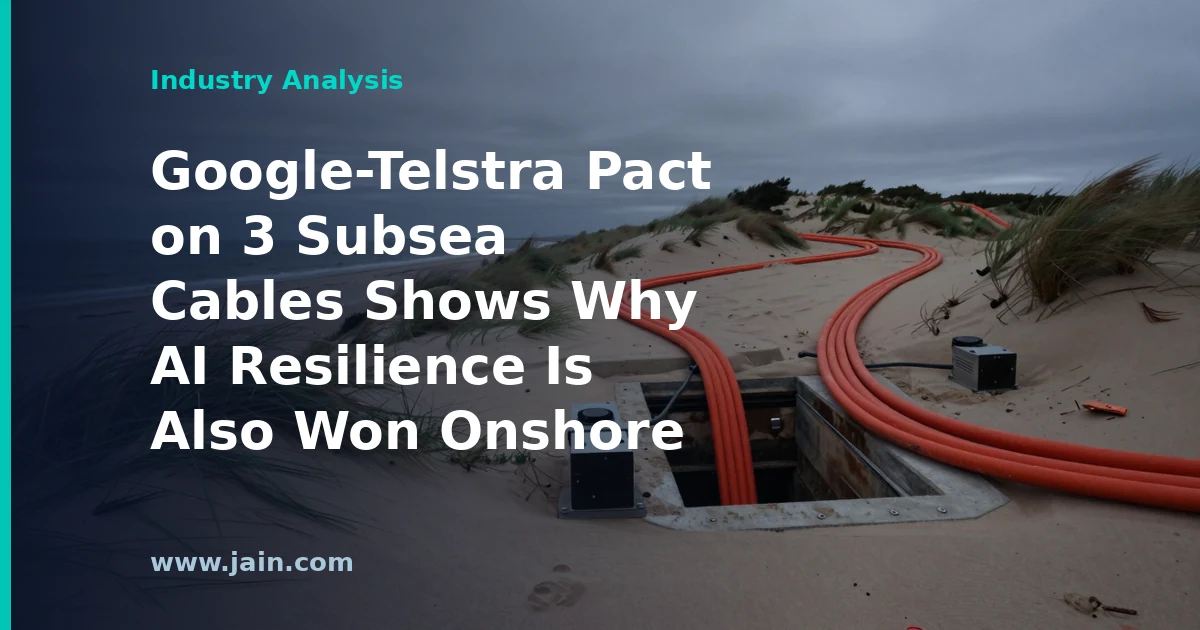
    A subsea cable comes ashore at a landing station, and from there its traffic still has to travel overland, over terrestrial fiber, to data centers, exchanges and cities. Network engineers call the full path end-to-end diversity. If two separate ocean cables land in different places but their inland backhaul runs through the same conduit or corridor, a single construction accident can cut both. The ocean diversity bought at great cost is lost a few kilometers from the beach.

    The Google-Telstra deal is built around that problem. Google already has subsea reach into the region through Tabua, Proa and Bulikula. What it lacked was inter-city capacity on land that it controls. It chose dark fiber, which means it lights the strands with its own optical equipment and sets capacity and upgrade timing itself, and it chose it on a new backbone that is physically separate from older routes. Telstra had the domestic network but wanted more international exits. The release states that integrating the two lets ‘Telstra and Google each remove single points of network failure.’ That is the substance behind the AI framing. As AI services depend more on moving data between Australian cities and overseas compute, a cable cut costs more, and the fix involves the land side as much as the sea side.

    Several groups are affected. Google’s Australian users and cloud customers get more alternative routes if a path fails. Telstra’s enterprise and government customers get more options for international traffic. Other carriers and cloud providers face a competitor pair that now controls diversity at both ends of the path. This is one deal, so it is not proof of an industry trend. It is a clear example of how a hyperscaler, meaning one of the largest cloud operators, and a national carrier can split the build instead of each duplicating the other’s half.

    A Two-Way Exchange of Scarce Assets

    The structure is notable because each company offers something that is slow and expensive to replicate. Laying new inter-city fiber across Australia takes years of trenching, permits and landholder negotiations. Building a trans-Pacific cable takes consortium financing, marine surveys and cable-ship time. By exchanging access, each company avoids building the other’s specialty. Long-haul fiber and subsea capacity commonly change hands through long-term rights of use. The companies have not said whether cash, capacity or both are involved in this deal.

    For Telstra’s Aura build, a hyperscaler taking dark fiber serves as an anchor tenant, a large customer whose commitment helps justify the network. Worrall tied the deal to Aura’s momentum and to ‘sustainable, disciplined growth.’ That suggests the company sees Google as validation for the backbone’s economics. How much of Aura’s capacity Google has taken, and on which routes, has not been said.

    What Is Substantiated and What Is Aspiration

    Some claims are concrete. These include the named cable systems and their destinations, the dark-fiber arrangement on Aura, Aura’s more than 8,000 kilometers laid, and the launch of the Melbourne-Canberra-Sydney coastal routes. The resilience mechanism is also sound network engineering.

    Other claims are broader and harder to test. These include the partnership being ‘a significant step forward in securing Australia’s digital and AI future,’ Australia’s role as a ‘regional connectivity hub,’ and the link to ‘the next industrial revolution.’ The release does not quantify AI traffic growth, capacity added, or any change in latency or availability. These are reasonable ambitions for a well-connected market. Readers should weigh them as direction rather than as measured outcomes.

    Background

    Australia’s geography makes it heavily dependent on subsea cables for international traffic. Its population is concentrated in a few coastal cities linked by long terrestrial fiber routes. That combination makes route diversity, both at sea and on land, a recurring concern for carriers, cloud providers and government. Telstra is Australia’s largest telecommunications company. Its Telstra Digital Infrastructure unit is building Aura, a new inter-city fiber backbone.

    Google, a subsidiary of Alphabet, has become one of the most active investors in subsea cables worldwide. It uses them to connect its data centers and to serve cloud and consumer products. Through its Pacific Connect and Australia Connect initiatives, it has backed new systems linking Australia with Japan, the Pacific Islands and the United States, including Tabua, Proa and Bulikula.

    Sources

    Source: Google and Telstra Partner to Connect Australia and Bolster its Digital Future: Google Cloud Press Corner announcement of the Aura dark-fiber and Tabua, Proa and Bulikula subsea partnership.

  • Microsoft’s A$25 Billion Bet on Australian AI Infrastructure, Security and Skills

    Microsoft’s A$25 Billion Bet on Australian AI Infrastructure, Security and Skills

    Microsoft has announced an A$25 billion investment in Australia spanning AI infrastructure, security, and skills — a commitment the company frames as a deepening of its decades-long presence in the country. At roughly US$16 billion depending on exchange rates, it ranks among the largest single-country AI infrastructure commitments any hyperscaler has announced to date.

    The announcement, published April 22, 2026 via Microsoft’s official news channel, packages three workstreams under one headline figure: physical AI and cloud infrastructure, cybersecurity capability, and workforce skilling. Detailed breakdowns of how the money divides across those three pillars were not included in the material reviewed here.

    Executive Summary

    The announcement matters for scale and for what it says about the direction of hyperscaler capital. A$25 billion is a step-change from Microsoft’s previous headline commitment to Australia — the A$5 billion infrastructure and skilling package announced in October 2023 — and it lands in the middle of a global race in which cloud providers are striking country-level ‘sovereign AI’ arrangements that bundle data centers, security cooperation, and training programs into a single political and commercial package.

    For Australia, the pledge signals continued confidence that the country will be a regional AI hub despite well-documented constraints on power availability and construction capacity. For the broader industry, it reinforces a pattern: AI infrastructure spending is increasingly announced as multi-year, multi-billion-dollar national commitments rather than individual facility builds — a format that makes headlines easy and verification hard. The substance will be in the details that follow: sites, megawatts, timelines, and how much of the figure represents genuinely new spending.

    From A$5 Billion to A$25 Billion in Under Three Years

    Microsoft’s October 2023 Australian commitment — A$5 billion over two years for hyperscale data center expansion, a cyber partnership with the Australian Signals Directorate, and skilling programs — was, at the time, described as the company’s largest investment in its 40-year history in the country. An A$25 billion figure roughly quintuples that headline number, and the tripartite structure (infrastructure, security, skills) mirrors the 2023 template closely. That continuity suggests this is an expansion of an existing playbook rather than a new strategic direction.

    The escalation tracks the industry-wide surge in AI capital expenditure. Hyperscalers have collectively guided toward hundreds of billions of dollars in annual capex, and country-level announcements of this size have appeared across the US, UK, Japan, India, and the Gulf states. Australia’s inclusion at the A$25 billion tier moves it firmly into the first rank of national AI buildout destinations — a meaningful shift for a market of roughly 27 million people.

    Why Australia: The Sovereign AI Logic

    ‘Sovereign AI’ — the idea that nations need AI compute, models, and data handled within their own borders and legal jurisdiction — has become the organizing frame for hyperscaler expansion outside the United States. Australia is a natural candidate: a Five Eyes intelligence ally, a stable regulatory environment, strong government cloud adoption, and a geography that makes it a serving point for the broader Asia-Pacific region. Bundling a security component into the package speaks directly to that sovereignty narrative, positioning Microsoft not merely as a vendor but as a national-capability partner.

    The economics cut both ways, however. Australia has among the higher data center construction and energy costs in the Asia-Pacific, its east-coast grid is in the middle of a complex energy transition, and skilled construction and electrical labor is in short supply — the same constraints that have slowed AI buildouts elsewhere. A commitment of this size implies substantial new power demand, and how that demand is met will shape both the project’s timeline and its public reception.

    Security and Skills: The Softer Two-Thirds of the Triad

    Infrastructure dollars are relatively easy to audit — buildings and servers either exist or they don’t. Security and skills commitments are harder to measure, and the material reviewed here does not quantify either. Microsoft’s prior Australian security work centered on threat-intelligence sharing with the Australian Signals Directorate under the MACS (Microsoft-Australian Signals Directorate Cyber Shield) initiative; a continuation or expansion of that model would be the natural reading, but that is inference, not disclosure.

    Skills programs serve a dual function in announcements like this: they address a genuine constraint — every market building AI infrastructure faces shortages of data center technicians, electricians, and cloud engineers — and they broaden the political constituency for the investment beyond the suburbs that host the facilities. The test, as with all skilling pledges, is whether the programs produce certified, employed workers at measurable scale, something that historically has been reported unevenly across the industry.

    Reading a Headline Number Honestly

    Multi-year country commitments deserve scrutiny on three questions, and they apply here as they would to any vendor’s announcement. First, over what period is the A$25 billion spread? A figure spent over four years is a very different signal from one spread over ten. Second, how much is incremental versus a re-badging of spending already planned or announced — including the 2023 A$5 billion program? Third, what counts toward the total: land, construction, and hardware clearly do, but security operations and training programs are operating expenses of a different character, and blending them inflates comparability with pure infrastructure figures.

    None of this makes the commitment less real — Microsoft has a track record of delivering data center capacity in Australia, where it has operated cloud regions since 2014. It simply means the number is a ceiling on ambition, not a receipt. Investors, policymakers, and competitors will get the true picture from planning applications, grid connection requests, and construction awards over the coming quarters, not from the announcement itself.

    Background

    Microsoft is one of the world’s three dominant cloud providers and has operated in Australia since the 1980s, opening its first Australian Azure cloud regions in 2014 and serving government workloads through dedicated Canberra-based capacity. In October 2023 the company announced what was then its largest Australian investment — A$5 billion over two years for hyperscale data center expansion, a cyber-defense partnership with the Australian Signals Directorate, and digital skilling programs — a template this new announcement appears to extend at five times the headline scale.

    The announcement arrives amid an unprecedented global surge in AI infrastructure spending, with hyperscalers collectively committing hundreds of billions of dollars annually to data centers, chips, and power. Country-level ‘sovereign AI’ packages — combining compute, security cooperation, and workforce development — have become the standard vehicle for that expansion outside the United States, and Australia’s combination of political stability, alliance relationships, and regional position makes it a recurring destination.

    Source: Microsoft deepens commitment to Australia with A$25 billion investment in AI infrastructure, security, and skills — Microsoft Source announcement, published April 22, 2026, via Google News.