Tag: atNorth

  • At 230 MW, atNorth’s Salo Plan Treats Grid Flexibility and Heat as Part of AI Siting

    At 230 MW, atNorth’s Salo Plan Treats Grid Flexibility and Heat as Part of AI Siting

    TL;DR · 30-second read

    The Short Version

    atNorth, a company that builds and runs data centers across the Nordic countries, plans a roughly €2 billion computing campus in Salo, a Finnish town near Helsinki.

    The first stage already has 75 megawatts of power lined up, enough electricity for tens of thousands of homes, with room to grow to about three times that. The computers customers install inside could cost up to five times more than the buildings.

    The twist: atNorth says it will look at using the campus’s waste heat to warm local buildings, and wants to help keep the national power grid steady.

    atNorth, a Reykjavik-headquartered operator of high-density data centers, announced on October 5, 2026, in a release distributed by PR Newswire, that it plans to develop FIN05, a new data center campus on a 28.6-hectare site in Salo, Finland. Power for the first phase, planned at 75 MW, is secured, with a path to up to 230 MW for the wider development through a substation on the national grid operated by Fingrid.

    atNorth expects to invest approximately €2 billion in the site. Customer-owned servers and their installation, which are excluded from that figure, could add an estimated investment of up to €10 billion. The company also plans long-term power purchase agreements with local energy suppliers, grid flexibility arrangements, and heat reuse partnerships with local stakeholders.

    Executive Summary

    FIN05 is atNorth’s second large campus in Finland, after Kouvola, and its sixth major development currently under way across the Nordics. The core facts are concrete: 75 MW of secured power for phase one, a 230 MW ceiling for the full site, a transmission-level grid connection, and a combined facility and customer-hardware investment that could approach €12 billion at full build-out.

    What makes the announcement worth reading closely is how it is assembled. atNorth places power purchase agreements, flexibility services for Finland’s transmission grid and waste-heat reuse alongside the capacity figures, not after them. The site itself came from a local developer, Regant Oy, which describes having prepared it with planning readiness and a power roadmap in place. Together, these suggest that in the Nordics, a campus of this size is now being presented as an energy-system partner to its host region, not only as a large electricity customer.

    The commitments carry different weights, however. The 75 MW is secured; the power purchase agreements are planned; flexibility services could support the grid; heat reuse is to be explored. The capacity case is firm. The community dividend is, for now, a well-structured set of intentions.

    At 230 MW, the Grid Becomes a Stakeholder

    FIN05 will connect through a Fingrid substation. Fingrid is Finland’s transmission system operator, the company responsible for the high-voltage national grid and for keeping supply and demand balanced second by second. A campus that could eventually draw 230 MW is not a routine customer on a local distribution line; it is a load large enough that its behavior matters to how the national system is run. That is the context for atNorth’s plan to offer “flexibility solutions that could support the efficient operation of Fingrid’s transmission grid.” In industry practice, flexibility typically means a large consumer agreeing to shift or reduce its draw, or to make on-site equipment available, when the grid is under stress, so that the operator has another tool besides building more generation and lines.

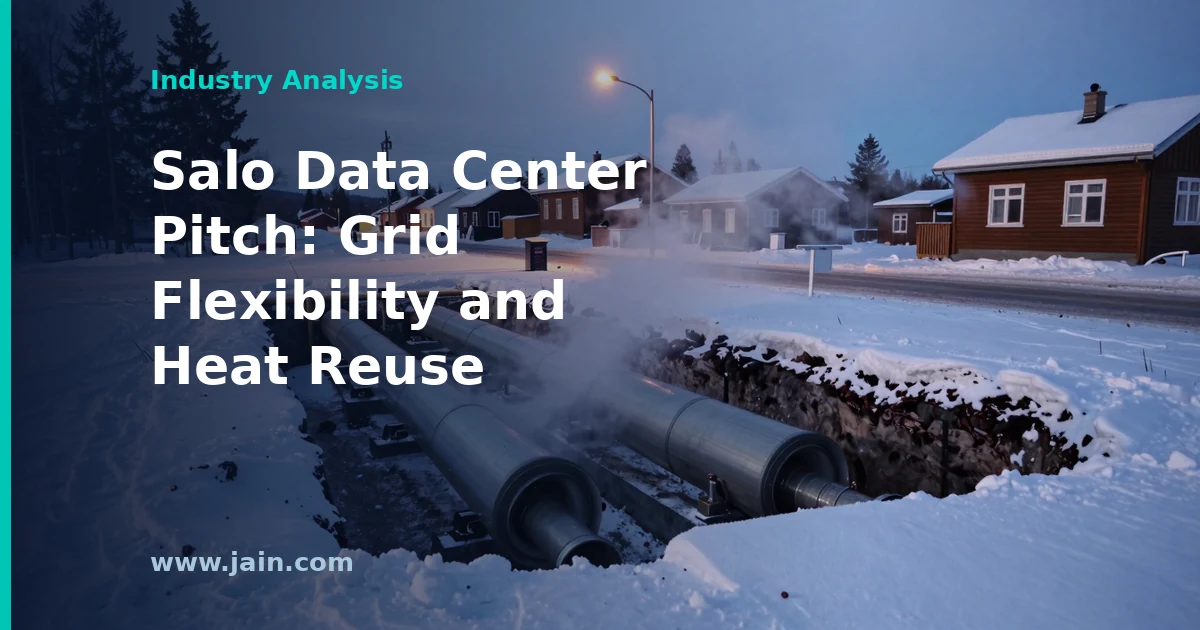
    The two other elements of the plan point the same way. Long-term power purchase agreements, contracts in which a buyer commits to take electricity from a producer for years at agreed terms, are framed as support for energy production in the region, giving local suppliers a dependable customer. Heat reuse addresses a physical fact of computing: almost all the electricity a server consumes ends up as heat. In Nordic towns with district heating, networks of insulated pipes that carry hot water to homes and businesses, that heat can have a buyer instead of being vented. atNorth points to existing heat reuse collaborations with Kesko in Finland, Stockholm Exergi in Sweden, and Vestforbrænding and Selected Group in Denmark as evidence it has executed this model before.

    The parties most affected are the Salo municipality, whose mayor emphasised construction and operating jobs; Fingrid, which gains a large load that may also offer flexibility; local power producers, who could gain a long-term buyer; and potential heat users. The measured conclusion is that, for a campus of this scale, atNorth is presenting grid support and heat value as part of the case for the site itself. Whether that case translates into delivered value depends on terms atNorth has not yet published: the power purchase agreements are planned, flexibility “could” support the grid, and heat reuse remains something to “explore.”

    Secured Power Is the Hard Asset; the Rest Is Roadmap

    The announcement uses carefully graded language, and the grades matter. Phase one power, 75 MW, is described as secured. The full 230 MW is a “path to power.” The €2 billion is an expected, approximate figure. For prospective customers, the secured first-phase power is the most bankable fact in the release: where grid connections take years to obtain, power already in hand is what turns land into a usable data center site.

    Regant Oy’s role reinforces that point. Its partner said the firm worked with atNorth and the municipality to provide a development-ready site with “the scale, planning readiness and power roadmap needed for large data center projects.” That describes a model in which a local developer assembles land, planning groundwork and a grid pathway before an operator arrives. What the operator is effectively acquiring is time-to-power, which is often the scarcest input in large data center development.

    €2 Billion of Buildings, Up to €10 Billion of Customer Hardware

    The most revealing number may be the ratio between atNorth’s estimated investment and its customers’. atNorth expects to spend about €2 billion on the site, while customer-owned servers and their installation could add up to an estimated €10 billion, as much as five times the facility spend. A ratio like that is characteristic of dense, accelerator-based computing, the specialized chip servers used to train and run AI models, where the hardware inside costs far more than the building around it. atNorth describes itself as a high-density colocation and built-to-suit provider; the announcement frames demand as high-performance digital infrastructure and does not name specific workloads or customers.

    Built-to-suit means a facility designed to one customer’s specification, and colocation means renting space, power and cooling to customers who install their own equipment. In both cases, when customers bring up to €10 billion of their own hardware, the length and credit quality of their contracts become central to the project’s economics. The €10 billion is also explicitly an upper-bound estimate, not a commitment. For Salo, the durable local value is more likely to sit in construction, operations, power sales and heat than in the hardware itself, which customers own and periodically replace.

    Another Mega Site in a Busy Nordic Slate

    FIN05 joins four mega sites atNorth already has under development, in Kouvola, Finland; Ølgod, Denmark; Sollefteå, Sweden; and Haugaland, Norway, plus a metro site in Stockholm, alongside seven operating data centers. Advancing that many large campuses at once requires capital, construction capacity and grid connections in parallel, and execution risk scales with the pipeline.

    The Nordic region’s appeal for this kind of capacity is well established: a cool climate that reduces cooling energy, grids with a high share of renewable generation, and widespread district heating that can absorb data center waste heat. The last of these is what gives Nordic operators a community offer that is hard to replicate in many other regions, and FIN05 is built around using it.

    Background

    atNorth is a Nordic data center company headquartered in Reykjavik, Iceland. It offers high-density colocation, in which customers rent space, power and cooling for their own servers, and built-to-suit facilities designed to a single customer’s specifications. It operates seven data centers across the Nordics and is developing four mega sites, in Kouvola, Finland; Ølgod, Denmark; Sollefteå, Sweden; and Haugaland, Norway, plus a metro site in Stockholm. The company says its sites run on renewable energy and support circular economy principles, including heat reuse partnerships in Finland, Sweden and Denmark.

    The Nordic countries have become a destination for large data centers because of their cool climate, which reduces the energy needed for cooling, grids with a high share of renewable generation, and extensive district heating networks that can absorb waste heat. As computing campuses grow to hundreds of megawatts, their relationship with national grid operators such as Finland’s Fingrid, and with the communities that host them, has become a central part of how projects are planned.

    Sources

    Source: atNorth to develop new data center in Salo, Finland — atNorth’s announcement of its planned FIN05 campus in Salo, including power, investment, energy partnership and heat reuse plans.

  • Equinix and CPP Investments Close $4B atNorth Deal

    Equinix and CPP Investments Close $4B atNorth Deal

    TL;DR · 30-second read

    The Short Version

    Two of the world’s largest infrastructure investors have paid about four billion US dollars for a company that runs eight warehouse-sized buildings full of computers in Iceland, Norway, Sweden, Denmark and Finland.

    The appeal is simple. The far north has cheap renewable electricity and air cold enough to cool thousands of hot machines without running expensive air conditioning. Everywhere else, both are getting scarce and costly.

    Those buildings are where artificial intelligence systems are trained. Where they get built decides who can afford to run them.

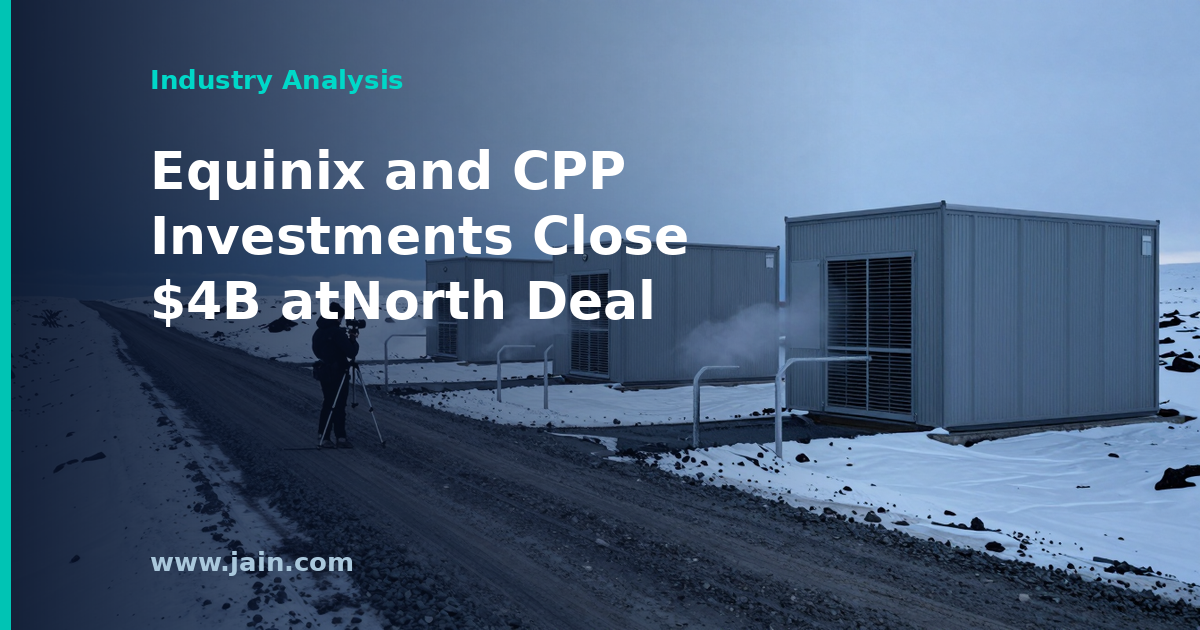
    Data Centre Magazine reported on 3 September 2026 that Canada Pension Plan Investment Board (CPP Investments) and Equinix have completed their acquisition of Nordic data centre operator atNorth in a transaction valuing the company at US$4 billion. CPP Investments takes an approximately 51% controlling equity stake for US$1.3 billion, Equinix an approximately 34% minority stake for US$895 million, and Partners Group — atNorth’s owner since 2022 — reinvests for roughly 10% at US$260 million. atNorth’s internal stakeholders retain the balance through an equity rollover.

    The transaction is supported by a US$4.1 billion debt facility underwritten by European and Canadian institutional lenders, sized to fund both the purchase and future construction. atNorth operates eight data centres across Denmark, Finland, Iceland, Norway and Sweden, with further sites in development; the company said earlier in 2026 that it had secured more than 1GW of power capacity across operational and pipeline sites. Chief executive Eyjólfur Magnús Kristinsson said atNorth will continue to operate independently under its own brand.

    Executive Summary

    This is a purchase of inputs, not of buildings. The binding constraints on AI training capacity today are electricity and heat rejection — getting power connected at a price that works, and getting the heat back out of racks drawing far more per square metre than a conventional server hall. The Nordics have an unusual concentration of both: hydro and geothermal generation, and an ambient climate cold enough that operators can cool much of the year with outside air or water rather than mechanical chillers, an approach the industry calls free cooling. atNorth’s stated position of more than 1GW secured across live and pipeline sites is the asset being bought.

    The ownership structure is as informative as the price. CPP Investments takes control and the largest cheque; Equinix takes roughly a third and no control. For a company that has built its business on owning and operating its own interconnected facilities, buying a minority position in someone else’s platform — one that will keep its own brand and management — is a deliberate choice to gain exposure to Nordic high-density capacity without absorbing the full construction risk or capital load onto its own balance sheet.

    The three disclosed equity commitments total roughly US$2.46 billion for about 95% of the company, against a US$4 billion valuation and a separate US$4.1 billion debt facility. Borrowed capital, in other words, is doing at least as much work as equity here, and a material portion of it is earmarked for construction that has not yet happened. That makes delivery — sites energised, halls filled, contracts signed — the variable that determines whether US$4 billion looks like a full price or a cheap one in three years.

    Buying the Two Things AI Capacity Is Actually Short Of

    Land and steel are not the bottleneck in data centre development. Power is. Across most of Europe and North America, connecting a large new load to the grid means joining a queue measured in years, and paying industrial electricity prices that have become one of the largest single line items in the cost of running AI hardware. Cooling is the second constraint: racks built for AI training draw many times the power of traditional enterprise kit, and the heat has to go somewhere. atNorth’s portfolio addresses both structurally rather than incrementally — renewable power contracts in markets with hydro and geothermal generation, direct liquid cooling that moves coolant to the chips instead of chilling the whole room, and district heat reuse that pipes waste warmth into local heating networks rather than dumping it into the air.

    Set against that, US$4 billion for eight facilities and a development pipeline is a bet that secured power is the scarce commodity and everything else is commodity. The stated position of more than 1GW across operational and pipeline sites is the number that matters, because a gigawatt of connected capacity is significantly harder to assemble today than a gigawatt of building shell. What the companies have not broken out is how much of that gigawatt is energised and earning revenue versus reserved or queued — a distinction that separates an operating platform from an option on one.

    A Minority Stake, a Majority Cheque, and a Lot of Debt

    Equinix’s 34% is the structurally interesting part of this deal. Equinix’s core business is interconnection — dense, network-rich facilities in metropolitan markets where the value lies in who else is in the building. Nordic hyperscale campuses built for training runs are a different asset class with different economics: fewer, larger customers, longer leases, thinner margins per megawatt, far heavier capital intensity. Taking a minority position lets Equinix participate in that growth, and offer its customers access to it, without consolidating the construction programme or the leverage that funds it. It is a pattern the industry has used repeatedly to add wholesale-scale capacity alongside a retail colocation core.

    The trade-off is control. atNorth will continue to operate independently under its own brand and management, with CPP Investments holding the controlling stake. Whatever commercial integration Equinix envisages — routing customers north, linking Nordic compute to its interconnection fabric — rests on a commercial relationship and shareholder influence rather than ownership. For customers, the practical question is whether that translates into something contractually real, such as network on-ramps and cross-connect arrangements between the two estates, or remains a statement of intent. Neither company has yet described what the operating relationship looks like in practice.

    The Distance Problem the Nordic Thesis Still Has to Answer

    Equinix Nordics managing director Regina Dahlström framed the acquisition around organisations needing infrastructure that brings together “data, clouds, networks and inference services” and around building interconnected hubs. That language is worth reading closely, because inference — running a trained model to answer a user’s query — is latency-sensitive in a way that training is not. Training is a batch workload; it can happen a thousand miles from the customer and nobody notices. Inference serving European end users generally wants to sit close to them.

    The Nordic proposition is exceptionally strong for the first category and harder for the second, particularly at the Icelandic end of the footprint, where the physics of distance sets a floor on round-trip times regardless of how much fibre is lit. That does not undermine the deal; training, fine-tuning and high-performance computing represent enormous and growing demand, and heat reuse and cheap renewable power are genuine structural advantages. But it does mean the inference and interconnection framing is the claim to test over the next few years, not the one to assume. Kristinsson’s disclosure that atNorth has secured new hyperscale contracts since signing, and added a development site in Norway, points to where demand is actually landing — though the companies have not identified the customers, the capacity involved, or the contract terms.

    Background

    atNorth grew out of the Icelandic data centre sector, where geothermal and hydroelectric generation made it possible to run compute-intensive workloads at electricity prices and carbon intensities unavailable in most of Europe. Partners Group acquired the business in 2022 and expanded it into a five-country, eight-facility Nordic platform aimed squarely at enterprise and hyperscale demand for AI, cloud and high-performance computing. The company’s positioning depends on high-density engineering — liquid cooling, heat reuse, sites designed from the outset for power-hungry racks rather than retrofitted from conventional colocation.

    Equinix is a global operator of interconnected data centres, historically strongest in metropolitan facilities where the commercial value comes from the density of networks, clouds and enterprises present in the same building. The Nordics have drawn sustained investment from operators and institutional capital over the past decade, precisely because the combination of renewable generation, cold ambient conditions and stable regulation addresses the constraints that limit development in more crowded European markets. CPP Investments, which manages assets for the Canada Pension Plan, has been an active allocator to digital infrastructure as an asset class with utility-like duration.

    Sources

    Source: Why Equinix & CPP Investments Have Acquired AtNorth — Data Centre Magazine’s report on the completed US$4 billion acquisition, including the equity split, the US$4.1 billion financing package and comments from Equinix, CPP Investments and atNorth executives.